



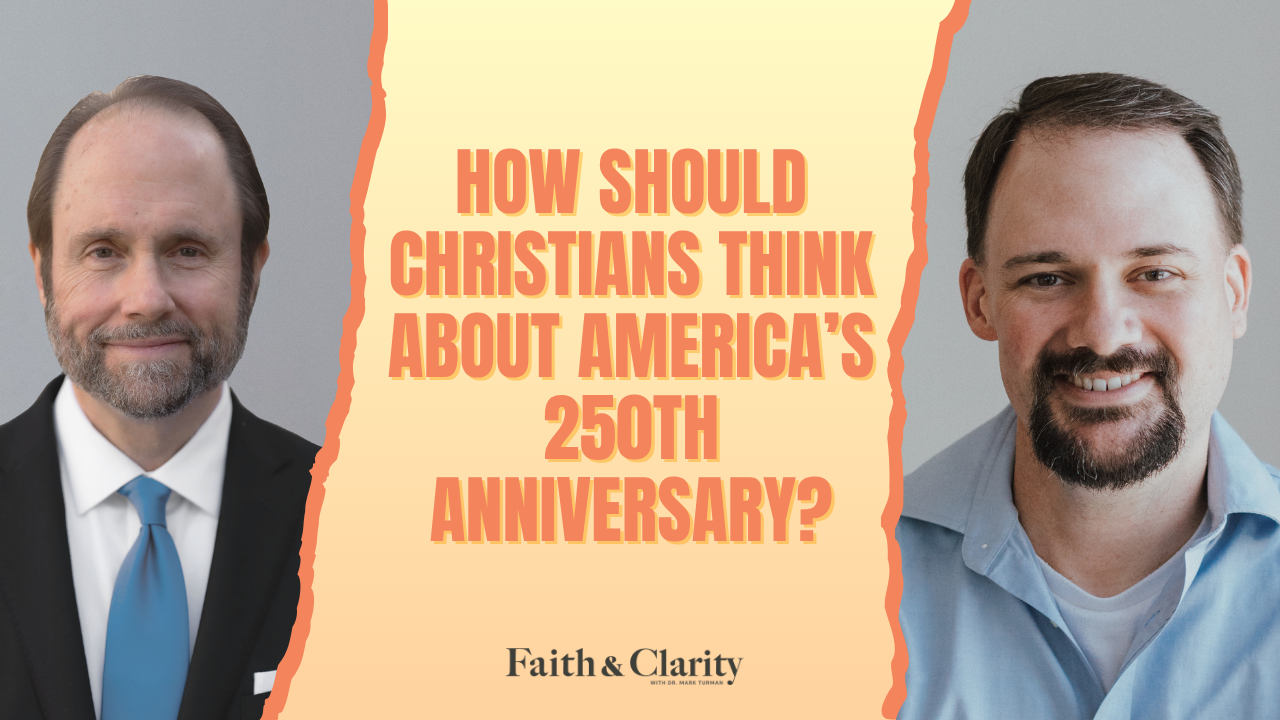
In this episode of Faith & Clarity, Dr. Mark Turman is joined by Dr. Jim Denison and Dr. Ryan Denison to explore how Christians can think about America’s upcoming 250th anniversary through a biblical lens.
They discuss why history matters for believers, what it means to celebrate a nation while living as citizens of heaven, and how to approach ideas like American exceptionalism with both gratitude and humility. The conversation also examines the spiritual patterns that shape nations, the complexities of America’s founding and legacy, and the importance of applying Scripture wisely in today’s cultural moment.
Together, they offer a timely invitation to personal and collective reflection—encouraging listeners to seek spiritual alignment and live lives God can bless as they look to the future.



Topics
(0:00) Introduction
(0:45) Why celebrate the 250th anniversary
(2:58) History and heavenly citizenship
(6:59) American exceptionalism
(11:03) History of Our Future series
(19:38) Providence and founding motives
(24:37) Loyalists, protesters, and revolutionaries
(30:53) Applying Scripture today
(35:59) Blessed to bless
(40:59) Three visions clash
(46:07) Slavery and identity
(50:58) Hope beyond racism
(55:46) Positioned for blessing
(1:01:31) Newsletter and farewell
Resources
- Ask Us Anything: [email protected]
- Sign-up for a Denison Forum newsletter: DenisonForum.org/subscribe
About Dr. Jim Denison
Dr. Jim Denison is a Cultural Theologian and the Founder of Denison Ministries. He speaks biblically into significant cultural issues through The Daily Article. He is the author of over thirty books, including The Coming Tsunami: Why Christians Are Labeled Intolerant, Irrelevant, Oppressive, and Dangerous—and How We Can Turn the Tide; Respectfully, I Disagree: How to Be a Civil Person in an Uncivil Time; and the Biblical Insight to Tough Questions series.
He has taught the philosophy of religion and apologetics at several seminaries. Dr. Denison serves as Resident Scholar for Ethics with Baylor Scott & White Health, where he addresses issues such as genetic medicine and reproductive science. He is also a senior fellow with CEO Forum, the International Alliance of Christian Education, and Dallas Baptist University’s Institute for Global Engagement.
He holds a Doctor of Philosophy and a Master of Divinity degree from Southwestern Baptist Theological Seminary. He also received an honorary Doctor of Divinity degree from Dallas Baptist University. Dr. Denison is the Theologian in Residence for the Baptist General Convention of Texas.
Prior to launching Denison Forum in 2009, he pastored churches in Texas and Georgia. Jim and his wife, Janet, have two married sons and four grandchildren.
About Dr. Ryan Denison
Dr. Ryan Denison is the Senior Editor for Theology at Denison Forum and the author of The Focus newsletter, contributing writing and research to many of the ministry’s productions. He holds a PhD in church history from B. H. Carroll Theological Institute and an MDiv from Truett Seminary. Ryan has also taught at B. H. Carroll and Dallas Baptist University.
He and his wife, Candice, live in East Texas and have two children.
About Dr. Mark Turman
Dr. Mark Turman serves as the Executive Director of Denison Forum, where he leads with a passion for equipping believers to navigate today’s complex culture with biblical truth. He is best known as the host of the Faith & Clarity podcast and the lead pastor of the Possum Kingdom Lake Chapel, the in-person congregation of Denison Ministries.
Dr. Turman is the coauthor of Sacred Sexuality: Reclaiming God’s Design and Who Am I? What the Bible Says About Identity and Why it Matters. He earned his undergraduate degree from Howard Payne University in Brownwood, Texas, and received his Master of Divinity degree from Southwestern Baptist Theological Seminary in Fort Worth. He later completed his Doctor of Ministry degree at George W. Truett Theological Seminary at Baylor University in Waco.
Before joining Denison Forum, Mark served as a pastor for thirty-five years, including twenty-five years as the founding pastor of Crosspoint Church in McKinney, Texas. Mark and his high school sweetheart, Judi, married in 1986. They are proud parents of two adult children and grandparents to three grandchildren.
About Denison Forum
Denison Forum exists to thoughtfully engage the issues of our day from a biblical perspective, helping believers discern today’s news and culture through the lens of faith. Led by Dr. Jim Denison and a team of contributing writers, we offer trusted insight through The Daily Article, a daily email newsletter and podcast, along with articles, podcasts, interviews, books, and other resources. Together, these form a growing ecosystem of Christ-centered content that equips readers to respond to current events not with fear or partisanship, but with clarity, conviction, and hope. To learn more visit DenisonForum.org.
EPISODE TRANSCRIPT
NOTE: This transcript was AI-generated and has not been fully edited.
Mark Turman: [00:00:02] This is Faith and Clarity. Welcome. I’m Mark Turman. We’re glad that you’re here as we seek to equip you to find the hope beyond the headlines of the news and clarity in the cultural chaos that we often feel in our experience. So let’s roll. We’re going to jump in. Let me just share with you a verse of scripture from Psalm 22. [00:00:21] Psalm 22:27 says this, All the ends of the earth will remember and turn to the Lord. All the families of the nations will bow down before you, for kingship belongs to the Lord. He rules the nations. Uh, we know in other places in scripture, particularly in the Psalms, uh, the Bible says that the nations at times rage against God. Um, but we’re going to talk today about a very special event that you have certainly heard about, and that is the celebration of America’s 250th anniversary. I really should say the anniversary of the United States of America. We got an email from one of our Canadian friends reminding us that America is not just the United States. And so I want to call that out. Uh, but this week we’re talking about God’s providential work as he established, guides, blesses, and sometimes corrects our nation. And as we take this very significant moment of our 250th anniversary, uh, to both look back, to look in, and even to look forward. And so, uh, my conversation partners today are familiar to our, to you, our friend, uh, and founder, Dr. Jim Denison is with us, as well as Dr. Ryan Denison, Denison the younger, we often refer to him as. Uh, and we’re going to talk about not only our, uh, our nation’s founding, but also some new material that we’re going to be releasing starting on May 3rd, a 10 week special series called America 250, the history of our future. And, uh, that’s kind of our reference point. We’re going to talk about some things that are in that material as well as the broader conversation. So, uh, Dr. Ryan Denison, senior editor for theology with us. Uh, let’s talk about why we even bother with something like, uh, a nation’s anniversary. Um, since you have background in history, obviously, church history particularly, um, is it a good thing, a biblical thing that a nation would step back and, uh, and celebrate an anniversary like this? Makes me remember that, you know, the founders of our nation, if they had been arrested, would have been put on trial for high treason. Um, but why is that a good thing to mark this moment? Um, why is it, uh, is it a biblical thing? Is the study of history valuable in a general or biblical way as Christians and as we try to walk out our faith?
Ryan Denison: [00:02:58] It’s a good question. And I think I’ll start with the latter question where I think part of the blessing of studying history is that human nature doesn’t change. And so so many of the problems we face today have echoes in the past. And by studying history, we can see how God has addressed those, how God’s people have addressed those. Um, and at times, we can see the ways that God’s people have failed to address those. And by learning from the mistakes of those who have come before us, by learning from the lessons of those who have come before us, we’re better equipped to respond today. And I think that’s relevant for the question of should Americans or should Christians celebrate America’s 250th anniversary because it’s a good reminder that Christians predate America. That is obviously something I don’t think I need to say, but it is a good call out sometimes to remember that as much as God has blessed this country, his plans for humanity go well beyond it. And I think as we think about our role in celebrating it, we need to celebrate it first as citizens of heaven and then as citizens of the United States of America. Um, one of the passages that came to mind as I was thinking about this is Jeremiah 29:7 where God tells his people, but seek the welfare of the city where I have sent you into exile and pray to the Lord on its behalf, for in its welfare, you will find your welfare. And I think that passage is relevant to us today because as Christians, this side of heaven, we really are kind of exiles in a sense that our first identity is meant to be found in Jesus and in our relationship with him. And so, but at the same time, God has placed us here in America, um, for a reason. God has placed us here to be a blessing to others. Going back to Israel’s purpose that he established through Abraham and that initial calling back in Genesis, that I’m blessing you to be a blessing. I think that’s so much of what we see in America and in our history is God uniquely blessing America and the United States of America and its citizens in order to be a blessing to others. And as Christians, we’re meant to model that. And so as we think about what it would look like to celebrate the 250th anniversary of our country this coming fall, I think we’re absolutely meant to do that with joy and with purpose, also with open eyes to remember that we’re this is not a perfect nation. Um, it doesn’t have to be. There is no perfect nation. And so we’re not meant to hold it to standards we would not hold any other nation to. Um, but at the same time, we are meant to, we’re meant to celebrate it as exiles to an extent as well and seek the benefit of this country, but also to remember that we’re first off citizens of heaven and that should be the primary lens through which we see it.
Mark Turman: [00:05:30] Yeah, I think that’s a good word. It just made me think of all the times in the Bible that we are reminded to remember that, uh, God calls us to look back, uh, as one historian said, you know, we look back so that we can see the future, uh, and see it with more clarity and with more, uh, understanding and with more wisdom, hopefully. Uh, also reminds me of a verse, I think in the Corinth, in the Corinthian letters where Paul’s writing and he recalls a story out of Israel’s history and then he says to the Corinthians, these things were written down for our benefit so that we could learn what it means to know God, what it means to walk with God. Um, Ryan, I just, I just know as I’ve kind of walked toward this topic over the last several months, uh, lots of things in the news and lots more that we can expect as we move into the summer and move toward July 4th. Um, a lot of celebrations that are being planned, probably going to be a pretty big spectacle in Washington, D. C. and in other places like that. Probably the biggest firework shows we’ve ever seen, uh, that are coming and probably some things that we’ve never seen that are coming. Um, but, uh, some people are, uh, are paying no attention. I’ve run into some people that just like, I don’t care about any of that. Don’t want to, you know, they may be cynical about our country for some reason. And then there’s a spectrum of people that, you know, they’ll have 10 flags in their yard. Um, but you get to this particular kind of celebration as Americans and you hear the names of Alexis de Tocqueville, uh, other historians, other sociologists. Uh, I can remember just tell both of you a story. Uh, so I’ve been involved here in my town in the Chamber of Commerce. Uh, I remember about a decade ago being in a Chamber of Commerce meeting where we got to talking about our country and for the first time, I heard a guy two rows behind me say, you know, people talk about American exceptionalism, but there’s no such thing. We’re not exceptional in any way. Um, it kind of brought the room to a stop, really. Um, Ryan, what do you see from the perspective of the Tocqueville, others? Um, do you see indications from a theological or providential perspective that America is in some way exceptional?
Ryan Denison: [00:07:52] I think so. Um, I think there’s we’re called to a level of humility with that where I don’t think we’re meant to be prideful in America’s exceptionalism because so many of the blessings are based on just the natural resources that we have in this country, the, um, the things that have the people, the generations before us have left us that legacy. Uh, but I I do think there is something exceptional about America. And one of the things that, um, that my dad writes about in the upcoming newsletter is just he goes into greater depth on what some of those look like. I think the way that we’re meant to live this out today is to remember that the exceptionalism of America is based largely and de Tocqueville talked about this as well, is based largely in our, in the way in which it was founded for the purpose of helping others, um, of kind of being a land of freedom. Uh, again, we haven’t always done that well, but on this ideal of freedom, on this ideal of being a city on a hill. On a previous podcast, we talked about how the first colonists that, uh, talked about that in the sense of being a warning more than an aspiration. And I think that’s kind of one way we can get the American exceptionalism a little twisted is if we kind of go back to thinking, again, like God has blessed us because there’s something amazing about us, rather than just because he’s blessed us because he has a purpose for us and a purpose for our role in the world, a purpose for our role among each other. And I think really kind of what America was founded to be is a place where people can really kind of test out, what does it look like to start a country, to start a community, to start communities that are built on this idea of serving the Lord and of being that city on a hill, um, that the rest of the world can look to and see, does this work? And again, when that was first, when that call was first given, it was under the idea of the world is watching and if we screw this up, it’s going to reflect badly on God. And I think so much of what we see in the American exceptionalism goes back to this idea that our country was founded on a set of ideals and a set of principles and a set of beliefs that don’t make sense outside of a Christian context. Um, not all the founders were Christians, but not all the founders were interested in a personal relationship with Jesus. But for the most part, the vast majority of the founders had a very high respect for the importance of Christian morality, for the importance of God, of the gospel to a functioning society and built our society on that. And so I think so much of the reason that American exceptionalism has been a thing over the centuries is it’s been in relation to this idea of what does it look like to found a culture on the ideals that God loves us, on the idea that God has a purpose for us and that every person is valuable. And again, we haven’t always lived those out well, but I do think there’s something to the idea that we need to, we can’t lose sight of that as well. Um, we can’t become so focused on the ways that we’ve lost or the ways we’ve messed up that ideal that we forget its purpose in the first place. And if we’re going to think about what American exceptionalism means for our culture going forward, I think it’s very important to remember what it meant when we began as well.
Mark Turman: [01:11:00] Yeah, that’s a good, good way of framing where we want to go. Jim, I want to turn to you for a few minutes here. Got this special newsletter that, uh, we hope people will engage with and that they will be, uh, assisted by, equipped with. Uh, we’re calling it America 250, the, the history of our future. Uh, when I first read that title, it immediately was intriguing to me. So if there’s a story about where that title may have come from, how God might have inspired that to you, uh, but what prompted you not only to create the title, but also to create this series? What’s your hope for this material that will come out for the next 10 weeks?
Jim Denison: [01:11:38] Yeah, well, thank you, Mark, very much. Glad to be in this conversation with both of you. I was sitting in a philosophy class back a number of years ago, let’s just say, in seminary, and I read something in Yandle Woodfin’s textbook that explained that human nature doesn’t change, which is why the Bible is perennially relevant. We don’t have to make it relevant. It’s already relevant. All we have to do is explain the intention of scripture and it will speak to human hearts because human hearts don’t change. As Ryan said just a bit ago. That’s why history is so helpful to us because we can learn from past mistakes and past victories and translate those into the present since the human condition doesn’t change. Well, all of that applies to America’s history as well. As we look to the history of our country, to the founding of our country, as we look at the things that worked and didn’t, specifically as as we look through a biblical and even prophetic lens at why God was able to bless the nation as he did and the places where he was not able to bless the nation. I think we can move that forward and ask the question, how will God be able to bless our nation or any nation in the future and what will keep him from blessing us in the future? So what I did essentially was to go back not just to our history, but back to biblical history and ask, what are the things that causes God to bless nations, Israel and others? What are the behaviors and the decisions that lead to God’s judgment on Israel and other nations? How do those relate to American history? And how therefore do those relate to American future? And so we remember our future when we look to see what God has done, and understand that because God doesn’t change, he said, I the Lord do not change. Jesus Christ is the same yesterday, today and forever. Because he doesn’t change and we don’t change. So our history is our future in that sense. And we can recapture what God has done, we can understand better what God will do in the context of our nation and its future together.
Mark Turman: [01:13:25] Yeah. Let me, uh, chase a rabbit with you if I can that that came to mind while you were talking, which is, um, we live in an age and particularly in a nation that is really consumed with hyper individualism. Uh, and our conversation today, our celebration, uh, around our 250th anniversary, um, the the whole concept of thinking of ourselves in the collective as a nation and so much of what the Bible says, particularly in the Old Testament, but not exclusively to the Old Testament, um, talks about us in a group or in a communal setting, in in nations and in groups. Uh, Jim, what do we in this present age, particularly as Americans, what do we maybe need to change about how we balance the perspective of seeing ourselves as Christians as individuals relating to God and as a group or as, uh, a collective relating to God? Because it doesn’t seem like we’re getting that right in in many ways.
Jim Denison: [01:14:29] Massive issue, Mark. Really a terrific and massive issue. To think about that, first of all, in terms of American history. Uh, something that has become even clearer to me in recent years as I’ve spent so much time studying the founders and writing this book and other material preparing for America 250, is the degree to which the founders came together as it were, and the colonies, the 13 colonies came together, united around one concept, and that was they wanted freedom from England. They wanted out from under King George. They wanted liberty for themselves. That was the one unifying factor. That’s why George Washington was the indispensable American because he was the one person from Virginia as a person who could unite those 13 colonies. He had the military history to be able to do it and so forth. He was the only person that could have kept the United States together as we move forward as our first president. Nothing else really united us except that idea. The spirit of 76 was the spirit of liberty from America. It wasn’t a motive to create a United States of America. You almost have two things working. 76 is liberty. 1787 and the United States Constitution is a very different idea. When Madison and Hamilton and Washington and others moved forward to create a United States, they did so against bitter opposition. Massive opposition on a variety of levels. And the only way they ultimately could do it was they came to understand that the European threat was still there. The British were still up in Canada, the British and the Spanish were still trying to settle the Mississippi basin. They had to pay off this massive war debt. They needed to settle the Western frontier. They had to do that together, had to do that collectively. And so they grudgingly became a United States. Someone has pointed out historian that it really isn’t until the Civil War that people stopped saying the United States are and started saying the United States is and started focusing on United more than on states. So I say that to say, there’s always been a hyper individualism in American, uh, cultural DNA as it were. Among the colonies and even inside those colonies, very different economy, economies, very different religious perspectives, very different ideas of what America is and what it’s about. That’s still the case today. You drive that through the postmodern existentialism of recent generations that says, you have your truth and I have my truth. You have your beliefs, I have my beliefs. And we get even more hyper individualistic as Americans. And so now we’re in a day where we’re trying to find a way to celebrate a collective nation when there’s a whole, uh, group of people in our country, as you said earlier, who say there’s really not much here to celebrate. They would say America was really founded in 1619 when slavery was introduced to the country, not 1776, who would say America is a racist, white supremacist experiment, who would say this is Howard Zinn and others, who would say that America is not a country worth celebrating. That would say make America great again implies America was ever great, and they would say it never has it been great. And so you’ve got that sort of, uh, of laying on this freeway as we’re moving toward July 4th. You have the other extreme that would say, well, no, America was uniquely founded as a Christian nation and was intended by God to be the new Israel, and therefore ought to be celebrated in that context. And then most of us are someplace in the middle. All that to say, if we can learn from the hyper individualism of our history to understand, it’s only when we’re collective that the individual flourishes. It’s only when the country is strong that the individual can be strong. That the both and here is really biblical. In the scriptures, there’s no such thing as a singular Christianity. Christianity is always done in the context of community. Every metaphor for the church is a collective metaphor, body with many members, a vine with many branches. No solos in the book of Revelation, as someone said. At the same time, we’re saved individually. We are individually born again. So the balance here is, I flourish best as an individual when I flourish in community. I flourish best as an American when America flourishes. So let’s celebrate what’s best about our nation, not be naive about what is not, constantly be seeking to make our nation better for the sake of the country, but especially for the sake of those who live in the country. And that’s the both and that I think is worth remembering, especially in a season like this.
Mark Turman: [01:18:44] Yeah, so helpful. Not not more than three days ago, a friend of mine and I were, uh, talking and we were talking about another friend that we’re concerned about and said, you know what? Uh, he he really needs some fellowship because he doesn’t seem to be flourishing right now. And we know that every Christian is meant to be in consistent fellowship and community. That’s how we flourish. And there are, as you said, there’s real aspects of our faith that are individual in nature, but so much of our faith, made me, as you were talking about, uh, vine with branches and a body with many members, it made me think of that, uh, passage in Peter that talks about we are the temple of God. We are stones fitted together, bricks fitted together where the very presence of God is made known, uh, in a unique way. Um, and that that would be something that would serve us well and that something our our own history would serve us well, uh, as Americans to understand. Jim, in your, in your upcoming material, you talk about, uh, what you talk about in other places often, which is God’s perfect will and God’s permissive will. And, uh, we’ll be spending all of eternity understanding how those two things wove themselves together. Uh, but particularly as it relates to the birth of nations, uh, as you mentioned just a moment ago, there are those even today who think that the creation of the United States was God’s reinventing his plan for Israel, uh, almost a, uh, or even boldly a, uh, open replacement kind of theology. Um, talk about that from the concept of your understanding of America’s founding, um, that it is not the same as what God was doing, uh, in the, in the creation of Israel in the Old Testament, but how do we understand God’s providential role, uh, in the creation of our nation?
Jim Denison: [01:20:40] Wonderful question. Uh, how many hours do we have together? Uh, you know, as you know, we’ll get predestination and free will all figured out, right? Yeah. In this context, terrific question, but in this context, I’m thinking on two levels. I’ll just try to do this briefly. The one is on a larger kind of theological sense. Everything that happens, God must either allow or cause if he is sovereign. As he said in Matthew 10, a sparrow doesn’t fall to the ground without the Father’s knowledge. And so God at least has to permit all that happens, even if it’s not part of his perfect will or his proactive will. Uh, this is where my Calvinist friends and I have a little bit of challenge. They don’t see a distinction between those things, whereas I’ll come along and say God is not willing that any should perish, but all should come to repentance, and yet not all come to repentance. So it seems to me that God permits, some things God permits are not his perfect will, but he nonetheless allows them. In the context of America’s founding then, God obviously, clearly in scripture, proactively creates Israel through Abraham. And he does this ultimately to create a chosen people through whom the Messiah can come. The Messiah has already come. God doesn’t have to create another nation through whom to bring Messiah. So in that sense, God has never and will never create another nation for the same reason he created Israel and will not, I think, ever create a nation, a geopolitical entity with that same level of proactive intentionality as we see specifically with Israel. However, even if God simply permitted the founding of America, he redeems all he allows. And now he wants to come and redeem the things that God has uniquely, as Ryan said earlier, endowed this country with, the resources we have, the remarkable opportunities that are ours that are unique in this new world and all of that. God wants to redeem that and use that. But there’s one other piece of this, I think, and that is how the founders themselves saw themselves in the context of that question. We may get to this a little later as well, but there are really three different sentiments here. There’s the founding of America as it were as a mission enterprise. You see that in St. Augustine, you see that with Catholic missionaries who came to the new world to evangelize the Native Americans and to establish a beachhead for advancing the church. You’ve got a Jamestown initiative, which was a very secular initiative to try to harvest the economic opportunities of the new world. Then you get the Puritans and the, uh, and to some degree, the separatists and the, uh, the pilgrims, this idea of creating new Christian community in America and and they would come closest, I think, to seeing their own impulses being that of trying to intentionally create a new Christian community in this new world, free from the oppressiveness of Europe. So even the early Americans wouldn’t necessarily have one voice in answering your question or one sense of why they came to the shores of this new world or what their intention was. But I’m convinced God used all of that. From the most secular economic impulse to the most evangelistic missionary impulse. God used all of that to help create a nation which he has now been able to use to bless the world in ways really no other nation ever has. As Ryan said earlier, and we can talk more about that in terms of the missionaries that have been sent, the the human good that has been done. In the book, I go into this in pretty great detail about hospitals and about health care and about educational institutions and all the ways America has uniquely blessed the larger world. And I do believe God is in the midst of all of that, redeeming all of that for his glory and for our good.
Mark Turman: [01:24:05] Yeah, I I I absolutely agree and and we’re going to have another podcast and we’re just going to talk for a while at length about that one concept of what God causes in contrast to what God allows. And we’ll spend two or three days just talking about that, uh, concept in and of itself because it’s really, really critical to understand. People have been talking about it for, well, several thousand years now. Yes, they have. Um, we’ll have it all figured out now. We’ll have it all figured out now. Thank you for the final word. That’s right. We were waiting for the final answer. That’s right. Yeah. Before we take a a little break, Ryan, I wanted to, uh, come back to a question for you. Um, so you and I are fans and Jim as well of a historian, Christian historian by the name of Mark Noll. Uh, part of my secret agenda here is that somebody knows Mark Noll and will pass this podcast on to him and he will come out screaming that he just wants to be on our podcast, okay? I’m sure he will. I’m sure. Hopefully, you know, that’s not too much of a goal, right? God can do anything. Uh, anyway, Mark Noll, great historian, really great writer. Um, recently was on a podcast I was listening to and he noted, uh, Jim, something that you and I’ve talked about as well, which is there were at least three perspectives among the colonial Americans. Uh, as you’ve noted that everybody was not exactly on the same page when it came to this whole idea of what was called, what was called the cause, uh, the spirit of 76 later on. Um, but there were at least three perspectives among the colonial Americans. There were those who believed things and in many ways supported them with biblical text. There were the loyalists or what were sometimes called Tories, who said, you know what, we are called by God according to Romans 13 to be respectful and completely loyal to the government. And in this case, the government of Great Britain, the government of King George. There were others who were what we might call protesters, what I would call kind of Christians living in the spirit of Paul and of Peter that we see in the book of Acts and in their letters, uh, they said, you know what, we should be pushing for a better relationship and better treatment from the crown and from King George, what I would call maybe a respect with resistance spirit. Uh, and then there were these revolutionaries who basically had the idea that they needed that they were even being called by God to rebel, kind of under the idea that unjust authority and abusive power is no legitimate power at all and must be thrown off. Um, so Ryan, a lightweight question for you before we take a break. Uh, how do these three differences still show up in modern America, either for good or for evil, do you think?
Ryan Denison: [01:26:53] I think one of the ways is just it speaks to the idea that if you we need to be careful not to speak too strongly with the idea that I have got, like we have God’s vision for America or we have God’s vision for our country because there are many people that can look to scripture and come up with very different views of what God’s purpose for this country may be. And I think the temptation is often when we feel like, especially if we feel like we’ve prayed a lot about it, we’ve studied in scripture and we feel like God has given us clear insights into what part of that is, to mistake that part for the whole and the only thing that matters in that perspective. Because I think if you look back at that era, all three of those groups played a role in helping to shape and guide America’s founding in different ways. And, uh, if with the revolutionaries that ended up sort of winning the day in terms of America revolting against Britain, if that same spirit had been allowed to endure after America was started, you would not see the same country that developed. I think there’s a a level to this where I think looking to that and realizing that all of them could pick and choose biblical passages that could be used to support some aspect of this debate, speaks to the idea that it’s a big debate as to what the role of faith in these in our country is meant to be, as the role of how we’re meant to relate to our government. It’s not a simple issue. And often times, I also think it’s an issue where God’s answer for some people might be different than his answer for others. I believe that God inspired some revolutionaries to revolt against Great Britain, uh, because of his purpose for America. I also believe that it’s very possible that God was inspiring some Tories to support Great Britain because maybe that helped other people know Jesus better during that time as well. God’s ultimate purpose for our country and for our lives is often times larger than our own purposes for what those might be. And so I think part of why that’s relevant and helpful for us today is just the reminder and warning not to get so confident in your own understanding of what God’s purpose, what God’s will might be, whether it’s his his perfect or permissive will, um, what that might be that we begin to speak as if God’s will for my life is God’s will for everybody’s life. That the perspective that he’s given me on this is the only correct one worth worth thinking about or worth debating. Um, because I just don’t think that’s how it works. Often times in scripture, that’s not how it works. And I think there’s a level of humility we’re meant to take to this that I I do think remembering kind of back to those three different parties, it should help build a little bit of that humility in us as well. Um, and hopefully as we look at dealing with a lot of the cultural issues we’re have we’re having today, how Christians are meant to relate to the government is one of the most hotly debated issues within churches. It divides churches, it divides communities. And I think the truth of scripture is that while we’re meant to debate these things, while we’re meant to think about these things, we’re never really allowed to let them keep us from working with one another to advance the kingdom of God. And to the degree that they become, that these issues become so divisive that we begin to question the faith of other Christians, that we begin to question whether or not we can work with them to help others know Jesus. That’s where Satan will come in and really start to to hinder the Lord’s plans. And so I think we’re we’re called to be to be humble and we’re called to also go forward with a just with a reminder that division among political beliefs, division among other aspects of our society, we can never let those divisions become more important than our what we have in common in our faith in Jesus, especially when it comes to how Christians relate to one another.
Mark Turman: [01:30:24] Yeah, I think that’s a great call out for humility and a great reminder that it is not always the case that the the journey of America and the journey of any nation is not the same thing as the journey that God has for the church and for his kingdom. Uh, we hope that they mostly parallel, but they are never completely the same. Well, we’re going to take a break and, uh, catch our breath and we’ll be right back. [01:30:48] You didn’t expect it to shake you this much. Maybe it was the diagnosis, maybe it was the funeral, maybe it was the prayer that went unanswered. You believe in God, you always have, but lately you find yourself wondering, why did he allow this? Why didn’t he intervene? Can I really trust him? The world has answers. Everything happens for a reason. Just have more faith. Don’t ask questions. But none of those bring peace because deep down, you don’t need cliches. You need clarity. You need truth strong enough to hold your questions. That’s why we re-released Dr. Jim Denison’s new edition of Wrestling with God. In this honest and personal book, Jim tackles the hardest questions Christians carry but rarely say out loud. Questions about suffering, about doubt, about prayer, about whether we can truly trust the God we serve. Not with shallow reassurance, but with biblical depth and thoughtful conviction. Because wrestling with God is not the end of faith. It’s often where deeper trust begins. If you’ve ever struggled to reconcile what you believe with what you’ve experienced, this book is for you. Visit supportdf.org to get your copy today. That’s supportdf.org. Get your copy today and learn to wrestle honestly and trust God more deeply.
Mark Turman: [01:32:27] All right, we’re back. Jim, I wanted to follow up Ryan’s comments from a moment ago with, uh, this kind of broader question that, uh, we work with all the time at Denison Forum, which is, uh, how can Christians properly apply scripture to the cultural questions and challenges of their day? Uh, those three different groups that Ryan was talking about in the colonial period, they were trying to do that. Many of them very sincerely trying to read their Bible, trying to understand the tension and the conflict between the colonies and the king, trying to figure out what God wanted them to do. Uh, and that’s what we’re trying to do, uh, here at Denison Forum is to try to help people think through and think deeply and critically, biblically about the issues of our day and to let scripture guide them. What are a few of the tools that we need to remember when we bring scripture into our questions?
Jim Denison: [01:33:23] Yeah, great question. The first, uh, thought comes to mind is something that, uh, in Fee and Stewart’s marvelous book on biblical interpretation, biblical hermeneutics, they make the point the Bible can never mean what it never meant. So what we really are looking for when we’re studying scripture is what is the intended meaning of the text? What did Paul mean when in Romans 13, he talked about being loyal to the powers, to the authorities? Because this is the same apostle who was beheaded because he wouldn’t do that. He was telling them to be loyal to Nero or to the Romans, and then he ultimately is beheaded. Peter, who makes the same appeal to be loyal to the authorities, who was crucified upside down according to early tradition because he wouldn’t stop preaching. And he said to the Sanhedrin, judge for yourselves as to whether we should serve you, but we’re going to serve God, not man. These are the same people that in the scriptures come along to tell us to be loyal to the authorities. And so the first thing we want to do is understand what did they mean by what they said? What did the Holy Spirit intend to say? And then we ask the second question, how does that meaning apply to our lives today or to our cultural questions or the issue before us or whatever. So there’s really four steps we take. I used to teach this in hermeneutics classes and to do them very briefly. The first is grammatical. What do the words say? What are the actual and a study Bible can really help us with this or a set of commentaries, but even a study, an ESV study Bible or an NIV study Bible can do us a a lot of good at this point. What do the words say? First of all, the grammatical. Historical, what does the historical context tell us? What about the culture? What about the times? What about what’s going on at that particular period in history? And then third, what’s the theological lesson here? What does this text tell us about God and ourselves or whatever it’s intended meeting? And then the practical, the last is, how do I drive that into my life? We sometimes get that backwards. We start by looking for a practical implication from the text without first asking, what do the words say? What does the history tell us? What’s the theological intention? And then how does that show me what I ought to be doing now at this point in time? So if we go through that process, we’re going to come a lot closer to getting to the intended meaning of the scripture and therefore closer to how God intends us to apply that text to our lives and to our issues today. There’s still going to be variance within that. There’s going to be genuine disagreements as regards how that theological intention applies to this moment of the day. But at the very least, we have a north on the compass. We have an objective means by which to have this conversation. It’s not just my truth versus your truth. It’s the intended meeting of scripture and how that applies to the moment of the day. That’s our job as Bible interpreters today, to apply the intended meeting of the text to our lives and to our culture.
Mark Turman: [01:36:01] Yeah. And we’re we’re back to what we referenced earlier, which is that balance between the individual and the group, the the congregation in this case. Uh, most Christians are not theologically trained, uh, believers. They haven’t been to seminary, they haven’t been to Bible school. Uh, we went, uh, a lot on their behalf in some ways, but we also, we also believe in the priesthood of every believer and every believer’s ability to engage and relate directly to God, uh, personally. Uh, we believe that individual Christians can read the Bible for themselves and engage a relationship with depth, uh, with the Holy Spirit and with Christ. But we would also equally affirm you should be doing this in the context of a community of faith and that, uh, God has given, uh, pastors and teachers and, uh, and, uh, those that can help and assist and bring some of those other aspects or deeper aspects at times perhaps around the grammatical and the historical and the theological, uh, that these things should be done in community, in the context of a church with a recognition that God has given leaders and teachers and helpers, uh, in that role and that we should not try to be our our, we should not be sole interpreters, uh, of what the scripture is trying to tell us. I think that’s a really good balance for us to think about. Uh, Jim, let me bring us back to this, uh, 10 week series about America. Uh, part of what you relate in this is some really great stories that illustrate the truths that you’re trying to bring out. One of those stories is about a Cuban pastor who’s a friend of you, yours that, uh, uh, expressed and said to you on one occasion that he believed that God blessed America so America could bless, uh, Christians and could bless the world. Uh, we live in an environment where many people are thinking and believing and advocating for an America first, uh, attitude about just about everything. Uh, how do Christians, how do Americans reground ourselves in this idea that God has blessed us to be a blessing, that our advantages and prosperity are not just for our own personal comfort and advantage?
Jim Denison: [01:38:26] My Cuban friend, uh, as we were having dinner together, brilliant person, just really a very learned person and just remarkable on just so many levels. And we were talking and somehow something came up around America and its history. And he said, he said, well, I’ve been studying American history and I have come to believe why God blessed America, why God founded America and why God blessed America. And I thought, well, this will be interesting to see what a Cuban thinks about American history and about America’s founding. And he said, God has blessed America so America’s Christians can bless the world. And that to me was, I thought, a brilliant insight. I believed that before he said it, and I believe it now, but it was a great way of putting it together and came from a very interesting place in which to do that. I think it operates on two levels very quickly in response to your question. The first is geopolitically. After World War II, one of the reasons America with the Marshall Plan, America with all the efforts that it undertook to rebuild Europe and to rebuild Japan, uh, part of the reason they did that was they understood what was good for the world was good for America. If we were going to have a global economy, we needed to have a globe with which to have an economy. If we were going to have trading partners with whom to export goods and import goods and grow as a country, we needed to build economic relations with these former enemies. And so part of the impulse behind building this larger global economy was for our sake as well as for theirs. The rising tide raises all boats. And so it was a both and, as we were saying earlier, what causes America to flourish, causes me to flourish and vice versa. So there’s an argument here for caring about the world is an America first move. Caring about the other nations is a way of helping America to flourish even as we help other nations to flourish. So on a geopolitical sense, I think that’s true. On a spiritual sense, I think that’s even more true. All that God does with us, he wants to do through us. We are the body of Christ. We are his hands and feet and eyes and ears. We’re here to continue the earthly ministry of Jesus today. Jesus said, you’ll do greater things than I did. He didn’t mean that we’ll raise bodies as he did. He meant necessarily. He meant that we collectively, two billion Christians can do more than one person in one body in first century, uh, Palestine could do. And so as we work together as the body of Christ collectively, we’re advancing the kingdom in a way we can’t otherwise. We’re glorifying God more fully. That’s why Jesus teaches us to pray, thy kingdom come, thy will be done on earth, not just in my life, as it is in heaven. But again, the same paradox comes to bear. The more I’m a blessing to others, the more I’m able to be blessed and used by God. I’m not trying to do a health and wealth move here, not promising anything like that, but I am saying when I’m in God’s will for the country, that will is what’s best for me as an individual as well. And so again, what blesses the world also blesses America. What blesses the nations also blesses the individual. Back to my Cuban friend, God has blessed America so America’s Christians can bless the world. We are blessed to be a blessing. And the more we are a blessing, the more we’re blessed. That’s, I think, just the biblical model by which God works with the individual and the collective to advance his kingdom together.
Mark Turman: [01:41:36] Yeah, I think it’s a great call out. Um, you know, as we walk up to our, uh, anniversary here, uh, Americans like to talk about, uh, often fight about, advocate strongly about their rights. And, um, that’s a very important topic. Maybe one we’ll take up in a future podcast. But, uh, instead of thinking so much about our rights, it might be doing us well to think more about our responsibility. Um, and the the responsibility that comes with the blessings, it just, you know, as we prayed before we started this podcast, just the incredible providential grace and gift of being born at this time and in this place and in this country. Um, there are exponential blessings that have come to all of us just by the by the opportunity to be born in this place. Uh, and what is the responsibility of those blessings? And I think that’s a great call out. Jim, I wanted to come back to something that you referenced, uh, earlier, and that is this idea of the three different visions, sometimes complimenting, often competing with each other, uh, in the early founding days and decades of our nation. Uh, you referenced the evangelistic missions represented by St. Augustine, the economic ventures and opportunities that were found in Jamestown, and also Christian communities like the Pilgrims and Puritans. Um, how do those differing understandings and agendas, what sometimes might be called the souls of America, how do they possibly inform and explain the cultural divisions that we are seeing in our country these days?
Jim Denison: [01:43:14] Really, in some ways, and I don’t want to be too simplistic about this at all, but in some ways, they really do, I think, carry forward across these centuries as three different answers to the question, why is America here even today? There’s the one very secular sort of a dimension that would look at America purely as a geopolitical enterprise and would be looking for ways that they can be benefited by that, by the economy of the country and all that all that that uh that that involves. There are a second group that would be the Puritan or the pilgrim who want to live in Christian community within America, grateful for religious freedoms, for first Amendment liberties, not so much concerned with evangelizing the culture as they are with raising their families. As as with growing in a spiritual sense in this nation that God has blessed. Then there’s going to be this missionary impulse that’s going to want to use the opportunity of the First Amendment to bring as many to Christ as possible. Well, the second and the third can obviously be aligned with each other. That’s more a difference of emphasis than anything. Uh the first can be very much aligned with the second and third if it’s a rather passive sort of secularism. Sort of idea all faiths and none, all creeds and none. We have the right to disagree, you have the right to be wrong. The problem comes when the first group begins to see the second and third as dangerous to itself. When it comes to believe, especially for evangelicals, that because of our positions on sexual morality, let’s say, that we are dangerous to the larger future of the country, that we’re dangerous to some subset of the nation if we’re homophobic or in some other way seen as bigoted and prejudiced, if we’re seen as racist in some way, a white supremacist move or what not, then you’re going to see a push back relative to the second and especially the third. You’re going to see the third move more just into the second, a Benedict option. Well, all right, if I’m not allowed to talk about this publicly, then I’ll just homeschool my kids and we’ll raise kind of a community and we’ll be monastic here. If I’m afraid of losing 501c3 or going to jail as is happening in other places in the world. So the third becomes the second. The second can over time become the first because it’s just tough to be unpopular. It’s tough to be that one family on the block that doesn’t look at the world the way everybody else does and the way your kids friends do and all of that. And so there’s going to be on one level, a kind of a balance on on another, a kind of a competitive sort of a friction that can occur. I think we’re seeing that friction now, maybe more than at any point in American history. We’re seeing more and more advances. I wrote about this the other day with some city councils that were advancing, uh, protections, legal protections for polygamous families, for polyamorous households and and classifying them as a protected class. If that happens, then in that community, if I’m a pastor in that community, am I allowed on Sunday to preach a message that declares the sanctity of marriage as one man or one woman, or am I exercising hate speech? If I have a Christian business, am I allowed to exercise my beliefs relative to polyamory when it comes to employment? Can a church do that? Or are we being bigoted, prejudiced, narrow minded, discriminatory and dangerous? There are levels that a pastor can’t go to where he is exercising hate speech. There are things churches can’t do without being discriminatory. Is this one of them? We’re at a place now as a nation where we’re starting to see some of that more than we have before. Europe is way ahead of us here. UK way ahead of us here. And certainly in the Muslim world, parts of the Muslim world, even more that being the case. My Cuban friends would think we are in no sense persecuted for our faith compared to what they go through every single day. Lots of stories I could tell there. But now we’re seeing a friction between that first kind of Jamestown economic secularist impulse relative to the second and especially the third, that kind of St. Augustine missionary impulse on a level I’m not sure we’ve seen in American history. And God redeems what he allows. This is an opportunity for us to be even more bold about our faith and even more willing to be sacrificial for to serve the cause of the kingdom. And that’s the opportunity perhaps of the moment.
Mark Turman: [01:47:13] And that that tension between our love and loyalty for God and our love and loyalty to our nation, to our community. Um, it’s always there. Sometimes it’s more intense. Sometimes it, uh, sometimes it becomes not just friction, but conflict. Yeah. Um, and we’ve seen that in biblical history, we’ll see it, uh, in our own history in different ways. And Ryan, that really kind of brings us into a conversation. Um, so many different perspectives about how and if and when and where, uh, we should or shouldn’t be celebrating America’s 250th anniversary. Uh, these conversations often at some point bring in this conversation about quote unquote the original sin of America, which is slavery. Uh, as your dad mentioned a moment ago that this was really started in 1619, not 1776. Uh, let’s talk a little bit about, uh, the introduction of slavery into Jamestown as quote unquote the original sin. From a theological and a historical perspective, um, how does that reality still show up in our country? How is it still a fault line that may be hindering God from being able to bless us more as a nation?
Ryan Denison: [01:48:30] It’s a great question. And I think a lot of it goes back to the way that the way that it’s often presented forces you almost to make a choice between do you recognize that slavery was a problem? And where do you elevate that on the list of America’s sins? Where do you elevate that as central to America’s continued identity? It is you can’t say otherwise. Like you can’t say that slavery was not a sin. Uh, if you want to be a Christian should not ever say that slavery was not a sin. The way that was practiced in America was horrible. The way that was practiced in America was also different from how it was practiced in biblical times. Um, for we don’t have time to go into those details today, but we have an article on our website, uh, that really kind of goes into that and, uh, we’ll we’ll link to that in the show notes below. Um, that kind of dives into the differences there for why the Bible does not support slavery. But the problem is that there were a lot of Christians that said it did and that used it to try and use their faith as a way to try and perpetuate this sin. And I think so the people that bring that up as the founding of the country are wrong. That’s not what America was founded on. But we also can’t completely ignore the fact that it did play a role in some in the way that America developed, in a way that Americans saw themselves and in a way that Americans divided up the culture. It played a role and it it did have a big impact on the way that America was going forward. Um, I again, I would not say that that impact rises to the level of challenging kind of the other principles on which America was founded. I don’t think that America did start in 1619. That’s not a historically accurate way to way to view it. But at the same time, I do think as Christians, we need to be really careful to not let the fact that that claim is wrong make us in any way minimize the horrors of slavery or minimize the degree to which it’s still racism does still play a role in our culture. Um, and God’s call, if America at its best, if we understood its ideals the way they were meant to be practiced rather than the, uh, then we should kind of look at that and go, every individual has value and worth as a person who was created in the image of God. And that’s how we’re meant to see everybody. That’s the ideals that we’re meant to that America was meant to be founded on. Um, and that’s the ideals we’re meant to practice today. And as Christians, I I think those are as we look at what America is going to be like going forward, I think those are the ideals we should be trying to get back to is to find how to view everyone around us as a person of value and a person of worth and a person who Jesus died to save. And how can we live that out today in a way that doesn’t deny our history, but also doesn’t act as though it has to define our the mistakes of the past have to define the trajectory of our future. Um, because I think that would be, that would be a way to perpetuate those mistakes more more so today than any other would be to say that going forward that has to continue to be our identity or we can’t understand our identity unless we somehow give that an outsized role in it. Um, and it is a contentious issue. It’s a difficult issue to kind of parse up, but so much of it is, so much of the conversation is brought up for the purpose of division. And I think that’s a problem. Uh, like we talked about earlier in the podcast, division is a is a problem in our culture today. And this is one of the areas where I think the conversation gets unproductive very quickly. Uh, because I think all of us should be able to recognize today that slavery was a problem, that slavery was a mistake and that the abolition of slavery was a turning point in American history for the better. Um, what we do with that today, the continued roles of racism today and uh, the way it continues to play out in our culture, I think changes from community to community and but as a result of that, I think if we’re looking at what this means for Christians as individuals today, we’re meant to just we’re meant to view every person as a as a person made in the image of God and worthy of our love and respect and to go forward with that.
Mark Turman: [01:52:32] Yeah. Ryan, I as a historian, I’m going to throw you a follow up curve ball, okay? Um, you you go back and you, you know, we talk about being a nation that’s 250 years old. Um, our friends in Europe and in other places of the world just kind of giggle when we talk about celebrating 250 years because their nations, their their countries have been around a lot longer. Um, and we could cite a number of examples. Um, but I want my question is simply this and I’ll tell you how I get there, which is my question is what gives you hope about us being a less racist nation? Um, as a student of history, uh, deeply, you know that cultures do change, but they often change very gradually over a very long period of time. Uh, so we go all the way, we want to go back all the way to 1619 and the introduction of slavery all the way up to the Civil War, from the Civil War to Jim Crow, from Jim Crow to the Civil Rights movement of the 60s and now today. Um, we would hope that we could reasonably claim some progress over that course of around 300 or so years. What gives you hope about us continuing to make positive progress, uh, in the overcoming of racism?
Ryan Denison: [01:53:55] I think if you look at how much the culture has changed over just kind of given the milestones you mentioned, I think it’s a much better place than it was than it was before. Um, and I think one of the interesting aspects, I I don’t know how much to go into detail on this, but I I do think there it’s an open question as to why racism continues to be a problem today and and what’s pushing that as a problem. I think there are cultural divisions, there without going, I don’t want to get too controversial with it, but I I do think there’s a degree to which a lot of the racism today is pushed in ways that because racism can be profitable, because division can be profitable. And so much of our culture today is built around this idea that we’re meant to define ourselves by what makes us different versus what makes us the same and what we have in common. And I think part of what gives me hope is I think as those impulses from whether it’s critical race theory, critical theory in any other way, I think a lot of our culture is kind of getting a little tired of focusing so much on what divides us. And it gives me hope that maybe going forward, we there’s going to we’re going to reach a point where people are willing to say, okay, yes, there we have problems in the past. Yes, we have differences. That’s not what’s most important. And I think as Christians, we should be able to lead that charge because the only thing that can give us actual cultural peace is the idea that our identity is based in Jesus, is based in who we are as people made in the image of God. Um, and our book, who am I that we wrote, uh, the look at identity, one of the things we talked about in that book was the idea that nothing short of an identity in God that Imago Dei can serve as the foundation of who we are without leading to division. We go into all the reasons why in that. But I think at the core of it, one of the things that gives me hope is I do think as a culture, we’re people are starting to get a little fed up of just people making of these differences becoming so important and being such a big deal that I think we are going to reach a point soon where people are willing to just say, yeah, we’re all a little messed up, but we’re all still people and just to go forward with that. I think the vast majority of people, that’s what they want. Um, that’s not the view you get on social media, but I think that’s not, that’s also because social media distorts it. The vast majority of people in this country just want to live. They just want to get along. They just want to be able to put food on the table for their families and go forward with their lives. And I think that’s what gives me hope is that the majority of Americans, I think, don’t want to be racist and are not racist. And I think we just need to be careful not to let social media or misconstrued, uh, publications make us think otherwise.
Mark Turman: [01:56:38] Yeah, I hope you’re right and my my additional idea is that those that maybe are frustrated and or angry are just hopefully growing fatigued with their anger because, um, uh, anger can wear you out and hopefully we’re getting to a place where, you know what, we just all be better off if we looked for solutions rather than talked about disagreements all the time. Uh, well guys, I I think I have somewhere around 12 additional questions and, uh, that means that we’re probably going to need an additional episode on the celebration of America and our 250th anniversary. Hopefully, I can convince the two of you to come back and we’ll pick up some of those questions. But Jim, I wanted to close because I know that this theme is really dear to your heart because you talk about it individually and in your writing often, which is the idea of positioning ourselves before God in a way that he can bless and in a way that he can pour out more and more of his grace. Um, so in this kind of introductory episode, uh, talking about the newsletter that’s starting this coming Sunday, that will go on for 10 weeks. As we look into the past and anticipate where we are and where God might be, uh, taking us as a nation and as Christians, a part of that nation. What do you feel like is the single most important, uh, movement of alignment or pivot that Americans and the American church could take to position ourselves to receive more of God’s grace rather than to experience perhaps experiences of his discipline or even judgment?
Jim Denison: [01:58:18] Yeah, a wonderful practical question. Uh, my wife has over all these years, made a statement quite often that is, uh, foundational to your question. Uh, and that is to live a life God is able to bless. The point that she’s making is God wants to bless because he’s a father. He loves his children. He wants to do that. He is love. God is love. But we have to live a life he is able to bless. By positioning ourselves in ways where his blessing is to his good and to our good, to his glory and to our good. A father cannot bless that which harms his child. A father can’t bless a child who’s going to take the keys and go out and drink and drive. Can’t bless a child who’s going to do that which is damaging to themselves and others. So positioning ourselves to experience God’s grace is not a denial of grace. It’s not a salvation by works. It’s not the idea that God loves some more than others. It’s just that we’re positioning ourselves to experience what God wants to give us all. To live a life God is therefore able to bless. More specific in the context of your question, what comes to my mind first is Ephesians 5:18. The command to be filled with the spirit. The word filled means to be controlled by the spirit. It’s in a passive present indicative. It’s the idea of continually being controlled by the spirit. The image there is that of filling a cup which has to be in the right position to receive that which is being placed in it. That which is wrong has to be poured out, has to be cleaned out, has to be pointed at the proper source, and then when it’s properly positioned, then it can receive what it’s intended to gather and intended to contain. Well, in the same way, when we properly position ourselves under the Holy Spirit, when we yield our lives to him every day, when we ask him to show us what to confess and then confess all that comes to our minds and claim his forgiving grace and every day we submit and we ask the spirit to control us today, guide us, direct us, use us, empower us, make us his instrument. Well, then we become an instrument in God’s reconciliation, the advancement of his kingdom across our country. Then we become salt and light. Then we become that light that defeats darkness. Then we become that salt that brings purity and preservation into the culture. Then we’re the body of Jesus, the hands and the feet of Jesus. And then Jesus can do in our nation what he began doing in ancient Israel 20 centuries ago, and he’s walking around in America through us. But it’s an everyday decision, everyday commitment. We start our day there by asking the Holy Spirit to fill us and control us. We walk through the day submitted to the spirit. When we face a temptation, we pray for strength. If we fall to temptation, we pray for forgiveness and grace. We ask for God to speak through us in conversations. We ask him to guide us in decisions. That’s what the Bible means, I think, when it talks about praying without ceasing. It doesn’t mean we walk through the day with our eyes closed and our hands folded. It means that we’re in a posture of prayer, that we’re in a posture of connectedness, where we’re staying connected to the Holy Spirit through the day. And when we do that, he uses us in ways we can’t use ourselves. I’ve been trying to do that even in this conversation and I’ve heard myself in the last few seconds say things I didn’t plan to say. I felt myself prompted to say things I didn’t know three minutes ago I would say. And I really do believe that when we yield on a constant basis to the spirit, then we position ourselves to be blessed and to be a blessing. Imagine every Christian in America doing that. Imagine just a tenth of those Christians doing that. Imagine the impact on our country across every spectrum of our country. If we were as filled and empowered by the spirit as God intends. Well, may it start with me. It’s the old thing the evangelist Gypsy Smith was, uh, said when someone asked him how revival begins. He said, well, go home, get a piece of chalk, draw a circle around yourself, get on your knees, pray till everything inside that circle is right with God, and revival will be upon us. If I’ll do that today, and those who hear this conversation will do this today, and submit every day to the Holy Spirit, by America 250, who knows what revival, spiritual awakening, transforming movement of the spirit we could experience together. That can be our prayer to the glory of God.
Mark Turman: [02:02:30] Yeah, such a good word. Such a good word. Love the reference to Gypsy Smith. It it gets so simple as it just the image that jumped into my mind was what happens at my house every morning, which is I go to the cabinet and I pull out a coffee cup that’s upside down because that’s the way it gets stored in the cabinet. Yeah. And I put it in the automatic coffee maker, but if I don’t turn it over to where it can receive the coffee, it’s not going to get filled. Bad things happen. And it’s not going to fulfill its very sacred and important purpose in my life. Well, thank you for that, guys. Thank you both, uh, for this really, really helpful conversation. And, uh, we want to thank our audience for being a part of this conversation as well. You may be wondering, how do I get this special newsletter called America 250, the history of our future? Well, if you already subscribe to the Daily Article, then you’re automatically going to get this newsletter starting on Sunday and continuing for 10 weeks. It’ll come out on Sunday afternoon. So if you receive the Daily Article, look for it as a special offering. If you are not a Daily Article subscriber, this is your opportunity. We’ll include the dailyarticle.org subscription link in the show notes. Uh, you can also find that on denisonforum.org. You can find it at denisonforum.org/newsletter. But perhaps the easiest way for you to get this special, uh, 10 week series is by just going to the dailyarticle.org and subscribing and you’ll get it every week. And we hope that this podcast will also be a great addition to the experience of engaging as we move forward over the next couple of months to July 4th, 2026, our 250th anniversary. And as we seek God’s direction and help, as we ask him to fill us so that we might shine brightly as his people in this time and place. Thank you for following us today. Thank you for your support of Faith and Clarity. We’ll see you next time on our podcast.










 Search