





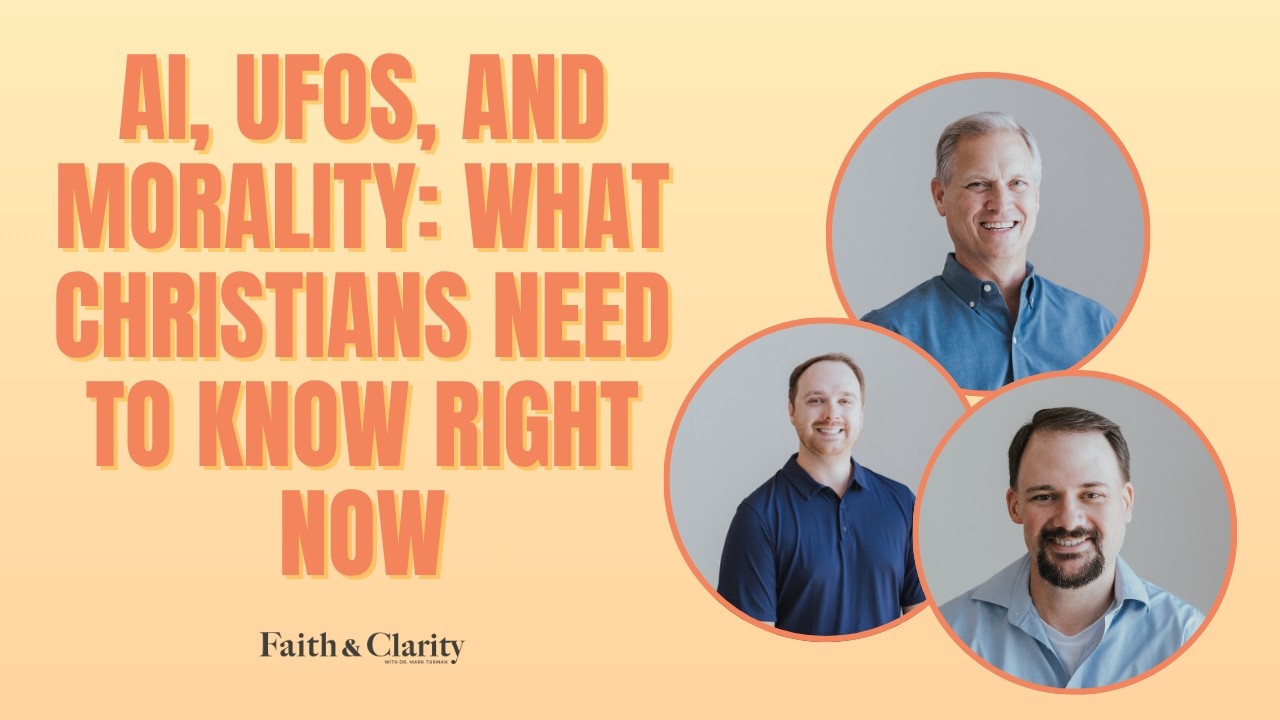
In this episode of Faith & Clarity, Dr. Mark Turman is joined by Dr. Ryan Denison and Conner Jones for a roundtable conversation on three of the biggest headlines shaping culture and faith today.
The conversation covers the shifting narrative around artificial intelligence—from widespread fear to growing inevitability and profit-driven momentum—including potential public offerings, government investment proposals, and calls for regulation from within the industry. Ryan walks through Pope Leo's sweeping new encyclical framing AI as a choice between a Tower of Babel path of human self-exaltation and a Nehemiah path of humble, God-blessed partnership, alongside important questions about AI and personhood. The discussion also takes up renewed public interest in UFOs, exploring the "disclosure" movement, Pentagon releases, whistleblower claims, and reports of briefings given to Christian pastors, and what it might mean for Christian faith if the existence of other beings were ever confirmed.
The roundtable rounds out with encouraging Gallup findings suggesting some moral views in America may be trending less permissive, along with a lighthearted Fourth of July Q&A.



Topics
(0:00) Introduction
(1:35) AI headlines and market rush
(9:50) Lessons from social media
(13:35) Pope Leo on AI
(18:15) AI personhood and Christian response
(23:04) Disclosure movement explained
(25:56) Pentagon releases and pastor briefings
(28:34) Faith and aliens
(29:39) God’s sovereign universe
(31:52) Angels demons debate
(38:45) Discernment and Scripture
(43:36) America’s moral shift
(48:54) Calling out sin
(52:38) Founding documents quiz
(55:59) Conclusion
Resources
- The new Babel: Reclaiming the image of God in a world of AI
- Pope Leo’s AI encyclical
- Idols of the Valley
- Why are Americans turning against AI?
- AI engine decides which religion is most rational
- UFO files: Pentagon
- Pentagon program, UFO, Harry Reid
- Good Faith Podcast
- Trump in China, summer movies & Hantavirus scare | Ep. 69
- What Graham Platner’s primary victory means for our culture
- Was Fidelity Month created to counter Pride Month?
- Moral acceptability falls for several behaviors
- Ask Us Anything: [email protected]
- Sign-up for a Denison Forum newsletter: DenisonForum.org/subscribe
- Listen to the Culture Brief podcast
About Dr. Ryan Denison
Dr. Ryan Denison is the Senior Editor for Theology at Denison Forum and the author of The Focus newsletter, contributing writing and research to many of the ministry’s productions. He holds a PhD in church history from B. H. Carroll Theological Institute and an MDiv from Truett Seminary. Ryan has also taught at B. H. Carroll and Dallas Baptist University.
He and his wife, Candice, live in East Texas and have two children.
About Conner Jones
Conner Jones is the Managing Editor at Denison Forum and Co-Hosts Denison Forum’s “Culture Brief” podcast. He graduated from Dallas Baptist University in 2019 with a degree in Business Management. Conner passionately follows politics, sports, pop-culture, entertainment, and current events. He enjoys fishing, movie-going, and traveling the world with his wife and son.
About Dr. Mark Turman
Dr. Mark Turman serves as the Executive Director of Denison Forum, where he leads with a passion for equipping believers to navigate today’s complex culture with biblical truth. He is best known as the host of the Faith & Clarity podcast and the lead pastor of the Possum Kingdom Lake Chapel, the in-person congregation of Denison Ministries.
Dr. Turman is the coauthor of Sacred Sexuality: Reclaiming God’s Design and Who Am I? What the Bible Says About Identity and Why it Matters. He earned his undergraduate degree from Howard Payne University in Brownwood, Texas, and received his Master of Divinity degree from Southwestern Baptist Theological Seminary in Fort Worth. He later completed his Doctor of Ministry degree at George W. Truett Theological Seminary at Baylor University in Waco.
Before joining Denison Forum, Mark served as a pastor for thirty-five years, including twenty-five years as the founding pastor of Crosspoint Church in McKinney, Texas. Mark and his high school sweetheart, Judi, married in 1986. They are proud parents of two adult children and grandparents to three grandchildren.
About Denison Forum
Denison Forum exists to thoughtfully engage the issues of our day from a biblical perspective, helping believers discern today’s news and culture through the lens of faith. Led by Dr. Jim Denison and a team of contributing writers, we offer trusted insight through The Daily Article, a daily email newsletter and podcast, along with articles, podcasts, interviews, books, and other resources. Together, these form a growing ecosystem of Christ-centered content that equips readers to respond to current events not with fear or partisanship, but with clarity, conviction, and hope. To learn more visit DenisonForum.org.
All episodes are produced by Sound of a Rose. For more information, you can visit soundofarose.com.
EPISODE TRANSCRIPT
NOTE: This transcript was AI-generated and has not been fully edited.
Mark Turman: [00:00:02] Hey, I’m Mark Turman. This is Faith and Clarity, a podcast of Denson Forum. We want to help you gain some clarity about today’s cultural confusion and equip you to live by faith, not by fear. So, grab a cup of coffee or a soda, maybe a glass of water, and join us as we sit down for today’s round table. We’re going to walk you through some of the stories that are grabbing headlines right now. Uh, we’ll talk about technology, specifically AI and what the Pope has uh, weighed in in that category. We’ll also have some fresh conversation about UFOs. I just got to tell you that one of my guests is really excited about that topic. And uh, if we have time, we’ll get to uh a little bit of the importance of shared morality and maybe, maybe a why did you ask moment at the end. So, let me uh introduce my guests today. You’re they’re familiar to you. Ryan Denson is our senior editor for theology and author of the Focus newsletter at Denson Forum. Connor Jones is our editorial manager for Denson Forum and also the host of our sister podcast, Culture Brief. So guys, Ryan, we’re glad to have you. How are you?
Ryan Denison: [00:01:05] Doing well. Thanks for the chance to be here.
Mark Turman: [00:01:07] You bet, Ryan. Thanks, uh, thanks for being here. Connor, thanks for jumping in as well.
Conner Jones: [00:01:11] Yeah, absolutely. Love joining Faith and Clarity podcast when I can. I don’t know how I feel about calling Culture Brief a sister podcast. I feel like it’s more of a brother podcast, but we’ll take it.
Mark Turman: [00:01:20] You know, I had I had that same thought that uh, but I don’t know why people always use that terminology, but nobody ever says it’s a brother of anything. Um, but in this case, it particularly applies. So, but it’s a good call out. Yeah, we appreciate that. [00:01:35] Uh, so guys, let’s just jump right in. Uh, Ryan, you’ve been writing in the focus and in the daily article about some different aspects around technology, around AI. It seems like every time we turn around, multiple times a day, there’s something else in the news. I pulled up some headlines just a minute ago. There’s more headlines uh hitting the stock market and other places about uh AI and that type of thing. Uh can you kind of give us kind of an overview of what the big movements are right now and then uh then maybe we’ll get into what the Pope had to say about technology.
Ryan Denison: [00:02:09] Yeah, absolutely. It’s it’s interesting. For so long, it seems like a lot of the conversation around AI has been centered on where is this going? Is it going to lead to the demise of humanity? Is the world going to blow up? Am I going to lose my job? All that kind of stuff. But lately, a lot more of the headlines have almost adopted this sense of inevitability to it and have shifted instead to this idea of, okay, well, what is how do we profit off of this? [00:02:34] You’re starting to see a lot of AI companies uh talk about going public. As we record this, uh SpaceX, which XAI is part of that, is about to go public and is expected to make Elon Musk the first trillionaire. Um by the time you’all are listening to this podcast, you’ll know if that’s true or not. Uh right now, that’s kind of seen as a as an inevitability of sorts, but it’s still a little up in the air. And you’ve had a lot of other companies looking at that wondering, um like OpenAI, for example, is looking at that wondering, okay, could we do something similar? Or a lot of other companies are looking at what happens with SpaceX as sort of a a gauge of whether or not they should follow suit. [00:03:12] Um and you’re even seeing it with the government as well. Bernie Sanders recently floated the idea of a one-time tax that would give the government a 50% ownership stake in AI companies through something called the sovereign wealth fund. That’s something you see in a lot of other foreign countries. Uh sometimes it’s gone well, other times it’s gone bankrupt and it’s generally just seen as a bit of a risky maneuver. Um but you’ve even had President Trump say that he sees something similar as being a possible path forward. Uh he President Trump though is looking to take a stake in kind of follow his the model he had with Intel where when they were going under, he kind of bailed them out in exchange for a a stake in the in the company. And I think to at this point, I think that’s risen uh it’s risen quite a bit to where that’s kind of paid off because he’s bailed out Intel. They’re they’re slated to do even better as these AI companies go public. And so it’s really kind of created this conversation around what should the government’s role be in AI beyond just a regulation standpoint, but even from the perspective of how should we invest in it? Should the government invest in it? [00:04:17] And what’s been really fascinating is you’re seeing a lot of these AI companies actually embrace that idea. Um for the most part, I always thought, you know, capitalistic system, these private companies would kind of frown on the idea of the government getting too involved. But lately they’ve kind of been all for it. And I I kind of wonder if part of it is you hear a lot about an AI bubble and about whether or not that’s going to pop. And if you look back at kind of the housing market and when that was a bubble, the internet bubble, if you can get the government to kind of make you too big to fail because they’re directly involved, then I think that’s a pretty good insurance plan for a lot of these companies. So I wonder if part maybe that might be part of why they’re open to the idea of government investment in a way that hasn’t always been the case.
Mark Turman: [00:05:00] kind of a kind of a maybe another pathway through some kind of regulation and control. Uh it’s it’s influence and regulation in a different way, right?
Ryan Denison: [00:05:11] Absolutely. And they’re also talking about how it’d be great if the government could build up infrastructure because so many of these uh so many of the plants that they have to build to actually make the AI function require an enormous amount of energy. And our grid’s not really set up for it unless we go unless they go nuclear or renewable energy or other sources, natural gas, uh stuff like that. And so, um there’s a lot of ways of how this could play out, but it’s just been interesting watching the conversation shift from a fear-based approach to more of a, well, this is going to happen, so how do we benefit from it kind of approach. And I was curious, what are y’all’s thoughts um when you think about kind of that change?
Conner Jones: [00:05:52] Well, well, Ryan, you bring up some really good points and I I’ve seen the same thing too with the AI bubble concerns. I’ve also seen uh the the guy who founded Anthropic, which is in charge of, you know, they they’ve created Claude, that AI model. I think his name is Dario Amadi, uh and he is out there literally telling the government, you need to step in. Like, please step in, restrict our company, use a third-party company to come in and test out these models before they get released to the to the public, to the greater world, to the to, you know, anybody who could do harm with them. Please come in and step in, prevent us from making missteps here. So, I think that’s kind of interesting. You bring up some really good points there. As far as like where Americans are feeling about this, I was reading this study this week uh from the state of the Bible. And so they’re asking Americans and they’re asking Christians in their polling, how do you feel about AI? [00:06:40] And roughly a third of the people who responded said that they are at least somewhat optimistic. Another third said they are not optimistic, and the remaining say they are undecided. So, you know, Ryan, you’re kind of pointing out like there’s this uncertainty. What is the future of AI? Um I think we all feel it to an extent. Like most people can say, yeah, there is going to be some benefit to AI. It will improve efficiencies. It could help the medical field. Like there are things you can see being so beneficial, but then there are so many concerns. And it doesn’t help when you got the leaders of these AI companies like Anthropic saying, whoa, everybody needs to hold up. We got we got some serious concerns here before we keep moving forward. That doesn’t make anybody feel great. It makes you feel a little uneasy, it builds up the anxiety and all of that. Um so, you know, I I I think when I consider my feelings on AI, I personally, I get the anxiety. I’m like, what, you know, I I start to question what everybody else is pointing out. What’s going to happen with this incredibly powerful technology? And how, like you’re saying, Ryan, how are they going to continue to power these AI things? It’s going to require massive, massive data centers that are very controversial right now. Um and people are worried about how those data centers are going to impact their communities. Like just their physical lives are now going to be impacted with their water being used to power these things with massive data centers being placed in the middle of what should be ranch land or farm land. Um yeah, there’s there’s a lot of big questions there and I think people are right to be a little worried, but also, uh you can’t let it own your day. You can’t let it just eat you alive all day every day.
Mark Turman: [00:08:08] Yeah, I think, you know, my my own experience, you know, we we have a very cautious approach at Denson Forum about uh engaging with some of this technology and particularly AI and so, but as we’re uh, you know, using it in cautious ways, it’s it’s kind of exciting when you become familiar with some of it. Um and so that takes some of the the mystery out of it. Uh, you know, Ryan, I know you wrote a little bit about how some communities are doing what Connor was talking about, they’re rising up to resist the building of a data center uh in their area. Uh but at the same time, what you were talking about at the beginning, makes me kind of think and this kind of does comfort me that that this technology as well as other aspects of the internet uh are starting to perhaps be positioned like a utility, like uh electricity and water uh and clean air that our our world, our culture is becoming so familiar and in many ways so dependent uh upon these things that there needs to be a a healthy kind of partnership between the private and public sector, um which obviously means the government. Um but there’s a reason why we do that when it comes to certain essential things like like again, water, air, uh energy, that kind of thing. We’ve had to kind of have a what you might call a modified capitalism in that way. Um and even today, if you started telling everybody, hey, you have to go back to using a paper map instead of, you know, directions on your phone, I think I think there’d be an uprising at that point. Um for sure. And so, uh you know, and this is, you know, one of the things I wanted to question uh or bounce off both of you on this topic, which is is some of our uh some of the lessons that we’re already learning relative to things like the internet and social media, do you think that’s causing us to maybe be a little bit more cautious in the embracing of new levels of technology, artificial intelligence?
Ryan Denison: [00:10:18] I do think it’s definitely driven home the idea that just straight up embracing all of this stuff, no questions asked can lead to some pretty dark places. I think we’ve seen that with a lot of the social media stuff where when that first came on, everyone paid so much attention to the benefits that if you raised concerns, you were almost seen as just someone who was trying to be negative um because clearly this stuff could only be good. Um that’s an over simplification of it, but I think that’s how by and large the culture treated it and we’re quickly seeing how that was a flawed approach. And I think there is some concern about AI about making a similar mistake with AI. I also think you’re seeing people maybe go too far in the other direction with it. But Connor, what are your thoughts?
Conner Jones: [00:11:02] Yeah, I mean, the rise of social media gave us so many positives, like you’re saying, Ryan, and then the the negatives that came along with that were overshadowed for so long. And so I think there’s a lot of people trying to get ahead of it this time, say, whoa, uh we need to we need to be very clear that there are dangerous aspects to this. I think one one phrase I keep hearing is uh at the beginning of AI kind of hitting our culture, which is probably about 2023, 2024 is when Chat GPT really started to get off the ground. People are like, whoa, we got a like a corporate space race going on. These different AI companies are going to try to create the best models to be our chat friend, um and help us do efficiencies in our lives and our daily tasks. But then it became very clear that really it wasn’t just a space race, this is more of a Manhattan project race uh for the US and other militaries around the world, right? They all of a sudden they were like, hey, this is actually something that can’t just be used in the workplace. We could use this as some sort of military aspect. Um hackers get a hold of it. We need to make sure we have the best ones available, the best models available. And so that’s that’s kind of what you’re talking about, Mark, too, the public and private sector coming together. That’s that’s what the government wants. They want the best models for self-de like, you know, national defense and security and military purposes. Um which is also why there’s debates about what are the dangers of AI, especially when you give it access to weaponry or decision-making that typically has been for humans to make. Yeah, there there’s concerns that people are calling out now, maybe before it gets to the point where we it’s too late to call it out, the way we’ve seen with social media with specifically like Facebook and meta and teenage addiction and all of that that comes with doom scrolling essentially that, you know, when it first started, we weren’t really calling out, but we look back and we’re like, man, that was it was terrible what we put in the hands of teenagers through 2010s and even up to today.
Mark Turman: [00:12:49] No. And we yeah, we’re going to continue to have to solve problems in that area. Um so anyway, because I’m a little bit older than you guys, like two decades older than you guys, two two decades plus, uh I will tell you that just especially in the last six months, I would say, this does feel strangely like it did back around 2000 when when the internet.com bubble burst from a, you know, because we’ve seen this very weird phenomenon that even with a war that’s now 100 days old uh and all the other disruptions that go on in the world, the stock market continues to climb and that’s the same kind of feeling that I remember from that season. And uh so it’s something to watch. But uh even the Pope weighed in on this and Ryan, you wrote about this recently. Uh the Pope and his team put together uh what has been received as a pretty uh a pretty warm reception to what is called a a papal encyclical, which is a letter from the Pope and his and his team uh called magnificent humanity. I’m not going to try to say the Latin name. I’m not that qualified. So, Ryan, give us a little sense of what uh Pope Leo and his team uh are saying about technology broadly and AI specifically.
Ryan Denison: [00:14:08] Yeah, it was it’s interesting to call it a letter because that’s the technical category for it, but it was over 42,000 words long. and I don’t know that I’ve ever written a 42,000 word letter. That’s a healthy book right there. It is, it is. But what’s interesting is while I don’t know anyone who’s actually I know very few people who have read the entire thing because it was that long, but it does cover all aspects of technology but with a particular focus on artificial intelligence. And what’s interesting is Pope Leo actually signed it on the anniversary of when his namesake, Pope Leo the 13th, uh wrote something similar in 1891 to talk to give guidance to how people should view the industrial revolution. And the reason he tried to time those up is he really sees the AI revolution as have as something that will have a similar impact on our culture as the industrial revolution did. And if you think back to how society changed, how quickly it changed and how unrecognizable the world was before and after that, I I think it paints a very clear picture of where he at least sees AI in terms of global significance. And what I really thought was interesting though within the encyclical is he kind of framed the conversation around AI as um choosing one of two paths and he used biblical stories to to exemplify that. The first was the Tower of Babel, which was essentially where humanity attempted to make a name for itself rather than embrace their God-given identity as people made in the image of God. If you think back to that story in Genesis and how so much of that was just building up and building up towards this point where humanity thought, okay, we can now function as God’s equals. That same sort of sin that that led Adam and Eve to eat the fruit in Genesis 3, uh just keeps replaying itself throughout history. And Pope Leo really used the Tower of Babel idea to offer one example of how if we go forward with AI with very little care to how it will impact other people, to very little care to whether God can bless it, how that can lead to some very dark places. And he contrasted that with when Nehemiah rebuilt the walls of Jerusalem after the exile. And there he highlighted how it was people partnering with people, but also people partnering with God in order to accomplish something great and something that most didn’t think was possible. And he uses and what I loved about that is in neither in by using Nehemiah as a positive example, he’s not saying that AI is something we need to fear, something we need to reject. What he’s essentially saying is that AI is too big to do by ourselves. And that if we try, we’re going to fail. But if we can find a way to do it in a way that God can bless, then it has the potential to be a blessing to the world. And that was really kind of the main idea he wanted to get across in the encyclical. And so I was curious when you’all think about kind of the role of AI in society, how people approach it, um how well do you think kind of Leo’s comments there represent the way people in general are trying to approach this?
Mark Turman: [00:17:01] Yeah, I thought it was a really good framing of the conversation from a biblical, spiritual perspective and even as you were talking about it just now, um made me think of what Connor said a moment ago about governments and governments wanting AI technologies for purposes of defense and that type of thing because what we’re going to likely see is is that there are going to be different actors, different organizations even on a national, global scale that are going to choose contrasting paths, right? Some are going to choose what Leo describes as the Babel path of domination, control, uh self-interest and others, hopefully the majority will choose more of the Nehemiah, Jerusalem path, the path of cooperating with God for the benefit of everyone. Um and and you’re going to we’re going to likely see those things being held in tension. Uh especially when it comes to to conflict between nations. Of course, you know, almost everybody’s going to try to grab the higher moral ground, I would suspect, but uh that’s going to be the tension that we’re likely going to be faced with in this and almost all technologies, I would think. Connor, what about what are your thoughts?
Conner Jones: [00:18:15] Yeah, I mean, I I tend to agree with both of you here and I I would say I think one of the other warnings that comes out of the encyclical is not raising AI, like you’re saying in a Tower of Babel sense, like not raising it to the level of God, right? It it there are people on this planet who are already starting to build kind of uh religious ideologies around what artificial intelligence is and can possibly become and see it grow and all of that and, you know, the question of does AI have a consciousness or a spirit or soul of any sort? We know biblically that it does not. We know that Genesis tells us that we as humans are made in the image of God. That is very unique to humanity, right? That is not something that artificial intelligence is going to ever have. It never will. And so, you know, Mark, you mentioned earlier how we approach AI at Denson Forum. We never let AI write or create any of our content because then it would not be Holy Spirit driven. It’s always humans. It will always be humans on this podcast. It will always be humans writing our articles, our newsletters, right? Because we get to be guided by the Holy Spirit. And that is a beautiful gift that God’s given us. He has not given that to artificial intelligence. That’s why it’s called artificial intelligence. It’s not real. Um it’s, you know, it’s it’s a powerful tool and this is what I think is unique, Mark, to your point of like, how can uh we come alongside AI and use that for the church? I think this is the same way that the church was able to adopt amazing tools with the internet. We’re sitting here doing a podcast over the internet, which if you said that 30 years ago, people would have been like, what are you talking about? This is such a unique way to spread the gospel and share discipleship, right? And I think AI is going to open up many, many doors like that as well. That’s what we’re talking about. There are exciting things with artificial intelligence, but you cannot get even close to placing it at the same level of uh value that a human holds and especially the value that our God holds. Um it’s just not even close to that. So as long as you watch that fine line, I think I think we can step forward safely, but who knows? There’s still so many questions.
Mark Turman: [00:20:11] Yeah, I think I think that’s a great insight, Connor and and maybe we should be really cautious if they stop calling it AI or they stop, you know, we got three big players out there right now. Only one of them is using a personal name uh in terms of how they describe their uh their tool called Claude. Um maybe we should be concerned if they all start switching to proper names as a way of uh trying to give it some kind of uh personhood. But uh we’ll close out, let me just close out on what uh we all kind of watch Ross Douthat as one of the commentators on our culture. Uh he wrote uh kind of reflecting on another commentator, Yuval Levin. He said, you know, the need here is going to be for philosophical argument and personal advice. Uh if we really want to build and maintain this cultural wall against AI being a person, uh then we can’t just kind of brush it off. Uh this is an opportunity for us as Christians to really talk about the uniqueness of what it means to be a person uh and the ability to not only relate to each other, but the ability to relate to God. Um and that that’s a powerful thought for us to keep our eye on and keep working through. But we’re going to step aside, take a break, and then we’re going to come back and kind of go maybe into a related topic. What’s going on with UFOs these days, even in the movie theater? We’ll be right back. [00:21:33] Thank you for being a part of Faith and Clarity. You’re choosing to slow down, think deeply, and engage the headlines through the lens of scripture. And that matters more than ever because in a culture full of noise, Christians need more than quick reactions. We need biblical clarity, thoughtful engagement, and the wisdom to live out our faith in everyday life. That’s the mission behind Faith and Clarity and the work of Denson Forum. Right now, we’re working toward an $800,000 summer goal to expand that mission and reach more people with truth. Give now at supportdf.org. Again, that’s supportdf.org. Find a link to give in today’s episode notes. Because when believers are equipped with truth, they don’t just understand the culture, they engage it with clarity, compassion, and conviction. [00:22:30] If you’ve ever wished the news felt a little less chaotic and a little more clear, Denson Forum has created something we think you’ll appreciate. It’s called The Focus, a new weekly email from Dr. Ryan Denson, one of our frequent guests here on Faith and Clarity. Every Tuesday, Ryan highlights three to five key stories from the week, curated so you don’t have to dig through the endless headlines, along with a deep dive into one critical cultural issue. He also adds in a God is good segment that highlights an uplifting story. The goal of the focus is to help you answer, what do I need to know from the last week? Why does it matter and how can I stay hopeful? If you appreciate this podcast or the daily article newsletter, but would like a wider snapshot of what’s happening, then the focus is for you. You can subscribe to receive the focus newsletter now at Densonforum.org/newsletters or find the link in the show description.
Mark Turman: [00:23:48] All right, welcome back. We’re going to talk a little bit about the movie theater and more than that, we’re going to talk about the phenomenon of UFOs or aliens. Uh you will probably already know when you’re listening to this that Steven Spielberg, the gosh, the Hollywood figure of my entire generation, uh has just released a new movie called Disclosure Day. If you’re of my generation, you’re old enough to remember movies like ET and close encounters of the third time of the third kind. We’re in that kind of genre here. Uh and that’s kind of back in the news. It’s we’ve already had the movie Hail Mary, but this kind of guys kind of became real to me about two weeks ago when uh a person at church walked up and said, hey, I’m I’m trying to talk to another friend. He said to me, I need to know what Christians think about aliens because if aliens are confirmed to be real, I think my whole faith is going to collapse. And my first response to that was, I wonder why. Um but Connor, take us into this. Uh I know you love this topic. So, uh tell us a little bit about what the fresh conversation of alien life and UFOs are all about these days.
Conner Jones: [00:25:01] Yeah, for sure. Well, and I want to address that question too. I think we’ll get to that of the should if we ever found out aliens were real, and I’m not saying we are going to, but if we ever did, should that shake our faith, the core foundation of our faith. So I’m excited for that conversation. But to your point, Mark, yeah, Steven Spielberg’s got this movie. We’re recording the day that the movie’s actually coming out. So disclosure day is his new film. None of us have seen it yet, so we can’t speak to what takes place in the film. Uh although I am eager to potentially go see it very soon. Yeah, it it’s kind of hinging on this new movement called this basically disclosure is what they call themselves. This this group of people, it’s a grassroots movement that are seeking uh truth and evidence from the government and basically for them to disclose everything that they know about oddities, UAPs, they call them United uh unidentified aerial phenomena or, you know, as most of us call it, UFOs, right? Basically, the movement is seeking out any way to get the government to release all of the information, potentially anything that they’ve got going on illegally. They’re saying essentially that the government is hosting secret programs funded by black money that does not properly go through congressional budget and allocations and thus using that money to fund these programs that not even potentially the president knows about, which, you know, you talk about alien movies, one of my favorite movies is Independence Day. And if you remember there’s the scene where they take the president to the bunker at Area 51 uh and they’re and he’s like, what is this place? It was a great depiction of here’s how a government could work with secret groups of people who never even relay stuff up to the top echelons of government, right? That’s what the disclosure movement believes is happening. And it really started in 2017 when the New York Times released an article that showed video evidence that came from fighter aircraft, the US Navy fighter aircraft of these oddly moving, fast moving and weirdly shaped and lit objects off the coast of America on the East and West Coast over the ocean. They are moving at basically in ways that defy physics as far as we know physics goes, right? And essentially that sparked a whole thing and that sparked a whole movement of disclosure, but also it got the attention of Congress. And so Congress actually ended up passing legislation after that article that formally looked into the matter and basically included protections for any potential whistleblowers who know more information from either these programs or military people who have seen and encountered any sort of unidentified aerial phenomena, right? So they started going about that and they also included language about uh crash material retrieval and reverse engineering of UAP. So it almost legitimized this idea that, hey, there could be something out there that the government is fully aware of. Maybe they’ve recovered items or biologics that they have kept secret from the American people and even from Congress uh and even leadership within the government. Uh so that ended up leading to actually a number of whistleblowers coming forward and explaining their personal encounters or the stories that they had been told through their own investigations of, hey, the US actually does have some stuff here. This now gets us to this year. That that was kind of the story over the last five or six years, right? Um this year though, there was a moment that really sparked it all and that was when former President Barack Obama was on a podcast and he was asked about aliens and he kind of quipped, yes, they’re real, but I haven’t seen them. Well, people took that very seriously and he had to come back and clarify that he was just joking and basically saying the universe is so big, I kind of believe that there is something out there. That’s what Obama said, right? That prompted Trump then to say, well, Obama released classified information there and we’re going to just have to go ahead and release it to the American people, which has gotten us to this point where we’re recording in June and in May, the government did release, the Pentagon specifically released two tranches of files, videos, everything that they’ve got or that they say that they’ve got, right? That’s the key point here on unidentified objects flying and it allows you can go log on to the Pentagon’s website for this. I think it’s aliens.gov and you can watch all the videos that they released and you can make up your own mind and that’s what they say. They’re like, we don’t know what these are. These are unresolved cases. A lot of people have, you know, dabbled through those videos and they’re like, this just is not really what we were hoping for. We wanted something a little bit more uh clear and evidence of what we’re seeing here. It’s a lot of videos that people have already, you know, kind of described as balloons or parachutes, things that have been explained away a little bit. There are some odd videos in there for sure, but it was a little bit, I think it hit it a thud uh when it was released, people were a little bit disappointed. All that to say, in the midst of this, there was a group of pastors who claimed that they were brought in by a secret government group to be briefed on the potential release of this information uh and what would be revealed, right? Saying these they they claim that these government people said it’s going to upend our understanding of the world order, our understanding of religion, our understanding of creation. And so start prepping your congregations now. There’s been a lot of skepticism around that meeting, who was actually invited, who actually made those presentations. Um the New York Times when they were reporting on this meeting noted that Tony Merkel, one of the podcasters there and who ended up inviting a lot of these pastors, actually declined to share the organizer’s names and he even said that they were not US government affiliated, they were intelligence operators. So take with that what you will. Um but it does present the idea of what you’re saying, Mark. If we were to find out through government means or any other means that we are not the only um intelligent life in our galaxy or in our universe, should that upend our entire faith or do we move forward and recognize, actually it doesn’t really do that much to our faith and it we can ask real good questions and we got I think it’d be fair to ask a lot of questions, but should that upend our faith? What does scripture have to do with this? So I’d love to just pose that question to you guys.
Mark Turman: [00:30:48] Yeah. Ryan, I’m going to let you go first on this.
Ryan Denison: [00:30:51] Sure. Um yeah, we uh honestly, for me, I don’t think aliens exist. I would be surprised if they did. If that if I’m wrong on that and they are out there, it’s not going to upend my faith. It’s just going to give me some more questions. And in a lot of ways, it could actually reinforce my faith. Like if if we did meet beings from another universe that had the intelligent intelligence capacity to make it all the way to us, then I would imagine they are intelligent life. They have come from a world where there is sin and I’d be very curious to know if they have any experiences of God there. I would presume that if God created them, he would have shown up to them. He would be working with them in a similar way to how he worked with us. And so it would give me questions, but I don’t think it would necessarily make me question my faith. I think it would just in some ways broaden uh have the potential to broaden or even reinforce my faith in some really cool ways. But Mark, what are your thoughts?
Mark Turman: [00:31:48] Yeah, you know, this number one is this is not a area of great passion for me. Uh I like a good sci-fi movie every now and then, but um not not as a regular part of my entertainment diet. But uh I I kind of start at this conversation at that scripture verse that says that everything was made by him, for him, through him, and ultimately goes back to him that no matter how big the universe may be, uh which we can’t even comprehend that at this point, um that maybe there is, I tend to lean uh away from the idea that there is, but it’s a apparently a very, very big universe. Um and uh as a podcast we shared together uh with uh Curtis Chang and Andy Crouch, you know, there’s there’s what Crouch calls the Goldilocks effect that there’s so many variables that have to come together to sustain life even as we know it. It’s it’s so majestic and astounding that our world exists, um that it seems to make it uh kind of remote that there would be more than the one that we experience. But then the other thing is, if they if there is and they actually came looking for us, does that automatically mean that they’re superior to us because we’re in some way exploring space to go see what’s out there and see if there is someone out there. So we’re kind of doing that already. Um and so, you know, a lot of the assumption, I think, uh in this conversation is is, well, if we encountered aliens uh of some kind, then we would assume that they’re superior to us. Well, why would we make that assumption necessarily if they just happened to find us before we found them? That that may not necessarily hold true. Um but again, I just start at this foundation that whatever is out there in the world, in the ocean, and in the broad, broad expanse of the universe, all of it is still under the sovereign hand of God. And he’s not threatened, therefore we don’t have to feel threatened as a place of starting. Um Connor, I uh ran into this, uh you and I kind of talked about this offline and talked about it with others as well. Some have brought in this conversation that this is the presence of angels and demons. Kind of take us through that part of the conversation.
Conner Jones: [00:34:19] Yeah, there’s been uh some of those pastors I mentioned, that was kind of their, you know, what their takeaway was. The, you know, demons, angels, spiritual beings are what’s being seen on these videos. Not just them though, even Vice President Pence said it. Uh he said he believes that they are demons. There are several congressional members who said that they believe that they are uh demons or angels, some big name commentators out there too. Tucker Carlson is consistently pointing back to this idea as well. I’m not saying you should listen to him or trust him in that sense, but that is a common um I guess understanding of what this could potentially be. And so when I look at these videos and all of that, you can see maybe a way that it could be explained away as demons or angels, but you know, one of the big question marks with it is where in scripture do we even see that angels and demons are flying around in a way that if you watch these videos, you’ll see they are they’re moving at like 3,000 miles an hour, stopping on a dime and then going 90 degrees the opposite direction. It’s things that we know cannot be done by a physical human being, right? So, could it be a spiritual being, uh some sort of thing that does not live in our realm, um but could could go through our realm, I guess in a sense. That’s that’s my question for y’all. Where have we seen in scripture the idea that this could be either angelic or demonic beings?
Mark Turman: [00:35:35] Well, I think, you know, a starting place is is that even a a simple reading of scripture uh has to affirm in my opinion the the reality of both angels and demons. Um I I I think you’re being unfair to scripture if you can’t start there. Um but that both angels and demons are spiritual beings and they are substantively different from human beings. They are not material in the the way that we are. Um and we have to accept, I think, the reality that they’re there. I’ve I’ve generally had the impression in the times that I’ve been a pastor that that’s an uncomfortable thought uh for most Christians. Most of us seem to get really excited about the presence of angels and that they’re on our side and that they’re assisting us. Uh but generally in the congregations I pastored, very few wanted to talk about demons and what demons might be capable of. Uh they want the comforting side of that, they don’t want the disturbing side of that. Uh but over the years, the things that I’ve I’ve kind of read through and thought through have been that both angels and demons have some level of influence in our lives and in our world, uh but they don’t have the ability to come and to uh make decisions for us or to in any way uh imprison us or uh control us, at least not without our consistent and repeated cooperation. Um that might be a general way I would summarize it. Ryan, what about you?
Ryan Denison: [00:37:15] Yeah, I mean, I think when it comes to demons, especially and Satan more generally, I think scripture’s clear there’s two mistakes we can make. We can give him too much influence in the world or not enough influence in the world. And I because I think scripture’s clear that he is here, he is powerful, he is at work. I forget who it was, but someone once said it’s strange for modern culture to have given up belief in Satan when he’s the only explanation for so much of it. And I do think there’s some truth to that. Um and so whether it would whether Satan and or his demons or angels are masquerading as UFOs or are masquerading as aliens, who knows? I mean, it would be within the playbook of Satan and his demons to try and deceive us or to try and make us search for more naturalistic explanations for what’s ultimately a spiritual reality. And so I could see that at work. Um I think it’s it’s plausible. I I don’t necessarily think it’s likely. Um if it was to be the case, I would suspect that it’s probably more on the demonic side than the angelic side. Um because throughout scripture whenever the angels show up, it’s at God’s bidding to do God’s will and rarely do they seem intent on hiding. Uh there’s a passage that says, um many of you may have entertained angels unaware. So I mean, I think there is some scriptural basis for the idea that they could be here and we wouldn’t recognize them or they could have influence and we wouldn’t recognize it in the moment, but I don’t think that they ever show up in order to be deceptive. And so I I if there is a spiritual explanation for what’s been seen, I would tend to think it probably goes more to the demonic side of that, which is understandably troubling in a lot of ways, but I also think at the end of the day, like we’ve been talking about with AI and with this, if if our initial response to this question is fear rather than looking to God for increased faith and for help to have the faith to respond well to this, then I think we’re making a mistake. And that’s where I see a lot of people kind of struggling, it seems like is they look at these questions and their first reaction is I need to understand this rather than I need to pray about this. And I think there are certain elements of this that we’re only going to understand if God reveals it. Um the government can release as many documents as they want and I feel like if there was incontrovertible proof that aliens existed, that would not have been kept secret. I mean, maybe I’m not giving the government enough credit, but I don’t tend to see the government as someone as a group of individuals capable of keeping that level of secret for this long. Um and so I would be surprised. I imagine this is going to remain one of those topics where it’s continually debated, it’s continually there’s more hypotheses around what we’re watching, uh around what could actually be out there, but um just kind of one last thought on it is I think it’s also helpful to remember that so much of the conversation around aliens and this belief that they must exist comes from a place of look how big the universe is, like you were talking about, Mark. Um clearly it doesn’t make sense for us to be the only ones here. And I think that explanation only holds water if you don’t think God could create the entire universe, an ever expanding universe without only creating us. And I think it’s not he’s God. It’s not like it was hard for him to create the universe. He just spoke it into existence. And if he wanted to do it for the sole purpose of reinforcing how amazing and how much larger than us he is, then that is well within his rights and well within, I think the example of who he is. And so I don’t want to give too much weight to the idea of look how big the universe is, clearly there has to be something else because I don’t think that’s an argument that the Bible necessarily requires of us. But Connor, what are your thoughts?
Conner Jones: [00:40:55] Yeah, I’ve I’ve got a handful of things here. Uh you both make really great points. Um and I I think one key scripture that we can take with this is Proverbs 14:15, which says, the simple believes everything, but the prudent gives thought to his steps. And so you can’t just take everything you hear from uh the government, from whistleblowers, from people telling their stories and and and take that as as basically as Bible. You can’t do that. No. You got to be very careful and wise and discerning about the information you take in before you move forward. Um and so you’re right, Ryan, there’s so much that we could take here and this whole idea of the government being completely upfront, it’s hard to know if they ever would be, right? But we can’t put all of our eggs in a basket and trust that the government will will be completely upfront or or that we should even trust the information that we’re receiving all the time, right? And at the end of the day, I would argue it should not shake our faith. Whatever we ever found out, if we ever find anything out, or if we find out that this is all just baloney and it is really the devil being a deceiver trying to shake our faith, right? Like there is reason to believe that this is a great way for the devil to use demons and his uh his basically his deception powers to throw the Christian church off, right? I I I could fully see him doing that. He’s very capable of deceiving us in that way. But I would also say to your point, Ryan, on the size of the universe, what’s cool is God could have created this universe just to show his power and majesty and we are the only life forms here in the entire universe. Earth is unique in that way. Humans are unique in that way, right? That’s such a cool idea. I would also say, you can’t limit him. He created a universe that big. If he wanted to create more life, he certainly could have and he may have. And we can’t say that he didn’t. It’s not mentioned in scripture that he did. So it’s hard to, you know, argue that there’s more life out there for sure. But I wouldn’t limit him in any way. In fact, I think it’s really cool to think about the endless possibilities of what God could have created and that the universe really there are trillions of galaxies and there are billions of stars in our galaxy alone. And we’re in a small galaxy. It’s insane to think about the size and scope of what our God is capable of doing. Uh and just kind of looking back at Genesis 1:1 literally says, in the beginning, God created the heavens and the earth and he did that to show us his glory right up front. And then back to what we were talking about earlier, Genesis 1:27, God created man in his own image. And so if you’re worried about what uh humanity’s place in the world or in the universe is, you got to remember that we were created uniquely by God in his image and dwelled with the Holy Spirit. That’s what makes us different than artificial intelligence. That’s what makes us different than alien potential alien life, right? Whatever we find out, it does not change the truth of God made us in his image and he sent his son to die for us on the cross. The gospel truth does not change, no matter what we find out now or 50 years from now or 100 years from now. Like as technology and science advances, the gospel stays true. That’s what I think is so cool. Um just just remembering the truth of it all.
Mark Turman: [00:43:45] Yeah, just just reminds me of what you’re saying just reminds me of of two things that we really need to hold on to. One is is just the incredible power that God has uh as Ryan said that all he had to do was speak the words and things came into being that never existed before. Um and and Connor, you pointed out uh in some of your preparation for this, the psalmist says, right, that God put all the stars in the heavens and he numbers them, right? He knows them by name. He has a name for every single one of those things that we see at night. And just the majesty and power of that. And then at the same time, he says that you are made in my image with the ability to know and create and and to relate to him. Uh and it reminds me of something we’ve talked on our podcast before, uh and that is that, you know, in the Bible, God gives us everything that we need to know, not everything that we want to know right now. Yeah. Uh and that’s part of what we have to look forward to in heaven. There’s a whole bunch of stuff that we’re going to get to understand that we can’t and don’t understand right now, simply because we don’t have the capacity and because God had to leave enough room for us to exercise faith. Um and those two things are necessary. And then one last thing and then we’ll we’ll move on to our last topic, but when it comes to secrets, I have no doubt that there that our government, all governments have secrets, okay? I have no doubt of that. But I also remember what Chuck Colson said who when he was convicted in the Watergate scandal back in the 70s, he said, you know what? There were 11 of us, most powerful men around the president and including the president, and even the 11 of us couldn’t hold on to the secret. Uh and it destroyed all of our lives. And so keeping secrets at any level, especially really big secrets is really hard. Um and and God has a way of bringing things into the light, no matter how hard we try to keep them in the dark. Um and Jesus said something about that. Before we go, I wanted to talk to you guys a little bit about where morality in America seems to be moving. Uh Ryan, your dad, Dr. Jim Denson, author of the Daily articles written a couple of articles on this recently. Uh he wrote a really intriguing article about uh how here in Texas, uh Republicans have nominated Ken Paxton uh for a Senate seat in the fall and uh another candidate uh on the Democratic side, Graham Planter, both of these men have been accused of uh moral failures, sex scandals. Uh in Texas, uh Ken Paxton’s wife wouldn’t even endorse him for this race. Uh and your dad had an interesting insight into this that in some ways it it may be beneficial in today’s political world to be somewhat immoral. Um because that gives the electorate confidence that you’re not going to try to impose a moral standard on them that you live by. It was kind of an interesting thought I’d never seen before that, you know, if you’re uh if you’re a politician who hasn’t been involved in these kinds of scandals and you subscribe perhaps to a particular faith and you know, moral code that the public might be afraid of that because you might try to bring that into policy and they don’t want you to do that. So that that’s one side of it. [00:47:15] Uh the other side of it was uh our friend Micah, one of our co-workers pointed us to an article and a research project by Gallup. I had no idea that Gallup was doing this, but for a couple of decades now, Gallup has done a survey consistently over time looking at the moral uh beliefs of Americans. And so in May, they ran their study again. They asked questions around 20 moral issues and the way they framed one of the questions was whether or not you think this should be legal, tell us if you believe that it is morally right or wrong. So 20 different issues, most of those issues have stayed kind of the same, but since last year, five or six of these issues have actually uh become more morally reprehensible to a larger number of Americans. Those issues uh in this survey were birth control, having a baby outside of marriage, gambling, which is a huge issue in our culture these days. Uh sex between teenagers and the last one, uh cloning and or using animals in scientific research. All of those topics are now less acceptable to Americans according to this Gallup study. Uh so with those two pillars maybe as a framing of the conversation, what do you guys think? Connor, what do you what do you make of that? Do you think we’re moving more toward biblical ideas of morality in some way or are we moving further away? What does it feel like?
Conner Jones: [00:48:59] I well, obviously, I hope we’re moving more towards biblical morality and this is actually kind of one of the first signs of hope that maybe our culture is grasping onto the ideas essentially that these things are bad. Everything you just mentioned, we would say is not fully morally right. Uh you know, there’s nuances to every single piece of that. Like gambling uh has a lot of nuances to it. And we have we’ve done deep, deep dives on culture brief. I’d encourage you to go listen to us talk about gambling and and prediction markets and everything there and uh what’s allowable and what’s not allowable and all of that. But yeah, to your point, Mark, it seems like we’re headed in a positive direction. I would point out though that that article also mentioned that every single one of those things is still higher than it was 25 years ago. Um even as it’s starting to finally decline. Now, hopefully it starts to decline, each of those points declines in uh moral approval less and less each year and we’re headed on the right trajectory. I would hope that this is also just a a showing of how the church is growing. I think we’ve seen numbers to suggest that younger generations are actually getting involved in church. They are seeking out faith in Jesus and that might be making up their minds on some of these topics such as abortion or gambling or uh sex between teenagers and even cloning animals. That one’s a little bit uh that one I can’t speak that much to, but the rest of them it’s it’s very much so clear in scripture and in the Bible that these are not things that produce righteousness, right? Nothing about them produces righteousness or flourishing communities. They typically only produce um destruction. Now, can blessings come out of those things and can God redeem anything? Absolutely. But I would hope that this is showing we’re on the right path here, especially uh going into America’s 250th year, maybe this is a year of turnaround for our culture.
Mark Turman: [00:50:42] Yeah, I hope so. I think I do think there if I remember correctly, there’s a couple of verses at least tucked away in Proverbs, maybe a couple of other places that the way you treat your animals is a reflection of your relationship to God and faith. Um so there’s at least that um as it relates to animals, but Ryan, what do you think? What do those stories kind of point to you?
Ryan Denison: [00:51:04] I think they’re encouraging. As you were describing them, one thing that kind of stuck out to me is it’s interesting how they had to frame the question as should this not as should this be legal, but is this moral? Um because I think that speaks to a lot of the issues in our culture as well where you can’t impose morality legally, but I do think there’s a strong temptation to use the, yes, I I think it’s wrong, but I I don’t want to impose my morality as a cop out to not actually speak up when you see immorality around you. Um I agree that changing the laws isn’t going to change the culture, but I I do think as Christians especially, we need to be willing to call out sin when we see it. And I hope that these statistics point to that becoming more common, especially among believers. Um if the existence of believers, if the growth of believers, especially among younger generations is part of what’s driving that, then maybe that is the case. But I do think there needs to come to a point where when we see sin around us, we’re willing to actually say that’s not right. Not just I would never do that, but you shouldn’t do that either. And know that it’s it’s not unloving to point out something in a person’s life that’s going to keep them from God. Uh we need to do it with love and we need to do it with grace and the recognition that we rely on grace as well, that we have sin in our lives as well, that we’re not perfect. Like it’s we’re not meant to judge from that perspective of look how awful you are as a person. That’s not a biblical concept, but scripture is clear that especially among fellow believers, when we see sin, we need to call it out. And if the culture really is beginning to recognize more and more of these things that the Bible calls sin as something that’s morally wrong, then I think that could help in that regard. And so I’m I’m curious to see if it keeps up or if it’s more of a blip, but I I hope it’s I hope it’s the former.
Mark Turman: [00:52:57] Yeah, it’s just really interesting something for us to keep our eye on and and take some hope in. Uh you know, whether it’s people moving back to faith just uh for other reasons or because we’re seeing the failure of secular society, the failure of secular religion. Um you know, that uh we’ve tried some of these things for a very long time without God and we’re seeing how it’s really damaged and uh hurt people’s lives and hurt our society as a whole. Uh I noticed another article that your dad wrote, uh he wrote an article quoting from a study and a an activity uh by one of our lead leading legal thinkers, a guy by the name of Robert George who teaches uh at Princeton. Uh and how he watched over the last couple of years that more and more people uh were lowering their value of things like faith, family, and patriotism, but they were raising their value around the idea of money, that money could fix anything. And he was calling out that, you know, those things are probably at least correlated if not causing each other. If you value money more, then you’re going to value other things like faith and family and country less. And that’s uh an indication that we’re on the wrong road. Um and I think it’s just something that we have to continue to to watch and to pray for and to work for. If we want God to favor our country, then that really starts with our own personal decisions that uh Ryan as your mom sometimes says, if you live a life that God can bless, then hopefully that spreads to your family, hopefully it spreads to your church and your community. And the more of us who live a life that’s positioned in a way that God can bless, that means there’s more opportunity for our nation to be blessed uh by extension. All right guys, before we go, uh this is my since you asked question, okay? So, uh let’s just take a little bit of a moment here. Um have either of you read the entire Declaration of Independence and or US Constitution?
Ryan Denison: [00:55:08] I know I have read the Declaration of Independence and I’ve pieced together aspects of the Constitution. I’ve never sat down and read straight through it. I may have been supposed to do that at some point in school, but I don’t think I did. So, but declaration of independence, yes.
Mark Turman: [00:55:25] Okay. Connor, what about you? Have you read these two founding documents?
Conner Jones: [00:55:30] Have I read them? Yes. Do I remember every detail of them? Absolutely not. Uh it definitely was something we did in high school and I remember being handed one of those like pocket book constitutions and it almost looked like a little Gideon Bible or something where they handed it to you so you can put it in your pocket, you can carry around your constitution, know your rights. Um but I have not opened that up in a very long time. Uh but they are, I mean, obviously very crucial, crucial documents to our nation and nation’s founding. So it probably would not hurt to go brush up on some of the details in there.
Mark Turman: [00:55:57] Yeah, well, I I did uh about a month ago find on YouTube that you can you can get somebody to read it to you if you want. So, um there are those videos and and those uh audio podcasts available. You can do just about anything these days. So you can have somebody read both of these documents to you, which by the way, would have been the way most original uh colonists would have heard them. They wouldn’t have had copies, they would have heard them read to them uh if they heard them at all. All right, last question. What is the cheesiest thing you’ve ever seen or done on a 4th of July?
Ryan Denison: [00:56:38] Oof. Um I’m not really sure on the cheesiest thing. Uh it I don’t think it necessarily qualifies as cheesy because I greatly enjoy it. Maybe that just makes me cheesy. But there’s always some sort of like American flag colored or shaped food. Um usually in the form of a cake or dessert of some sort, but there always has to be one dish that is red, white, and blue. Um for it to be 4th of July. So I guess that would probably be my closest answer, but I also, mom, if you’re listening, don’t change that. I love that stuff. So keep it going.
Mark Turman: [00:57:15] All right, Connor, you got one?
Conner Jones: [00:57:17] Yeah, I can’t really think of anything super cheesy other than just probably similar to you, Ryan, really diving into the red, white and blue aspect and probably showing up in uh tacky USA gear to to 4th of July parties. I’ve definitely done that before and I would say it probably has been seen as cheesy in the eyes of others, but in in my eyes, I’ve seen it as patriotism all out, you know, we’re here to celebrate.
Mark Turman: [00:57:40] No. My my wife would probably tell you that it’s the shirt that I used to own that was, you know, made in the form of a flag. Um but to your but to your point, Ryan, uh multiple years in a row, I’ve gone to 4th of July gatherings where the fruit bowl was a mixture of red, white, and blue fruit. And they sometimes had to force it to really make it come out that way. But um sometimes it’s a pretty good uh expression of patriotism, I guess. Anyway, we hope you have a 4th of July that is outstanding as we celebrate our 250th anniversary. And uh just want to thank you guys for joining me for this conversation. Again, you can find us at Densonforum.org, not only Faith and Clarity, but also Culture Brief and the Focus and other things as well. We hope you’ll check those out. I want to thank our audience for being with us today. I also want to thank our uh staff, our editorial coordinator, Aubrey Kerr, I should say, and our friends, our technical producers at Sound of a Rose. You can find out more about them at soundofarose.com. We’ll see you next time on Faith and Clarity.








 Search