



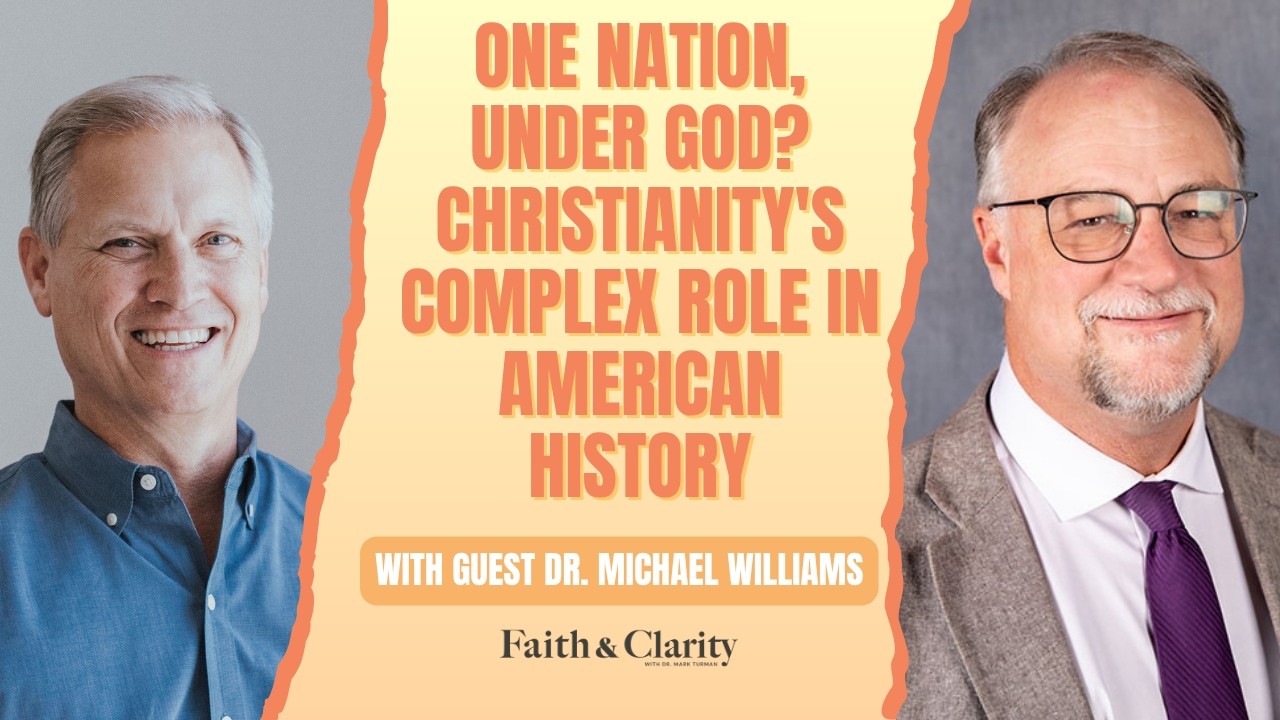
In this episode of Faith & Clarity, Dr. Mark Turman sits down with Dr. Mike Williams of Dallas Baptist University to explore how Christian faith has shaped America's story as the nation approaches its 250th anniversary. Mike shares his excitement about a renewed public interest in history while also raising concerns about false and distorted narratives that threaten to undermine our understanding of the past. He explains how colonists gradually developed a shared American identity and how he approaches teaching history through the lens of periods, themes, and people. Together, they examine how the Great Awakenings deepened religious diversity and forged a common colonial experience, and how the Constitution held a fragile new nation together in remarkable ways. The conversation takes an honest look at slavery as the central cause of the Civil War, the complex roles Christians played on both sides, and the ongoing pursuit of a "more perfect union" — including the deep polarization facing Americans today. They also reflect on immigration, diversity, and the enduring significance of religious freedom, tracing its roots through figures like Roger Williams and John Leland as one of America's most meaningful contributions to the world.



Topics
(0:00) Introduction
(5:18) Why we say America
(9:29) Teaching US history frameworks
(14:23) Christian worldview in history
(29:20) Constitution and unity
(34:46) Compromise and constitution
(36:34) Civil War and faith
(54:33) Religious freedom legacy
(59:03) Conclusion
Resources
- America 250
- Dallas Baptist University
- Ask Us Anything: [email protected]
- Sign-up for a Denison Forum newsletter: DenisonForum.org/subscribe
About Dr. Mike Williams
Dr. Mike Williams is known by many of his students as "Dr. Mike," has recently retired as Senior Professor of History at Dallas Baptist University where he taught full-time since 1995.
Upon his retirement on August 29, Dr. Williams was named Emeritus Professor for the College of Humanities and Social Sciences at DBU. For fifteen years, 1996-2011, he served as Dean of the College of Humanities and Social Sciences at DBU. The DBU faculty has twice named Dr. Williams “Outstanding Professor of the Year” and Piper Award Nominee in both 1999-2000 and 2012-2013. The DBU Student Government Association also named him “Professor of the Year” for the 1995-1996 academic year. The Baptist History and Heritage Society named Dr. Williams its W. O. Carver Distinguished Service Award recipient for 2013. He is a two-time recipient of The Baptist History & Heritage Society’s Carolyn Blevins Meritorious Service Award (2006, 2018), the first person ever to receive the award twice. Also in 2013, The Oak Cliff Chamber of Commerce selected Williams as its Higher Education “Educator of the Year.”
He has authored, co-authored, edited, and co-edited a total of seven books and is currently working on authoring two additional books. He also contributed a number of chapters to books, as well as encyclopedia articles and articles and book reviews for scholarly publication. Additionally, as a former pastor, he frequently serves as an interim pastor and supply preacher in Baptist churches.
His wife, Robbie, is a C. P.A., and they have three sons, Michael who is married to Shelby, Josh who is married to Allison, and Carey who is married to Morgan. They currently have four grandchildren, Jackson, Luke, Addie, and Palmer. They live in Aledo, Texas.
About Dr. Mark Turman
Dr. Mark Turman serves as the Executive Director of Denison Forum, where he leads with a passion for equipping believers to navigate today’s complex culture with biblical truth. He is best known as the host of the Faith & Clarity podcast and the lead pastor of the Possum Kingdom Lake Chapel, the in-person congregation of Denison Ministries.
Dr. Turman is the coauthor of Sacred Sexuality: Reclaiming God’s Design and Who Am I? What the Bible Says About Identity and Why it Matters. He earned his undergraduate degree from Howard Payne University in Brownwood, Texas, and received his Master of Divinity degree from Southwestern Baptist Theological Seminary in Fort Worth. He later completed his Doctor of Ministry degree at George W. Truett Theological Seminary at Baylor University in Waco.
Before joining Denison Forum, Mark served as a pastor for thirty-five years, including twenty-five years as the founding pastor of Crosspoint Church in McKinney, Texas. Mark and his high school sweetheart, Judi, married in 1986. They are proud parents of two adult children and grandparents to three grandchildren.
About Denison Forum
Denison Forum exists to thoughtfully engage the issues of our day from a biblical perspective, helping believers discern today’s news and culture through the lens of faith. Led by Dr. Jim Denison and a team of contributing writers, we offer trusted insight through The Daily Article, a daily email newsletter and podcast, along with articles, podcasts, interviews, books, and other resources. Together, these form a growing ecosystem of Christ-centered content that equips readers to respond to current events not with fear or partisanship, but with clarity, conviction, and hope. To learn more visit DenisonForum.org.
All episodes are produced by Sound of a Rose. For more information, you can visit soundofarose.com.
EPISODE TRANSCRIPT
NOTE: This transcript was AI-generated and has not been fully edited.
Mark Turman: [00:00:01] From Denison Forum, this is Faith and Clarity. I'm Mark Turman, your host. We want to equip you to find hope beyond the headlines and equip you to live by faith and not by fear. Today, we're continuing our focus on America's 250th anniversary, coming up on July 4th here in just a few weeks. We're going to talk today about some of the significant turning points in America's history and how our faith as Christians has in some ways informed that, guided that, strengthened it, maybe even at times suffered from it. So joining us today is a new friend of mine, Dr. Mike Williams, often called Dr. Mike by his students. He is today the senior professor emeritus in the College of Humanities and Social Sciences at Dallas Baptist University. Dr. Williams has been a full-time faculty member at DBU since 1995 and served for 15 years as the dean of the college. He is a distinguished and award-winning educator and historian. He has authored and contributed to seven books and is currently working on a couple of more. Uh, he brings a unique perspective as well because he has not only been involved in ministry on the college campus, but also as a pastor, oftentimes serving as an interim pastor or a supply preacher in many different churches. So, welcome to the podcast, Dr. Mike. We're glad to have you.
Dr. Mike Williams: [01:26] Thank you, Mark. It's uh, good to be here and uh, I've appreciated the work of Denison Forum over the years. been on the email list before and uh, really appreciate what you guys do and of course have a great respect for Dr. Denison and his uh, teaching and preaching ministries through the years. So it's a, it's a real honor to be here today and to, to talk with you guys.
Mark Turman: [01:47] Well, thank you. I, I just got to tell you, you got a pretty high bar to live up to, not only in that, uh, biography that I just read, but I work with, uh, several of your former students. And when I, when I started floating the idea of doing this podcast, they started, uh, jumping out of their chair about having you come and be a part of this. And so, just want you to know, they're watching, they're listening, and, uh, they are eager to see you, uh, have a conversation on this podcast. So we're glad. Um, but let's jump right in to exploring some of the connections, intersections, I even thought maybe even some of the collisions, uh, between biblical faith and the founding, the development of our country. So with the, uh, with the 4th of July coming up, uh, everybody's buying red. You and I are wearing red and blue appropriately today for DBU as well as for the country. Uh, but let me ask you to kind of book in the conversation at the beginning here. Uh, what excites you about celebrating 250 years as the United States and maybe what are two or three of your concerns as we move toward this celebration?
Dr. Mike Williams: [03:00] Yeah, that's a great question. I've I've been kind of watching to see how things are unfolding. You know, are getting beginning to get, you know, a little bit of discussion about what what does 250 years mean and and what has transpired. And I think the one of the things that really excites me, of course, as as a historian, you know, reminding people of lessons that they've learned in the past, um, in some cases correcting uh, lessons that they've learned in the past, but also trying to build on people's interest. Hopefully, we'll see a greater interest in in history and in the history of the country, the history of uh, American Christians, this kind of thing during this time period. Uh, you know, that's that's something that excites me. I think I the the flip side of that, one thing that concerns me is we know there are some narratives out there that sometimes can be completely off the wall, uh, have more uh, basis in legend or story that uh really is is hard to authenticate. Uh, and maybe to the ignorance of uh the true stories in some cases. And, uh, you know, we we all tend at times to uh, study things that we like and we enjoy. And that happens with history too. Sometimes people only study the parts that they agree with. And uh, sometimes I think it's important that we hear, you know, different sides of the story. And that's one of the things that historian and, you know, you mentioned uh, my my students in the past, one of the things they'll uh, tell you, may have even told you is that, you know, I try sometimes to kind of challenge what people think, you know, okay, now why why do you think this? Where does this come from? And and try to do the same thing with the things that I'm teaching is try to help them see some different perspectives. Certainly, as you kind of mentioned in the lead in, within a biblical framework and in the Christian framework.
Mark Turman: [05:18] So, uh, yeah, lots, lots to think about. Uh, like you said, there's a lot of, uh, if not false narratives, uh, twisted narratives that sometimes come out, uh, as we look across. Yeah, misinformation would be another thing. Yeah.
Dr. Mike Williams: [05:18] Right.
Mark Turman: [05:18] And and uh, in the wide scope of history, right? America's really still pretty young. Uh, it's still, exactly. a very, very young nation in many ways. Uh, I was thinking of, you know, I've done a lot of reading over the last number of months getting ready for these kinds of conversations as well as my own celebration. Um, but I just, uh, kind of thought to myself, you know, we've just defaulted, uh, in recent times to talking about the United States as America. And, uh, you know, we've seen this conversation grow up a year or so ago around the Gulf of Mexico, the Gulf of America. Uh, it reminds me that in the Bible, naming things is really significant. Um, Adam is allowed to name all the animals. Uh, God comes and names Adam and Eve, then God changes the names of some people in a very significant way. Uh, can you give us a little background when the United States became more commonly known as America and why did that happen?
Dr. Mike Williams: [06:13] Well, I think there was some of that from the very beginning with the the colonists that came. Um, I think that, you know, that they, uh, especially the the English colonists, the British colonists that came, they still considered themselves Englishmen and English women. They still considered themselves very much Britons. But, uh, as the colonies grew and really on the eve of the revolution, they began to sort of see themselves as, yes, we're still Englishmen. Yes, we still believe in British law, this kind of thing. But there's something different about us. Uh, one of the things that happened in the the mid 1700s leading up to the revolution is, uh, they they began to see themselves not just as part of the British Empire, but on the cutting edge of the empire. And, uh, one of the things that there were a couple of things that happened, uh, during that time period prior to the American Revolution that began for them to think of themselves, um, as something a little bit apart, as Americans, uh, or British Americans rather than just British citizens. Um, and, you know, there were a couple of key events in that that led up to that. And then certainly, once the American Revolution began, uh, and then with the, uh, end of the revolution, the establishment of the Constitution a few years later, you know, they began to call themselves the United States of America. And I think, um, you know, really it's probably, nobody's really asked me that question before, but I think that really in the early 19th century, the early 1800s, especially as the country grew and expanded, they began to see themselves more as continental people as opposed to a collection of states along the the Eastern seaboard. And so I think those are a couple of things that that are at the beginning of that. It seems like to today that we, uh, tend to refer ourselves more often as we're from America rather than from the United States. And, uh, one of the things that I was kind of taught even as an undergraduate is, yes, we are Americans, but so are Canadians and and Mexicans. And so are, you know, uh, people technically that are in Cuba or are some of the, uh, Caribbean islands could be even considered Americans and to a certain extent, even South Americans would be Americans. So that was one of the things that learning history, you know, our our professors, uh, as undergraduates and even in graduate school say, you know, be careful, don't insult people from other countries in the Americas. Uh, and so I I always try to tell people I teach US history. Uh, now I teach some American history. I understand different parts of Canada and Mexico and South America and so forth. But I really try to qualify that just to be careful and respectful to, uh, other other nations in the Americas, if you will.
Mark Turman: [09:11] Yeah, and especially, you know, as, um, so many on this podcast will relate to doing mission work in a lot of different places. Um, you know, uh, and that if if nothing else, it can just be a way of demonstrating a respect, right? Uh, and an appreciation for each person's country and role and that type of thing. Um, I wonder, uh, Dr. Mike, when you sit down to teach a semester, a course on American history, I got, I just love this part of my education. Um, I loved studying history. I went to a sister school of Dallas Baptist, a place called Howard Payne University in the middle of Texas and took several classes, uh, on American history, took one whole class on the American Civil War. We'll get to that in a minute. But when you set out to to talk about, uh, American history, the United, the history of the United States particularly, um, can you map that out around a handful of pivotal events? Is it even helpful to think about it that way?
Dr. Mike Williams: [10:12] Yeah, I think, uh, sometimes, you know, that, uh, typically the way that I teach it, and I think this is probably pretty consistent, is during time periods, chronological time periods. You know, we talk about the colonial time period, we talk about the revolutionary, uh, period and early Republic. We talk about the antebellum, uh, country, which of course is before the Civil War, Civil War and reconstruction. So we tend to look at it at time as time periods and I tend to frame it along those time periods. And then within that, thematically, you know, that, uh, you know, different things like political history, cultural history, which would certainly be, you know, religion and and, uh, society, culture, and, uh, you know, politics, diplomacy, um, right. that kind of thing. And then I try to, uh, the other thing I try to build around is some of the key people. I think that, uh, one of the things that a lot of people, even if they're novices in history or they really don't aren't very interested in history, are interested in a couple of things, and that is, you know, certain key people, but also what what was life like for the common people, you know, the the people that are us today. And, um, so I try to build within those frameworks. That's kind of the skeleton of a an outline, you might say, is the the, uh, period approach, chronological period, the themes within that, and then the people, both the names that we know and the names that we don't know.
Mark Turman: [11:42] Okay. Let me ask you to take that one step further. You, you kind of walked us all the way through reconstruction. What would be the period kind of framework for the last 125 years from say the end of reconstruction to now? What, what kind of outline applies there?
Dr. Mike Williams: [11:59] Yeah, it, um, one of the classes that I have taught has been 20th century US history. And so usually what I do is I begin with the background of the reconstruction and the Gilded Age kind of together, the emergence of America on the world stage, which is all kind of, uh, the latter part of the 19th century, very first few years of the 20th century. And then the progressive movement, World War I, um, and then events leading up to the great depression and World War II, and then, uh, post World War II, I really take more of a thematic approach within that rather than using a chronological approach just because it's more recent. And, you know, the even the students today, while they've not lived through that, their parents and grandparents have. And so I tend to take more of a thematic approach, uh, focusing on domestic movements and issues post, post, uh, especially post, uh, World War II, and, um, and then foreign, foreign policy, uh, events on the world stage that the United States has been involved in. And that would be everything from the, the, the wars that the country has been involved in up to, you know, even current times, but also the globalization of culture and how the United States has been in many ways the driving force behind that globalization because of the fact that, you know, if you go to other countries now, if they know, um, especially in the Western hemisphere, but you'd find this in other parts of the world, one of the things they do is try to learn English, uh, because English is the language in a lot of ways of commerce and business and, um, so you find that a lot even in places where, you know, they may just speak their their local dialect and maybe whatever is the main language for the area. And you you alluded to your your mission work, you certainly would find that, you know, that people, one of the things they want to do is they want to practice their English with you. Um, and I think that, uh, is part of, uh, understanding now 21st century US is that global factor, both, uh, the United States and the United States in relationship with other countries, if you will.
Mark Turman: [14:23] Okay. Yeah, that's helpful. So, uh, you're not just a history professor, you are a Christian teaching history in a Christian, uh, a wonderful Christian college context. Um, how would you, how do you map a Christian worldview, uh, onto these events that you've just been describing, the periods and the people and the themes that, uh, come out when you're teaching American history? How do you, uh, how do you work to map a Christian worldview onto that? I I even wondered, this may not sound right, but I'm going to try to say it anyway to frame the conversation. Uh, is it perhaps the opposite that, um, it was Christian faith that inspired and drove the development of the country as much as the other way around, uh, in terms of people pursuing their faith all across this 250 years. How do you put those two things together?
Dr. Mike Williams: [15:20] It's, well, it's one of the things you kind of have to be pretty intentional about. You have to kind of to to think through it. And I do that in a number of different ways. Uh, one of the things that that I do when I teach, uh, US history is that, uh, I begin, obviously, you know, one of the things we talk about is when you talk about colonization, uh, why did the people come here? Well, those who came to Virginia came for very different reasons than those who came to the New England area. And part of that was religious faith. And so one of the things that I do, um, when we talk about that is we talk about, um, the original colonists in Virginia, the fact that while they were Anglican, the Anglican church initially didn't have a lot of immense concern about spreading Christianity. It was almost a secondary thing for them. Whereas the people that came to New England early on were highly motivated by their religious faith and trying to play, find a place where they could practice their form of Christianity, uh, freely, you know. Uh, and then one of the things we talk about in the context of that is in some cases, once they began to do that, uh, and they were practicing their faith, they were not nearly as cognizant or understanding of other people's faith as they were doing that. And, uh, those who had been persecuted turned around and persecuted, uh, other people, uh, who didn't believe like them. And so that gives us a good, uh, way to talk about the diversity of the religious experience in the colonies even before the American Revolution is as people came from different places in Europe, the first thing they had to deal with was to deal with these Native Americans who had had no exposure to any sort of Western faith and whatever, or what they had, if, uh, you know, it's further south, hadn't been necessarily a pleasant experience. And unfortunately, we could say the same thing is true about even, um, after the the English colonists came in and and the French in Canada, it wasn't always a pleasant experience there as well. But, uh, that gives us a chance to talk about some of the things that both drove those people to come to the colonies, but also how they practice their faith in the colonies. And you can't really understand, um, New England, for example, without understanding the Puritans and the separatists that came to New England. Uh, later on, as people came into the middle colonies, uh, the Quakers and people like the Quakers, you know, saw the value for not just religious, uh, toleration, but actual religious freedom where people could, they weren't penalized because they weren't Quaker in the case because Quakers were in the majority initially in in the middle colonies. Um, and, uh, they began to, you know, lay some foundation work as did some of the the separatists and dissenters in New England, the foundation of, uh, the ideas of separation of church and state and especially religious freedom that ultimately were part of the the Constitution.
Mark Turman: [18:24] Yeah. Yeah, it's just amazing how those things are woven together. I I took note of your reference to indigenous Americans. Um, I was reading a a book on church history by Mark Noll recently. And, uh, he took note that even in the early colonial periods that there were Christians, Christian leaders who were calling out that relating to indigenous Americans is something that Christians should do with compassion, with understanding, um, with a desire to know them and relate to them well, uh, and not, uh, ultimately to see them as enemies. Um, it unfortunately didn't on the whole work out that way, but there were early Christians trying to call for that, you know.
Dr. Mike Williams: [19:09] Yeah, exactly. Roger Williams is a great example of that in Rhode Island and and Massachusetts before he was exiled to Rhode Island. And then in the middle colonies, one of the things that the Quakers and, uh, specifically the colony they established here, they said, you know, these Native Americans should be treated with respect and they should still be paid for their land. Um, you know, kings do not have the authority to give the land of others away. You know, which is is not just a religious matter, that is, you know, a a financial matter and a a societal matter as well as it is a religious issue. So, yeah, I'm I'm sure you probably, if you read Mark Noll, you got a really good description of that. I recommend his his work and actually use his, uh, history of Christianity in in, uh, the United States and Canada as a textbook for American church history. So, um, yeah, and and it's sad, as you said, these people like Roger Williams, uh, like some of the the leaders in the middle colonies, they they were saying, hey, these are people, they're human beings just like us. And one of the things that happened in the first Great Awakening was that the awakening preachers, um, like George Whitfield said, you know, these indigenous people have souls. They're not animals. And sad as it is to say, there were people that believed that. And the same thing was true with the the African-American slaves that were brought. There were actually people that thought that they didn't have souls or that they were subhuman forms of life. And one of the things that George Whitfield, the great awakening preacher, uh, preached was they have souls too and they should be evangelized just like, uh, people of, uh, that are coming from Europe or, uh, who, uh, parents, grandparents were born in Europe. These indigenous people, these African-American slaves, they they have souls too and we need to to evangelize them. The sad part was, as you kind of said, the equality part didn't go along with that even for some of those who were calling for the preaching. So, sad, sad part of.
Mark Turman: [21:15] Yeah, and so it's it's great, you know, it's one of the great things about history is the more you study it and the more you study it well from qualified sources, the more the more the story becomes more vivid and it becomes more accurate, right? Yeah, exactly. And and we'll get to this in a minute relative to to slavery, but, you know, to just learn some of those facts that there were people, particularly Christians thinking about these things and trying to do it in a a healthy and holy kind of way, um, as this new world was being discovered and and unfolded. Uh, I appreciate you talking about the spiritual awakenings and George Whitfield. Um, you know that Dr. Denison has spoken often, written about the spiritual awakenings. Anything else about those particular three awakenings, the great awakening and others? Uh, is there is there an aspect or two of those that you want your students to walk away with when you're studying particularly that colonial period and, uh, the revolutionary period, how the spiritual awakenings really affected what was happening?
Dr. Mike Williams: [22:19] Yeah, I I think one of the things, Mark, that I'm glad you brought that up because this is this really is very significant. One of the things that that we see with the awakenings is how it contributed to, you would think it would contribute to uniformity in religion. And what what reality happened was it created greater diversity. And the established churches, like the Anglican Church, Congregationalist Church, some of them embraced the awakenings when they came. Others did not. And so what happened was you had, um, separate congregationalist churches that were formed and there were low church Anglicans as they were called, uh, who ended up, uh, either changing their denomination. Many of the separate congregationalists became separate Baptists. Uh, the low church Anglicans, a lot of them embraced this new movement called Methodism at the time. And, uh, so it it led to a greater diversity, especially out on the frontier where there weren't as many rules and where there weren't, uh, some of the established customs and in some ways even established, uh, church influences, there was more freedom for people to worship the way that they, uh, felt led to worship, those kinds of things. Um, that's one of the things that I really try to emphasize. Uh, another thing and you'll get some disagreement among historians about this, even Christian historians, but I think especially the first great, uh, first great awakening contributed to, and you raised this question earlier and I'm glad we were able to come back to it, uh, people feeling American. Um, one of the things that happened with the Great Awakening, not everybody became Christian. I think we need to be very honest about that. Not everybody became church members. And when the first Great Awakening ended and especially through the revolution and after the revolution, church membership and church participation dropped back really to the way it was before the awakening. Um, the second great awakening was really the one that birthed Christianity as we have known it and in large part consumed it for the past 200 years, really was the second great awakening. But the first great awakening, what it did, and George Whitfield was a big part of this, was it gave Americans a sense of, uh, a commonality and a shared experience. And just because they shared experience did not mean they embraced the experience. But, um, what one of the things that happened was, uh, George Whitfield traveled throughout the colonies and nobody had ever really done that before. Um, people were very limited in their travel. They would travel overseas if they were merchants or if, uh, they were especially wealthy and they sent their their sons to be educated abroad. Um, they mainly traveled localized areas or they traveled along the coastline. That was basically it. And Whitfield traveled throughout the colonies. It said, and, you know, again, uh, who actually said this and how accurate this is could be debated, but it was said that on the eve of the American Revolution that the two names that were best known in America, both the initials were GW. And George Whitfield was one of those and George Washington was the other. And George Washington because his exposure during the French and Indian War, he was a war hero, if you will, that at least in the colonies emerged. Yeah. Uh, George Whitfield was, um, somebody that everybody knew who he was, even if they weren't believers. People had heard of George Whitfield. And it's also said that at the time of the American Revolution, there was approximately two and a half million people living in the colonies, about two million of those, uh, of European descent, about a half a million of African descent. But that of that two and a half million people, everyone had either heard George Whitfield preach or knew someone who had. And I think that that that's pretty, uh, amazing when you understand it. Um, when Whitfield went to preach in Philadelphia for the first time, Benjamin Franklin was very skeptical about these crowds that he was hearing, uh, hearing, uh, Whitfield preach to. And you may have heard this story before. Martin Marty tells this story that he decided he was going to go and disprove the size of these crowds when he came to to Philadelphia. And so, uh, he stood on the outskirts of the crowd that day, and when the crowd had dispersed, he stepped off the area and he estimated that in fact, Whitfield had spoken to over 20,000 people. Well, the population of Philadelphia at that time was 25,000 people. And it just shows, and it was the largest city in the colonies. Now, obviously everybody in Philadelphia probably didn't come. There were people from outside of Philadelphia came in. But I think that illustrates the impact, the influence of George Whitfield and the awakening, not that everybody became Christian, but it was a common experience that they shared on the eve of the American Revolution. And it was one of the things that I think, and there are others who think this, that contributed to this sense of the colonists not just being British citizens, but of having this common experience of the frontier, uh, the French and Indian War, and then the the the first Great Awakening. And, um, in some ways, George Whitfield was the first icon, uh, or first, um, religious icon in in American history just because of his, uh, popularity. Franklin was in in Noll talks about this. Franklin, uh, was, uh, realized a good thing when he saw it and he, uh, worked out a deal to send stenographers to, uh, record Whitfield's messages because Whitfield delivered his messages extemporaneously. And, uh, he sent those, uh, stenographers and they would compile their notes and then he published the sermons and made a a hefty profit off of it. And Whitfield took his proceeds and, uh, used it to support an orphanage in Georgia that he had established. But I always like to, uh, use that to to illustrate, uh, what a, what a sensation in the the colonies he was. And in fact, he preached himself to death in the colonies and is buried, uh, in New England, uh, because, uh, that was where he was preaching when he, he, uh, passed away.
Mark Turman: [28:49] Yeah, essentially, uh, as you were talking describing it, um, the Billy Graham of his day. Oh, yeah. Yeah, that's a great way. And in in many ways, the Billy Graham of his day and we recently did a podcast, uh, with Dr. Denison and his son, Dr. Ryan Denison, uh, talking about the movie, the, uh, the Awakening movie. If you haven't seen that, it's a great thing. You can stream it on, uh, one of the platforms. I think you can get it on Prime, but it tells the story pretty well. Um, and it's just powerful, uh, to see how God was at work in that way. Uh, let me ask you one more question, then we'll take a break. You you made reference to the Constitution. Uh, when you study the founding of America, uh, you kind of learn a little bit that the Declaration of Independence, uh, signed on July 4th was, uh, kind of a random day to pick as the birthday of our country. Um, it's a lot more complicated than that, especially when you study the journey from Declaration of Independence to the Constitution. It's pretty difficult, okay? Right. Uh, but the Constitution, let's talk a moment about the Constitution, uh, that is not yet 250 years old, but getting there quick. Uh, it stood the test of time. Uh, in your view, in the wider sense of of history, broader sense of history, um, uh, how significant and unique is the Constitution? Uh, some of my reading recently around this topic, Joseph Ellis and others, how close we were to becoming, you know, 13 independent nations as opposed to a united country. Talk about that, talk about the Constitution, uh, as a catalyst for that.
Dr. Mike Williams: [30:32] Yeah, I I think, uh, boy, that is that's a mouthful there. Um, but you're you're very right. And it's one of the things that we have to to recognize is even though the awakening, the French and Indian War, the awakening, this experience of the frontier, uh, the American Revolution had created an idea of Americans. It's really not until the Civil War and maybe even the 20th century before people really, um, had the idea that they were not first Virginians or New Yorkers or, um, you know, North Carolinians or whatever, that they were Americans first. Um, because even during the Civil War, um, you know, Shelby Foote says this, uh, that, uh, up until the Civil War, when you said the United States of America, the emphasis was on the states that the United was lowercase. And that when you talk to the United States, you would say the United States are a country. Um, the Civil War changes that and you began to say what we say today, the United States of America is a great country. So we go from being a a many to a one, the the pluribus unum that they originally, uh, hoped would come. It took 100 years and maybe even more before the United States really embraced that completely. And I think if you ask, now, Texans are a little bit different and I'm not originally from Texas. I I, uh, I came to Texas in 1985 and I've been here ever since, married a Texas girl, have three Texas sons and four Texas grandchildren with two more on the way and, uh, two of our three daughters-in-law from Texas. The other one, her dad was in the Air Force and so she was buried, she was, uh, born overseas, but both her parents are Texans. So I tell people I'm about as Texan as anybody could be without being born here. But if you ask most people, if people ask, uh, someone abroad, where are you from? Most people are not going to say I'm from from Alabama, where I'm originally from, or from New Mexico. They're going to say I'm from America or I'm from the United States. Um, but if you'd asked somebody even in the early 1800s that was traveling abroad, they might just as well say they were from Massachusetts or from Delaware as they would say from the United States. And that's one of the ways that the country has grown and changed. And the Civil War and the events leading up to the Civil War, the Civil War and aftermath certainly had a lot to do that in terms of, um, you know, uniting, truly uniting the the the United States. But boy, those early years, it was it was touch and go and it was a it was something that, uh, Abraham Lincoln dealt with in detail during the Civil War and, you know, in the his Gettysburg address, he talks about this is an experiment. You know, it's a test, the Civil War is a test whether or not this experiment's going to work. And, uh, you know, the the founding fathers knew that and that's why they were willing to compromise, some of them at least, were willing to compromise on things that we would rather them not have compromised on, but it was the only way that they felt that they could bring this union into being was by by compromising on certain issues. And, um, you know, some of those compromises ended up, uh, as you mentioned very early on, ended up colliding with some of the other ideas of what the United States was meant to be. And and so that's certainly those, uh, those first few years and I would say even, you know, to to, uh, sort of paraphrase Abraham Lincoln, you know, four score and five years at least before that was really settled and the the five years of course would be at the end of the Civil War. Um, yeah. you know, and you might even say today it's something we still are trying to hash out 250 years later. What does it really mean to be an American, you know? And there are a lot of the issues we're struggling with as a country today that go back to those things that they were struggling with in the 1770s and 1780s even as the Constitution was being formed.
Mark Turman: [34:57] Yeah, and it's it was it's just fascinating to learn, you know, we we only have so much time, right, when we're students in high school, college. If we don't be if we don't all become historians, uh, in a a deep sense, then we only get so much of the story. Um, but one of the things that you can learn to appreciate, especially when it came to the found or the formation of the Constitution is how they were negotiating and they were trying to walk and find this line of, okay, how can we compromise to actually tie us all together, um, while at the same time recognizing that this is not going to be perfect. Um, and there's there's going to be some problems that we're going to have to continue to work on, but if if we push some of these issues too far, we're never going to ever have anything that would be resembling a united group of people, uh, under one banner. So it's really much more complicated than you think. Yeah. Yeah. And it's part of the genius of the Constitution, what they did, um, because nothing like this had ever really been done. Um, at least on the size of scope of what they were envisioning and what ultimately came to be. So, um, yeah. even though these were were men with great faults as well as great ideas, they did, uh, do something that was quite unusual and to this point at least has stood the test of time. So.
Mark Turman: [36:24] Well, we're going to take a break on that note and, uh, we'll be right back in just a moment. Thank you for being a part of Faith and Clarity. You're choosing to slow down, think deeply, and engage the headlines through the lens of scripture, and that matters more than ever. Because in a culture full of noise, Christians need more than quick reactions. We need biblical clarity, thoughtful engagement, and the wisdom to live out our faith in everyday life. That's the mission behind Faith and Clarity and the work of Denison Forum. Right now, we're working toward an $800,000 summer goal to expand that mission and reach more people with truth. Give now at supportdf.org. Again, that's supportdf.org. Find a link to give in today's episode notes. Because when believers are equipped with truth, they don't just understand the culture, they engage it with clarity, compassion, and conviction. If you've ever wished the news felt a little less chaotic and a little more clear, Denison Forum has created something we think you'll appreciate. It's called The Focus, a new weekly email from Dr. Ryan Denison, one of our frequent guests here on Faith and Clarity. Every Tuesday, Ryan highlights three to five key stories from the week, curated so you don't have to dig through the endless headlines, along with a deep dive into one critical cultural issue. He also adds in a God is good segment that highlights an uplifting story. The goal of The Focus is to help you answer, what do I need to know from the last week, why does it matter, and how can I stay hopeful? If you appreciate this podcast or the Daily Article newsletter, but would like a wider snapshot of what's happening, then The Focus is for you. You can subscribe to receive The Focus newsletter now at denisonforum.org/newsletters or find the link in the show description. All right, we're back talking with Dr. Mike about turning points in American history and faith intersecting with those. Dr. Mike, I wanted to, uh, obviously keep the conversation going around the very, very significant reality of the Civil War, slavery, uh, as the driving force around the Civil War. Uh, and as we were talking offline, we could talk for hours just on this topic. Uh, so much to think about. Uh, two questions I wanted to see if maybe we could frame this part of our conversation. If you were teaching us, all of us listening today in your class, what would be the one or two things about the Civil War you would most want us to remember today?
Dr. Mike Williams: [39:27] Whoo, boy. That's, nobody's ever asked me that question. Um, I think one of the things that, you know, I I would want people to understand is that, um, Civil War had numerous causes, but the ultimate cause was the was the question of slavery and what to do about slavery. And one of the things that I did that I've done even in just freshman history classes, um, is we would talk about how there were Christians on both sides of the issue. And and our, fortunately, I hope we think this today, we would think anybody who was a Christian had to be against slavery. And that wasn't the case. And there were people that, you know, at that time were considered very devout Christians who believed that slavery was biblical and they used the Bible to to explain it. And on the other hand, there were other people who were opposed to slavery who probably, you know, today we would consider irreligious people who would not even at the time have necessarily identified themselves as Christians, but they were opposed to slavery. And there were Christians on both sides of the issue. One of the things that some historians argue and I would be one of them is that one of the contributing factors to, uh, the Civil War was that second Great Awakening because it was it spawned this explosion of reform movements in the United States. And one of those, even though there had been abolitionism around, um, Benjamin Franklin toward the end of his life was a member of an abolitionist society just for the last couple of years. So there had been abolitionism around, but what really gave the abolition movement its impetus was, uh, the second Great Awakening. Um, and the fact that in the north, Christians said slavery is a sin and it has to be done away with. And in the south, they did they were slavery has always been around. Slavery, you know, as long as you treat your slaves as, you know, uh, gently and as human beings, um, and they can even be Christians too, but they're still going to be slaves. And one of the things I've tried to teach students is, um, that we need to, it's really easy for us to point our fingers at the past and say, oh, you bad people, you bad people. When there are things going on today that 200 years from now or 150 years from now or maybe even 20 years from now, people will look at us and say, how could you allow this to happen? And I usually will take classes discussion and just say, okay, what are some things that are going on today that we either turn a blind eye to or we just say, well, there's nothing we can do about it. It just is. Um, because that's the way people viewed it at that time period. And so that would be one of the things I would really want people to understand is that there were good people on both sides. Now, that didn't mean that they were right. And that's not making excuses for those who defended slavery. I mean, they were right. As Abraham Lincoln said, if slavery is not wrong, then nothing is wrong. Um, it was one of the things he said. He said that in the the Lincoln Douglas debates, for example. Um, the, I think the the other thing, um, and I thought about this a minute ago and I'm trying to recall back what I was was thinking about. I I think that one of the things I would want them to know about the Civil War is kind of a continuation of what we were talking about earlier. It was not a done deal that this nation was going to survive. Um, we in hindsight, we say, oh, of course the North was going to win. Slavery was wrong, slavery had to end. The North had all these resources that the South didn't have. It was more populous. Uh, you know, so forth and so on. Um, in 1863, even when Abraham Lincoln delivered, uh, the Gettysburg address, and even though things were going better for the United States at that point, there were still almost two more years of bloody fighting that went on. And as late as the late part of the summer of 1864, Lincoln and many others had, uh, still had doubts that the union was going to win. And that's why I think that a couple of things and I am a big Lincoln file. I admit that. And if I could turn the the camera around, I could show you all the the Lincoln books I have have on my shelf. Yeah. Um, but one of the things that I admire about him most are his, uh, two keynote speeches, his Gettysburg address and the second inaugural address because the the the Gettysburg address, he says, you know, this is a great test, testing whether that nation or any nation so conceived and so dedicated can long endure. And, you know, he was just he was just saying it like it was to him. And then the second inaugural address, he says slavery is wrong, but we need to keep scripture, holy scripture in mind, judge not lest you be judged. And that was one of the things he said that he had said for years because in the Lincoln Douglas debates, for example, in the 1850s, he said, uh, we should be careful and I'm paraphrasing, but he said we should be careful about judging these southerners because they are what we would be if we were in their place. And so those are the two main things I think I would want us to learn about the Civil War is that, um, that really, and you alluded to this earlier and I meant to come speak to this, this idea of pursuing a more perfect union was what they were trying to do. And the union survived. Um, but we're still working to achieve that more perfect union. And that's where I think, that's where I really try to integrate faith with my students. Is that's where, that's where faith really comes in. Because we as Christians, that is part of who we are as believers to to make the world a better place and to share the gospel and to share, uh, the ministry of the gospel with the world. But there's also a calling on us as a as citizens of America to pursue that more perfect union and to translate our faith into that context, not to impose our beliefs on others by law, but through the example that we set, through the ministry that we share. And one of the things I typically, and I hope my any of my students that may be watching this, former students would remember me saying this is one of the things that I would try to do to end the semester is to challenge them, you know, take what you've learned this semester and and go out and make a difference with it. You've learned, you've learned some stuff, apply your faith to it, you know, and apply it to your faith. So and to me that's let's go find a way to use it. Yeah. And that's what the challenge to me, uh, that comes out of the Civil War and and as we've talked about earlier in this this podcast, you know, there's still those those issues that come back. They just, uh, you know, you've heard it said, you know, history repeats itself. But other people say it's not really history, it's people. People repeat themselves. Yeah. And, uh, hopefully, uh, study, conversations like this, um, and, um, Christians trying to be Christian in the world can help heal some of that division.
Mark Turman: [47:29] Well, I hope so. And and maybe a simple way, maybe one of the takeaways from this podcast today for our listeners would be, maybe we should be more focused on referring to ourselves as the United States as a reminder that unity is a very precious thing, something that we all have to pursue, whether it's as a family, as a company, as a school, as a church, as a as a country, unity is hard. And you're telling the truth there. But as at the same time is a very dominant, uh, biblical value. Oh, yeah. Exactly. And um, and something that we need to to pick up. So, you know, maybe that's a call out of if you take nothing away from this podcast, just focus on the word United States. Um, which is a, we got time for a couple more questions. I got, I have about a dozen more questions, but we have time for a couple of more. Uh, one of those relates to this topic. Obviously, a lot going on in America these days, in the United States around, uh, immigration, around assimilation. I can remember, Dr. Mike, all the way back to high school and one of my very first, uh, conversations and classes about America, about the United States, and this term melting pot. Uh, I can remember that maybe even a middle school, uh, history class that America is a melting pot. Um, uh, some would say, uh, it's better to talk about us as a garden salad or a piece of stained glass mosaic. Um, how do you want, how do you think Christians should think more about this conversation? Uh, you know, we're seeing a lot of unfortunate events, some violence coming out in different ways. Uh, I saw a report just this past, uh, couple of days around, um, you know, white supremacy and that type of thing. But our country in so many ways has this rich history of bringing people together from literally all over the world. Uh, I live in a very diverse neighborhood even today, um, with people from, if you just look at the names of the people on my street, their names are global in nature, okay? Um, take, talk to us a little bit about this heritage that we hold as either a melting pot or a, uh, you know, a garden salad and how we need to value that more than we are right now.
Dr. Mike Williams: [53:20] Yeah, boy, that's that's great, Mark, and I love the garden salad. I just think that that really is more truthfully who the United States has been rather than the melting pot. Um, because, you know, if you if you go back and study at the time when the melting pot was supposed to be its greatest, you go to New York City and there were sections of New York City where people of the same culture, same language, and there's still some of that today even in New York City. But and the same way in in Chicago, uh, some of the larger cities, it's it's still that way. So I think a garden salad is much more effective as an approach because it respects the differences. And I love salads. Uh, now, I I say that and one time I was talking about it and I was telling my best friend, I was talking to him and I said, man, I love salad. And I started talking about it. And he said, Mike, you don't love salad, you love all the stuff that goes in the salad. And I think that's the way we should approach the garden salad of the United States is to enjoy all that goes into the salad, uh, rather than pulling out parts, uh, and separating it. The salad works best when it's all mixed up together. And so, but it's still unified. It's still a dish that you can, I mean, you can make a meal off a salad, you know, if it's got enough good things in it, it's, you can make an entire meal off a great meal off a salad. And I think that's the way we need to approach the United States that we have today is recognizing that diversity. Um, you know, again, from from doing mission work, that the way that you reach people is not by telling them you adopt my culture, teach me what your culture says and then let's look for things that we have in common. And, you know, one of the things I've told my students for 30 years, if you really want to learn a culture, the best way to do it is to learn their language, uh, because when you learn their language, you understand their culture. And I think that one of the things that, um, that we again as Christians and as churches need to focus on is, uh, getting to know people that aren't like us and, um, I I've been guilty myself of times of not making enough effort to do that to enjoy all parts of the salad. But one of the things I've tried to become more intentional is if I'm in a group setting is not to pick out the people that look like me or sound like me, but the people who are different and find out about them when I'm in that kind of and try and put myself in more situations where I'm going to be in a in a garden salad rather than in, uh, you know, uh, I don't know, I was trying to think of some some dish that is all the same, but, uh, you know.
Mark Turman: [56:05] Well, and it and it makes me, it takes me back to that first big controversy in the early church in Acts 15. Um, there's a lot there. It's not simply, uh, about this, but it is a conversation about, you know, if you're a Gentile of whatever stripe, do you have to become a Jew in order to be a Christian? And so that's the first big challenge that the early church faces and it's very much, uh, parallel to what we're talking about right now. Is and it doesn't have to be either or, it can be both and. Um, yeah. in in the best, most redemptive way. All right, a couple of minutes left and and I it would be remiss for me to talk to you and not allow you to have a a conversation at the end here. Uh, we you talked about, uh, periods and themes and people. Uh, as I've been working in this area, doing podcasts on America's 250th anniversary, I've been thinking about what is the greatest contribution that America has brought to the world, uh, so far in 250 years. I'm wondering if it's not the pursuit of religious freedom for everyone. Yeah. And I want you to comment on that as the as the possible greatest, uh, contribution that we've made, uh, to the world. And I want you to to just comment a minute or two about how John Leland and Roger Williams were a part of that.
Dr. Mike Williams: [57:34] Yeah. That was the first thing that came to my mind when you asked that was religious freedom. I just don't think that any country has ever tried to do what we have at least tried to do. And we have not always been successful. I mean, there were times in the United States in our history, we haven't been as good about that as we should be. But Roger Williams, uh, is such a great example of this. Now, he, I tell people all the time, if you were to meet Roger Williams today, some of you would immediately love him and the rest of you might hate him because he was just that kind of guy. Um, you know, he he, uh, he told it like it was and he didn't care if you didn't agree with him. It's the way that I perceive him at least. But he he basically said, um, you know, you have to, if you, um, if you don't respect someone's religion and their freedom of religion, and that may even be freedom from religion, from religion as well as of religion. Um, then that's the most basic of all human rights. And, um, you know, John Leland, uh, took that sometimes to the extreme end of of things, but he and and Isaac Backus said, Backus said to the Continental Congress basically, he said, if you don't guarantee us some religious liberty, we may not back this revolution. You know, he, that's how serious it was to him. And John Leland for him, you know, he just said that if there wasn't something in the Constitution that protected religious freedom, then Baptists in Virginia were out. They weren't going to support the the adoption of the Constitution. And I think that says for each of them how important that was to them, but even more so how important it is to us. If you really consider, um, if you really consider freedom important, the most important freedom of all is that of our conscience and what, uh, we are able to do in terms of our religious faith. And that may be to choose not to worship. It may be to choose in worship in ways that other people will think really is weird, but as long as it doesn't, the first amendment and the first part of the first amendment is a two-edged sword. It's also, it's, uh, respecting, uh, regarding the establishment of religion or prohibiting the free exercise thereof. And there's this constant, and if I've got one here, I'll pull it out, but I don't think I have, but I typically have taken a rubber band and say there's this constant tension between those two things. And we have to keep that tension, like you do with a rubber band, if you stretch it too far, it breaks. If you don't have tension, it's worthless. And I think that's the way religious freedom is. Um, and I think that is the, I think if you get back to the roots of democracy, what is most important to a person in most cases, if it's not, it should be, but that's your religious faith, your spiritual, spiritual needs. And, um, I'm right there with you. I agree. I think that, you know, may be the greatest thing of all. It's, it's certainly something that, um, we need to thank God for every day that we have that. Um, and there are so many Christians in other parts of the world that don't have it, uh, and are giving their lives for it even today. So.
Mark Turman: [01:00:54] Yeah, and work and work to preserve it and to expand it into other places and other people. Because fundamentally, it is it is the core of who we are and the very by very nature of faith, it has to be free. It cannot be forced. Uh, if it's forced, it's not real faith. Um, That's right. Yeah. Dr. Mike, thank you so much for this conversation. I would love to to follow it up with another one and we'll pick up some more topics that can help us not only to be stronger Christians, but to be stronger citizens of of the United States as we pursue these things together. Thank you for being a part of this conversation. I want to thank our audience for tuning in and following us here on Faith and Clarity. If this has been helpful to you, uh, we would encourage you to rate and review our podcast. We really want to hear from you and how, uh, this podcast is helping. Send us a small testimony of three or four sentences if you would. Just send that to [email protected] and that'll get to us, uh, and let us know how we can help you with further podcasts. And we'll see you next time on Faith and Clarity. God bless.










 Search