


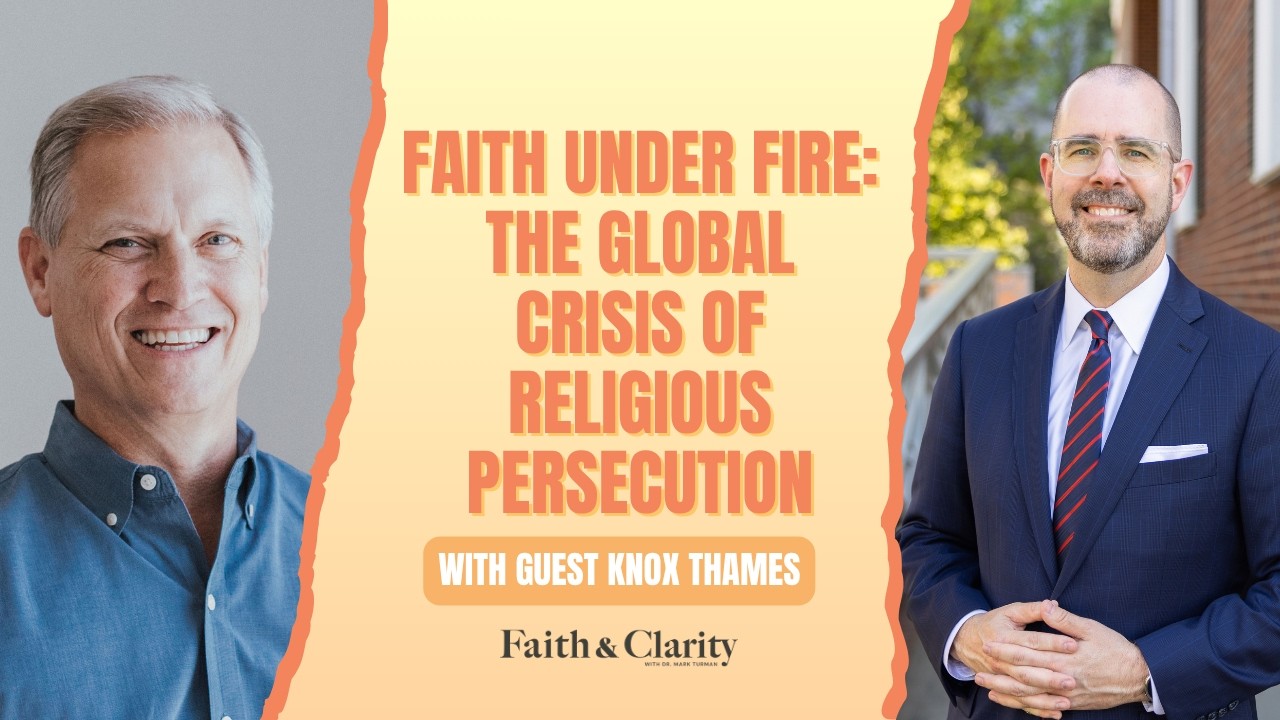
In this episode of Faith & Clarity, part of our America 250 series exploring faith's role in shaping the American story, Dr. Mark Turman sits down with Knox Thames, a human rights lawyer, former State Department special advisor under both Presidents Obama and Trump, and now executive director of the Everett Center for Global Religious Freedom at Dallas Baptist University, for a wide-ranging conversation on religious liberty and freedom of conscience. Knox draws on Acts 5 and America's founding legacy, including John Leland's influence on the First Amendment, to frame why religious freedom is both a biblical value and a cornerstone of democratic life. He explains why the global persecution of billions of believers demands the church's attention, and why Christians in particular should champion religious freedom for everyone, not just their own.
Knox outlines four types of persecution found around the world: authoritarian repression, extremist mob violence, democratic majoritarianism, and terrorism, and proposes a practical framework for response built on consistency, coalitions, call-outs, and consequences. The conversation also touches on moving advocacy stories from his years of frontline work, his own unexpected path into this calling, and the graphic novel Blood and Water, which tells the story of Pakistani martyr Shahbaz Bhatti. Listeners will come away with a deeper understanding of how prayer, church engagement, and thoughtful policy can together advance freedom of conscience across the globe.



Topics
(0:00) Introduction
(2:38) America's religious liberty roots
(5:34) Why persecution matters
(8:13) Good Samaritan framework
(11:02) Launching the Everett Center
(16:43) Confessional states today
(20:26) Pandemic of persecution
(27:56) Knox's personal calling
(36:10) Four faces of persecution
(41:18) Shahbaz Bhatti story
(49:33) Gen Z and calling
(54:09) Conclusion
Resources
- Everett Center for Global Religious Freedom
- Global Religious Freedom Gathering
- Ending Persecution: Charting the Path to Global Religious Freedom
- Blood & Water: The Life and Martyrdom of Shahbaz Bhatti
- Ask Us Anything: [email protected]
- Sign-up for a Denison Forum newsletter: DenisonForum.org/subscribe
About Knox Thames
Knox Thames is an international human rights lawyer and advocate who served under both the Obama and Trump administrations as the Special Advisor for Religious Minorities in the Near East and South/Central Asia. Since leaving the State Department, he has continued his mission through powerful storytelling—authoring the book Ending Persecution and producing the poignant graphic novel Blood & Water, which chronicles the life of Pakistani martyr Shahbaz Bhatti.
He currently serves as the inaugural Executive Director of the Everett Center for Global Religious Freedom at Dallas Baptist University.
About Dr. Mark Turman
Dr. Mark Turman serves as the Executive Director of Denison Forum, where he leads with a passion for equipping believers to navigate today’s complex culture with biblical truth. He is best known as the host of the Faith & Clarity podcast and the lead pastor of the Possum Kingdom Lake Chapel, the in-person congregation of Denison Ministries.
Dr. Turman is the coauthor of Sacred Sexuality: Reclaiming God’s Design and Who Am I? What the Bible Says About Identity and Why it Matters. He earned his undergraduate degree from Howard Payne University in Brownwood, Texas, and received his Master of Divinity degree from Southwestern Baptist Theological Seminary in Fort Worth. He later completed his Doctor of Ministry degree at George W. Truett Theological Seminary at Baylor University in Waco.
Before joining Denison Forum, Mark served as a pastor for thirty-five years, including twenty-five years as the founding pastor of Crosspoint Church in McKinney, Texas. Mark and his high school sweetheart, Judi, married in 1986. They are proud parents of two adult children and grandparents to three grandchildren.
About Denison Forum
Denison Forum exists to thoughtfully engage the issues of our day from a biblical perspective, helping believers discern today’s news and culture through the lens of faith. Led by Dr. Jim Denison and a team of contributing writers, we offer trusted insight through The Daily Article, a daily email newsletter and podcast, along with articles, podcasts, interviews, books, and other resources. Together, these form a growing ecosystem of Christ-centered content that equips readers to respond to current events not with fear or partisanship, but with clarity, conviction, and hope. To learn more visit DenisonForum.org.
All episodes are produced by Sound of a Rose. For more information, you can visit soundofarose.com.
EPISODE TRANSCRIPT
NOTE: This transcript was AI-generated and has not been fully edited.
Mark Turman: [00:00:01] From Denison Forum, this is Faith and Clarity. We want to equip you to find clarity in the chaos and hope beyond the headlines so that you can live by faith and not by fear. I'm Mark Turman, your host, and today we are talking about religious freedom, freedom of conscience, one of the most important aspects of our nation and of our faith. Let me uh tell you a couple of quick stories before I introduce my conversation partner today. Some of you will readily recognize the great story of Acts chapter 5, uh one of the early struggles of the new church uh as they contended with the established authority, religious authority and civil authority in this case in the city of Jerusalem. If you read Acts chapter 5, the last part of that is a struggle between these followers of Christ and the established authorities. Uh God was doing great things through the leaders, apostles especially. And part of that chapter says this, they were all, that is the Christians, they were all together in Solomon's colonnade. That's a part of the Jewish temple 2,000 years ago. It also says of them, no one dared join them. That's an interesting statement. But the next phrase says, the people spoke well of them and believers were added to the Lord in increasing numbers, multitudes of men and women. What a great experience that must have been. But then it says right after that that the religious leaders that were both uh both civil and spiritual leaders of the time became jealous of the apostles and this growing group. They took the leaders, Peter and others, threw them in jail, but then the Holy Spirit came and let them go and they went back out into the temple and started talking about Jesus again. So when they came to try to put them on trial the next day, there was nobody to try because they had all been released and it created all kinds of confusion. So they rearrested Peter and some of the other leaders, tried to put them on trial again and reminded them, we strictly ordered you not to teach in the name of Jesus. And then there's this very famous verse out of chapter 5 verse 29 where Peter and the other apostles said to the leaders, we must obey God rather than people. Well, the next thing that happens is there's a conversation among these authorities. They end up flogging Peter and the other leaders, which means they beat them with rods or whips. They turned them loose and it says in the very last verse, every day in the temple and in various homes, they continued teaching and proclaiming the good news that Jesus is the Messiah. That's story number one. That's one place of context. The other one is a story out of our own history as a country. Uh, we as a nation are celebrating 250 years of being a nation and one of the things that is a part of our story, perhaps the greatest contribution that America has made to making the world better over 250 years is the prioritizing of religious freedom. You know names and you're celebrating names this summer like Washington, Adams, Jefferson, Franklin, Hamilton and others. You ought also to add in names like John Leland. John Leland was a very popular Virginia minister, Baptist minister and worked in the colonial period as a diligent advocate for religious freedom. He even challenged James Madison at one point that he would run against him if Madison did not include security for religious freedom, not just tolerance, but freedom. And ultimately Madison agreed, wrote the Bill of Rights, including the first amendment that establishes that the government will not establish a religion of preference. Um, so what we understand from that story from John Leland and others is that the freedom to worship God or not worship at all is something that is according to the dictates of everyone's own conscience and that the true essence of faith is that it cannot be forced and it can never be stopped because it is the primary nature of the human soul. So we're going to talk about that today and my guest is Knox Thames and let me introduce him to you. Uh, he spent two decades at the intersection of high stakes foreign policy and personal struggle for human rights, including the the right to freedom of religion. Knox is an international human rights lawyer and advocate who has a unique distinction. He served under both the Obama and Trump administrations as special advisor for religious minorities in the Near East and South Central Asia. After leaving the State Department, he continued his mission uh in a unique way, powerful storytelling. He authored the book called Ending Persecution and also produced a graphic novel called Blood and Water, which chronicles the life of a martyr in Pakistan by the name of Shabbat Bati. We'll get to his story in just a minute. He was recently named the inaugural director, executive director of the Everett Center for Global Religious Freedom at Dallas Baptist University, one of the friends of our ministry is Dallas Baptist University. Uh, it is a great honor Knox to have you with us. I appreciate you taking the time for this conversation today.
Knox Thames: [05:17] That's my pleasure. Thanks for having me.
Mark Turman: [05:19] Well, we're glad to have you coming all the way from Virginia and outside of DC just a little bit, little bit. So let's jump in and uh have some conversation around uh what you've been working on for the better part of your life, I suppose. Um, but in your book, uh ending persecution, I caught this statement early on in the book, the defining question of the 21st century will be whether we can defeat the age-old scourge of religious persecution. Why do you start the book that way?
Knox Thames: [05:53] Well, religious persecution is a daily reality for millions, if not billions of people. And thankfully, those of us in the United States and the West, we don't experience it ourselves. And so the purpose of the book was to open up a window into the reality of religious persecution, but not just admire the problem, also put forward some ideas for what the United States can do, what people of goodwill can do to push back. Um, so I identified different types of persecution. It seems like a monolithic problem. Well, there's actually different uh, different ways people experience persecution in an authoritarian government, from terrorists, uh, in a democracy, by extremists. And I based on my 20 years of US government service, I put forward some ideas based on what I saw that worked, what didn't. Um, and to challenge America, to challenge the United States, challenge all of us to redouble ourselves to this that uh the Pew Research Center has found that roughly two out of three people on earth live in an environment where they're susceptible to religious persecution. So it's it's an astounding number. And if we're going to have a more peaceful, secure and prosperous world, it's in our interest and reflects our values that we do everything we can to ensure that people don't have to live in fear of discrimination or violence for what they believe or how they pray. And of course, the church is on the front lines of this. Uh, Christians face um, violence and hatred because of their allegiance to Jesus Christ every day. But they're also not alone. People from other faiths are also persecuted and I think it's it's a an American value, I think it's a Christian calling that we be a a voice for the voiceless and speak up. So that's why I was hoping the book would would spark a conversation around that.
Mark Turman: [07:43] Yeah, I think I think it's a really, really important idea. Um, I wonder if you'd expand this a little bit further from the standpoint of not just Christian faith, but all faith that uh, there is a calling, a biblical calling on our lives, not just that Christians would have religious freedom around the world, but all people of faith would have. Uh, sometimes I think Christians may lose that distinctive. Can you kind of frame that out a little bit for us?
Knox Thames: [08:12] No, it's a great question. And you know, this comes out of if we believe that freedom of conscience is a God-given right. If we believe that every person is of incalculable wealth, if we believe in human dignity that God has touched every human soul, then we need to be concerned about their well-being, whether they're our fellow believers or people outside our faith. Um, so I've really been taking inspiration over my career from the parable of the good Samaritan in Luke 10. And of course, you know, it's in the context of a lawyer trying to stump Jesus on what it takes to inherit eternal life. And he turns the story back on him and, you know, what does the law require? The lawyer knows this, love your Lord, your God with all your heart, soul, mind and strength and love your neighbor as yourself. Jesus says, do this and you will live. And so then the lawyer, you know, he was clearly embarrassed or felt um, like Jesus had kind of trumped him. He said, well, who's my neighbor? And that led Jesus to tell the parable. We all know the story, people outside of our faith know the story of a traveler beset upon by robbers, left for dead, two people from his community walk by on the other side, maybe they were afraid, maybe they were busy, we don't know, but they they they left him to die basically. And the hero of the story was a Samaritan. Now, one of the things I've discovered is in our 21st century years, we miss how what a huge twist in the story that was because at that time, Samaritans were viewed as the other, as religiously and ethnically different. Jews and Samaritans hated each other. You know, the disciples didn't want to walk through Samaria. And so to have the hero be a Samaritan, that's like finding out Darth Vader is Luke's dad or, you know, these sort of modern twists that just got the listener's attention. And it made a powerful point that, you know, we're to go and do likewise, to cross over lines of religion and faith to help someone in need. And so I think in the same way, we're called to speak up for those who are persecuted. Of course, our own, and I think the church doesn't do enough to remember our own. But I've seen time and time again when Christians are persecuted, others are persecuted too. And we should be standing up for them as well. Just like Christians feed anyone who's hungry, heal anyone who's sick, we should speak up for anyone who's facing religious persecution, not kind of out of some sort of all faiths lead to God. No, we can hold our truth claims, but we believe that we know that God loves them and God wants the best for them. And so how do we make a loving God real to someone who's outside of our faith and being persecuted by showing up and caring for them and advocating for them. And so that's the center at DBU that we've launched is is trying to make that case and live it out in how we at our research and our advocacy and our engagement with churches.
Mark Turman: [11:02] Yeah. Now, let's talk about that for a minute of uh, I I wonder in your own mind as you've helped stand up this center at Dallas Baptist University around religious freedom. Again, for everyone, global, it's important to call out that the center is described as the global center for religious freedom. Um, I I wonder if you're thinking that after a couple of decades in government work and the DC uh uh halls of power, uh, if you're thinking that uh now this center that's called to inspire and equip students and churches, um, how is that different? How is it maybe even more important than what you've done in the the halls of the government?
Knox Thames: [11:42] Yeah. Well, I mean, the way, you know, I could not have envisioned uh landing at DBU four years ago, certainly not 10 years ago. Our our founder and namesake, Randall Everett, he was our pastor here in Northern Virginia when my wife and I were newly wed some 25 years ago. And so just how God brought us back together and sort of shared this commitment to religious freedom for everyone as a Christian conviction, as an American value and just how this we we feel so blessed that God has allowed this to happen and invited us into this work and found this great partner with Dallas Baptist University. Um, so, you know, our our mission, we exist to inspire and equip students, churches and policy makers to advance religious freedom for all. Um, we're exclusively global. We don't look at the domestic issues. Um, and so we're we want to, you know, get students, the next generation excited and have their conscience pricked about, okay, what is happening beyond the United States? To have them have a global sense of the reality of persecution. We want churches to, you know, I I keep saying if the church became advocates for religious freedom for all, it would change the world. Like that is a sleeping giant. Um, again, for remembering our own, but remembering their neighbors and and speaking up, I think it could could change the world in ways we can't even comprehend. And then all of that leads to motivating policy makers here in Washington to leverage the power and influence of the United States to be a voice for the voiceless. And I've seen over my 28 years here in DC, interest in this topic fade because politicians don't hear from their constituents that it matters to them. And at the end of the day, unless there's a few that have a personal passion, but um, this this working with students, churches and policy makers, we think can be a virtuous cycle that can can just really uh, shake the the chains of oppression and and see people have the ability to pursue truth as their conscience leads. And we know in an environment of religious freedom, that's where the church is going to thrive. Um, you know, people have said, well, isn't this helping other faiths or are we advancing a different belief? And and look, I if we if we have confidence in the truth of Jesus Christ, we know that in an environment where everyone has religious freedom, that truth is going to shine and that's an environment where the church is going to thrive and grow. Um, and so we we help our our neighbor inside or outside of our faith by speaking up for them. We help the future of the church by creating an environment where the the fields are ready to receive the seed of the gospel. Um, and so I think this center, we feel like this is the time that God has placed us to do this work and we're excited about it. We're honored by it. We're terrified by it. And we're really prayerfully hopeful that, you know, we can we can move the needle and put some points on the board on this important issue.
Mark Turman: [14:51] Well, and it just it just strikes me and it sounds like that when you start trying to name human rights, that the the right of religious freedom would be at the lead, right? Um, and we we see some of those named obviously in our founding documents, inalienable rights, but we also have the sense that, you know, every everybody, every human being has the right to be in a safe environment, to have food and shelter and health care. Uh, but among all of these various fundamental human rights would be the right of religious liberty. Um, and that they those those human rights should not be played against each other, right? Of I'll give you food and shelter if you promise to worship my God. We they should not be leveraged against each other. Right. Um, which kind of takes me back to one of the things I've learned just doing a deep dive over these recent months heading into uh this celebration that we're going to have in a couple of weeks around our 250th anniversary is that there was this struggle of religious liberty in our early founding. Uh, these or these early colonists came and they set up 13 very different colonies with very different faiths in many ways. They were essentially Christian, but they were very different denominations, Quakers, uh, Presbyterians, Baptists, uh, other forms, uh, and in some ways they viewed each other with a a level of suspicion for sure. Um, but Knox, I I noticed in just studying this that there was kind of a tension between those in the colonial period that were like trying to protect the faith or the church from the influence of the government or from the overreach of the government. And then there were some others who were trying to protect the government from the overreach of the church or the religious groups. Um, that's part of our story, that's part of our history. Have you seen that dynamic played out on a global stage as well?
Knox Thames: [16:48] Absolutely. You know, this idea of a confessional state, like to be a citizen of a country means you are a member of this faith is was the only um, the only approach to governance in the 1700s. Like that that was the only model that existed and that what made our model so radical that we actually were saying we're not establishing an official faith, we're giving freedom to all our citizens to explore faith as they wish and we're protecting that right of exploration. Um, but we see that playing out today, be it in um, sort of Hindu nationalism in India, this rise of this far right Hinduism that's victimizing Christians, but also Muslims. We see this in Sri Lanka with a militant Buddhist nationalism that's again targeting Christians, Muslims and Hindus there. Um, we see it in Russia with like this Russian Orthodox nationalism where you literally had police priests blessing tanks before they invaded Ukraine as some sort of holy war. And of course, you see Islamic nationalism throughout the Arab world where to, you know, to be Saudi is to be a Sunni Muslim. Um, and it creates incredible problems. It leads to human rights violations because when when state and faith is fused, then it puts government officials in the position of determining what is ultimate truth. And being a former government official, that is not a place where we want government officials to be. I can tell you that. It's not what they're good at, right? It's not what they're good at. Um, and I I keep going back to the experience, you know, as you mentioned, I live in Northern Virginia and the Thomas Jefferson's role in writing the Virginia statute for religious freedom, which was the sort of precursor to the first amendment. It was because of the Anglican church was established in the in the colony. They were persecuting the Baptists because they didn't want to pay the tax to that goes to the Anglican church. They disagreed with infant baptism. The the Anglicans didn't like their tent revivals and sheep stealing. And it was John Leland writing um, Jefferson and Madison saying, you know, this isn't right. And the the first sentence of the Virginia statute is just a beautiful, powerful statement that says, Almighty God hath created the mind free. And then it's just explains why um, you know, secular leaders are not equipped to deal with these theological, spiritual questions and it's inappropriate and it just it created that separation that allowed faith to flow and I think is one of the when I was a diplomat, I would meet with other countries. I would say, look at how how energetic and entrepreneurial America is. It's because we created this space for freedom of thought, freedom of religion, freedom of belief. Like you can you have this space to explore and ask and um, and go places where, you know, political and religious establishments usually don't want people to go, but that's what leads to innovation and new ideas and breakthroughs and gives us this vitality that's very few other countries have have been able to harness like we have.
Mark Turman: [20:03] Yeah. Well, it just seems to me that it just raises that idea that every person is made in the image of God and is therefore worthy of our respect and uh and should be protected from violence, especially violence that's motivated by some kind of a religious idea, uh coming from anywhere. Um, and and that that's fundamental to the way all Christians should live. Um, Knox, you've used um at times the term a pandemic of persecution. You've talked about that a little bit already. Um, but uh and and you talk about in the confines of of politics and government, you know, the government has a lot of things to try to uh deal with and often politicians are their attention is drawn by what their constituents are saying or not saying. Uh, but in my mind, you know, I'm thinking about I've had the opportunity to travel to Cuba, which is probably the place of greatest uh religious persecution that I've ever visited. Uh, I remember not too long ago, uh there was attention around the Weers uh and the the situation, the persecution that they've had more recently. Uh, it's been stories about Nigeria. Um, uh one of the reasons I wanted to have this conversation with you and create a podcast around this was because not only our heritage as a country around this, um, but the need to draw more attention to it. Uh, talk a little bit more about how you would want and envision believers and churches and maybe even denominations becoming more focused on this issue.
Knox Thames: [21:39] Um, I think first just to educate themselves so that they are aware of what's happening in Cuba or Nicaragua is the other in our hemisphere, the two worst places for religious persecution. Um, what's happening in China to the Weer Muslim community, but also Christians and Buddhists. Um, and you know, perhaps with missionaries, there's a connection to a particular region or a country, like to really have the church be educated about those dynamics. And that leads to prayer. Like, okay, what are we, how do we, what are we asking God to do? And you know, this is something I always have to remind myself like I have access to the God of the universe and he wants us to to approach him with requests and I need to take advantage of that. Like, uh, and I sadly don't enough. But how are we building the the practices of prayer for these situations of persecution, both for our own and for others. And then that's leading us to use our voice here in the United States. Um, where we have access, we can approach our representatives, our senators, the president himself and have our voices be heard. So before President Trump visited China, we did a campaign called the two empty chairs campaign. And we talked about there are two empty chairs in two households of two men who have been jailed for their faith. One is Pastor Ezra Jen, who led a very large underground church and he's been arrested, charged with sedition. His family hasn't seen him for months and uh, we need to pray for him. But we also highlighted a Weer Muslim scholar named Ilham Toti, who has been jailed for 10 years. Um, he and his daughter were actually in route to fly to the University of Indiana, Bloomington, where he was going to be a guest lecturer. He was pulled off the plane and he told his daughter who didn't speak a lick of English at the time, go on to America. And so she flew by herself, claimed asylum, has since learned English, graduated from Indiana as an advocate for her dad. And um, we wanted to remind Christians of these two empty chairs to pray for these men, pray for their release. And then we said there's an opportunity if you want to go to the next step, you can sign our letter to President Trump urging him to request Chairman Xi release these two gentlemen and to express concern about the overall climate for religious freedom in the country. China is one of the worst. No. Um, so I was really happy to hear that President Trump raised Pastor Jen. Um, don't believe he raised uh Ilham Toti uh and both of them still in jail. So, you know, this work is is going to take a long time. It takes a lot of steadfast commitment of prayer and advocacy. Um, and so these are the kind of muscles we want to develop with churches and praying people that to approach God with these requests and approach your elected leaders to make sure they know we care about this. And I've seen that's a powerful combination. Um, and you know, the the first prisoner case I ever worked on 25 years ago was in the former Soviet Republic of Turkmenistan and there was a Baptist pastor who had been wrongly jailed. I was a young analyst right out of law school. I got the information. I was working at a special government commission. There was a congressman who cared. I briefed the congressman. He called in their ambassador and read him the riot act and like kicked over a trash can and because an American congressman was mad about this what this little country had done with this pastor, two weeks later, he was freed and he's been freed ever since. And that was a really powerful lesson to a a young, fresh law school grad of, you know, actual information given to policy makers who care to leverage our our great influence for good can see people freed and oppressive systems change. Now, China is the most difficult of them all. No. But again, I think we'll be blessed as a country if we're using the gifts of liberty and prosperity that we've been blessed with to advocate for others. That's going to be a good thing for us to be doing.
Mark Turman: [25:59] Yeah, I just it just strikes me Knox that when you tell stories like that, you know, we hear politicians all the time from Ronald Reagan and many others talking about America being a city on a hill, right? Well, this is this is what the real uh, you know, rubber meets the road kind of experience of being a light on a hill is when you can look at your daughter and say, go on to America without me because there's hope and opportunity and the possibility of of recovery, redemption in that, right? Yeah. Um, and and that's the way historically we have been seen and I would think we would want to continue to be seen uh as influencing the world in that way that we would advocate for these kinds of things. The very fact that you had to say about Pastor Jen that his church was an underground church. It shouldn't ever have to be described that way, right? Amen. And and to be able to bring focus to that, you know. This is when in this competition with China, you know, the world knows the United States is for individual liberty and the world knows the Chinese Communist Party is not. The world knows we're for human rights and religious freedom. The world knows the Chinese Communist Party is not. And so if we're in this real true competition for influence and ideas, you know, doing the right thing is always the right thing to do and it's got the other benefit of like it draws people to us that we want to influence, that we want to be in partnership with. Um, and so I think it's, you know, having our a religious freedom I've always said is where American values and American interests truly meet. Like it's in our interest to see China not persecute its own people, to have an open society because then they're not going to be a global competitor, they're not going to be funding oppositional efforts and it reflects our values of religious freedom for all that we're pushing for this, that we want people to be able to, like I've said, live free of any fear of discrimination or violence for just simply how they pray.
Mark Turman: [27:55] Yeah, absolutely. All right, well, before we take a quick break, I wanted to just ask if you would share a little bit of your story about how did you get involved in this? Where did where did this come from for you personally that this would be the ministry that you give yourself to?
Knox Thames: [28:11] I mean, it's God's Providence. Um, I grew up in Kentucky. Um, I have looked at the census data from the 80s when I was young and Kentucky was like the second most homogeneous state in the country next to like Vermont. Like there just wasn't a lot of diversity. But my parents were teachers at a local state university and they would always make a point to bring in an exchange student from Thailand or a professor who was from Iran. And I and so it always kind of had an interest in the in the world beyond Central Kentucky. Um, went to a little Baptist school, Georgetown College there. Um, traveled to Poland one summer that again kind of grew the interest in international affairs. But what was really life altering was I moved to Atlanta to help resettle refugees with World Relief. Um, and as part of an Americorps program, domestic peace core. And there for the first time, I had friends from other countries and other faiths who had suffered incredibly, incredibly horrible things for how they looked or how they voted or how they prayed. And it did pose that tough question about like, why do bad things happen to good people? Yeah. And I kind of came out of it with this sense of like, well, I've been blessed with all these freedoms. I've been blessed with the knowledge of Jesus Christ. I should lend myself to these efforts. Um, and felt like that was where God was calling me. So then I pursued law school, moved up to DC. Um, and not thinking to do religious freedom, but then uh a job opened up at a place I had interned because the religious freedom uh director had passed away suddenly. And I've just been doing it for a quarter of a century now, which is hard to believe. Um, because it's relevant everywhere. Uh, some type of, you know, issues of religion and state are being grappled with in Europe, extreme persecution around the world. Um, and it aligns with my values of this, I believe this is a God-given right. I believe people should have the freedom to pursue, hopefully him, but the freedom to choose other things. Um, and the world is a better place when these rights are respected. Uh, I I think, you know, religious freedom goes to the soul of the individual person, it goes to the soul of the human rights system because so many other things spring from it. And so it's just been a great honor and a privilege to be able to work in this and to know people like uh Shahbaz Bati who we'll talk about who really gave their all towards it. And it challenges us to think about, okay, how do we carry on his work and the work of others who are on the front lines of this important issue.
Mark Turman: [30:57] Yeah, it's just when you look back after a couple of decades, it's just amazing how God leads you one door at a time. One one conversation, person, door, opportunity, right? That's absolutely right. Yeah. Well, we're going to take a quick break and then we'll be right back. See you in a moment. Thank you for being a part of Faith and Clarity. You're choosing to slow down, think deeply, and engage the headlines through the lens of scripture. And that matters more than ever because in a culture full of noise, Christians need more than quick reactions. We need biblical clarity, thoughtful engagement, and the wisdom to live out our faith in everyday life. That's the mission behind Faith and Clarity and the work of Denison Forum. Right now, we're working toward an $800,000 summer goal to expand that mission and reach more people with truth. Give now at supportdf.org. Again, that's supportdf.org. Find a link to give in today's episode notes. Because when believers are equipped with truth, they don't just understand the culture, they engage it with clarity, compassion, and conviction. All right, we're talking today about religious freedom with Knox Thames and continuing our conversation. Knox, you had uh one of the unique opportunities to serve both in a democratic and a Republican administration to serve under the Obama administration and then under Trump uh in his first term and to not be in that small group of people who bridged both of those. Uh, very political, uh very polarized environment in our country these days. Maybe it's always been this way, but it seems worse in some ways. But when you're working on big core uh important issues like religious freedom, why is neutrality and being non-partisan critical to the success of what you're trying to do?
Knox Thames: [33:04] Well, that was, you know, when I came to Washington was to study international human rights law and to do human rights work. So, you know, many friends are drawn here for the politics and I made an early decision, I'm here to do human rights work. And so I want to work with people right, left and center who care about the issue the way that I care about it. Um, it's hard and it's increasingly hard to have that non-partisan approach to the work, but I think it's really important because you need both conservatives and progressives, Republicans and Democrats to care about religious freedom and care about religious persecution. And one of the things I was very proud of um, when I was working in the Obama administration and then the Trump administration asked me to stay was we were advocating for this American value that people shouldn't be harmed for what they believe. And while our domestic debate is incredibly fraught and partisan, the fact that the issues internationally are often like literally life and death. Like it really clarifies that this this isn't about these nuanced debates we're having here. Um, this is about should people are being murdered for what they believe. They're being tortured for what they believe. They're being jailed and disappeared for their part of the wrong faith group. And everybody thinks that's wrong. And so it's encouraging that at our time of a great divisiveness, there is still a consensus that agrees like, yeah, this is wrong and we should speak up about it. Um, and so we were able to, I was able to have great partnerships in the Obama administration and then when the Trump administration to find ways to advance this, um, separate from the politics. And one of the most encouraging moments was we we launched a couple of summits during the Trump administration focused on international religious freedom. Sam Brownback, former senator and governor of Kansas, he was the religious freedom ambassador. He had this great idea at the first summit to have uh Nancy Pelosi come into the State Department and sit down with Congressman Frank Wolf, a Republican from Virginia, who was the father of the the law that created the special offices at the State Department. Talk about, okay, how do we as Americans push back against the persecution of different faith groups in China? And just to see like a staunch Republican and a staunch Democrat come together and say, yeah, we need to we need to work on this. And they they come at it from sort of different motivations, but they agree that it's something the United States should stand for. It was a really powerful, encouraging moment, you know, in an environment of that's often not encouraging. Um, and so I I keep going back to that. Like when Americans are aware of the situation abroad, because a lot of times, you know, people just normal people aren't aware of what's happening in Sudan or China and why should they? But once they see how different the environment is, there's sort of this natural reaction like, yeah, we should we should respond in some way, at least in prayer and maybe even as a national policy.
Mark Turman: [36:10] Well, and you know, such an encouraging story just to know that we can across political spectrum have a consensus uh approach because like you said, this work is it's slow, it's long, it's hard, especially on a global stage. And so it needs to transcend administrations, right? Right. It it needs to be something that we're continually putting attention and pressure on uh at a lot of levels and being able to do that with a consistent ongoing voice through the government being one part of that is so encouraging and important to be able to say, okay, we do agree about this. We may not agree about a lot of things at home, we may not agree about all the methods of contending for religious freedom around the world, but we agree we should be. Yes. Um, because it's such an important, it's at the it's the wellspring out of which people live and and out of which they flourish. Uh, earlier in our conversation, you mentioned, uh, your book talks about this, uh, you've talked about it in other context that persecution is not monolithic, that it looks a lot of different ways in a lot of different parts of the world. Uh, your book actually outlines four different kinds that each each of these requires a different kind of response, I would assume, but can you kind of frame that out so that we have a better understanding of when we talk about religious persecution, we're not just, you know, there's not just a soldier standing at the front of a building keeping people from going in to worship. Yeah. Uh, it can look like that, but it looks a lot of other ways too.
Knox Thames: [37:43] Well, you have these meta statistics like I shared from the Pew forum about, you know, two out of three people on earth live in an environment where they're susceptible to persecution. And it's that's an overwhelming, mind-boggling number. But what I was trying to do is break it down into more specific types because if we're going to come up with a solution, we need specific answers. You know, aspirin's not going to cure cancer, right? So we need to understand the challenge. So the first type is authoritarian persecution. This is where the power of the state is brought to bear against a religious group that's deemed impermissible or dangerous. And the examples I look to in the book are China and Burma, where you see like literal genocide happening against the Weer Muslim community in China, the Rohingya Muslim community in Burma, and the whole power of the state is brought to bear. The second type of persecution I highlight is by extremists. So this is where, this is sort of the opposite. This is where non-state actors, people in society will rally a mob to go burn down a church or a village, um, out of because of some perceived religious transgression. And I talk a lot about Pakistan, country I visited more than any other, about what that looks like there, as well as Sri Lanka, where you have, uh, you know, Buddhist extremism victimizing Christians and Muslims. The third type is, uh, persecution in a democracy. And this is where, you know, a large religious community uses its numerical superiority to transform its beliefs into law through the ballot box, through a democratic process with then severe implications for religious minorities. So I talk about the world's largest democracy, India, and how the the party of Narendra Modi, the BJP, has had incredible success transforming what was sort of a secular India into a a far right Hindu environment that has led to churches being closed, Muslims being lynched. Um, and uh, the fourth type is terrorists. That's ISIS, Boko Haram, where these groups use extreme violence to try to force a society to behave or pray or believe in a certain way. So I talk about Iraq and Afghanistan, two countries I spent a lot of time focusing on when I was at the State Department and how we tried to help religious minorities in Iraq who had suffered the ISIS onslaught like Christians and Yazidis, pick up the pieces after that devastation and feel like they had a future in their ancestral homeland. And so with each of those types, I also had some ideas, different way, I had the four Cs as a way to frame a response that we need, um, be consistent, have coalitions, call outs and consequences. So we're consistent. It's religious freedom for everybody. Yes, we care about our own, that's natural, that's good, but if we as a nation advance religious freedom for all. Um, we do it in coalition. So right, left and center, all faiths and none, uh, United States is the indispensable nation, but we shouldn't do it by ourselves. Um, we should build alliances. Have call outs. So, you know, when a country persecutes, highlight it. You know, China doesn't like it when we highlight that they persecute people. India doesn't like it. And that can see the needle change. And lastly, consequences. If we say religious freedom matters, then our bilateral relationship shouldn't stay the same if they're a severe persecutor of religious groups. And so we can leverage our great influence to create consequences which can change the calculus of an authoritarian despot to hopefully cease the persecution that's happening.
Mark Turman: [41:36] Yeah. Well, and it's, you know, from other parts of our conversation and some of what I've seen you write, that it can be call out, right? Call out relative to an individual, like a pastor, like uh in the case of of Pastor Jin, uh but also can be a group like the Weers. Um, and then, you know, as it relates to consequences, the way the way nations put pressure on each other, right? It it has economic realities and military realities, but there can also be human rights realities and and all of those things ought to be on the table, especially when there are great abuses going on. Um, but uh let's talk about uh Pakistan. We've had uh even on our podcast, the opportunity to learn more over the last year or so about Pakistan and some of the things that God is doing in Pakistan. A lot of Americans just, you know, I think if something comes up on the news related to Pakistan, Afghanistan, that part of the world, we just want to tune it out. Yeah. Um, as such a uh seemingly chaotic and in many ways hopeless environment to us. Um, but you had a friend, Shahbaz Bati, uh a Pakistani leader. Uh, tell us a little bit just I don't want you to give away uh all the story of Blood and Water, but tell us a little bit about his story and why did you choose to write a novel about what happened to him?
Knox Thames: [43:03] Yeah. So Shahbaz Bati was a uh Pakistani Christian who was a religious freedom advocate, um, willing to risk his life to advocate for those who have been victimized by their blasphemy law, who have been victimized by their oppressive system, both Christians and non-Christians. Uh, he was a friend of mine. I got to know him uh and I would help him connect with policy makers here in Washington when he would visit. I would meet with him when I would make my diplomatic trips to Pakistan. And he was making a difference out of his and he was he knew that there were risks to this. He was getting death threats from the Pakistani Taliban and he was fearless. He was unwilling to stop advocating for religious freedom, for persecuted Christians and Hindus and Sikhs. And it cost his life. Uh, it was 15 years ago on March 2nd that uh he was killed outside his mother's home because of his advocacy. And uh, in the intervening years, I got to know his family. His brother lives up in Toronto, who's trying to carry on the ministry from there. And I just wanted to honor my fallen friend and create a uh comic book, basically, a graphic novel that tells his story in a way that's accessible to the next generation. And it's not intended to be a tombstone, but rather a a challenge, a passing of the baton uh to learn about his courage, his dedication to Christ and ask us who remain, what are we going to do? How are we going to carry on his work so that people in Pakistan and elsewhere need not suffer. Um, so we were able to, thanks to the Timbleton Religion Trust, to hire a uh a former Air Force colonel who's a believer, but also uh had written comic books for Marvel as a hobby. He'd written Avengers and Wolverine. Great guy. What a thought. Yeah, I know. And this is another God thing. So we got connected to him. He found an artist who's a professor at Lee University outside of Chattanooga, who'd never been to Pakistan, but was a fabulous artist and really just studied Pakistani culture to get the vibe. He had a connection with Ignatius Press, a Catholic press out of Chicago. Shahbaz was a Catholic. And um, it was just released about a month and a half ago. And I'm really proud of the story it tells of Shahbaz's courage, his faithfulness to Christ. There's sort of three chapters in the book and each chapter begins with a a scene of Christ's ministry and kind of saying this is a piece of how it inspired Shahbaz in this phase of his life. Right. Um, and and one of the, you know, very small survey group, I have two teenage boys, one just finished his freshman year in college, the other's a junior in high school. They don't read anything that I write and I write a lot of stuff. I posted on Instagram a picture of the cover. They immediately messaged me saying, can I get a copy? So like this is sort of the on ramp for young people, right? That it's a medium that they can pick up casually, but has a very deep message and a and a challenging message. Um, and so as we're thinking with the center, how do we create on ramps for young people to get involved, this this comic book, this graphic novel is going to be a I think a really useful tool in that.
Mark Turman: [46:27] Yeah, what a great um, creative way, innovative way to try to bring that in. Uh, in the few minutes that we have left, Knox, let's let's try to focus in on those kinds of things, the the practical ways of what Christians like you and I, our churches, uh, what can we be doing? You're standing up this center uh to work on these issues. Uh, I'm thinking right now again about things like Nigeria, uh, where people are are today facing possibly the loss of their freedom or the loss of their life because of what they believe. Um, what kinds of specific things, um, can the center that you're leading do? What kind of things can a church do when it comes to, you know, most of us think, well, I I don't know how I would ever get a message to the Secretary of State, maybe even to my congressman. Um, how could I get my pastor or the denomination that we're engaged in? How do we get them to mobilize around this? Uh, what would be some of your suggestions for that individual Christian or a church that's thinking we want to be a part of this?
Knox Thames: [47:36] Well, our our website, um, at dbu.edu, you can find the Center for Global Religious Freedom. We're going to have, we're building it out now, we're going to have resources. We've developed a Bible study and a facilitator's guide to help Christians think about our obligation as Christ followers to speak up for those who are suffering religious persecution. We're going to have, you know, quarterly prayer and advocacy campaigns like we did on China to provide opportunities for people who are very far away from Washington DC to know of moments where focused prayer is needed and moments when focused advocacy is needed. And that can just be as simple as, you know, signing your name and we can convey that through our office here to the policy makers. And then we're going to have a conference on September 28th and 29th at DBU, the Global Religious Freedom Gathering where we're going to bring Christians of all denominations together to think about, okay, what do we do to advocate for all? And we're very excited. Jim Denson is going to be one of our speakers. Our founder, Dr. Denson, yep. Help us think through our that responsibility. Um, but we'll also have um, survivors of persecution speak, Christians, and we'll have a chance to pray for them. But we'll also have non-Christians. And uh last year we had a Weer Muslim, uh the daughter of Ilham Toti who I mentioned. And she spoke via Zoom and it was on her dad's birthday. Oh wow. And she shared about, you know, she hadn't seen her dad in 10 years and I said, you her, we want to we want to pray for him. Um, you're welcome to stay if you're comfortable, you don't have to. And and she said she would love to hear Christians praying that her dad would be released. Wow. Now, of course, we hope they would join our fellowship, but that wasn't the time for that prayer. It's just a prayer that God would be with Ilham Toti, that he would set him free and to show her that we cared. Um, so we're going to have another opportunity to do that in September as well. So this is not easy work. This is not the quick win microwave kind of opportunity. Um, but it's something that we've we know with steadfast engagement and prayer and using our voices, we can see people set free, we can see oppressive systems change. And um, we can we can go and do likewise to those neighbors that we don't know.
Mark Turman: [49:58] Yeah, and it's seems to be, you know, after pastoring churches for 40 years, it just seems to be that uh God is playing a long game and the best fruit, the the best fruit that gets developed is fruit that develops over a long period of time. Yes, that's right. And um, it's it's why I tell people that most pastors love to wash their own car, mow their own grass so that they can feel like they made a difference in the world on those days because there's a lot of times you're just not sure if you're if you're really moving the needle at all. Um, Knox, I was wondering, you you've spent a a fair amount of time, you'll be spending more time around college students, around young adults, people in this wonderful season of life. Uh, we're celebrating that in the last few weeks of people graduating from high school, heading off to college. Uh, what is the tone or the feel that you're getting from the emerging generation, we call Gen Z? Uh, do they care about this issue? Do they seem hopeful about life and about opportunities to make a difference? Uh, what vibe are you picking up from them around this and around things like this?
Knox Thames: [51:04] I think a lot of them are mission driven. Like they're they're causes are something they gravitate towards. I think for this specific issue, the domestic debates have been offputting for many because they're so partisan and they're on these sort of fine-tuned issues like, you know, cake bakers and like things that Right. I pray for the day that that's the debate the Pakistan's having. Um, so I think once they become aware of like the global environment and how exceptional the United States is. I often tell young people like, we're not perfect, but you should understand a bad day in America beats a good day in just about anywhere else in the world. And you should thank God that you live in the United States of America in the 21st century. Um, and then I think it's that challenge of how do we leverage that as kingdom citizens, as good stewards, stewards of what God's given us to help others and to expand the kingdom. And I think that's an attractive message and it's just now we're we're working to create those opportunities so that initial interest, there can be a pathway that leads them into this work. And I think being based at a great school like Dallas Baptist is going to really position us well to explore that and and see what God has in store.
Mark Turman: [52:19] Yeah. Well, we'll absolutely uh put in the show notes uh information about the center, also about the conference coming up, uh other links that people can get to to get uh more information about this. Knox, I'm wondering, uh, uh when this podcast publishes, we'll be a few weeks out from July 4th. Um, how will you be thinking about America's religious liberty legacy and opportunity? It I'd have to say it's still an aspirational value, uh, as most of our values are, not only for us, but also for the world. Uh, and part of what your perspective, what I've gained today is that, uh, you know, not only is it biblical, which is fundamental to calling us to action in and of itself, but when you see what other people experience in terms of persecution and oppression for their beliefs, it does remind you that, hey, if it can happen there, it can happen anywhere. It really can happen in America. Uh, and we never know how things could change. Um, how would you want to leave a message with our audience today about, hey, when you're celebrating what America is and what America does and what America seeks to do, how would you want them to think about religious liberty for the next 50 years and in and from America?
Knox Thames: [53:43] I think just to have an appreciation for how exceptional the American experience is when it comes to faith freedom. Um, because of the tensions between, you know, from the from the founding generation 250 years ago, different threads of Christianity, Anglican, Baptist, Quaker, Puritan, Catholic, you know, that tension actually led us to create this system where we all have the space to pursue truth. We have this freedom to do that and there's not a government official telling me, here's how you should pray, here's how you should believe, you're going to be penalized if you don't. And that is truly exceptional. Um, this is not the norm in human history. And so to appreciate that and to appreciate how precious it is, how we need to continue to preserve this space, um, not to draw false equivalences with our domestic debates with the extreme persecution we see in places like China and Saudi Arabia and Pakistan. Um, and then think about, okay, how do we steward this at home but also abroad because the United States is a force for good and when we show up, good things happen. Um, and it's a great reflection of who we are as a people.
Mark Turman: [55:02] Yeah, absolutely. Good word. Knox, thank you for what you're doing and thank you for being a part of our conversation today. We hope you'll come back and talk with us some more about your work, especially as you continue to build out the center. Uh, and look forward to those opportunities as we go down the road together. Thank you for being here.
Knox Thames: [55:19] Thank you so much.
Mark Turman: [55:21] Want to thank our audience as well for tuning in today. If this podcast has been helpful to you, we pray that you would rate and review us and share it with other people as uh you move forward. Want to also thank our team, Alex Candradov and uh Aubrey Kerr, who help us on the production side and also our friends at Sound of a Rose. You can visit them at soundofarose.com and you can of course find more information about these kinds of issues at denisonforum.org and we'll see you next time on Faith and Clarity. God bless you.









 Search