


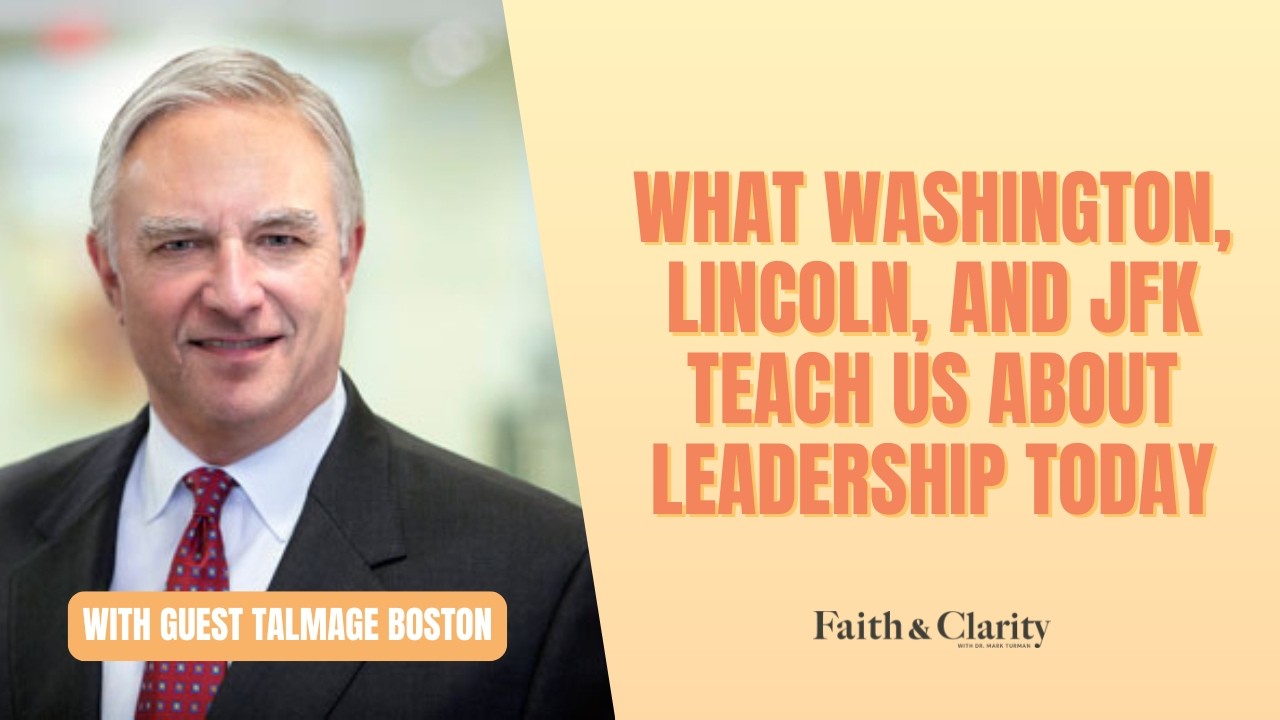
In this episode of Faith & Clarity, Dr. Mark Turman is joined by author and attorney Talmage Boston for a conversation on leadership, history, and faith, drawing on Talmage's book How the Best Did It, which examines eight of America's top-ranked presidents based largely on C-SPAN historian polls. Talmage explains why he studies history not just for facts, but for wisdom, and how that approach makes the leadership lessons of past presidents surprisingly relevant for today's challenges. He and Mark dig into George Washington's singular legacy as the unanimous choice for four nation-shaping roles, exploring his gift for unifying collaboration, his humility, and his quiet but steady faith, while also acknowledging the hard complexities of his relationship to slavery.
The conversation then turns to Abraham Lincoln, whose unmatched breadth of leadership traits—magnanimity, equanimity, and resilience—were shaped by a difficult marriage, profound personal loss, and a faith that deepened over time, culminating in the haunting humility of his second inaugural address. They close with a look at John F. Kennedy, tracing his growth as a leader after the failure at the Bay of Pigs, his steady crisis leadership during the Cuban Missile Crisis, his moral framing of the civil rights movement, and the unique pressures of leading in a new media age as the nation's first Catholic president. Talmage ends with a call for listeners to lead with integrity and pursue bridge-building in an age of deep polarization.



Topics
(0:00) Introduction
(4:34) Early leadership fascination
(9:11) Why leadership matters
(12:58) Washington leadership traits
(19:52) Washington slavery tension
(24:30) Washington faith influence
(26:48) Lincoln genius and humility
(30:13) New Lincoln book honesty
(47:21) JFK learning curve
(54:23) Celebrity presidency era
(57:11) First Catholic president
(1:00:04) Choosing leaders today
(1:04:35) Conclusion
Resources
- Talmage Boston
- Ask Us Anything: [email protected]
- Sign-up for a Denison Forum newsletter: DenisonForum.org/subscribe
About Talmage Boston
Talmage Boston has spent the last 48 years balancing two high-profile careers: one of Dallas's top commercial litigators and an acclaimed author of books on baseball, law, and the American presidency. A partner at Shackelford, Bowen, McKinley & Norton, LLP, he has been board certified in Civil Trial Law and Civil Appellate Law by the Texas Board of Legal Specialization, and has prevailed in trials and appellate courts throughout Texas, including the Texas Supreme Court and the U.S. Court of Appeals for the Fifth Circuit. He has been named a Texas Super Lawyer every year since 2003 and listed among the Best Lawyers in America every year since 2013.
Boston's unique footing in both law and history made him uniquely qualified to write his latest book, How the Best Did It: Leadership Lessons From Our Top Presidents, which draws leadership lessons from America's greatest presidents and applies them to leaders today. His other acclaimed books include Cross-Examining History (foreword by Ken Burns), Raising the Bar (foreword by former U.S. Attorney General Dick Thornburgh), Baseball and the Baby Boomer (foreword by Frank Deford), and 1939: Baseball's Tipping Point (foreword by John Grisham). He received both his undergraduate and law degrees from the University of Texas at Austin.
About Dr. Mark Turman
Dr. Mark Turman serves as the Executive Director of Denison Forum, where he leads with a passion for equipping believers to navigate today’s complex culture with biblical truth. He is best known as the host of the Faith & Clarity podcast and the lead pastor of the Possum Kingdom Lake Chapel, the in-person congregation of Denison Ministries.
Dr. Turman is the coauthor of Sacred Sexuality: Reclaiming God’s Design and Who Am I? What the Bible Says About Identity and Why it Matters. He earned his undergraduate degree from Howard Payne University in Brownwood, Texas, and received his Master of Divinity degree from Southwestern Baptist Theological Seminary in Fort Worth. He later completed his Doctor of Ministry degree at George W. Truett Theological Seminary at Baylor University in Waco.
Before joining Denison Forum, Mark served as a pastor for thirty-five years, including twenty-five years as the founding pastor of Crosspoint Church in McKinney, Texas. Mark and his high school sweetheart, Judi, married in 1986. They are proud parents of two adult children and grandparents to three grandchildren.
About Denison Forum
Denison Forum exists to thoughtfully engage the issues of our day from a biblical perspective, helping believers discern today’s news and culture through the lens of faith. Led by Dr. Jim Denison and a team of contributing writers, we offer trusted insight through The Daily Article, a daily email newsletter and podcast, along with articles, podcasts, interviews, books, and other resources. Together, these form a growing ecosystem of Christ-centered content that equips readers to respond to current events not with fear or partisanship, but with clarity, conviction, and hope. To learn more visit DenisonForum.org.
All episodes are produced by Sound of a Rose. For more information, you can visit soundofarose.com.
EPISODE TRANSCRIPT
NOTE: This transcript was AI-generated and has not been fully edited.
Speaker 1: [00:00:01] Faith and Clarity is brought to you by Denison Forum, a 501(c)(3) nonprofit ministry committed to helping people think through today's hardest questions with biblical clarity. Denison Forum is a non-partisan organization and does not engage in political campaign activities on behalf of or in opposition to any candidate for public office. The views expressed by guests on this podcast are their own and do not necessarily represent the positions of Denison Forum.
Mark Turman: [00:00:36] I'm Mark Turman and you're listening to Faith and Clarity. We're glad that you're a part of our podcast as we try to cut through the noise and get to the clarity, the insight, and the hope that we need for our daily lives. As we begin today, I'm reminded of Romans chapter 12 where the Apostle Paul is inspired by the Holy Spirit to list a number of gifts that God has given to various members of the church for building up the church and for sharing the good news of Jesus around the world. One of those gifts that is listed, not first, but kind of in the middle of the pack, is leading. And it says that we are to lead if we are gifted in that way with diligence, along with mercy and cheerfulness and other gifts. Leadership is vital to what God is doing in the world today. And that's our topic. We're going to talk about what God is doing with and through our leaders, both in the culture and in the church. And my guest today to talk about this is Talmage Boston. Talmage is a remarkable thinker and he lives and works at the intersection of law, leadership, and legacy. Uh, by day, he is a commercial litigator in Texas and is often referred to as one of Texas's super lawyers, having been voted that, uh, for the last two decades in his career. But that's only a part of what he does. For the last 25 years, Talmage has simultaneously worked as a full-time historian, an author, and has earned the praise from people in this field such as David McCullough, Doris Kearns Goodwin, and Jon Meacham. If you pick up one of Talmage's books, you may quickly run into familiar names. Uh, people who write the forwards of his book include Ken Burns and John Grisham, one of my favorites, as many people have as well. Uh, he was recently named the history maker of the year by the Dallas Historical Society, and he has dedicated his life to uncovering, uh, many interesting topics around baseball, as well as our topic today, which is the work of leaders and how they have achieved their success, particularly in this case, presidential leaders, as we step into our 250th anniversary as a nation. Talmage is a husband, a father, a grandfather, and an author of a great book that we are using as the foundation of our conversation today called How the Best Did It, a study of our eight greatest presidents. Talmage, welcome to Faith and Clarity.
Talmage Boston: [00:03:03] Mark, glad to be on your program.
Mark Turman: [00:03:06] Well, we're glad to have you with us. I just having to begin here asking how, uh, did you get the name Talmage, uh, because that sounds like something right out of colonial America.
Talmage Boston: [00:03:17] I am the third, uh, and my paternal grandfather, who was born in the 1890s, was an identical twin, and his family, they were religious people. A twin baby boys, and they came up with first names, but they couldn't come up with middle names. So they chose as middle names the last names of two very prominent theologians, such that my great uncle Carl's middle name was Spurgeon, Charles Spurgeon. And my grandfather's middle name was Talmage after DeWitt Talmage. You know, it's, uh, and there were apparently there were a few people who named their kids after DeWitt Talmage because he spelled it without a D. The most logical way to spell Talmage is M A D G E, and he didn't have a D, and so neither did my grandfather, my father, or me, but anyway, my wife and I have a son, we did not name him Talmage, it stops with me.
Mark Turman: [00:04:14] Okay. Well, I was wondering, having just finished, uh, the popular, uh, mini series called Turn, in which, uh, Benjamin Talmage is featured in that story around the Revolutionary War. Uh, I've been sensitized to the name. Uh, but let's jump into this topic of leadership. Uh, I'm reminded of what General Norman Schwarzkopf was credited as saying that when in command, take charge. Uh, when did you become interested in the topic of leadership and how did that happen?
Talmage Boston: [00:04:46] Well, I became interested in the topic of presidents when I was seven years old. Uh, we were living in Houston. Uh, I fell in love with baseball and baseball cards and my mother became very concerned that her little son who seemed to be real smart, uh, my head was filled with nothing but baseball statistics. And so for my seventh birthday, she went to a children's bookstore and found a booklet that had presidential trading cards that were exactly the same size as baseball cards. On the front was a picture, on the back were their statistics, you know, when they were born, when they died, when they were president, what were the high points. And so just as I had done with my baseball cards, I immediately memorized basically everything that was on the back of the presidential trading cards. And I had my childhood in the early 1960s, which happened to be when America celebrated the centennial of the Civil War, and of course the great hero was Abraham Lincoln. And so, uh, early on, I was a big Lincoln fan. I could, uh, immediately could recite all the presidents in order from beginning to end. And so my first grade teacher thought I was pretty smart. So it started young and, uh, my love for presidents in general and and Lincoln in particular, uh, has never wavered.
Mark Turman: [00:06:10] Well, that's such a great thing. Um, I I've been in school a long time, uh, to this point. My favorite class in all of my education was a class on presidents and presidential leadership. So we have something in common. Uh, in this study, uh, of the eight greats, uh, you lean on, uh, an idea from John Avlon about applied history. What are you aiming at in that term? What does he mean? What do you mean when it comes to understanding and studying leadership?
Talmage Boston: [00:06:43] Well, he and I mean the same thing. Uh, John is a is a good friend, a great historian. He used to be the lead political analyst on CNN. Uh, but when we're talking about history, unfortunately today, not enough people are studying history. There's a lot fewer history majors in colleges, uh, a lot less history is being taught in our public schools. Uh, and the reason is because for too many people, the study of history has just been about names and dates and events. And nobody's, uh, spent enough time talking about how can we apply the lessons of history to what we're doing today so as to make it relevant and applicable and dynamic. And so that's what I try to do with my books, with my Dallas Morning News op-ed pieces, with my speeches and, uh, interviews with leading historians, all the things I do in the world of history is always aimed at at at making it relevant, making it impactful, and the way to do that is by bringing these these concepts, these patterns, you know, Mark Twain famously said, history doesn't repeat itself, but it rhymes. Uh, and, uh, and so that's what my newest book, How the Best Did It, was trying to take these leadership lessons from George Washington through Ronald Reagan and say, this stuff still works. Uh, what it took, uh, in the way of George Washington to be a great leader, uh, was as, uh, good for him and caused him to have success then as it would be for anybody who uses those same traits now. So I think that's the way we restore history to its prominent place in our culture is by people being more in the business of applying it, uh, so that it's that much more useful and impactful.
Mark Turman: [00:08:38] Well, and having worked my way through the through your book, I can tell, uh, our listeners that that's one of the unique contributions here. Uh, I heard you in another interview talk about that the goal is wisdom. Um, and, uh, you'll find at the end of each one of these presentations about these eight presidents, uh, really insightful questions about how could this apply to your life, your situation, your context right now. And, uh, that's a really, really unique expression, uh, of how you're engaging with history. Uh, Talmage, since the time I was a teenager, uh, my pastor and others would quote this phrase, everything rises and falls on leadership. Uh, I'm just wondering, do you agree with that? Do you think that's a legitimate, uh, even a biblical idea? I I've wondered that at different times in my life.
Talmage Boston: [00:09:32] I think it's absolutely true and it's always been true. Uh, try to be a part of any organization that does not have good leadership and see where you go. Uh, you don't go anywhere. Uh, so, uh, leadership is key to the success of any organization. Certainly, uh, true about our American presidents. Our country doesn't do very well when we have bad presidents. And when we have great presidents, good things seem to happen. So that's why the the topic is so important. And obviously our presidents being the most powerful people in the world, what they do right in particular is worthy of study and emulation and, uh, can guide people who are leaders in any type of any field of endeavor, businesses, nonprofits, churches, you name it, uh, all organizations need to have leaders who who have vision, who have follow through, who have integrity, who know how to work with people, uh, who have emotional intelligence, so on and so forth. So yeah, it's absolutely the key to the success. If you don't have good leadership, you're not going to have a successful organization.
Mark Turman: [00:10:44] Yeah, just extraordinary influence for sure in every way. Well, this is a a study of the eight great. Um, and we have limited time. I'd love to talk about all eight, but in a moment, I want us to talk about three of them, Washington, Lincoln, and Kennedy. And I'll get to at least the reasons for Kennedy in a moment. Um, but could you give us the quick, uh, explanation about how you arrived at these eight that this is actually not just you randomly picking your favorites, uh, but there's actually a a basis behind the eight that you study.
Talmage Boston: [00:11:18] Yeah, the network C-SPAN, uh, every time one president leaves the White House and his successor comes in, uh, does a presidential ranking poll where the voters in the poll are the country's 150 leading historians. And they've been doing this for decades and decades. And, uh, they they rate the presidents on the basis of 10 presidential leadership traits. And so you can Google C-SPAN presidential ranking polls, see how everybody's ranked, see what the traits are and how they were ranked. So anyway, the last few times that C-SPAN has done that poll, uh, Lincoln was number one, Washington was number two, Franklin Roosevelt three, Theodore Roosevelt four, Eisenhower five, Truman six, uh, Jefferson seven, Kennedy eight, and Reagan nine. So I took the C-SPAN ranking and made one adjustment. I think Truman is overrated. Uh, I think he gets a lot of credit for coming in as a president and dropping the bomb and bringing a prompt into World War II when in fact, there was no other choice. If he didn't drop the bomb, plan B was for us to invade Japan, which would have resulted in the loss of hundreds of thousands if not millions of lives. He botched handling McCarthyism, he botched the Korean War, and so I pulled him out and moved the others up. So that's the only adjustment from the C-SPAN presidential ranking poll.
Mark Turman: [00:12:50] Have you gotten any pushback on that change?
Talmage Boston: [00:12:53] Uh, not much. Uh, I not much.
Mark Turman: [00:12:57] Yeah. Okay. Well, this podcast, uh, releases on July 1st, the Wednesday before, uh, our 250th anniversary. So there was just no way I could not talk about George Washington among these eight. Uh, so as I read through your work, uh, I just kind of came up with this, uh, overall theme of ambitious integrity or ambitious humility. Um, I saw one presentation where Ben Franklin supposedly said of Washington that he was the tallest man in every room. Uh, you talk about his command presence, his very, uh, intense focus on the way he presented himself, what, uh, what I think Jack Welch called dressing for success, that Washington was doing that, uh, 250 years ago. Um, but you also just gave this stunning kind of summation of how Washington was chosen inside of a 25-year period to lead four nation-shaping initiatives. Can you kind of review those for me?
Talmage Boston: [00:14:02] Yeah, not only was he chosen for the four, he was chosen unanimously. The first, he was unanimously chosen to be our commander in chief of the Continental Army during the American Revolution. The second, he was chosen to be the chairman of our constitutional convention in Philadelphia in 1787. The third was he was chosen for his first term as president unanimously by the American people and the electors. And then the fourth was he was chosen for his second term unanimously. So you know you're pretty good when nobody ever thinks about opposing you. Uh, but there was a reason for that. Uh, he was, uh, the nation's conscience in chief. He was also the great unifier. He realized how important it was to the future of this great American experiment, uh, with the new nation that we'd be unified. He was a an opponent of extreme partisanship, uh, which he talked about at length in his famous farewell address before he left the presidency. He was extremely good in, uh, collaborating and that was tied to his humility. Washington knew he was not the smartest guy in the room. He knew that Thomas Jefferson and Alexander Hamilton and James Madison were, you know, high IQ guys. And he would defer to them and he would rely on them. Now he was a Washington was a great decision maker. So as you had these brilliant guys who were giving him all kinds of feedback and and and and he's listening and he's weighing one against the other. Hamilton and Jefferson were usually in disagreement over what to do. Anybody who saw the Broadway show Hamilton has seen that live and on stage. And so Washington during the cabinet meetings, Hamilton, his Secretary of Treasury, Jefferson, his Secretary of State, he'd let them argue a while, but then he said, you guys go back to your office. I want a detailed position paper of your position on this issue you're arguing about, give it to me, I'll make the final decision, but he wouldn't choose sides in front, you know, again, the great unifier. Uh, and so, uh, all of these are extremely important, uh, leadership traits. And back to this presence that when George Washington entered the room, yes, he was over 6'2, which in that era made him usually the tallest guy in the room, but he was a sharp dresser, he was perfectly groomed, he had ramrod straight posture, uh, he wore a gleaming, he, uh, he rode a gleaming white horse, he moved with an athlete's grace, he had piercing eyes, the portrait artist Gilbert Stewart said, you looked in his eyes and it was the eyes of the most ferocious warrior in the jungle. Uh, a great listener and so with those penetrating eyes as he listened, he was not a great public speaker, uh, but he didn't have to be. When it's kind of like that old EF Hutton commercial, when George Washington spoke, people listened. And George Washington was usually the last guy to speak because he wanted to listen and hear the other perspectives. Uh, so you put all of those traits together and yes, he had self-confidence, yes, he had ambition, but yes, he also had humility. And of course, one of the the, uh, aspects of his life that he's best, uh, remembered for and admired for was his willingness to walk away from power after, uh, the American Revolution. Uh, the King George III said he's the greatest man in the world if you can be the commander in chief of the victorious army and say, I just want to go home. I don't want to hold on to power. And then, uh, at the end of his second term, everybody wanted him to run for a third term. He said, no, two terms is enough. He set a precedent that lasted until Franklin Roosevelt came along. So, uh, that humility, that that, uh, acknowledgement that everybody has a time and a place and he knew his time and place and he knew when it was time for somebody else to to to try to take over for him. So, uh, an amazing list of leadership traits, uh, that that are still absolutely, uh, in place for today.
Mark Turman: [00:18:19] Do you think that that skill of collaboration, of listening and then discerning through these various voices, some, as you said, he would have considered, you know, higher octane thinkers. Do you think that spirit of discernment that ultimately comes to decision is something that needs to be reclaimed or, uh, have we decided that that kind of collaboration is a weakness that, uh, if you if you can't figure these things out, then maybe you shouldn't be leading.
Talmage Boston: [00:18:47] Well, I I think that is a problem, uh, that we've had particularly in recent years where our presidents, uh, appear to think they are the smartest guys in the room and therefore they are not listening, they are not discerning, they are not collaborating, and they're surrounding themselves with people who for the most part are not as smart. And so you have a cabinet instead of a team of rivals, you have a team of sycophants. And and all that does is bring down the overall quality of of the executive branch when you do not have the powerhouse thinkers like Ronald Reagan with not only George H. W. Bush as his vice president, but James Baker as his chief of staff and then his Secretary of State and, uh, you know, so many, uh, influential, uh, people surround the president who who will make that president better as opposed to surrounding themselves with mediocrity and so don't expect good things to happen when when that's who's in the room.
Mark Turman: [00:19:52] Yeah. I let me see if I can put a couple of things together from your Washington coverage that that, uh, that that might need some understanding at least on my part, which is you refer to him as being conscience in chief. Um, and then your book is also, you you give deference to the fact that none of these men were perfect and some of in some ways they had some pretty significant blind spots. Uh, toward the end of this discussion about Washington, you say that on the the greatest moral question of his day, which was slavery and maybe by extension the treatment of Native Americans, he was silent. Um, how do you reconcile those two things of conscience in chief and yet silence on this big question?
Talmage Boston: [00:20:37] Well, it's complicated. And on the one hand, Washington, particularly while he was commander in chief of the colonial army and saw the valor of, uh, black soldiers, uh, that was an awakening to him that he had not, uh, clearly appreciated that as the Declaration of Independence said, all men are created equal. And yet, uh, in his era, he had this huge plantation as did Jefferson at Monticello. And if you're going to make the plantation work, you obviously have to have a workforce. Well, this was before the massive wave of immigration. So you didn't have Europeans coming over who you could put to work. You couldn't possibly, uh, sire enough children, uh, to be able to do everything it took to make things work on your plantation. So slavery was legal under the Constitution and was in at least, uh, most of the states, particularly the southern states. And so, uh, he he had his slaves. Now, he felt very guilty about it and with each passing year, he felt more and more guilty about it, so that shortly before he died, he changed his will and freed the slaves that he owned upon his death. Uh, but you have to, uh, as opposed to looking at Washington or Jefferson or Madison, who was also a slave owner with a 21st century, uh, social consciousness, you have to go back and put them in their time under their circumstances and, uh, and evaluate them on that basis. And, um, uh, it it's obviously, uh, unfortunate that they did Washington, Jefferson, and Madison did not take direct action, but as we all know, it finally took a civil war for this issue to be resolved. No great presidential leader, Washington, Jefferson, Lincoln, any of them were going to solve this slavery division issue without a civil war. Uh, as James McPherson, the Pulitzer Prize winner at Princeton has written so many great books on the Civil War, and quoting Lincoln, some issues have to be tried by war. And because the southern economy was so dug in on slavery and the need to have slavery in order to make the economy work and King Cotton, uh, they were never going to voluntarily turn loose of it. And of course, slavery had been permitted, uh, in the Constitution because that was the only way they could get all 13 colonies to sign off on it, the 13 states. And, uh, and they wanted to be unanimous, so there was a compromise. Uh, so thank goodness, Abe Lincoln came along. We had a horrible Civil War where 750,000 people lost their lives, but at least it brought an end to slavery, thanks to Lincoln's greatness, the issuance of the emancipation proclamation and then pushing through the 13th Amendment to the Constitution. So it took a while, it took lots of, uh, lost lives and of course, unfortunately, Lincoln was killed a week after Appomattox and he was succeeded by one of the worst presidents in American history, Andrew Johnson, who everything went backwards as far as reconstruction went and it stayed that way for quite some time until really the civil rights movement of the 1960s, a century later. So that's how complicated all these for slavery and then civil rights are, particularly where people are dug in and have their prejudices. And again, there's no great leadership, uh, in the south who's saying, Jim Crow is wrong. We need to abolish these laws. We could push them through the state legislature. Nobody could do that. Nobody did that.
Mark Turman: [00:24:30] Right. So in your study, we'll talk about this with each of these, but in Washington's case specifically, what have you discerned about his faith in God and what influence that had on him as he led?
Talmage Boston: [00:24:44] Well, he was a man of deep faith. He was not what you'd call an evangelical. Uh, he repeatedly referenced the importance of God in the grand scheme of things as far as the success of America was concerned. Uh, he was, uh, Anglican. Um, and he was, he was not outspoken in his faith, particularly the way Lincoln became during his presidency. And I know we're going to come to Lincoln and that faith explosion that took place during his presidency. But but Washington was was always, uh, recognizing where his power and America's power came from and how everybody needed to do their best to stay on the side of God as opposed to doing something that would, uh, cause God to turn his wrath on the new nation.
Mark Turman: [00:25:37] Yeah, something something to watch for if you decide to pick up a study of Washington for sure. Well, we're going to take a quick break and, uh, let everybody catch their breath and then we're going to come back and pick up Abraham Lincoln. We'll be right back.
Speaker 1: [00:25:51] Every day, you're making a choice about how you engage the world around you. You can react to the headlines the way the culture does, or step back and ask, what does God's word say about this? That's what faith and clarity is all about. Slowing down, thinking biblically, and responding with wisdom, conviction, and grace. And right now, there's an opportunity to help more people do exactly that. An additional $30,000 matching grant has been released. So your gift will be doubled to equip more believers with clarity in this crucial moment. Give at supportdf.org. That's supportdf.org. Find a link to give in today's episode notes. Because when you help someone see the world through scripture, you're not just informing them, you're helping transform how they live.
Mark Turman: [00:26:56] All right, we're back. Thank you for again joining us. We're talking with Talmage Boston about presidential leadership and lessons that we can learn from that for our time. Uh, Talmage, let's pick up, uh, this huge, huge figure of Abraham Lincoln. Uh, I've been a fan of his, uh, as as you have been since your childhood. Uh, is it really fair to say as I was reading through your coverage in this, uh, in this book about Lincoln, it just feels like in that coverage and in many other things I've read that it's when it comes to American presidents, it's Abraham Lincoln and then everybody else is a distant second, even George Washington. Is that a fair assessment?
Talmage Boston: [00:27:39] I I I think for the most part it's fair, although I do not say George Washington is a distant second. I think George Washington is a fairly close second. Uh, in my book, How the Best Did It, I cover a total of 24 leadership traits over the course of eight presidents, an average of three per president. And as to those entire 24 traits, you can make a very good argument that Abe Lincoln had all 24. You cannot say that about any other president. You also, in terms of his genius, uh, and I I make this argument in the book, you could say he was a legal genius, you could say he was a literary genius, you could say he was a military genius, you could say he was a theological, uh, genius, you could say he was a political genius. Uh, and, uh, and we're talking about somebody who had less than one year of formal schooling. So we're talking about somebody who absolutely was what we call an autodidact, self-taught, and he self-taught himself entirely by reading. Everything from Euclid geometry and logic to the Bible, to Shakespeare, to the British poets, to Aesop's fables, uh, to to to engineering. He's the only US president who ever got a patent. Uh, I mean, his his genius on so many different levels with such depth and it's all lasting, uh, is is just beyond amazing. Uh, uh, in my comment a few minutes ago about George Washington, he knew he was not the smartest guy in the room. Lincoln knew he was the smartest guy in the room. But he was humble. He didn't lord it over. And he did have this famous team of rivals cabinet and he did listen to him. And on occasion, he would make tweaks based on what they said. William Seward, his Secretary of State, made tweaks to his first inaugural address. Lincoln made some of Seward's changes, not all of them. Uh, but he was he was in a listening mode, but when he made a decision, for example, on the emancipation proclamation, that decision was set. Nobody's going to talk him out of it. Um, and so this, uh, quiet but real self-confidence, uh, and and, you know, the record was great in terms of when he made a decision, they were usually the right decisions. And of course, his eloquence, his capacity to move the nation, move big groups, small groups, uh, groups of all sizes just because of the power and this gets back to his study of Euclid, the power of logic. It was airtight. The speech that made him president at Cooper Union in February 1860 where he made the argument that in fact our founding fathers did not believe that slavery should be determined in the West by each different territory under a concept of popular sovereignty, that they recognized that it was a a federal issue and he set it all out, boom, boom, boom, just taking that screwdriver tighter, tighter, tighter with with every, uh, compelling fact into a logical sequence that was undeniable. Uh, that's why he's at the top of the mountain.
Mark Turman: [00:31:08] Yeah. Yeah, just an amazing and such a really great, um, portrait.
Talmage Boston: [00:31:13] And my next book is on Lincoln, by the way. I'm I'm now writing a next book on Lincoln and my co-author, uh, Richard Carwardine, uh, just won the Lincoln Prize in 2026 for his book that came out last year. It's the second time he's won the Lincoln Prize. And it's all about how we can take what we know about Lincoln and start applying it today. Uh, and and remind ourselves of all these important traits of Lincoln that we had seemingly lost sight of. Chapter one is on honesty. Lincoln's honesty, honest Abe, intellectual honesty, every angle on honesty. Wouldn't it be nice if we had political leaders who were honest?
Mark Turman: [00:31:55] Now, can we just we have become so pessimistic, right? We have just become so, uh, even to the point of cynicism that anybody that is in public life, we have now come to view with suspicion and even cynicism.
Talmage Boston: [00:32:11] Well, for the most part, our cynicism is well-founded.
Mark Turman: [00:32:14] Yeah, that's right. Unfortunately, there's too much evidence. Yeah, there's just too much evidence. But, uh, but you do a great job, uh, in the book of putting this into at least two really big buckets. Uh, magnanimity, uh, which I had to go just get my mind wrapped around it. That's a good way of saying kindness, uh, which the Bible talks about, you know, with the Holy Spirit operating in our lives, that kindness is one of the fruits of the spirit that…
Talmage Boston: [00:32:41] Well, it's kindness, but it's also forgiveness. It's also being willing to turn the other cheek. It's it's it's to not take the bait. It's it's to always take the high road even when people are trying to bring you down to to their level. And and obviously that is tied to a spirit of kindness, but it's also ultimately emotional intelligence. If if you allow friction to take over your consciousness, then you won't go anywhere. Lincoln famously said, what I have to deal with is too vast for malicious dealings. I'm not going to get bogged down in nit-picking battles with politicians or, uh, media people. Uh, I'm going to always take the high road so that so that my mind is where it needs to be toward being able to move forward and actually do something as opposed to being stuck in this interpersonal conflict.
Mark Turman: [00:33:42] Yeah, it's a just a a largeness of spirit, I think is the way people used to talk about it, right? Just a that incorporates all those things of humility and forgiveness and mercy and not being petty, just not getting bogged down in pettiness with any one individual, uh, because he had his eyes focused on bigger aspirations, bigger goals for the country and and the as you said, the the stakes and the issues were just too big to get caught up in some of those things. Uh, and then that balanced with this, uh, spirit of of, uh, calmness, um, uh, equanimity, uh, a word I'm not easily said. It reminded me of what, uh, Paul charged Timothy with in Second Timothy, his last letter in the Bible, where he's inspired to write to his protege, keep your head in all situations.
Talmage Boston: [00:34:37] Yeah, so stay on an even keel. Don't get too high, don't get too low. Do not get angry, do not get agitated. Or if you do, minimize it, come up with some approach that's going to calm yourself down so you can get back into a mode of clear thinking. Uh, but for the most part, particularly Lincoln, here he is, this crazy war, the first half, all all his bad generals are losing almost all the major battles, you know, hundreds of thousands of people are losing their lives. And if there was ever a situation that would cause somebody to lose their even keel personality, that would be it. And yet, uh, every day he was, he was on an even keel. He was making the best decisions that anybody could have made under those circumstances. And so again, that that's a lesson, uh, of emotional intelligence and wisdom about if you're going to be, if you're going to be constantly angry, constantly agitated, and again, our recent presidents come to mind, then then don't think you're going to be a successful leader because it doesn't work that way.
Mark Turman: [00:35:51] Yeah, and you allude you allude to this in a story in the book that reminded me of something. I I read a, uh, a leadership book on Lincoln 20 years ago and learned in that book that Lincoln sometimes would be so upset at one of his generals or someone else that he would write a scathing letter, but then he would put it aside and think about it, sleep on it, maybe for a day or a few days and often not send it. Uh, and you tell the story of one of those in the book, just even that skill, right, of learning, hey, I need to get this out. I need to I need to vent this onto paper, but that doesn't mean I have to send it. And I just think about all the emails that might not need to be sent.
Talmage Boston: [00:36:38] Exactly. And you know, there there is the lesson. And particularly emails, people will write an email and you know, I'm I'm a trial lawyer, so I'm I'm I'm involved in friction and battles and these kind of things and people will send edgy, sarcastic, uh, demeaning emails. And you can either respond to them, uh, promptly and harshly and thereby ratchet up the anger on both sides, or you can do what you just talked about Lincoln doing, sleep on it, think about it, realize, I mean, this is what I do as a lawyer, that if something's going sideways in emails, you pick up the phone. You can talk through it. You are never going to win an argument or or or have things go the right way when the email friction is ratcheting up. It's going to take conversation. Maybe you can do it on the phone, or you can do it Zoom, or you can do it in person. Uh, and and and Lincoln knew, you know, when it was time to have face-to-face meetings, uh, etc, etc. But also, as you say, knew that it's good to vent as long as you don't cause that venting to make your problem even worse. And and, uh, and of course, we all know that when you quote sleep on something, the next morning, you typically do look at it differently and with more wisdom and with more emotional intelligence and you've pulled all the emotion, the the anger out or most of it anyway, and you're and your communication is just going to go so much better when you do that.
Mark Turman: [00:38:26] Yeah, it does. Talk about this. I was fascinated, uh, in reading this chapter about how this spirit of equanimity and calmness was demonstrated by Lincoln in his very difficult marriage. Um, there's lots been written about Mary Lincoln and about this relationship. You do a great job spending some time on this. It seems to me by personal experience and by other people I've known that many people would say they are empowered to lead because they have a supportive spouse in their corner. Uh, by what you describe, it seemed to be completely the opposite for Lincoln. Can you talk about that?
Talmage Boston: [00:39:04] Well, let's talk about it. I mean, on the one hand, Mary Lincoln was very supportive of Lincoln's political ambition. Mary Lincoln, when she was a girl and a teenager, was telling people around her, my goal in life is I want to marry the guy who's going to be president of the United States. And she was very smart and she was very ambitious, she was very well read. Uh, she had all kinds of horsepower. Uh, and so, uh, she wanted Lincoln to rise. She wanted him to become and she, when they were dating and engaged, she's telling people, I think this guy can be president. Everybody's saying, what? I mean, there's nothing about Lincoln at that time that anybody could possibly say, oh yeah, this guy's going to go on to become president. She saw something there. So on the one hand, she was supportive. On the other hand, her psyche just just twisted off, uh, and and she was argumentative, uh, she was disruptive, she was petty, she would do crazy things like go to New York and buy 200 pairs of leather gloves and, you know, she would never wear and very expensive and and she made lots of bad decisions. And, um, and and and, you know, Lincoln during his lawyer years before he became president, had six months out of the year, he would ride the circuit, the 14 counties around Springfield, because there wasn't enough business in Springfield to keep a lawyer busy year round. So if you want to stay busy year round, you had to travel around on your horseback and ride the circuit, which is what Lincoln did. Well, on the weekends, almost all the lawyers who were riding the circuit would go home and be with their wife and children. Lincoln didn't do that. So I mean, part of his strategy for just being able to function was to do his best to maintain his distance with Mary and just to kind of keep his sanity going. Uh, but, uh, and of course, to Mary's, if we want to understand her and and be sympathetic, I mean, my gosh, they lost two little boys who one of them died, Eddie when he was three, Willie when he was 11, while Lincoln was the president, Mary went into the deepest funk, which people who have lost children do. And so, you know, it's not like there weren't bad things going on that would cause somebody to kind of twist off, but that's back to Lincoln, no matter how bad things got, he he maintained his wisdom, his sanity, his magnanimity, his equanimity, etc, etc. And and and and did an A plus job of leadership, whereas Mary seemed like with each passing year was was becoming more and more of a problem. I mean, famously on the on the day he got shot, Grant and his wife were supposed to go to the Ford's theater with him to see that show. And Mary did something that ticked off Julia Grant and she said, I'm not going to the theater with that woman. And so they didn't go. And people think if Grant had been up there with Lincoln at Ford's theater, John Wilkes Booth might not have gotten up there and shot him. So, you know, it was kind of the final straw. And then of course, after Lincoln died, their only son who lived to full adulthood, Robert Lincoln had Mary committed to an insane asylum for a while. So, uh, it's a tricky story with Mary, but you do, you know, want to give her some credit for high intelligence, high ambition, and and and being an instrument in, uh, Lincoln's political rise.
Mark Turman: [00:42:51] Yeah, one of one of the most interesting and complex facets of of his life and of their life for sure. Just, uh, yeah, an incredible part of their story. Um, you make the comment, uh, in your book that, uh, at at certain times in his presidency, people would come to interrupt him if they needed him for something and they would find him reading his Bible. Uh, talk a little bit about the, you you mentioned at the beginning about Lincoln the theologian. Uh, how does that progress and move forward? How does it evolve, uh, as we see his story unfold and particularly his presidency unfold?
Talmage Boston: [00:43:33] Well, so many people have their faith grow in response to a major setback in life. And in Lincoln's case, it was the loss of his two sons. First in Springfield when three-year-old Eddie died, and a minister there in Springfield named James Smith, who, uh, gave the the lesson at the funeral and then, uh, James Smith was an intellectual. He had written a book called The Christian's Defense. At one time, he had been an infidel and he had seen the light and come around and had a full appreciation for Jesus as savior. And all of a sudden, uh, he and Lincoln became very tight. And and so he was a very strong spiritual influence on Lincoln during the last part of his Springfield years. But then when Lincoln got to Washington DC and then less than a year into his presidency, 11-year-old Willie died. And I mean, Willie was a fair-haired boy. He was a golden boy. He had Lincoln's personality. He was fun, smart, dynamic, you know, the total package. And, um, so anyway, there was a minister in Washington DC named Phineas Gurney, who presided over Willie's service and he and Lincoln connected and and so it was really in response to Willie's grief that, uh, I mean to Lincoln's grief over losing Willie, that his his faith really took off. And so people would, he was reading the Bible all the time, he was praying all the time, he was talking to all kinds of religious leaders all the time. And and he was, uh, trying to connect the dots. Here I am, I'm the president, hundreds of thousands of people are dying. We're the north, we're the union, we're in the right, and yet we keep losing all these battles. Uh, what is God thinking in in causing all this bad stuff to happen? And he finally figured it all out in his mind and most people, I think, agree with him and that it was all compiled in his second inaugural address when he put all the pieces together. And that's been called Lincoln's sermon on the Mount where he's saying, here's what happened. We had this thing called slavery and it was the worst possible sin and we allowed it to to be a part of us for a long time. And so this horrible drawn out war is is is God's wrath, uh, upon us for having allowed this this horrible state of affairs to be with us as long. And to try to get past it, I mean, obviously, we need to find a way to win this war, but we also need to be in the business of reconciliation and, you know, uh, God-like principles. And so that second inaugural address, which is only 702 words, took a little over five minutes to deliver, but he, uh, quoted four different scriptures, uh, made several references to prayer, uh, he, uh, used, you know, God several times during his presidency, he was, National Day of Prayer, National Day of Thanksgiving, National Day of, uh, fasting. I mean, all these things. So with each month, he's becoming more and more, uh, impacted by the the strength of his growing faith. And that is such a powerful story. And the good news as far as historians are concerned is it's taken a while, but in recent years, more and more historians are realizing that, uh, that was a big part of Lincoln's greatness was his more and more saying, hey, I don't want, I don't care that much about, uh, God being on my side. What I care about is I want to be on God's side. I want to be in God's favor. I want to conduct my wife, my life in a way that's going to be pleasing to God. And that's going to be my moral compass and that's what's going to control my every move. And was certainly instrumental in issuing the emancipation proclamation and pushing through the 13th Amendment to bring an end to slavery. So that that is a huge part of, uh, the Lincoln presidency and and what drove it drove him to greatness.
Mark Turman: [00:48:01] Yeah, and and something that we all would do well to learn more about as, uh, and as you describe, we talk around here about living a life that God can bless and that he was moving more and more toward that. Um, and, uh, a life that God can bless and through him and through others, uh, a life that God can bless the nation hopefully. Uh, let's spend a few minutes talking about JFK, uh, while we're here. And here's the reason why, Talmage. Uh, I was born six months before JFK was assassinated in Dallas. Uh, I was born 100 miles to the east of Dallas, uh, and I was born as the seventh son in a Catholic family. And so, uh, JFK's presidency and his assassination have literally hung in the air and the atmosphere of my life and my family since the day I was born. Uh, my family, my parents were very devout Catholics at this time. They deeply, deeply identified with the Kennedy family and with the aura, uh, around that family. And so it's just like it's been in the air. Uh, but you talk about, uh, JFK from this, uh, perspective of both energy and youth and also humility. Uh, talk a little bit about just the context that JFK, uh, had to deal with. You talk about, uh, the Cuban missile crisis, the economy that he inherited and ultimately how his life and presidency intersects with civil rights. Talk about his willingness to humble himself, to listen and even to change his mind in pretty significant ways.
Talmage Boston: [00:49:46] Well, Kennedy did surround himself with a very high-powered cabinet. David Halberstam, uh, long after Kennedy's death, wrote a book called The Best and the Brightest. And so you had all these Ivy League educated brilliant guys. Uh, his speech writer, uh, Ted Sorenson was A plus. Um, and and and so he was not surrounding and and of course he was pretty inexperienced. I mean, he's only 43 years old. I mean, he's the youngest president to be elected. Theodore Roosevelt was younger when he became president, but it was because of McKinley's assassination. But Kennedy's only 43 years old. He'd been in the house and he'd been in the Senate, but he had not been an active legislator. And now all of a sudden he's president because he is a dynamic, charismatic speaker, and he's great on television. He's witty, he's handsome, he's got a beautiful wife, he's got a young, beautiful family. Uh, he knows how to debate. And, uh, so but all of a sudden he's president and he's really not been schooled in in so many, like areas like foreign policy and areas like managing the economy. And so, thank goodness, he was a brilliant guy, he was a fast learner, and he and in fact, came around and and started doing the right things in foreign policy, started doing the right things in, uh, managing the economy. And and he knew he needed to be educated. He didn't from day one say, I've got I've got this all figured out. Uh, I don't need any, uh, advisors. But yes, he was surrounded by the best and the brightest, but one thing he learned from the Bay of Pigs, uh, three months into his presidency that if all he did was listen to advisors and not use his own internal discernment, then they would lead him astray because that's exactly what happened in the Bay of Pigs. He relied on others and they took him into a totally embarrassing disaster in in the Bay of Pigs where we sent these, uh, insurgents into Cuba and they were immediately wiped out and the whole thing was an international embarrassment. But but he learned, so that by the time the Cuban missile rolls around, uh, in October 1962, uh, he knows, yeah, I I'm going to listen to all this expertise, but I'm going to be the decision maker. And and he was the decision maker and rather than all these hawks and these joint chiefs of staff leaders are saying, we got to invade Cuba, we got to bomb Cuba, which would have brought on World War III, nuclear Holocaust, who the heck knows how bad it. Instead, uh, it was McNamara, his Secretary of Defense, who was a a bright guy in many respects, said, no, we're just going to implement this blockade. And then Kennedy got involved in direct negotiations with Khrushchev, which led to the deal that prevented World War III, whereby America agreed to pull its missiles out of Turkey in consideration for Russia pulling their missiles out of Cuba, and and, uh, no lives were lost or anything else. Uh, the thing that stands out about Kennedy's presidency for me the most is just the power of his words to move the nation forward. That was true in his inaugural address, ask not what your country can do for you, ask what you can do for your country. And then he implements the peace core and we have tens of thousands of young Americans going around the world, third world countries doing great things in the height of the Cold War to heighten our prestige. That's point number one. Point number two, the space race, we're losing. He gives a speech at Rice Stadium and comes up with this American moonshot where we're going to put a man on the moon by the end of the decade. And at Rice Stadium says, we're going to the moon not because it's easy, but because it's hard. It's going to show how great and smart we are. And all of a sudden Congress starts funding the space race and of course we do have a man on the moon by the end of the decade. But third and most importantly, as you mentioned, is civil rights and and the recognition, the first time recognition by an American president that the issue of civil rights was not a political issue, it was a moral issue. And he exerted moral leadership, uh, in moving forward with the first ever strong civil rights bill, which he was trying to push through when he got assassinated, which his successor LBJ pushed through, became the civil rights Act of 1964 that ended, uh, Jim Crow. So, so Kennedy, even though he was president for less than three years, a thousand days, did some amazing things that, uh, and of course, like Lincoln, when you're a popular, uh, president who's perceived to do great things and you get killed, you become a martyr. And so your your fame and your influence and your impact on history, uh, expands. And that's certainly been, uh, true of the Kennedy presidency as it was with Lincoln.
Mark Turman: [00:55:09] Yeah, yeah, a mythology grows up that's just and it's and it's kind of interesting, right? We've had four presidents assassinated, but we only remember two of them that were assassinated and kind of an interesting phenomenon. But JFK is the first legitimate television president, uh, president. Um, we live in a world driven by media and by celebrity. Um, what do you think we learn both positive and negative about the the reality, you have this young, uh, very handsome, very beautiful family and they are now being able to be seen on television by everyone and so there's a a connection that becomes different. Um, now 60 years later, uh, in a media hyped environment, um, what do we what do we benefit and or struggle with because the presidency has become so wrapped in celebrity at this point?
Talmage Boston: [00:56:11] Well, uh, obviously Kennedy was very fortunate in that during his era, uh, everybody in the press, everybody around him knew that he was a sexual predator and and a and a, uh, serial philanderer. And now all that's come out and it's, uh, embarrassing. And of course, he also abused drugs. Uh, Dr. Feelgood was feeding him all kinds of drugs, uh, illegally. And and so there was all this bad stuff going on that at the time nobody knew about. Whereas in today's era, everybody knows everything instantly. And it gets reported and overreported and of course, people hear different things and see different things and report different things. And so, uh, if if people decide they don't like President X, then they're going to take a negative slant on everything he says and does. And they're darn sure going to be looking for anything that they can pull out of his background that's potentially embarrassing to him. And that was not really the case during the Kennedy presidency. So we are living in a different era, not only in terms of we have social media and so on and so forth, but just the whole, uh, attitude by the media to uncover everything and report everything, uh, more bad than good, which was certainly not the case with Kennedy. The the media kept their hands off, they kept all this bad stuff to themselves. And so that heightened, uh, his aura and his popularity because people didn't know all the bad stuff and the embarrassing stuff that was going on.
Mark Turman: [00:57:54] Right. Yeah, it just is is an amazing reality and what comes out, uh, later. Um, you know, that may that may never be true of any other president going forward because of, uh, of the tools that are available now and how people are watched so diligently. Um, talk a minute about, um, what you've learned about JFK as the first Catholic president. That was a significant issue in his, uh, campaign, uh, very clearly articulated that the Pope was not going to be in the White House with him if he became president. Um, what influence, significance did his Catholic faith and being the first Catholic to be elected, what what significance did that have?
Talmage Boston: [00:58:39] Well, he famously wrote a book that he won the Pulitzer, I should say, his name was on the book. Actually, Ted Sorenson wrote the book called Profiles in Courage. Uh, but it was a courageous thing for anybody to be the first, whether you're talking about Jackie Robinson in baseball or Barack Obama in the presidency or John F. Kennedy, the first Catholic president. When you're the first and you're breaking barriers, it takes courage, it takes perseverance, and obviously you got to be a a great persuader to start getting people to go beyond their long-held prejudices and rethinking their positions. And and Kennedy did a great job of that. He didn't try to, uh, uh, backtrack on his Catholicism or or or make give any indication that he was going to that his Catholicism was not important to him. Uh, and, uh, he said, look, you know, I fought in World War II. I nearly died in World War II. I had a brother who died in World War II. Nobody asked us if we were Catholics before we joined the armed forces to win this war that we just won. And and and I'm going to be, uh, and I'm not going to be listening to the Pope when I'm making policy decisions. And there was never any indication that that ever happened. I don't think he was a deeply religious person. I think there's a lot of Catholics who go to mass all the time who are not necessarily deeply religious. And I I don't, unlike a Lincoln where people would go in and he's reading the Bible, he's on his knees in prayers. That didn't happen with Kennedy. Uh, but he was, you know, committed to his Catholicism and and knew that, you know, that's a good thing for political presidential candidates and then presidents to let the public believe that you are a person of faith and that you are aware of there being a higher power who you are trying to, uh, uh, stay in the good graces of. And so, uh, but but Kennedy did a great job of just as you know, he made this persuasion on the space race and civil rights. Also, he got people to realize this Catholic bias is nonsense.
Mark Turman: [01:01:02] Yeah. Yeah. Yeah, helpful in that way. Talmage, as we wrap up today, this podcast is going to release just as we're going into the 250th anniversary celebration of our country on July 4th. Uh, as we look down the road a bit to our next presidential election, even our local elections, uh, based on your work in this book, uh, what kinds of qualities, uh, both practical and biblical do you think we need to be thinking and praying more about as we have the opportunity to select, uh, new leaders as perhaps God calls some of us to be those leaders? Uh, what kinds of things would you think we need to be focusing on?
Talmage Boston: [01:01:44] Well, first and foremost, integrity. Uh, I think, uh, in in recent years, uh, we have not had presidents with integrity. And that's obviously a shame and don't expect anything good to happen when you have a president who doesn't have any integrity. I I also think that on the one hand, at least some recent presidents have given lip service to attempt to be unifiers and build bridges and cross the aisle and be able to work together and make government function. Uh, we haven't had that either. And the history of our country is that for government to function and and be able to do what what we need it to do, there's got to be that, uh, capacity for people in different parties to work together and compromise and come up with something that that is acceptable to both sides. Um, we are living in an unfortunate time where with this primary system, and we've just seen it in Texas, that with the primary system, whoever is perceived on the Republican side to be quote, the more MAGA or the more conservative is is going to win in the primaries against, in this case, John Cornyn, high integrity, top performer, uh, everything you'd ever want, and he gets beat two to one in the runoffs by somebody who has no integrity, no conscience, anything. And so now that's who our Republican nominee is. And, uh, so we have some systemic problems that cause these extreme candidates on both the left and the right to keep getting the nomination, which only enhances the partisan division and the polarization. So that's that's a problem. I'm not sure how we're going to get solved, but until we solve it, don't expect, but because the moderates, you know, I I've considered myself a moderate, our greatest presidents always talked about the great American middle, the middle way. Well, now if you're in the middle, like John Cornyn or, uh, uh, others, um, you're you're you're out. You're not, you're you're you're in the wrong, you don't get it. And what's particularly troubling is we're living in a society today where people, voters are saying, what's more important to me is a candidate's policies on issues than on his character. And I I think George Washington and Abraham Lincoln would absolutely turn over in their graves if if they thought, this is a country where character doesn't matter. This is a country where we're electing people who are well known for being dishonest and and and playing fast and loose with the facts. Uh, they would be horrified. And so I I do think, you know, this is a time of crisis. I mean, the history of America is that over time, we have had great presidents step up at opportune moments when they were needed the most to turn things around. And I'm certainly hope that that's going to be true in 2028 when we have our next presidential election. Uh, but, uh, obviously some people are going to have to be rethinking their positions, uh, about what they've been doing in recent years that have caused us to be where we are, uh, with the leaders who we have. And, uh, you know, I I'm I'm hopeful that people will come to their senses, but, uh, that doesn't always happen.
Mark Turman: [01:05:29] Yeah. Well, there's lots lots to pray about and hopefully lots to to look forward to coming. Uh, Talmage, thank you for being a part of our conversation today and our celebration of America's 250th, uh, anniversary. Uh, for our audience, we want to thank you for listening as well. You can find this book by Talmage Boston called How the Best Did It, Leadership Lessons from Our Top Presidents. Uh, you can find that on all the major book distributors. You can also follow, uh, Talmage's work at talmageboston.com. You can find him on the Cross-Examining History podcast. And, uh, we look forward to future conversations as well. Again, thank you for tuning in. If this has been helpful to you, please rate, review us and share this podcast with others. Want to give a shout out to our staff, Connor Jones and, uh, our editorial coordinator, Aubrey Kerr for their help, as well as our friends at Sound of a Rose Productions, uh, soundofarose.com. They do all of our post-production work. We're grateful for them and grateful for you, our audience. We'll see you next time on Faith and Clarity.









 Search