


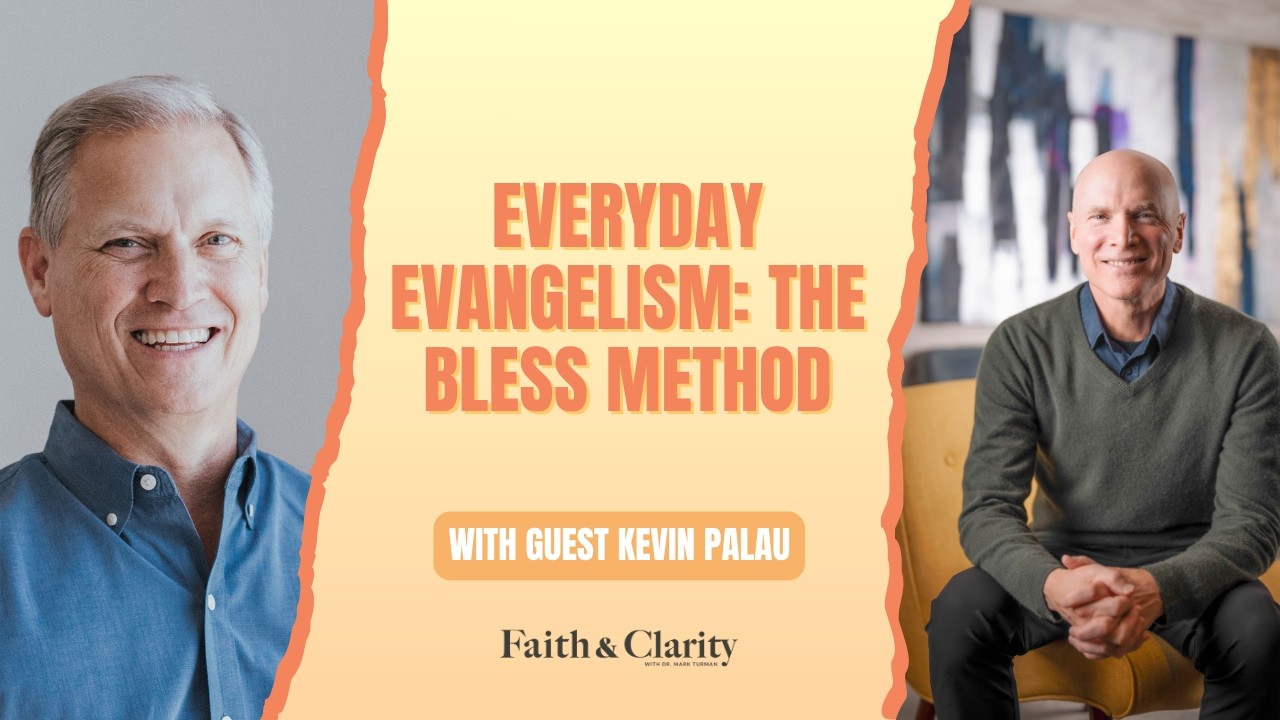
In this episode of Faith & Clarity, Dr. Mark Turman sits down with Kevin Palau of the Luis Palau Association to explore what everyday evangelism can look like in your own neighborhood. Kevin shares how praying by name for his neighbors in unchurched Portland opened unexpected doors—leading to gatherings, shared meals, acts of service, and genuine spiritual conversations. Together, they unpack the BLESS practices (Begin with prayer, Listen with care, Eat together, Serve with love, Share your story), rooted in the BLESS app from Bless Every Home, which the Palau Association recently acquired to expand its reach. The conversation also touches on the importance of hospitality, how believers earn the right to be heard, and why evangelism is less about strategy and more about joining the work the Holy Spirit is already doing. Kevin also offers a broader look at the Palau Association's ministry—from city gospel movements and festivals to online evangelism in an age of emerging AI—encouraging listeners that sharing faith faithfully begins right outside their front door.



Topics
(0:00) Introduction
(0:59) Meet Kevin Palau
(3:13) Why Portland shapes evangelism
(4:54) Mark's Palau Crusade memory
(9:14) How the BLESS method works
(18:40) Diversity in your neighborhood
(27:53) Meals and mission
(29:09) Hospitality in practice
(42:53) Evangelism reframed
(44:30) Holy Spirit conversations
(48:47) Digital outreach and AI
(53:59) Palau Ministry today
(58:05) Conclusion
Resources
- Palau Website
- The Bless App
- Ask Us Anything: [email protected]
- Sign-up for a Denison Forum newsletter: DenisonForum.org/subscribe
About Kevin Palau
Kevin Palau is the President and CEO of the Luis Palau Association. Since taking the reins in the late 90s, Kevin has helped transform the landscape of modern evangelism. He’s the visionary behind City Gospel Movements, a global initiative that has united tens of thousands of churches to serve their local communities through long-term, sustainable partnerships. Kevin is also a pioneer in the digital space, advising on some of the largest online Gospel campaigns in history, and is the author of Unlikely, a book detailing the power of radical collaboration.
Beyond his global work, he leads TogetherPDX in his home state of Oregon and serves on the boards of Alpha USA, Christians Against Poverty, Transforming the Bay with Christ.
Kevin lives in Beaverton, Oregon, with his wife, Michelle. They have three grown children and two grandchildren.
About Dr. Mark Turman
Dr. Mark Turman serves as the Executive Director of Denison Forum, where he leads with a passion for equipping believers to navigate today’s complex culture with biblical truth. He is best known as the host of the Faith & Clarity podcast and the lead pastor of the Possum Kingdom Lake Chapel, the in-person congregation of Denison Ministries.
Dr. Turman is the coauthor of Sacred Sexuality: Reclaiming God’s Design and Who Am I? What the Bible Says About Identity and Why it Matters. He earned his undergraduate degree from Howard Payne University in Brownwood, Texas, and received his Master of Divinity degree from Southwestern Baptist Theological Seminary in Fort Worth. He later completed his Doctor of Ministry degree at George W. Truett Theological Seminary at Baylor University in Waco.
Before joining Denison Forum, Mark served as a pastor for thirty-five years, including twenty-five years as the founding pastor of Crosspoint Church in McKinney, Texas. Mark and his high school sweetheart, Judi, married in 1986. They are proud parents of two adult children and grandparents to three grandchildren.
About Denison Forum
Denison Forum exists to thoughtfully engage the issues of our day from a biblical perspective, helping believers discern today’s news and culture through the lens of faith. Led by Dr. Jim Denison and a team of contributing writers, we offer trusted insight through The Daily Article, a daily email newsletter and podcast, along with articles, podcasts, interviews, books, and other resources. Together, these form a growing ecosystem of Christ-centered content that equips readers to respond to current events not with fear or partisanship, but with clarity, conviction, and hope. To learn more visit DenisonForum.org.
All episodes are produced by Sound of a Rose. For more information, you can visit soundofarose.com.
EPISODE TRANSCRIPT
NOTE: This transcript was AI-generated and has not been fully edited.
Mark Turman: [00:00:01] From Denison Forum, this is Faith and Clarity. I'm Mark Turman, your host. We want to equip you to find clarity in today's chaos and hope beyond the headlines so you can live by fear or live by faith, not by fear. So we're going to jump right in. Uh, we want to talk about today something that I uh remember as a young Christian in the in the mid 80s, sitting in church. I was a teenager and I remember my pastor sharing this statement. God has a really wild idea. He wants to use the whole church, all of us, to share the whole gospel with the whole world as fast as possible. Now, that's a lot. Um, and you probably heard your pastor say something to that effect. At least I hope you heard your pastor say something to that. And so we're talking about connecting to God's heart for sharing the good news of Jesus with the world and doing it through a strategic prayer effort that we're going to talk about today and some other things. So joining me today is Kevin Palau. Kevin is the president and CEO of what is called the Luis Palau Association. If you haven't heard of that, you've probably lived a little bit under a rock, maybe. Um, but think Billy Graham with an Argentine flair, okay? Uh, since taking the reins of the Palau organization in the late 90s, Kevin has helped to transform some of the landscape of modern evangelism. Uh, he also has a vision for city gospel movements. We hope to talk about that a little bit. And he's also been involved in designing some of the gospel campaigns, uh, that go online, that use technology. He's also the author of a book called Unlikely, a book detailing some of the power of radical collaboration. Uh, he works in Oregon where he lives with an a movement called Together PDX. He is also a board member of Alpha USA, Christians against poverty, transforming the Bay with Christ. And when he's not doing some of that stuff, he has a great life with his wife, Michelle. They have uh three grown children and two grandchildren, which is probably where where we're going to start, right, Kevin?
Kevin Palau: [00:02:10] Let's fit in one more. Welcome to the podcast. Third grand, another grandson on the way in about three weeks.
Mark Turman: [00:02:17] Yeah, and they they as a fellow grandparent, they are the best of the best of the best. I just finished a week of vacation with them on the beach. So, uh, just absolutely the best of all things. So, uh, gosh, tell us a little bit about you and tell us a little bit more about the work of Palau and what things are going on in the Pacific Northwest these days.
Kevin Palau: [00:02:38] Yeah, you know, yeah, as you as you mentioned, Mark, um, if people know the name Palau, it's usually because of my dad who's been with the Lord, um, five years now. And uh, he was such an incredible evangelist, not only because he was able to communicate the gospel with clarity and joy and boldness to a crowd of 100,000 at a time, but he just loved people and he would share the gospel just as enthusiastically with a waiter or server at a restaurant, especially if they were from Latin America, boy, did he make friends quickly. And so I had the privilege of growing up, my um, three brothers and I here in Portland, Oregon, which is a pretty radically unchurched place. Uh, my mom and dad met in 1960 at a Bible school here. And once the ministry got bigger, we were in Latin America when when we were little kids, but once the ministry got bigger and more global, it made sense to be based near mom's family. And so Portland, Oregon's been home all these years, which kind of felt random for for decades if people would ask me why we're based here, I would just say, well, my mom's from here and you know, just it is what it is. Now I would say God knew what he was doing and we have been so shaped in a healthy way by living all these decades in a very unchurched place, a place that forces you to think long and hard about not not the power of the gospel, not the truth of the gospel, but how do we get it across faithfully and effectively when you're surrounded by people who think they know all about it and who are very much clear on why they don't choose to follow Christ. There's a lot of interesting things about Portland that have led us to go away from kind of a Billy Graham crusade model to more of a festival approach, then to add in community service as a way to kind of earn the right to be heard. So, um, we love being in a place like Portland, hard as it is, and we feel like God called us here.
Mark Turman: [00:04:40] Well, it certainly has become a unique laboratory, right? If you if you can figure out how to effectively share the gospel in Portland and the surrounding area, you can probably share it in a lot of other places around the world. Very true. Very true. But but I wanted to tell you, I I became aware, so I came to Christ, uh, in 1980, um, and then in my home church in East Texas, uh, over the years, 30 years ago last month, Luis Palau came to my hometown of Tyler, Texas. I was about to say if you said East Texas, it's got to be Tyler, Tyler Longview. came because uh in in in part, uh invited by my home church and a number of other churches in the East Texas area. I remember going to a place appropriately titled for Texas called the Oil Palace. Oil Palace. Right. And uh, we we got to experience the crusade ministry of your dad and was just, yeah, so if you you really think about it, you got Billy Graham coming from the East Coast and Luis Palau coming from the West Coast and just, you know, converging in the middle of the country. And so There we go. There we go. Yeah. So I've been a I've been a fan and a follower for a good number of years of uh, both your dad and of the now uh ongoing Palau ministry. Now we just call it Palau. Yep. Yeah. Just Palau.org for people that are looking. Uh, people that have intersected with y'all in the past and truly a a global ministry, um, in so many ways and, um, you know, such a the world's just becoming smaller all the time by technology, right? Very true. Um, but I caught a a message from you, uh, a few weeks ago. I've been using uh an app and a tool for prayer, uh, for more than a decade, uh, that is called Bless every home. And, uh, as I was telling you offline, some of the people I know helped with a precursor to this ministry. Uh, but I was just intrigued when I saw that this tool of ministry and of prayer that I've tried to utilize, uh, for again, more than a decade, that Palau had acquired Bless every home. Uh, and I'm just curious what's behind all of that. So tell people who don't know what bless is and then why you guys acquired the ministry platform.
Kevin Palau: [00:07:01] Yeah, you know, um, I'll I'll start just personally. Um, I've lived in the same neighborhood, my wife and I for 25 years. And like a lot of believers, you know, you want to be on mission, you want to join God in his never-ending quest to know people, but I, you know, I this is about three years ago, I realized I just didn't even know the names of most of my neighbors. I I would wave at some of them and like, by golly, I can't remember that person's name. So I'd heard about this app called the Bless app, just B L E S S and I'll we we can I can quickly go over like that's an acronym if in case you're wondering. So I just thought someone had told me like, you know, if you if you get this app, it's free and you put in your name and address, it will immediately populate it with the names of 50 of your nearest neighbors. So I thought, oh, this will be perfect. And the more I started using it, I mean, it's been incredible to see the three-year journey in my neighborhood to go from not even knowing the names of most of my neighbors to now having had three Christmas parties. We're getting ready for our third summer barbecue. I know the names, not just the names, I I know pretty well about 60 of my neighbors now. I'm kind of viewed as like the connector for the neighborhood. I'm a big like Christmas decoration guy and we've helped a bunch of other, some of them are Hindu neighbors, put up Christmas decorations because they don't want to be left out. We've done an alpha group in our neighborhood. The change that's come just from praying by name for my neighbors has been incredible. So when we heard that uh the app was was kind of in a bit of trouble that they had some debt and they they were basically looking for a larger organization to take it over, we jumped at the chance because I I would say basically, it's the best mission engagement tool that I'm aware of. If you're living in the US and you're looking for a way to get reminded every single day to be on mission. So, you know, we talk about it as a prayer app, but it's really kind of a full life engagement in the kingdom app because bless stands for, you know, B, begin with prayer. M. L is for listen with care, like how to have deep conversations with people. E is for eat together. Let's practice hospitality and actually get into people's lives by eating together. The first S is for serve in love, and the final one would be to share your story or share the gospel. So when you think about this as a simple way to remember what does it mean to love my neighbor? You know, Jesus boiled down the whole of the the the the law in a sense to love God and love your neighbor. But what does it really mean to love your neighbor? If we don't even know the names of our physical neighbors, that's a problem. So to have a tool that gets us on mission and gets us thinking about how to love our neighbor, I found it such a difference for me personally and now to think of 170,000 believers and counting across the country that are reminded every day to pray by name for neighbors. But you know, we have a vision to take it, you know, in a lot of fresh directions as as we've Palau's had it for only 90 days. We want to make it where you can put in the names of so it's not just your physical neighbors because we all know the people that God has put on our hearts include our family members or someone who might work out with at the gym, um, people you work with. So we're going to have a place uh in about a month, the the app will be fully updated, this bless app and you know, there'll be a place for you to put down the names of other people that are in your life so that you basically are encouraged and reminded and inspired to live on mission every day.
Mark Turman: [10:53] Yeah, it's such a a great idea. I love to hear those innovations coming because like you said that, you know, neighbor can simply be defined as somebody that's near you, right? And they can be near you geographically, like we normally think of neighbor, or they can be near you relationally or emotionally. Because you work with them, because they're at. But yeah, we want we want this app to not just be like, oh, it's a prayer app. Oh, it's a prayer walking app for your neighborhood. Yeah, but it's a lot more than that. We really want it to be something that a if a pastor's listening and he's like, boy, I I just always am trying to find fresh ways to get my people to live out the gospel, to live on mission. This is for the average person that doesn't feel that they're an evangelist, that they're kind of like nervous. Are you going to make me go door-to-door and share the gospel? Well, some people are called to that, but really it's living in this Christ-like way, praying, having good conversations, practicing hospitality, finding creative ways to serve people, and then finding ways to share your story. So anyway, I I I have the zeal of a new convert, Mark.
Mark Turman: [11:59] Well, I love that and and I and I, you know, I love this app. I get a, I get an email reminder every morning. So do I. Hey, don't forget about your neighbors. And I got to tell you, Kevin, sometimes, like I said, I've I've you don't have to sell me. I'm a satisfied customer on this for sure. But I I sometimes uh pull up this app or this email. Sometimes I do. I do walk a lot. I am a walker in my neighborhood just for exercise, but you know, sometimes I think to myself, I may be the only person mentioning this person's name in heaven today. Yeah. And I think, wow, how tragic could that be, right? And but I also think that about people in my family. Everybody's family is a mission field to a certain extent. Uh, or other environments that we get to be in. Um, but I want to walk through just for a few minutes those five letters. Um, this this whole idea of because it's such a simple reminder, but it's so encompassing of the lifestyle of an ambassador, of a believer. Uh, when I think about this conversation, I think about second Corinthians 5 that God gave us the ministry of reconciliation that we not only get to be adopted by him, but we get to be involved in what he's doing. Um, but I got to ask, I just want to let people know right off the bat that this is is uh something that they can be confident in. Uh, give us a little bit of the background of how in the world do you get the names of the neighbors without being invasive? Right, because that can be that can be creepy to people. So, you know, we there's a lot of safeguards built in. This is absolutely not for people to misuse. So there's no contact information. We absolutely are not creating a weird situation where people have got someone's cell phone or their email address. It really is this is all publicly available data. So it's not, you know, kind of like sneaking around and getting stuff that's that's inappropriate. It really is just a simple way for you to just know the names of the people that are around you. And again, I would always caution people like don't be foolish in how you use it. Don't walk up to someone you've never met before and pull out your phone and say, I know your name because I've got this app and I'm praying for you. I mean, do that if you want someone to go running the other way and say like, I got to stay away from that crazy neighbor. So obviously, use common sense. It's really just for us as everyday followers of Jesus to be encouraged in um caring about our neighbors. So it's funny for me, I'd lived there for more than 20 years, but once I started praying by name, it just it it it gave me a kind of a different set of eyes. It gave me more of a desire whether I'm walking the dog or walking around with my, you know, grandson in a stroller, it gave me more of that mindset of, um, I'm hoping to find the opportunity, a natural opportunity to get to know this person who I've been praying for by name, but I'm not just going to go knock on their door. One of the reasons we decided with our with a couple across the street that are believers to start doing a Christmas party is we thought, well, you know, most of my neighbors are probably like us. We've lived here for a long time and we just don't know people. So I in that case, I did go door-to-door with a little invitation to a Christmas party. And of course, the first thing I said every time was if I if if it was a ring camera or the person answered the door is like, I'm not selling anything because in my neighborhood, most of our houses have a no soliciting sign. That's right. So even in going and knocking on the door, I'm like, okay, I got to immediately say like, I'm I'm your neighbor from right around the corner and my name's Kevin and you know, I'm a little embarrassed that I've lived here more than 20 years and I think you've lived here for quite a while too and I've just never introduced myself. Some of us are getting together for a Christmas party to just get to know neighbors and oh my goodness, the first we had 60 people show up. Wow. Every when we gathered together in a big circle and kind of introduced each other, how long you've been in the neighborhood, a little bit about yourself. Everyone's response was, I've lived here 10 years, 15 years, 20 years. I can't believe this is the first time I've been in the same room with my neighbors and I'm so grateful. Thank you, thank you, thank you for just taking the time to create a way for us to get to know each other. So it was the easiest thing in the world. People were nothing but grateful to have been given the opportunity to get to know their neighbors a little bit.
Mark Turman: [16:37] Yeah, yeah, and you really just serving the neighbors in that way in some ways by helping them introduce each other. That's the way I view it. It's like I'm I'm helping provide you an opportunity to get to know your neighbors when that can be a little bit of a hard thing to do. You know, why did everyone sit in our neighborhood? Why did everybody sit in their own homes for 20 years not talking? Because no one was willing to just take that little bit of a step of discomfort to say, let's have a Christmas party or to just have an eye for for the neighbors that I'd kind of hadn't got to know and just making a point of going over and introducing myself. Yeah. And saying like, you know, I've lived here a long time, tell me a little bit about yourself. No one was upset that we had that we decided to have a Christmas party or that we're becoming a more friendly neighborhood. Everybody was grateful.
Mark Turman: [18:40] Yeah, Kevin, one of the one of the things that caught my attention when uh over the years I've been using this app and it really kind of speaks to. So I I live in a suburb of a major city of Dallas and as do you. Um, but I I continue to be struck by the variety of names. Um, you know, uh, I I was expecting to see the Smith and the Jones and the Andersons and they're there, but just by looking at the names, you start going, wow, my neighborhood is an incredibly diverse experience of culture if I am willing to engage it. Are you seeing that as well?
Kevin Palau: [19:22] 100%. In my neighborhood, it's probably less than 50% that would be um, again, like you say, your Smith and your Jones, your kind of like traditional Anglo-Saxon kind of names. Um, in our neighborhood, it's probably a third Indian because we have uh thousands of Nike software, sorry, um Intel engineers in the west side of Portland. So we have a lot of neighbors um that are Indian and Chinese, Vietnamese. And so it's funny as I've as I've pushed myself and in some cases like had to work pretty hard or been praying for some people for years before a natural opportunity came to meet them. But it's amazing how a little bit of friendliness uh backed up by in some cases years of prayer. I mean, I'm I'm just mostly praying for open doors like Paul says. You know, he says, pray for me that there'll be an open door. It's funny how siloed people can be and how separate people are. We're very used to getting in our cars, coming out of the driveway in our car and literally not talking to another person in our neighborhood. It takes effort to push out of that. But in my neighborhood, I've found nothing but gratitude as I've been willing to do that. And it's funny, it's things like a Christmas party or the fact that I love decorating my house for Christmas. I'm one of those people that goes crazy. I would start the day after Halloween if my family would let me. So you're a Griswold. And it's funny, I became so known for doing that and with such enthusiasm that um I had a number of Hindu neighbors ask me to help them get their house all decorated with lights and things because I have extra lights and I love to do it and it's been one of the ways that I kind of like am serving my neighbors is by helping them decorate their houses. That might seem like a weird way to serve, but they're asking for my help and I love doing it.
Mark Turman: [21:23] Yeah, could you make a trip to Dallas around November 1st so you could come by and do my house? It sounds like you have the skill of of uh, you know, uh Art Griswold. That's it. That's it. to come by and decorate everything up. So, yeah, we we'd love to have you swing by here if you have a chance. So let's let's walk through this before we take a break. Let's walk through these letters for a moment. Um, you know, uh it just love this. So begin with prayer, right? Begin with prayer, the B. And just, um, so important. You know, sometimes, Kevin, my simple prayer when I'm looking at these names or when I'm in my neighborhood is, Lord, Lord, would you trust me enough to know this person? Um, is would you just let me know them? Um, and to see that kind of open up at times. You know, I had a guy, I was walking around, he's a he lives a block over and he had a wheelbarrow and I was recovering from surgery and he saw me walking very cautiously and he just came out into the middle of the street and he said, are you all right? I said, well, I'm recovering from back surgery. And he immediately told me his story of a of a surgery he had, heart surgery he had had 18 months ago. I mean, it just just people want to talk. Yeah. Um, but what do you think is the significance of praying for people by name?
Kevin Palau: [22:41] I do think that you're right. I think that there's something powerful about praying by name. God knows each of us by name, we're told. It's one of the things that is so powerful about God's love is that we're not just loved generically as sons and daughters, we're known by name. And when someone, people love to hear their name. So to me, it's like there's something about, even when I haven't met the person yet, there's something about praying by name, wondering about them, kind of building up a sense of curiosity, wondering about their lives, what makes them tick, knowing that everybody has struggles and pain and heartache in their life, knowing that not every dream they had came true. It's so I just, it's funny, when I'm praying for someone by name, even when I don't know them, and how much more when we when I have got to know them, there's something about slowing down, even if it's for 60 seconds to slow down and stop thinking about myself and my problems and my situation and my kids and my grandkids and my work and etc, etc. and saying, Lord, you love each of us. So let me just please focus for a minute on um, uh Ulas and Usha, my my neighbors that are both Intel engineers and thinking about them and their two boys and one of their sons, Roshan has become a believer now and we've gone for meals regularly. She's part of my wife's alpha group. So in some cases, even when I don't know the person yet, there's something about saying, God, by the power of the Holy Spirit, I know you can somehow take something that feels so insignificant, like literally the synapses and and neurons in my brain firing and communicating with the God of the universe, the creator and and just sometimes I'm it's out loud, other times it's just me thinking about that person and trusting that by faith somehow something powerful can happen that intercessory prayer changes things. And it certainly changes me. When I pray for someone by name, you can bet that I am looking for a chance to say hi or I'm looking for God to get them out of their house sometime. And um, so I just feel like rather than just generically, Lord, bless all my neighbors, there's something about walking through the neighborhood knowing that Ulas and Usha live here on this corner house and praying for them by name with whatever I know about them, which might be very little.
Mark Turman: [25:13] My pastor used to say, you know, don't pray for me wholesale, pray for me retail. Retail. That's it. Pray for me retail. We've talked we've talked a little bit already about listening and I wonder if you have a word of encouragement for our audience. Uh, Christians ought to be leading the way of being curious about people in an age and time where we are normally by default just suspicious of people we don't know. Yeah. Um, can you speak into that? A lot of, you know, I've read a number of books on this, uh, a social commentator by the name of David Brooks talks about this all the time that we are so camped up in our own lives and in our own groups that we are afraid of people and Christians need to be opposite of that. Can you speak a word about that?
Kevin Palau: [25:58] Yes. I I you you're so right. So if the B is begin with prayer, then the L is listen or listen with care. I one of my favorite quotes that relates to this is from um David Augsberger, a counselor and author. He says that for most people being listened to is so close to being loved that they can hardly tell the difference. And I love that because we don't, you know, we tend to think of, well, I if I've got to love someone, I've got to go do something. Don't underestimate the power of giving someone a chance to be heard. People love to talk about themselves. People don't know what to do with someone that's genuinely interested. So I guess I would say be genuinely interested. Don't pretend to listen and you're kind of mentally drumming your fingers so that you can then have a chance to talk. It takes a lot of discipline, especially if you're a type A kind of person that got stuff to do and you want to move a conversation forward to take the time to listen, to develop a kind of a cadre of of questions to ask because, you know, if you're not used to being a good listener, it can take some practice. Um I try to think about questions. There's certainly obvious questions about what a person does and you know, maybe where they came from and about their family, but once you exhaust those, you know, take the time to sit and think about deeper questions that can go behind the surface a bit that can show someone that you care. But I really do think that one of the best ways to show the love of Christ to someone is to just be a good listener, to ask questions and give people plenty of time to answer.
Mark Turman: [27:42] Yeah, good, good word. Yeah, again, reference to David Brooks. He wrote a great book two years ago called how to know a person, which is just how to create a good conversation with somebody, you know, and how to get it started. Let's talk about eating because I think this is this is one of my, uh, this is really one of my hot buttons because this is where I think Christians may be missing it in a big way, including, uh, me and many I know. So, Kevin, I grew up in Texas. I grew up in the world of what I call drop-in screen doors and walk-ins, okay? So, I grew up in an environment, my wife as well, there were constantly people just stopping by our house. They didn't call ahead, they didn't make an appointment. It wasn't like on the calendar for weeks. It was constant in my childhood, uh, all the way up until I went to college, people just stopped. It could be a relative, it could be a friend, it could be a business person that my dad knew. There's just constantly people pulling up in the driveway. We also had screen doors, glass doors, people just walked up and we had we had some neighbors that we knew so well that we called them walk-in neighbors. We just they didn't knock, they just walked in and we did the same with with them. We just walked in their houses as if we were part of their family because in essence, relationally we were. Um, we have seemingly lost any vestige of that in our even in the south, which is known for this kind of of lifestyle. Um, talk about the biblical calling and the incredible opportunity. You mentioned, you know, having a barbecue or a Christmas party. Uh, I've hosted some of those, my wife and I in our house. Just the incredible calling and tool of hospitality as a way of just serving your neighbor as well as representing God very well.
Kevin Palau: [29:35] Yeah, I do think that eating together is another biblical practice. And one thing just to back up a little bit, when I think about this this bless acronym, it really are it it really is just like the Jesus way of being on mission. Like these are not like, oh, what a cute thing, you know, you grab this acronym bless. They're really just biblical ancient practices. I like to think of it that way as opposed to like, oh, here's some newfangled thing. None of this is new. These are all visible in the life of Jesus. Jesus prayed to his father all the time. He got away to do that. He was an incredible listener. He asked way more questions than he answered questions. And then of course, the eating together, how many of the gospel stories are around food? How many of the of the the the best examples of Jesus engaging with people were around meals. And of course, you could say, well, it was part of the culture. You you referenced Mark, the the the fact that this was part of the kind of the southern culture and sadly we're losing that in the US all just if we haven't already lost it, it's it's going fast. People are very concerned about their privacy. They get in the world of screens. I mean, not screen doors, these physical screens that take up so much of our time. So I think it's a great gift to people to be hospitable. And that can be having people over for a barbecue or just a cup of coffee. It could be meeting in a neutral spot, just going to Starbucks or something. But it takes energy. What I have found is, um, it takes quite a few invitations. In my neighborhood, people can be a little bit leery. It can take a little bit of trust building for them to be willing to go out for a meal. I mean, it's funny like we're in a culture, I would say that that that people that have come from other parts of the world, they will jump at the chance for a meal every single time. It tends to be the good old people that look like you or I, you know, good old traditional sort of like white Anglo-Saxon Protestant. That's in my neighborhood who I find are like kind of a little bit leery and skeptical. But it's funny, my Indian neighbors, my Vietnamese neighbors, my Chinese neighbors, it's so much more a part of their culture to have a meal. They love to have us over because they love to serve the amazing delicious food that that that that they like to make. So, um, but it's a it's a incredibly biblical approach. It gives you the time to have calmer, quieter, intimate conversations. When I look at how do you have, um, the chance to listen with care, so often the best opportunity is going to be around a meal. And I think people are so unused to having neighbors treat them that way that I would love to think that it would be the Jesus followers in our neighborhoods that would be pushing for these kind of opportunities. I mean, again, we found a couple of other believers in our neighborhood and now we're just saying like, we're going to be committed to doing a every December doing a Christmas party and then every summer, sometime in the summer doing some kind of a simple barbecue or a simple potluck kind of a thing. We just kind of say if you're, you know, first half of the alphabet, you bring a main course and then the second half bring a dessert and we'll bring some um, drinks. And it's funny how just creating that opportunity to to eat, it gets people disarmed in some ways. It gets them outside of a work-a-day world. Yeah. And um, gives you an hour at least to have a conversation about all kinds of stuff.
Mark Turman: [33:23] Yeah, and we've and we've seen some success in our area, you know, trick or treating is still a big deal on Halloween. So one of these is kind of already built in. You know, we've we've tried to take that to the point of, well, we're just going to take some lawn chairs and go sit on the sidewalk and meet people where they are and generate conversations while their kids are trick or treating. That's a great idea. Seen that and then, uh, you know, sometimes people are leery about going in somebody's house that they don't know. So to your point, like in the warmer months, um, you can pull the barbecue out to the front sidewalk and and uh invite people to get to know each other and and it doesn't have to be over a full meal. Sometimes it can be over a dessert or It's it's very true. ice cream, you know, something like that. So you don't have to make it super complicated at times. So That's right. That's right. Let's talk about the two S's and then we'll take a break. So what does what does serving look like uh as encouraged by the blessed lifestyle and the blessed platform? What does that look like in your neighborhood, do you think?
Kevin Palau: [34:25] You know, I think I think in a neighborhood basis, um, depends on the kind of neighborhood that you're in, but I would say, I would say, you know, there's always older people in a neighborhood who struggle to keep up with their yard work or like I'm not a very handy person, but my neighbors next door, Trisha and Heidi, um, Heidi's a surgeon, Trisha's getting her MBA, very capable um, couple of women, but like and and they were like putting building this kind of like roof thing over their deck and I, you know, lean over the fence and said like, I'm not super handy, but in any way that I can help. And so they were incredibly grateful and literally it was nothing more than holding like holding up something so they could attach the bolt. So it was like, it took no skill for me to do what I did. But you know, they just they they very much appreciated me noticing a little tiny area of need and just volunteering to help. Um, so sometimes it will be like me, I'm not a I'm not a huge pet person, but I've I've made it clear like, hey, if you need someone to go feed your dog or cat while you're gone or it's like little things like that that don't take a ton of time, but once I became known as someone looking to help, I'll have neighbors, you know, regularly reach out when they're on vacation, can you take out my garbage cans from the garage? That kind of a thing. And then I mentioned again, the Christmas decorations. I'll have like three different kind of nativity scenes in my house, or you know, on our on our yard. An inflatable one, then a bigger one with these kind of lit up plastic, you know, wise men and the camel and the all the stuff and the little wooden manger and some hay. And it's funny how that will call out one, it's kind of alerting people that have some kind of faith background and people will comment on it at times as a way to kind of say like, oh, I noticed that you've got a nativity scene. I do the same when I walk through my neighborhood. I'm kind of noticing the kinds of Christmas decorations people have. And again, I've been super eager to volunteer to help people with their decorations because that's again, one of the few times that people are out putting up decorations, whether it's Halloween stuff or Thanksgiving or Christmas, that time of year has become a a place for me to kind of build a little bit of a relationship.
Mark Turman: [36:59] Yeah, you look just look for those again, once you start kind of thinking through this and praying through this, you just start kind of noticing things, right? So when we, you know, we moved into our current house about 10 years ago and, you know, on the sidewalk just started getting to know the people immediately around us and we took the opportunity to go first and say, hey, here's our cell phone number, you know, we're in and out traveling some. If you ever see something that doesn't look right, call or text us. And then of course, it was pretty natural for them to turn around and say, well, here's our number. I remember my one neighbor, my neighbor Ryan to the side of me, he gave me his phone number. I literally just taped it up inside of the cabinet, uh, where the coffee cups are. And then four years, five years later, it's Christmas time, they've gone to visit family and I'm out, I hear water running and, yeah, I'm able to I'm able to figure out it's not coming from my house, it's coming from his house and it's running continuously. So obviously they're not home. So I just called him and he was completely shocked that, oh wow, somebody is cared, somebody noticed and somebody cared, you know, and it really became an opportunity to build relationship and build trust with him. And so it can be just simple stuff like that. That's exactly. It usually is simple stuff. It's it's more being willing to notice like you did with the water running and then just finding that way to be a a good neighbor. You know, good old Mr. Rogers, it's like I still love that show and even, you know, I've seen every read the books and seen all the different documentaries because here was a man of faith that was so known and so loved and respected by simply being a good neighbor. Like caring and having all the this is all these blessed practices. kind of lived his life of this is the way I hope my neighbors treat me, so I'm just treating them that way. A wise guy talked about that at one point. So let's talk about story before we catch our breath here. And I want to here's obviously the story is the story of Jesus and our stories with Jesus. I want to uh get you to respond to something that, you know, people of faith often talk about when it comes to sharing faith, which is this idea of earning the right to talk, okay? So talk about a little bit, uh, Kevin, where that is legitimate, but maybe there's some ways that it's not legitimate. Yeah, I think you're right. to say that we have to earn the right to talk about Jesus. Uh, where where do we maybe hide behind that in some way?
Kevin Palau: [39:29] I think, you know, it's funny, that's one and then the other one you've probably heard too, your listeners have probably heard as well, which is, you know, preach the gospel at all times and when necessary use words. That was something that was kind of attributed to St. Francis, though it was clear that he never said anything like that. But the same thing, like the the truth of those two statements is sometimes our actions do speak louder than words and sometimes there is a real value in building a relationship before directly sharing the gospel. So there's there's a certain truth to it, but I do think that most believers that don't feel necessarily a calling or a confidence in evangelism do hide behind that. They feel like, well, someday down the road, once I've really built a relationship, once this person really trusts me, then I'll make it clear that I'm a follower of Jesus or that I go to church or I'll kind of start hinting a little bit. But there's there can be this real fear and reticence to just joyfully be known as a follower of Jesus. And I think that for most people, if the gospel is communicated in love and with a joy, like this is something that I that has so changed my life. I'm so proud to let people know that I follow Jesus. I mean, there are ways to share the good news and share the our story with Jesus that don't have to be pushy, obnoxious, uncomfortable. We all know people that just talk about the things that they love with enthusiasm, whether that's the Dallas Cowboys or a new barbecue place. So I'd like to think that if we've, especially if we have been praying for people, we've had conversations, that when it comes to the opportunities to share a bit of our story with Jesus, that we have found ways to do it that are joyful and loving and that don't have to be off-putting. I think we sell ourselves that no one's interested and I think that that's just not true. Um, especially if we have been a good neighbor and we're if we're known to be loving and kind, people want to know what makes us tick. I think that's a good part of the the the value of the conversations and listening carefully too, because most people have some sort of faith background and if genuinely asked to talk about their journey of faith, most people are willing to share and then that automatically opens up a door for you to talk about your journey of faith. Being a a spiritual person is is for the vast majority of us, again, there's some kind of faith background, there is an interest and a desire to be seen as a spiritual person. So asking someone what kind of spiritual practices give them life, what ways do they find to deal with and just cope with the pressures of life? Like there's ways to start conversations that don't have to feel pressured and awkward. But you got to prayerfully look for those kind of um opportunities, but don't hide behind this whole thing of, you know, I got to earn the right to be heard.
Mark Turman: [42:38] Right. Yeah. That's that's such a good word. Yeah. Well, we're going to take a quick break right now and let our audience catch their breath and we'll be right back.
Ad Voice: [42:48] If you've ever wished the news felt a little less chaotic and a little more clear, Denison Forum has created something we think you'll appreciate. It's called The Focus, a new weekly email from Dr. Ryan Denison, one of our frequent guests here on Faith and Clarity. Every Tuesday, Ryan highlights three to five key stories from the week, curated so you don't have to dig through the endless headlines, along with a deep dive into one critical cultural issue. He also adds in a God is good segment that highlights an uplifting story. The goal of the focus is to help you answer, what do I need to know from the last week, why does it matter, and how can I stay hopeful? If you appreciate this podcast or the Daily Article newsletter, but would like a wider snapshot of what's happening, then the focus is for you. You can subscribe to receive the Focus newsletter now at denisonforum.org/newsletters or find the link in the show description.
Mark Turman: [44:08] All right, we're back talking with Kevin Palau about just how to be representatives of Christ. And it's just, Kevin, really astounding to me that God even lets us do this. That he that he trusts us enough to do this. Um, I I was wondering, you you obviously through your family, through your dad, through the ministry you do today, it just is such a eager, passionate thing to help people know who Jesus is. Um, I I got to tell you, almost my whole Christian life, the word evangelism has kind of been intimidating to me. Yeah. Um, do you think we define what we mean by sharing the good news of Jesus too narrowly?
Kevin Palau: [44:48] Yeah, I think you're right. I think one of the things I love about these blessed practices is it puts the gospel in this biblical lived out context where we see that almost every aspect of our lives, us just living with a loving attitude toward everyone in our lives is all part of communicating the good news because how we live does matter, how we love people, how we listen. But I do think that the missing link in a lot of cases is the intentionality to be a vessel to be able to communicate with clarity and joy and boldness, the life-changing message of Jesus because simply being kind to someone, simply loving and serving our neighbors isn't enough to help them know Jesus personally. So it does need to get to the point one way or another where people are are encouraged to encounter the living Jesus Christ, to have that encounter. And so, um, you know, one of my favorite definitions of evangelism is evangelism is simply joining the Holy Spirit in a conversation he's already having with someone. Wow. What I love about that is it it it reminds us that the Holy Spirit is the great evangelist. The entire arc of scripture is one of a loving God that creates people for relationship with him that knows what is best for us and knows that that us living in a beautiful, loving relationship with our creator and with each other is the way life was meant to live. Jesus modeled what a truly human life was like. And we're surrounded by neighbors that want the good life. They invest endless amount of time and energy into podcasts and and vitamins and exercise and things to try to take advantage of this life that they have to live. And if we can somehow view it that way that, you know, God is speaking to people, whether they're conscious of it or not, the Holy Spirit is drawing people in different ways in their experience of the beauty of the universe and their experience of their love for their child or their grandchild. All of those things are little whispers of the Holy Spirit in their lives. And so to me, when I think about evangelism as cooperating, just joining the Holy Spirit in this conversation he's already having, it puts me in this posture of listening and learning and looking for those little windows that go deeper than the the Cowboys or the Portland Timbers or, you know, whatever surface stuff and get down to the matters of the heart, which people are looking for chances to deepen their understanding of themselves and when someone cares about their whole life, when someone cares about helping them experience life that is truly life, which is the life of Jesus, and it doesn't come across as I've got this canned thing that I've got to deliver to you and then I'm going to make myself feel better. I think unfortunately people have sometimes had experiences with evangelism that have felt impersonal or this feels like you're just trying to argue with me or you're it feels like you're angry with me before we've even gotten a chance to know each other. When people experience love and that part of our love is, I can't wait for you to experience life that is truly life. And for me, that is my relationship with Jesus Christ because I see in Jesus a person that lives the way we all would love to live. Um, I I just think that there's there's a million ways to get to Jesus, but we've got to be willing to prayerfully open or pray for those open doors and then actually take a step of faith, which is hard at times to actually talk about Jesus or the difference Christ has made in my life.
Mark Turman: [48:40] Yeah. But it is such a great thing to to see yourself as uh, you know, most people don't want to call themselves an evangelist, but um, but to see yourself as a representative and as an ambassador and that we do have a calling and a commission and that, you know, this this this is something that we should be excited about and should seek to engage and you know, when I when I started using the the Bless app years ago, I remember just it it kind of connected me to the scripture in Colossians 4 where Paul, even the apostle, the great church planter says, you know, pray for me. Yes. Um, when I'm when I'm hanging around people who don't know Jesus, pray for me that I will know what to say and how to say it. He uses that great terminology that my words would be seasoned with salt. Um, and and he says, pray for me that I'll have open doors. It's one of those places he uses that terminology and I'm like, well, if Paul felt this way about trying to be a good ambassador, some somewhat feeling, you know, that his efforts were not strong enough or whatever, then how much more the rest of us that we would pray those same kinds of prayers. Um, again, you know, Colossians 4, 2 Corinthians 5, that God, you would just somehow show me how you want me to be a part of this. Yes. Um, and be a part of it in in healthy ways. Um, before we wrap up, Kevin, I you you've worked in so many different other areas. I want to touch on them just a little bit. Um, you've done work on online campaigns. I think we learned uh a lot in COVID and in the season after that that there are a lot of good things you can do on the internet, especially in the spreading of the gospel. Yeah. Uh, there's some really unhealthy things you can do uh in a digital uh online context. Um, give us a few thoughts there and particularly uh with so many people thinking about AI, where do you think AI is going to be able to help us in the spreading of the gospel?
Kevin Palau: [50:41] Well, I do think, yeah, I do think that that for all the dangers of AI and we've got to be cautious. I'm encouraged that there are a lot of believers um of of technical prowess, you know, that are in that space. Um in the San Francisco Bay area in particular, I know many that are um, in fact, I I learned about a um a gathering that took place just a few weeks ago at Anthropic, which is one of the leading AI companies where they at their request gathered with about 30 pastors and leaders, um, because they're saying like, we desperately need uh a grounding, like a moral grounding for AI. And and with the speed of which, you know, artificial intelligence is is growing and developing these large language learning models, we've got to base it on some things that have stood the test of time. So it's interesting to have these very secular people recognizing that there's got to be kind of a historic grounding and so they've gone back to the Christian church, you know, a 2,000 year tradition of what is it like to morally form people, to form people because they've seen that run a muck, technology can quickly become amoral or or worse and can be leading people, you know, into very, very bad formation. So, so there's people that are thinking in that way. Certainly we at Palau along with many, many others, we do like every day ads on Facebook, Tik Tok and Instagram that just ask like very simple thought-provoking questions that then lead people on a journey if they so choose toward a very clear gospel presentation. And then those that respond in some way and every single week, hundreds of thousands of people, you know, visit uh our hope with God website and hear a gospel presentation and thousands of people at least indicate a commitment or recommitment to Christ. So, you know, it's a way to get the good news out in a simple way like every single day to people as they're scrolling either mindlessly just wasting time or in some cases desperately searching for answers. The reality, sad or not, depending on your perspective, is that people, especially younger people, turn to the digital spaces to answer their deepest questions. That is where they're going to ask about the purpose of life, etc. So we've got to be in those spaces with the life-changing message of Jesus Christ. Um we obviously want and hope and pray that people that encounter Christ in some way in the digital world will find community in what I still can I'm old enough that I can still consider like the real world versus the digital world. And of course, some younger people are like, I don't quite make that same distinction you do, oldtimer. But um, you know, I mean, you you've probably heard as well as I have, Mark, uh uh many, many stories of younger people, especially young men, you know, encountering Jesus in some supernatural ways. We had this neighbor that I mentioned Roshan who came to the Lord entirely from watching YouTube videos. Wow. He's a came from a Hindu background. And then his mom was the one who told me that Roshan had become a Christian. And so he's been at church with us virtually every Sunday the last three years, super, super engaged. But he came to the Lord entirely, not one person shared the gospel with him in person, face-to-face, but it was through curiosity and wanting to know, can the Bible be trusted and did Jesus Christ really rise from the dead? He became convinced that that was true from watching YouTube videos and then eventually found his way to me and then now our church. But um, so God can use it, you know, I mean, God can use all sorts of means and I'm I'm glad to see many organizations including ours that are investing into sharing the good news, um sometimes in very hard to reach places in other, you know, in more traditional ways.
Mark Turman: [55:02] Yeah. Well, and you know, we've seen what God can do uh with the printing press over 500 years. Um, and, you know, this is at least that big if not a whole lot bigger. Well, before we go, Kevin, so many more things I'd love to talk with you about. We could easily fill another hour, but before we wrap up, tell us a little bit uh more about the evolution of Palau. How is the ministry like the crusade ministry of your dad? How is it different? How has it moved forward from there? Give us a word on that before we go.
Kevin Palau: [55:33] Yeah, so, you know, we still love to do big evangelistic seasons. We call them festivals now. And my younger brother Andrew, who didn't come to the Lord till he was 27, um, so he had kind of a more radical conversion to Christ out of a lot of partying, etc. So he and his wonderful wife Wendy are very gifted communicators of the good news. So at least eight times a year all around the world, we'll do what people tend to think of as a crusade. Getting hundreds of churches to work together in a season of, in our case now, serving the community, people, you know, taking advantage of things like a bless app to kind of begin to be on mission, praying for their friends, serving the community in unity, and then having a a large scale gathering of the body of Christ with friends that need to hear the good news and to declare the good news in a public space is still a beautiful thing to do. We always encourage a city, hey, every decade or at least once in a generation, find some way to have a visible unity in the body of Christ around the good news. So we still do festivals every year. We have about 7,000 evangelists from 100 different countries that we've formed into country networks. So we have a Latvian network of evangelists and an Albanian network and a um Colombian network, a Zimbabwean network. We love that gift of the evangelist to the local church to prepare God's people for the work of the ministry, but also to to directly lead the way in sharing the good news. Whether those are professional skateboarders that use their skills to share the good news or people that are influencers online that have a million, there's one guy who has a million followers because he does reaction videos of like K-pop music videos. He's a he's a music video editor himself for people like Justin Bieber. So he has and then he'll occasionally just share the good news to the audience that he has cultivated. So we love serving those with the gift of evangelism. And then we and then we love to kind of keep the body of Christ working together in what we call a city gospel movement. We we don't have time to go into that a ton, but if you can mobilize the body of Christ for a big event like a festival, why wouldn't you also try to keep the body of Christ together sustainably? So in Portland, Oregon, we had our big evangelistic outreach way back in 2008 with 50,000 people over the weekend in our big park. But we've maintained now unity of a couple hundred churches around serving our homeless community with our mayor and forming a refugee care collective, forming a network to help the foster care system. So we've found ways to serve the body, I mean, to have the body serve the community. And then also find ways to do 50 churches running alpha groups together at the same time. So we're always trying to keep the body of Christ in Portland, Oregon actively working together because biblically, that's the way the church was always described in the New Testament. It was the church in Antioch or the church in Ephesus. It was basically recognizing that wherever we choose to worship, there's one movement that began on the day of Pentecost and it expresses itself in every believer and in every congregation that's honoring to the Bible and preaching the good news. So we love to to see churches working together. And I know you're involved in that in McKinney, Texas there, Mark. So time doesn't allow, but lots of good, lots of good things going on in the world of Palau.
Mark Turman: [59:15] Yeah, one one body, one faith, one baptism, right? Yeah. Absolutely. Kevin, so many more things I want to talk about. We'll have to have you back on for another conversation and uh talk about some of these things as well and how people can jump into them uh in their opportunity as well. I want to thank you for spending some time with us today and we look forward to how you guys are going to steward and and grow the Bless app and um people can well, tell people they can find things obviously at Palau.org. Where else can they find the Bless app? Honestly, just go to the App Store in whatever format, whatever whichever phone you've got and just literally type in B L E S S and uh this is what uh this is what will show up is that black with the with the kind of light blue B. That's what it should look like. And honestly, I would challenge every listener, download this free app and just see what God does as you begin to be um encouraged and inspired to live on mission every day.
Mark Turman: [01:00:16] Yeah, absolutely. And uh, yeah, we look for great things coming with that. I want to thank our audience for tuning in with us today. And as always, if this has been helpful to you, please share it with family and friends, rate, review us on your podcast platform. I want to shout out today to our friends at Sound of a Rose who help us with production. And if you'd like more uh information from us, more resources, you can find those at denisonforum.org. We'll see you next time on Faith and Clarity.










 Search