


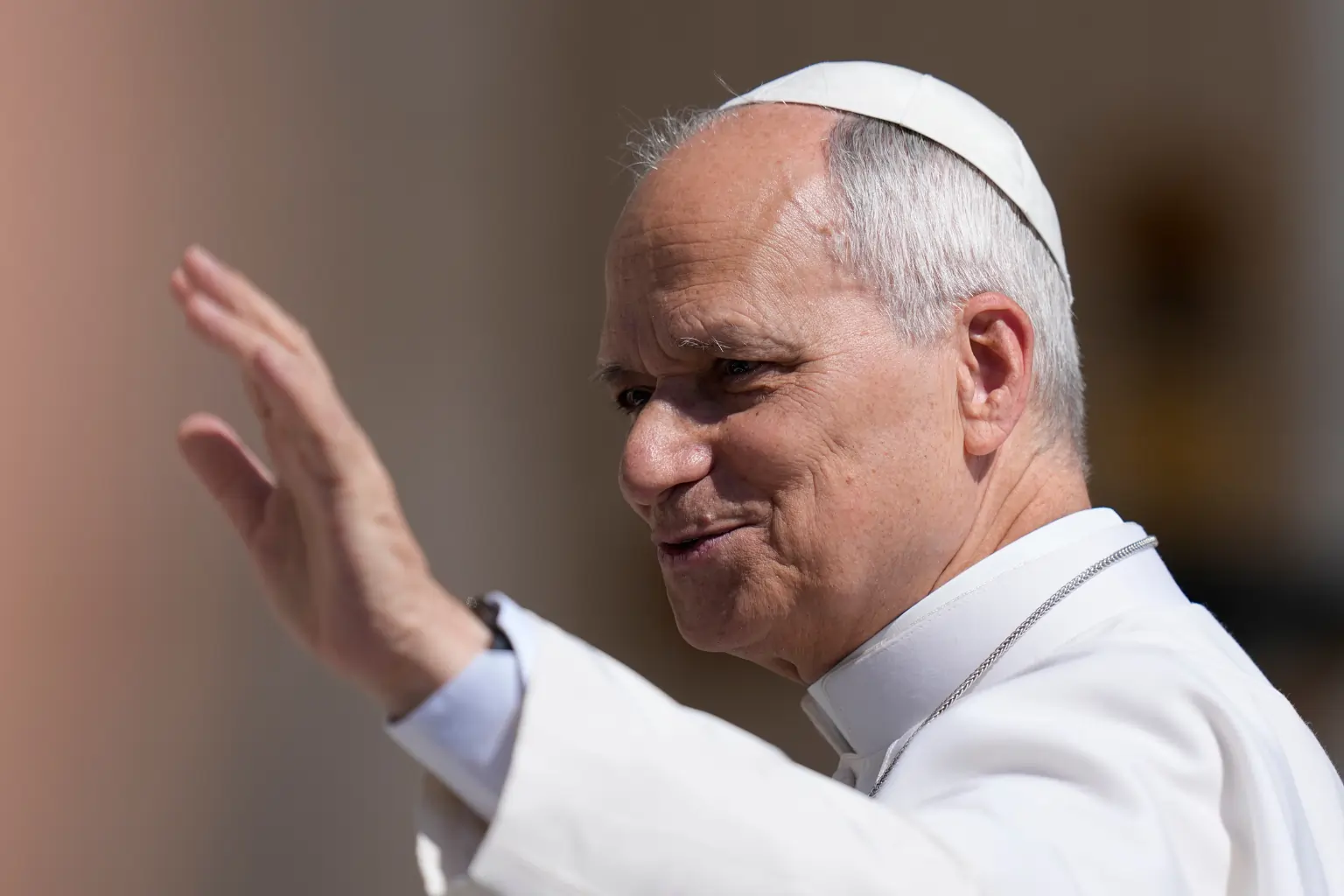
Pope Leo XIV waves as he arrives for his weekly general audience in St. Peter's Square at the Vatican, Wednesday, May 27, 2026. (AP Photo/Alessandra Tarantino)


Earlier this week, Pope Leo XIV presented his first encyclical: a letter from the pope to the Catholic Church and its leaders. The 42,300-word document, titled Magnifica Humanitas, or “Magnificent Humanity,” outlined his thoughts on technology—with a specific focus on artificial intelligence—and called for remembering the importance of people as we integrate it into our lives.
While the document was presented on Monday, it was actually signed on May 15 to mark the 135th anniversary of Rerum Novarum, an encyclical written by his namesake, Pope Leo XIII, in 1891 to provide Catholics with guidance amid the Industrial Revolution. The current pope sees AI as potentially having a similarly revolutionary impact on our world.
At the same time, his letter encourages Catholics and all “people of good will” to be wary of the potential impact artificial intelligence could have on our culture, without being fearful of the technology itself. In his view, the chief danger is far less dystopian than many of the books and movies featuring a future dominated by AI might suggest.
Rather than artificial intelligence conquering humanity on its way to taking over the world, Leo suggests a far greater risk is humanity giving up our position in God’s created order and elevating our own creation instead.
Is he right? Let’s take a closer look.
Are we building Babel or Jerusalem?
Leo frames the conversation around AI by positing that the technology presents us with two choices, both of which he likens to stories from the Bible. The first is that artificial intelligence is akin to a modern Tower of Babel. If you think back to the story in Genesis 11, the Tower represented humanity’s attempt to “make a name for ourselves” (11:4) rather than embracing the identity they had already received from the Lord as a people made in his image (Genesis 1:27).
He argues that Babel “reveals the limits of any effort that, however grandiose, arises from self-affirmation, sacrifices human dignity for efficiency, and aspires to reach heaven without God’s blessing.” We’ll discuss those parallels more in a moment, but for now, it’s worth noting that the basic similarities in both the impulse behind much of AI’s development and the ways in which it’s used mirror Babel quite well.
However, Leo argues it doesn’t have to be that way.
The other story he presents is from Nehemiah, where the post-exilic Jews attempt to rebuild the walls of Jerusalem. In this view, AI could succeed and be a boon to humanity so long as its development is undertaken in partnership with one another and in such a way as to receive the Lord’s blessing in the process.
In short, it’s a choice between trying to replace God and working with God.
Leo is clear on which approach is more biblical, but the larger question is whether a Nehemiah-like approach is realistic. After all, humanity doesn’t exactly have the greatest track record of walking alongside the Lord when running ahead of him is also an option.
If there was ever a time to get it right, though, this would seem to be it.
“A valuable tool that requires vigilance”
In one particularly poignant part of his encyclical, Leo describes AI as “a valuable tool that requires vigilance.” As Ross Douthat goes on to describe, “Leo isn’t standing athwart Skynet yelling ‘Stop’; he’s blessing AI, to a point, while warning that the line between Babel and Jerusalem runs through every nation, every corporation and every human heart.” And, as a result, we all have a role to play in ensuring that artificial intelligence remains a tool rather than an idol.
Yuval Levin speaks to this tendency toward idolatry with AI, warning that the technology presents us with the very real possibility of “turning our tools into idols, and thereby becoming little more than tools ourselves.”
Of all the dangers posed by humanity’s embrace of artificial intelligence, this tendency toward self-serving idolatry is the most dangerous, and the pope is right to emphasize it.
Most of our modern idols look relatively little like the golden calf or household gods we read about in the Bible. Rather, they tend to take the form of our phones, friends, jobs, or even our families. Anything that takes God’s place as our highest priority is an idol, and our world is full of them.
Moreover, AI makes for a particularly pernicious option because it is among the most difficult to recognize as an object of worship since it’s often more of a tool through which we can worship ourselves.
What does it mean to be human?
Humanity’s first sin was the desire to be like God. Creating artificial intelligence is just one more way we can try to emulate our own creator while attempting to prove ourselves to be his equal. Such an effort is doomed to fail, of course, but it could very well lead to a similar outcome to what we see in Genesis 3.
The dystopian futures often envisioned for AI revolve around a very similar rebellion to humanity’s. So many of the movies, books, and stories about artificial intelligence pivot at the point where AI begins to believe it is entitled to be our equal, then rejects us as we once rejected God. There would be a tragic irony if humanity’s final mistake mirrored its first.
Yet, even if those stories remain fiction, they point to the unsettling reality that Leo writes about in “Magnificent Humanity.” As artificial intelligence gets closer to resembling real intelligence, it will increasingly call us to question what distinguishes us from the technology we’ve created.
If we define ourselves by our ability to think or our capacity to work, it won’t be long before AI can surpass us (if it hasn’t already). If we look to our ability to relate to one another or find community with others, there are already countless examples of people turning to technology for that purpose as well.
Ultimately, the questions of what makes us unique from the artificial intelligence we’ve created require an answer that goes back to the Bible. What sets us apart from the rest of God’s creation and our own is that we are made in his image. Every other definition of what it means to be human will fall short of Scripture’s because the imago Dei is God’s answer to that question, and nothing else can compare.
Is his answer enough for you? Are you content with finding your identity in the Lord rather than in your accomplishments or some other characteristic you can call your own?
I suspect most of us know the answer we’re supposed to give, but unless we’ve embraced that answer, then we will constantly struggle with the pull to find our identity in something other than our relationship with God.
How strong is that pull in your life today?
Quote of the day:
“To worship God in truth is to recognize him for being who he is, and to recognize ourselves for what we are.” —Brother Lawrence
Our latest website resources:
- First the roof, then the rest
- Iran deal problems, Spencer Pratt for LA Mayor, Pope’s AI warning, Kyle Busch & New York Knicks | Ep. 71
- Everyday Evangelism: The BLESS Method with Kevin Palau
- Does the anti-weaponization fund grant justice or subvert it?
- The altars of our culture’s excess


