



Note: This episode was originally published on September 17, 2025 and was one of our most popular conversations over the last 12 months. We're currently taking a summer break for the month of July, but we will be back with new episodes starting on August 5th.
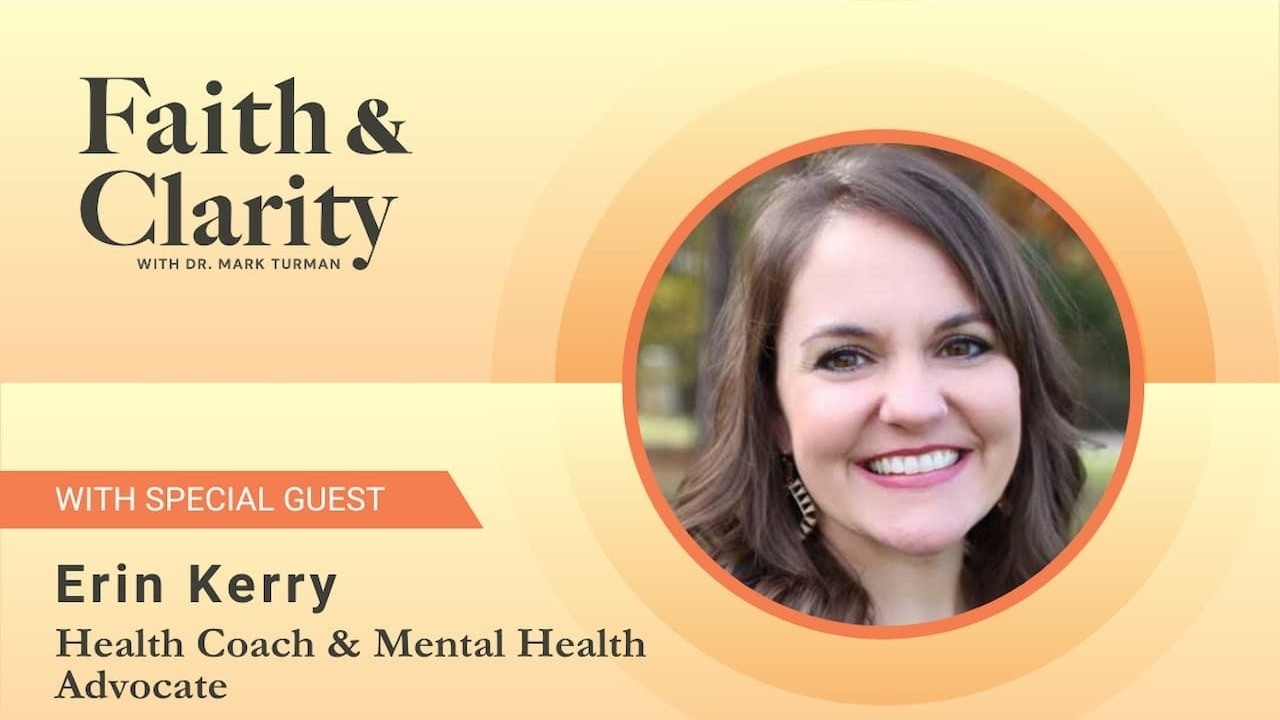
On this episode of Faith & Clarity, Dr. Mark Turman welcomes health coach and mental health advocate Erin Kerry for an honest conversation about the labels we carry and how to live beyond them. One in four Americans struggles with a diagnosable mental illness every year, and for many, those diagnoses come wrapped in stigma, shame, and judgment. Erin knows this firsthand. By age eighteen, she had been labeled with PTSD, depression, and bipolar disorder. Today, she’s living symptom-free and helping others find the same freedom.
Drawing from her new book, Live Beyond Your Label: A Holistic Approach to Breaking Old Patterns and Rediscovering a Healthier You in Mind, Body, and Spirit, Erin shares how faith, functional nutrition, and self-advocacy work together to bring healing and wholeness. She introduces her LIVE process: addressing stress, uncovering root issues, nourishing the body, exercising the body and brain, and living in wholeness, offering a roadmap to integrated health.
If you’ve ever felt defined by a diagnosis or trapped by a label, this conversation will encourage you to see yourself as God does, discover practical ways to care for your whole self, and take your next step toward freedom and hope.



Topics
- (00:00) Introduction
- (00:30) Addressing the mental health crisis
- (01:39) Meet Erin Kerry: Health coach and advocate
- (02:57) Erin's personal journey with mental health
- (07:44) Understanding functional medicine
- (19:47) The importance of labels and identity
- (26:19) Biblical perspectives on labels
- (32:22) Advocating for yourself beyond labels
- (38:09) The impact of trauma and adverse experiences
- (43:00) Faith and mental health: A holistic approach
- (53:55) The role of nutrition in mental and physical health
- (59:52) Conclusion
Resources
- Ask Us Anything: [email protected]
- How has Denison Forum impacted your faith?
- Denison Forum | North Texas Giving Day
- Live Beyond Your Label: A Holistic Approach to Breaking Old Patterns and Rediscovering a Healthier You in Mind, Body, and Spirit
- Erin's Website
- Sparking Wholeness Podcast
- Erin’s Instagram
- Erin’s Facebook
- Check out Erin’s free Bible app devotional, Reset Your Stress Response with Scripture
- Also available on the Life Bible app
- What is Christian self-care? A conversation with Erin Kerry
- How can a Christian deal with anxiety?
- How to practice biblical self-care
- Why the church doesn’t want to talk about trauma
- The truth about triggers: What the church needs to know about trauma
- Should I take meds for my depression? A Christian approach to the mental illness epidemic
- Are you SAD? How to fight against the winter blues
- Does the Bible say being anxious is bad?
About Erin Kerry
Erin Kerry is a health coach and mental health advocate. She encourages people to live beyond their labels, sparking hope and wholeness each week through her podcast, Sparking Wholeness. Erin knows how suffering from a chronic illness can infiltrate every area of life. By the age of 18, she was given the labels PTSD, depression, and bipolar disorder. Today, she is living symptom-free. She empowers people to be their own health advocates so they don’t have to be limited by a label or diagnosis. She and her husband, Richard, live in Tyler, Texas, with their three kids: Isabel, Roman, and Rhett.
About Dr. Mark Turman
Dr. Mark Turman serves as the Executive Director of Denison Forum, where he leads with a passion for equipping believers to navigate today’s complex culture with biblical truth. He is best known as the host of the Faith & Clarity podcast and the lead pastor of the Possum Kingdom Lake Chapel, the in-person congregation of Denison Ministries.
Dr. Turman is the coauthor of Sacred Sexuality: Reclaiming God’s Design and Who Am I? What the Bible Says About Identity and Why it Matters. He earned his undergraduate degree from Howard Payne University in Brownwood, Texas, and received his Master of Divinity degree from Southwestern Baptist Theological Seminary in Fort Worth. He later completed his Doctor of Ministry degree at George W. Truett Theological Seminary at Baylor University in Waco.
Before joining Denison Forum, Mark served as a pastor for thirty-five years, including twenty-five years as the founding pastor of Crosspoint Church in McKinney, Texas. Mark and his high school sweetheart, Judi, married in 1986. They are proud parents of two adult children and grandparents to three grandchildren.
About Denison Forum
Denison Forum exists to thoughtfully engage the issues of our day from a biblical perspective, helping believers discern today’s news and culture through the lens of faith. Led by Dr. Jim Denison and a team of contributing writers, we offer trusted insight through The Daily Article, a daily email newsletter and podcast, along with articles, podcasts, interviews, books, and other resources. Together, these form a growing ecosystem of Christ-centered content that equips readers to respond to current events not with fear or partisanship, but with clarity, conviction, and hope. To learn more visit DenisonForum.org.
All episodes are produced by Sound of a Rose. For more information, you can visit soundofarose.com.
EPISODE TRANSCRIPT
NOTE: This transcript was AI-generated and has not been fully edited.
Mark Turman: [00:00:01] Hi friends, this is Mark. Welcome to Faith and Clarity. Summer is here and like a lot of you, our team at Denison Forum is taking a little time to rest, recharge, and reconnect with family and friends. So for the month of July, we're going to be taking a step back from producing new episodes, but we're not leaving you without something great to listen to. Over the next four weeks, we're going to be bringing back some of our most popular Faith and Clarity conversations, episodes that clearly resonated with you and that we think are worth another listen or maybe a first time listen if you're newer to the podcast. These conversations are about faith, culture, and the questions that matter most. We're grateful for every one of you who tunes in, shares episodes, and keeps engaging with the things we talk about here. This community means the world to us. So enjoy your summer, slow down when you can, and we'll be back with brand new episodes in August. Until then, let's get to one of your favorites.
Mark Turman: [01:04] Welcome to Faith and Clarity with Dr. Mark Turman. We're glad to have you along. Remind you that this is a podcast of Denison Forum, and you can always find more helpful resources to see the world through a biblical lens at denisonforum.org. We want to help you live by faith, not by fear, and we do that by trying to explore and explain things from a biblical perspective because we don't want to escape our culture, we rather want to engage it with hope through the promises and truths of Jesus Christ. Today we're going to have a conversation. Uh, had a little trouble just thinking about what kind of title I wanted to give this. Uh, but I'm going right now with the working title of Christians pursuing health in the biggest way that you could define health in the current mental health crisis. Some of you may remember that that May is mental health month. September relates to that as suicide awareness month. Some of you may also recognize the name Leonard Sweet, a, uh, theologian in our day. A couple of years ago, Leonard Sweet included this quote on X. He said, one person dies of suicide every 40 seconds somewhere in the world. That's somewhere between 800 and 900,000 people every year since the year 2013, and that number is double the number of people who are lost to violent crimes like murder. 90%, Sweet says, of these global suicides are from mental health issues. When will we start taking mental illness and mental health seriously? So let's roll. We're going to jump into that conversation. My conversation partner is one of those that ministers in this space. Her name is Erin Kerry. Erin is a health coach and a mental health advocate. She encourages encourages people to live beyond their labels. We're going to talk about that today, sparking hope and wholeness each week through her very popular podcast called Sparking Wholeness. She knows something about suffering from a chronic illness and how it can infiltrate your life. By the time she was 18, she was given labels such as PTSD, depression, and bipolar disorder. But today, through God's help, she is living symptom free. She now works and ministers to empower people to advocate for their own health so that they don't have to be limited by a label or a diagnosis. She and her husband Richard live in East Texas, which is dear to me, and they have three kids, Isabel, Roman, and Rhett. So, welcome to the podcast, Erin. We're glad to have you.
Erin Kerry: [03:40] Yeah, thanks for having me. I'm glad to be here.
Mark Turman: [03:42] Yeah, looking forward to the conversation and to touching on your new book. I want to plug that for you. Live Beyond Your Label: A Holistic Approach to Breaking Old Patterns and Rediscovering a Healthier You in Mind, Body, and Spirit. And uh, we want to definitely talk about that connection of mind, body, and spirit. But, uh, tell us a little bit about your background, Erin, and uh, some of your journey. Like I said, uh, not everybody I talk to, uh, says, you know what? I, I was labeled with depression and things like bipolar, PTSD from a pretty young age and how that shaped your understanding of yourself, what we commonly refer to as identity, how it, uh, how it may have hindered some of the early development in your life and ultimately led to the ministry and the work you're doing now. Talk a little bit about that background.
Erin Kerry: [04:32] Yeah, I mean, I like to consider myself an early adopter of some of these labels. I think when I was diagnosed, when I was diagnosed, definitely with bipolar disorder, it was in fall of 1999. So, I mean, this was in the 1900s where we were still just learning about what kind of medications to use to help support people. And at that time, they they called it manic depressive illness. At first, and now it's shifted into bipolar one and bipolar two. They didn't even get that far with me. They were just like, yeah, it's it's you're having a manic episode. This is bipolar disorder. But, um, I did grow up as a pastor's daughter. And so one of the things that I wrestled with the most with my labels that I do talk about quite a bit in my book is is trying to figure out where is the line between my my spiritual world, my spiritual life, my connection with God, and then then where does this identity as somebody who suffers from this mental illness, like where does this come into play? And does this make me a bad Christian? Like, shouldn't I be praying harder? I mean, I remember being in eighth grade and feeling just waves of sadness and overwhelm and burnout. That's when I first really started struggling with depression and going, well, gosh, I should just pray harder. I did take comfort in in the Psalms. I knew that David struggled with lots of big feelings, lots of big emotions, and some of those were the unpleasant ones that I was struggling with, but I couldn't figure out how to snap out of it. And I what was interesting at that time is, you know, we weren't talking about mental illness in the church or mental health in the church at all. And so I felt a lot of shame for what I was struggling with. And the more I pressed things down, the more it would come up. And so my parents did all the things that they could do. Ultimately, I ended up on, you know, all the antidepressants and medication and then come to find out some of the medication was sending me too high and late in my high school years to where my freshman year of college, I had my first manic episode, which mania, I want to make sure people understand bipolar disorder is not a personality trait, right? It's not just, um, multiple, we're not multiple, but like split personalities. It's not like you're happy one day, sad the next day, and you're just going to switch on an instance. For me, it was periods of time where I had weeks with this burnout sort of depression, this deep whole body aching sadness that filled me. And then I would have weeks of heightened activity and, um, as you know, I've I've written for Denison Forum. I'm a writer. I love writing and I would spend hours and hours at night writing for, you know, coming up with stories and ideas and I had a lot of creativity and then I would talk really fast and and then that turned into risky behavior to where my parents were like, all right, something's not right here, you know, and they took me in, got my diagnosis, got put on more meds and anybody who's been on bipolar medication, they are very hard hitting. Um, and then they kind of numb you. And I was used to having these waves of excitement and waves of sadness. That was my pattern. That's what I knew. So being on the medication, numbing me out didn't feel so good. And eventually I just became really angry at God and, um, it resulted in an unexpected surprise pregnancy at the end of my senior year of college because when you're taking medications the way that, um, I was taking them and you're also drinking alcohol, it comes with blackout experiences and, um, lots of lapse in in judgment there. But, um, I ended up pregnant with my daughter and they said because of the medication that I was taking at the time, maybe termination would be a good idea for her or for for the pregnancy. That was encouraged. And, um, even just the nature of what I was going through, my stability was a question, like, should we, should she be put up for adoption? Should she be placed for adoption? Would that be the more loving thing to do? And ultimately, I chose to raise her and, um, that was a big wake up call for me and that really caused me to, I I still was struggling after I had her, but, um, I started incorporating some other things that that are all the things that show up in the book.
Mark Turman: [08:28] Yeah. And so really this is, uh, an expression, the book and and also your wider ministry is an expression of your own experience and your own journey through a lot of this. It's a lot of ways God leads us, right? He leads us, um, we've heard pastors say for many years, God never wastes a hurt, uh, if you put it back in his hands, he can do amazing things with it. And that, uh, sounds like so much of what your journey has been, has been putting it back in God's hands and saying, God, do something with this that's redemptive. Absolutely. That's that's healthy. Um, I wanted to touch on just, uh, kind of the larger framework of not only your own story, but how this book comes to us, which is you practice yourself, uh, and you also advocate for what is sometimes called functional medicine. Um, and I want you to kind of unpack that term. It's fairly new to me over the last, I guess, five, 10 years maybe. Uh, sometimes people use the term holistic, uh, medicine or a holistic approach. Uh, sometimes you may even see the word homeopathic connected to this in some way. Um, but can you kind of explain, uh, what functional medicine is, uh, and a little bit about how you have built a ministry that, uh, incorporates faith. You talk about mind, body, and soul. How does that all kind of come together under this umbrella?
Erin Kerry: [09:53] Yeah, I love talking about this because it was not something that I grew up with. You know, I grew up with the traditional, mainstream, conventional, Western medicine approach, whatever you want to call it. But, uh, functional medicine, what I consider to be how I practice as a coach and the thing that has really restored a lot of health to my mind, body, and spirit is the fact that all things are interconnected and that our symptoms that we experience typically come from some sort of imbalance in our internal environment, our physiological health environment, or in our external environment as well, whether that's, um, something that's happening relationally with us or something that's happening inside that's imbalanced. And what functional medicine does is instead of just saying, okay, well, here is the diagnosis, let's treat it with, you know, let's just do a medication. It digs underneath. It's more of a, um, peeling away the layers of the onion. And I can give you the definition here, according to the Institute for Functional Medicine. It is a systems biology based approach that focuses on identifying and addressing the root cause of disease. Each symptom or differential diagnosis may be one of many contributing to an individual's illness. So, for example, let's take depression, for example, or, um, even bipolar disorder. Typically, what we hear is that those are considered disorders that are based in a chemical imbalance. But what we know now is that there's a lot more going on in the body to create depressive symptoms than just a chemical imbalance. And the many, many experts now are considering depression to be an inflammatory condition. Well, if we're talking about inflammation, the root of inflammation is a lot more than just a serotonin issue or a dopamine issue or norepinephrine or some of these things that we try to address through medication. And so what I would look at from a functional medicine approach, if somebody came to me with the symptoms that I had in my early life, is I would look at, um, all of the things that affect their diagnosis, which would be lifestyle, genes, nutrition, sleep patterns, inflammation, as I mentioned, medications, vitamin, mineral deficiencies, immune health, metabolism, digestive health, toxin exposure, hormones, past trauma. I talk about trauma a lot. That can really, um, disrupt the function, the balance of the internal environment of the body. And so I just take all of the puzzle pieces and go, okay, what can we do to support this unique person's body to give them some tools in a lifestyle approach. I don't, I don't prescribe medication. I don't take anybody off of their medication. I try to meet people exactly where they are. We do know that many of the medications that people are are prescribed create deficiencies in the body. So how can we rebalance that and how can we restore those nutrients to bring a felt sense of safety back in the body? I believe that we are all born, we're all designed with a need for safety and a need for connection. And that ultimately is what we would get from what I would consider our primary nourishment, which is our heavenly Father, right? But when we go through enough life experiences that result in physiological imbalances or relational imbalances or trauma, any of these things, that can really disrupt that felt sense of safety. That can disrupt safety and connection to where it can make it in my, in my case, almost impossible to connect with my heavenly Father because I had so many blocks. And so this is just a way to dig down deep and go, what could we do to enhance that connection through what is lacking in the body?
Mark Turman: [13:19] Yeah, it's just so important to think about as you were were talking, I started seeing, uh, people's faces come to mind. Uh, I pastored churches for 35 years. Uh, and across those years, uh, ran into several people, usually young people, but not exclusively young people that got to places where they actually had a psychotic break. Uh, I'm thinking of a couple of individuals, uh, they were just pushing themselves really hard at that season of life. Uh, and they lost touch with reality and, uh, a couple of cases, they were hospitalized. They could have easily ended up in the criminal justice system, but some, some discerning police officers took them to the hospital instead of to the jail. And when they were initially assessed, uh, they were thought to be, well, they, they may need to be committed to a mental institution because they are so ill. But then after being in a hospital setting and being put in an environment where they could sleep consistently, where they could eat, and then get up and move around in a in a healthy and controlled environment, all of a sudden they came back to themselves. Um, because they had been pushing themselves too, too far, too hard. Uh, they had not been doing some of these basic things like sleeping and eating in a regular way. And it kind of illustrates what you're talking about that everything is connected. Um, and in our culture, we've spent a pretty good amount of time trying to compartmentalize our lives. Yes. Um, and to put them in these buckets as if the these buckets don't talk to each other. Yeah. And don't spill out on each other. Um, so talk about that from a little bit of what you've experienced and how you work with what you refer to as traditional healthcare, uh, and this broader, more holistic approach. Um, uh, do you work with other medical professionals that are more, uh, I have, I have family members that have said to me, you know, the Western traditional healthcare system is really good at handling acute problems. Like if you have a car wreck, you're going to be really happy that there's a doctor and a hospital and a surgeon that can maybe put your bones back together, but not as effective perhaps in some ways with the chronic, uh, realities. Um, we deal with that in my family with a chronic health issue as well. Um, talk about that a little bit about how traditional healthcare and broader, more holistic approaches may be learning to collaborate and how that works in the work that you do.
Erin Kerry: [15:51] Yeah. Now, I will say I am a former teacher, a former middle school teacher. So collaboration is something I am so passionate about because that's what we did with my students. We had a team of teachers. We had the math teacher, the science teacher, the history, the English, right? And we would work as a team to help that student restore balance. And so what I do now is I I actually work at a counseling center with therapists who are trained to help support, you know, the verbal processing or maybe trauma therapy from a somatic standpoint. Um, and so we are collaborating as a team. And I also have quite a few medical professionals who, whether they're nurse practitioners or medical doctors who I refer to, they refer to me, and we collaborate together when we have, of course, it all, we have to have the the signed release of agreement and all of that. But I think it can be really helpful because like you said, for the medical system that we have right now, it does a really great job with those acute needs, especially, I mean, some people, they need immediate medical care with a medication or what have you. But many of our, our medical professionals don't have the time to help somebody walk through, well, what does a daily routine look like for you? What could you do for your sleep? I mean, they can say, I mean, I was told, yeah, you know, take your medication and sleep more. That's what I was told when I was diagnosed. And it's great advice. It does help a lot of people who are struggling, but I did need a little bit more one on one attention and support. And so that's what I do is I go in and I go, okay, well, let's look at, we can look at some lab tests, maybe you've had run through your doctor, or I can run, there's various lab tests that I'll offer as well from a nutritional standpoint to see where are some deficiencies and how can we rebalance with what you're eating, with with what you're thinking about. I mean, that, um, in my book plays a huge role in the very first part of my book is just how our thoughts impact our health and how we can just get really trapped. We can talk about this later. I'm jumping ahead, but we can really get trapped in negative self talk that God has designed our bodies to respond to all stressors out of protection, right? And so if our bodies pick up on a stressor from our brain, our bodies are going to act on that stressor in a in a state of survival and that creates a survival response in the body, which can create digestive issues, um, a lack of nutrient absorption and digestion. It can create all sorts of inflammatory conditions down the line that we don't always think of as being connected to our mind or what our brain is doing or the state of stress that we're in in our life, but it's absolutely all connected. And so what I like to do is just to really just talk to people. I I love talking to people. I mean, I I'll I'll talk to anybody. And I like to ask them questions about their lives. I want to get into their heads and I want to know like what are you struggling with and how can we help you get out of that pit? One, because I was there, you know, and I wish somebody had sat with me and gone, you know, those gummy bears that you eat when you're stressed might actually not be the best thing for your brain in the moment, right? Or whatever it is. Um, you know, the fast food that you keep craving, maybe you could add some vegetables to that or whatever it is. I wish somebody had thought to tell me these things were connected. I had no clue that a lot of these lifestyle habits or things that, um, that I recommend to my clients, I had no idea that they would have benefited my brain. That was so foreign to me for many, many years until I experienced it myself. It was like, oh, wow, I, I mean, I've been, I don't know if I think you might have read that in my bio. I've been symptom free. I always joke. I I ask my husband to make sure because husbands know, but I've been symptom free for definitely throughout the duration of our marriage. And I, you know, I've struggled with trauma is always something that can kind of pop back up at us like a game of whack a mole, right? Um, and so I've struggled with there are flashbacks I struggle with and traumatic memories that can happen. Um, but I don't struggle with the mania, hypomania, depression, other than, you know, seasonal here and there when there's not as much sunlight, when it's cold, I don't like it. I'd rather just stay home and sleep. But nothing to the extreme that I struggled with before. And this I've been married for, oh gosh, 16 years. I've been married for 16 years.
Mark Turman: [19:52] Yeah, you're supposed to know that number.
Erin Kerry: [19:54] Yeah, I think the wives are supposed to know that. Is that sexist to say? But, um, yeah, I am supposed to know that. Um, but yes, 16 years and he would say he he doesn't know what a manic episode would look like from me because I I put a lot of protections into place early on.
Mark Turman: [20:09] Okay. Yeah, and just so much to think about there and like I said, we, you know, we don't want to throw the baby out with the bath water. There's, you know, we do have, uh, an important healthcare system. Yes. Uh, that is, I I serve on a hospital board, so I know the system is basically overwhelmed and it's not really designed to spend a a significant amount of time with people. Um, and that's great where we have people like you come in and say, hey, let's take a a slower, longer, broader look at how all of these pieces are fitting together. Um, and how it's going to take, um, some different changes and rhythms and patterns for these things to truly get better. Yeah. Uh, so let's dive in a little bit further into… Can I ask something real quick? Go ahead. I just say I want people to understand it's not an either or. It's not you're doing traditional medicine or functional medicine. It's a both and. I mean, these things really do complement each other. Now, now you mentioned homeopathic support. Homeopathy is a whole different, it really is a different form of medicine. I don't practice that. There are naturopaths that are more trained in that. But if we're just talking about functional medicine with traditional medicine, it's a both and approach. So I think that's important to distinguish.
Mark Turman: [21:18] Yeah. And this does functional in this case have to do pointing again to systems and processes and the inter, uh, the interconnectedness of how all of those systems work, right?
Erin Kerry: [21:29] Yes, absolutely.
Mark Turman: [21:31] Okay. So, uh, you talk about in the early parts of the book, uh, you talk about, uh, where these labels come from. And we live in a very label rich environment. Uh, but you talk about, uh, three categories, diagnostic, experiential labels, and and and the interesting one, self-assigned labels. Um, talk about, um, how those labels come about. Yeah. Uh, and how sometimes they're helpful. Um, they can be kind of pathways to defining and understanding some things about yourself, but they also can be very hindering. So kind of talk about the pros and the cons there.
Erin Kerry: [22:09] Oh, yes, I love this because it our labels help us to make sense of symptoms, right? Whether it's a diagnostic label. So that first category is diagnostic. If you are struggling with, say, um, and something I would say too is 26% of people, as of right now, the research says 26% of people have been diagnosed with a mental health condition. 50%, one in two, 50%, half of our people have been diagnosed with a chronic illness. And I would say that a lot of those chronic illnesses, side effects can be depression and anxiety because that is a side effect of struggling with a chronic illness on a day to day basis. It can be debilitating, whether it's fibromyalgia, autoimmune disease, chronic fatigue. I mean, these are things that I see day in, day out, and they're growing exponentially right now. We are seeing an increase in all of those things. And so the label, especially that initial diagnosis can be really helpful. I there is an aspect of relief when I was diagnosed with bipolar disorder because it was like, yeah, I know something is not right. Tell me what it is, right? Like I I I don't always feel this way. So explain to me what is going on. So there was an aspect of relief there. I was also diagnosed with mononucleosis at the same time, which is a whole different rabbit hole to go down that I talk about in my book and I think it relates to this concept of psychoneuroimmunology where our brain and our immune system are connected, like a brain on fire aspect. But, um, the the label of bipolar just diagnosed disorder was the one initially for me. I was like, oh, well, that makes sense. But then I felt like it it took root in me to the to a negative extent where it was, oh, well, I'm that girl who's on medication because she's crazy. All these things that we pick up on culturally becomes negative. Or I felt like I was held back from certain things. Like I I wanted to be a writer my whole life and I thought, well, gosh, I could never finish a book because I have these bouts of depression and mania, even on the medication, and that's something else that we could talk about is that medication works for a time until it doesn't. And so even the medication did what it could, um, but I still struggled with my mental health, as I know countless people do, but it's kind of a taboo talk topic to discuss is that sometimes these medications don't work the way we would like them to. And so that's a diagnostic label. We have the experiential labels, which we pick up on from something like trauma or something like chronic bullying, chronic PTSD or complex PTSD, CPTSD is where we have these experiences that are going on for an extended period of time that really disrupt our felt sense of safety and leave us with a nervous system that's kind of always on alert, that's just kind of hypervigilant and it really changes our interaction with people. It changes our interaction with ourselves, with God. Um, it completely alters the way we show up. And so then that can become a label. We also have the labels that we give ourselves, whether that's from, you know, things we were told and then we just internalize because as especially when we're young, we just pick up on, well, I have a focus issue. I'm just unfocused. That's just me, you know, or I, um, I I always forget things. I'm forgetful. That's my label. So it doesn't mean that these labels are negative things. I'm a firstborn. I take on a whole lot of qualities of being a firstborn daughter, right? Um, but that that's neither positive nor negative. It's it's just what it is. And so labels can help us make sense of things. I think when the label becomes an identity, that's where we see a lot of struggle. That's where I experienced a lot of struggle. That's where a lot of my clients struggle with, okay, what does this mean now that I've been diagnosed with X? How do I live out my life in this way? Does this prevent me from living a thriving life? Does this prevent me from showing up how I want to in my marriage, as a parent, in my relationship with God? And we can really get in our heads about it and and it it almost becomes like this negative, like it's like this mosquito that's just always there in our head buzzing around, um, to remind us that there's a deficiency somewhere. And some people, they have they get diagnostic labels and it helps them to make sense of their symptoms. They get the support they need and they're okay. But my experience is that most of us have some sort of unpleasant label that we have internalized as part of our identity. And that can really interfere with this abundant life that we do receive in Christ and that we are as as believers, we are called to so much more than these earthly, I mean, I think about, you know, not conforming to the world, to the patterns of this world. The patterns of this world, the world wants to label us, right? I mean, we live in an age right now where we're labeling everything. And that's not a bad thing. Again, ADHD is probably one of those labels I could have had had I been born 20 years later, um, with just the way that my brain works. Neurodivergence, some of these things are helpful, but they become part of our identity. Oh, sorry, that's just my ADHD or, oh, my mom's bipolar, she's crazy, just whatever. You know, and they become patterns of personality traits instead of, wait a minute, what can I do to support myself day in, day out to live this abundant life?
Mark Turman: [27:09] Yeah, it just it just seems like, um, we're overwhelmed in our culture with making attempts to build an identity by ourselves. Yeah. Um, and we and we talk about this, uh, a lot at Denison Forum. Um, that human beings were never designed to create their own identity. Our identity emerges from who God is. Absolutely. And and lives and thrives, flourishes in our relationship with him. You talk about that some in this overall connection. Uh, but that's a big part of this as well. But it seems like maybe we're grabbing and creating all of these labels in different ways in our attempts to try to understand ourselves and to build our identity. Uh, and that as you point out, at some point, when a descriptor becomes a label, that's where it may be detrimental to us. And so, all right, well, we're going to take a short break, Erin, and then come back and I want to talk a little bit more about labels and about how that affects our thinking and that plays into our overall health. So we're going to step aside and catch our breath and we'll be right back.
Mark Turman: [28:12] I'm really glad you're here listening to Faith and Clarity. It matters that you're taking time to slow down and think biblically about what's happening in the world. But we're coming up on an important moment. Our summer campaign ends July 31st, and we're still working toward an $800,000 goal to keep this content going and growing. And the need isn't slowing down. People are still trying to make sense of a noisy, confusing culture. And without a clear biblical voice, they're left searching for answers in the wrong places. So if this podcast has helped you, now's the time to give. Go to supportdf.org before July 31st. Find a link to give in today's podcast episode notes. Because when you give, you help more people not just understand what's happening, but respond with truth, wisdom, and faith.
Mark Turman: [29:17] All right, we're back with Erin Kerry, talking about, uh, mental health and how do we live past our labels? Uh, Erin, I just was wondering as I was reading through your book and just understanding what you were trying to help us to get our arms around, I was just wondering, are there labels in the Bible that God applies to us that can be helpful? Some people would maybe go so far as to say, well, you know, the Bible says I'm a sinner. I don't like that label. Uh, and yet it's a reality that we need to confront because if we don't confront it, uh, in the way that God tells us to with his grace and through a relationship with Jesus, then we're not going to be on the right road. Uh, what kinds of labels might, does this even apply, uh, from a biblical context, do you think?
Erin Kerry: [30:03] It absolutely applies. And I I think, I will also say on the flip side of that label of I'm a sinner, which is foundational to what we believe in the Bible, right? Is if you grow up in a church and that's all you hear, that can turn into a shame statement. And that's a whole other rabbit hole to go down. And I think for me, growing up in a church and focusing so much on my sinful nature, focusing so much on this is my nature, this is, I forgot that there were other identity markers that Jesus offers us. And one of my favorite verses that I do quote in the book in that very first chapter is it's actually from the message version. It's Matthew 11:28 through 30 where it says, are you tired, worn out, burned out on religion? Come to me, get away with me and you'll recover your life. I'll show you how to take a real rest. Walk with me and and work with me. Watch how I do it. Learn the unforced rhythms of grace. I won't lay anything heavy or ill fitting on you. Keep company with me and you'll learn to live freely and lightly. Those labels are heavy and ill fitting for many of us. Even that label, some of us can't get past that sinner label. It's really hard to do, no matter how much we read and no matter how much we try, we are human and shame is is I think the work of the enemy. Shame can really get inside us and take over. But Jesus does not put that burden on us. He is not, when we believe in him, when we choose to trust in him, put our faith in him, instead of labels, he offers us the the free markers of of loved, redeemed, precious, forgiven, gifted, empowered, freed. We are a new creation in him. I mean, the Bible says that over and over again through various ways. And I think that that's so important to remember because we will get wrapped up, especially if you've struggled with this, I get into this later in the book, but when you've struggled with a chronic illness or a condition like bipolar disorder, where bipolar disorder is associated with manic episodes. Manic episodes is associated with not always making the best decisions. Even ADHD is associated with impulsivity. And I know so many people who struggle with ADHD and they can't figure out, but I did this thing. It's like when our kids are little, you know, and you're like, what were you thinking? And they and they look at you like, oh, thinking was involved. That happens with certain mental health issues too. Like ADHD, bipolar disorder, the ones I can think of, I'm sure there's there's other things, but it impacts the way our prefrontal cortex is functioning, which is that that decision making part of our brain. And even people who are overwhelmed with stress and overburdened with inflammation, even inflammation itself, physical inflammation in the body can override that prefrontal cortex and kind of cause our thinking brain, our decision making brain to go offline. And so to be able to reconnect with Jesus and what he thinks of us and how he values us, that will go back in and override that activated amygdala, which is causing the prefrontal cortex to go offline. And he goes in and offers us that reminder that can ground us and bring us back to mindfulness, which is what, you know, the the new age movement has really taken on what I think God wanted us to get first, um, is is is mindfulness and meditation and understanding that we can ground ourselves in in the truth that as Hebrews 4:12, I love this so much, how God's word is living and active and it pierces through our soul and spirit and joints and marrow. I mean, that is body, mind, spirit. God's word pierces through that prefrontal cortex when we're offline, pierces through those places in our brain that can be shut off due to inflammation or our disorders. There is something to that that I think is so important, but we really do have to be consumed by the truth. We have to.
Mark Turman: [33:51] Yeah. And it's so so important that you let the authority of scripture, the the power and clarity of scripture think through that and just, you know, uh, as I was reading through and then also listening to you now, just, you know, that there's so many different things that God gives us as, yes, we are sinners that need to be redeemed by his grace, but that's only a portion of the story. That's that's more like a diagnosis than a label. Yes. Um, and that he calls us, you know, disciples and he calls us brothers and sisters and he calls us, uh, heirs and he calls us, you go so far as to call us saints. Yeah. Um, and to like, what do you mean? I I would never claim to be a saint. Well, it's like, that's what God calls you. Um, and so many of those more important grace oriented, uh, descriptors and definitions of our lives that can get lost, uh, if we're only listening to part of what Jesus says to us and part of what the Bible's trying to teach us. Um, Erin, you you talk about handling these labels and not necessarily abandoning all of them. Some of them certainly need to be abandoned because they seem to come straight out of the pit of hell in some ways. Um, but some of them are, uh, helpful at least for a season. Um, how do we work to redefine and at certain times even release labels? Um, you I love this phrase that you talk about being an advocate for your own health. Uh, my wife and I talk about that all the time that, um, if if you're expecting any health professional, uh, to ask all the questions that you want and to get to know your story as well as you'd like to get them to get to know your story, that's probably not going to happen in most of the traditional pathways. Um, but you can advocate for yourself and particularly about not only understanding labels, but even getting past those labels and letting some of them go. Talk about how that works and what are some steps to do that.
Erin Kerry: [35:55] Yeah, I think when it comes to some of those diagnostic labels that a lot of times we can't let them go. They're ever present, right? Like like truly somebody who is struggling with, um, let me think of like an autoimmune disease, you know, that impacts your energy levels, that impacts how you are showing up from day to day. This is one of those situations where it's you get to establish, you're the only person in your body. That's that's part of that advocacy, right? You are the only person who knows your symptoms. So really tuning in and instead of, you know, compartmentalizing as you how you mentioned before, we tend to do that. Like, okay, well, I'm just going to keep pushing through. I have this thing, but I'm just going to keep pushing through the way I always have and just going to make it work. Or a lot of people they'll just take the medication just to make it through, but they're not going to address any of the things because we don't want to. It's uncomfortable. We don't always, a lot of times, depending on what you've been living with, you've been living with this thing for a very long time. So if you can take a medication that's going to relieve you a little bit, you can keep pushing through. You don't have to reconnect. And so I do think there is something to be said for connecting back into the body and remembering that your body doesn't give you symptoms because it's mad at you. A lot of times your body is giving you symptoms because it's under attack in some way. And that can be driven from the HPA axis, which is our internal, I always describe it as the internal stress alert system. HPA axis stands for hypothalamic pituitary adrenal axis. And those are all, it's your body really just being in cahoots with your thoughts and that everything that you're picking up on at the brain level is sending signals to everywhere else in the body. And so if your body's responding with symptoms, whether it's, you know, a lot of people with, I I keep using autoimmune disease as an example because it's so prevalent right now and a lot of people are told, well, your body is attacking itself. And I like to pose the question, what if your body is protecting you? Because your body is is getting signals that there's a threat, that there's something going on that's making it not feel safe. So your God designed our bodies to survive threats very well. We think about Bible times, goodness, I definitely could not have survived some of those threats, right? Like invading armies and like having to go outside and do things with sheep and watch them and kill lions or whatever it was that that David did, right? Like I think about those times going, wow, those were some threats. But they had threats that were these really big threats and then there was a whole usually periods of peace. That's sympathetic stress state, which is that fight flight or freeze, and then parasympathetic, which is rest and digest. In our culture, we don't take time to rest and digest. We don't take time to slow down at all. We have a lot of micro stressors all the time. So tuning into your own body and asking that question, what is my body picking up on as a threat can be really helpful. Not because your body's against you and not because there's something wrong with you for responding in that way, even with anxiety or, oh gosh, you know, I'm really tired right now. I'm so mad at my body for doing this. Why is it doing it? Why do I have these aches and pains or all these things that we get mad at ourselves for. Instead it's like, okay, what is my body trying to tell me about my state of stress, about my load at work, about, um, my environment, my relationship status, all these things that can really become these micro stressors are all hold up right now, one of the biggest threats to our to our health right now is our phones. I mean, those alerts that are going, have we ever had access to this much information throughout the day at in any other time period of history, right? To know what's going on 24/7. I don't know if that's healthy for anybody because what it does is it just alerts our stress response system, that HPA axis over and over and over again. And so just understanding that, I think sometimes can be the first step to creating curiosity about what your body is saying to you, asking yourself how to partner, how can I partner with my body to support my body in spite of these labels? How can I work with these labels? How can I understand my anxiety? How can I partner with it? And and that's not what we want to do. We want to shut it down and we want to push it away. And I'm one of those too. I did that for a long time. Just push away the symptoms as much as I can. They just kept popping up. More and more symptoms kept popping up. It it didn't work, you know. So, um, I think partnership is is is a huge key to supporting labels and not necessarily losing them, not tossing them aside, but to understanding and creating curiosity.
Mark Turman: [40:24] Yeah, and it just, uh, you know, uh, the symptoms have a way of getting stronger and bigger when you don't pay attention to them. And, you know, can be, like I said, it becomes a, uh, an advocate for yourself rather than, uh, when I hear that word, it makes me think, well, that's the opposite of of surrendering as a victim. Yeah. Um, and and instead of saying, well, I just have to accept this label because it came from somebody smarter than me or bigger than me or more powerful than me or whatever. Uh, and and instead of just accepting those labels as being, first of all, factual and then being permanent, because I love what you said about 2 Corinthians 5:17, that God says you're a new creation. And that there isn't anything that he can't help to redeem. Uh, and he wants you to bring that story to him. That doesn't mean that he's promising health, wealth, and fame for everybody. That's not what that means at all. Um, but it is the, uh, it is the promise of Romans 8:28 that if you put all of those things in his hands, he will bring good out of it. Um, and he will do something beautiful with it if you keep putting it in his hands. And that's the the mind, body, spirit connection of this that I want to get to in just a second. But before we move to that, I just, Erin, it just feels like at times that the word trauma is overused in our culture. Um, and it becomes this mindset. I I like the way you define it and talk about it in the book that trauma is telling it it's your mind telling you it's not safe to feel safe even when it is safe to feel safe. And that that creates part of what you were just talking about, uh, an a mental and an emotional attack upon your sense of well being. Um, you know, so I wanted to I wanted to just ask you simply, has everybody in the world been traumatized?
Erin Kerry: [42:19] Yeah, I mean, we all experience adverse things, right? That is part of being human. That is part of the struggle. I mean, from from the fall, right? Good versus evil, we are going to experience adversity. Not everybody is going to have a diagnosis of PTSD. Not everybody's going to have a chronic trauma response. And that is again, when it can depend on how overloaded the nervous system gets to respond to that trauma because trauma isn't necessarily about the event. I mean, I will just say say one of my, um, big traumatic experiences when I was a kid, I experienced with my brother, my sister, they were two years younger than me, they're twins. My brother and I, um, had a diagnosis of PTSD afterwards. My sister did not. And so three different people can experience the same event and some can come out with a traumatic response or um, trauma response or PTSD and some won't. That's not to say that people that don't have these responses to trauma, it it wasn't painful, it wasn't harmful in some way, but some people recover and some people the nervous system is just constantly remembering that event. And so that's where that word triggered, talk about another word that gets thrown around a lot. I mean, ask any middle schooler right now how triggered they are and they're going to tell you they're triggered. I mean, I've got an 11 year old that told me I traumatized him a couple weeks ago. I don't know what I did, but probably told him to pick up his clothes. Anyway, point being, we do throw these words around a lot, but a trigger is a very real thing. It's when we experience something that bumps up against an old wound that our body experiences real time as if that old trauma is still happening. And newer research is even showing and I talk about that in my book is, um, trauma is not stored like a like a regular memory in the hippocampus where all our other memories are. A traumatic memory is stored in a place that part of our brain that informs our autobiographical narrative. It is something that is explaining how we're experiencing the world real time today. So trauma is real time for a lot of people. And so there are a lot of people that and it's helpful sometimes for me, right? Because it's like, oh, that person is overreacting to this, but it must have bumped up against an old wound, right? So sometimes that can be helpful. Like, okay, that did something. I think about all the keyboard warriors on on, you know, social media, right? Like, all right, they've got their own stress or hurt going on right now that this bumped against. But so all to say that yes, we all experience adverse experiences. It's really what are we doing to support our our mind, body, and spirit in spite of that that can really play a role in our healing journey. And not all trauma is going to be healed. Like you mentioned earlier, like healing is not promised, complete healing is not promised to everybody on this side of heaven. But God did give us a body to live out a purpose on this earth. And how we show up is how we live out our live out our purpose. And when how we show up is hindered because of these ongoing threats real time, because of traumatic experiences in the past, I don't I I think that that God has also given us resources in our mind, body, and spirit to help us to move forward, that we aren't left, you know, just flailing around in a deep ocean. I think that we have innate support in the body that he's given us.
Mark Turman: [45:40] Right. And and we just have to trust the goodness of God in all of that because we know that there were times when, you know, God did heal people and and still does heal people instantaneously if he chooses. But we, you know, we have plenty of examples that Paul said he had a thorn in the flesh that God decided providentially not to remove. Uh, you know, I remember a very powerful sermon that my pastor preached decades ago. Uh, he talked about one of Paul's companions, a guy by the name of Trophimus. He said of Trophimus, I left him at the city of Miletus because he was sick. He could have been sick with some kind of a mental ill illness struggle. We don't know. Um, but Paul, Paul could not apparently be used of God to heal his his teammate, his friend. Um, and he had to stay behind. Yeah. Uh, and we don't know if Trophimus ever got better. Maybe he did, but we don't know for sure. And that's just part of the mystery that we live in. Um, which kind of brings me around to this question of how faith has been so much, you've already alluded to it in so many different ways, just coming to an understanding, a deeper reality of your relationship with Christ as formative to your identity. How does that and how is that continuing to help redefine the understanding of who you are and how it can how can that help other people?
Erin Kerry: [47:00] I think one of the biggest hurdles that I had to get past is that my spiritual health and my mental health were separate from each other and that God didn't care about my mental health, that God didn't care about what was happening in my body. And when I reflect on even the Old Testament, the parts of the Old Testament that we don't normally like to read about building the temple, right? And all those details. When I reflect on all of those details of how God specifically designed for his temple back in the, you know, Old Testament days to be his holy dwelling place. We know New Testament wise that we are his temple, that we are that dwelling place of the Holy Spirit. And if he cared so much about those details and how many cubits and how many, you know, all those things that are in the Old Testament, he cares about those details in our bodies and he cares about our mental health. And for me, that's been the biggest thing that I've had to come to grips with. It took a long time for me because I was so angry with God for giving me a broken brain because also I was told that I would always suffer. You know, I think that's our diagnosis don't have to be a prognosis. Your diagnosis is not a prognosis, right? But unfortunately, depending on the messaging that we're given, that can really play a role in these labels that we have. And so for me, thinking that I always was going to struggle and God just left me, like I said, flailing around in that ocean with a label, and now I have to figure out how to navigate through life and does he even care? That that took some time for me to process through and I really had to dig into scripture to see, wait, he cares a lot about our bodies. He cares a lot about everything that he's made. And I I think about there are so many Psalms where the psalmist talks about, you know, looking at his creation and oh these, you know, the wonder, praising the wonder of his works and how, um, intricately designed and and made creation is. Well, that goes for us too. We're part of his creation, right? And instead of getting mad at ourselves for symptoms, we can choose to rejoice and go, wait a minute, he he made this body. He made it on purpose for a purpose. And so for me, that was really helpful. That played a huge role in reconnecting. The other thing I would say is that a lot of my information on, um, health and science and wellness and all that comes from the secular world. And what has always made me really sad about that is that in some ways, the secular world has a better grasp of this holistic mind, body, spirit connection than we as believers do. And that irks me. That really bothers me. I wish that we could make better connections as believers. And I think it's changing. I think we're all starting to understand that a little bit better. But it was in, you know, researching a lot of scientific articles and talking to different experts on my own podcast who are kind of woo woo and out there. I thought, well, wait a minute, what does the Bible say about all this? And again, once I started diving into the Bible, I'm like, wow, there's so much about how our mind, body, spirit are connected. There's so much about how, um, I mean, just like taking captive your thoughts. I mean, that is neuroscience right there. That is there there's even trauma, like there're generational trauma. We know scientifically that generational trauma is stored in the mitochondria of our mitochondria DNA of our hypothalamus is my understanding. And that is also biblical, the generational bondage. And so it's like there's all these things that are reflected back in scripture and I want so badly for people to see the connections. And that's where the heart of this book came from is just my own search to go, wait a minute, how come the woo woo new age people have the market on this? Because we have the ultimate power of the universe working on our behalf in us. We have the mind of Christ. That's what the Bible says. We have the mind of Christ. And how how can we see that and learn to accept that instead of going, oh, I I don't know. I don't know if he really loves me. I I've got this, you know, I I just there's so much there. I'll I'll stop there. I'll go on and on forever about that.
Mark Turman: [51:19] Well, there, yeah, there and there's so much to think about and just like to understand how, uh, as you said, beautifully and wonderfully we are made, uh, and that we are all complex. You know, I I find at times some comfort in knowing, yes, I am a broken person, but I'm also a part of a broken world because, uh, number one, sin's reality has has broken things more than we want to admit, including each of us. But that also means that God's grace is bigger than all of that and that he's putting it back together in a way that's just going to be so astounding that we're hardly even going to have words for it. Yeah. And he uses our broken stories. He used my broken, he's using my broken story right now, you know, this this story that I thought he gave me because there was something wrong with me is the story that he's using to hopefully give give a lot of hope to others who have suffered.
Mark Turman: [52:12] Yeah, and and is demonstrating the power of his love and grace to to redeem even things that seemingly appear to us to be completely without hope. Yeah. And he keeps bringing more and more light and hope and and redemption into those stories. You you kind of stole a little bit of my thunder because part of what you write about that I I want us to get to before we finish up is you talk about how important it is to learn practical ways to manage stress. Uh, and you mentioned one of my favorite and most perplexing verses, which is what does it mean to take every thought captive to Christ? And what is how does that actually work when it comes to managing stress? Because if you don't, if you don't identify it, if you don't, if you don't manage it, it ends up showing up in different places.
Erin Kerry: [52:59] Oh, I love this because I I think that this one verse is backed up so much in what we know now just with neuroscience and and even like what I mentioned with the HPA axis. I think where a lot of Christians struggle and I hear this a lot is they get upset with their natural stress response, which would be fight, flight, freeze, fawn, right? It would be like, oh, I just I get really overwhelmed and I snap at my husband. Or I get really overwhelmed and I just have these, my anxiety takes over and then I'm paralyzed with anxiety and I don't know how to go from one thing to the next, right? And we get mad at ourselves as if that's a sin. And I think this is where taking those thoughts captive comes into play because if we think about our autonomic nervous system, which is how our body protects us automatically to adjust every single function in our body to respond to stress, to respond to, you know, a charging tiger or bear or another email, whatever it is, is that typically what happens is that our breath rate will change, our heart rate will change, maybe our, um, blood pressure can spike a little bit, digestion is altered for people, you get these little flutters, you know, in your belly when when you get nervous about something or you see that email pop up. And that is our first instinct response. There's nothing wrong. I mean, those are alerts from the body that there's nothing wrong with them being there because that's how God, I mean, imagine if David in the Bible didn't have a fight, flight, freeze, fawn response. Like Goliath, the whole Goliath thing wouldn't have happened. Those lions and bear, whatever, whoever it was, you know, like any of our our greats in the Bible that we talk about, they had to have fight flight freeze fawn. They had to have one of those internal stress responses. But this is where I think taking thoughts captive really targets that supernatural power of the Holy Spirit. My husband is a therapist. We talk about this all the time. How does the Holy Spirit line up to what we know about modern neuroscience, right? How do we understand how there is this supernatural aspect of the Holy Spirit being in us that can cause us to pause in that stress response and go, wait a minute, what is true here? What do I know about this situation that's true? Is this a real threat? Is this a perceived threat? Is there really a tiger coming at me right now? Or is it just an email and I need to take a few seconds to breathe? You know, because the body is going to recognize both those threats the same way depending on how your day is going. And so I think that taking every thought captive is just that way to respond to our internal innate stress response system and go, okay, I can take a second to pause because if we can adjust our breath rate by changing the way we breathe, I have a whole chapter on breathing in the book, we can also change our responses that are interacting or that are causing us to interact negatively with people around us too. We we can have those moments to flip the switch.
Mark Turman: [56:03] Yeah. Yeah, and just, uh, so much of what you talk about in this book and in your other work is just about choosing to be more self-aware. Um, and particularly of, man, I'm I'm feeling something significant and then taking a moment to take a breath and say, okay, now why am I reacting this way? Um, I was watching, uh, a Netflix documentary last night, um, and, uh, only about 30 minutes long, and it was a a documentary about a part of life that I live through. And I found myself having, um, a certain intense reaction to some of the storyline and people and I was like, why is that so significant to me 40 or 50 years later? Like, why? Does it, why does it bring that up in me, right? Um, and just trying to be a student of yourself. Now, in some ways, we're too consumed with ourselves. Absolutely. Um, in other ways, we're not asking ourselves good questions. Um, and then as as you were talking about this as well and just the the kind of thing we talk about all the time, which is you need to, you need to learn to spend time with God on a consistent basis. You need to learn to get his word into your life in a number of ways. This is where I was just thinking how important it is to memorize scripture, um, so that, uh, the Holy Spirit can bring that back up in your life at the right moment. Uh, and just all those ways to let God speak his truth and his light into these moments that we're having. Um, you just I could just we could talk another hour, but I I want to try to get one or more, one or two more questions in here. One of those is is just exploring this connection between, um, our spirit, our mind, and our body, particularly around the idea of nutrition. Uh, a lot of areas in here. Um, and before people like, oh, well, you're just going to tell me I don't eat right. Well, Right. Probably we probably don't eat right. Okay. Um, but, you know, I was just praying this morning and trying to call up some verses that I remember. You know, Jesus said that part of the thing we're supposed to pray on a regular basis is give us our daily bread. Uh, and there's a lot in that statement. Um, but, you know, having the, having enough to eat and having the right things to eat, uh, is a big part of this as well. Can you kind of speak to that for a little bit?
Erin Kerry: [58:33] Oh, yeah. I mean, we live in a time where I believe we are overfed but undernourished. And that can be figurative, that can be literal, but definitely, we do know that a lot of the food that we consume now, and I I believe the statistics are about 70% of the calories we're getting come from ultra processed foods. And, you know, people are like, well, what's the big deal with ultra processed foods? Well, they're they're nutrient deficient. And a lot of times because of the processing, they're not going to contain those nutrients we need for our body to feel safe to function optimally. And I think that when we're looking at just a natural stress response from a nervous system perspective, our body needs nutrients to have energy to do anything. We have to have B vitamins and magnesium to break down carbs, fat, and protein. And many of the foods that we're eating are deficient in B vitamins and magnesium. Our stress depletes us of B vitamins and magnesium. And so we're it's like, I the way I often describe this with my clients is it's like you're filling up your bathtub, but there's nothing there stopping up the drain, right? Like it's just running through. And then also something that we are encountering right now in our modern world is these foods that are ultra processed have been engineered to hijack our neurotransmitters, to make us want more because the companies want us to spend money on their food, right? It's not it's it's a marketing thing. It's not like they have this like real bad, you know, master plan to make us all sick, but they want us to buy their product. It's a product. And so if we can get hooked on it, especially in childhood where we can have those good memories associated with the Twinkies and the Doritos and those things, we're hooked for life. And that really can interfere. It can create that inflammation that interferes with our judgment. And a lot of these, um, like I'll I'll give MSG for an example. I talk about it in my book. I can't have anything with MSG because I feel like it flips a switch on in my brain and makes me want to not be able to stop eating. It's like, I I can't stop. And so I think that that's something that we have to consider when we're talking about, you know, creating a nourishing environment for our bodies and brains to function optimally, optimally, we do have a lot working against us. And that's not an issue of morality, right? Like it's not like, um, we're just all really bad, immoral people for caving to the Doritos. It's just that these foods have been designed to make us feel a certain way. And maybe it's an option to consider adding in foods that were designed to give us the nutrients that we need to function optimally, which would be as much, you know, whole food nutrients as possible. But it it absolutely plays a role in our healing mentally and physically and even I do think that there's, I mean, this could get a little, I I'm working this out for my next book is just going to be on nutrition from a spiritual perspective. So I'm still working this out. But I do think that there is something spiritual here that's yet to be uncovered, um, in our modern church that we just don't really talk about, but I I think we have a lot of people that, um, and I put myself in that category too that I I would show up to church. I mean, at one point in high school, I ate eight Boston cream pie donuts in one setting because I just couldn't stop. And I mean, how was I able to focus in church after eating my eight Boston cream pie donuts? I mean, maybe I was for a little bit because that, you know, that dopamine kick really really got me. But I mean, it is something to consider. Is this hindering our ability to be able to focus on what God wants us to focus on? It's it's a question.
Mark Turman: [1:01:51] Yeah. Well, and it's a it's a good call out and, uh, we'll look forward to that next book because like I said, that it's so much a part of what our lives are like. Uh, I don't know that, um, I don't think I would say that everything that the food industry has done has been, you know, uh, ill intended. Some of it is just unintended consequences from the standpoint. They were trying to, for the last 100 years, trying to feed the world. Oh, and make it convenient. Yeah. And make it convenient and and in many ways we've made a lot of progress. We haven't completely eliminated abject poverty, but we've gone a long way in in some of the processing of food and being able to preserve food has made that possible, right? Yeah. Um, but sure, there's absolutely some profit motive that's driving a lot of this as well. Um, but we're learning more and, um, your your your writing, especially in this area made me think of some of the work of John Mark Comer as he talks about, you know, fast food isn't really food, it's just fast. Yeah. And that really hurts me because I really like some fast food every now and then. Yeah. Um, but it plays into just overall how how much we're able to flourish and be healthy. And I also loved, uh, I love the balance that you have in this conversation. Um, and that you talk about, hey, maybe the best thing is is to create a sustainable plan of adding in some of the healthy things. I love I love the comment in your book. I've never met a vegetable who didn't like all the other vegetables. That's right. Yeah. And I had to come up with that myself. I I hated salads because I thought of dieting. And that's another thing is a lot of people don't want to eat healthy because they think that it's restriction. When instead, it should be addition. And what are you adding in that tastes good?
Mark Turman: [1:03:36] Yeah, and for me it's become in recent days, um, I just want interesting food. Yeah. Um, and interesting food usually will equate to something more healthy. Um, I'm still wondering why God created cauliflower because it doesn't seem to have any taste other than that like of cardboard. Yeah. But if you put, if you put a really nice sauce with it, it's not so bad. It's a pretty good texture.
Mark Turman: [1:04:00] Erin, thank you for your conversation today and your work on this. What, what would be one thing that you would hope people would take away from encountering your book and working their way through it? What would you hope they would take away as one big item?
Erin Kerry: [1:04:15] Yeah, I mean, I think the the biggest message that I would love for people to hear is that you are not your label, that your identity is rooted in the truth of who Jesus says you are. And that you can advocate for yourself and it's okay to advocate for yourself. I think some of us feel or have felt, I put myself in that category, limited in order to do that. And so there are tools, there are resources, and I'm hoping that my book is a resource for people to learn to live beyond whatever that means for them. There's lots of options. I have lots of options in the book of how to do that and how to support your own body because everybody's different. We're all unique and individual and God made us that way for a reason, right? Like it's it's part of the plan is is that we should all be working together and creating a community on purpose for a purpose to live out our God given purpose for him. And it's going to show up differently for every person, but we need that.
Mark Turman: [1:05:15] Yeah. And, you know, Jesus talked about it. We mentioned it often that he said that he came to give us life and give it to the full, to give it to an overflowing, thriving, beautiful thing. And that that's what his desire and his plan and his purpose. And that's not something that has to wait until heaven. It can start now as we walk with him and as we learn from him and grow with him. Erin, thank you for being a part of the conversation at Faith and Clarity and for your work on this book. Again, the book title is Live Beyond Your Label: A Holistic Approach to Breaking Old Patterns and Rediscovering a Healthier You in Mind, Body, and Spirit. Uh, it's published by Tyndale and you can find it at all the major book providers. Uh, you can also follow Erin's very popular podcast called Sparking Wholeness, and you can find her on all of the social media places. We'll put those in the show notes if you want to connect with her on one of your favorite platforms. There's lots of ways to do that. I want to thank our audience for tuning in, as always. Pray for us, rate us, review us, and share this with others. And as I said at the beginning, if you're looking for more resources about the issues of our day, you can find those at denisonforum.org. We're grateful for your attention and grateful for your prayers as well. And we hope that we'll be able to provide you more biblical, timely, and accessible resources for free here at Denison Forum and at Faith and Clarity. We'll see you next time. Have a great day.







 Search