



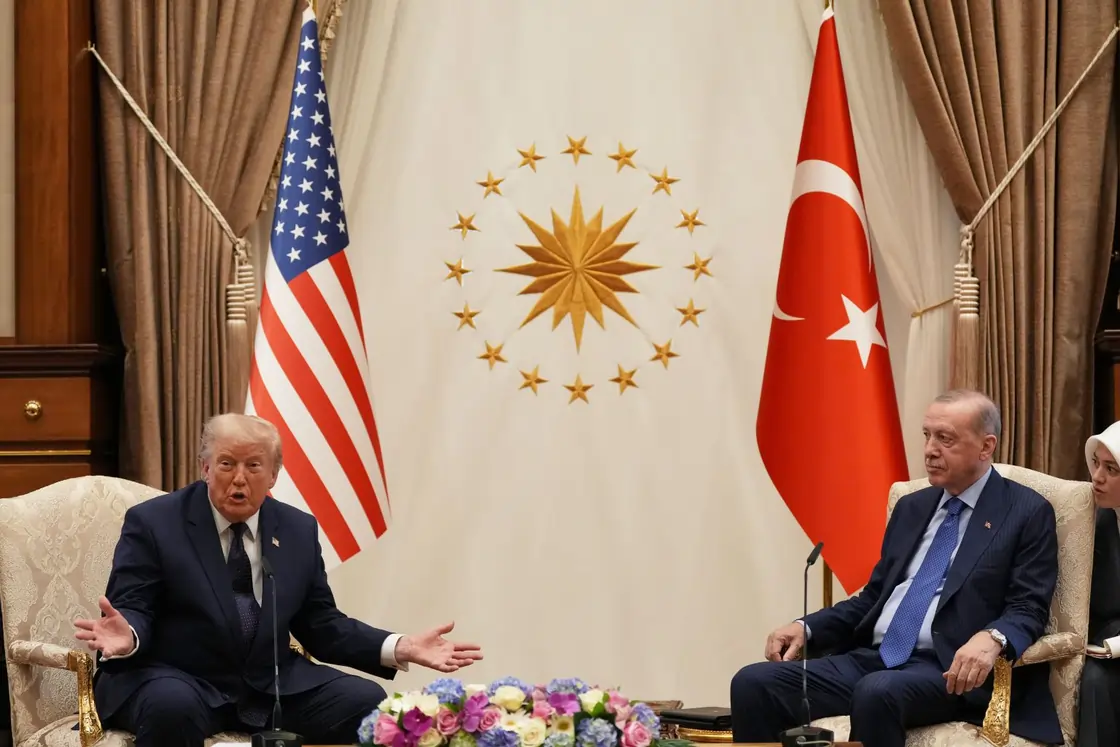
President Donald Trump gestures during a bilateral meeting with Turkish President Recep Tayyip Erdogan at the NATO summit in Ankara, Turkey, Tuesday, July 7, 2026. (AP Photo/Alex Brandon)
What happened: Most weeks, this space is devoted to a deep dive on a particular story. However, today we’re going to switch that up a bit and take a brief look at three topics that could have significant repercussions for countries around the world. We’ll start with the NATO summit that kicked off today in Turkey, then take a look at the escalating conflict in Ukraine and whether the recent change in leadership in Gaza is actually something to be excited about.
Why it matters: Each of these stories demonstrates the degree to which what goes on in one part of the world can easily impact the rest of us. They also offer an important reminder of how actions matter far more than words, especially when nations have little incentive to tell the truth.
The backstory: What to expect from the NATO summit
Let’s start with NATO. President Trump left on Monday for the summit in the Turkish capital, Ankara, and no one really seems to know what to expect from his time there. While there will be a series of meetings over the two-day conference, the president is only confirmed to attend a dinner on Tuesday night and the most substantive of the gatherings on Wednesday morning. Outside of those events, he is also scheduled to meet with Syrian President Ahmed al-Sharaa and Ukraine’s Volodymyr Zelensky.
President Trump’s most pressing concern in attending seems to be ensuring that each of NATO’s member nations is making progress toward allocating 5 percent of their GDP to defense. The nations technically have until 2035 to complete that task, but NATO Secretary General Mark Rutte let the group know that he expects “nations to present clear, concrete and credible plans” for how they’ll get there.
And while many member nations are already at 4 percent, the details matter. Up to 1.5 percent of that total can be allocated toward roads, bridges, and ports that “facilitate troop movements” rather than on weapons and munitions that would be needed in the event of an attack.
For his part, President Trump does not seem overly impressed.
In what many saw as a warning shot to set the tone for the summit, the president posted a graphic on Truth Social comparing what the US spends with that of other member nations before concluding, “Ridiculous for the U.S.A. to continue along this one-sided path when the relationship is not reciprocal.”
That said, Europe’s hesitancy to help in America’s war with Iran has further complicated matters and provoked a great deal of the president’s ire. As such, many are curious to see if the lack of support in America’s war will impact his willingness to pledge further support for what the administration increasingly sees as Europe’s war in Ukraine.
And that conflict is showing few signs of slowing down anytime soon.
Ukraine and Russia continue to trade attacks
On July 4, President Trump spoke with both Russian President Vladimir Putin and Ukrainian President Volodymyr Zelensky in separate conversations. All parties involved said that the discussions went well and reiterated their desire to see the war end, but that’s where the agreement stops.
Russia still holds that they will only consider a peace deal that leaves the entirety of the Donbas in their hands, and Putin recently claimed that his forces have taken a key city in that region. Those claims are heavily contested and likely an exaggeration at best, but portraying their victory as inevitable remains Putin’s highest priority in the conflict. To that end, Russia continues to attack Kyiv and other cities with impunity.
For their part, Ukraine is working hard to bring the war closer to home for Putin, with frequent attacks on Moscow and drone attacks deep into Russian territory.
Ukraine recently launched more than 430 drones at Moscow and, while most were destroyed, Zelensky claimed that the attack was more about sending a message than doing damage:
When it is no longer one hundred drones but one thousand flying towards Moscow . . . he will understand. Once he begins to feel it personally, once he begins to see it with his own eyes, you will see advisers urging him to relocate somewhere beyond the Urals. The farther Putin is from Moscow, the closer the end of the war will be.
Other attacks across Russia and Crimea are intended to have a similar effect.
In particular, Ukraine has targeted the country’s 11 largest gasoline producers, with Monday afternoon’s bombing of the Omsk refinery the most significant yet. Those attacks have led to fuel rationing and a growing sense of unease among the Russian populace, but have simply provoked larger attacks from Putin rather than drawing the war to a close.
This week’s NATO meeting is the next opportunity for the status quo to change, but most of those represented in Ankara seem more concerned with ensuring Ukraine can continue fighting than with bringing the fighting to an end.
And, despite recent changes, the same may remain true in Gaza as well.
Hamas dissolves its government in Gaza
On Monday, Hamas announced that it was formally dissolving its government in Gaza and getting ready to pass control over to the Board of Peace’s National Committee for the Administration of Gaza (NCAG). However, they have not given any indication that they’re willing to give up their weapons, which has remained the primary sticking point for the better part of nine months.
Hamas also plans to remain in charge of security and policing in the areas it still controls, which is not how the agreement is supposed to work and has raised understandable concerns.
Israel’s Foreign Affairs Minister, Gideon Sa’ar, warns that a willingness to give up government authority while maintaining military power is essentially the “Hezbollah model” that has proven so dangerous in Lebanon, adding that:
As long as Hamas retains its weapons, any civilian government will of course operate as Hamas dictates. This would allow Hamas to continue oppressing the Palestinian people in Gaza, while pursuing its jihadist war against Israel.
The Board of Peace was similarly dubious, stating simply that “Ultimately, our assessment will be guided by actions, not promises, to meet the critical needs of the people of Gaza.”
The prioritization of “actions, not promises” is a thread that runs through all three of these stories, and each demonstrates why actions matter more than words. That’s especially the case when nations have little incentive to tell the truth. But while empty words can prove effective in the short term, they undermine credibility and trust over time.
And, as Christians, remembering that basic truth is especially important for us.
Spiritual application: The dangers of a dead faith
One of the more convicting passages in the New Testament, for me at least, is where James writes:
What good is it, my brothers, if someone says he has faith but does not have works? Can that faith save him? If a brother or sister is poorly clothed and lacking in daily food, and one of you says to them, ‘Go in peace, be warmed and filled,’ without giving them the things needed for the body, what good is that? So also faith by itself, if it does not have works, is dead. But someone will say, ‘You have faith and I have works.’ Show me your faith apart from your works, and I will show you my faith by my works. (James 2:14–18)
The idea that faith without works is dead has been used across various points of Christian history to advocate for a kind of works righteousness that is simply unbiblical. However, going too far to the other extreme risks missing a crucial truth about how God expects us to demonstrate that faith.
If you’ve been a Christian for very long, it can be easy to take for granted just how amazing the gospel story truly is. When we ask people to place their faith in Jesus for salvation, we’re asking them to accept the idea that the God who created everything chose to leave heaven, enter earth, then suffer and die for our sins before rising from the dead and ascending back to heaven. That’s a big ask.
Jesus pointed to that truth when he told Thomas, “Blessed are those who have not seen and yet have believed” (John 20:29).
What we’ve seen across two thousand years of Christian history, though, is that the gospel spreads most effectively when people can first see its truth and relevance in us. If our lives—often demonstrated through our works—exude the love and grace that God has shown us, then it draws people to the Lord in unique and powerful ways. However, if our lives are defined more by empty words than by actions, the gospel loses much of its appeal.
So, where does your life fall along that spectrum? The truth is that most of us shift along that line from day to day, but we cannot afford to accept a dead faith if we want to help people find new life in Christ.
Let’s make sure our lives demonstrate a living faith today.
News worth knowing
1. Graham Platner accused of sexual assault
News broke Monday that Democratic Senate candidate Graham Platner was accused of sexual assault by his former girlfriend, Jenny Racicot. Platner’s sexual history has been a source of controversy throughout recent months of his campaign, but Racicot’s allegations have led to calls for him to drop out of the race, including from key supporters.
Why it matters
While Platner has denied the allegations, he has since canceled several town hall events and has asked for time to consider the future of his campaign. As of this writing, he has yet to formally drop out, but with Maine considered a toss-up in November’s elections and pivotal to Democrats’ hopes of retaking the Senate, the calls to withdraw and allow someone else to take his place are only growing louder.
What to watch
State laws allow Platner to be replaced on the ballot as long as he withdraws before July 13. The Democratic Party would then have until July 27 to choose a replacement. Will Platner withdraw and, if so, will he have any say in who takes his place?
2. Charlie Kirk’s alleged killer goes to court
The preliminary hearing for Tyler Robinson, the man accused of killing Charlie Kirk, began on Monday. Over the course of this week, evidence and testimony will be presented before the judge decides if Robinson will stand trial.
Why it matters
While Robinson has been tried in the court of public opinion and in the news for months, this is the first opportunity for the prosecution to present their evidence. At this stage, they only need to demonstrate that it’s reasonable for Robinson to be found guilty rather than prove beyond a reasonable doubt that he is. As such, it’s almost certain that he will stand trial for the murder.
What to watch
One of the primary points of contention leading up to the hearing centered on media access. The defense sought to keep the proceedings private, while the prosecution fought for an open hearing. The latter carried the day and, as such, we have a far more detailed account of the evidence presented than would otherwise be available. It will be interesting to see how that influences the eventual trial, and whether it quiets or gives oxygen to the conspiracy theories surrounding Kirk’s death.
CBS News has more on the story
3. The US Men’s team loses to Belgium in the World Cup
The US Men’s soccer team has been one of the most fun stories of the summer, but their run came to an end Monday night against Belgium. Hopes were high going in, particularly after their leading scorer—Folarin Balogun—was surprisingly reinstated on Sunday. Still, as enjoyable as the previous games had been, the men’s team was simply outclassed and played like it for most of the match.
Why it matters
Tyler Adams summed it up well when he said, “I think overall there were positives that we’re going to take away from it, [but] it just doesn’t feel like it matters.” It feels like moral victories follow the team’s final loss every time the World Cup comes around, but this iteration was put together with the hope of making real progress and advancing further than this. Perhaps they did make progress, and we’ll look back on this loss four years from now as the start of something truly special. But, for now, “it just doesn’t feel like it matters” seems to sum up the disappointment from fans and players alike pretty well.
What to watch
As disappointing as last night’s game was, the rest of the World Cup is shaping up to be a lot of fun. So, before checking out completely, pick another team or player to follow and don’t miss out on what the next couple of weeks have to offer.
God is good
Back in May, I wrote about pastor Ezra Jin, who had been imprisoned by the Chinese government for preaching the gospel. At that point, President Trump had promised to advocate on his behalf with the Chinese President Xi Jinping, but their meeting came and went without any further clarity on Jin’s fate. However, Jin was released late last week and reunited with his family in Los Angeles on Friday.
Kingdom impact
While Jin’s release is reason for praise, his family hopes it also signals “a positive turn for people of faith in China.” Still, eight other leaders from Zion Church, where Jin was the pastor, remain in prison, so further prayer is needed.
Prayer point
Will you pray that all the Christians who are imprisoned in China will be released? Will you pray that, until that time comes, God gives them the strength and faith needed to endure and share their faith with the other prisoners around them? And will you pray that God uses their example to bring people to salvation who may never have otherwise heard the gospel?
The Free Press has more on the story









 Search