



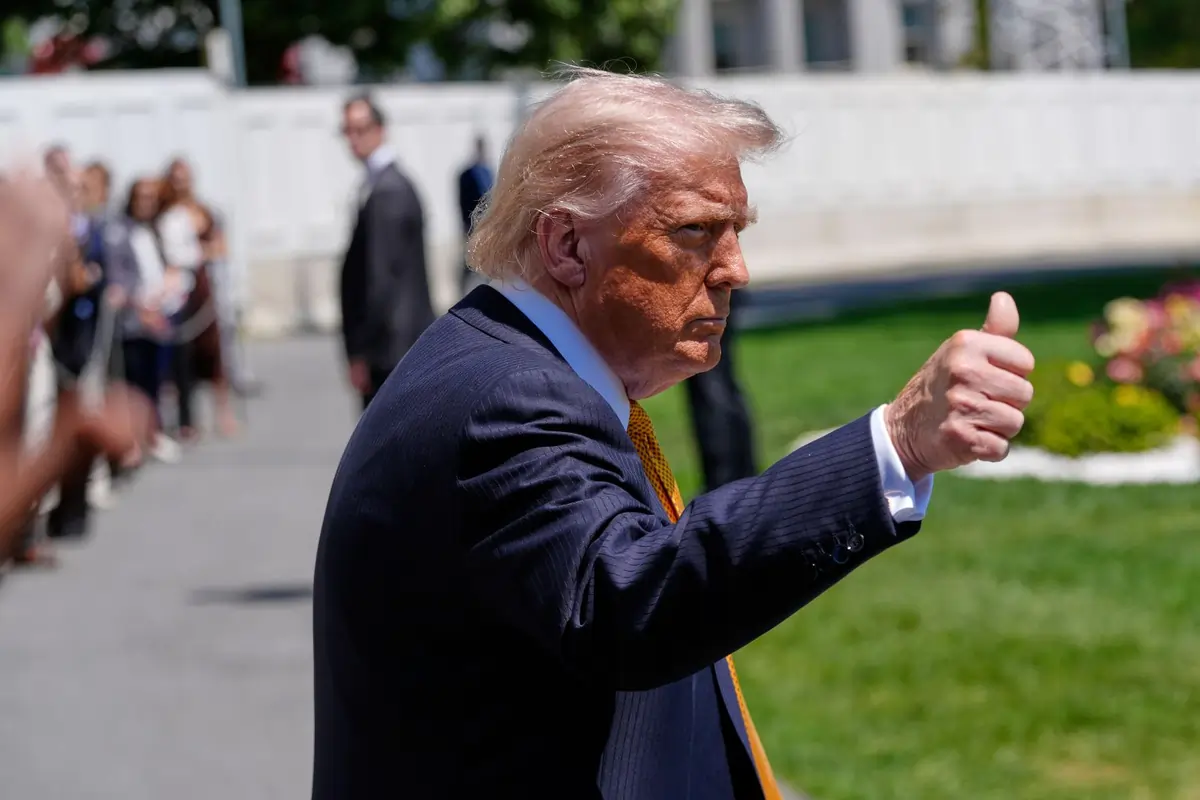
President Donald Trump gives a thumbs up as he leaves the White House for travel to Beijing, Tuesday, May 12, 2026, in Washington, to meet with China's President Xi Jinping. (AP Photo/Manuel Balce Ceneta)
What happened: President Trump and key administration leaders are on their way to China for three days of negotiations with Xi Jinping and others in the Chinese government. While Taiwan, Iran, trade, and AI are expected to feature prominently in the negotiations, President Trump has also stated that he will bring up the cause of Ezra Jin, a Chinese pastor who was arrested last October.
Why it matters: While freedom of religion is technically guaranteed in the Chinese constitution, the government has stepped up its persecution of the underground church and its leaders in recent years. American leaders, from Marco Rubio to the entire Senate, have denounced these arrests, but this week’s meetings could be the first real chance to do more.
The backstory: What to expect from this week’s meetings
President Trump is on his way to China for what is currently scheduled to be three days of negotiations with President Xi Jinping. The meetings were originally slated to occur last month but were pushed back, with the expectation that the United States’s war with Iran would be wrapped up by now. However, the stalemate continues, with President Trump describing the already tenuous cease-fire with Iran as currently “on life support” after the most recent round of negotiations failed to produce anything close to a workable arrangement.
Whether China would consider renewed escalations in Iran a blessing or a curse remains to be seen.
Last week, President Trump described his counterpart as having been “very respectful,” adding that “We haven’t been challenged by China.” Other reports have described China as encouraging Iran to negotiate and to pursue a “comprehensive cessation of hostilities.”
At the same time, many onlookers are concerned that China will use its influence in Iran as a bargaining chip in this week’s negotiations, with some suspecting that Xi will offer to facilitate an end to the war in Iran in exchange for concessions on Taiwan.
Taiwan figures to feature prominently in the upcoming meetings. Its role in producing semiconductors places it at the center of most advanced technologies, and the United States has long expected that China is preparing to take the island by force as early as next year.
Still, as important as Taiwan is to the US—and the rest of the world—it’s not slated to be the only topic of conversation. Trade, fentanyl, AI, and the general stabilization of relationships between the two nations are also on the docket.
The subject I’m most curious to follow, though, has little to do with any of that.
Hope for persecuted Christians
China has a long history of oppressing Christians, particularly members and leaders of the underground church. One of the more notable examples is pastor Ezra Jin, who was arrested last October.
Jin leads the Zion House Church, whose membership rose to more than 10,000 when he started sharing his sermons online after the government shut them down. And while his latest arrest is not the only encounter he’s had with the Chinese government—in 2021, authorities showed up to “take him out for tea” before drugging and interrogating him at a local restaurant—his family has been unable to contact him since his arrest. Jin has passed occasional messages through his lawyer, but overall, the outlook has been bleak.
That could change if President Trump follows through on his promise to bring up Jin—and, hopefully, many of the other imprisoned Christians—in the upcoming negotiations with President Xi.
American officials have spoken out against China’s crackdown on Christians before, with Marco Rubio releasing an official statement denouncing Jin’s arrest days after it occurred, and the Senate unanimously approving a resolution condemning the arrests as well. But while China has little reason to care what the Senate or even the Secretary of State thinks about their policies toward religious minorities, they might listen if the President brings it up.
To be clear, it’s a long shot that they would release Jin or any others as a gesture of goodwill—although that would clearly be preferable. But there’s reason to hope they could be included in whatever deals do take place.
Even if that were to happen, though, China’s policy toward the underground church is unlikely to change. A group more dedicated to God than government simply poses too great a threat to the way Xi wants to run his country.
The state of the church in China
Frannie Bock has an excellent article in The Free Press that dives deep into the story of Ezra Jin and China’s underground church. In it, she describes how:
Neither famine, chaos, nor coup attempts could bring down Mao’s reign in China. What could possibly threaten the power and legacy of a man—and an ideology—elevated to such a god-like status? The answer, according to the Communist Party, is God himself.
Freedom of religion is technically a right guaranteed by the Chinese constitution. However, Communist Party officials must be consulted before choosing songs or sermon topics in the official church. Moreover, if the gospel moves powerfully and too many people—the government gets to define what is “too many”—get baptized, the church comes under suspicion and is likely to be targeted by further restrictions.
At first, Ezra Jin and his family tried to function within these restrictions. However, the time came when that was no longer something he couldn’t do. So, in 2007, he started a church called Zion as part of the growing house church movement in the country.
However, he didn’t hide their presence, even going so far as to alert the local government office that he was the pastor of a new church. And when the government eased restrictions after an early 2000s crackdown, the house church movement grew to an estimated 45–60 million members. Zion grew during this time as well, rising to 300 members in its first year.
That changed in 2018, when the government imposed new regulations outlawing any unsanctioned religious activity. As Bock describes,
The Bible could no longer be sold on the internet, and churches were forced to display banners with Chinese Communist Party slogans, and perform the national anthem before singing traditional Christian hymns.
Police even went so far as to pull Christian children out of school and freeze the bank accounts of those families who continued to attend underground churches. Even those, like Jin, who were “intentionally apolitical,” were swept up in the oppression.
As such, even if President Trump and his team can secure Jin’s release this week, countless others like him are liable to take his place in the years to come.
How should we respond when every example of good seems overwhelmed by the prospect of further evil? Perhaps the answer is to re-examine what we define as good.
Spiritual application: Asking God how to pray
Bob Fu, who started the nonprofit China Aid to help persecuted Christians, spent two months in prison for running an illegal house church in 1996. He believes that the persecution “has reached the worst level since the Cultural Revolution” more than fifty years ago. Yet he still believes that “Xi Jinping will ‘fail miserably’ if he tries to force people to abandon their relationships with God.”
Fu goes on to say, “He can bind them, their hands and into their prison cell, but he cannot bind their prayers directly to God. Whenever he imprisoned more Christians, Xi Jinping became God’s servant in the opposite way. He will revive God’s church in China.”
Admittedly, that’s perhaps an easier perspective to hold when you are not the one in the cell, but both Scripture and history are replete with examples of God using his people to grow his kingdom in truly remarkable ways as a result of persecution. From the Philippian jailer in Acts 16 to the believers in ancient Rome and beyond, Tertullian’s belief that the blood of the martyrs is the seed of the church has been proven correct time and time again.
So, while God calls us to “Remember those who are in prison, as though in prison with them, and those who are mistreated, since you also are in the body” (Hebrews 13:3), let’s also take some time to ask the Lord how we can best pray for them before assuming we already know.
It could be that God’s will is for the arrested believers in China to be set free, and if that’s the case, then we should absolutely pray and work to that end. It could also be that, at least for some, they can do far more to advance the gospel while in chains than they could if set free. In such instances, perhaps a better prayer is that they receive the strength and faithfulness required to endure that suffering well, trusting that Christ’s promise is true that a great reward awaits them in heaven (Matthew 5:11–12).
And the next time you face persecution or suffering, take some time to ask the Lord how to pray then as well. After all, we serve a God who takes a far larger view of our lives than we often do, and it could be that he has plans to redeem those moments of hardship and trial to help you grow in that would not otherwise be possible.
How will you pray today?
News worth knowing
1. 18 Americans from the hantavirus cruise ship return home
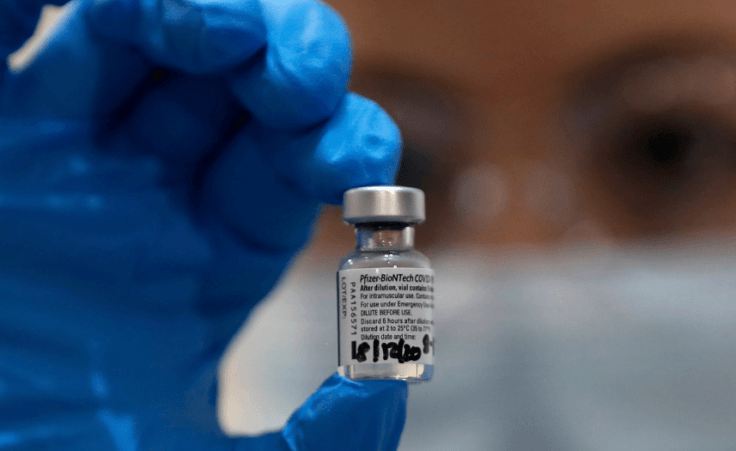
Eighteen Americans were aboard the cruise ship Hondius when the hantavirus outbreak occurred. While all eighteen are now back in the United States, sixteen were taken to a facility in Nebraska, while two are at Emory University Hospital in Atlanta. The ship’s other passengers have been similarly repatriated to their home countries.
Why it matters
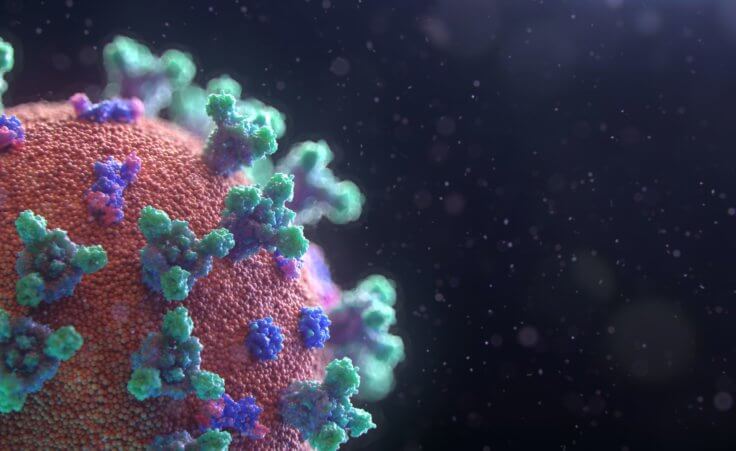
Given the general anxiety over reports of a hantavirus outbreak and fears that it might trigger another Covid-type pandemic, the fate of those on board has been a concern worldwide. While the CDC is taking extreme precautions, knowing where the Americans who were exposed will be until they are either healed or deemed safe provides at least some sense of control over the situation.
What to watch
One of the patients at Emory has shown mild symptoms, while the other at that location is their significant other and is there as a precaution. Will more of those from the ship get sick, and if so, will they recover? While it’s natural to focus on the threat of an outbreak, please take a moment to pray for those in containment and their loved ones as well.
NBC News has more on the story
2. Supreme Court temporarily extends access to abortion pill again
Justice Samuel Alito extended the temporary pause issued last week on a Louisiana court’s ruling that would require mifepristone to be dispensed in person. It will now last until at least this Thursday, though it could be extended again if the Supreme Court needs more time to come to its decision.
Why it matters
I described the case and the larger issue of abortion pills in last week’s Focus, and many of the issues remain unchanged. However, the Court’s delay in rendering a verdict could indicate that it is giving the case more thought than most experts expected. A ruling that would make it harder to obtain mifepristone is still unlikely, but that it’s not out of the question is at least cause for some hope.
What to watch
Will the Court put the issue to rest before Thursday, or will the pause be extended further? If they do render a verdict, where will they come down across the spectrum of possible outcomes?
SCOTUSblog has more on the story
3. Has AI-assisted hacking gone from theory to reality?
Google identified what they believe to be the first known case where AI was used to discover and exploit a previously unknown vulnerability to bypass two-factor authentication in a popular open-source system.
Why it matters
The attempt was stopped before it succeeded, but Google warns that advanced AI models are becoming better at identifying and exploiting these vulnerabilities. North Korea and China are generally seen as the leading culprits of AI-assisted hacking, though they are far from alone in their attempts to find new ways into protected systems.
What to watch
Will Google’s suspicions that AI was used in the attacks be confirmed? If so, what steps can be taken to help mitigate future risks?
God is good
Faith has been a recurring theme on American Idol recently. Between sharing the contestants’ testimonies and an entire night dedicated to songs of faith for Easter, many of the season’s most memorable moments have revolved around worshiping the Lord. And each of the show’s three finalists spoke repeatedly about their faith and the impact it has had in their lives.
Kingdom impact
Carrie Underwood, who is one of the judges on the contest, recently shared her appreciation for ABC’s willingness to give the show that kind of latitude. This season put up some of the best ratings in more than four years, while also expanding its streaming audience by appearing on Disney+ for the first time.
Prayer point
Will you pray that the testimonies and songs of faith from this year’s contestants planted seeds in the lives of their audience? Will you pray that God will help those seeds grow in the lives of those who may never have set foot in a church?
Christian Post has more on the story
And for more on Hannah Harper, this season’s winner, see Dr. Jim Denison’s “Why did Hannah Harper win ‘American Idol’?”









 Search