



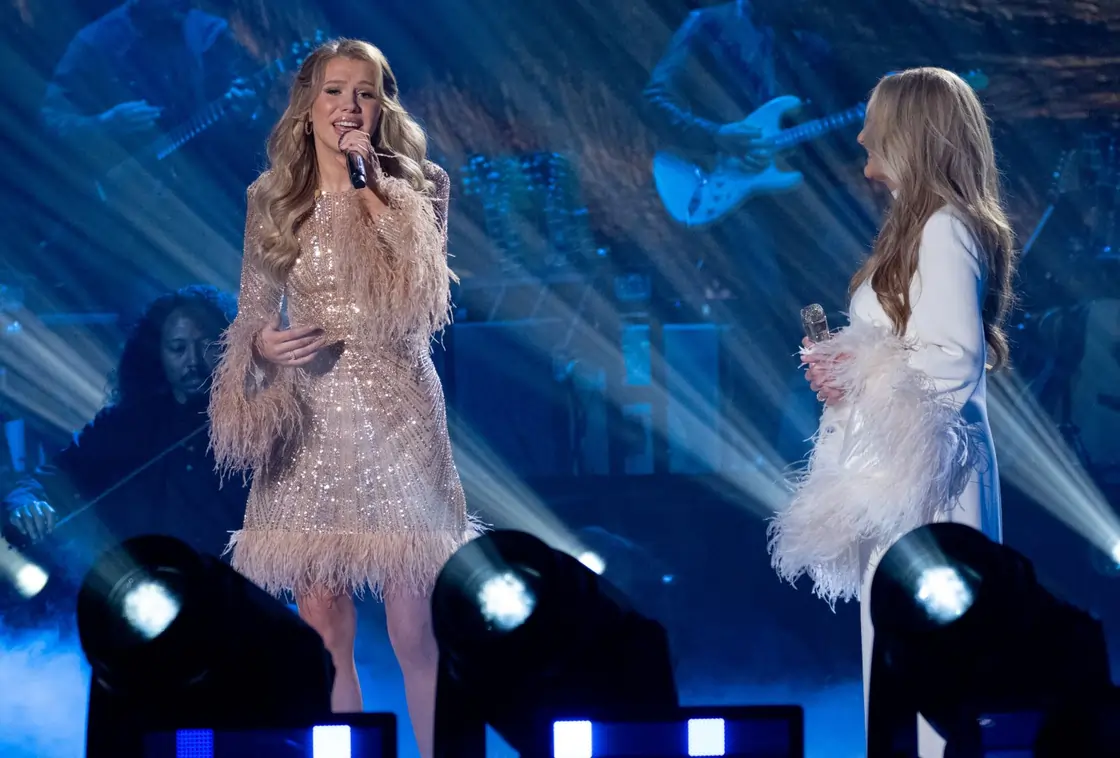
AMERICAN IDOL – “916 (Grand Finale)” – The Top 3 finalists give their all for the last chance to earn America’s vote. Alicia Keys serves as guest mentor and performer, plus special performances from other music legends and today’s top stars. MONDAY, MAY 11 (8:00-11:00 p.m. EDT) on ABC. (Disney/Eric McCandless) HANNAH HARPER, LEE ANN WOMACK
My wife and I don’t watch many television shows regularly, but for some reason, American Idol is one of them. In the early days, I’ll admit, I found Simon Cowell’s sarcastic critiques of the various performers paradoxically entertaining, and the premise of voting on singers seeking to become stars was unusual. Over the years, some winners went on to fame, while others went to obscurity.
But none captured our interest as did this year’s winner, which points to my point.
“The most relatable song I think I’ve ever heard”
Last February, viewers met Hannah Harper, a twenty-five-year-old stay-at-home mom from Missouri. She auditioned in a patchwork dress that she sewed herself. When she told the story behind the song she wrote and was about to perform, she began to cry.
Harper has three sons. She told the judges that she suffered from postpartum depression after her youngest was born and was sitting on the couch one day, “having a pity party and praying that the Lord would calm my spirit.” One of her kids then began asking her to open a packet of string cheese.
“I’m like, ‘Leave me alone with the dadgum cheese,’ she said, her voice choking up. “And I finally opened his cheese. And when I did, I realized that God had put me in that place, and that where I was in my house was the biggest ministry that I could ever have. And being a mom . . . I realized that that was exactly what I wanted, and I kind of kicked the postpartum depression in the butt and said, ‘I ain’t doin’ it.’”
In response, she wrote a song called “String Cheese.” When she sang it, judge (and mother) Carrie Underwood wiped her eyes and said, “Well, that’s the most relatable song I think I’ve ever heard.” Host Ryan Seacrest said later that the video of Harper singing her song is one of the most-viewed clips in “Idol” history, with more than 120 million views across platforms.
Countless mothers posted comments about feeling understood by her lyrics, which was her goal. Harper wanted to reassure women that they were not alone and to encourage them to raise children while still pursuing their dreams.
She focuses especially on country and Christian ballads, singing with a clear and emotive voice. To be honest, however, some of her competitors performed with more powerful vocals and stage presence. The difference was that millions of voters connected with her story.
During the finale, she repeatedly thanked her husband for taking care of their children while she competed on the show. After her victory, she sang Chris Tomlin’s song “At the Cross,” declaring to the nation the focus of her talent and her heart.
“Nothing is so humanizing as love”
My father died when I was a senior in college. After his passing, a friend gave me a copy of John Claypool’s book, Tracks of a Fellow Struggler. The small volume contains sermons preached by the famed pastor, centering on the diagnosis and eventual death of his young daughter to leukemia. His honesty with his deep questions and broken heart spoke viscerally and powerfully to me.
I never had the privilege of meeting Dr. Claypool. He had no idea, when he preached those sermons and later compiled them into that book, that they would make such a profound difference in my life, or that I would be writing about him and his reflections many decades later.
Such is the power of transparency.
Claypool’s preaching was modeled on the teaching ministry of our Lord. When people asked Jesus a question, he often responded with a story drawn from their daily lives (cf. Luke 10:29–37). His parables came from their culture and shared experiences, connecting those who heard him to the heart of his Father.
And his messages were driven by his compassion (cf. Mark 6:34). He loved them, and they knew that he loved them. Not only did he incarnate his Father’s love by leaving heaven for earth—he demonstrated that love by touching leprous bodies, welcoming notorious sinners, and dying a horrifying death for us all.
The famed theologian Jǔrgen Moltmann captured the essence of Jesus’ ministry with his book, The Crucified God. In it, he powerfully called us to share the life of the cross with sacrificial compassion:
It is true that in a world of high consumption, where anything and everything is possible, nothing is so humanizing as love, and a conscious interest in the life of others, particularly in the life of the oppressed. For love leaves us open to wounding and disappointment.
But it is in sharing the wounds and disappointment of our world that we share the healing and hope of our Father.
One reason God “comforts us in all our affliction”
You and I have a story that is uniquely ours. I could not hope to sing or write songs like Hannah Harper. I have no idea how postpartum depression feels or what it is like to be a young mother of three boys.
But my story can connect with someone hers cannot reach. My fears and hurts will resonate with someone’s pain today, if only I will share them and use them to point to Jesus. The same is true for you.
Michel Quoist noted that God leads by limitations. Accordingly, we can see our limitations as opportunities to connect hurting people with the heart of our loving Lord.
Paul called our Father the “God of all comfort” (2 Corinthians 1:3). One way the Lord expresses his compassion is by using us to share it: he “comforts us in all our affliction, so that we may be able to comfort those who are in any affliction, with the comfort with which we ourselves are comforted by God” (v. 4).
As Henri Nouwen noted, “wounded healers” can be the most powerful healers of all.
What wounds will you share with the world today?














 Search