



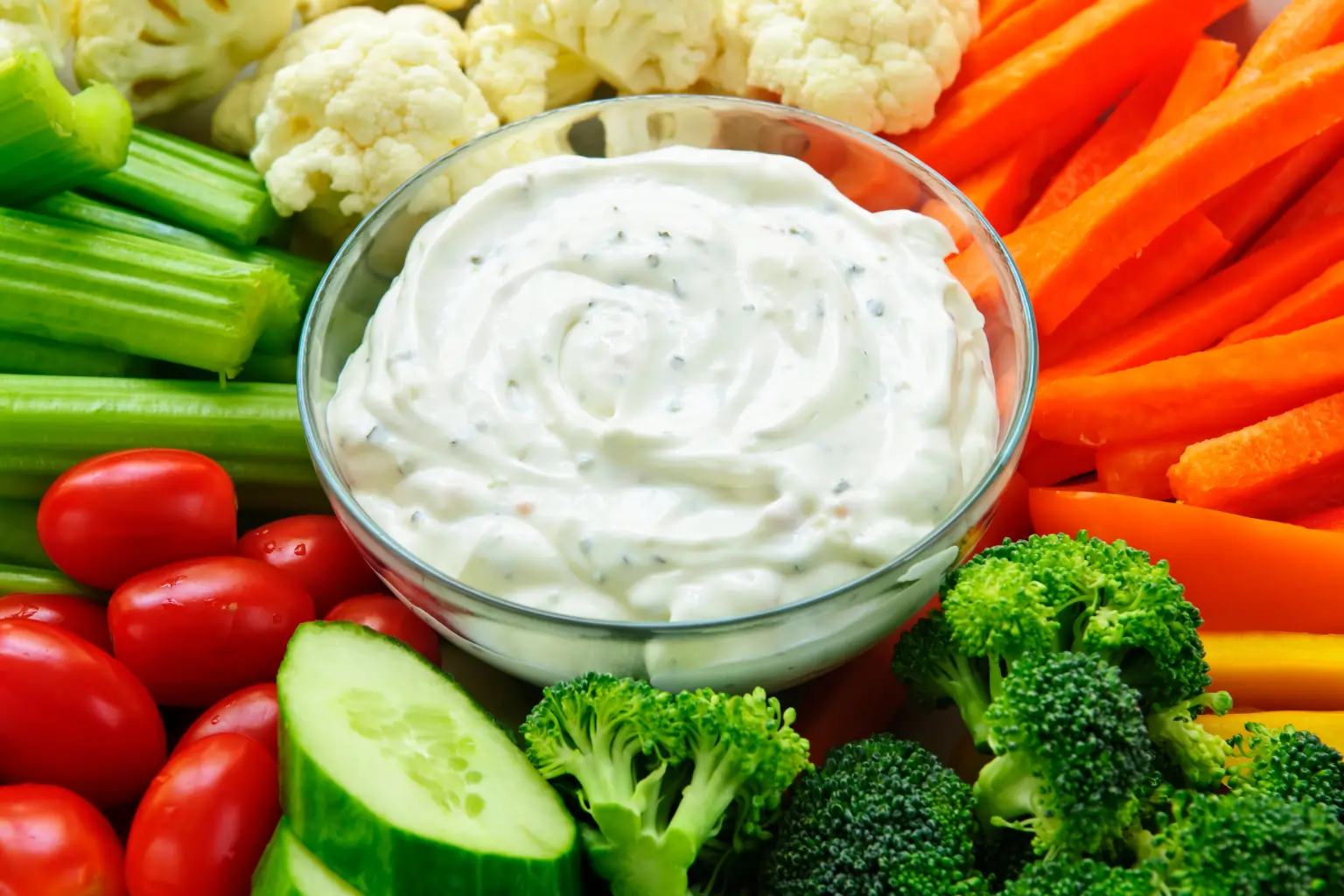
Vegetables and ranch dip. By Elenathewise/stock.adobe.com.


As America’s 250th anniversary nears, patriotism is the order of the day.
We’re aware of bad news in the news, from the horrific death toll following the Venezuela earthquakes to deadly wildfires in Colorado and the dangerous heat wave abroad and at home. But we’d rather read stories that celebrate our nation in these historic days.
To this end, let’s talk today about ranch dressing.
Writing for the Atlantic, Ellen Cushing reports that “ranch dressing has become, deservedly or not, a face of the nation during the World Cup.” She tells the story of its humble beginnings in the early 1950s, when a plumbing contractor in Alaska invented it to feed his crew. Fast forward to today: some 75 percent of Americans like or love ranch, making it our best-selling salad dressing.
It’s not just us: as the World Cup has brought international soccer fans to our shores, Cushing tells us that they are “falling in love with ranch.” One visitor asked on X whether he should “leave a pair of shoes and jeans here to fit in more” bottles of the salad dressing in his luggage.
Ranch has become so popular with travelers to America that the TSA issued a statement: “If you’re visiting for a very large sporting event & you happen to discover RANCH while you’re here . . . pls pack it in your CHECKED BAG on the way home.”
I find in this surprising story a parable about what makes America unique and what Americans need most.
The “multicultural miracle” that is America
America’s original thirteen colonies were like countries settled by ethnicities from the Old World. There were English Puritans in New England, the Dutch, Germans, and Scots-Irish in the Middle Colonies, and English planters in the South. Scots-Irish and German immigrants populated the Appalachian and frontier regions.
As Dr. Ryan Denison and I note in our latest America250 article, settlers came to our country with very different motives, from evangelistic missions to secular economic advancement to Christian community.
This diversity is a strength worth celebrating. As Andrew Sullivan reports, World Cup visitors have discovered that “America is itself a stupendous achievement of multicultural energy and fun.” He responds: “We forget too easily the multicultural miracle we have already achieved in this quarter of a millennium, and the loving, generous, bountiful culture that is still America at its core.”
I cannot imagine that mixing buttermilk and mayonnaise with onion and garlic powder would sound appealing to anyone. But such disparate ingredients, originally combined out of necessity rather than culinary artistry, made a salad dressing that has become “a face of the nation.”
When our Founders adopted the Great Seal of the United States in 1782, they chose the Latin phrase E pluribus unum, “Out of many, one.” They chose wisely.
What nation ranks highest for individualism?
Here’s the problem: Our diversity as a nation promotes self-reliance that bars us from God’s best.
Two hundred and fifty years ago today, we were a collection of small colonies about to declare independence from the British and face the mightiest military superpower in the world. Much of the wilderness we were settling was untamed. We had no king upon whom to depend, no pope or established church to support us, no constitution or judicial system to guide us. Unlike European nations then and today, we had no shared ethnicity to unify and defend us.
The self-reliant cultural DNA established at our founding persists today. The US ranks highest in the world for individualism, as our trust in other people and our institutions continues to decline. Many baptize their self-sufficiency in self-reliant religiosity: 82 percent of Americans believe that “God helps those who help themselves” is in the Bible.
However, the fact is, God cannot help those who help themselves. He cannot save souls who will not seek salvation in Christ. He cannot lead those who will not follow or provide for those who will not admit they need his help.
Self-reliance may be popular religion, but it is spiritual suicide.
“Like us but more perfectly human”
To respond, I’ll close by quoting from a homily by Pope Paul VI that I recently read and found inspirational. He described Jesus in this way:
He is like us but more perfectly human, simple, poor, and yet, while burdened with work, he is more patient. He spoke on our behalf, he worked miracles, and he founded a new kingdom. In it, the poor are happy. Peace is the foundation of a life in common, where the pure in heart and those who mourn are uplifted and comforted, the hungry find justice, sinners are forgiven, and all discover that they are brothers.
Accordingly, the pope testified:
I can never cease to speak of Christ, for he is our truth and our light; he is the way, the truth, and the life. He is our bread, our source of living water who allays our hunger and satisfies our thirst. He is our shepherd, our leader, our ideal, our comforter, and our brother.
Who is your “shepherd” today?
Quote for the day:
“Men have no taste for [God’s power] until they are convinced of their need of it, and they immediately forget its value unless they are continually reminded by awareness of their own weakness.” —John Calvin
Our latest website resources:
- “A nation with the soul of a church” Pulling together America’s spiritual heritage, strengths, and failures
- Reflecting pool mess, Air Force One drama, Clavicular, ‘Maxxing’ trends, World Cup & new studio!
- Faith under fire: The global crisis of religious persecution
- Should Christians use The Passion Translation?
- Former Texas Tech chaplain on Brendan Sorsby














 Search