



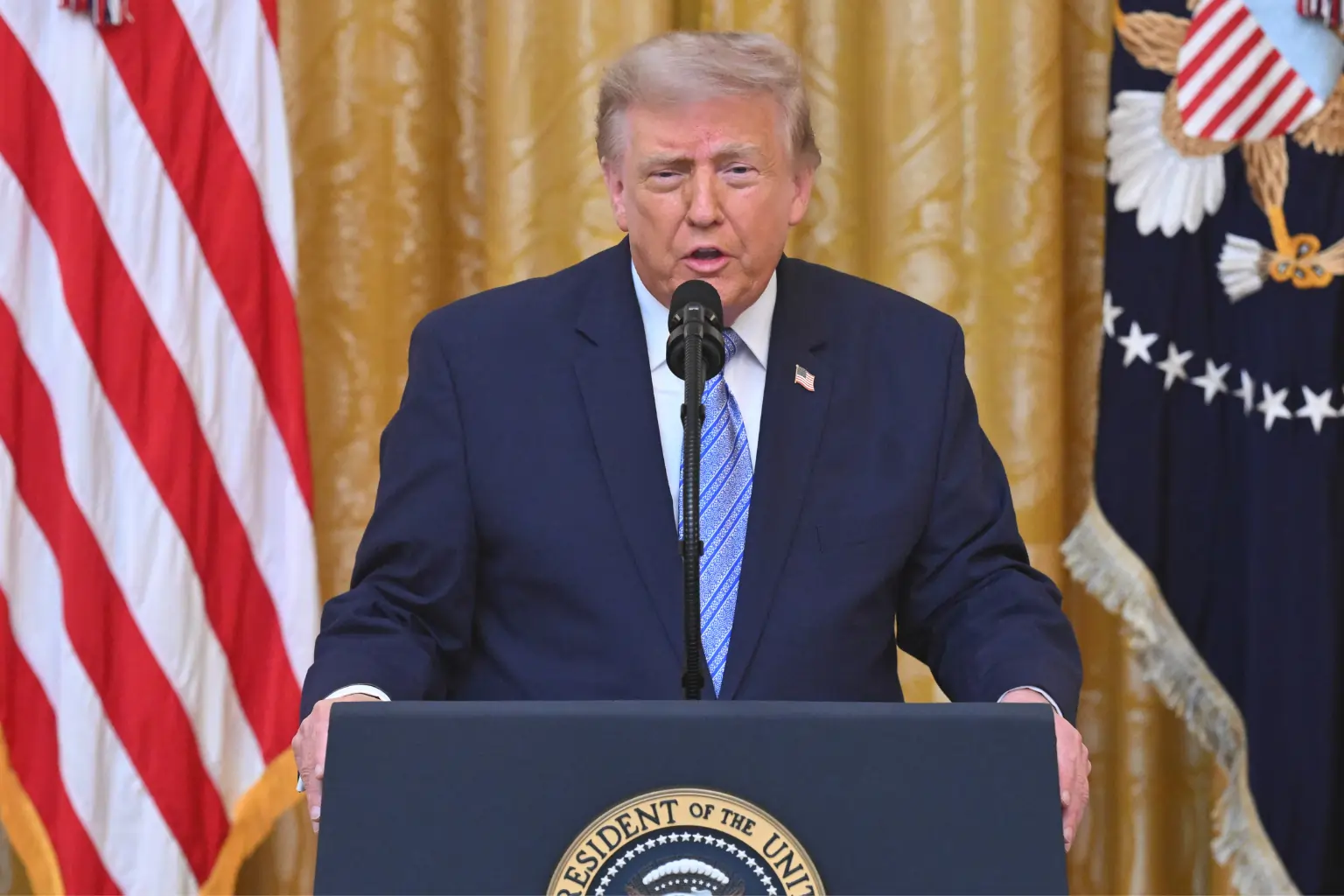
President Donald Trump speaks in the East Room of the White House, Thursday, July 16, 2026, in Washington. (Saul Loeb/Pool via AP)
President Trump addressed the nation last night, briefly touching on the economy, prescription drug prices, and the war with Iran before pivoting to election integrity for the bulk of his speech. In the buildup to last night’s address, the president promised “really big news,” claiming that “it doesn’t get bigger because without free and fair elections, you don’t have a country.”
To that end, he touted a series of declassified documents pertaining to alleged voter fraud, vulnerabilities in our ballot counting systems, and the “acquisition and exploitation of American voter data” by China. The latter was the closest to new information, though much of it had already been leaked years earlier.
And even with China—which he revealed has gained access to 220 million voter files over the last six years—President Trump was clear that they stopped at acquiring information rather than materially impacting actual votes.
Overall, the president made a number of claims that, even when true, do little to cast any real doubt on the validity of the 2020 election or give cause for new concerns over the legitimacy of this November’s midterms. Our election system has clear vulnerabilities that need to be shored up, but neither the scope nor the scale of what he presented fundamentally changes that conversation. And if those concerns are legitimate, proposing cuts of $707 million to the agency responsible for guarding against overseas interference would seem like a strange way to address them.
However, President Trump did take the opportunity to once again call on the Senate to pass the SAVE America Act as a better alternative for addressing many of these concerns. The latest iteration passed the House back in February but has stalled on the Senate floor, where Republicans lack the bipartisan support needed to reach sixty votes.
The House recently announced the framework for a budget bill that could theoretically allow Congress to pass many of those stipulations without Democratic support, but the legislation is considered a long shot at this point.
Even if it passed, though, would it really put these concerns to rest?
What is the SAVE America Act?
At first glance, it’s difficult to see why the Safeguard American Voter Eligibility Act (SAVE for short) is so controversial. After all, requiring voters to show some form of government-issued ID in order to cast a ballot is enormously popular across party lines and most demographics. Moreover, many of the concerns about getting an ID that have been used to call the idea “Jim Crow 2.0” and similar monikers make little sense and border on being outright racist.
After all, a government-issued ID is already required to get a credit card, buy or rent a home, get welfare benefits, travel by plane, or open a bank account. If a large number of Americans lack the necessary ID to do those things, then it seems the time and energy of those who oppose the bill would be better spent on smoothing out the process of obtaining that kind of identification.
However, what the president wants goes beyond simple ID. A key provision of the SAVE America Act also calls for proving that every voter is a US citizen. Given that it is illegal to vote if you are not a citizen, that requirement is reasonable. However, as much as 9 percent of Americans don’t have “ready access” to proof of citizenship, which complicates matters.
Under the current system, registration just requires checking a box stating that voters are citizens, with the state and local government then tasked with ensuring that claim is true. That’s less than ideal, and there have been incidents of abuse or simple errors in which someone who should have been ineligible to vote was enabled to do so. The numbers are, by most accounts, far less than what the president claimed, but they’re not zero.
Ultimately, what the president wants is reasonable and largely supported by most Americans. As is often the case, though, executing the idea is more difficult than justifying it.
Why the SAVE Act is not so simple
In a previous edition of The Focus, I went into more detail on the SAVE America Act and the three primary reasons why the issue is more complicated than it appears on the surface. The most important of those problems, though, is the timing and resources required to make it work.
In his speech, President Trump stated that the only reason not to pass the bill is “you want to cheat.” But rushing the implementation of the SAVE Act would carry risks as well.
While the SAVE America Act dramatically increases the burden placed on states to manage the voter registration process, it does not provide additional funding or any phase-in period for the new regulations. It’s expected that states would need at least a year to implement the new policy, but tonight the president spoke as if he expected that everything could be in place in time for November’s midterms. That simply does not seem realistic and is likely to lead to far more errors than if the current system were allowed to endure.
However, with federal elections every two years, there’s never going to be a good time to make these kinds of sweeping changes. Carveouts that would exclude this year’s midterms or provide additional funding would help, but at some point, if the changes are truly necessary, they are worth whatever discomfort and problems arise in their implementation. It’s just important to go into it knowing that, at least to start, there are going to be some pretty significant bumps along the way.
Those bumps would be easier to overcome, though, if the rhetoric surrounding this subject spent less time relitigating the past and more time focused on the future. And there’s an important lesson in that truth that extends far beyond elections and politics.
How to address past hurts
In the Sermon on the Mount, Jesus tells his followers,
You have heard that it was said to those of old, ‘You shall not murder; and whoever murders will be liable to judgment.’ But I say to you that everyone who is angry with his brother will be liable to judgment; whoever insults his brother will be liable to the council; and whoever says, ‘You fool!’ will be liable to the hell of fire (Matthew 5:21–22).
An important distinction, however, is lost when we read this statement in English. You see, there are two words in the Greek that are often translated as “anger.” The first, thumos, most commonly refers to the spontaneous emotion. This kind of anger is what we feel when someone wrongs us or when circumstances don’t go our way, and it is not what Jesus calls a sin in this passage.
The word he uses in verse 22 to describe this anger is orgizomenos, a verb that is perhaps better translated as something akin to “holding a grudge.” It’s an anger that is cherished in the heart, nursed and kept alive by our own volition. This kind of anger is a choice and, as such, a sin that is within our power to avoid.
The inability to let go of the past can be the greatest hindrance to a successful future. Christ calls this kind of anger a sin not only because it harms our relationships with others and makes it more difficult for us to forgive, but because it invariably hurts us as well while placing a much lower ceiling on what he can do in and through our lives.
God wants more for us than that, and so he calls us to let go of the past for the sake of what’s to come. That doesn’t mean ignoring what was wrong or setting ourselves up to get hurt in the same ways again, but it does mean caring more about what the Lord wants to do than what others have already done.
So, where do you need to let go of that kind of anger today? Are there any grudges or old wounds preventing you from fully embracing Christ’s call for your life going forward?
Most of us have something that fits that description. The only question is whether you’d prefer to hold tight to that grudge or open your hands to whatever God wants to put in its place.
Make your choice today.
Quote of the day:
“As we pour out our bitterness, God pours in his peace.” —F. B. Meyer
Our latest website resources:
- Lindsey Graham dies, Charlie Kirk hearing, Trump’s address, RIP Sam Neill & World Cup Final | Ep. 77
- Thomas Jefferson’s childhood home lists for $17 million
- What baseball’s long road teaches us about following Christ
- Best of: How can understanding the mind-body-spirit connection improve mental health struggles?
- Why the Strait of Hormuz echoes an unpredictable war









 Search