



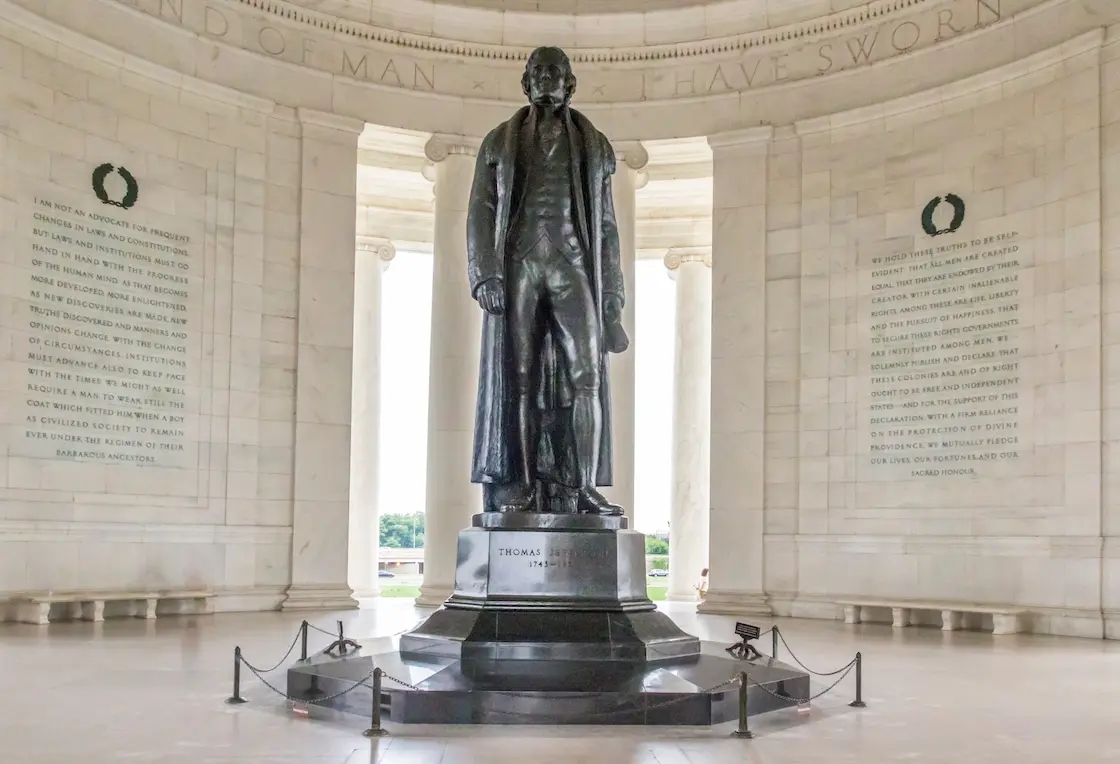
President Thomas Jefferson's Statue at the Jefferson Memorial in Washington DC By travelview/stock.adobe.com
Thomas Jefferson’s childhood Virginia home, built three hundred years ago, is now on the market for $17 million. Mr. Jefferson lived on the former plantation for seven years. Known as Historic Tuckahoe, it spans 557 acres along the James River, thirty minutes outside downtown Richmond.
The property’s manor house was built between 1733 and 1740 by the colonial planter and politician William Randolph III. Randolph died in 1745, a year after his wife’s death, and his will named his cousin Jane Randolph and her husband Peter as the guardians of his orphaned children.
Thomas Jefferson was the two-year-old son of Jane and Peter and came with them to live in the manor house until they returned to their own plantation at Shadwell, near Charlottesville. The founding father continued to visit Tuckahoe on occasion in his adult life.
Tuckahoe operated mainly as a tobacco plantation. Hundreds of slaves worked on the land over the decades under the Randolph family’s ownership and later owners. Some of the original slave quarters still remain on the property.
“When Thomas Jefferson dined alone”
Thomas Jefferson was, without question, one of the most brilliant people in American history. He was a student of law, politics, agrarianism, music, gardening, history, philology, poetry, philosophy, weather, archaeology, and architecture. He served our nation as the author of the Declaration of Independence, secretary of state, vice president, and president.
He was also president of the American Philosophical Society and founder of the University of Virginia. He could read and speak English, French, Italian, and Latin; he could read ancient Greek and Spanish; and he had some knowledge of German and Anglo-Saxon as well. When my wife and I visited Monticello, the Virginia mansion he personally designed, we were deeply impressed by the length and breadth of his giftedness.
John F. Kennedy, at a 1962 dinner honoring Nobel Prize winners of the Western hemisphere, said, “I think this is the most extraordinary collection of talent, of human knowledge, that has ever been gathered together at the White House, with the possible exception of when Thomas Jefferson dined alone.”
“I tremble for my country when I reflect that God is just”
And yet Jefferson enslaved more than 610 people throughout the course of his life. Four hundred were held in bondage at Monticello; the other two hundred people were enslaved on Jefferson’s other properties. At any given time, around 130 people were enslaved at Monticello, most notably Sally Hemings, with whom he fathered at least six children.
Jefferson knew slavery to be evil. He understood its utility, writing: “In a warm climate, no man will labor for himself who can make another labor for him. This is so true, that of the proprietors of slaves a very small proportion indeed are ever seen to labor.”
But he also understood its inherent danger: “Can the liberties of a nation be thought secure when we have removed their only firm basis, a conviction in the minds of the people that these liberties are of the gift of God?”
In fact, he warned:
I tremble for my country when I reflect that God is just: that his justice cannot sleep forever: that considering numbers, nature and natural means only, a revolution of the wheel of fortune, an exchange of situation, is among possible events: that it may become probable by supernatural interference! The Almighty has no attribute which can take side with us in such a contest.
The Ten Commandments are not suggestions
Choosing what we want over what we know to be right is always a prescription for eventual calamity and divine judgment.
The Founders did not seek to eradicate slavery in the Constitution lest the southern states leave the Union before it was formed, and the Civil War (the bloodiest conflict in American history) was the eventual result. Jefferson did not free his slaves because he depended on them financially (and with Sally Hemings, sexually), and they suffered the tragic consequences.
This is what happens whenever we consider truth to be “self-evident,” as Jefferson’s Declaration asserts. What is evident to you may not be evident to me, and vice versa.
In academic terms, deontological ethics argues for right and wrong based on rules and duties, regardless of the consequences. Teleological ethics disagrees, evaluating right and wrong based entirely on outcomes or personal goals.
Our “post-truth” culture has embraced the latter, rejecting objective ethics and biblical authority for subjective opinion and personal outcomes. Slavery is just one example: a good outcome for a slaveholder is obviously a tragic outcome for a slave.
Biblical morality insists strongly on the former. The Ten Commandments are not suggestions. God repeatedly sets out rules by which to live, whatever the cost of obedience. The good news, however, is that such deontological obedience positions us for teleological outcomes in God’s providence. His “perfect” will is ultimately best for everyone, ourselves included (Romans 12:2).
Viewing abortion as we view slavery
It took many generations and a horrific war for our nation to finally eradicate slavery. But the teleological ethos behind it, based on “self-evident truth,” remains.
Abortion is the most tragic example. As Mother Teresa said, “It is a poverty to decide that a child must die so that you may live as you wish.” I pray for the day when society looks at abortion in the same way we view slavery—an abhorrent evil that should never have existed.
But other examples exist whenever we choose what we want over what God wants. This is the essence of sin, and it forfeits God’s best while incurring his inevitable judgment. It grieves the heart of our Father and hinders his Spirit in our lives.
James counseled, “Whoever knows the right thing to do and fails to do it, for him it is sin” (James 4:17).
What “right thing” is God calling you to do today?











 Search