



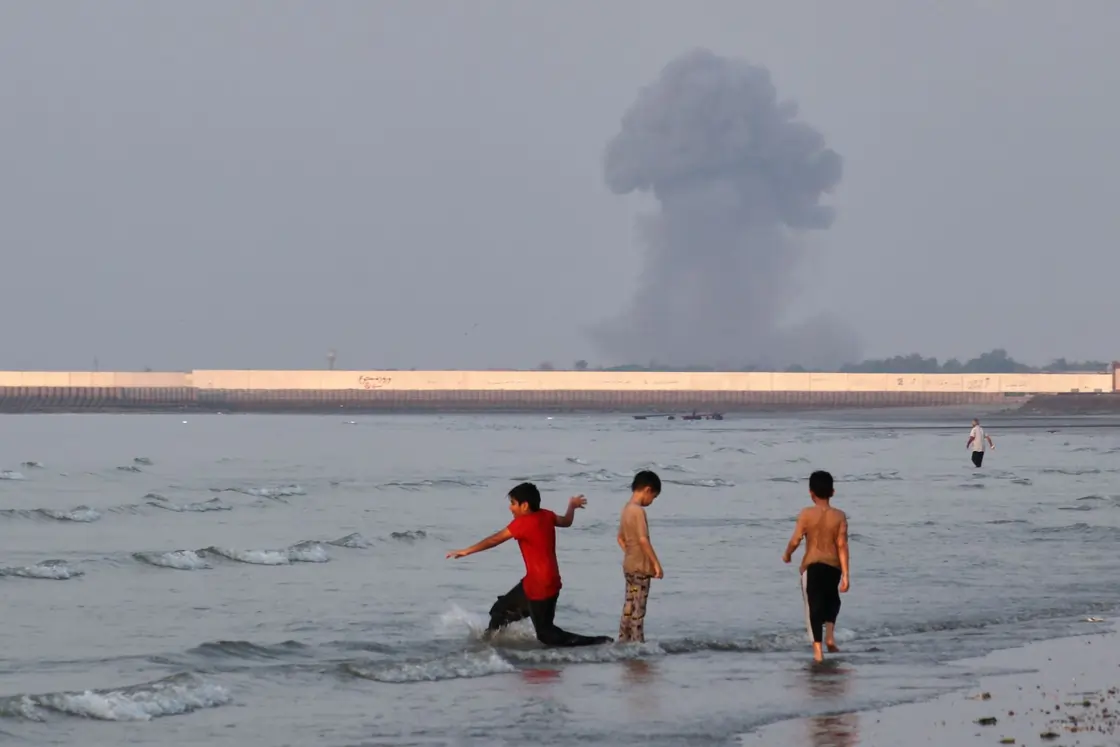
Three boys play in the shallow waters of the Strait of Hormuz, as a plume of smoke rises from an explosion in the background, off Bandar Abbas, Iran, Monday, July 13, 2026. (Razieh Poudat/ISNA via AP)
What happened: President Trump formally notified Congress last Friday that the war with Iran was back in force following the Iranian regime’s repeated attacks on ships in the Strait of Hormuz. The last few days have seen an increase in bombings on both sides, though it’s unclear what will happen next.
Why it matters: Oil prices have already begun to rise again, and the White House’s constantly shifting strategies for securing the Strait and bringing the war to an end have led many to wonder whether such an end is actually possible anytime soon. Still, buried beneath the headlines and hot takes on both sides is a more complicated reality that we can easily miss when proving our previous beliefs becomes more important than understanding the truth of the situation.
The backstory: Does the White House need Congress?
In a letter dated last Friday, President Trump formally notified Congress that hostilities with Iran have resumed. Citing his “responsibility to protect Americans and the United States’ national security and foreign policy interests,” he argued that the renewed attacks represent the opening of another 60-day window to use the military without needing Congressional approval to do so.
If you’re thinking back on the last few months and wondering at what point those hostilities actually ended, well, you’re not alone. And given that both the Senate and the House passed a resolution directing the President to withdraw American forces from the region, it seems unlikely that Congress will go along with another 60-day, blank check to continue the war.
In the end, though, it probably won’t matter.
As we discussed in this space back in March, the line between Congress’s power to declare war in Article 1 of the Constitution and the president’s authority to prosecute that war in Article 2 has always been a bit nebulous. Presidents have sent troops into battle on their own since the mid-1800’s, and the Vietnam War is pretty much the only example of Congress eventually deciding to try and limit that authority. And that was only after about eight years of fighting.
Normally, when the executive and legislative branches can’t agree on something, they turn to the courts. However, the courts have essentially decided this fight doesn’t involve them. As a result, they’ve left it to Congress and the president to decide how to interpret the divisions of war, which has typically gone pretty decisively in the president’s favor.
You can argue it shouldn’t be that way—and, to be honest, there’s a lot to that argument. But the reality is that the Executive branch’s definition of war as a prolonged military engagement that carries significant risk to US personnel over a substantial period of time has often carried the day. Couple that definition with a broad and loosely defined understanding of what constitutes national defense, and presidents are often able to find enough leeway to justify skipping Congress and going straight to the fighting.
And so, we’re back to the US and Iran bombing each other with no clear end in sight. The lack of a clear end hasn’t stopped many from looking for one, though, and it’s worth taking a few minutes to explore what—if anything—may have changed to make such an end possible.
A battle over the Strait
One of the most significant shifts from the war’s earliest days—though it had been trending in this direction for some time—is that the primary battlefield now appears to be the Strait of Hormuz. Iran’s repeated attacks on ships attempting to cross the Strait without their approval sparked the recent return to heavy fighting. And while President Trump has warned of massive, nation-wide destruction “at levels they’ve never seen before” should Iran cross a red line like killing him, for example, most of the bombings over the last several days have continued to target the military infrastructure used by Iran to attack those ships.
The president made it clear that controlling the Strait to ensure that every country other than Iran “will have fair and open use” of it is now the primary goal. Shortly thereafter, he clarified that “fair and open use” would also include a 20 percent charge on cargo as a cost for making sure ships traversed the Strait safely, though he has since walked that back in favor of “Trade and Investment Deals that the Gulf States will be making into the United States.”
The details are still murky there, but it does appear that the administration will no longer have to navigate some gray area between the floated 20 percent charge and their claims of previous months that “No country is allowed to charge tolls or fees on an international waterway.”
Despite declaring the Strait open, though, traffic has continued to slow since the hostilities resumed in earnest. Perhaps that will change, considering the blockade by American forces did not technically start until earlier this afternoon. But crossings already dropped by 52 percent over the weekend, which was still a fraction of the pre-war traffic.
As prices for oil and other products begin to rise once again, the next big question is whether either side has the ability and willingness to prevent another stalemate from dominating the waters. And, at least in that regard, there is perhaps reason for hope.
The line between hope and overconfidence
On a recent episode of The Dispatch Podcast, Jonah Goldberg made the argument that while we are often quick to look to the mistakes of our own leaders, it’s important not to forget that Iran is just as—if not more—capable of potentially catastrophic errors as well. It’s easy to forget how bad things were in Iran during the protests at the start of this year, and conditions haven’t exactly improved after more than four months of bombings.
While the Iranian government has shown an enormous disregard for the well-being of its people, they are still a fractured and weakened state. They are by no means debilitated, and the last few days have shown that the threat of an attack is often just as effective as an actual attack when it comes to stoking fear and eliciting their desired response from the rest of the world. However, it’s important not to give them too much credit.
They need something to change if their government is going to last. The MOU was quite possibly the last real lifeline they were going to get, and they screwed that up.
That said, it would also be presumptuous to assume that the president’s current frustrations with the Iranian regime will lead to a fundamental shift in how he views the war.
For example, much has been made about comments in which he characterized Iran’s leaders as a “cancer,” with some arguing that the statement represented “the language of national security” and indicated a renewed commitment to regime change. However, in the same venue, President Trump also referred to them as “scum,” “loco,” cuckoo,” and “evil, sick people.”
Honestly, all of those monickers likely apply, but choosing one as somehow more definitive for how the administration will approach the next 60 days of war—or however long it continues—seems like wishful thinking.
At the very least, President Trump seems disillusioned with the prospect of reaching any sort of lasting deal with those currently in charge, which is good, given there is little evidence that Iran’s leaders can be trusted in any such deal. (For more on why that’s the case, see Dr. Jim Denison’s “American drone boats attack an Iranian submarine.”) But we need to be careful not to hold that hope with too much confidence.
And therein lies a lesson that goes well beyond the war in Iran.
Spiritual application: The most important person to be honest with
The subject of truth has been a common theme in recent editions of this newsletter. But one aspect of it that I haven’t touched on enough—and an angle that the Lord has laid on my heart in recent days—is that far too often I tend to view the truth primarily in the context of my relationships with other people.
To be sure, that’s an important application, and Jesus is abundantly clear that being someone people can trust is essential to our ability to share the gospel well (Matthew 5:33–37). However, as vital as it is to be honest with others, the most important person to be honest with is yourself.
So much of the coverage of the war in Iran—along with most other stories in the news—is driven by the desire for people to prove that they are right, whether the actual truth of the situation points in that direction or not.
Those who opposed the war from the start are quick to highlight all the ways it’s gone wrong and the administration’s inability to back up its claims that it would be over quickly. By the same token, those who were in favor of the war are quick to point out all that Iran has lost and cling to the hope that victory is still just around the corner. And there’s just enough truth in both positions to justify continuing to hold those beliefs.
But when our desire to prove ourselves right prevents us from taking an honest assessment and identifying the ways in which we’ve been wrong, then we only fall further from the truth.
CS Lewis once wrote:
If you are on the wrong road, progress means doing an about-turn and walking back to the right road, and in that case, the man who turns back the soonest is the most progressive man . . . going back is the quickest way on.
At its core, that’s what it means to repent (Matthew 4:17). And the first step toward true repentance is the humility to make correcting our mistakes more important than proving we were right in the first place.
That’s often easier said than done, but we put a far lower ceiling on how well God can use us and how closely we can walk with the Lord when we make our pride a higher priority than the truth.
So, where are you most prone to make that mistake? Do you know where pride has left you vulnerable to caring more about proving yourself right than being right?
Take some time to ask the Holy Spirit to show you where those areas are, then give them over to the Lord. And know that you’ll probably need to make that prayer part of your daily walk with him.
I know I do, and I suspect I’m not the only one.
News worth knowing
1. ICE agent fatally shoots misidentified suspect in Maine
A US Immigration and Customs Enforcement (ICE) officer shot and killed a Colombian native in Maine after mistaking him for someone else. Homeland Security Secretary Markwayne Mullin claims that the man attempted to “weaponize” his vehicle while driving away from the attempted arrest, though details are still unclear.
Why it matters
The shooting in Maine comes roughly a week after another man was shot and killed in Houston under similar circumstances. In both instances, ICE agents were not wearing body cameras, despite their deployment theoretically becoming more standard in February following the deaths of Alex Pretti and Renee Good. The Trump administration has reportedly ordered ICE officers to stop attempting to halt vehicles in the wake of the shootings, though it’s unclear how consistently or for how long that order will be followed.
What to watch
The lack of body-cam footage in the deaths of Alex Pretti and Renee Good meant that our understanding of what occurred continued to evolve as more information came to light over the following days and weeks. Will the same be true here, or will time prove that the shooting was as simple and tragic as the initial reports depict? And will these shootings mean that body cameras finally become standard-use equipment for ICE officers around the country?
USA Today has more on the story
2. Lindsey Graham’s sister appointed to finish his term
Darline Graham Nordone was appointed by South Carolina Governor Henry McMaster to finish the final months of her brother’s term in the Senate after Lindsey Graham’s sudden death this past weekend. After their parents died relatively young, Graham helped to take care of Darline, who was thirteen years old at the time of their passing, and the two have remained close ever since. While Nordone has never served in Congress, she has been a fixture at her brother’s side throughout much of his political career.
Why it matters
President Trump called Nordone’s selection “a fabulous tribute to Lindsey, who loved her dearly!” Given that Graham was up for re-election this fall and Nordone does not appear to have plans to seek his seat, her time in the Senate will be short, though it started quickly, considering she was sworn in earlier this afternoon. A number of candidates are already lining up to run for the seat this fall, but few would have the immediate impact—particularly in terms of influence with President Trump—that Graham did.
What to watch
With the Republican majority so small, will Nordone look to exert her influence in ways that mirrored her brother’s or be more inclined to go along with what the party wants? Given that Graham was a staunch proponent of US intervention in both Ukraine and Iran, her choice could have a real impact on the future of those conflicts.
NBC News has more on the story
3. The MLB All-Star Game is tonight
The 2026 MLB All-Star Game starts tonight at Citizens Bank Park in Philadelphia. Of all the all-star games in the major sports, baseball’s version feels the most like the real thing, and the chance to see the best in both leagues compete against each other is always a lot of fun.
Why it matters
The National League has been laughably better than the American League for most of the season, and analysts expect that to continue to play out in this game as well. Still, the chance to see the game’s young stars compete alongside and against the players who have dominated for years is always fun, and you never know when one bad pitch or a lucky bounce could send the game’s outcome in a surprising direction.
What to watch
The game starts at 8 p.m. EST on Fox, and tuning in from the start will give you the best chance to see the best matchups. Mike Trout is playing for the first time since 2019, and it could very well be his last All-Star Game as well if his recent injury history continues to prevent future appearances, so catching his first at bat will be worth the effort.
God is good
The online world is often a dark place, and that tends to be especially true in the corners that allow the greatest degree of anonymity. However, a group of Christians with Cru (formerly Campus Crusade for Christ) has made it their mission field. Using VR headsets, they spend Friday nights in VRChat, a popular social media platform, looking for opportunities to share the gospel with the people they meet. They’ve also started a VR church that they invite people to attend, and many have.
Kingdom impact
While the format may sound strange, the level of anonymity afforded by interacting in a virtual world can lower the stakes for religious conversations. As a result, the team at Cru has found a good deal of success in simply inviting people to talk. Stewart Freeman, who connected with a pastor in VRChat and ended up joining the team after coming to faith in the Lord, described how “One of the main things that’s nearest and dearest to my heart is stepping into the darkest of those places, of getting to know the individuals in that space, growing in relationship with them, and then pointing them to the answer that they’re searching for.”
Prayer point
Will you pray that God continues to bless and protect those who are engaged in this work? Will you pray that he sets up divine opportunities for them to discern where they need to go and whom they need to talk to? And will you pray that more people like Stewart Freeman are saved as a result?








 Search