



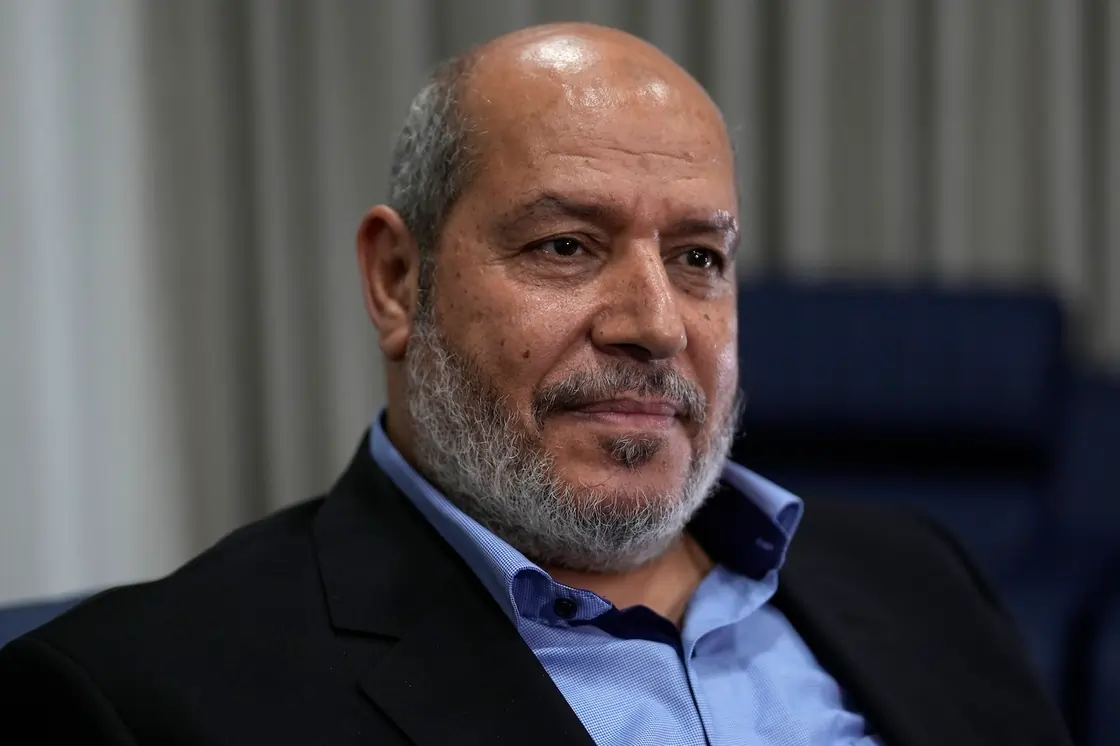
FILE - Khalil al-Hayya, a high-ranking Hamas official who has represented the Palestinian militant group in negotiations for a ceasefire and hostage exchange deal, gives an interview in Istanbul, Turkey, April 24, 2024. (AP Photo/Khalil Hamra, File)
What happened: Hamas elected one of the chief architects of the October 7th attacks as its new leader. Khalil al-Hayya won the vote by the narrowest of margins and is now tasked with rebuilding Hamas following the devastation of its war with Israel. His past paints a rather bleak view of what that future will hold, though.
Why it matters: Of the two men at the heart of the vote, al-Hayya favored closer relations with Iran than with the other Gulf Arab states. Given that Hamas announced that it would dissolve its government in Gaza two weeks ago, how will al-Hayya approach the new balance of power in the region? While he favors Iran, will he be as beholden to them as the larger nation’s other proxies?
The backstory: Hamas has a new leader
On Monday, Hamas chose Khalil al-Hayya as its new leader. The terrorist organization had been run by a five-person group since the death of Yahya Sinwar in October of 2024, with both al-Hayya and runner-up, Khaled Mashaal, working as part of that group.
The elections are supposed to happen every four years, though they are routinely clouded in mystery, and very few of those actually impacted by the election get to cast a vote. 2021 was an exception when the group felt sufficiently secure to hold open elections in Gaza, where an estimated 20,000 people participated. By contrast, the most recent selection took place in Qatar and was decided by a fraction of that.
A senior Hamas official stated that “Khalil al-Hayya was elected by an overwhelming majority.” However, the unofficial—and likely more accurate—reporting claims that it took two tries for someone to get a majority, and the final tally was 35 to 34 in favor of al-Hayya.
Given the fractious nature of Hamas—and the recent history of its leaders tending to die before their term comes up—it will be important to watch whether al-Hayya’s election brings stability or further dysfunction to the group. Given his history as both an architect of the October 7th attacks and the lead negotiator in bringing the ensuing war to a tenuous truce, it could go either way.
Digging a bit more into his background may help answer the question, though.
Who is Khalil al-Hayya?
Born in 1960, al-Hayya grew up in Gaza alongside the rest of those who would eventually comprise Hamas’s leadership. He joined the group when it was founded in 1987 and eventually rose through the ranks to become one of its key negotiators while also overseeing its communications. He served as Yahya Sinwar’s deputy in the Gaza Strip until leaving for Qatar in the days just before the October 7th attacks.
Al-Hayya spent three years in an Israeli prison in the 1990s and has survived multiple attempts on his life. It’s reported that nineteen of his family members were killed in these attacks, including four of his sons.
While these numbers are difficult to corroborate, they have helped him build a reputation as someone who has suffered for the cause and understands the grief felt by others who have lost family and friends in Israeli attacks.
Of course, it must not be overlooked that he has also played a key role in engineering the attacks that precipitated such a reaction from Israel. So, while he and his family have suffered, empathy is far from the only reasonable emotion to feel in response.
Al-Hayya had learned nearly two decades earlier that the October 7th attacks he helped to design would be effective, though.
He was among the chief negotiators with Israel following the kidnapping of Israeli soldier Gilad Shalit in 2006. In the aftermath, he remarked that the exchange of 1,000 Palestinian prisoners for Shalit proved that kidnapping works. Al-Hayya went on to say, “The one and only solution is more resistance against the Israeli oppression, and more abduction of Israeli soldiers and settlers.”
And there is little evidence that his beliefs have changed since. So, where does that leave us?
What happens next?
A couple of weeks ago, I spent part of The Focus looking at Hamas’s decision to dissolve its government in Gaza while refusing to give up its weapons. At that time, it was clear that most were taking a wait-and-see approach regarding the promised change.
Israel’s Foreign Affairs Minister, Gideon Sa’ar, warned that anything short of complete disarmament would turn Gaza into Lebanon, where the government in charge was not the government in power. The Board of Peace’s official stance was a bit less absolute, though they noted that “Ultimately, our assessment will be guided by actions, not promises, to meet the critical needs of the people of Gaza.”
The election of Khalil al-Hayya is the first notable action since that announcement, and the signal it sends is not exactly encouraging.
It’s debatable whether Khaled Mashaal would have set Hamas along a different path than al-Hayya. However, the general expectation was that al-Hayya’s vision for Hamas centers on a close relationship with Iran. By contrast, Mashaal was more interested in reaching out to the other Gulf Arab states as potential allies.
While neither man wanted to see Hamas become beholden to Iran in the way Hezbollah or the Houthis are, al-Hayya is clearly more comfortable with Iranian influence. It remains to be seen just how much influence Iran can wield once the war with the United States comes to its eventual end. But, for now, it appears that Hamas has chosen to reinvest in that relationship, and that decision could have a profound impact on the future of Israel, Gaza, and much of the region.
Spiritual application: Don’t be like David
One of the most consistent principles we see throughout Scripture is that the people we associate with will have a direct impact on the way that we live. But while we see this idea play out from Genesis through Revelation, King David is one of the clearest examples.
My family and I have been reading 2 Samuel before we get the kids to bed, and one of the trends that has stuck out most after revisiting this book is how David’s best years came when he was either alone with the Lord tending to the sheep or in the palace of Saul, fostering a close friendship with Jonathan. His life turns into a bit of a rollercoaster after that, though, and by the time he’s firmly established as king, Scripture paints a clear picture of a man who no longer felt the need to surround himself with the kinds of people that could hold him accountable.
Take the story of Bathsheba, for example. It’s not an accident that the author of 2 Samuel starts that passage by stating, “In the spring of the year, the time when kings go out to battle, David sent Joab, and his servants with him, and all Israel” (2 Samuel 11:1).
King David chose to ignore his duties, and no one around him seemed to care. There were no Jonathans in his life to tell him to get out on the battlefield and lead by example. The closest it gets is a sketchy general who, later in the story, threatens to steal the glory for himself if David doesn’t get his act together.
As a result, he ends up seeing Bathsheba cleaning herself, calls her into his quarters, takes advantage of her, and then has her husband killed when that seems like the only way to hide his sin.
At no point in this story does anyone step up to challenge him. At no point is there a friend, family member, or even a prophet who has his ear enough to convince him to change. And when God finally sends Nathan to confront him and detail the consequences of what’s to come, his response is to say “I have sinned against the Lᴏʀᴅ,” with no mention of the others he wronged along the way (2 Samuel 12:13).
I bring all this up today because it never really seems like David recovers from this mistake. While he does ask for the Lord’s forgiveness, every other story in 2 Samuel after this point depicts a man who is lost and left to watch his world crumble. And the little details of that downfall all point back to this basic idea that he never again seemed to surround himself with someone who could consistently point him back to God or confront him when he sinned.
As a result, the story of the man after God’s own heart ends with a fractured kingdom, a broken family, and a poor, pitiable existence.
The people we choose to surround ourselves with—for better or worse—will inevitably impact the quality of our lives and the quality of our relationship with the Lord.
So, who are you surrounded by today? Do you have the kinds of friends and family members that make it easier or harder to follow God’s will?
And, just as importantly, which of those friends are you?
News worth knowing
1. Nearly 100 American troops have been injured in Iran over the last two weeks
The last two weeks have seen some of the most intense fighting in recent months as the war with Iran escalates once again. The Pentagon said Monday that three American troops have died, with nearly 100 more injured, over that period. The statement was notable for both the number of people hurt and the fact that it was acknowledged in the first place.
Why it matters
The official Pentagon database of casualties in the war had not been updated for some time. The stated reason for the paucity of news in this regard was a desire to limit information Iran could use to plan further attacks. The idea was that if Iran knew where they were having the greatest success in terms of casualties, they would focus more of their fire on those regions. Still, the numbers are important for gaining a solid understanding of the war’s true cost.
What to watch
The same reports claimed that 96 percent of those injured over the last two weeks have since returned to duty, which is encouraging. Still, the intermittent nature of the updates raises the question of whether the numbers are now accurate or if we’re still waiting for a true assessment of the casualties. With bombings continuing today, will Iran maintain the capacity to put American forces and those of our allies at risk? Please pray that the answer is no.
The Washington Post has more on the story
2. Cyclospora outbreak continue
The Cyclospora outbreak continues to make headlines, with the latest reports of a known source now called into question. The FDA announced last weekend that the parasites were coming from Taylor Farms’ shredded iceberg lettuce, a fixture at Taco Bells and grocery stores around the country. On Sunday, news broke that the Taylor Farms story was the result of a false positive, though the FDA maintains that other evidence points in their direction.
Why it matters
Until the source is known—or at least narrowed down—it will be difficult to make much progress on containing the outbreak. At this point, officials don’t even know whether they’re dealing with a single, widespread problem or multiple smaller outbreaks that occurred simultaneously. For now, the best guidance remains to wash your fruits and vegetables well and hope for the best.
What to watch
As prolific as the outbreak seems, it will come to an end. Choices made now—by both the implicated companies and the government—will shape what that end looks like, though. Will each party’s desire to insulate itself from blame and damages get in the way of making food safe again?
The Dispatch has more on the story
And, for a spiritual perspective on this topic, see Dr. Jim Denison’s “Wondering if cyclosporiasis is in my future”
3. FIFA made $9 billion from the World Cup
The World Cup came to a close on Sunday with Spain pulling ahead in extra time to defeat Argentina 1–0. It was a phenomenal game, and the tournament helped raise the profile of a number of the game’s biggest stars. However, no one benefited as much as FIFA, the World Cup’s governing body, which is poised to take home a record of its own: $9 billion in net revenues.
Why it matters
A big reason why FIFA made so much from the World Cup was the expanded field of play. The tournament included 48 teams this year—up from 32 in the previous iterations—which meant an additional 40 matches and two more weeks of soccer. Now they’re reportedly planning to expand the field to 64 teams for the World Cup’s centennial anniversary in 2030.
What to watch
While expanding to 64 teams will mean more revenue for FIFA, at what point will diminishing returns in the level of competition prove to be a net negative for the tournament? Will the world’s best teams go along with the changes, or will some start to push back?
God is good
“A pastor and a salesman get into an Uber” sounds like the start of a bad joke, but as more ministers and Christians embrace ridesharing, it’s become a bourgeoning ministry that God is using to change lives. Bryan Sands, who started driving for Uber while serving as a campus pastor in Fullerton, California, estimates that around half of his passengers were open to faith conversations during their rides. And some, such as a woman who was going out for the first time since her husband killed himself in front of her, just needed someone to listen. Whatever the circumstances, though, Sands and others remarked on the unique relationship in that setting and how the Lord can use it to do remarkable ministry.
Kingdom impact
As Cody Benjamin describes, “Christians have paired driving with ministry for years.” From Jerry Falwell’s bus ministry to the “moving pulpits” of taxi drivers in Uruguay, Brooklyn, and everywhere in between, there’s something about the idea of sitting in a car with someone that seems to make conversations about faith feel just a bit more natural. The key is being willing to surrender that time to the Lord and step outside your comfort zone to engage with the people he brings across your path.
Prayer point
Will you pray for Christians driving for Uber and other ridesharing services to see their job as a potential ministry opportunity? Will you pray that God will do the same for the passengers? And will you pray that the next time you need an Uber, taxi, or other such service, the Lord will provide you with the chance to help others know him through that time?
Christianity Today has more on the story










 Search