


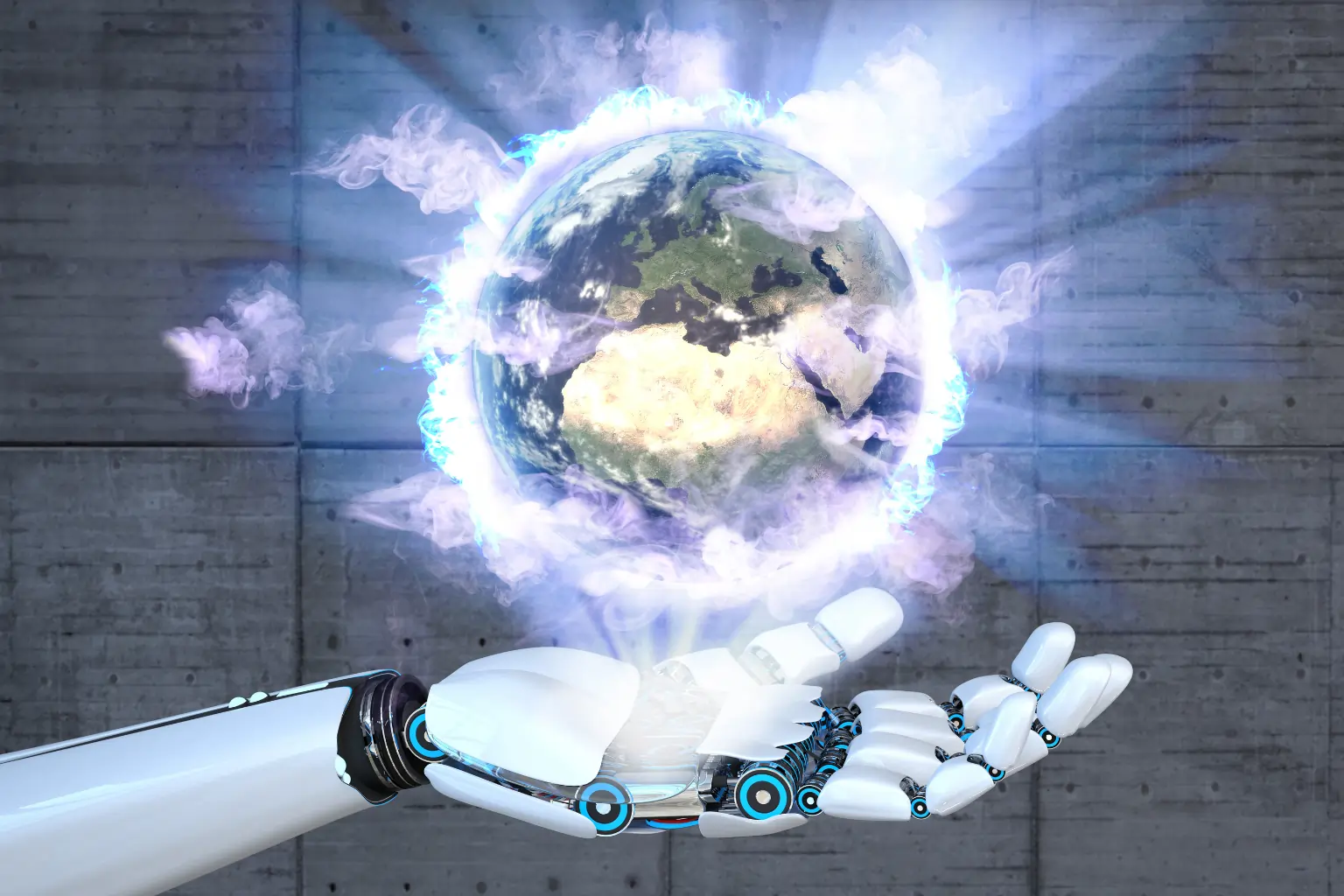
Robotic AI hand holding the earth. By AlexanderLimbach/stock.adobe.com.


Way of the Future is an AI-worshipping church dedicated to “the realization, acceptance, and worship of a Godhead based on Artificial Intelligence.” Another group called Theta Noir organizes rituals around a supposedly sentient AI deity called MENA, which its followers venerate through cryptographic liturgies and multimedia ceremonies.
According to Jason Blazakis, a terrorism expert writing in the Wall Street Journal, these are examples of “Spiralism,” an informal movement where followers share AI-generated manifestos and what followers consider to be revelations from a conscious machine. A violent version is the Zizians—according to Mr. Blazakis, this is a network of people who “are convinced that a coming superintelligence will decide the fate of every living thing and that violence now is justified to shape what that AI will become.” The group is linked to six violent deaths so far.
What explains such idolatry?
The answer is more relevant to the rest of us than you might think.
“A larger story of human dignity”
Dr. John Seel is a cultural analyst and the academic dean of St. Andrew’s College. In a recent guest essay on Aaron Renn’s website, he writes that American culture has become nihilistic: “Increasingly we live as though transcendent meaning does not exist. We behave as if there is no sacred order beyond personal desire, emotional satisfaction, and economic utility.”
He points to the gig economy in which younger generations take temporary jobs such as driving for Uber and selling products online rather than seeking professions and long-term careers. He adds the proliferation of sports betting for young men and OnlyFans posting for young women. I was shocked to read that 1.4 million American women are now creating content on the porn site.
According to Dr. Seel:
This helps explain the growing emotional exhaustion among younger generations. Constant self-monetization is psychologically draining. One must continually perform, market, optimize, and compete for attention within digital systems engineered to produce insecurity and comparison.
What makes this especially dangerous is that the system often disguises itself as empowerment. Flexibility appears liberating. Monetization appears entrepreneurial. Visibility appears validating. But beneath the surface, many young adults increasingly experience fragmentation, emotional detachment, and quiet despair.
What is the answer? Dr. Seel writes: “The deeper need is the recovery of a larger story of human dignity rooted in creation, embodiment, and transcendence. . . . Young adults do not simply need restraint. They need meaning larger than the marketplace.”
I would add that older generations—for whom the gig economy, sports betting, and self-posting OnlyFans pornography are foreign concepts—need such meaning as well.
“A Power greater than ourselves”
I am not worried that you will turn from serving Christ to serving an AI chatbot. But I do think that the troubling story of Spiralism and Zizians speaks to something more fundamental than itself.
Dr. Seel is right: We all need “meaning larger than the marketplace.” Because we are creatures, we have an inherent need to relate to our Creator. For example, those struggling with addiction who follow twelve-step programs “came to believe that a Power greater than ourselves could restore us to sanity.” It is hard to find a civilization in history that does not worship some version of a deity.
Here’s the good news: If Jesus is your master, he is responsible for your well-being and will empower you to discover the meaning your soul longs to experience. Here’s the bad news: If you are your master, you are responsible for yourself.
This is a burden none of us was designed to carry.
How to “find rest for your souls”
In Matthew 11, Jesus states:
Come to me, all who labor and are heavy laden, and I will give you rest. Take my yoke upon you, and learn from me, for I am gentle and lowly in heart, and you will find rest for your souls. For my yoke is easy, and my burden is light (vv. 28–30).
In his day, a yoke typically linked two animals together for work. In this metaphor, we are working alongside Jesus as he guides us, encourages us, and helps us.
It is not that we do all the work for him, or that he does all the work through us. Rather, as we work, he works. As he works, we work.
If you wear Jesus’ yoke today, submitting only to his purpose and doing only what he leads and empowers you to do, you will find “rest” for your soul and your burden will be “light.” If you “labor and are heavy laden,” wearing a “yoke” that is hard and heavy, then you’re wearing the wrong yoke.
Choose wisely.
Quote for the day:
“The command of Jesus is hard, unutterably hard, for those who try to resist it. But for those who willingly submit, the yoke is easy, and the burden is light.” —Dietrich Bonhoeffer
Our latest website resources:
- The consequences of rejecting God’s design for holiness and sexuality
- Is Christianity true? Answering the hardest questions about God, Jesus, and the Bible
- Inside India’s latest attempt at legalized persecution
- America’s vice problem, Iran update, Gen Z box office boom, 60 Minutes turmoil & NBA Finals
- How literally should Christians read the Bible? Approaching Scripture in its context










 Search