




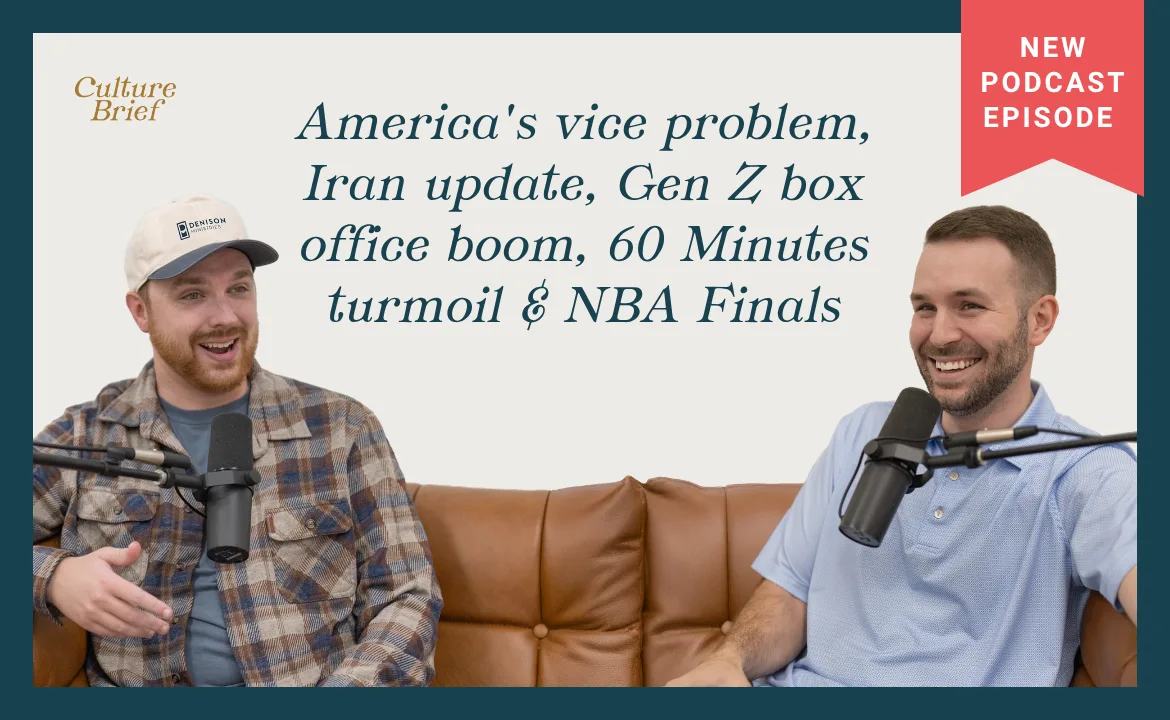
Culture Brief: America's vice problem, Iran update, Gen Z box office boom, 60 Minutes turmoil & NBA Finals | Ep. 72
In this week's Brief: The Iran deal negotiations feel like Groundhog Day—another week, another "we're almost there." We break down Trump's heated call with Netanyahu, the stalled peace talks, and a call to prayer for an end to the conflict.
Then we look the vices that are quietly dominating American culture—sports gambling, marijuana, and online prostitution. We explore how instant gratification has turned every phone into a pocket Las Vegas—and what biblical stewardship looks like in response.
Plus, Scott Pelley fired from 60 Minutes, the Spencer Pratt mayoral race update, Gen Z directors are blowing up the box office while Star Wars stumbles, Myles Garrett sent to the Rams in a blockbuster NFL trade, and the Stanley Cup and NBA Finals are here!
Through it all, we're reminded that God is our refuge and fortress—and that the vices of this world were never meant to satisfy what only He can fill.



Topics
- (0:00) Introduction
- (1:37) Iran deal stalemate
- (2:03) Trump and Netanyahu clash
- (7:50) Psalm 46 and prayer
- (15:22) Sports betting everywhere
- (22:46) Marijuana goes mainstream
- (25:05) Porn industry and AI
- (31:23) CBS 60 Minutes shakeup
- (33:48) LA mayor race update
- (40:03) NFL blockbuster trades
- (42:04) College baseball and softball
- (43:38) World Cup betting boom
- (44:34) Stanley Cup and NBA Finals
- (48:27) Conclusion
Resources
- Send us your thoughts, questions, and topic ideas: [email protected]
- Culture Brief Instagram
- Watch on Youtube
- Sign-up for a Denison Forum newsletter: DenisonForum.org/subscribe
Articles on this week’s top headlines:
- Trump ‘shouted and cursed Netanyahu over threat to resume Beirut bombing’
- The altars of our culture’s excess
- Confidence in Institutions
- The Rattled Generation: A unified theory of this American moment
- Behind the Curtain: Scaling sin
- The Future of Movies Is Here: ‘Backrooms,’ ‘Obsession’ Mark Turning Point for Hollywood | Analysis
About Conner Jones
Conner Jones is the Director of Performance Marketing at Denison Ministries and Co-Hosts Denison Forum's "Culture Brief" podcast. He graduated from Dallas Baptist University in 2019 with a degree in Business Management. Conner passionately follows politics, sports, pop-culture, entertainment, and current events. He enjoys fishing, movie-going, and traveling the world with his wife and son.
About Parker Jones
Parker is the Groups Pastor at Midway Church in Pilot Point, TX. He received a Bachelor's degree in Politics, Philosophy and Economics from Dallas Baptist University and recently completed a Master of Arts in Theological Studies from Southern Seminary. Parker's main interests include baseball, football, history, and current events. He loves fishing, attending Texas Rangers games, and spending time with his wife and two daughters.
About Denison Forum
Denison Forum exists to thoughtfully engage the issues of the day from a biblical perspective through The Daily Article email newsletter and podcast, the Faith & Clarity podcast, as well as many books and additional resources.
All episodes are produced by Sound of a Rose. For more information, you can visit soundofarose.com.
EPISODE TRANSCRIPT
NOTE: This transcript was AI-generated and has not been fully edited.
Conner Jones: [00:00:02] Hi, I'm Connor Jones.
Parker Jones: [00:00:04] I'm Parker Jones.
Conner Jones: [00:00:05] And this is Culture Brief, a Denison Forum podcast where we navigate the constant stream of top stories and news, politics, sports, pop culture, technology, and so much more, and we do it all from a Christian perspective. And yeah, that was Parker that said hello, not Micah. Guys, it's summer. It's just one of those things. You know how summer is where you go on vacations, you got conferences, you got some of other obligations and all of that. So, you know, Mike and I are going to be a little bit hodgepodge over the next few weeks and so we're going to be bringing on some other names to come in and help us out here. But yeah, Parker, welcome back to the show.
Parker Jones: [00:00:36] Grateful to be here.
Conner Jones: [00:00:38] Yeah, and if y'all remember Parker came on a few weeks ago and we talked about really the birth rate crisis. Him, Mike and I had a great discussion around that. So was like, hey, Parker, you want to come back on and kind of do a full episode today and dive into some of the topics you've written about recently. Parker does a lot of our writing here for Denson Forum as a contributing writer. And yes, we should mention up top, Parker is my younger brother. And so you may hear some brotherly jabs here and there throughout this episode. But Parker, welcome back. And do you want to just give us a quick preview on what we're going to be talking about today?
Parker Jones: [00:01:05] Yeah, absolutely. We've got a lot to cover. We're going to be talking about an update on Iran. We'll be covering some of the the vices that are dominating American culture today. Look at the box office, which is exploding in the month of May and now early June. And then several sports topics to hit, big NFL trades and a lot of upcoming events on your TV. So I'm excited to talk about it all.
Conner Jones: [00:01:29] Thanks, Parker. Let's jump into the brief. Okay, yeah, up top, let's just hit on Iran because we've been discussing this almost every few weeks. Last week we really dove into it, kind of the latest on some of the peace deal negotiations and guys, it's like Groundhog Day around here. It's another week of hearing we're just on the finish line. We're on the one yard line to a deal between the United States and Iran with mediators trying to help figure out some sort of negotiated peace, ceasefire, future deal to get nuclear weapons out of Iran. The real update is there's not really an update other than, I mean, it almost all got derailed on Monday until Trump called Israeli Prime Minister Benjamin Netanyahu, aka BB. They had it out on the phone and Trump apparently really just yelled at him, cussed him out. It was not a great scene apparently, according to those who were familiar with the call. And this is all coming out of Axios. There was some deep reporting on how this call went. But essentially, just some background information on this, Israel started to attack Lebanon in recent months and weeks and then they were headed towards the capital city of Beirut to do more attacks. You know, they're saying that they are targeting Hezbollah. There's some conflicting reports on how many civilians are getting killed in the crossfire of these attacks on Hezbollah, which is one of the Iranian terrorist proxies. And so, Iran, one of their sticking points in these negotiations with the US has been, you have to pull Israel back from attacking Lebanon. They did not want them to keep doing that. If we want these peace deals to keep being talked about, Israel's got to stop. So as Israel was pressing forward in Lebanon, Iran basically was like, we're suspending talks. We're not talking with the US anymore. So then Trump calls up Netanyahu and just lets him have it on the phone, apparently. Yeah, I mean, Trump literally, according to some of the notes on this call from people who were in the room, they said that Trump called Netanyahu crazy, literally the word crazy, and accused him of ingratitude. He put the brakes on Israel's plans to strike Beirut, telling Netanyahu that following through on his threats to bomb the Lebanese capital would further isolate Israel around the world. He also claimed that he'd helped Netanyahu stay out of jail by supporting Netanyahu during his corruption trial there in Israel. And he said specifically these words to Netanyahu, Everybody hates you now. Everybody hates Israel because of this. So that's Trump really rebuking Netanyahu and trying to say, hey, look, Israel's not popular right now across the Middle East and it's not even always popular across the world. And as we've seen here in America in the last several years as this conflict has just gone and gone and gone, the position of Israel in the minds of the American people is really divisive. And so I think Trump is trying to like tell Netanyahu that. And he's also saying, stop doing things that are going to upend our negotiation talks with Iran here. So that's kind of just some context. Some more context would be Hezbollah has been launching missiles towards Israel over recent weeks and months. And so Israel feels like they are doing self-defense, just as some like information there for you as to what's kind of behind this operation there in Lebanon and Southern Lebanon specifically. But there have been hundreds of civilians killed there. That's the super sad part of this is there's always casualties that you don't want to see and that that are really unfortunate in the midst of these type of conflicts. Another US official said that Trump specifically was concerned by the fact that Israel had killed so many civilians in Lebanon and that he objected to the Israelis knocking down buildings to take out a single Hezbollah commander, essentially, which is what Israel does. They'll identify where a commander is and then they'll strike that building. After that call, Israel stopped their march towards Beirut. Essentially, there were their tanks and vehicles already on the way. They had plans for air strikes. Israel canceled all those plans and they have peeled back. So we're sitting here on Wednesday morning now recording this and there's really no further updates beyond that and there's really no further updates from the State Department or anything on the negotiations other than Trump continues to say day after day, we're right there. We're almost there. We're getting there, but also we're not in a hurry. You know, that's kind of his weekly statement. But Parker, just what have you seen this last week in regards to the conflict in Iran? Do you believe the US officials are actually close and do you believe them when they say that they're almost there pretty much daily?
Parker Jones: [00:05:36] No. No, I but that's a blanket statement. I think it's representative of kind of where the American public is with this. This news cycle just feels extraordinarily repetitive and I think it's hard to latch on to any one statement or word from the administration because we've been going through this for weeks now. You say in the last week, but this last week feels very similar to the week before, which feels very similar to the week before that. And so I have very little confidence on an upcoming end date because I think once upon a time, the thought was this would be a six day and then maybe a six week operation and we're well beyond that now. And and I think there's some fatigue. Well, I don't think there's definitely fatigue from the public on the topic of Iran, on war in the Middle East, of course, and as it relates to the economic standing on the home front and I I think people generally speaking would like to just put this story behind us and and move on and have peace on the other side of the world.
Conner Jones: [00:06:37] Yeah, I'm right there with you. I I think a lot of people do feel that way. I also, I'm picking up on, you know, just kind of perusing the internet and conversations here and there anecdotally of there is a fatigue and there is a easy way of saying that is so far away. But there's also people who are anxious about it all like, oh my gosh, this is, yeah, you mentioned the economy. I mean, that's a here back home type of situation where gas prices are high, economics are weird, supply chains are starting to get affected big time and just an anxiety of like global conflict is not fun to talk about or think about. This is not the only conflict where it feels like it's day after day the same thing. The Ukraine Russia war has been going on for four years now and it's the same thing. And that was also supposed to be a war that was supposed to be over quickly according to Putin and his people over there in the Kremlin. They were like, this is going to be quick and easy. It's just usually not as easy as people seem to think. And then ending a war, even if it's, you know, quicker, like this, if this was just a three-month operation and then it needs an ending with some sort of deal, it just is never that easy. You're talking about two completely different philosophies coming to the negotiating table between Iran and the US. But anyways, if you're feeling fatigue from this, if you're feeling anxiety from this, I totally understand. I think a lot of us feel that way, either of those ways or somewhere in the middle. What I would say is this, would you just continue to join us here at Denson Forum, here on this Culture Brief podcast in praying for a peaceful resolution. I mean, this is just basically a call to prayer. There's really not much we can do unless you are in those halls of power negotiating this deal and maybe you're listening to this and you are. And then you have a very specific special calling from the Lord in this thing. But for the rest of us, let's pray because we cannot trust that fallen and sinful humans are going to be able to come up with a perfect path to peace. That's just not how it works. But, you know, we can pray that our God would make a path towards the end of destruction, right? Towards the end of this conflict and war and death and destruction and upending of so many lives. And we, you know, we can remember that as wars do rage on, God is our refuge and fortress. And I'm pulling that from Psalm 46 where verse one says, God is our refuge and strength, a very present help in trouble. You go down a little bit in verse six and seven says, the nations rage, the kingdoms totter. He utters his voice, the earth melts. The Lord of hosts is with us. The God of Jacob is our fortress. Even a little bit further down verses 9 through 11 says, he makes wars cease to the end of the earth. He breaks the bow and shatters the spear. He burns the chariots with fire. Be still and know that I am God. I will be exalted among the nations. I will be exalted in the earth. The Lord of hosts is with us. The God of Jacob is our fortress. I pull comfort from that knowing that, you know, whatever our battle is, and this is not just geopolitical battles. This is our own internal battles, our spiritual battles, our daily, man, this day is going to be hard type of battles. When we get up, we know that God is our refuge. God is our strength. God is our fortress. There's a comfort in knowing that because all the other fortresses can fall. Every other refuge can let you down, but God will not. And so just remembering that as we talk about any of these geopolitical things, but also, man, as you're battling something today in your daily life, remember that God is your fortress. Any last thoughts there, Parker?
Parker Jones: [00:09:50] I love Psalm 46. I think there's a balance in all of these things and the importance of caring about current events, caring about what's happening in the world. I believe scripture commands us to seek the welfare of our community. And yet also remembering that we can find joy and contentment in every circumstance. And for the believer, we have an eternal home, a kingdom, the author of Hebrews says that cannot be shaken. That's the kingdom we await and it's far greater than the kingdoms of this world. In fact, the kingdoms of this world will bow down to the eternal kingdom of Christ one day. So there's a lot of hope in that. That's been true for 2,000 years for believers across every circumstance and every life stage and every geographical conundrum. This is the hope that we have in Christ.
Conner Jones: [00:10:37] Yeah, you're exactly right. That's a golly, man, we the kings will bow before the king. I mean, we we we serve the king of kings, which is just such a comfort. All right, well, let's move on to our next topic here that Parker, you're going to dive into, but I want to kind of offer a little bit of a context bubble before we dive into this. So you're going to be talking about some of the things that are up in our culture with vices and taboos and and major sins just at the center of everything. But I kind of want to offer a little bit of context here, which is that by really most objective measures, it's actually a really good time to be alive, specifically in America. If you look at our wealth here in America, it's still going up, up, up. Now, you could argue that that's entering the pockets of a very few, even though our stock market is raging, there's people at the top of the, you know, food chain that are getting a lot of that. But essentially, man, with our technology, with our medicine, with our wealth here in the United States and even across much of the world, especially the developed world, it's a great time to be alive. If you look back at history, you'd be hard pressed to choose a better time to be living than now. You know, wealth is soaring. Violent crime actually sank to a 20-year low this year and is still falling. The murder rates are down for the first time in 20 years, which is great. Life expectancy has just hit its new peak of 79 years old here in the United States. We're producing more energy than ever. And that's just something that's great here in the United States to be producing our own energy, not having to relying on other places that brings the cost down. Yet, the University of Michigan released a new data set that basically showed that consumer sentiment actually just hit its lowest reading in half a century. So there's a lot of like things that seem like they should be positive, but people are not feeling that is essentially what that's showing. And Gallup did a poll and they found that most people think that things will only get worse. And other Gallup data is actually showing that trust in most major institutions is at or near record lows, such as institutions like the government specifically, media, organized religion, that includes us as the church, public schools, higher education, law enforcement, science, medicine. People don't trust these institutions that were for a long time had a lot of trust put into them. But as we've seen, much has upended that. Axios wrote an article about this and they called what we're living in the rattled generation. And they're saying they're we're rattled by three main things. This is their theory of the case. I'm not saying this is what it is. I think we're going to dive into some more here. Their theory of the case is they pointed to three main reasons that people are rattled. And that would be the rise of social media, the chaos of COVID in 2020 through 2022, and then the rise of AI, political extremism, and information bubbles in the aftermath of both of those things. So, you know, they say that these factors produce a perpetually rattled generation, basically one that's too unsteady and uncertain to believe things are truly good or getting better is their theory of the case. But I think there's more to that. And that's one of the things we want to talk about here is there's darker reasons behind there being a rattled generation right now. It's not just a lack of trust in these institutions. There's more stuff happening. So Parker, if you want to dive into some of the things you wrote about last week on, I think you were basing it off of the idea of the Las Vegasification of the United States of America.
Parker Jones: [00:13:42] Yeah, well, I I do want to kind of transition into that by mentioning one of the key ideas that I think came up in what you just shared is that we have a culture that has access to everything and that alone does not satisfy us. And so there's this instant gratification that has permeated our culture and our world as a whole. AI is like an extreme amplification of that. But instant gratification is an idea that's been growing pretty rapidly over the last century plus. Really, honestly, you could probably take it all the way back to the industrial revolution. This idea that we can have access to anything and everything all the time is kind of the culmination of it today. And those things don't satisfy. So we have access to everything and yet those numbers you mentioned are shockingly low as it relates to like satisfaction and happiness in our world today. And part of it is because of where we are seeking satisfaction. And I think this is the transition for us is Americans are at new levels and new heights seeking satisfaction, seeking happiness, seeking joy in some of these key vices. Many of these are things that are really Las Vegas has been a hub for historically. We're going to talk about gambling in a second and some other things that are downstream effects of that. But Las Vegas has been the place, the Sin City for for people to travel to, to flee to these indulgences and to try and find satisfaction in them. But as instant gratification has taken hold across the country, we have access to all of the things that Las Vegas used to be special for, if that makes sense. And so the first one I want to talk about is is gambling because physical casinos are not necessarily having a resurgence. In fact, there's some numbers that would suggest that a lot of physical casinos are struggling more than they have previously. It really the key is we now have a casino in our pocket. Everybody, basically anybody, anywhere at any time can access gambling on their phone. And the big, maybe the primary way in which this is taking place today is through sports gambling, sports betting. If you can't watch a sporting event or listen to a sports-based podcast without a DraftKings ad or a FanDuel ad or or whatever the chosen sports book is that's sponsoring that event. And it's the irony is really extreme when ESPN wants to cover a story about how there's a player, a professional athlete is being suspended for gambling or a coach is caught in a betting scandal or something like that. And at the bottom right corner of the screen, there's a DraftKings ad. So this is happening all the time now. And sports betting is rampant across our country. And hear me say this, the idea here is not that if you spent $5 on a parlay once that you you have committed some grave sin. That's not my point. My point is people are losing their livelihoods to this. Yep. And our sports are losing their integrity to this. And we've we've got a point now where 52% of men under the age of 50 have an active sports book account. And two-thirds of professed gamblers have bet over $100 in a day before on sports gambling. And 22% of Americans know somebody who has a gambling problem. That's a number that may sound somewhat low on the surface, but it's not. If you consider 22%, that's an enormous amount of population. It's also seven points higher than it was in 2025. So in one year, 15% to 22% of people know somebody that has a gambling problem. And large majorities express concern about the risk of online betting to younger adults and the normalization of it across our culture and the potential for it to corrupt and build fraud within our sports. And we've seen this. There's we don't have time to unpack all these story lines today, but there's plenty of examples now in NBA, MLB, college football of professional athletes, I guess in college football, they're not technically professional, but they're getting paid millions in NIL deals now that are losing their careers to sports gambling. And in doing so, they're sacrificing the integrity of the game. And so sports gambling is is extreme. Connor, what do you think the appeal is to specifically to younger men? That's the that's the group that is most enthralled with this, that is most impacted by it. People like you and me. What is the appeal to sports betting?
Conner Jones: [00:18:30] Quick wins, quick money. That's the idea. Mike and I have discussed this before on this podcast. I've written articles on sports gambling specifically as well. And then we've also talked about the prediction market thing. Polymarket and Calshi and the way it just allows you to log onto your phone and basically, I mean, do what you used to have what you already said, you used to have to go to a casino to place some sort of sports bet or sit at a slot machine or a table or something. Now, man, you can just pull up your phone, sit back on the couch, grab a bag of chips and watch a game and place bets throughout the whole game. There's an idea of the quick win and then it, you know, if that keeps you excited or what not, it hits that dopamine rush. And then next thing you know, you're you're down a spiral that you didn't realize you were going down and you're out money and all of that. Now, that's not everybody. There is a few people who go down this complete path to addiction. In fact, one of the stories that you're probably kind of working around here, Parker, is the quarterback at Texas Tech, Brendan Sorby, who is now basically been suspended by the NCAA because it has come out that he has just dropped hundreds of thousands of dollars on gambling on college football. And he is a quarterback for college football. He's using the NIL deals that he has gotten and now he's not even going to be able to play for Texas Tech most likely unless he gets some appeals through with the courts. But man, the idea that you were in this position of power, position of influence and you're going to use that to basically take the money that you've been blessed with through your skills and talents and gamble it away all the way to the point of for him specifically and this is a lot of people out there, he was so addicted that he was gambling on like cricket games in the middle of the night happening over in India. Like that that is a whole another level. That is not everybody. But the idea that, hey, if I can just get that quick win, I'm going to feel good. I'm going to be able to go on to the next thing. And then I'm going to just gamble again. I'm going to put my winnings from that into the next thing. And then next thing you know, there's lots of losses. For every win, there's more losses.
Parker Jones: [00:20:17] Yeah. Yeah, and everybody everybody involved in this industry profits on it except the consumer. Obviously, the consumer can profit to a marginal extent from time to time, but it's in comparison to the house and in comparison to the TV networks or the podcasts or the leagues, like the the profits are there's a massive disparity. And it is fueling certain leagues that previously did not get much attention. I think about the Mid-American conference plays Tuesday and Wednesday night games in the fall, football games on a Tuesday and Wednesday night. Part of that is so they can be on TV. Part of that is there is a network of gamblers that love football every single night so they can bet on something. And so, you know, you mentioned the prediction markets. This is really sad. Prediction markets, while they're not as popular as sports gambling yet, you can bet on anything that's happening in the world. You can try your very best to profit on the destruction and suffering of our world. And I think there's a a significant ethical dilemma with that. The other aspect of it is easily manipulated stuff. A lot of the things that you're betting on, if you're betting on how many times Pete Hegseth is going to say a certain word in his, you know, in in the speech he delivers at the Pentagon, guess what? The speech writer might be betting on it too. So Right. There's there's a lot of problems with that. And and we've already seen some of that play out. When the Iranian Ayatollah was killed earlier this year, $54 million in bets on him being ousted from power through Calshi, which is a prediction market, still waiting to be distributed because technically, legally, you're not supposed to wager on somebody's death. And so Calshi claims to have put in the fine print that he could be ousted, but it it couldn't be by means of killing him. And so people are still waiting on the money. There's just a it's a mess. Everything about it's a mess and it's degrading our culture at a high and rapid rate. And I think the numbers show us that. And you know, when a casino comes to town, a lot of other things come with it. And I don't know that these next two items are necessarily downstream effects from the the sports betting, but I think all three of these things go hand in hand. The second thing I want to talk about is substance use, specifically marijuana. Marijuana has been prevalent for a long time in our culture. It's not a new phenomenon, but I don't know that people realize how much more popular it has become in the last 10 years. There's a 62 and a half percent increase in marijuana usage between 2015 and 2024. A quarter of high school seniors are using marijuana and 40 states now have some form of legal access to the substance, whether that's recreational or medical. And it's actually become more popular in the United States to use marijuana than tobacco. And so that just gives you insight into the rapid rise of marijuana as kind of a staple in our culture. And, you know, underrated aspect of it is the impairment that comes with it is still pretty extreme. You know, there are lots of vehicle fatalities that are being linked to marijuana usage, much like drunk driving. And so it is something that also over time deteriorates your brain and your body. It is not a healthy substance, but it's one that has become increasingly popular. And that's just another vice that's being thrown out. And and the states are able to justify this because they can make a lot of tax dollars on it. So even though there's a widespread recognition that it's not something that is good to use and certainly not something that underage adults should be partaking in, states have found ways to justify this through a cannabis tax that brings in a lot of money.
Conner Jones: [00:24:24] It's the exact same reason they're the states are justifying opening up sports books on their states. Like it used to be limited to basically Nevada and New Jersey, right? Sports betting. And all these other states were like, well, now that it's online and now that we can tap into some of those tax that tax revenue that comes from that, let's do that and it'll support our state revenue. So that's how, you know, a lot of these lawmakers are they're getting lobbied too by the cannabis industry, by the casino industry, the sports betting industry. They're getting lobbied constantly like, here's how it's going to benefit you and your office and your state and your constituents. Even though it's going to have other effects on your constituents, financially it's going to be great for, you know, your tax revenue.
Parker Jones: [00:25:04] Right. Yeah, absolutely. Maybe in a a different realm, the the third thing I want to talk about doesn't necessarily bring in tax revenue in the same way, but the expansion of the billion, multi-billion dollar pornography industry has also taken over our culture in a very disgusting way, frankly. And pornography or rather, I should I should say profiting on the sin of lust is something that is ancient and it's evolved over the years. And its most recent adaptation is being catapulted by AI certainly, but even apart from AI, the idea of individual quote unquote creators or online prostitutes that are selling their bodies through the internet to create a more individualized and relational experience for the consumer. And all of this is a ploy to steal people away from marriage and family and frankly, God's design for what human flourishing should look like. And so we're at a point now where the majority of Americans consume pornography regularly. That includes 78% of men, 40% of women. And here's maybe the saddest stat to go alongside those extraordinarily sad stats. Only 46% of Americans believe pornography is harmful. And so this goes back to the sports betting and to the marijuana usage. These are things that are that are not good for human flourishing and things that especially pornography and marijuana when consumed at an indulging rate are extraordinarily destructive. And I think this is one where the culture is I my hope and prayer is that some of this is being realized, but the numbers don't really suggest that to be the case. It's shocking how normalized this is and how accepted it is and how profitable it is. And so I don't know, Connor, I'm curious if you have any additional thoughts to to that in particular and then I I want to give us kind of a redemptive tie in.
Conner Jones: [00:27:13] Yeah, we need a redemptive tie in here because this is this is not feel like a hopeful situation, but there's always hope, right? No, you're you're right. I mean, all of these things are just pervasive across our communities and across our individual lives because of what you've said from the beginning. It's in our pockets. Casinos, prostitution, the access to drugs, whatever it is, and so many other things that we have access to. Man, it is harmful in so many ways, but I'm eager to hear your redemptive thing to the online, you know, prostitution point here. AI is also taking this to another level. You mentioned AI, but people are chatting with AIs like it is some sort of individual, like they are building some sort of relationship because AI is telling them what they want to hear. It's built on an algorithm to individualize around you and it's not a real connection. There's no human soul on the other side. And I'm not saying that the other forms of online prostitution is a great thing either. They're both terrible in their own ways. I'm saying, but but some people are like, oh, well, I'm not I'm not doing that type. I'm talking to an AI robot, so it's not real. I'm not harming any other individual, but you're harming your heart. It's not it's not legit, you know?
Parker Jones: [00:28:21] Right. Please, yeah, please, Parker, take us into some sort of redemptive. Yeah, well, you mentioned the you mentioned the heart. This is a key and this is what separates the believer who has Christ indwelling them through his Holy Spirit from the the unbeliever who is seeking satisfaction in in the things of this world is that our heart posture, it's demanded to be different and we've been set apart for a purpose to glorify God. But it doesn't mean believers don't struggle with these things as well. And so I want to be keen on that. If you're a believer that struggles with these things, I just want to think through the importance of stewardship. And stewardship is just this biblical idea that God owns everything. And and so anything that we have in this life, the very breath we breathe, the time that we have on our hands, the relationships we have with others are things on loan. They they've been entrusted to us for a season, this temporary life that we have from God. But they truly they belong to God. We don't truly own anything. And so the time that we've been given, how are we stewarding that, for example? Are we stewarding that through online betting, through online consumption of of prostitution, pornography, or are we stewarding that in a way that's glorifying to God? We have the responsibility to steward our bodies as well. And I think that's critical for us to think through because both marijuana and pornography affect our bodies in different ways, especially our brains. And so we we should steward the body that God has given us in a way that's glorifying to him. And then, of course, our finances. This is goes back to the online gambling, but money gets spent on those other two vices as well. How are we stewarding our finances in a way that is glorifying to God? And I would I would argue that online betting is a poor use of stewardship unless you have a guarantee that you're going to win every time. And even so, that may not be the most ethical, God-honoring way to to make money. It is a a poor stewardship. And so these are things to think through as believers. Our hope is in Christ. He is our satisfaction. He's our anchor. And so the vices of this world that people are indulging in are things that that we can look at and say, that's not helpful. In fact, it's it's far more harmful than helpful. And so that's just a couple things for us to think through. And then the last thing I would just say is to care for the person that is chained to these vices, that that's become an addiction and hold accountable the person that professes Christ, but also professes the value of these cultural vices because you cannot serve two masters. And so the person that is professing value in those in these vices, but also claims to be a Christian, they need to be held accountable. This is not something to to mess around with.
Conner Jones: [00:30:55] Yeah, and that's where a lot of lawmakers come into play too. It's like, you know, they'll they'll they'll be on their soap speech and talk about their Christian values and everything, but then they're like, hey, we should open up the legality of so many of these things. So it's a good call there, Parker. Thanks for taking us through that and so many of the the things they're all pervasive in our culture. I'm sure everybody listening to this has seen it. Maybe you know somebody in it, maybe you're in it. Let's pray for redemption in our nation. Let's pray for redemption in the souls of the believers and everything there. So thanks for taking us through that, Parker. All right, let's jump into our check-in section. You may or may not have heard of everything going on over at 60 minutes at CBS. You know, our younger audience is like 60 minutes. Who's who's watching 60 minutes? Our older audience is like, man, I'm it's appointment television every Sunday night. You catch me watching Scott Pelley taking us through the big stories of our, you know, national interest every Sunday night on 60 minutes. Whatever your position is on if you watch or don't watch or haven't watched in a long time, 60 minutes is just a big one of those institutional shows that has been at the center of American culture for a long time. It used to pull in 30 to 40 million viewers every Sunday night. It still pulls in quite a few million, especially in the fall when it follows up the CBS football game, the NFL game every Sunday. And because of that, it's a big deal that the show is kind of on the rocks. And you may have seen a lot of the reporting coming out this week that Scott Pelley, the main face of 60 minutes, the guy you see doing the ads during the NFL games, the guy you see sitting down with the biggest names across the world has been fired. And that's because he really kind of shot back at some of the new leadership over there at CBS. That includes Barry Weiss, who founded the free press. She was brought in by the new ownership of Paramount CBS, the Ellison family to helm CBS News. And then she brought in this new producer named Nick Bilton, who has basically no television experience. And they fired a bunch of the top talent there, some of the the reporters that have been there for a long time, some of the top producers. And Scott Pelley just in the open meeting really just let them hear it and was what they call basically insubordinate in the way that he approached them. So they fired him the next day. That was on Tuesday night. Scott Pelley was fired. So this this kind of like bastion of American journalism is no longer in the job. I'm sure he'll find a spot somewhere else if he'd like that. He's obviously very well respected. But just I wanted to point this out. One of the reasons he railed against the new leadership is he said that in a statement after he was fired, he said, the new owner of our network is casting the legacy of 60 minutes aside, apparently to curry a moment of favor with the Trump administration. So he is lobbying the accusation of this new leadership at CBS is trying to just do right-wing stuff or find favor with Trump and pull back from the what they always were as a non-biased journalism institution. But just want to bring that up because there is a lot there with CBS and Paramount that we have talked about in the past about new ownership coming in and, yeah, the Ellisons are friends with Donald Trump. They are the new owners there. So what does this mean for this very, very influential network and television show? We don't know. We'll see. Another thing to mention, the LA mayor race results. We talked last week, if you heard us last week, Micah dove into what he called the enigma of Spencer Pratt, who is running for mayor in LA. Well, the results are coming in as we're recording this right now. The election there in LA and across the country, there were quite a few primaries as well. But this election in LA happened on Tuesday night and in typical California fashion, everything is moving very slow in counting the ballots. And so
Parker Jones: [00:34:12] Wait, you're telling me this is has this happened before that California is slow to count ballots?
Conner Jones: [00:34:18] Yeah, California tends to be pretty slow. Now, generally it doesn't matter that much because everybody knows how democratic they lean in most things. You just kind of already have an assumption. This one's a little bit different. Mayor Karen Bass, the current mayor who's running for re-election, has secured her position in the upcoming runoff that will happen in November. Now it's a question of who will she run against, Spencer Pratt or Nithia Raman. Looks like Spencer Pratt's probably going to win this, but there's I think Parker, you were telling me that there's so many mail in votes.
Parker Jones: [00:34:41] It's a lot of, yeah, a lot of mail in votes, which tend to to lean a specific direction, probably doesn't favor Pratt. But it seems like a pretty big gap, but I don't know. I I've read some different different thoughts about that, but Pratt seems to be like, it seems like he's in a decent position to move on.
Conner Jones: [00:34:56] We're just going to see. Again, this is very similar to the Mom Donnie thing where if he could just keep his name in the race, then maybe six months from now in November, he's up there. We'll see. All right, here's something that we really want to talk about. Guys, you know, big movie fan here. Love talking about the box office because it just shows where the American culture is at. The box office is back, baby. I mean, last year, Mike and I were talking about we're like, man, summer box office not looking good. Are movie theaters going to die? Like, what's going to happen? And now this year is just reviving everything. There's a lot behind that. We talked about Project Hail Mary earlier this year. Parker, you wrote a great article on Project Hail Mary talking about just how unique it was and different it was. And then the movie Michael about Michael Jackson blew up. I didn't see that one, but you know, it was a big popular movie based off of his name. And then we've got these new movies coming from Gen Z directors, these horror movies. One of them we talked about on our Bust the Block game a couple weeks ago when AJ came on. That movie's called Backrooms. That came out this past weekend and it's just, dude, it's doing insane numbers. It's it's brought in $81 million on its opening weekend alone. This is by a 20-year-old director who was making YouTube videos. Studio found him, they said, hey, take your YouTube videos and make a movie. And they gave him $10 million to do it and they've already made $81 million. Lots of Gen Zers are out there watching this film. They love it. They love him. The director Kane Parsons. And they're checking that out. There's another horror movie called Obsession that's been doing big numbers as well, made by a 26-year-old director named Curry Baker. It was made for $1 million and it's already brought in over $100 million. I mean, we're talking like Blair Witch project type of phenomenon going on here where basically these just cheap movies made by young, young people are finding something that people want, which I think is freshness, authenticity, originality, like new types of content. And some of these directors, they have a following on YouTube that they're saying, hey, go watch my movie now. You've been watching my videos for years. I've got a movie, go see it. And these these loyal audiences are doing that. But I want to point out that they both beat out the second weekend of Star Wars's The Mandalorian and Grogu, which had a just terrible drop of 20% in the box office from week one to week two. Nobody went week two, essentially to see this movie. Everybody is going to see these fresh, youngly made horror movies. And we could talk about if horror is the right genre for this. That's not my point here. It's it's more so like something's happening. There's a new phenomenon happening, a new zeitgeist happening with Gen Z and audiences across America who are like, we want to go to the movies. It's not that we don't want to go. We just need the right kind of movies. You got to make things that appeal to us. So, Parker, initial thoughts here.
Parker Jones: [00:37:25] Yeah, I I love that the box office is back. I love the movie theater and I think there's a lot of great movies yet to come this year that will keep the box office zooming. But yeah, it is interesting. You know, you would think in in the month of May seeing the movies that were on the on the horizon that surely Star Wars would steal the day and there is a I think a fatigue with franchise films and people want something new and original. Franchise films can still do numbers and it's it's better if they are well-made and reviews and critiques on on the Star Wars Mandalorian and Grogu suggest that maybe this was just not a movie that built excitement in preparation for a second weekend. You know, the interesting thing about these two horror films and I don't know if Backrooms is is necessarily a traditional horror film, but Backrooms in particular, I've been around a lot of cultural conversations leading up to this movie with people that were familiar with the original Reddit post or the original YouTube video. They're familiar with the story, not because they read a book, not because there was a TV show first, not because there was a comic book, but because of new age media, modern media that that set up a story that made it to the big screen. I think that's really interesting. I'm I'm curious to see if that formula continues to to take hold and continues to generate excitement and and ticket sales. And of course, I I'd love to see more movies like Project Hail Mary that are for all audiences, all ages, that are original and exciting and well done and generate that same kind of buzz.
Conner Jones: [00:38:56] Yeah, I'm right there with you. I do think both of these movies are are rated R and I'm not sure all the reasons why. It might just be straight up for scariness or some other things as well. So I'm not saying to go see these movies, but I did want to point out that 86% of the opening weekend audience for Backrooms was under the age of 35. 86%. This is young people going out to the theaters to see this, whereas Mandalorian and Grogu had an under 25 audience share of only 27%. And that's a movie made for kids. Like the idea is young teenagers and kids are going to see Mandalorian and Grogu and they're just not. So there is a lot to learn there for Hollywood studios, what's sticking out. I think the rap, which is a Hollywood publication, kind of summed it up perfectly with this one sentence. They said, just as music videos and commercials paved the way for filmmakers like David Fincher and Michael Bay to explode in the 90s, YouTube is the creative playground for Gen Z directors. Studios need to start looking there to find their next talent. And my hope would be that there's some Christian creators out there on YouTube that get pulled by studios say, hey, you've got cool stories, you're telling stories, you're making these unique films. Go make faith-based films. That would be so unique to see. All right, great stuff on the box office. We'll keep posting on that just as more movies blow up. Let's talk about sports real fast. Myles Garrett and AJ Brown were both traded. The big story though was Myles Garrett. If you're an NFL fan, you know this name. He is the best defender in the league. A lot of people would say that at least I I think that. I think he's better than Micah Parsons, who was traded last year. We talked all about that when that happened. But when one of these big blockbuster trades happen, it just stops the NFL world, stops the sports world like, holy cow, where did this come from? What happened here? But essentially the Cleveland Browns sent Myles Garrett, their best player, the face of the franchise to Los Angeles, to the Rams for multiple draft picks including a first and a second and a third round pick over the next few years and a player named Jared Verse, who's also a great defensive end. Just one of those things that, man, when it happens, it's like, okay, dude, the NFL doesn't ever go away. It's here year round. The season's not going on, but it's it's still the biggest story in sports this week up until the NBA finals starts, which we'll touch on here in a second. But yeah, Parker, I think this broke the NFL.
Parker Jones: [00:40:52] Yeah, you hit on something that I think is really important to see in the NFL, they want to be a monopoly on every day of the year. And there's a lot of value for them to have a blockbuster trade like this, the week of the Stanley Cup, the week of the NBA finals in the midst of college women's World Series and the men's baseball tournament and Major League baseball season. There's a lot of in preparation for the World Cup. There's a lot of other sports things happening right now, but the NFL always finds a way to steal the show. And so, yeah, it's it's fascinating to to see a blockbuster trade like this and that's really the angle I I look at it from. Obviously, it's beneficial for the Rams in the immediate. It's beneficial for the Browns in the future if the Browns can find a way to not squander the draft picks they've been given. But there's a lot of intrigue across the sports world when when a player of this caliber is moved.
Conner Jones: [00:41:45] And here comes my soapbox. Cowboys, what are we doing? We missed out on another opportunity. Come on, Cowboys. Make a move. Go get the star player. All right, Parker.
Parker Jones: [00:41:53] One day, one day you'll one day you'll learn to give up on the Cowboys like I have.
Conner Jones: [00:41:56] Oh, I well, here we are 30 years in and I've pretty much given up. So, anyways, Parker, what else is going on in sports?
Parker Jones: [00:42:04] Yeah, so there's a lot coming up to tune into. One of the big things that's that's on the horizon right now is this college baseball tournament. I I love the college baseball tournament and what leads into the college World Series in Omaha. I think it's the absolute best tournament format. You get 64 teams, double elimination. You can have an incredible season, but unlike March Madness, one bad game doesn't ruin it all for you. But still, you have teams like the number one team in the country this year, the UCLA Bruins. They lost two of their first three games and they were gone just like that. They couldn't make it out of that first round. There's always cool moments that happen in this, incredible upsets. There was an incredible walk-off, University of West Virginia the other day off Kentucky to make it to the next round and they were in Morgantown, West Virginia and the whole crowd is singing Take Me Home Country Roads together and it's just a a beautiful moment, beautiful ballpark. And I I love it. It just feels so kind of Americana this time of year to have outdoor baseball, exciting, energetic environments. And so there's a lot to come this weekend. There's eight more super regionals this weekend. That's the second round of the tournament. And then all eight of the teams that advance from that will go to Omaha for the college World Series. The Women's College World Series, the championship for that starts this week and that's Texas Tech versus Texas. It's a rematch from last year. A lot of NIL money involved in that one. And so those the school year is over, there's still a culminating championship moment for college sports that that's taking place. And so there's a lot more coming up too. The World Cup is on the horizon.
Conner Jones: [00:43:38] Yeah, man, we'll we'll touch on the World Cup more next week because we'll be leading right into it. But just want to mention, man, we are one week out from the World Cup. It starts next Thursday and the first US game will be on Friday night. I wanted to point out a stat I saw this morning though. Analysts are estimating that $2.9 billion are going to be bet on World Cup games at US sports books this year on those apps and all that like you were talking about earlier, Parker. That is more than double what was wagered in the 2022 World Cup. It just shows everything you're saying how rapid this is. How rapid it's grown, how easily accessible these sports gambling apps are and how pervasive it's become and how much people are willing to bet. And what's interesting about that is soccer is not a big sport in America. So you got people that are going to be betting on a sport they don't know tons about. So they don't, you know, similar to these things. That that is an estimate. Nobody knows for sure how much it'll be. It could be lower, it could be higher. But the idea that that much money is going to go to betting on this World Cup is interesting. And that's going to be a huge deal. World Cup will stop the entire world, most watched event every time it comes around. It's bigger than the Olympics. So we'll discuss that a little bit more next week. But yeah, Parker, we've also got the Stanley Cup finals, right?
Parker Jones: [00:44:37] Yep, Stanley Cup actually kicked off on Tuesday night and the Stanley Cup this year is the Vegas Golden Knights and the Carolina Hurricanes and Vegas is I feel like trying to cement themselves as kind of a dynasty since they're I mean, they're a new franchise, but it feels like they're constantly in the mix and they've already won a Stanley Cup. And so, anyways, always exciting to have some championships this time of year and the Stanley Cup is on ABC and so is the NBA finals and they kind of structured that. So basically every night for the next two weeks, you're getting one of these championship events.
Conner Jones: [00:45:11] Yeah, it's kind of cool. Well, and ABC's loving this. They're getting these big events every night and then they've got the Super Bowl later this year or really early next year. And that reminds me, the NBA finals. This is kind of the really big thing. Obviously, Stanley Cup is a big deal, but this NBA finals feels like there's so much hype for the first time in years. There's like actual hype going into a finals. I think there's several reasons for this. One, it's the New York Knicks are playing, right? This is one of the original teams. They are a blue blood team. It is the center of that city who has for so long wanted an NBA finals. They they went in 99. They did not win that year. They lost to the Spurs. And that's who they're playing this time around. It's a rematch from the 1999 NBA finals. You got celebrity row, you got these insanely expensive tickets. It's going to be the center of so much conversation around the country. And you've got these young stars, Victor Wembanyama on the San Antonio Spurs. That dude, you want to talk about an enigma in politics? Yeah, you can talk about Spencer Pratt. You want to talk about an enigma in basketball? This 7-4 dude who can shoot threes, it's unheard of. And he's young, he's French. So he's got this kind of unique personality and he comes in and he's stealing the show. He's kind of becoming the new face of the league. And he's playing against Jaylen Brunson and the New York Knicks, another young star who used to be on the Dallas Mavericks, so we traded him away. Heard that story before. This is going to be a fun series, I think. These teams are not playing the traditional basketball that we've gotten, not not traditional. They're playing traditional. The last 10 years, we've seen basketball turn to more just three-point shooting and all that. These guys are actually playing physical, they're playing in the paint. This is going to be a fun series. And so game one, you know, we're recording Wednesday morning. They're playing tonight. So when you listen to this, you'll know who won game one. I'll be watching as well. Game two though will be fun. This is going to be Friday night, 7:30 p.m. Eastern on ABC like you said, Parker. But do you have a prediction on who's going to win this series?
Parker Jones: [00:46:51] I don't know that I have a a good prediction. I'll go with my gut and say the Spurs and Wimby can be the reason why. I I just think it's interesting to see that the NBA is garnering extremely high viewership for this so far. This has been a a league that's struggled in recent years with getting people to tune in for its biggest event. And the the Western Conference finals between the Spurs and the Thunder had more viewers average per game than last year's NBA finals. And so that certainly means with a New York team especially in this year's finals, you're going to see some pretty high viewership numbers. I think NBC having some of the playoffs plays a factor in that, adding in kind of a new place for people to find games there and on peacock. But the finals, like you mentioned, all on ABC.
Conner Jones: [00:47:41] Yep. And one thing we like to look out for in these big moments is who's going to step up and and speak about their faith between coaches and players and everybody. There will be somebody out there, I'm sure who's going to say, man, praise God for this opportunity. This is not for me, this is for him and for his glory. And so we love to look out for those stories. We'll be on the lookout for that. I I do want to say my favorite thing I've seen so far as content from the NBA is Timothy Chalamet being there on the sidelines and he ended up in a post that one of the wives from the Knicks players because he's a huge Knicks fan, so he's court side at all of these games. One of the wives posted a picture of all the other wives and then Timothy Chalamet is in there and she just said, we love our Knicks wives. And so it's like Timothy Chalamet's been thrown in there as like just a one of the Knicks players like significant other. It's it's pretty funny and he's like, you know, the biggest star around, but he's kind of entered this other zone in pop culture. But guys, thanks for joining us this week. It's been a great conversation. Thanks for joining us on this week's episode of Culture Brief, a Denison Forum podcast. All articles and videos mentioned in this episode will be linked in the show notes. If you want to help us reach more believers with truth in today's chaotic culture, please share this podcast around and leave a five-star rating and review. All episodes are produced by Sound of a Rose. For more information, you can visit soundofarose.com. See you next Thursday.









 Search