



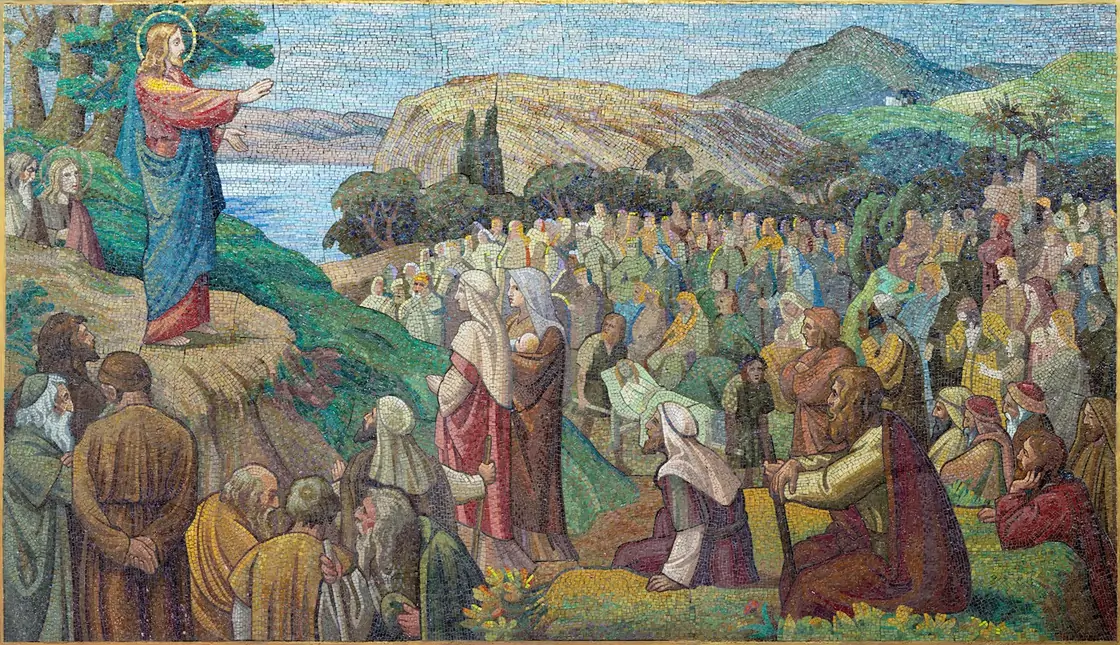
PRAGUE, CZECH REPUBLIC - OCTOBER 13, 2018: The mosiac of Sermon on the mount in church kostel Svatého Václava by artwork of S. G. Rudl in workroom of Albert Neuhauser (1928.) By Renáta Sedmáková/stock.adobe.com
It is common for Christians to debate how to read Scripture. Some argue to read it purely literally, and some argue to read it mostly figuratively; so, where should believers draw the line? The truth in this instance is in the middle, as both are required to read Scripture accurately.
Often, this is by no means a simple task, as it demands reading and seeing different biblical passages in their original contexts. Some of these contexts are being heavily debated in the current culture, such as women in ministry, eschatology (the end times), Jesus’ Sermon on the Mount, Philippians 4:13, and how to interpret Romans 7.
If one reads Scripture with preconceived notions or bias, it can greatly hinder or harm the interpretation of the passage. It is important to remember that the Bible was not written to us; it was written for us.
For example, the author of this article—and, I suspect, most of its readers—are modern Western thinkers attempting to read and interpret an ancient Eastern text from thousands of years ago. The way we view history, events, language, and communication is worlds different from how they did. Thus, to be responsible readers of Scripture, we must seek out how the authors of Scripture intended their Spirit-inspired writings to be read and understood.
My hope today is to use examples from Scripture to show why reading the Bible well requires looking beyond an entirely literal or figurative approach when seeking to understand all that God intends to share through his word.
Jesus’ Sermon on the Mount
In one of the most famous sermons of Christ, He gives significant direction in what believers are to do and how they are to act. This is seen throughout the narrative in Matthew chapters 5-7. Within this, there is a particular section that is troublesome if you are devoted to pure literalism in your reading of Scripture.
In Matthew 5:27-31, Jesus talks about adultery and how one is not to do such a thing. In verses 29 and 30, Jesus says,
If your right eye causes you to stumble, gouge it out and throw it away. It is better for you to lose one part of your body than for your whole body to be thrown into hell. And if your right hand causes you to stumble, cut it off and throw it away. It is better for you to lose one part of your body than for your whole body to go into hell.
It is seriously doubted that any of the readers of this article have cut off their hands or gouged out their eyes to prevent sin. But why not? After all, Christ’s command could not be more clear.
The truth is that we recognize with passages like this that following a literal reading of the text would be extreme and miss the larger lesson that Jesus is trying to communicate.
Unfortunately, it’s not always this easy to discern when a literal reading is not the best way to read Scripture.
One could argue that, outside of John 3:16, the most popular and recited verse is Philippians 4:13: “I can do all things through Christ who strengthens me.” And that is true, believers truly can do all things through Christ; nothing is impossible for God. But how literally should that be taken?
Paul is talking about being content despite all the hardships in ministry. After all, he had gone to prison, been beaten, gone hungry, etc. Paul knows what suffering for Christ looks like and feels like. That is the context in Philippians 4.
While it is true that God can do all things, discernment is also required.
For example, what about gravity? Paul is not saying that you can flap your arms like wings and fly across the Grand Canyon. God created gravity, and you should think twice before thinking Philippians 4:13 is going to carry you across the canyon safely.
Reading Scripture in context is essential for biblical living and for discerning when a simple, straightforward reading is best and when that approach could actually lead us further from the truth.
That said, it’s also possible to go too far in the opposite direction as well.
Who is Paul talking about?
One of the most debated passages in all of Scripture is Romans 7. This is often known as the “do do” section. Many have read this passage without giving much thought to a potentially different meaning Paul may have intended to communicate.
In 7:15-20, Paul says,
I do not understand what I do. For what I want to do I do not do, but what I hate I do.And if I do what I do not want to do, I agree that the law is good. As it is, it is no longer I myself who do it, but it is sin living in me. For I know that good itself does not dwell in me, that is, in my sinful nature. For I have the desire to do what is good, but I cannot carry it out. For I do not do the good I want to do, but the evil I do not want to do—this I keep on doing. Now if I do what I do not want to do, it is no longer I who do it, but it is sin living in me that does it.
This seems, at face value, quite simple: Christians cannot control sin sometimes, as much as they would like to, thus they sin.
But let us consider another possibility in this section; as a matter of fact, one that the author of this article holds to: Paul is not talking about Christians in this section, rather he is talking about those who are lost, those who are in Adam (the flesh).
Paul uses figures of speech just as Jesus does, and in this section, he employs what’s known as impersonation speech. He actually talks as someone else to drive home a point that anyone familiar with the Torah would understand. And that becomes easier to see when you read it in light of the larger context building up to this passage.
In verses 7-11, he says,
What shall we say, then? Is the law sinful? Certainly not! Nevertheless, I would not have known what sin was had it not been for the law. For I would not have known what coveting really was if the law had not said, ‘You shall not covet.’ But sin, seizing the opportunity afforded by the commandment, produced in me every kind of coveting. For apart from the law, sin was dead. Once I was alive apart from the law; but when the commandment came, sin sprang to life and I died. I found that the very commandment that was intended to bring life actually brought death. For sin, seizing the opportunity afforded by the commandment, deceived me, and through the commandment put me to death.
Paul says some interesting things in this section. Immediately after discussing coveting in verse 9, he says, “I was once alive apart from the law.” That is an unusual thing to say. This is followed up with the statement, “but when the commandment came, sin sprang to life and I died.”
If you were a Jew or a gentile believer in AD 55-56 (when Romans was estimated to be written), you would know Paul was speaking of a particular person and event: the fall of man.
Who was alive apart from the law? Adam. What was the first sin committed? Covetousness of the fruit on the tree; the one thing God told Adam he could not have in the Garden. Who would most “certainly die” if he sinned? Adam. Who was deceived, and through the commandment, was supposed to live, but instead died? Adam.
Many biblical scholars argue that Paul had Adam in mind and say that the context of those who “cannot do what they want to do” refers not to actual Christians but to those in Adam (lost and in the flesh). They cannot do what they want because they are not of Christ. Thus, the entire passage shifts from being comforting to being convicting.
This perspective adds nuance to our reading of Scripture. Whether one agrees with this understanding or not, it underscores the importance of reading Scripture carefully.
A treasure we cannot replace
So, should we read the Bible literally or figuratively? Yes. We must do both!
As believers, we should do our best to understand the context when interpreting Scripture. It is not always easy, but it is always worth it. Studying often takes time and effort, but the reward from God in rightly applying his word is a treasure we cannot replace.













 Search