



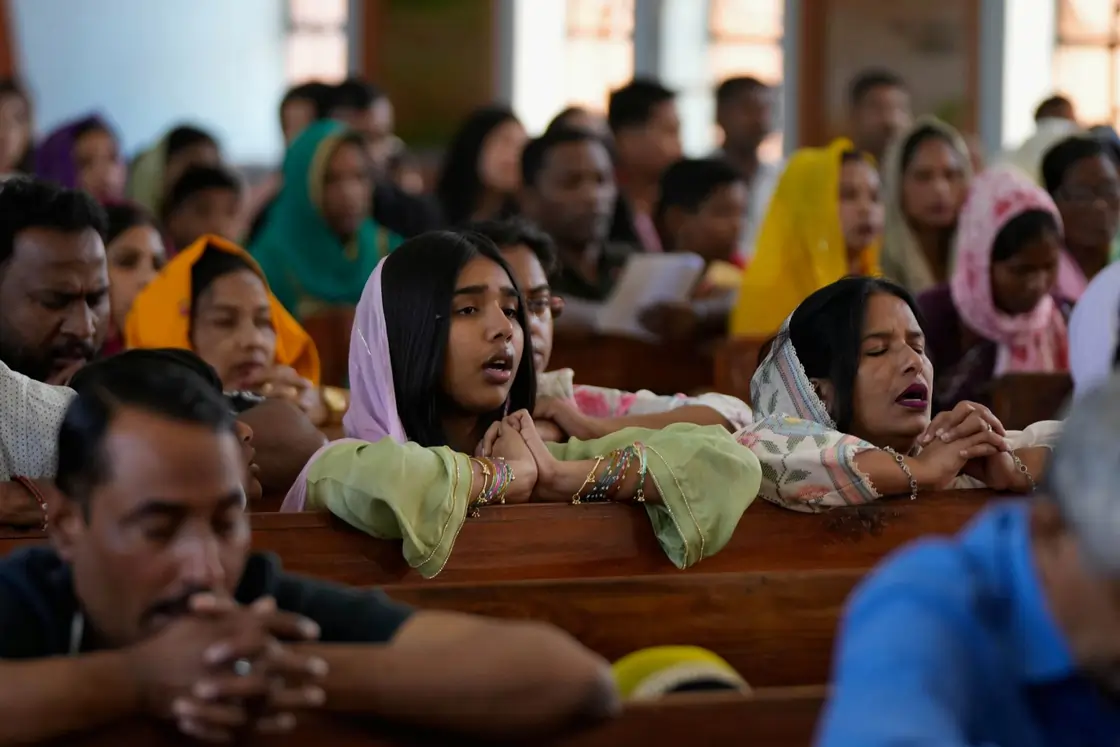
Indian Christian devotees offer prayers at a church on Easter Sunday in Jammu, India, Sunday, April 5, 2026.(AP Photo/Channi Anand)
What happened: India’s recently tabled amendment to its FCRA laws governing foreign donations to charities marked the most pressing threat to Christian ministries—and other non-profits—in recent years. It was also far from the only means by which the Hindu-first government has sought to repress religious minorities.
Why it matters: While the amendment failed to pass for now, it points to a striking reality and escalating threats of persecution to believers within its borders. Knowing what’s going on helps us know how to pray, and our fellow Christians in India need our prayers.
The backstory: Persecution in India is escalating
While countries like Iran, China, and North Korea typically come to mind first when we think about persecution, India belongs in the conversation as well. They hovered just outside the top 10 of Open Doors’ “World Watch List” for years, and the recent drop from eleven to twelve has more to do with other nations jumping up than with conditions for Christians improving in any noticeable way.
Perhaps part of the reason why India is not typically thought of in that same category is that the Christians there share much of the Hindu government’s aggression with the nation’s much larger Muslim population. That said, Christians can face persecution from Muslims as well, but it is the government’s efforts that are most troubling for the future of the faith there, and there’s reason to believe things might be getting worse soon.
India’s Foreign Contribution Regulation Act (FCRA) was passed in the 1970s to prevent foreign money from interfering with domestic politics. Its focus was primarily on preventing influence over the government, but a series of amendments passed since 2010 have expanded its scope to include charities and other non-profit entities.
Since the shift, nearly 22,000 organizations have lost their FCRA licenses, including more than 10,000 Christian groups like the Evangelical Fellowship of India, World Vision India, and Compassion International. Compassion International served 589 churches and more than 147,000 children, young adults, and mothers before losing its license and, as will be discussed in a bit, epitomizes the core struggle between the government and those groups attempting to help the needy.
And the latest proposed amendment could make it even more difficult for non-profits and charities—Christian or otherwise—to help those in need.
What would the FCRA amendment do?
In March, an amendment was proposed that would allow the government to claim any assets created with foreign funds—even if only in part—for organizations whose FCRA registration expires without renewal. Given that the government decides which organizations are approved for renewal—they must apply every five years—the prospect of the bill’s passage has introduced yet another level of uncertainty and apprehension for charities and ministries that rely heavily on support from outside India.
Practically speaking, that means foreign entities are much less likely to help Indian charities purchase land, buildings, or other assets that are likely to appreciate in value, since those would be the most logical targets for the government to take. Instead, they are likely to focus on programs and services that are more difficult to seize or monetize. Those are still helpful and needed, but they typically require a level of pre-existing infrastructure that is not always available, especially for grassroots efforts to help those in need.
The government’s argument is based on the belief that “assets created for the public good are not private property.” As such, if the entity that owns them ceases to exist or no longer serves what they deem to be in the public’s best interests, their assets should be reallocated to a more beneficent purpose.
In reality, though, it’s just a pretext for the government to further crack down on religious minorities and those who push alternatives that would minimize the reliance upon and authority of the Hindu-first ruling party.
Fortunately, the amendment was put on hold following parliamentary pushback, but it remains a priority for the majority factions despite Prime Minister Modi’s claims that the government is not antagonistic toward the Christian community. To date, though, his actions have seldom supported that statement.
The real cost of India’s anti-conversion laws
Modi’s government pushes a Hindu-first vision for the nation’s future, and their plan to achieve that vision often revolves as much around suppressing other beliefs as promoting their own. And that conflict often plays out most overtly among the lower castes.
Compassion International, for example, lost its FCRA license because of “anti-national activity” and allegedly forcing people to convert to Christianity. With regard to the first charge, Stephen Oakley, the former general counsel for Compassion International, pointed to the organization’s work with the Dalits—or “untouchables”—as a threat to the Indian caste system and the social order that much of the Hindu government is built upon.
The second, however, is just as important. Twelve states in India have anti-conversion laws, with a thirteenth awaiting the president’s approval. While the purpose is, ostensibly, to protect people from being pressured into converting—such as through marriage or fraud—those accused of converting people by force are considered guilty until proven innocent rather than the reverse.
If convicted, the standard sentence is seven to ten years in prison…unless the person who converted was a minor, a woman, a member of a Scheduled Caste (Dalits), or a Scheduled Tribe (indigenous people). In those cases, a longer sentence is permitted. Moreover, gatherings of two or more people that the authorities consider to constitute an attempt at “mass conversion” can carry a charge of twenty years to life. These rules, however, do not apply to someone who has left the Hindu faith and returns to it.
To further complicate matters, because the caste system is a legacy of Hinduism, if someone from a Scheduled Caste converts to Christianity, they give up the protections and benefits afforded to those classes. The Supreme Court’s reasoning was that Christianity “by its very theological foundation”—the Court cited Galatians 3:28—does not believe in classes, so it shouldn’t be an issue for those outside of the Hindu faith. Should a member of an indigenous tribe cease to follow the traditional practices of their tribe after converting, they too would lose those protections.
All of that to say, while the persecution of Christians in India is less overt than in places where conversion can carry the death penalty, choosing to follow Jesus or to help others do the same requires a level of commitment and faith that should inspire us to both pray for our brothers and sisters facing those threats and re-examine our own relationship with God to see if there are aspects we’ve taken for granted.
Spiritual application: Understanding your response
I bring up both the charge to pray and the challenge to examine our own faith because when we hear stories like those of Christians in India, there are a few different ways we can respond, and not all of them are biblical.
One response is to simply shrug our shoulders and move on with some version of “glad that’s not me.” I would hope that we can all understand that’s not the way God would want us to react.
A second response is to feel some level of guilt or shame that others have to endure more than we do, or because we genuinely don’t think our commitment matches their own. However, that too is not the kind of response the Lord is looking for from us.
The third option is to hear these stories and be inspired to follow Jesus more closely. If that desire arises from an awareness of areas where you need to improve, that’s a healthy part of God’s redemption of the struggles faced by persecuted believers. However, it will only make a real and lasting impact on your walk with the Lord if your motivations are genuine.
Guilt is not an emotion that honors God unless it leads to real repentance and change. If it simply motivates you to try harder, then you may improve for a time, but any growth is unlikely to last. Ultimately, if our relationship with God is built on anything other than an earnest and honest desire to know him, then we’re likely to end up like the plants Jesus warns will wither because their roots aren’t deep (Matthew 13:5).
So, again, if you read about the persecution faced by believers in India and it drives you to prayer, that’s good. If it drives you to desire a deeper relationship with the Lord, that is good too. But if it simply guilts you into thinking your faith doesn’t measure up, then that’s probably a sign that you have some deeper issues to resolve in your walk with Christ.
And if you find yourself in that latter category—as I do, from time to time—don’t be afraid to have those conversations. God stands ready to help you dig through those rocks to the fertile soil below.
Will you let him?
News worth knowing
1. Trump administration pauses its “weaponization fund”
In last week’s Focus, we discussed President Trump’s $1.776 billion “anti-weaponization fund” and the reasons why it was proving so controversial. Since then, a federal judge ruled that further review is necessary before the fund can proceed. The administration has said it will abide by the court’s decision.
Why it matters
Most of the headlines surrounding this issue in recent days have made it seem as though the president has given up on the fund, but that is not what they’ve actually said. To this point, they have simply committed to abiding by the court’s decision to pause its implementation. While that pause could turn into a permanent stop, there is still much that’s unknown.
What to watch
Once the court renders its verdict, will the administration’s promise to abide by its decision remain? Will Congress use the interval to push reforms to the fund that might make it more politically palatable?
2. No one seems to know what’s going on in Iran
The latest news out of Iran essentially boils down to the fact that no one really knows what’s going on or what will come next. A senior Iranian military officer said Tuesday that further hostilities feel “inevitable.” President Trump says that the conversations are ongoing, though “Where they lead, one never knows.”
Why it matters
As long as uncertainty around the war continues, global markets will continue to vacillate, and any sense of economic stability will be hard to find. Moreover, it seems to grow more and more clear every day that Iran is divided between those who want the war to end and those who would genuinely rather die than give up their power, with the latter likely characterizing the highest levels of Iranian leadership.
What to watch
Honestly, the best advice might be to just try to ignore the day-to-day changes of what’s going on. Until an agreement is signed or the bombs start dropping again in earnest, believing that either outcome is clearly more likely than the other is unwise.
3. NBA Finals start Wednesday night
The NBA Finals kick off tomorrow night when the New York Knicks travel to San Antonio to face the Spurs. The Spurs are favored to win, but most expect the series to be a good one. The Knicks enter the series with the top offense and the number one-ranked defense in the playoffs, but have not faced nearly the same caliber of competition as the Spurs.
Why it matters
The Spurs have one of the youngest rosters in the NBA, and to already be this good has many talking about a dynasty in the making. By contrast, the Knicks have been a team on the cusp for the last several seasons, and this season feels like it could be their best—and perhaps only—chance to bring a title to New York.
What to watch
With the Knicks sweeping their conference finals and the Spurs playing a brutal seven games against the Thunder, will the disparity in rest leave New York rusty, San Antonio exhausted, or a bit of both?
God is good
The Museum of the Bible is hosting a series of lectures—both in person and online—while also offering new exhibits and a theater production about George Washington’s faith as part of its celebration of America’s 250th anniversary. The lectures feature prominent historians and scholars, and their overarching purpose is to highlight the Bible’s importance in Colonial America.
Kingdom impact
It sounds like the museum is trying to offer an honest portrayal of how the Bible was used—and, at times, misused—around the time of the American Revolution. Understanding both sides of that conversation could be immensely helpful in learning how to apply the Bible to our culture today as well.
Prayer point
Will you pray that the exhibits, lectures, and play help people not only gain a better appreciation for the Bible but, even more importantly, draw closer to its author?
Christian Post has more on the story










 Search