


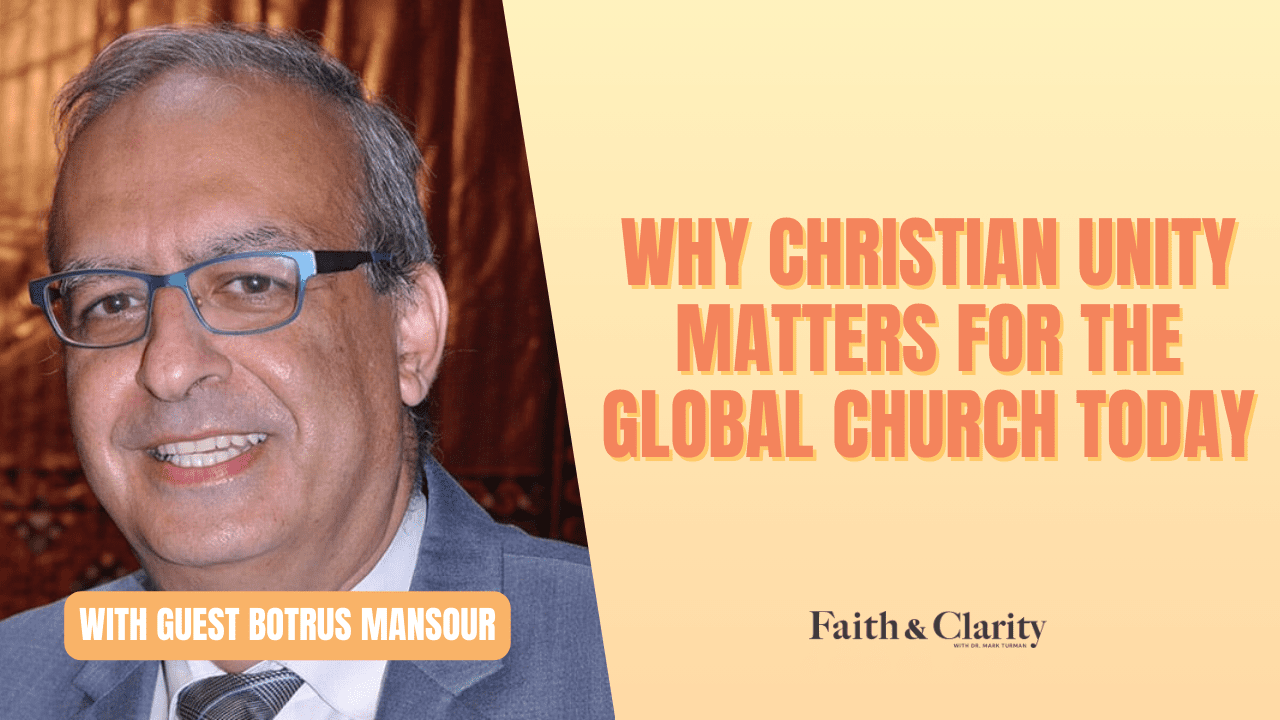
In this episode of Faith & Clarity, Dr. Mark Turman is joined by Botrus Mansour of the World Evangelical Alliance to explore why Christian unity matters and how it strengthens the church’s witness around the world.
Together, they discuss how churches are partnering across 163 nations to support evangelism, discipleship, and global advocacy, while also addressing real challenges facing believers in regions of conflict. The conversation highlights both the complexity of global ministry and the growing spiritual hunger seen in many parts of the world today.


Topics
(0:00) Introduction
(4:39) Why unity matters
(7:50) World Evangelical Alliance global reach
(9:53) Advocacy and UN work
(21:41) Botrus’ journey to Secretary General
(26:21) New season challenges
(31:35) Why evangelical matters
(33:59) Planting a church in Nazareth
(37:36) War and prayer fatigue
(40:00) Global revival reports
(43:25) Conclusion
Resources
- World Evangelical Alliance
- Lausanne Movement
- Nazareth Baptist School
- Ask Us Anything: [email protected]
- Sign-up for a Denison Forum newsletter: DenisonForum.org/subscribe
About Botrus Mansour
Botrus Mansour, based in Nazareth, Israel, is a lawyer, an ordained elder, and the General Director of Nazareth Baptist School. He has held significant leadership positions across the evangelical world, including serving as the Chairman of The Convention of Evangelical Churches in Israel and Co-Chairman of the Lausanne Initiative for Reconciliation Israel-Palestine. He is also a published author, with books including When Your Neighbor is the Savior and Looking from the Precipice.
About Dr. Mark Turman
Dr. Mark Turman serves as the Executive Director of Denison Forum, where he leads with a passion for equipping believers to navigate today’s complex culture with biblical truth. He is best known as the host of the Faith & Clarity podcast and the lead pastor of the Possum Kingdom Lake Chapel, the in-person congregation of Denison Ministries.
Dr. Turman is the coauthor of Sacred Sexuality: Reclaiming God’s Design and Who Am I? What the Bible Says About Identity and Why it Matters. He earned his undergraduate degree from Howard Payne University in Brownwood, Texas, and received his Master of Divinity degree from Southwestern Baptist Theological Seminary in Fort Worth. He later completed his Doctor of Ministry degree at George W. Truett Theological Seminary at Baylor University in Waco.
Before joining Denison Forum, Mark served as a pastor for thirty-five years, including twenty-five years as the founding pastor of Crosspoint Church in McKinney, Texas. Mark and his high school sweetheart, Judi, married in 1986. They are proud parents of two adult children and grandparents to three grandchildren.
About Denison Forum
Denison Forum exists to thoughtfully engage the issues of our day from a biblical perspective, helping believers discern today’s news and culture through the lens of faith. Led by Dr. Jim Denison and a team of contributing writers, we offer trusted insight through The Daily Article, a daily email newsletter and podcast, along with articles, podcasts, interviews, books, and other resources. Together, these form a growing ecosystem of Christ-centered content that equips readers to respond to current events not with fear or partisanship, but with clarity, conviction, and hope. To learn more visit DenisonForum.org.
EPISODE TRANSCRIPT
NOTE: This transcript was AI-generated and has not been fully edited.
Mark Turman: [00:00:01] Welcome everyone. This is Faith and Clarity. I'm Mark Turman, your host. Psalm 47 one and two says this, Come everyone, clap your hands, shout to God with joyful praise for the Lord most high is awesome. He is the king of all the earth. And I really want you to focus on that word all this morning. As this week, we're talking about what God is doing to unite Christians around the world to spread the good news of Jesus and to help people flourish through the work of a ministry called the World Evangelical Alliance. Uh, this conversation aligns really well with the mission of Denison Forum. We want to help you today and every day, uh, to be more equipped to think critically, to live faithfully, and to serve intentionally to cultivate flourishing communities everywhere for everyone. So, let's roll, let's jump in. My guest today is Botrus Mansour, the Secretary General of the World Evangelical Alliance. Uh, he was appointed to that position in November, the 1st of November last year. So just a few months, Botrus getting used to this. Uh, let me tell you also a little bit more about him. He is uh, a resident of Nazareth, Israel. Uh, he's an an attorney. He's also a church planter, an ordained elder in his church, and is also the director of the Nazareth Baptist School. We're going to get him to talk a little bit about that. He has held significant leadership positions in the evangelical world, including serving as the chairman of the Convention of Evangelical Churches in Israel and co-chairman of the Lausanne Initiative for Reconciliation Israel Palestine. He is also a published author with books including When Your Neighbor is the Savior and Looking from the Precipice. So Botrus, uh, welcome. We're glad to have you on Faith and Clarity.
Botrus Mansour: [01:52] Thank you. Thank you, Mark. Thank you for having me. God bless you.
Mark Turman: [01:56] Well, we are glad to have you and just so everyone will know, you're actually not in Israel today. You're in Dubai, uh, because before we started, uh, Botrus was telling me that he was attending a conference, uh, around movement, uh, movement day, which many people in America will be familiar with. Uh, but he has had to stay in Dubai because of the outbreak of war with Iran and uh, Israel and the United States. We're going to get him to talk about that a moment, probably as well. But he is uh currently just uh hanging out in uh Dubai with some other believers and having an opportunity to extend those conversations. And so we're grateful for us to be able to make a connection. So, Botrus, I just wanted to talk for a moment about what uh the word alliance means in the description of the World Evangelical Alliance. What do you mean by alliance and what is the WAE trying to achieve in terms of unity and why is that important to this conversation?
Botrus Mansour: [02:58] Yeah, um, as you know, evangelical churches are independent. Each church has its own governance and doctrine and so on. And sometimes it's part of a denomination, but an alliance is that these independent churches all come together uh under one uh roof, we can call it, or like a network of of churches that have things in common. We as evangelicals, you know, have differences between different denominations, different emphasis, each church uh with the other, but they come together putting the common things first and coming under or with a in a network in order to move for ministry, for mission, for relief, maybe, for just cooperation, fellowship together. So they come together in a one organization that does not interfere in a certain church, but we come in order to cooperate, to work together, to do fellowship together in such an alliance, what we call an alliance. And uh, the theme behind it, you know, World Evangelical Alliance was established 180 years ago. And uh, the the we think that uh, according to Jesus's prayer before going going to the cross, he prayed on um Mount of Olives uh to the Father saying, let them be one. Like me and you are one. Like the Father and the son are one. Just imagine what type of connection and oneness we have in the Trinity. He is asking the believers to be one. So uh we want to do that. We want to come and be one, one another with one another, uh despite the differences here and there with emphasis and so on, but the core faith or the core doctrine, even the practices are are very similar, very very close to one another. And uh we can come together for a better purpose, for a better mission.
Mark Turman: [04:56] Yeah, talk talk a little bit. I have the feeling that uh especially as American Christians, uh but perhaps this is true around the world that we do not value or teach or focus on unity as uh the body of Christ as much as we should. Could you kind of explain a little bit more about how important unity is to our overall witness and testimony to the world?
Botrus Mansour: [05:22] Well, in another place in the the the gospel of John, he says, be love one another so the world will believe. Our unity uh reflects something deep and something that's very attractive and something that the Lord blesses. When we are seen as loving one another in one, we don't need to be one denomination or one organization that interferes or centralized and decides things for, no, no, I'm not talking about that, but at least that we show the love through our fellowship, through helping one another, cooperating, collaborating with one another, that's also a reason for the world to look and say, ah, these are believers in Christ. What unites them despite the differences, despite the different cultures, different mindsets, mentality and so on. It's a reflection and it brings a blessing and people come to know Jesus through that. So I think that's very important. Uh, I think when a church thinks that, oh, we have all the truth, we don't need anybody, we're going to do our own thing. We don't care about anybody else. Anyway, we're self sufficient. We have our own thing. I think this is not biblical. I think this is not biblical. We should be helping one another, standing with one another and because at the end of the day, this is the kingdom, this is the church of Jesus Christ. If I stay alone, then I'm not going to be a blessing to somebody else that maybe needs something that I have. And working together also multiplies the the impact that we can have. So I think it's very important for us to really have unity, not becoming homogeneous, all of us like one another or under one denomination, God forbid, but that we come in order to help, to collaborate, to cooperate with one another.
Mark Turman: [07:12] Yeah, and especially in these in these times, right, when the world, especially the here in America is so fractured, but uh it's something um that's a part of the the brokenness of our world around the world, correct? That um the world is very much a fractured place. Uh and as Christians come together around the core doctrines, uh the things that we agree upon, as we come together and respect each other and uh help each other, work with each other and pursue common uh objectives in the kingdom of God, that is a a powerful thing that the world is longing for, um but is often missing and just uh even the realities of what we're dealing with today that you're not able to go home right now because of conflict and because of division in the world. I mean, it's just a very obvious thing that the world needs uh a message of hope, a message of of uh of compassion, a message of love and cooperation, um that Christ and his kingdom have to give to the world. Um, tell us a little bit more about the World Evangelical Alliance, um, what kinds of groups uh would would you find uh Methodist, Baptist, Protestant or uh um charismatic, would you how many give us a sense of the scope and size of the diversity that is found under this large umbrella called the WEA.
Botrus Mansour: [08:42] Yeah, um, the World Alliance has 163 alliances around the world. So uh every country has uh one alliance. Um few exceptions because of uh specific situations in different countries, but that's almost, you know, covering most of the world. So we have these alliances and almost every country in the world. And uh and the denominations vary, you know, we yes, Baptist, Nazarine, brethren, Mennite, Pentecostal, of course, a large number, Methodist, Anglican, even Anglican, the more conservative Anglicans also are part of this. And you name it, everyone who claims to be evangelical in different countries, it's different, it's different than one another, than than any other country, but you will find people from different denominations who come uh together in the alliance in order to work together, uh serve together, minister together uh for for Jesus.
Mark Turman: [09:47] So, talk about how that actually looks when it comes to doing the work. Uh some of the mission and ministry of the World Evangelical Alliance. Um people can go on the website, we'll list that in our show notes. Um but the work of the WEA seems to fall around what I could discern four or five major objectives or initiatives. Uh your website lists church engagement, global advocacy, global theology, global witness and some special initiatives. Uh unpack some of that for us. Pick one or two if you want, I guess. Um but there's a lot here. Uh talk about what this work actually looks like in a particular country uh or in a particular setting.
Botrus Mansour: [10:34] Yeah, the I'll um divide them to two parts. The first part is being a voice or representation or advocacy. So that includes uh we have an an office in New York and an office in Geneva that works in the UN bringing forth, we are uh an official representative of evangelicals uh in a consultative uh status in the United Nations to bring forth issues of mainly religious freedom, but not only religious freedom. So if there's one country we get report that there is um the government is uh looking uh, you know, persecuting, doing taking some measures against evangelicals and not only evangelicals, we we even not only Christians, we we think religious freedom should be for everyone, but it's mainly for evangelicals, then we will bring that issue to the United Nations. And we also represent the evangelicals in uh among in front of governments, uh in official uh things happening all around the world, installation of a pope or archbishop of Canterbury and so on. So that's the first part. The second part is with the alliances that I mentioned before. These are these organizations all around the world that have under them churches from different denominations. And we do what a church would do, not in replacing a church, but I mean, in a church you would do it for individuals. Here you would try to do it between for the alliances themselves. Uh youth ministry conferences, uh a theological commission that actually uh the famous uh uh theologian John Stott was head of one of the theological commissions long time ago before of course he passed away. And um so uh discipleship, uh woman uh ministry and so on. So we do that but on a scale of national alliances among the world, trying to help them. And the the thing that the Lord has been pushing us towards in the last period is that doing the collaboration. There are lots of great nonprofit organizations, para church ministries that are doing great job in evangelism, in uh discipleship, in youth, relief, you name it. But what we can give is the collaboration because this is a huge group of these alliances, representations all around the world. Plus we have uh members who affiliated members in the World of Alliance. I mentioned the alliances, but we have also organizations, all types of Christian evangelical organizations that are part of the of our organization, of the World of Alliance. We do collaboration between them. One alliance in a certain country has a big need, they feel the Lord is leading them to do evangelism or to do uh relief because of a certain situation or justice issues or uh discipleship issues, then we we facilitate a collaboration between them and an organization that specializes in this and has the means and the resources to do this together. So this is actually what what we do.
Mark Turman: [13:56] Yeah, so a big part of the work is being a connector. Helping like-minded believers who are facing a a shared uh situation, being able to to put people together, to share phone numbers or email addresses or just simply to get people uh aware of each other and network together to address a a common need or a problem or uh you know, um a natural disaster, something like that, just being able to to build those connections between partners uh who would be of similar faith, would all name the name of Christ. Um it also sounds like what you're telling me is that uh part of what WEA does on a global scale is, well, you know, as an individual believer or as a single church, we don't have the opportunity to speak into issues, you know, in a government setting most of the time, certainly not on a global stage such as at the UN, but that's part of what y'all are able to do on behalf of evangelicals. Is that uh am I understanding that correctly?
Botrus Mansour: [15:04] Yes, yes, of course. Uh with God's favor and God's grace, you know, we're able to talk into issues. Um last week I was in Geneva. I wanted to see what we really do on the ground. And there was the opening of the human human rights Commission uh with the Secretary General of the UN also who came from New York especially and they opened it. So I I was in attendance. But uh we can speak in um side events and uh when there is a time for review of certain countries, we are able to take a country and do a review of human rights, religious freedom issues in a specific country and that has a weight uh in a lot of countries don't want to be reviewed negatively. So uh if we contribute to a negative report, let's say in a certain country, then that's that might help also evangelicals in that country to continue to worship freely or you know, to keep on going in their lives.
Mark Turman: [16:05] Okay. So, uh, tell us what the focus of WEA is for the next four or five years. Uh, what's what's the near-term vision uh as you've stepped into this role a few months ago, uh, starting to get familiar. I have absolute certainty that you've been involved in the WEA well before being appointed Secretary General. Um, but what is the vision that that you're picking up and stepping into, uh, in in addition to advocacy and and building of network and collaboration, uh, where are you hoping that this uh organization can go on behalf of the kingdom of God over the next three to four years?
Botrus Mansour: [16:45] Actually, I was not involved in WEA as such. I was the head of our convention as you said in your introduction. So I was in one of the alliances, I was the head. I was connected, you know, slightly with uh few activities that the World of Alliance did, but I did not know the insights of the organization. So I've I'm learning that right now and uh during these uh last months, I I had the opportunity to get to know more how things are being done and so on. Uh actually, I don't have anything else than the collaboration that I shared with you and I see it as a big thing that can have impact on the whole world. I asked myself with my with the team that we work together, oh Lord, what do we have? What did you give us? What are the loaves and fishes that you put in our hands? How can we multiply them, you multiply them in our hands? What are we bringing you? Um so at the end, we there are lots of huge organizations around the world that have millions of dollars and the professional people in different areas uh including evangelism and uh you know, so you you know all these organizations, especially in America, thousands of organizations that do great things. But what do we bring to the table? We bring these alliances. These they are not ours. I if I tell them do this, they're not going to immediately automatically do it. They're part of our organization, but they are also independent. We have, by the way, the alliances, the 163 around the world are divided into nine regions. So they we have regional secretaries. Under that, there are there are nine countries, let's say or in Africa, 42 countries or so and so on under the region. And then the World of Alliance is sort of uh above above all of them. But we have these alliances and then we have these connections and the representation part. So what we can bring to the kingdom is this collaboration, bringing them together. I, you know, I was praying and the Lord, you know, uh drew my attention to the fact that if we want a revival in the world, it's not going to be uh this organization or that or not even a mega church, a huge mega church or not even a denomination. They're not going to do a revival. Maybe yes, the Lord might use this organization or that or that denomination, fine, but at the end of the day, this believer sitting in the pew in church has a membership in a certain church somewhere around the world. If he is revived, if he has the Lord works in his heart through the spirit of the Lord, then God can make a revival. The Lord wants a revival, of course, and he's open, of course, and he he will do that, but we need the willingness of the people. We need to revive the people with the grace of God, you know, the spirit of God should work there. So how can we reach that believer sitting in the pew? If we can help a certain church, so we have the the believer and then we have the church that he's part of and then there is the alliance that that church is part of and then there is the region that this church or this alliance is part of and then there is the world of. So if we are able to get to that that believer sitting in the pew in the church, then the Lord can use us. This is what we have. These are the loaves and fishes that we are bringing to the Lord. So how can we do that through this collaboration? Again, I know this word is so much, it's used so much. Everybody says collaboration and then at the end they do their own thing. This is what we're used to. We say, oh, we want to collaborate then I'm doing my own thing. I have my own vision and I just go forward by myself. So if we can bring and and not come with an agenda that we have. I don't have an agenda for for every country in the world. I know my country maybe, but even my country, I don't have an agenda. We need we'll ask every alliance around the world, what is your need? They pray, they decide what their need is. We have an open door for uh evangelism these days. So they tell us we want to be helped in evangelism or we have mature believers but they need help in discipleship or they have hurricanes and they need relief. That's also part of the ministry or they have a justice issue or they have and youth issue. They have a lot of youth coming and they are open to hearing the word of God. So maybe they want youth. So then we bring these connections that we have with these organizations that have resources and have expertise in a certain area that they decide, not us. We don't come with that agenda and they tell us we need somebody to help with youth and we need somebody to help with relief, for example. So we bring organizations that are in these uh areas and the have the expertise and the resources and we bring them together with the alliance. So as a result, with God's favor, with God's grace, this will lead to effectiveness. I don't want to say more. I don't want to be, you know, presumptuous and say, ah, this is going to bring revival. No, but at least this bring brings a little bit of, you know, this is what you wanted. This is what the Lord has put on your heart, youth and relief, let's say. So if the Lord does that and this connections, these connections really bring a push, then we can reach that believer in the pew for the glory of Christ and revive and and the Lord will be uh glorified.
Mark Turman: [22:32] Yeah, and see what just see what God does with it. Yeah. Well, that that really helps us to get our mind around it. Well, let's take a break for a moment and then I want to come back and go back to what you referenced a moment ago, which was just the journey and the story about how you became Secretary General of the uh World Evangelical Association Alliance. Uh there's a story there that uh helps to illustrate how God does amazing things. And uh we'll come back to that in just a moment. We're going to step away for a quick a quick break and we'll be right back with you.
Ad Voice: [23:04] You don't usually say it out loud. Maybe it's the conversation you avoided. Maybe it's the article you read that unsettled you. Maybe it's the quiet question that surfaces late at night. You believe in God, you love scripture, but sometimes you still wonder, how do I know if God is speaking to me? What is heaven really like? How do we know Jesus truly existed? Can I trust how the Bible was formed? The culture has answers, some loud, some confident, some convincing, but confidence is not the same as truth. And deep down, you do not need louder opinions, you need biblical clarity. That's why we created biblical insights to tough questions volume five. In this powerful volume, Dr. Jim Denison explores 10 of Christianity's most challenging questions, not with speculation or shallow reassurance, but with scripture, historical insight, and thoughtful conviction. Questions about the Trinity, about heaven, about baptism, about the role of the church, about what we truly believe and why it matters. Because unanswered questions do not disappear, they shape us. But when we bring those questions to God's word, they can strengthen faith instead of shaking it. If you want a faith that stands firm in a culture of confusion, this book is for you. Visit supportdf.org to request your copy today. That's supportdf.org. Get your copy today and anchor your faith in biblical truth.
Mark Turman: [24:51] All right, we're back and glad that you're with us as we continue our conversation with Botrus Mansour, Secretary General of the World Evangelical Alliance. Uh, Botrus, you were talking about, um, your recent ascent into this role as Secretary General. Um, tell us a little bit about how that came about and the story behind that that journey for you.
Botrus Mansour: [25:13] Yeah. Uh, I was working in Nazareth Baptist School as a general director. I've been there for 22 years. It's the place where uh my late mother graduated, I graduated, my children graduated from that school and I came to know the Lord through the ministry of that special K to 12 school in Nazareth. I had just stepped down from heading the alliance in Israel, the called the Convention of Evangelical Churches in Israel. And I thought to myself, you know, the I I should slow down now. I'm uh approaching 60 years old of age. Um, my daughter-in-law is pregnant now with our first grandson and they're living in the same building with us. So that'll be a nice time to spend with the grandchild. And my wife had just took um early retirement also. So, and I've been in ministry since, you know, since the time I remember when I was 18, I was already in the ministry in in a students' committee. I was the head of the students' committee and we planted a church and then I was in para church organizations and so on and so on. And I loved it, you know, wherever the Lord opened the door, I would go there, you know, not not every place, of course, where I feel I can contribute, but as a lawyer also, an evangelical lawyer, one of the first evangelical lawyers in our country, the, you know, we're sort of a lot of people want us to be on their boards and you know, free legal counsel maybe, I don't know. So, uh, I had just finished the six years as uh chair of the alliance and thought I'm slowing down. Um, I I have another few years. I had a good team working with me in the school, you know, and I have known the school so well, you know, so well. I've been years there. I was on the board even before the 22 years. So, uh, but then, um, I saw the announcement that they are uh fetching uh a secretary general for the organization, the World of Alliance. And I spoke to some friends who knew the World of Alliance about it and I said, maybe we we half jokingly, let's say, saying, why don't I nominate you or you telling uh some of them. And they said, actually, you you are the one for this. Come on, me? So that was the first pastor who told me that. And then someone else out of the blue, also another pastor, well known and uh blessed person told me, um, Botrus, I think you should nominate uh yourself. Really? He said, yes, you you're for it. We've seen what you have done, you know, humbly speaking, you know, with the our alliance, we were with the favor of God, we were able to do things, move things forward and so on. And then a third person told me, uh, you are the person for this. Um, it needs also a lawyer and also someone who has been in nonprofit organization, also spiritual on the same same side. So several issues that sort of came together. So I started taking that seriously and I spoke to my wife, Abir, she's a godly uh person and uh she did not need to, you know, she said we'll pray about it, but it didn't take her a lot of time to say, Botrus, go for it. If it's the Lord's will, um, just go, just go for it. So I applied and actually in the beginning, you know, we're humans. I did not even tell, I just told my family, not people from the outside. I was embarrassed, you know, to say I applied and then, you know, they rejected me. It seemed, you know, it's the whole world, the nominees from all around the world. So I did an application and they uh invited me to the first uh interview and I was uh I was very transparent, you know, I was not under pressure. I did not have high expectations, you know, I I was praying and the Lord was giving me peace, but uh, you know, we're human beings at the end. And I was very open with them, very transparent, you know, whatever they asked me, I would answer without, you know, lots of diplomatic or thinking about what they want to hear or so. And I felt it flew well, you know. And then I got this uh after the interview, they said you're on the short list and the second time with the International Council and with God's favor, you know, um on the 6th of August 2025, I got the um I got uh a message saying that they elected me. I didn't believe, I tell you. I punched myself. Is it a dream? What's this new season the Lord is opening now after all these years, I'm 60 now, 60 and and a bit now. And uh but God is good. I'm I'm not I did not look back. I'm very happy with it. It it's not without challenges. It has lots of challenges, but the Lord is good. He's opening the door, he's showing me, leading and uh with God's grace, we will do something for the kingdom. And for him. A new chapter, but we want to serve him. That's the most important thing.
Mark Turman: [30:23] Yeah. So, um, part of the story here is uh you as you described yourself when when we first met, you are an Arab Palestinian Israeli. Yeah. Uh, some people listening to this will just be completely confused by me using those three words to describe you and and we could add uh evangelical onto that if we wanted to. An Arab Palestinian Israeli evangelical. Talk about explain those terms uh in a basic way for us and then why is it significant for you with that kind of an identity to be in this position?
Botrus Mansour: [31:04] Yeah, uh a lot of people don't know that in Israel proper, I'm not talking about the West Bank, Palestinian Authority or Gaza or the Palestinians who are scattered around the world, but in Israel proper in 1948 when Israel was established, there was 150,000 Arab Palestinians who uh did not leave and were not dragged out by the war and the uh the battles that were happening at that time. And they became Israeli citizens. Today their number is 2 million, 2 million and a bit out of the 10 million that Israel has. So a lot of people don't know that in Israel proper, uh there are Israeli citizens who are also Arab and Palestinian. So you can imagine, I'm Israeli, I travel with my Israeli passport. I uh vote for the Knesset. I went to the Hebrew University in Jerusalem. I speak Hebrew better than English even. And at the same time, I'm I'm Arab Palestinian. This is my descendant, this is my nationality, this is my people, my culture. My father was born 1934, even Israel was before Israel was established. So, um, you can see this is the our nationality or ethnicity versus our citizenship. And because of the conflict, so we're caught in between our citizenship as Israelis and as ethnically as Arabs, Palestinians with the conflicts going on. So it's always, you know, there's tension there. And uh being born, raised in that community, um has of course its difficulty, big challenges and difficulty, but it also uh trained me to be a peacemaker also. My my father who just passed away a month ago, uh he was the first Arab Palestinian to work for a Jewish Hebrew speaking newspaper, Haaretz. He worked there since the year 54 until the 90s. And uh so it came natural for us that Arabs and Jews come come together. My dad's colleagues would come to our home with their kids and we play with them. It came natural. It wasn't a big deal for us. And at the same time, you know, as a Christian, evangelical, as Christians, we are a minority among the Muslims. 90% of the the Christians, the Arabs in Israel, Arab Palestinians in Israel are Muslim and there's a sect called Druze. So the Christians are a small minority. So we are a minority in a minority, in the Arab minority. And then as Arabs, a minority in the Jewish state. So we're a minority in a minority in a minority. And I don't want to confuse more, but as evangelicals, we're also evangelicals are a small minority among the Christians in in Israel as well. So living there, you know, you you learn how to deal with uh different ethnicities and religions and people and so on uh in these areas. And that helps when I'm coming going now to the larger worldwide uh scenery where we have people from different cultures and different countries and so on. So maybe that gives me uh additional sensitivity maybe or I don't know what, maybe, I think, I pray this is the case. At least we gained this uh talent or competency to to deal with people from different places.
Mark Turman: [34:28] Yeah, it gives it certainly would seem to give you a lot of credibility and a lot of different contexts of living in living in an experience with uh multiple loves and loyalties, right? Yeah. Um and we it it can be very confusing uh at times, uh especially for us as Americans, but when you start you start understanding what goes on in Israel and what goes on in the Middle East that we try to help people understand that it's it's always the intersection of of race, religion and region. Um that that produces a very diverse uh culture where many people have multiple loyalties that they're trying to understand, that they're trying to balance and uh I would I would expect that maybe for such a time of this as this, as the Bible says that God has put you uh in your unique background uh for the opportunities that uh are in front of you in this new chapter, in this new role. Uh you mentioned the word evangelical. Uh much conversation around that term over the last five to 10 years, especially here in America. Um do you have a particular perspective on whether or not that word is still continuing to be useful? Is it useful in this new chapter that you're in? Uh is it important that we hang on to that word and to its historic definition?
Botrus Mansour: [35:56] Um, my answer is yes. Um, even in my region, a lot of people are um sometimes the word evangelical uh is connected to nationalistic or sometimes um some political policies that's uh not favorable for a lot of people in the Middle East. And it's sometimes embarrassing being uh an Arab Palestinian evangelical. Some people tell me, ah, but these are evangelicals, they're doing this, they're doing that, they're taking that stand politically and so on. And sometimes it's a stumbling stone even, sorry to put it that way. And I've heard a lot of people in our surrounding saying maybe we should not use this word evangelical. But it's so beautiful word. I love this word evangelical. Evangelon, the good news. What nicer word to be called the bearers of good news. And I don't think we should because of a certain stream maybe that's more nationalistic and more uh political maybe uh and not kingdom minded that we should just abandon using the word evangelical. I'd love us to keep on using it. Um it doesn't have to mean a certain stream in evangelicism, but uh I think it's a it's a nice word. We should continue to use it. Uh it uh it tells who we are. And you know, Nazareth is called the the town of the annunciation or the good news actually. So uh yeah, as a Nazarene, someone from Nazareth, I I love also that word evangelical. It's a bearer of this these good news. What better what greater news is there than the the news of the redemption, of the salvation of Jesus coming and paying the price, the full price for each person on the world in the world. So it's a lovely word and I'd love us to keep on using it despite the difficulty.
Mark Turman: [38:02] Yeah, maybe maybe we can redeem it back towards its uh most fundamental and spiritual uh definition uh as the telling of the good news for sure. Um, Botrus, one of the things I I love about your story is that you are you are very much engaged and involved in a personal way in your own town in Nazareth, uh which I've had the privilege of visiting a couple of times. Um you've helped plant a church uh while at the same time you have this global perspective of trying to uh help the entire world to hear the story of Jesus and to experience the blessing of his kingdom. Uh tell us a little bit about what it is like to plant a church, an evangelical church in Nazareth, uh and how is that going? How is the the ministry of your church there?
Botrus Mansour: [38:57] Uh the church that we planted actually, unfortunately, like uh most of our evangelical churches is it was a group that left. We left a church, we were not happy with. And we started another church. So that was um I I co uh founded that church. Uh it's doing well. Um Nazareth has about one third of its population are Christian. It has the largest Christian uh presence in the Holy land and also nine evangelical churches we have, which is relatively uh a large number. Uh God is good. It's a good church. We had some difficulties through the years, but right now we're doing well. Um people come and uh they uh last several years have been tough. Covid, the war, now another war. Um so uh people want to come to the church and hear something that's hopeful, something that will encourage them in in their daily life. A lot of people in our community in Nazareth want to leave uh because it's not only the war, but as a result of the war and what's happening, we also have criminal gangs that unfortunately the government is not dealing with. So there's been a lot of crime in in town. And as a result, a lot of Christians want to leave the country. And we try in the church to help them, you know, cling to their calling and to to stay in Nazareth. We want to be witnesses for Jesus in his hometown. You know, when I was appointed the World of Alliance said, would you like to move maybe going to go somewhere easier to to go to Europe or to go somewhere else and uh have your offices there or something like that. I told them, no, no, no, I'd I'd love to stay in Nazareth. This is my hometown. I lived most of my life there. I have my children there, my grandchild right now also there. And I love to be in that place. I have a calling there. We want to be witnesses for Jesus from and in his hometown. And uh, you know, he was called the Nazarene. We are called the Nazarene. We are called the followers of the Nazarene of the the person who is from Nazareth. So I should leave Nazareth. No, I'm not going to leave Nazareth. I love that place. I love the people despite the difficulties, but I love that place and uh we want to be a blessing uh in that place through our ministry, through our life, a testimony for Jesus. Yeah.
Mark Turman: [41:28] Yeah, what a yeah, what a powerful, powerful testimony because it like you said, you could live anywhere and and life on a daily basis might be uh easier or more comfortable. Um but you know, if if everyone leaves, if all of the Christians leave, even if all the Jews leave uh from Israel, then the terrorist have won or the gangs in your local community will win. Um and that's that's not the testimony that any of us would want. Um even though it it does require uh a significant amount of of commitment and courage and uh a willingness to follow God's calling that, you know, in this place, God needs us to be his people in this time. Um tell tell us a little bit about, you know, obviously this new war that has broken out uh with Iran. Um how are you thinking about that? How is your your family thinking about that? How's the ministry of the World Evangelical Alliance thinking about uh what's happened recently in the region?
Botrus Mansour: [42:33] It's a distressing uh issue. You know, we uh two years of war. Ceasefire, which is was a good thing. It's wasn't 100% ceasefire. People were continuing to be killed in in Gaza. But at least, you know, the it went down the the conflict. Now again, I, you know, I shared here in Dubai where where I'm stuck now and hopefully going back tomorrow to to Nazareth via Jordan. But I told them, I'm fed up of being a prayer request. I, you know, so sweet people, friends all around the world send me messages, we're praying for you and um I'm fed up of being that. You know, I really appreciate their their heart, their compassion, but I don't want to be. I want to be a an answer for prayer. I'm not a a prayer request for people all the time. They have good means and they have good intentions, but just pray that there will be peace here. Um I pray for the people of Iran, these innocent people, the people of Israel, the people of uh the Emirates here, Jordan, all around the area here, the region. We want peace. We want to live a good life, prosperous life, uh a life where we can share the gospel and be a blessing to our communities. The Lord um wants us to be a blessing to the cities we live in because he uh he created those cities and these where a lot of people come together and so on. So, yeah, just my prayer only for um I don't want to to enter into the political side of it and so on, but I think we need peace and uh people to live a peaceful life.
Mark Turman: [44:24] Yeah, and as a as the scripture tells us, right, that we should pray for not only the peace of Jerusalem, but for the peace of the world that everybody might lead a uh a peaceful and quiet and godly life and that we we might be able to share our understanding and our our testimony uh and and allow that to be done in a a civil and calm and peaceful and safe environment. Um, Botrus, with just a a few minutes before we wrap up here, uh, tell us a little bit about some of the other things that you're witnessing through the work of the WEA. Uh, many people are talking today about the movement that God is doing south of the equator, uh, in the southern regions of the world. Uh, tell us a little bit about that before we finish up.
Botrus Mansour: [45:10] Yeah. Uh I'm really encouraged, I tell you. Um you would think that things are uh steady, not moving, but the Lord is doing a lot in different countries. People are coming to know Jesus. There is hunger, there is emptiness in the lives of people and the Lord is really doing a lot of things and there is revival in lots of places around the world. And the Muslim world also, the Lord is appearing to hundreds and thousands of people appearing in dreams and visions uh and uh bringing them closer to him. Even in Europe and in North America, there is uh young people who are coming back and they meaningless, there's no purpose in their lives. So they're coming to churches and they're being we've I'm hearing that report from a lot of alliances in Europe where they say we're seeing uh we're witnessing uh young people, Gen Z and others coming to churches these days and they they they are hungry, they want to hear about uh Jesus, they they have a different perspective. So uh the Lord is opening doors in different places around the world, even though sometimes you feel, ah, here and there, it's not moving, but God is doing a lot of things around the world and this is a blessed thing and we would love to join in and help if we can help in these areas, then we can, then it'll be a blessed thing. So, yeah.
Mark Turman: [46:40] Right. Okay. Well, if others are, I'm just thinking at this point now about pastors and Christian leaders in, you know, other nonprofits, uh para church ministries, uh other types of settings. Where can they go and find out more about the the World Evangelical Alliance and how they might become more involved in some of these alliances? Where can people go?
Botrus Mansour: [47:05] If they have an alliance in their country, then they can go directly to them. But we on our website, world um EA, um.org, that's the our website, world EA, uh one word, you know, world EA.org is our website. You will find all the alliances that are 163 alliances that are part of our organization. And send us an email and we can connect you with the people. Uh also organizations that would like to be part of this collaborative uh initiative that we are taking forward. If they want to uh write us also and be part of this, they're most more than welcome. We want a joint collaborative effort for the gospel uh by the year 2033, 2,000 years for the uh resurrection or the establishment of the church. So uh we are part of that uh movement and uh everybody's welcome. Everybody has a place. We want you there on the table with us.
Mark Turman: [48:10] Yeah, because he the the king that we follow is the king of the whole world. As we started out with and we we want everyone to know that this that he is not the king of a a certain group of people or a single place. He is the king of all things and uh his love and power uh is something that is a blessing to all of us, especially when we open our hearts in faith to him as savior and Lord. Botrus, thank you for the work that you're doing. Thank you for opening your life up to this new chapter that uh God has put in front of you. And uh I know you said you didn't want to be, but we will continue to pray for you and for all of Israel and the Middle East that God will bring peace there. Uh we have a longing to come back to Israel as soon as possible and to bring friends with us. And so, uh it's very dear to our heart at Denison Forum. And uh maybe we could have lunch sometime in the good cafe right there in the middle of Nazareth. We'd love that opportunity.
Botrus Mansour: [49:09] Good good hummus together we can eat.
Mark Turman: [49:12] That's right. Yes. And and many other good things as well. Some of the best food I've ever eaten, I've eaten uh in that area of the world and in Israel specifically. But uh thank you for this. We hope we have more conversations in the future. I want to thank our audience for tuning in. If you'd like to know more about the World Evangelical Alliance, you can find that at worldEA.org. We'll put that in the show notes. And uh you'll be encouraged. Just spend 10 or 15 minutes on the website learning about what God is doing all around the world because he is king over all. We'll see you next time on Faith and Clarity. God bless you.


