



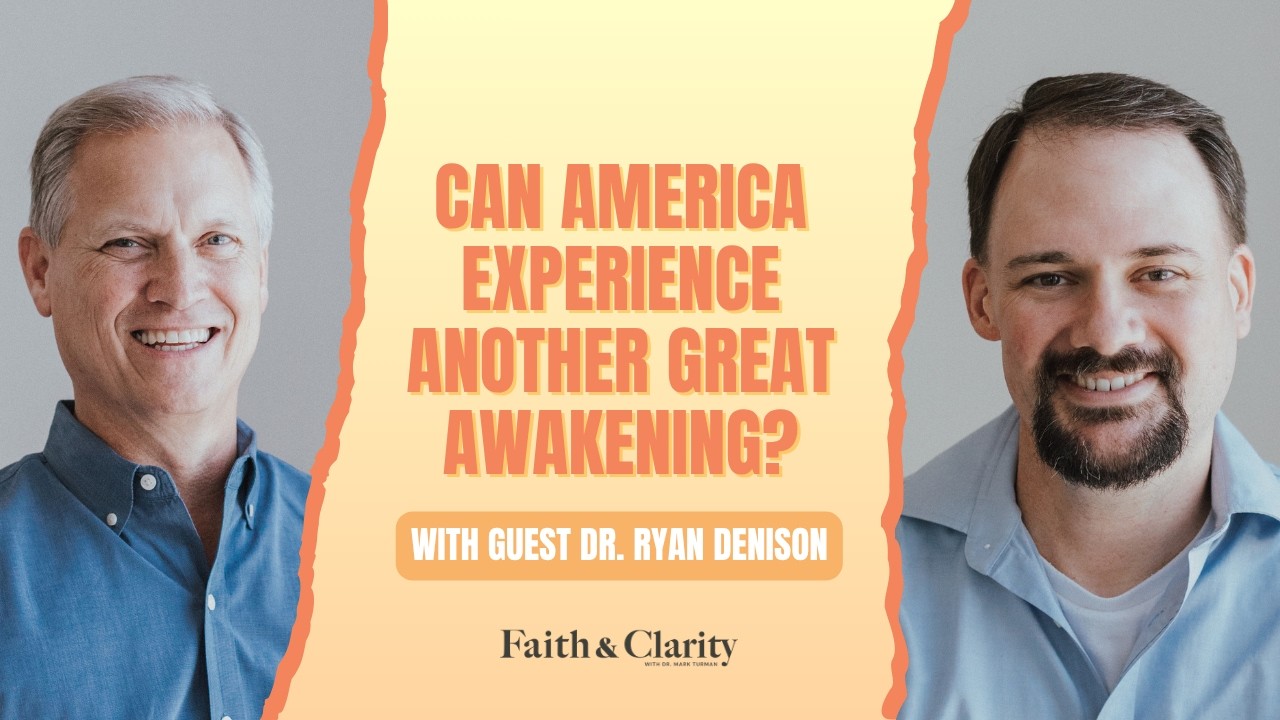
As part of the ongoing America 250 series, this episode of Faith & Clarity features Dr. Mark Turman joined by Dr. Ryan Denison for a conversation about spiritual awakening—what it means personally, within the church, and across an entire culture. Drawing from Acts 2 and the recurring pattern of rebellion and return throughout the Old Testament, they reflect on the Holy Spirit’s sovereign role in revival and why true awakening cannot be manufactured through formulas or emotional moments alone. Together, they discuss the importance of repentance, discipleship, and genuine transformation, while cautioning against responses driven primarily by peer pressure or temporary enthusiasm.
The conversation also explores the historical impact of the First Great Awakening, inspired in part by the film A Great Awakening and Ryan’s earlier discussion on Reconstructed Faith. Mark and Ryan highlight the influence of George Whitefield’s preaching, Benjamin Franklin’s friendship with Whitefield, and how a shared spiritual revival helped shape unity among the colonies and contributed to the ideas surrounding the American Revolution as America approaches its 250th anniversary. They also consider the mixed influence of modern media, the dangers of transactional faith, and close the episode with a lighthearted patriotic quiz.



Topics
- (0:00) Introduction
- (3:16) Defining awakening
- (7:47) Biblical foundations
- (24:39) Great Awakening lessons
- (32:55) Awakening and revolution
- (35:34) Revival unites colonies
- (40:19) Reformation to Great Awakening
- (43:43) Back to the Bible
- (47:50) Transactional faith warning
- (52:54) Whitefield and Franklin friendship
- (57:54) Patriotic quiz finale
- (1:02:33) Conclusion
Resources
- A Great Awakening
- Can It Happen Again? Lessons from the First Great Awakening with Ryan Denison, PhD & Jim Denison, PhD
- “A Great Awakening” and the future of America
- Ask Us Anything: [email protected]
- Sign-up for a Denison Forum newsletter: DenisonForum.org/subscribe
About Dr. Ryan Denison
Dr. Ryan Denison is the Senior Editor for Theology at Denison Forum and the author of The Focus newsletter, contributing writing and research to many of the ministry’s productions. He holds a PhD in church history from B. H. Carroll Theological Institute and an MDiv from Truett Seminary. Ryan has also taught at B. H. Carroll and Dallas Baptist University.
He and his wife, Candice, live in East Texas and have two children.
About Dr. Mark Turman
Dr. Mark Turman serves as the Executive Director of Denison Forum, where he leads with a passion for equipping believers to navigate today’s complex culture with biblical truth. He is best known as the host of the Faith & Clarity podcast and the lead pastor of the Possum Kingdom Lake Chapel, the in-person congregation of Denison Ministries.
Dr. Turman is the coauthor of Sacred Sexuality: Reclaiming God’s Design and Who Am I? What the Bible Says About Identity and Why it Matters. He earned his undergraduate degree from Howard Payne University in Brownwood, Texas, and received his Master of Divinity degree from Southwestern Baptist Theological Seminary in Fort Worth. He later completed his Doctor of Ministry degree at George W. Truett Theological Seminary at Baylor University in Waco.
Before joining Denison Forum, Mark served as a pastor for thirty-five years, including twenty-five years as the founding pastor of Crosspoint Church in McKinney, Texas. Mark and his high school sweetheart, Judi, married in 1986. They are proud parents of two adult children and grandparents to three grandchildren.
About Denison Forum
Denison Forum exists to thoughtfully engage the issues of our day from a biblical perspective, helping believers discern today’s news and culture through the lens of faith. Led by Dr. Jim Denison and a team of contributing writers, we offer trusted insight through The Daily Article, a daily email newsletter and podcast, along with articles, podcasts, interviews, books, and other resources. Together, these form a growing ecosystem of Christ-centered content that equips readers to respond to current events not with fear or partisanship, but with clarity, conviction, and hope. To learn more visit DenisonForum.org.
EPISODE TRANSCRIPT
NOTE: This transcript was AI-generated and has not been fully edited.
Mark Turman: [00:00:04] I'm Mark Turman and this is Faith and Clarity, a Denson Forum podcast. Uh, we want to help you today to find fresh hope and clarity in today's cultural confusion. So we hope you'll grab your coffee, your Coke, your water, whatever it is you like to drink and join us for a little bit of conversation. Today we are talking about spiritual awakening in America and maybe more broadly than that, from a historical perspective, what is possibly happening currently and even more importantly, personally. And uh, when we get to the end, we may have a little bit of fun with a patriotic quiz that uh, I've put together. So let's roll. My uh, friend for today's conversation is my co-worker friend, Ryan Dennison, Dr. Ryan Dennison. You're familiar with him if you follow our work. The Daily article is often written by Ryan on Friday. He's also the author of our newest newsletter called The Focus. He is senior editor for theology and it'll be important in our conversation today for you to remember that he has a PhD in church history. I don't have one of those, but I am a great lover of history. Uh, so I'm not going to try to keep up with him, but I will try to add in some color. Uh, Ryan, welcome back to the podcast.
Ryan Denison: [00:01:18] Thanks for the chance to be here. It's going to be a fun conversation.
Mark Turman: [00:01:21] All right, we're going to see if that PhD really was worth all the time, energy and effort, all right?
Ryan Denison: [00:01:27] Sounds good. Although I do like to say getting a PhD is more about being stubborn than smart. And so I was just too stubborn to quit and ended up with a degree. So.
Mark Turman: [00:01:37] Yeah. The the reason I don't run marathons is because I ran the marathon to get a doctor of ministry degree and or to get any degree as that matter. It's just an endurance test more than it is an intellectual test for sure. Um, yeah. So today's uh, conversation is really set up around a context of two or three things. One of those is, uh, we are moving obviously toward the summer and we are moving toward the celebration of America's 250th anniversary as a nation as we mark it by the Declaration of Independence on July 4th, 1776. Um, we'll get into some of the aspects of that, I hope, but we're also going to reference today a podcast that you and your dad participated in with your church, uh, in your town, uh, my hometown of Tyler, Texas. You did a podcast with your pastor, uh, Chris Legg, who is a friend of our ministry, uh, on their podcast platform called Reconstructed Faith. We'll add that to the, uh, to the show notes for this conversation. But I wanted to just pick up that conversation and maybe carry it a bit further and into some other direction. Uh, that podcast was prompted by a new movie that we would encourage people to go see called A Great Awakening. Uh, it is in theaters right now. It is soon to move to streaming. It will be on Prime. Uh, you can actually order it or put it in your queue on, uh, Amazon Prime right now. And that's the way most people go to the movies these days, unfortunately, in some ways, they miss out on all the best popcorn in my opinion. Uh, but that movie is currently out, tells the story of one of America's great spiritual awakenings and that kind of prompted this conversation of what in the world are we talking about when we talk about spiritual awakening. A lot of church people kind of have an intuitive sense of what that means. Um, but Ryan, when you and your dad were on this podcast with Pastor Chris, um, this question came up really early. What do we mean by spiritual awakening? And your dad's answer was, well, kind of in a what I would call a numeric answer. Uh, we talk about or he talked about that when a person is converted or recommits their life in their faith and relationship with Christ, we would call that personal awakening. If a church experiences what we historically have called a revival, we would say, well, that's some or a group of people experiencing uh, a fresh encounter with God. And an awakening would be, as your dad explained it, when the culture changes. Uh, so just wanted you to build on that or expand on that a little bit. Are we just simply talking about a movement of the spirit that we can measure by size and scope?
Ryan Denison: [00:04:27] Yeah, that's a great question. And I do think it helps to frame the conversation we're going to be having today to get some clarity on this from the start. And I agree with what my dad said there. I mean, I think a lot of it does go back to the different, um, in a lot of ways a spiritual awakening on a national level is just a whole lot of individual spiritual awakenings coming together in the same movement around the same time. I think it's helpful to remember though that often times historically, we more define great awakenings or spiritual awakenings by looking back on them than when then in the moment. I think one of the ways that people get into trouble is that we're constantly looking for, are we in the middle of an awakening now? Is awakening going on somewhere? When there's a a huge revival on a college campus, for example, it's really tempting to look at that and go like, is this a start of another great awakening? And the answer is maybe, but I really think we get into trouble when we try and label it as that too early because in a lot of ways, it's just when you look back on a movement of God and you see all that the Lord did through it. That's kind of the only way you can really know with any certainty if it was a true spiritual awakening or if it was just a more localized movement of the Lord. Um, and I also think it's important not to denigrate those local movements of the Lord. Just because something may not rise to the level of a national awakening, doesn't necessarily mean that it wasn't amazing, that God didn't isn't going to use that to do amazing things in the culture and amazing things in our world. Uh, but so often we kind of want to put labels on on the Lord's work in ways that I think are and can be kind of a little counterintuitive and can be counterproductive.
Mark Turman: [00:06:06] Yeah, and and it just makes me think that when we start labeling it, uh, we we start to maybe get tempted to go down the road of turning it into some kind of a formula. Um, if you if you see that happening in a church, uh, you know, we're we're all many of us are familiar with the Asbury revival, uh, or awakening, we're not sure what we want to call it at this point. Uh, and and we've seen some other indications of that on college campuses. Those may be, uh, you know, in the light of history, as you said, we may look back on those and say, well, those were the first personal conversion and or campus revivals that when you start, if you start connecting the dots over a period of time, might actually historically be described as an awakening, but we really don't know at this point and it's really not necessary that we do know. Um, it uh, these awakenings, we we ought to always be praying for and and asking God to pour out his spirit in fresh ways at every level, right? Personally, congregationally, uh, nationally, internationally, globally, we would certainly want and should be praying and and seeking that. Um, but it it's not important that we label it all or try to frame it and certainly we would want to stop short of trying to create some kind of a formula, uh, where we could say, well, we're going to, we can take what's happening on this campus or at this church or in this state and put it somewhere else, uh, as if we are in charge of the awakening rather than the Holy Spirit. Um, so it's a good way, I think that's a good way to think about it. Uh, it also made me, as I listened to your podcast with Pastor Chris and with your dad, it maybe maybe ask the question of, is this biblical? Uh, when we talk about, uh, spiritual awakening and we think about it perhaps at scale, uh, as a a large numeric experience. It started causing me to ask the question, uh, do we see this in the Bible? Is it something that, uh, is even described or maybe even prescribed or called or, you know, issued to us as something for us to pursue? Uh, is it, you know, we often talk about when we read the Bible here at Denson Forum, we talk about, uh, is this something that is just described in the Bible? Is it prescribed? Is it normative for believers? What should be our expectation? So I wanted to kind of think about that with you from a biblical perspective for a moment. And so my first thought process was, well, we do read like the ultimate spiritual awakening that comes, I guess you could argue in the, uh, the birth of Christ, um, in, uh, in the time when Jesus was crucified and resurrected at Easter that we just celebrated, but maybe the clearest New Testament example is the book of Acts chapter two, uh, when Pentecost occurs and the church is formally born at scale, I would put it in those frames. But, uh, Ryan, I just want to, I went back and read, um, before this podcast, the last part of Peter's sermon that the Holy Spirit gave him on the day of Pentecost, uh, just weeks after Easter. So here's the part that says, Acts chapter two, verse 36. So let everyone in Israel know for certain that God has made this Jesus whom you crucified both Lord and Messiah. That seems like the content of what spiritual awakening is really all about. Uh, then Peter goes on, Peter's words pierced their hearts. That sounds like a Holy Spirit action. And they said to him and to the other apostles, brothers, what must we do? Peter was then replied under the Holy Spirit's guidance, each of you must repent of your sins and turn to God and be baptized in the name of Jesus Christ for the forgiveness of your sins, then you will receive the gift of the Holy Spirit. This is promised to you, to your children and to those who are far away, all who have been called by the Lord our God. Then Peter continued, I like this, uh, ending here, verse 40 says this, Peter continued preaching for a long time, urging all the listeners, save yourselves from this crooked generation. Those who believed what Peter said were baptized and added to the church that day about 3,000 in all. Um, just kind of reflecting and thinking through that for a minute, Ryan, what what things jump out at you about how that passage informs spiritual awakening? And then as I thought about this from an Old Testament sense, I thought about when Moses went up on, uh, Mount Sinai, received the 10 Commandments, and while he was gone, Aaron and the people became rebellious and idolatrous. We read this story, uh, about how they became, um, just rank in their sinfulness. They created a golden calf to be their God instead of the true God who had been leading them. That might be an Old Testament example, but, um, others that come to mind as you think about this, other things from this these two stories and particularly the Acts passage that grabs your attention when it comes to spiritual awakening.
Ryan Denison: [00:11:27] I love the way you framed the Acts passage by highlighting kind of the distinction between Peter's words and the Holy Spirit's actions. Because I think one of the things we see throughout scripture and especially in Acts, you see this a lot is how you'll see the disciples, the apostles or just early Christians preaching the gospel and sometimes they get run out of town for it and maybe a few people convert. Other times thousands do. And it's the same message. It's just the difference is how did the Holy Spirit choose to act and how did people choose to respond? And as we think about this in the context of revival and awakening, I think that's really important for us to remember. Uh, you mentioned earlier kind of avoiding that desire to be formulaic with it. And I think that's this is a great passage to remind us that at the end of the day, we're called to preach the word of God. We're called to tell people about Jesus and help them become disciples. But ultimately, it's their choice whether they'll accept it and it's up to the Holy Spirit on with regard to what he wants to do with it and how far it goes. And one of the main mistakes, I think one of the main principles you see in Acts, I've heard Acts described as sort of the gospel of the Holy Spirit in the same way the gospels are the gospels of Jesus Christ. And I think one of the main messages in Acts is that we do not get to control the Holy Spirit. The Holy Spirit goes where he wants, does what he wants, and he invites us to participate, but at no point in time is the Holy Spirit ever under our control. And as we think about awakening, I think that's essential for us to remember. And it's a truth that we see throughout the throughout the Bible. Um, but how do when you think about kind of the these passages in the context of awakening, um, and sort of the role in the Holy Spirit of it, what kind of what jumps out to you about that?
Mark Turman: [00:13:10] Well, one of the, one of the things I hope that we can claim here is that the Holy Spirit is eager, uh, to be active and to be active not only in our personal lives, but but in our, uh, corporate lives, whether that's within our family. Uh, I love that there's a reference here, right? Uh, even in what Peter is inspired to say, uh, that this is for you and for your children and for even those who we would call very far away from God, that this is for anybody and everybody that will humble themselves, um, and, you know, uh, as evangelical Baptist Christians, we don't always, uh, in our context know how to think about when we read in the book of Acts, like, uh, Peter's reference here to the Philippian jailer that comes several chapters down the road, uh, about he and his whole household. There's probably, I think two or three examples of that phrase, uh, that come across in the stories of the Holy Spirit and the, uh, the opening chapters of the church that he and his whole household, he and his children. Well, was it, was it because they were truly personally responding to the Lord just at the same time? Or was it because they were being obedient to their parent? Um, and we're not quite sure always how to think through or work through that. Um, and what we would want to obviously be aware of, uh, in any of these contexts, whether it's as a family or as a church or a campus or even a larger environment, we would want to be careful that, uh, that we don't go down the road of emotional contagion. Um, that people just start responding, um, because they see the people around them that perhaps they're friends with or they're related to, and they're like, well, there must be something going on and I don't want to miss it. I don't really know if I understand it. I don't really know if I believe it, but hey, if my friends are doing it, uh, it's kind of like what would happen when I was a young Christian in my teens and in my early 20s, if you went to a worship gathering and everybody started kneeling or some people started kneeling, then everybody thought they should kneel. Or if you go to a church worship service today, if two or three people stand, then all of a sudden everybody else feels like they're supposed to stand, uh, if not, if not for spiritual reason, just so it doesn't look awkward or doesn't feel awkward. Um, yeah. And so I think that one of the cautions here is, uh, yes, we hope and we pray and we want the Holy Spirit to be moving in these ways and to be moving, uh, a large number of people to a place of humility and repentance and true faith, but we have to be conscious and aware and and some of the best leaders in these environments that I've ever seen are saying, hey, look, check yourself. Is this really what you believe? Is it really that you sense personally, individually that God is moving in your heart? Don't let this just simply become a peer pressure experience or an emotional response because you're seeing and experiencing that emotion around the people that you're with. Um, and I I I take it as gospel when it says that 3,000 people were genuinely converted on this day with Peter. I've always read this passage and I'm like, I wonder who counted. And I and I wonder if, you know, uh, seven days or 15 days or 30 days later, they went back and they said, well, we actually talked to 5,000 people and we figured out that only about 3,000 of them really were were participating in this in a genuine and legitimate way. I don't know if all that makes sense, but just is that does that make sense to you?
Ryan Denison: [00:17:16] It does. And I I do think it it brings up a really good point that we have to draw a very clear distinction between genuine works of the Holy Spirit and what we're often tempted to do for other reasons. Um, I think one of the and I think you can go too far in that skepticism. If you look at the first grade awakening, for example, one of the main distinctions coming out of that was between what they called old light churches and new light churches. And old light churches were kind of the more, um, uh, they were kind of the denominations that largely rejected the the work of the first grade awakening, the Holy Spirit's work because the way the Holy Spirit led people to worship was so different from what they were used to that they didn't think it could be legitimate when it was. Um, at the same time, you see that one of the points I made in that podcast with with Pastor Chris is that we're as humans, we're really good at recognizing the Holy Spirit's role in starting awakening. We're really bad at recognizing that the Holy Spirit gets to be the one that decides when that awakening ends as well. And when we're moving past it. And towards the end of all the great awakenings, you start to see people continue to chase that feeling or chase that movement of the Holy Spirit when maybe the spirit's moved on and said to the point where it's like, all right, we've gotten past the revival part. Now we're in the discipleship part where we really need to dig down to make sure that this has roots and can last. Because I I do think there's a there can be a disconnect between that highly emotive, highly persuasive initial calling in an awakening and the kind of true discipleship that allows that to grow deep and to grow the kind of roots that aren't scorched by the sun to go back to kind of Jesus's analogy in the gospels. And I think that's one of the ways that one of the reasons the Holy Spirit doesn't just keep us in a perpetual state of awakening is so that we learn our relationship with God is meant to be more about more than the emotions and the emotions aren't enough. Uh, they can be a tool that God uses to bring us to salvation, but they are not a good foundation for our relationship with the Lord. And as we think about awakening and how to use it well, um, I think that's really one of the things we need to keep in mind is that we're not just chasing conversions, we're chasing disciples. That's the call of the gospels. And awakening can be a tool in that, but it's it's not meant to be kind of where that ends. And so as we're thinking about how to help others know the Lord, if we're kind of putting all of our eggs in that awakening basket, then we're less likely to be doing it well. We're less likely to we're more likely to kind of ignore the other ways the Holy Spirit is already at work. And uh, because awakening is also not the only tool that the Holy Spirit uses to draw people to himself. And I think too often we can kind of look for the those big moments, those big revival kind of experiences when a lot of times it's in the more mundane everyday kind of stuff where the Holy Spirit truly shows up in powerful ways. But what are your thoughts on that?
Mark Turman: [00:20:07] Yeah, it just it just brings to mind so many things. It it brings to mind, um, what I heard you say maybe in the podcast or in a conversation afterward, uh, with Pastor Chris talking about the movie, which is, uh, kind of this cyclical nature of human nature. Uh, you see it certainly very profound in the Old Testament where Israel would follow God very faithfully for a season, and then for reasons that sometimes are not really very well explained, they just decide to stop following him faithfully. And it happens, you know, the story of the most important story in the Old Testament, which is Israel coming out of Egyptian slavery, it's not very long before, you know, they've they've gathered all of these, uh, resources from the Egyptians and they're heading out and it doesn't take very long before they're like, we want to go back. We we would rather be slaves back in Egypt. Um, and they've been having all of these incredible, uh, moments with God and with Moses as their leader, and they just keep repeatedly getting tired or, uh, frustrated or fatigued or just downright sinful and they just go, I want to go back, you know, or they even get to the point where they threaten Moses's life at at one point. Um, but then you see that on a national scale through the long story of the Old Testament where Israel is constantly going through this cycle of faithfulness to drifting to ultimately being rebellious and and indifferent toward God and then God moves in a significant way and there are, uh, very various awakenings we would say at various sizes and they come back. They sometimes come back individually, sometimes as small groups, sometimes on a large national scale. It's really almost a summary of the Old Testament. Um, and I started learning this as a young Christian, uh, I I came to Christ early enough to go to church camp one time before I finished high school. And there there I learned that there was this experience of, hey, we're going to we're going to have a special encounter with God or or we're at least going to go to youth camp and hope for and pray for a special encounter with God for many, for most or even everybody that was going into this church camp experience. And I remember learning, uh, the story of, uh, the Mount of Transfiguration where Jesus says to three of his disciples, Peter, James and John, come up on the mountain with me, and they get this very profound, unique engagement and experience. They get to glimpse the glory of Jesus as it fully was. And it is not a surprise that Peter says, let's stay here. We'll build shelters for you and like like these like Jesus and Moses and Elijah needed shelters for any reason. So he's, you know, but he wants to stay on the mountain top and Jesus says, no, we're going back down in the valley where discipleship happens, where people need to know the gospel and they need to know Jesus in a clear way. There is a purpose for this mountain top experience in the same kind of similar way that we might say there was a purpose in going on an intentional retreat or camp to have an encounter with God. And in the same way the Holy Spirit has particular purposes at times, Old Testament, New Testament of bringing these moments of encounter and clarity, but that probably should not be the normative way that we think about our faith. Um, otherwise we're we're going to be chasing the encounter rather than engaging the relationship on a consistent basis if that makes sense. I I love your comment. I can't remember the exact context the last couple days, but you said nobody wants to be the first one to leave the revival, right? And, uh, and and that kind of makes me wonder about, you know, the statement you also made in the podcast, a lot of people that were in a spiritual awakening didn't know it at the time. Um, and I'm I'm still kind of wondering if that's a good thing or a bad thing that they didn't perhaps know what they were involved in. What do you think?
Ryan Denison: [00:24:39] Yeah, I think over time they probably came to realize it, but the a really important distinction when we think about the way that awakening happens and especially the way that over the first, uh, first and second grade awakenings especially, kind of, uh, first grade awakening was kind of mid 1700s, second grade awakening was sort of into the 1700s into the start of the 1300s or start of the 1800s, I mean. And with both of those and especially the first one, you really, we look back on it and we see these amazing revival movements. We see George Whitfield going traveling 5,000 miles and preaching 350 sermons in a single year. We see John Wesley preaching sermons, we see Jonathan Edwards's sermons, and we see like just congregation after congregation, uh, and group after group giving their lives to Jesus and we think, wow, this is was an amazing organized movement of the spirit when the reality is that to whatever extent they recognized that the Holy Spirit was doing something throughout the colonies. And I think they did have a general awareness of it. I mean, Whitfield's sermons make clear that his goal was not to lead nationwide revival. His goal was to help whatever whatever people were standing in front of him on that day encounter Jesus. And I think that's so important when we think about just the nature of what awakening is meant to accomplish and what how God uses it is that it's most successful when we remember that at at its core, it's just a whole lot of individuals giving their lives to Christ and renewing their faith in in him. And when we start to chase these more organizational elements of it or this massive scale of it, I think it's easy to lose sight of the fact that at the end of the day, God cares about us as individuals. It's individual souls being saved. And when they're saved in mass, then huge culture-wide changes can happen. And that's awesome when it does. But it doesn't happen if we set out to change the culture. It happens if we set out to change to help individual lives turn to Christ, to help individual people find the Lord. And that's the that seems to be historically at least, that seems to be the kind of movement the Holy Spirit honors the most is the one that or the ones that don't lose sight of the fact that at the heart of awakening is meant to be this just helping people encounter Christ and to do so in a powerful way, to experience the the truth of the gospel. Um, because the other thing that's interesting about the first grade awakening especially is Jonathan Edwards's sermons were very different from George Whitfield's sermons. Jonathan Edwards was, uh, write a manuscript, stick your head in the paper and read it. Like some of the most terrifying verse you can read in this in this monotone voice and the Holy Spirit blessed that. Like sinners in the hands of an angry God gets a lot more terrifying when you think about this spindly old guy just kind of like reading it in this monotone matter of fact way. Um, versus George Whitfield traveling and giving these emotive like one of the things the movie does a great job of is highlighting how he was able just with his voice to boom out a sermon to thousands of tens of thousands of people at once. And just but Whitfield's sermons were a lot more based on kind of the the love of Christ and this desire of God to help you know him better. And God honored both approaches because both I think were meant to be were the word of the Lord. And I think at the end of the day, what we see is that when we preach the gospel in the desire to help people know Jesus and be saved, God honors that. When we preach the gospel in the desire to bring institutional change or to change aspects of our culture, we it gets really easy to start using the gospel as a tool for our purposes rather than as God's tool to help people know him. And I think that's the line that we can't cross.
Mark Turman: [00:28:22] Yeah, I think that's a great, great call out and, you know, like I said, it it was about what the Holy Spirit wanted to do, not what the the skill of any particular person or preacher. And, um, you know, and love the the story of Whitfield that, you know, he wanted to be an actor. He, uh, he was familiar with the stage and wanted to be an actor and then came to Christ and and realized that his ability to stand in front of people, his ability to speak was something God could use, but that was not going to be the most important thing. The most important thing is is was he going to be available to the Holy Spirit? Was he going to be humble and let the Holy Spirit use those gifts? Um, and and God did. Um, one other question, uh, real quick before we take a break, which is, uh, you mentioned that the, uh, the colonies began through their mechanisms of media, which were basically newspapers. Uh, they began to become aware of, uh, Whitfield's sermons and we'll get into the relationship that he had with, uh, Benjamin Franklin, uh, who had the most successful newspaper in Pennsylvania at the time. Uh, the movie does a wonderful job of explaining and exposing that relationship, that friendship. Uh, we'll get into that after the break. But I want to come back to the question of media. Uh, in our day, if God is doing these kinds of movements and creating awakenings at some scale in different parts of the world, uh, our ability now to know what is going on anywhere is so much exponentially higher. Uh, is that a, is that helpful to what God may be doing in terms of a possible awakening or is it somewhat detrimental, do you think?
Ryan Denison: [00:30:12] I think it can probably be both. It's a great question and honestly, it's a perspective I hadn't really considered much before this. And I I do think it can be both though where at times kind of it's encouraging to know what the Holy Spirit's doing. I do think it it kind of makes it easier for us to get ahead of the spirit. Where if you look at the great awakenings, they all, every one of them was precipitated or, um, by this just massive prayer movement of people going to the Lord in desperate, earnest desire for him to work. And I think when we start to hear stories of revival elsewhere, it can be really easy for us to kind of skip the prayer stage or to skip the the stage that would encourage us to kind of really make sure our hearts are ready for revival, that we've cultivated the field well enough that those seeds can actually take root. And I think that's maybe one area where the where our media landscape of today can make that more difficult. Um, I also think there are some benefit to it though because it is it does give the Holy Spirit more opportunities to share what he's doing in the world and to encourage us to pray that he would do the same. But I think where those stories cause us to start chasing revival versus cause us to start praying for revival, I think we make a mistake. Uh, it has to be the latter where if we hear when we hear news of what God's doing, if that drives us to our knees to kind of just seek after the Lord and ask that he would do the same thing here, I think it can be a huge blessing. But what are your thoughts on it?
Mark Turman: [00:31:46] Yeah, I totally agree. And I just there was a a kind of a prayer forming in my mind, whether you whether you're learning about something that God did like these awakenings in the past, in the Bible, in church history, or you're learning about them something that God may be doing or appears to be doing in some other part of the world, um, your prayer ought to be, Lord, do it again and do it here according to your will. Thank you for what you're doing. Thank you for what you have done all through history. Lord, do it again according to your will, do it here, do it with me. Um, it reminds me of that story your dad tells often about the evangelist Gypsy Rose when he was asked, when will revival come? And he said, go home, get a piece of chalk, draw a circle, get inside the circle and pray until everything is is in that circle surrendered and revival will be here. Um, it needs to be that kind of spirit rather than trying to get ahead, uh, or create a formula. Well, we're going to take a break and we'll be right back in a few minutes with a few more ideas to share.
Narrator: [00:32:51] You didn't expect it to shake you this much. Maybe it was the diagnosis, maybe it was the funeral, maybe it was the prayer that went unanswered. You believe in God, you always have, but lately you find yourself wondering, why did he allow this? Why didn't he intervene? Can I really trust him? The world has answers. Everything happens for a reason. Just have more faith. Don't ask questions. But none of those bring peace because deep down, you don't need cliches. You need clarity. You need truth strong enough to hold your questions. That's why we re-released Dr. Jim Dennison's new edition of wrestling with God. In this honest and personal book, Jim tackles the hardest questions Christians carry but rarely say out loud. Questions about suffering, about doubt, about prayer, about whether we can truly trust the God we serve. Not with shallow reassurance, but with biblical depth and thoughtful conviction because wrestling with God is not the end of faith. It's often where deeper trust begins. If you've ever struggled to reconcile what you believe with what you experienced, this book is for you. Visit supportdf.org to get your copy today. That's supportdf.org. Get your copy today and learn to wrestle honestly and trust God more deeply.
Mark Turman: [00:34:29] All right, we're back talking about spiritual awakening, historically, currently, personally, and uh, thanks for joining us. Uh, Ryan, I wanted to pick up our conversation with a quote that your dad made in a previous podcast with your pastor, Chris Legg. Uh, he said, uh, talking about the connection between spiritual awakening in the colonial period and the actual American Revolution, he said, the children of the first great American awakening became the founders of the revolution. Uh, we know historically that many, many historians as well as theologians talk about the four great awakenings. Uh, your dad does a really good job of explaining those four great awakenings. Uh, I believe the one that the movie, a great awakening, uh, that's in theaters and soon to be on prime is talking about is the first of those four great awakenings. Um, but I wanted to talk a little bit about your thoughts about, uh, what your dad said, that these children who experienced with their families in the colonies, this first great awakening, George Whitfield, how they would grow up and become so instrumental in America's history, in the founding of America. How do you see those things connected?
Ryan Denison: [00:35:48] It's a great question and I think a really important piece of the film does a great job of emphasizing this. Um, and I think what makes it so important for us, especially as we approach the 250th anniversary of America, to remember is that it really was what the only thing that really united the colonies outside of a hatred for Britain in a lot of ways was the first grade awakening. And it came about because so many of the colonies started, um, kind of for spiritual purposes where people were seeking religious freedom and it's important to remember they weren't seeking religious freedom generally, they were speaking, they were seeking the freedom to practice the religion the way they wanted to. Um, so a lot of kind of even those who came over from England in pursuit of that, they had a very clear idea of how they thought Christianity was Christianity was supposed to be practiced and they wanted the freedom to do that. And so they were kind of restrictive and, um, and the whole phrase puritanical comes from this idea of the way the Puritans, uh, practiced their faith. And after a while, you start going back to that generational conversation. The first generation of colonists was were highly committed to the Lord by and large. Um, by the time you get two or three generations later, most of them had kind of burnt out on the idea of God. And spirituality was this stale, mundane sort of, often times it was seen as something for the upper classes to do, um, while the lower classes, they had to worry about working. They didn't have time for church. And, um, there was a it was really kind of the state of Christianity in America was in a bad place when the first grade awakening started. And it was through that revival that the colonists for the first time really experienced something that united them. They they had a common experience. Um, before the break you mentioned, uh, how Benjamin Franklin kind of helped people keep up to date on George Whitfield's movements and George Whitfield's sermons. And that that enabled people to experience it as a collective and as a group. Um, and they they so you could have people from Florida all the way up to New England and Philadelphia and that area that when they read the sermons of George Whitfield, they knew who you were talking about. And outside of, um, I I think it's been said like outside of King George, George Whitfield was probably the only name that every colonist knew. And I think it's kind of like that's what the Lord was able to do through that. And it gave them not only a shared sense of identity in Christ, um, but it it also established a lot of the principles behind the the the American Revolution. This idea of individual freedom, of individual worth and value that were philosophical in some sense. Uh, you see, but what really kind of made them click for the American Revolution is they came to be seen as these divine rights. This isn't just something that humanity has, this is something God has given to humanity. And that really was in a lot of ways, uh, what proved pivotal for uniting the colonies against the against Great Britain.
Mark Turman: [00:38:46] Yeah. Yeah, I think it's really good to understand how they're connected and, uh, just a shout out if you find yourself sometime in the next few months in a game of revolutionary trivia, um, if somebody asks you to name three important people named George, uh, we now have it, okay? So it's King George, uh, George Whitfield and probably George Washington needs to be put in there as well, okay? Those are the three Georges that you need to remember from this particular time and how how things were working out, uh, in all of those intersections. That's a that if you can understand that, you can pretty well understand the revolution and the birth of America. Um, Ryan, I want to get a few thoughts from you. I've been thinking about this as well. Uh, having listened to you, having listened to your dad talk about spiritual awakening on a number of occasions, it just seems that, uh, even from a biblical perspective that desperation, uh, always seems to precede awakening in a very real way. Um, and and not desperation has its own, uh, particular flavor if you will, in various situations. But we'll be celebrating America's 250th anniversary as marked by the signing of the Declaration of Independence in July. Um, but as students of history, I'm going to draw on your expertise here and my curiosity as well. Establishing a nation that we now know today as America took a lot longer than signing a document or even a few months to write the document and then to get, uh, these leaders, uh, to sign it. Um, what we sometimes don't remember is that there's at least 250 years of specific history that we know a lot about before those revolutionary leaders signed that document in Philadelphia. Uh, so you have to roll your mind back to Christopher Columbus and, you know, that little song that he sailed the ocean blue in 1492, okay? What you also need to remember about that and I've had a recent appreciation for that is that when Christopher Columbus is setting sail from Europe to America or to and ultimately discovers America, you also have a very profound movement going on in Europe that we today call the Protestant Reformation. Think of Martin Luther, John Calvin, uh, other very prominent personalities in church history. It's not a surprise that those two things are happening, uh, very much in the same season of time. But I wonder if you could give us some of what you understand about the 250th, 250 years that come before 1776, this kind of Columbus to George Washington, if you will, and how does that really show a season of desperation that really becomes the context that George Whitfield and others step into?
Ryan Denison: [00:41:54] Yeah, it's it's a great question. I I think what you see is sort of even within that an an ebb and flow of how how comfortable people are in their faith. And I think what really drives a lot of that desperation is you see moments where people look at Christianity as it's presented and they go, that that's just doesn't something doesn't seem right about that. I think in the Protestant Reformation, you see that with Martin Luther and with how quickly others as soon as they're kind of given license to rethink what Christianity can mean, just immediately begin to see where he's coming from with it. And a lot of times it's at its strongest, it's when people rediscover the faith of the Bible versus the faith that was presented to them and how that plays out. Um, one of the most powerful scenes in the movie I thought was when towards the end, Whitfield, uh, encourages Benjamin Franklin to evaluate, essentially evaluate Christ based on the Christ of the Bible, not the Christ that he was presented with. And I think we see that's what drove a lot of the Protestant Reformation was Luther kind of looking back at scripture and comparing that with the way that that Christianity was presented in the Catholic Church at the time and going, these two things don't match up. And I think you see that at various cycles throughout, um, the following 250 years where or the following, uh, 300 years or so where a lot of it really was built around this idea of, okay, now that we've had the freedom to rethink what Christianity can mean, what are we going to do with that? And you see at times where they treat that well, where they really do kind of emphasize, okay, this is what the Bible says. This is what this is what a faith is supposed to mean. This is what a relationship with Christ looks like. And other times where they go into the mistake of trying to institutionalize that and saying, no, no, this is the only way that we can understand this. And really a lot of what determines how closely people are following the Lord over that period of time is how well do they draw lines between essentials of the faith and points at which we can faithfully disagree. And I think even within Protestantism, you see so much of, uh, that division kind of threatened the Protestant Reformation and the counter reformation from the Catholic Church. We could do a whole another podcast on the Protestant Reformation and everything that goes into that. Um, but a lot of it, I I always think it's interesting that if you look at a map of kind of where Protestantism took off and where it ends up, it was really kind of in by the by the end of the counter reformation from the Catholic Church, you've got Protestant the Protestant churches in Germany and where the German princes protected them and in Hungary where the where they were in largely in Islamic Muslim controlled lands. Everywhere else kind of went back to Catholicism. And then England where they kind of broke off into their own thing, which is sort of the the genesis for a lot of what we see with the American Revolution. And, uh, the first grade awakening is kind of a a rejection of that understanding where king where the king kind of became the Pope in a lot of ways. But not much else changed. And even within England, you see this ebb and flow of, uh, Protestantism versus Anglinism and what are the what's the proper way to worship God? And that question of when we think about like how we're going to worship God, what's the right way to do that, drives so much of this conversation, uh, throughout that period of time and I think it drives it today too. This is something we're still struggling with. Um, but as you've thought about and studied that period, like kind of what's stood out to you?
Mark Turman: [00:45:17] Well, what I love about what you said and about this period of history is that, uh, it so much of it is one way or another, it's getting back to what the Bible says. Um, and coming back to this idea that and and to this this truth, this doctrinal truth that we hold on to very deeply, which is that the Bible is the most authoritative thing for our faith and practice. Um, and in usually in well-intentioned, uh, ways, Christians, sometimes large groups of Christians try to answer that question, what is the right way to worship God? And in the pursuit of that, often times, like I said, with noble motives, they end up creating pathways that they they begin to think are as sacred and as spiritual and as authoritative as what the Bible itself is. And I I think this was the fundamental, most important thing about what Martin Luther was experiencing and what you see disseminating out across Europe and then ultimately into the American colonies is, um, if it's going to be genuine, we have to keep coming back and asking ourselves the question, what does the Bible say about this? What does the Bible say about this? How can we get the clearest and best picture of what this will look like, uh, by going back to the Bible rather than going back to what a previous group or generation might have done with it. Let's go back to the original question that they hopefully had, which was, what does the Bible say? And what picture can we grasp from that? Um, because nothing will ever be as objective or as clear or as important as what the Bible says. And and that's not an easy thing to do. Um, uh, the reason that Christianity is so diversified in so many different groups, uh, is because, uh, in many ways, people took their understanding and tried to make it the sacred and only way rather than saying this is a way, um, that seems to align with the Bible based on our understanding. Um, and hopefully we're getting better at that inside of the Christian, uh, faith. I think are very well, uh, very important and something that should continue, something that should, uh, be more characteristic of us going forward because we get lost in that sometimes. Um, and it it is a call for us to come back over and over and over again. What does the Bible say? What does the Bible say? Uh, what our churches say, what our denominations say, what our friends say, those are important, but we have to keep anchoring ourselves back to that. Um, is kind of the big lesson I take away from that over and over again. And I appreciate you calling this out. It would we don't realize how close we were to becoming more like Europe than we are as a nation of states. We could have easily become 13 individual countries rather than the United States. Even with all the problems and challenges of being the United States then and now, we were very close to being 13 different countries. Or maybe nine or seven, who knows what it would have been, but we're very close to that. Um, there's a lot of stuff I wanted to talk about here. Some of them are anchored in the movie. So I we could have a whole other conversation easily here. But a couple of days ago from this podcast, your dad referenced the movie and some of his thoughts about the movie, and he also talked about one of the things that he often writes about, which is turning your faith into a simple transaction. Uh, we live in a capitalistic, uh, democratic environment. Uh, we are very familiar with this idea of you get what you pay for. Um, but your dad made a statement I wanted to get your reaction to in this daily article, uh, that was on April the 15th, tax day. He said, he believed that capitalistic transactionalism, this idea that we get what we pay for, could be the greatest hindrance to spiritual awakening in America. What do you think about that statement?
Ryan Denison: [00:50:11] I think a I think there's a lot to it where so much of because so much of awakening is based on this idea of giving God a blank slate and just asking him to do whatever he wants with it. There's a level of unpredictability to that that I think really does go against kind of that larger impulse of being able to know kind of we're going to get what we pay for sort of mentality. Like what at the end of the day, like that's not the kind of relationship God calls us to have with him. It's not the one that he'll, it's not one he'll bless and it's not one he'll accept from us because he knows he can give us more than we could ever hope to ask. And but when we have our minds fixated on, okay, if I give God X amount of tithe or X amount of time, then this is what I expect in return, then we're limiting what God can do because we're basically putting constraints on like on the kind of blessings that we'll accept from the Lord. And we're not demonstrating the trust necessary to leave that up to him. And throughout scripture, that's what we see is what we see most clearly is that when God blesses his people, it's often in ways beyond their wildest expectations, but it's also often in ways they never would have thought to ask for. And at times even in ways that don't necessarily feel like a blessing in the moment. And I think that's part of why God asks for that blank slate is so that we can trust him enough to to walk with him while he blesses us and while he helps us understand those blessings and while he uses us to be a blessing to other people. And so much of kind of that focus on ourselves robs us of that opportunity. But what were your thoughts when you read that?
Mark Turman: [00:51:47] Yeah, it it struck me in a couple of different ways. One of those is, um, I remember, um, there's a book back here on my bookshelf by, uh, a pastor theologian named John Stott. He talks about different ways of understanding the cross. One of those ways is he says, you know, the Bible uses the language of, uh, of transaction, uh, where Jesus says, you know, I didn't come to be served but to serve and to give my life as a ransom for many. Um, the Apostle Paul picks up on that in some ways seemingly in the Corinthian letters. He says in 2 Corinthians 5:21, God made Jesus who knew no sin to be sin for us that we might become the righteousness of God. That in some way sounds like a transaction to me, right? Um, and both of those passages sound like a transaction, but it's not a transaction in the way that we normally think of, well, you get what you pay for. It is a grace transaction that is in fact mindboggling and not something we can fully comprehend. That's why it's only one of at least four different ways that John Stott says that you can understand or should think about grace and the cross. Um, but it also just reminded me that that for us as religious people, we are constantly tempted toward performance. We are constantly tempted to be, uh, what I believe Mark Twain said, self-righteous, which is to be righteous or good in the worst sense of the word. Um, and that that we so easily turn faith into a bargaining experience of what is is essentially legalism. If I perform well, then God is obligated to me. And that is so antithetical to what faith is all about. Uh, that the only legitimate motivation of faith is gratitude. Um, in my perspective. Um, and and it's just a warning to us. Uh, it's a it's a dire warning to us in the story of Jesus and the cross that it's the most religious people of his day, of his culture that are leading the way to putting him on the cross. And that's a that's a very sobering thing to think about when you are a person of faith, a person who is pursuing an encounter and a relationship with God. It's a very important thing to remember. Uh, Ryan, I I have a an entire hour more of conversation here, but we're we're going to need to end. I don't want to rob people of our patriotic quiz. But one other aspect about the movie, again, the movie is called A Great Awakening. If you can't get it in theaters, you'll soon be able to get it on your streaming platform, particularly Prime. Uh, but I wanted to call this out because it came out in your podcast conversation with your pastor. Uh, this movie describes the unique friendship between George Whitfield and Benjamin Franklin. Franklin is known, uh, in history more generally, uh, not as a person of biblical Christian faith, but as what your dad described, others have described as maybe a deist or a moral deist, somebody who, um, somebody who believed that God, if he is real, uh, created the world, kind of spun it like a top and then sent it out into space and doesn't intervene or engage with it anymore. Um, talk about, we talked about this at the beginning of our podcast. Uh, for me, the movie was an insightful picture of friendship between people who did not share a common understanding of faith. And it became a picture of what you talked about before relative to Whitfield. He was concerned about the person or persons in front of him at any given moment. And there's a very powerful scene how that plays out between he and his really deep friend, uh, toward the end of, you can see and even feel Whitfield's spiritual concern for Franklin. Um, I wonder if you would just give us a a comment or two about how that is a a picture of how we ought to be approaching everybody in our life when it comes to faith.
Ryan Denison: [00:56:13] Absolutely. Yeah, it's because Whitfield and Franklin did have a friendship, a genuine friendship. It wasn't just a, I don't think it was just a business partnership, even though both profited from that relationship. Um, there really was, I think this desire to to see Benjamin Franklin come to Christ. And one of the things the film does a great job of, as I mentioned before, is kind of this idea of really cutting to the idea of was Benjamin Franklin rejecting the God of the gospels, the Christ of the gospels, or was he rejecting the Christ that was presented to him through the religion of his day? And I think a lot more of it was the latter. And that and I think that's what was driving Whitfield nuts is he's like, you've printed all my sermons. You know who Jesus is. And that's not who you're rejecting and you can't see it. And I think it speaks to this idea of like we're never, God doesn't give us the liberty to ever give up on anybody. We don't get the, we don't get to be the ones that say like, okay, you've had enough chances. I'm I'm done with you now. Um, as long as God keeps putting somebody in our life, we are called to pray for them and we are called to help them know Jesus. And what that looks like needs to be based on the whole, that's up to the Holy Spirit as to how we kind of interact with that person, what we say, when we're when we're quiet, when we are willing to just be a friend and not just kind of constantly beat them over the head with scripture every conversation. I don't think that's what Whitfield did. It was never more than a breath away, but it was never it wasn't always the focus. And I think that's why it was really effective in some ways. Um, but one of my favorite stories about Franklin, uh, and I it didn't make it in the movie, so I'm unsure if it's true, but he used to talk about how like and it that it didn't have anything to do with whether or not Whitfield was persuasive. Like he would make a point of not bringing money to hear Whitfield preach because by the end of it, he would be giving everything he had in support of of the causes that Whitfield was presenting. And, uh, the story goes that by the end of it, he ended up just borrowing money from other people in order to be able to give because like that's how persuasive Whitfield was. But, uh, at the same time, it's like it it's not enough, it wasn't enough to just kind of like be persuaded. Franklin needed something more. And I think so often it can be frustrating when we've presented the gospel, when we've told people the truth, when we understand that they get it and it's still just not enough to break through whatever walls they've erected between themselves and the Lord. And the the story of this movie and I think the calling of this movie is that we don't get to give up on people just because that's the circumstance.
Mark Turman: [00:58:39] Yeah. And that, yeah, and yeah, one of the great principles here is that the Holy Spirit is always at work more and and and more powerfully than we get to and that salvation is always a work of the Holy Spirit, not of our mechanics or our methods or anything else. Yeah. I can tell, I can give you the testimony. My wife is, uh, not the history buff that I am, but after this movie, she came home and she stayed up for at least an hour pursuing more understanding about the faith of Benjamin Franklin that the movie pointed her to. And then she starts sharing resources with me, which in these ways just doesn't happen. And so that's a testament, um, and and a review of the movie if, uh, if you want it, okay? Uh, Ryan, before we go, uh, I want to finish with what I've called the since you asked, uh, feature. And today, uh, I'm going to give you my patriotic test. How patriotic are you? And I'll answer the questions if you'll answer the questions, all right? Uh, so these are six questions on how patriotic are you? The first question is, do you know all the words of the national anthem?
Ryan Denison: [00:59:57] I can sing along with it and get all the words. Although there are certain words that I think I learned wrong when I was a kid that if I'm not intentional about getting right, I end up like saying something that sounds like it, but was just how I understood it when I was younger. Um, if you went like line by line, like what's the fourth line of the Star Spangled Banner? I don't think I could tell you that. But if it's if it's playing at a baseball game, I can sing along. So.
Mark Turman: [01:00:21] Do you want to do you want to sing it for us now? Is that what you're saying?
Ryan Denison: [01:00:24] Uh, if you're in a hurry to get people to close the podcast, then yes, I can do that. But otherwise, it would not be in the best interest of anybody.
Mark Turman: [01:00:32] Okay. Well, I'm going to give you my percentage here in a minute. If you were asked to write or type out all the words of the national anthem, there's 80 of them. How many of them do you think you would get right by percentage?
Ryan Denison: [01:00:44] I could probably nail at least 75 of them, uh, if I was just going in order, but.
Mark Turman: [01:00:50] Well, when when you get done with this podcast, give yourself a a shot. Uh, this morning after only one cup of coffee, I got 45 of the 80 words correct. So I'm not really proud. Uh, second question, do you fly an American flag at your house on patriotic holidays or more than that?
Ryan Denison: [01:01:12] We used to at our old house. We don't have a flag post at this one. So I do not. So we'll usually kind of find some like little like the little tiny ones and have that somewhere in the house, but that's about it.
Mark Turman: [01:01:25] Okay. Well, I got you on this one because I not only have a flag pole, but I have multiple flags including, uh, the 13 colony Betsy Ross flag. So, um, yeah, I love flags, all right? Uh, third question, have you ever misused fireworks on a patriotic holiday?
Ryan Denison: [01:01:43] Not on a patriotic holiday. Um, I have misused fireworks at other points in time, probably. Um, but usually I'm not the one in charge of the fireworks anymore. And so it is not my role to misuse. Um, I just kind of help clean up afterwards.
Mark Turman: [01:01:59] Okay. Well, I am I am guilty of both and, both on patriotic holidays and on other days as well. Uh, I think it's a great American tradition to sometimes misuse fireworks. Don't burn anybody's house down, but yeah. All right, three more questions to go. Have you or will you read a book about America and its history sometime this year?
Ryan Denison: [01:02:21] Absolutely. We have one coming out from Denson Forum in the near in the near future and I have and will again read that one at least. So, yeah. If that counts, then yes. So.
Mark Turman: [01:02:30] Yes, okay. Yeah, lots of good stuff to be reading. Uh, how many of the American founding fathers can you name?
Ryan Denison: [01:02:38] Ooh, uh, can I use the cop out of defining who's a founding father is a bit of a nebulous concept?
Mark Turman: [01:02:46] Yes, you can use that. Well, let's just see if we can get to five, okay? George Washington is a gimme. Uh, Ben Franklin is a gimme in this podcast. Give me three, give me three more.
Ryan Denison: [01:02:59] Thomas Jefferson, James Madison, uh, Andrew Hamilton. Um, we've got a number coming out, um, that we're doing a faith of the founders kind of series. Uh, that I'm like Thomas Payne is in there. Uh, got, yeah, so I'll stop there in the interest of time and solely in the interest of time. So.
Mark Turman: [01:03:22] And George Whitfield. And George Whitfield. Yeah. Yep. All right, one last question. Have you ever read all of either the Declaration of Independence or the US Constitution?
Ryan Denison: [01:03:36] Declaration of Independence, yes. US Constitution, not in one sitting. I think I've probably pieced it together over the years, but I I don't think I've ever just sat down and read through it. Have you?
Mark Turman: [01:03:47] Uh, I'm probably right there with you. Um, it's obviously easier to read the declaration, it's shorter. Um, and but, yeah, skipped through various parts of the Constitution. I can't say that I've ever sat down and read it start to finish in one at one time or in a continuous process. So, anyway, I want to thank you for that. Thank you for the conversation, Ryan. Thank you to our audience. Uh, hope that you'll take your own patriotic, uh, test and, uh, that God will use that to help you not only to be a better citizen, but to be a better follower of Christ. Uh, we'll put all of what we've talked about in the show notes and you can obviously follow us and find more resources at Densonforum.org. Thanks for listening today. Thanks for supporting our ministry with your prayers and also with your donations. We're grateful and we'll see you next time on Faith and Clarity.









 Search