



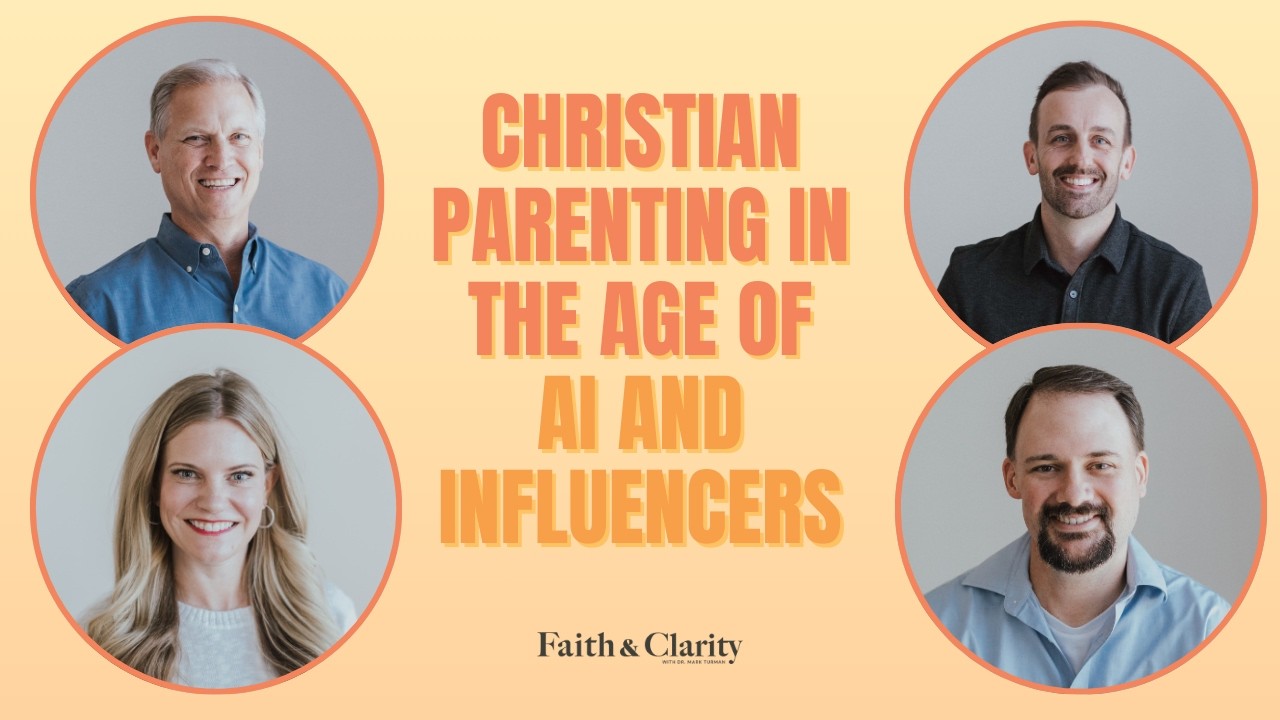
In this episode of Faith & Clarity, Dr. Mark Turman is joined by Stephanie Thurling, Josh Miller, and Dr. Ryan Denison for a timely roundtable on authority, wisdom, and raising kids in a noisy culture shaped by influencers, AI, and declining trust in institutions.
Together, they explore a four-phase parenting framework—caregiver, cop, coach, and consultant—and reflect on how authority is being redefined by authenticity and relatability. The conversation offers practical insight on helping kids discern character and spiritual fruit through a biblical lens, while keeping ultimate trust anchored in God. They also discuss the growing role of AI in teens’ lives, the difference between knowledge and wisdom, and how families can process polarizing news with prayer, humility, and intentional media habits.



Topics
(0:00) Introduction
(1:35) Parenting phases framework
(7:39) Authority crisis and Gen Z
(13:03) Influencers and trust online
(20:38) Information vs. wisdom in the AI age
(28:34) Kids using AI for schoolwork
(33:22) Wisdom beyond information
(37:09) Immigration news and kids
(44:39) Emotions, facts, and Scripture
(48:13) Media diet and guarding hearts
(54:20) Prayer and parenting wrap up
Resources
- Ask Us Anything: [email protected]
- Sign-up for a Denison Forum newsletter: DenisonForum.org/subscribe
- JH Ranch: 4 Phases of Parenting
- Teens, Social Media and AI Chatbots 2025
- The Christian Parenting Podcast
About Stephanie Thurling
Steph Thurling is the host of The Christian Parenting Podcast, and a mom of three amazing kids! Steph has her master’s in youth, family, and culture from Fuller Theological Seminary and has a background in youth and children’s ministry. She is the co-author of Raising Prayerful Kids, a book that shares easy, life-giving, and fun ways to teach kids to pray. She loves helping families grow closer to each other and to God through meaningful experiences and conversations. Steph is a frequent speaker at churches and mom groups and is known for her relatable stories, practical ideas, and gentle encouragement.
About Josh Miller
Josh Miller is the Chief of Staff and Chief Strategy Officer at Denison Ministries. He is also a disciple of Jesus, husband, and father. A Christian leader, author, and songwriter, Josh brings over 20 years of ministry experience, from global worship tours to pastoral leadership. He lives in Plano, Texas with his wife and two sons, fueled by faith, craft coffee, and a love for tacos.
About Dr. Ryan Denison
Ryan Denison, PhD, is the Senior Editor for Theology at Denison Forum and the author of The Focus newsletter, contributing writing and research to many of the ministry’s productions. He holds a PhD in church history from B. H. Carroll Theological Institute and an MDiv from Truett Seminary. Ryan has also taught at B. H. Carroll and Dallas Baptist University. He and his wife, Candice, live in East Texas and have two children.
About Dr. Mark Turman
Dr. Mark Turman serves as the Executive Director of Denison Forum, where he leads with a passion for equipping believers to navigate today’s complex culture with biblical truth. He is best known as the host of the Faith & Clarity podcast and the lead pastor of the Possum Kingdom Lake Chapel, the in-person congregation of Denison Ministries.
Dr. Turman is the coauthor of Sacred Sexuality: Reclaiming God’s Design and Who Am I? What the Bible Says About Identity and Why it Matters. He earned his undergraduate degree from Howard Payne University in Brownwood, Texas, and received his Master of Divinity degree from Southwestern Baptist Theological Seminary in Fort Worth. He later completed his Doctor of Ministry degree at George W. Truett Theological Seminary at Baylor University in Waco.
Before joining Denison Forum, Mark served as a pastor for thirty-five years, including twenty-five years as the founding pastor of Crosspoint Church in McKinney, Texas. Mark and his high school sweetheart, Judi, married in 1986. They are proud parents of two adult children and grandparents to three grandchildren.
About Denison Forum
Denison Forum exists to thoughtfully engage the issues of our day from a biblical perspective, helping believers discern today’s news and culture through the lens of faith. Led by Dr. Jim Denison and a team of contributing writers, we offer trusted insight through The Daily Article, a daily email newsletter and podcast, along with articles, podcasts, interviews, books, and other resources. Together, these form a growing ecosystem of Christ-centered content that equips readers to respond to current events not with fear or partisanship, but with clarity, conviction, and hope. To learn more visit DenisonForum.org.
EPISODE TRANSCRIPT
NOTE: This transcript was AI-generated and has not been fully edited.
Mark Turman: [00:00:01] Welcome to Faith and Clarity. I'm Mark Turman, your host for today's conversation. Uh, we're glad to have you joining us. Today is a round table conversation with some of my friends. We're going to talk about authority, relating to authority, wisdom in a noisy and complex world, and how to have compassion in all of those environments. And we're particularly targeting our conversation today in how we influence the generation and generations behind us, whether we're parents, grandparents, or we simply have the opportunity of influencing others through ministry at church or in other environments. Uh, even if you're not actually a parent or a grandparent, there's still people that are looking to you and can learn from you and that you have significant influence with. And so this is a podcast we think is for everybody. Uh, we hope to give you some handles on helping your kids, grandkids, your friends, uh, to process what's happening in our culture with biblical hope, to help them find clarity and to live by faith and not by fear. So grab a cup of coffee, uh, or your other favorite beverage and let's roll. My uh, guests today are friends and co-workers here at Dennison Ministries. Uh, we have Steph Thurling who leads our Christian parenting ministry, uh, Josh Miller who is our chief of staff and Jack of all trades, I like to call him, and Ryan Dennison who is our senior editor for theology. Guys, say hello this morning.
Stephanie Thurling: [00:01:30] Hello.
Josh Miller: [00:01:31] Morning.
Ryan Denison: [00:01:32] Hi.
Mark Turman: [00:01:33] Glad to have you guys with us. Uh, I wanted to start, uh, with a parenting icebreaker that I learned, uh, just, just so everybody has a context here. I am by far the senior adult presence on this podcast. Uh, so I am a grandfather, 62 and a half years old. Um, and the folks I'm podcasting with are, let's just say they're 40-ish. Um, maybe that's a not so offensive way.
Josh Miller: [00:02:03] Not quite, Mark. Come on now.
Mark Turman: [00:02:04] Not quite.
Stephanie Thurling: [00:02:06] I got a few days.
Mark Turman: [00:02:07] Okay, well, just tell off on yourself. Yeah, tell off on yourself if you want. It's, uh, if it's, if it's not a reality for them, they can see it on the near horizon. Let's put it that way. Um, but, uh, all these guys are parents. Uh, I'm the parent of two and the grandparent of three, which is a whole different deal. But when guys, when I was, uh, at your stage, 25 years or so ago, hard to remember that far back. Um, but a really great friend made it possible for me to take each of my kids to a, uh, very unique Christian camp in Northern California called JH Ranch. And the entire design of the week of camp was to just build, uh, a level of connection between parent and child that would really kind of set a foundation for them going into their teenage years. Uh, one of the things I learned from them is that they approached parenting, uh, along four phases, and I'll give you the phases. They said, phase one is that you're a caregiver or a fireman. Um, that is from birth to kindergarten. You're just trying to meet the basic needs, uh, of this child and keep them out of any severe danger or get them out of danger if they're in it. The second phase starts at about kindergarten and runs to about 13 primarily, which is being a cop or a policeman. Uh, the distinction being firemen are the people that come and help you when you're in trouble. Policemen are the ones that come and help you many times when you are the cause of trouble or somebody around you has been a cause for trouble and you need some assistance. Uh, 13 to 18 or so is what you would call the coaching phase where it's more about teaching, modeling, explaining, and then letting your kids experiment with trial and error and recovery from that. And then the last phase, uh, is that of a consultant when your kids turn 18 or 20 and they have now become adults and you get to be an advisor, you get to offer wisdom, but here's the key, only when you're asked. Um, that's a very unique dynamic at that point. Is that a helpful framework for you guys?
Josh Miller: [00:04:26] Well, being in my 30s still, uh, I can only really speak to a couple of these stages so far. Uh, but I'll, I'll, uh, defer to your wisdom, uh, Mark, as you're entering this senior adult section here.
Mark Turman: [00:04:45] Well, thanks for that.
Stephanie Thurling: [00:04:46] I think it's really helpful. I do. I think I'm two, I got two kids in the cop phase and I got one kid in the coaching phase. And it's the transition between phases that that's really hard in parenting. And I imagine, I have a theory, obviously I'm not there yet, but I do have a feeling a theory that parenting adult kids is one of the hardest seasons of parenting because you have to enter into that consultant phase and I have a lot of opinions that I think are right. So I would love to share them with my kids at all times.
Josh Miller: [00:05:16] Yeah, just like all transitions, what I could speak to is there's a letting go of the previous one in all stages, the way that you used to do things, they they don't work anymore. And so you kind of have to grieve what was, adapt to this next phase and learn that the responsibility, the role that you had, even their your children's perspective towards you is different than it used to be. And so I think it's intentionality in those transitions is certainly really important and recognizing what's different in those new seasons, what do you have to do that's new? What do you have to give up from previous ones that that no longer works anymore?
Ryan Denison: [00:05:54] Both of mine are in the cop policeman stage and one of them's kind of getting creeping up on that coaching stage as well. We're about a year away from that. And so I do think it's helpful, helpful framework in that perspective for just it helps me to think that over the next year I need to be working towards that coaching stage so that maybe she doesn't still need the cop policeman by the time she gets there. Um, but it's helpful kind of just looking ahead to know kind of what we're what I'm supposed to be aspiring to as a parent as well.
Mark Turman: [00:06:23] Yeah, it it it's been really helpful and clarifying for me. Obviously, these things overlap in different ways and, um, you know, if you're, if you're helping your kid pay for college, um, you're not exactly a consultant because you're financially invested, uh, and so that, uh, can bring some opportunity, uh, or responsibility. Uh, but being in the consultant phase now, you know, my kids are 35 and about to be 31. Um, it's an interesting, uh, dynamic. Um, when they start making adult decisions and yeah, Steph, you do have, I have a lot of opinions. Um, and we now have, you know, our own opinions about how my daughter is parenting her kids. Um, and that that always creates conversation, uh, not always easy conversations, but it always creates conversation. And, um, trying to learn that responsibility of what an an adult adult relationship looks like with one of your children that, you know, I think everybody would want that to to blossom into a friendship, um, and not just a a simple family relationship, but at some level, you're always mom and dad, uh, no matter how old everybody gets. Um, and so that's an interesting dynamic, but it's been helpful. Uh, and it kind of sets a little bit of the stage for Steph where we wanted to start talking about, uh, just some of the things going on relative to authority. Some really disturbing stats out there about how people across the board, young and old, have become distrusting of authority and institutions where a lot of authority is vested. Uh, I had a hamburger with a friend of mine recently and I said, why is it that when our kids are young, we're eager to take them and put them in the car and run them over to the fire station and let them crawl all over the fire truck, but you almost never hear of anybody loading up their kids and taking them down to the police station. And he said, well, that's pretty easy. The firemen are the people you call when you're in trouble and the policemen are the ones that show up when you cause trouble. And so the appeal is not exactly the same. Uh, but maybe that's a a field trip that, uh, everybody needs to to plan on when you're in the cop stage or just before that maybe. Uh, but Steph, talk about authority. What did you want to bring up today?
Stephanie Thurling: [00:08:50] Yeah, I wanted to talk about how specifically the next generation, how they view authority because we are, kind of like you said, we're raising kids in a culture that has a deep distrust in authority. Like Gen Z shows historically low trust in institutions like like law enforcement or government and even the media. But at the same time, they love a good influencer and they put a lot of trust there. And so their version of authority has just been redefined and it's not, absolutely not based off of titles and position, but it's based off of perceived authenticity and relatability. So the next generation, they definitely still trust authority and they still respect authority. It's just that blind obedience to authority doesn't come easily for them and it just doesn't really exist. So I think as parents, what that means for us is that helping them learn how to discern who to trust, it feels like a really important discipleship opportunity right now. Um, because we do have the responsibility to help our kids evaluate those influencers and those online voices and even traditional authority figures through a biblical lens. Like like even government figures, like we need to evaluate them through a biblical lens too. And I think that we need to focus, really, really focus as parents on challenging them and ourselves too, because I think we need this as well, but we need to challenge our kids with questions like, why do you trust this person? Like what fruit and what goodness do you see in their life, especially if they claim to follow Jesus. So if you are viewing someone as an authority figure and they claim to follow Jesus, but you are not seeing the fruit of the spirit and you're not seeing integrity and you're not seeing honesty, then maybe that's someone that you shouldn't be trusting. Like no matter how confident or popular or how easy it is to view them as authority. And the tricky part is is that those questions, asking those things about an authority figure is a lot easier when the authority figure is far away, but it's a lot harder when it's someone personal like a coach. But when you take into consideration what Gen Z is going with and what they believe, it's all personal because authority is based off of their perceived authenticity. Like they're placing their personal trust in them because of what they think their character is. And so that makes authority really, really hard when it fails. And so we have to also help our kids process that. You know, like how do we help them process disappointment or distrust without becoming really, really cynical and still being respectful and still valuing authority in their life. Um, and that seems to be a really big disconnect, I think. And it's also a good teaching opportunity to point our kids to scripture and remind them that our ultimate goal is not to put our trust in human authority, but in God's authority. That's what Acts 5:29 says is, you know, we first have to obey men and then God. And so I've just been thinking about this a lot lately. And I guess my thought that I've my question I've been rolling around isn't, do my kids and kids my kids ages respect authority? Because they do. It's just do my kids know how to recognize character and godly leadership when they see it? Because that is the skill that's going to shape their faith for their lifetime and really influence the culture that's around them, which is what we're all about at Christian parenting.
Mark Turman: [00:12:07] Yeah, it's it brings up a question that I I keep wondering about, which is, you know, several times in the scripture they say about Jesus when he finished teaching, he was different. He taught as one with authority. And there was something that people perceived. Um, but that statement is never explained or it never explained the way I would want it to be explained. Um, you know, what what was it that that they perceived that made his authority as a spiritual teacher, what was it that they perceived that they that registered with them? Um, and was it something that they grew to over time? Was it because he was, you know, constantly moving around them and among them and they they could see and know him on a consistent basis. It just interesting to me and I I'd love to get your perspective on this. It just seems like, uh, obviously the internet and the social media generation is willing to give their trust to people that they only know in an online experience and they will never most likely have the opportunity of knowing this person in actual real life, but they seem to be, well, if this person has this many followers, then obviously they must be trustworthy. Is that are you concerned about that? Are you seeing that at all?
Stephanie Thurling: [00:13:32] Yeah, I'm really concerned about it. I mean, I think you can talk about that on totally different levels, but, you know, like you see influencers who are health and fitness like experts, but they're really not. They just did some research on the internet and they're basically telling you everything that's the exact opposite of the medical community. And so you're like, okay, can there be some truth to both sides of this? Maybe, but like where am I going to who's the real authority figure in this? And even just in the parenting world, I think it's so hard to be a parent in general, but specifically a mom when we are seeing an influencer culture take over saying, I'm I'm an expert parent and look at all the things I'm doing with my kids to make them happy and successful and you should be doing these things too when it just doesn't match who you are and you don't even know if it matches who they are, but you see their highlight reel. And so I think that's been really damaging already. And so I can only imagine that it will get harder and harder for people underneath us.
Josh Miller: [00:14:29] The other thing that came to mind here too is the the distinction between what would be formal or sort of involuntary authority, the authority that's put over us that we don't choose versus the voluntary authority, those that we allow in or choose to be an authority figure in our lives. And I think for our kids, it's important to understand the distinction there between those two because if it if you are talking about police or you are talking about maybe the principal of their school, uh, or the people in in government, to some degree, you know, we we don't have a choice in a lot of those things, but we are still God has put those people over us as authority figures that we should respect, uh, and obviously follow rules, laws, regulations, all those things that have been put in place that we need to honor and respect. There's a different way of looking at that than those if we're going to go to a social media figure and we are choosing them to say, I'm going to let that person have authority and influence on my life. We have to pick those a lot more carefully and use a lot more discernment and and just treat that differently where I think if we push that all together into one to one sphere, one category, it could also add confusion for kids to go, what do you mean? I've this person on social media, I didn't give them authority in my life like the principal of my school, but they can still have the same sense of influence and uh affect on our lives in different ways if we're not intentional in in those kind of voluntary authority uh type relationships.
Stephanie Thurling: [00:16:01] Yeah, I think that difference is so hard for kids to understand too.
Josh Miller: [00:16:04] Yeah.
Stephanie Thurling: [00:16:05] Because they just think authority is authority and like I either have a choice or I don't. Like I just think that's so hard. So as parents, we have to walk alongside our kids as they do that too.
Mark Turman: [00:16:13] So have y'all had…
Ryan Denison: [00:16:14] Go ahead, Ryan. Yeah, go ahead. I was just going to say too, if you look at how people get authority when they're influencers, it's because they're entertaining in the way they present themselves and it's because they often are telling you the things you want to hear. And if you look back at kind of going back to like Genesis 3, where Adam and Eve fell, it was because Satan tempted them with the by telling them like, oh, don't worry about God's authority. You can be your own authority. If you eat this fruit, if you know, if you just listen to me, then you will know the difference between good and evil and everything that God is in your life, you can be for yourself. And I think on some level, like I I don't think a lot of the social media influencers are being that overt or even are that bad in that way. But I do think there's something to the idea that when we're choosing our authority based on whose message sounds most appealing, then it becomes really easy to kind of fall into that temptation to believe people that don't deserve our to don't deserve our attention and don't deserve our trust. And so teaching our kids how to pay attention to the content of what they're saying rather than just how it makes us feel or how whether or not we enjoyed listening to it is I think a really important part of this as well.
Mark Turman: [00:17:26] Have you all had experiences with your kids, uh, so far where they were disappointed by somebody that, uh, had authority over them, either, you know, as Josh was talking about, kind of imposed authority that comes from parents, family, school, uh, culture, uh, or, uh, somebody that they accepted as being authoritative in their life. Um, have they, have you had experiences with them working through disappointment and that, hey, no human authority is going to be perfect.
Josh Miller: [00:17:59] It's been personal for me mostly. It's not been a lot of external authority. It's it's been me messing up and and failing as a parent, uh, that I've had had to kind of walk through that conversation with them. And so I'm hoping those are kind of preliminary examples of that of, hey, yep, I messed this up. I should have handled that better. Uh, and I'm flawed, please forgive me and we practice restoration of relationship. Uh, but because of the age of my kids, nine and 11, they haven't quite been disenchanted with external authority figures at this point, but I've certainly given them enough practice, uh, in our family enough to have to work through what that looks like to when expectations of authority figures don't line up with reality and and how do you process that and and in relationships like ours, repair, which is not always the case. And an important call out with external authority figures, there's not real relationship there. And so should you be giving the same level of influence in your life to a person that you actually don't have real relationship with. If there's not a way to have personal restoration in that relationship when something does fall apart there, that that should put that influence and authority in a separate category uh than someone who's close to you that has authority in your life.
Mark Turman: [00:19:20] Yeah, I think it's just really important, right? Of, uh, of helping them understand that, hey, as you get older, particularly, you're not only going to notice more the disappointment of your parents and people that are in your family, but it's likely you're going to have it with a coach or a teacher, um, somebody that is, you know, external to your family. Uh, you may end up, you know, we see this too regularly in our society, right? Where a teacher or a coach, somebody in that world that they live in, uh, does something inappropriate. Those stories seem to be all too often. It happens with pastors in their churches, uh, you know, their youth ministers, those kinds of people. Uh, and they're just they're going to have to get used to the reality that people that they they thought they could trust and should trust in most all cases are sometimes going to be, uh, very flawed and are going to be disappointing to them. But that doesn't mean that you give up completely on all authority and the institution such as the church or the government or the school that holds, kind of is the repository of that authority, um, and is actually the one charged with holding them accountable. Uh, and that's a good thing. That accountability, uh, can be a good thing for all of us. So, yeah, really helpful. Uh, Josh, you wanted to talk a little bit about the difference between knowledge and wisdom and that applies into this conversation as well. Uh, take us down that road.
Josh Miller: [00:20:47] Yeah, I think there's a really good connection here because part a little bit of cause and effect, I'd say is that part of the reason we need to have a conversation about who do you let have authority in your life? How do you deal with, you know, influencers or whoever else who may be wanting to kind of, uh, take authority over your life or give you insight here is that these circles have grown where previously, it wasn't that long ago where your authority or the people who influenced your life was this pretty small circle. It was your close family, maybe your church community, friends. Well, that's just not the same anymore in the age of social media, YouTube, and now as we're getting into the age of, uh, AI, we get information and recommendations, uh, from all over the place in a way that's really hard to vet whether or not that stuff is true, whether or not it is wisdom. Uh, and so I the the thing I wanted to bring up here is just how important it is with our kids for us to to teach them the difference between information and wisdom in this day and age that we're living in. I I saw a stunning fact from Pew Research, uh, the other day and I've been following them pretty closely because I think they have a good pulse on just the change in media and culture. But they're saying that 64% of teens are now using AI chatbots on a regular basis and almost 30% are using that using that every day. And so, you know, the where social media has been the concern, who's, you know, what videos are they watching, who's influencing their decisions, who's influencing where they go, you know, how they, you know, approach life. Uh, now what's happening is kids are just going to to chat GPT and asking those same questions. Uh, and so my concern is as the volume of information goes through the roof that, you know, I could I can literally push a button on my steering wheel in my car right now and ask AI for answers to things. So it used to be my kids would ask some question, didn't know the answer to, oh, I'll Google that when I get home and get back to you. Now I can hit the button, ask AI, AI responds to us. It's just wild to me how easy, you know, easily accessible information is to us right now. But my concern is that our our kids are going to have a harder time differentiating between what is information and what is actually wisdom, not to mention biblical wisdom. And so I think we have to be aware of that as parents and and really helping them understand, hey, just because you saw that from an influencer, just because chat GPT told you that was a good idea, you need to use your discernment. You need to learn how to understand what is just information or advice and what is actually wisdom that would line up with scripture. Uh, one one kind of framework that has been helpful for me. This actually comes from, uh, kind of a business ethics type framework, but it kind of helps differentiate the difference and I think this this is actually helpful to use with kids. Uh, where there's these three categories here. One would be knowledge, so that would be information. That's the first category and that that essentially means what are the facts? And so that's a great thing to to go to AI for, although that's can be wrong as well. Uh, certainly you go to what are the facts from influencers, you're going to get all sorts of wild information there. So, but that's something kind of a safer zone. What are the facts? You can go look for that. The second category is understanding. So you have knowledge and understanding. Understanding is what do the facts mean? So that's the data point up top, then it's what does that mean? Which that starts to already get into some gray category when you're looking to outside influence, whether it's AI or wherever else for interpretation of what does that mean, that can get into some gray category there. But wisdom asks, the third category here, wisdom is, how should I live in light of what I know? So I'm taking all this information in, the facts, what the facts mean, and then then what do I do about it? How do I live in light of that? That's the wisdom. And I think that's the one that's most dangerous to be utilizing, uh, AI, social media influencers, uh, people outside of who you would trust to have biblical wisdom and perspective to try and interpret that, that becomes I think really dangerous. But my concern is if you were going to look at, you know, go back to that Pew study, I think a lot of kids are using it for all three. And we're seeing that in terms of some of the negative outcomes from teens and AI usage. They're not only asking it for information, they're asking it how to live. Uh, and so I think as parents, we need to help our kids understand the difference that I I will encourage my kids when they're a little bit older to learn how to use AI as a tool. I think I don't think you can get away from that in in the future we're heading toward. Uh, so I don't think we should, you know, be scared of that forever, but we do need to learn what it's good for and that this is not the place that we would want to give, going back to the authority, uh, concept. This is not the tool we would want to give authority in our lives to understand how we should live in light of what we know. That should be where we go to scripture, where we go to people who are close in relationship to us, uh, to look for true and obviously to to our church community, all of that kind of stuff. We need to go to those people we can trust to be able to actually help us answer that third question. So, that a lot of words there, curious around how you all have addressed teaching your kids the difference between information and wisdom and and how you're thinking about that in light of kind of how things are changing in the world.
Mark Turman: [00:26:39] Yeah, it made me first wonder when when you, uh, mentioned that stat, made me wonder what are they, what are they asking the chatbots? You know, uh, because I find myself doing that and right now my phone and I are kind of in conflict because if I'm driving down the road and ask, you know, Siri for some, uh, information, a lot of times I'm getting the response of, I'll be glad to tell you when you get through driving. And and I'm like, I'm not, I'm not on my phone, I'm talking to my phone like I would be talking to the person next to me, but, you know, interesting that that's built into the software in some ways. Um, but also reminds me of a book that's a little bit dated now, but was written by Tim Elmore, uh, maybe 20 years ago, maybe not quite that long ago, called Artificial Maturity where, uh, his whole book kind of explores this whole conversation of the difference between knowledge, information and wisdom and that the social media generation, uh, has become very, uh, in in Elmore's terms, has become very, um, confident to the point of being arrogant because they can get facts and some understanding about almost any topic very fast. Whereas they used to have to go through parents or coaches or teachers or pastors, they used to have to go through those people to get that information and they would often get the beginnings of understanding and or wisdom by having to go to those people. But now in an internet world, they can get to it faster than those traditional, uh, authority figures. And it's done two things in Elmore's estimation. It's made them confident to the point of arrogance, but it's also terrified them because the information alone without understanding and without wisdom, without counsel can become terrifying. So, yeah, Steph, you had a thought?
Stephanie Thurling: [00:28:34] Yeah, and I guess this doesn't quite follow the same framework, but I just was thinking it's been really interesting to watch my kids learn how to use AI a little bit. Um, my eighth grader is in algebra. I don't help with math. That's not my thing. So my husband does the math help, but he even he is like has to relearn as he's teaching him what he's studying for school. And so my husband will take a picture of the assignment and ask chat GPT to help him solve it so that he can confirm that he's doing it right. So he's not teaching our son how to do it wrong. And it's really, like Calvin is like, that's cheating. You can't use AI. And Trevor's like, well, I'm if I like me doing this is different than you because I'm trying to teach you and just that is a really gray area that a 13, almost 14 year old brain is having a hard time wrestling with is, well, if you ask chat GPT how to solve this math problem, is that still cheating if you teach me? You know, like there's so there's that wisdom there too of like what's okay, what's not? How do we walk through that ethically with our kids? And that's just what we have to figure out as parents, which is wild to think about because it's not just cheating by looking off your friend's paper anymore. You can cheat with a robot.
Mark Turman: [00:29:46] Yeah.
Ryan Denison: [00:29:47] And I I think one of the things that makes it hard is especially when your kids are young, chat is I think of it more kind of in the writing side of it and because early on like chat GPT is going to write a better paper than my sixth grader is. And so in some ways it's like teaching them that it's more important to do something yourself that the final product may be inferior, but the benefit is doing it yourself. And I think the other side of that too is just as our kids get older and get more and more adept at AI, I mean, personally, I'm kind of a late adopter to this. I'm still weirded out by a lot of it to the extent that I'm trying to figure out where I want to use it, where I don't. Um, but I I could easily see a day coming where my kids are better at it than I am. And at that point, kind of getting back to the authority conversation we we had before, it's like, if your kids ask you a question and it's about a subject they know more about, does that diminish your sense of authority in their eyes? Like, how do you handle that as a parent and not get defensive about it? Um, I that's something I'm still struggling with. Like, do y'all have any thoughts on how to do that well?
Mark Turman: [00:30:56] Well, you know, I think it's, um, a great thing in some ways to be able to say to your kids, especially as they get older and start to come into their teen years, you know, I don't know. Um, one of, one of our big challenges just as human beings, but especially with, uh, younger generations is is getting to the place of where we can be comfortable with that. Um, but helping them to see that there's actually a really kind of a holy, uh, humility that comes out in that. Um, that no person, uh, no matter how significant they may be in a kid's life, no person knows everything. Uh, and it's actually a great thing that they're advancing into some areas of and understanding where, like, hey, I I get this. You know, hey, I am more wired for math than mom or dad, or I am more wired for science, or I am more wired for technology. You know, my my son was 12 or 13 when we started going to him for all of the technology questions. Um, and a week ago, I had to call him and say, hey, I've got this old computer that I need to wipe clean. Can you tell me how it took him 10 minutes to walk me through the whole process? Would have taken me three days to find it on his own, you know. Um, and so it it it actually becomes a a really interesting pivot into the depth of relationship when a parent can say, you know, hey, as as Josh said, hey, I messed up, would y'all forgive me? And you teach them to walk through that kind of dynamic or, hey, I don't know, I don't understand, you seem to grasp this better than I do. Could you kind of work me through it? Because you're modeling for them something that we talk about at Dennison Forum a lot, which is how do we help people think critically, um, in a in a biblical framework? So that when you get down to this issue of understanding and wisdom, that the wisdom is built on the framework of biblical truth, biblical values, um, that are reliable. Um, and so, uh, it's been helpful for me and and the older you get, the more you do this is just, hey, I don't know. How about we either figure it out together or if you're if you're getting an understanding that I am not grasping, you can help me and that strengthens the relationship in a lot of ways.
Speaker 1: [00:33:18] In a world filled with constant headlines and endless noise, believers need more than information. They need biblical discernment. Dennison Forum exists to help Christians think critically, live faithfully, and serve intentionally by filtering today's news through the truth of scripture. This podcast and all of our free resources are part of that mission. Frontline partners make this work possible. Their monthly support helps keep biblical clarity free, accessible, and responsive in a rapidly changing culture. If you believe Christians need trusted, scripture-centered guidance today, I invite you to join us. Visit supportdf.org or click the link in the show notes to become a frontline partner today.
Josh Miller: [00:34:11] Yeah, I think I think you're right on. Humility is the place to start here. You know, there's this, uh, quote attributed to Spurgeon that says, many men know a great deal and are all the greater fools for it. Uh, basically saying there's plenty of, plenty of smart people out there and yet can they can still be foolish. And I think we've all experienced that. We wouldn't none of us would consider ourselves fools or unintelligent, but we've all done foolish things. And so I think that's the the balance there of, yes, we can gain as much information as possible and there's nothing wrong with that, but we have to walk in humility and go before the Lord to learn how to take that knowledge and live faithfully with it. You know, you look at Ephesians 5 and say, you know, uh, five, I think 17 says, therefore, do not be foolish, but understand what the Lord's will is. And so there's this contrast here. The way to get out of foolishness is not to be smarter or to ask AI more questions. It's understanding what the will of the Lord is. And in James, we're told to ask God for that. Ask God for wisdom and he'll give generously. And so I I think that is part of the key. It's not it's not clean, you know, these conversations with our kids to help them navigate every situation's differently, every piece of information's differently, but the more we can help our kids take that information, walk in humility and go before the Lord asking for wisdom, I think we're going to see some a lot better outcomes there.
Stephanie Thurling: [00:35:35] And I think also that humility and recognizing where your authority, where and when your authority changes and shifts a little bit is so valuable in helping, like we were talking about at the beginning of this episode, helping us transition into different phases of parenting. Like you can't transition to the coach if you think you are 100% the authority on every single topic. And you definitely can't transition to the consultant if you can't get there either. And so that that authority all shifts as your kids age and you age and then they get to be the authority over something. And I think that's just a really beautiful thing and kind of how God designed families to work, but it doesn't mean that it's easy at all.
Mark Turman: [00:36:15] Yeah, but it, you know, it can be great when you can, when you can turn to your teenager and say, hey, I'm trying to figure this out. What do you think? And, um, and it's really great if neither of you really understand, but you can start figuring it out together and start using the same sources of information, using AI together and saying, well, hey, now it's me, you and AI. AI just said this, you think that's the right thing or the wrong thing? Um, but, you know, the the goal is to get down to really good biblical answers to that last question is, how should I live? What choice should I now make going forward based on what I've encountered, what I'm worried about, uh, and what I understand about the facts, uh, and the situation. It reminds me of how many times the writers in the church period of the New Testament, particularly Paul, so many of his prayers that he prays for these congregations is that God would give them spiritual understanding. That they would be able to see the facts and that he would give them the ability to properly understand the facts and then to make the best decisions for how they were going to live in the context that they were having. That's that's the ultimate goal that we would have in all of these situations that, you know, James is pretty, you know, as you point that out, James is pretty clear, hey, if you, if you look and learn the truths of God, but then you walk away and don't live them, you're the ultimate fool. Um, because you know and you know better from the perspective of God, you're just choosing not to accept that authority in your life and it's going to end up, uh, bringing some havoc into your life. Um, which can kind of take us into, uh, Ryan, what you wanted to talk about in terms of kind of applying both of these ideas of authority and wisdom into some of the context of what we're experiencing now, particularly around big issues in the news recently about immigration, about the practices of people in authority, whether that's, uh, the immigration, uh, folks, the border patrol folks and some of the things that we've been seeing in the last, uh, couple of weeks. Uh, walk us into that conversation.
Ryan Denison: [00:38:34] Yeah, thank you. It's, uh, we're recording this on February 5th and so we're about two weeks, um, away from when Alex Pretty was shot about a little less than a month away from when Renee Good was killed and as well. And so this is, these are issues that are as we're recording this are still in the news and it's quite possible that by the time this recording comes out, something new will have happened to put it back in the news cycle once again. Um, but I just, what I wanted to talk about about it today is just, I remember last year, um, our kids went to a school that was probably 90% plus Hispanic and it was really interesting hearing the perspectives that they were coming home with, um, from their school versus kind of the things we were seeing in the other areas of our lives. Um, stories from where because I mean for a lot of the people they went to school with, they had relatives that were in fear of deportation, that were living this every day and this issue wasn't just something they were seeing on the news. It was something that was very personal to them. And so talking with our kids about how to process all of that, how to think through the perspectives that are that you get to not lose the human side of it, but to also not let the human side be the only side you think about was really, it was really interesting and helpful for me as a parent to know how to, to think about how do I do this well? Um, how do I talk about this stuff that when she go when our daughter goes to school the next day, she's going to see someone for whom this story, like this is their experience, not just something they saw or talked about on the news. And it really kind of has helped me as I've thought about it over the the last year or so, um, to kind of process the news in a different way than I may have otherwise. And I think that's particularly important, um, with the last two shootings. One of the aspects that I think hasn't gotten as much coverage as it needs is just the impact of the primary way that people are exposed to these stories. Um, so much of the news used to come through either, I mean, a few decades ago, it was you wake up in the morning, read what happened in the paper, maybe see what happened on the morning news and that was your first exposure to it. For the last decade plus, it's been you'd see it when it goes viral online and you'd see just people talking about it over and over and over again. What really stood out about these last two shootings is that for a lot of people, our first exposure was when we saw the video of someone dying. And there is something different about being exposed to the actual event itself as your prime as your first time seeing it, learning about it that changes the way you consume it and changes the way you talk about it because it's almost impossible not to form an instant opinion. Like some of the things we've been talking about on this podcast have been related to how do we, um, whether it's influencers, the other people we give influence in our lives, how do we, you know, measure their authority against the truth of scripture? And I think we're entering in on a day and age where especially for our kids, more and more they're going to be experiencing this stuff for themselves and their first opinion is going to be their own, not what they've received from someone else. And, um, I think especially as we think about these controversial issues like ice, but even beyond that, how do we help our kids kind of learn to measure their own reactions against the truth of scripture as well? Because so much of the focus is and I think well placed on the idea of who are we allowing to have influence in our lives? Who is allowed to have authority in our lives that it's also important to go back and just make sure that we're helping our kids understand that they can't trust their own authority in their lives as well. And teaching them how to do that well, how to and then how to take how to be humble enough to think maybe my first reaction wasn't entirely correct. Because part of what happened with those videos is that neither one of them showed the full story. And it wasn't often until days later when we saw more about what happened and started to learn more of the story than when around that first, but it gets so much harder to change your opinion when you are confident that it's correct. And I think especially with video and especially with the way things are going now, it gets really easy to form a strong opinion quickly. And so what are your thoughts on how we can help our kids do that well? How can we help ourselves do that well and model that well to our children?
Mark Turman: [00:42:46] Yeah, I think it's a really good insight to bring out is just the impact of readily accessible videos that are in many ways, uh, from a time stamp point, uh, almost immediately relevant to the event. Um, you know, I can remember your, uh, your dad, Jim Dennison, who writes the daily article, uh, talked recently about the, uh, 40th anniversary of the Challenger, uh, space shuttle explosion. Uh, I can remember watching that event live. Uh, I was supposed to be in class at graduate school. I chose not to go to class. And so I was watching a little TV and I watched the launch and I watched that disaster happen. And, um, just that experience of seeing something in real time, um, was profound in a way that would have been different if I had watched it three or five hours later on a newscast with somebody, you know, giving me some kind of explanation or experience around it. Um, and like you said, when we watch these videos, um, either live, you know, it takes me back to a few months ago in the reality of the Charlie Cook Cook or Kirk assassination and the very first thing that came out is is very viral, did you see this? Oh, be very careful about watching this video. It's pretty horrific. Um, and there there was a really strong, um, advice coming to me because I didn't see it live. They were like, don't watch it. It's just it's too graphic. So not only from a trauma standpoint, but just from an exposure standpoint. Um, because, you know, we we lived in a world for a long time where we thought, well, a picture doesn't lie or a video doesn't lie. Uh, well, in the world of AI, more and more they can lie, especially as you, uh, get down away from an event, the videos can themselves be changed. But there is, you know, and when we saw in these shootings, we had people that were very concerned and some of them said, hey, I'm glad that we have all this video. It helps us to eventually understand the story better, which is probably true. But I think your point's well taken that the immediate viewing of these events creates a response in us of, well, now I understand it because I saw these videos close at hand. And that's a that's a danger point we need to be aware of.
Stephanie Thurling: [00:45:26] Steph, this is a little bit more relevant to you because of where you live. What's what's some of your thought? We, so my husband and I, we live in Minneapolis and so or right outside of Minneapolis. And so my husband Trevor and I talked a lot about this in a different context in, I mean, in all, we've Minneapolis has been a very interesting place to live. We've talked about it a lot. It's a very small city. So everybody has a connection to everybody in some way. So everything that happens is very personal here. Um, which is unique to somewhere compared to Dallas, a new large city. Um, but I think one of the things that we've talked about is the the place of emotions in situations like this because for us being in a small city, being very connected, I was born and raised here, you know, like it was a very emotional, it still is a very emotional time here. There's a there's a lot to have big, big feelings about. And it's really easy to see a very traumatizing video like the two videos we have or multiple videos we have of these two shootings and get really, really emotional about them. And so we've kind of talked as husband and wife and how do we talk to our kids about this of, yes, feel the emotions. People died. People are, you know, like bad things are happening, okay things are happening. You know, like there's a lot of emotions here. Feel the emotions. But then take your emotions, balance them with the facts, what you know, and then balance them with scripture and let them be a part of your decision making, but not the driving force because our emotions can't really be trusted because they're liars. And so we have to we have to feel them and we have to work through them, but we also really have to take time to look at information that we know is true and scripture and what God says and and base of all of our feelings off of that, not just how we feel in the moment because it's really easy to get carried away with our emotions, especially when something so big is going on.
Mark Turman: [00:47:21] Yeah, it really is, uh, a real call out for us to take a deep breath and to pause. I I'm old enough as a senior member of this conversation to remember that when big things happened like what's happened in Minneapolis in the last number of weeks, a couple of months, um, there there was this sense, you you would hear people constantly saying pending investigation, pending investigation. Um, that in the immediate moment, especially, uh, in these two shootings, um, that there was a lot more going on than one or two or even a half dozen cameras could actually capture. That this situation, these stories actually played out over a longer period of time that contributed a lot of different varying dynamics that ultimately led to these tragedies. Uh, and that's perhaps often the case with really big things that happen and really big tragedies. Um, is that there's usually a larger context. And if we don't slow down from our immediate immediate emotional reaction, Steph, as you point out, if we don't slow down and say, hey, we've got to take some time to understand all of what the facts are here and how they fit together and how one thing led to another, led to another, led to another that ultimately sometimes ends up in a really bad tragedy. Sometimes ends up in a really beautiful, good thing that happens, but that's a that's a way of saying that life is always more complex than what, uh, a 20 second video can show us. Josh, you had a thought?
Josh Miller: [00:49:05] Yeah, I wanted to get just very practical here too because I I think there's just the reality that even as adults, we aren't really equipped emotionally to handle the volume of horrible things that we're watching. Uh, and again, as a symptom of our day and age right now that we see the free, you know, things like this so violent, so visceral, uh, and and that this frequent. Uh, and so I think we're seeing this as a nation, our inability as adults and a society to really process all of this well, uh, just because I don't think we're our bodies and our minds and our hearts aren't meant to really handle all of this. And so I think there's just a practical reality here too that we need to be careful in what we're consuming as adults and also watching that for our kids as well. If we as adults have a hard time processing all of these things, how much more are our kids going to have a hard time reconciling what they're seeing and processing it from an from an emotional level as well. You know, I this time of year, I always kind of read the, uh, atomic habit atomic habits book, uh, this kind of year to kind of reestablish rhythms and things for myself and remind remind myself, uh, what's important and he talks about creating the environment to where you can be successful. You know, not to rely so much on willpower, uh, but create an environment where you can be successful, make it easier on yourself. Uh, and in this context, I think watching what we consume, if we're not careful, we'll create an environment where we make it so difficult for ourselves to live in a healthy way, to to walk in spiritual maturity, to treat people who think differently than us with compassion. We're going to be always stressed, always anxious, always afraid, and we're creating an environment through our consumption habits that makes it really difficult for us to live faithfully in today's culture. And so we end up personalizing all this stuff feels close and personal when it not technically isn't in the same way. These aren't people we know, but we feel like we do. We hear their stories, we watch these videos and all of a sudden, we're being emotionally, you know, we're getting emotionally distraught over these situations and it's happening over and over and over again. And so I just wanted to practically call out that, yes, we need to discern these situations and be very careful about that and have good conversations and all of those things are very true, but to some degree, I think we also need to be very careful in what we're letting in our minds and our hearts to begin with. Uh, to your point around Charlie Kirk, I immediately regretted having seen that video. Uh, I feel I I feel I have emotional reactions to watching the good video or the pretty video. Those I feel them, not just see them. And so for me, I've had to make really intentional decisions to guard my mind and my heart because I it makes it hard on me to be the person I know God's called me to be. And I don't know that he's called me to be emotionally invested in everything that happens in the world. I think when I'm being emotionally invested in a thing across the country, I'm less capable of being emotionally invested in what's happening in my neighborhood or in my families or in my church. And so I think there's some trade-offs thing, trade-offs here that we need to just use some discernment around that there are things that God calls us to be aware of and our hearts in it and us getting in the weeds of how do we fix this situation? And there are some things that we're not being called to speak into every situation or live in the emotional rollercoaster of what's happening in society. And so I think that's important for us as adults, certainly important for our kids. And so in in things like this, I'm also aware of, I'm going to make sure my my kids at their age ages aren't going to see that video, you know, they're not going to see me watching that on my phone. I'm not going to pull up the news on TV, whatever it may be, uh, because that's I don't think that's healthy for them at their age in this context. And so I'm not saying that's the way to do that, but it's something I would at least encourage people to be intentional about and what is the right thing for them to see and know and what are they capable of processing emotionally? What are we going to be able to work through together? Uh, and is this something that God is really calling us to be invested in or is there something else that we should be focused on that's a little closer to home?
Mark Turman: [00:53:39] Yeah, I think it's a really good call out, you know, and it's something that all of us, uh, as adults, but then also adults responsible for others is, you know, what is our, uh, what is it that God wants us to be aware of and alert to on any given day? Um, and like you said, we can't take in everything that's going on in the world. Um, especially because we know that in many ways in the media environment, you know, it is it is the tragic stuff, the the bad stuff that gets the attention. And there's reasons for that. Some of them are are legitimate. Um, but, you know, even the frequency now, uh, when you're watching major news, uh, outlets, you know, it used to be pretty rare, uh, in my experience that they would say, hey, the video we're about to show you is disturbing and you may want to, uh, you may want to make a decision based on that. You almost would never hear that. Maybe once or twice a year, you hear it almost every newscast now. And so making wise decisions about what our own media diet is and particularly the media diet that is coming toward our children at various ages. Uh, that's why some of these movements that we're seeing pick up around, uh, social media and around the restriction of phones and technologies in schools. I think much of that is good as a way of trying to curb the the media diet into something that's more healthy. Ryan, you had a thought?
Ryan Denison: [00:55:13] Yeah, I was just going to say I kind of along the lines of what you're talking about and what y'all have mentioned as well that just starting with prayer is so important now. I think when we're trying to understand issues, but also when we're trying to know how to address them with our kids because I the one of the things that I still don't have a good handle on with issues like this is how do I like how do I address it if I feel like my kids may have already been exposed to it or someone may have talked to them about it? Like when do I bring it up? What do I say and how much of that? And I think just knowing that at the end of the day, so much of that just has to start with God just telling us, like this is what I want you to do. Um, and just kind of go with that. But yeah, I mean, prayer has been, it's been a lifeline for me with this story throughout as I've tried to understand it more and as I've tried to know how to talk about this with our kids, like the conversations that start with prayer go so much better than the ones that don't. And it's just been really affirming, uh, throughout it that that's just what I need to do more often. But yeah.
Mark Turman: [00:56:15] Yeah, really, really helpful. Well, guys, we need to wrap up today. Thanks for the help on these com these topics, really, really important stuff for us as parents to think about, to pray about and to ask God to give us wisdom about. Before we run off, I'm playing around with, uh, a closing feature that I've dubbed for the moment as since you asked. So, uh, you don't have to respond, but I'm going to ask anyway. You can respond if you want to. What are you most looking forward to or dreading in the in the upcoming experience of parenting and influencing others in the younger generation? What are you looking forward to? What are you dreading? Either one or both.
Ryan Denison: [00:57:01] I think for me, what Nobody wants to answer. I'll I'll give it a shot. Um, what I'm looking forward to, I think is, uh, I think I mentioned this on the podcast recently, but just kind of seeing my kids become more and more kind of the person I expect to know the rest of their lives kind of thing, the rest of my life at least. Um, but I'm also kind of dreading that in ways because I'm starting to see things pop up that I'm like, that's that needs to not be a forever quality. Uh, we we got to work on that a little bit. So that's kind of what I'm that's what I'm both looking forward to and dreading is like how to have those conversations and how to do that hopefully well. Um, but it's an honor to get the chance to. It's a privilege of being a parent, I guess, is that you get to help shape another life, but it's also a pretty intimidating responsibility at times.
Stephanie Thurling: [00:57:52] Yeah. I was going to kind of say the same thing in that we have our oldest is going to high school next year and so I feel like I'm just very all of a sudden aware of the fact that we have four more years of super hands-on active parenting with him before he goes off to do whatever his next step is. But I am so looking forward to watching him fly. He's switching schools, he's making, you know, high school's big. Like it's big. This is the time that he's going to really start growing into the man that God wants him to be. And I just cannot wait for that because I think it's the most exciting thing in the whole entire world. But basically exactly what Ryan said, it's like I'm very aware now also that little kids are little problems and big kids are big problems and I am not overly looking forward to the big problems that are going to be coming my way with all of my kids as they get older.
Mark Turman: [00:58:45] Yep. Yep.
Josh Miller: [00:58:48] I'll just I think for me living in Dallas, the thing I'm most scared of is them learning how to drive around here, honestly. That's the that's terrifying here in Dallas. Uh, I'm scared to drive myself, so it's uh, that'll be an interesting one. That's a very uh, close to home. It's getting closer there. But I have enjoyed watching our kids learn how to do things themselves and succeed. And there's failures too, but it's fun to see them take on things that I couldn't have imagined that they would do themselves or attempt that seemed so hard and overwhelming for them at younger ages and now they're like, oh, I got that or I could do that or I'll try it, you know, wouldn't have dared tried it before, but I'll try it now. I I get a kick out of it every time of them taking on something that seemed insurmountable before. Uh, so I there's going to be some pros and cons to that and some some failures to walk through in that as well, but I I love that process walking through that with them.
Mark Turman: [00:59:45] Yeah, and yeah, from from the mature perspective that I have, one of the greatest joys is not just seeing them accomplish it, but seeing the confidence that grows in them because they were able to accomplish something that they know in a not so long time ago, they couldn't do it, but now they can. And when they when they start exploring and discovering something and then they discover how they can engage with it, um, and be successful with it, their confidence grows. And that's a beautiful thing to see as, uh, they start stepping into more and more of these opportunities and discovering the beauty and the wonder of God's world and how they get to be a part of it. That is the fun part of being both a parent and a grandparent. Well, guys, thank you again for being a part of the conversation. Want to thank our audience as well. And, uh, we hope this conversation's been useful to you. Please rate and review us on your podcast platform and we'll see you next time on Faith and Clarity.











 Search