



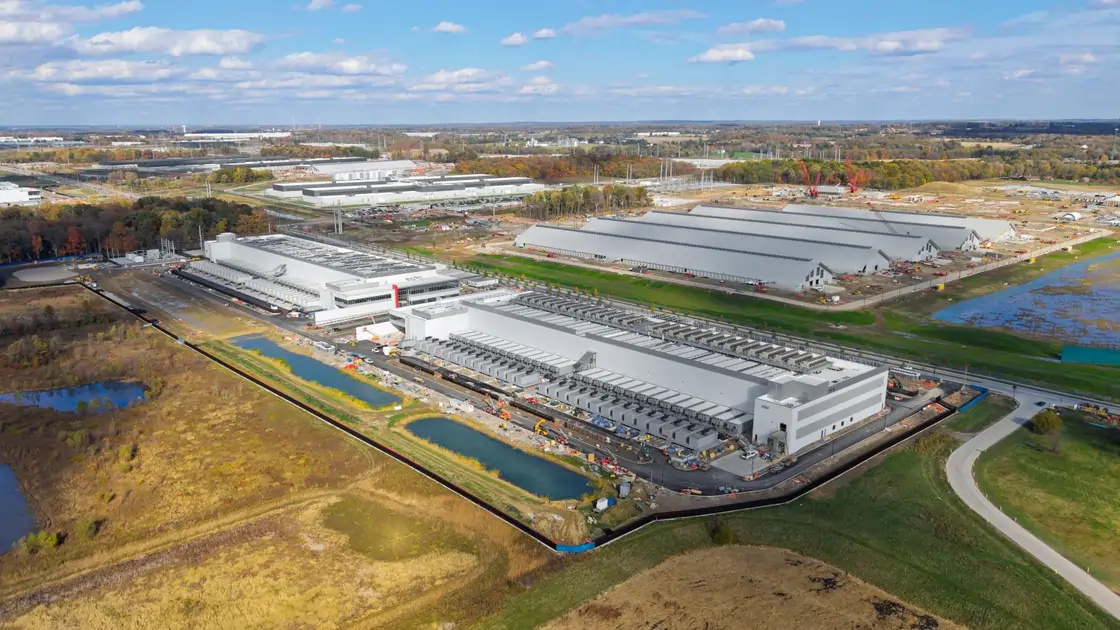
Large data center complex under construction in Ohio By SNEHIT PHOTO/stock.adobe.com
What happened: While the world continues to grow increasingly reliant upon artificial technology, many are becoming disillusioned with the society it’s creating at an even faster pace. Between concerns about the job market, to massive data centers and beyond, AI is quickly becoming an appealing target for the frustrations of those who are starting to feel left behind.
Why it matters: Even though sentiment is quickly turning against AI, most do not feel like they can afford to avoid it. As such, there’s a sense of impotent acceptance that’s becoming the norm among many, despite their concerns. However, the difference between people accepting AI and embracing AI could have a profound impact on the ways in which the technology is integrated into our society going forward.
The backstory: “A collective, ‘This sucks’”
“The only thing growing faster than the artificial-intelligence industry may be Americans’ negative feelings about it.”
That’s how the Wall Street Journal began a recent article examining the shifting dynamics of how many are coming to view the pervasive influence of artificial intelligence on our world. Those who have studied the shift note that “the souring of public opinion is all but unprecedented in its speed.” And the timing couldn’t be worse for those who have already invested billions in the belief that AI is the future.
To be fair, though, they’re probably still right.
Even though an increasingly large percentage of the population doesn’t like AI, few think they can actually stop its progress. Most just hope not to get swept aside in the process. And that particular fear seems most acute among the younger generations.
At the University of Central Florida, for example, recent graduates were treated to a speech by Gloria Gaulfield in which she noted they were entering the workforce at a time of “profound change” before touting AI as “the next industrial revolution.” The students in attendance replied with a chorus of boos that only grew louder as she continued to speak.
Former Google CEO Eric Schmidt received similar treatment at the University of Arizona. Granted, at least some of the negativity levied at him was the result of sexual harassment accusations and a host of other allegations, but the loudest boos were reserved for when he tried to describe all the ways that AI would make their lives better.
And it’s not hard to understand why. The job market for 22–27-year-olds is the worst it’s been since the pandemic, and even Fed Chair Jerome Powell acknowledged that AI is largely to blame. A recent survey found that 43 percent of global CEOs plan to hire fewer junior roles over the next few years, which is roughly twice as many as last year.
As one student explained, the response at graduation was “just sort of like a collective, ‘This sucks.’”
And they’re not the only ones who feel that way.
Are AI data centers worth it?
While college graduates booing commencement speakers is making headlines, the concerted effort across much of rural America to stop big tech companies from building data centers in their midst is a more telling story. As Frannie Block describes, “These data centers are the physical footprint of the artificial-intelligence boom in America.” Companies like Google, Amazon, Meta, and others are planning to invest upwards of $600 billion in AI computing power this year alone, and these data centers are a big part of that equation.
The Tangle offered a very helpful back-and-forth on the reasons why many support building more data centers while others oppose them, and it’s a great resource for understanding the main arguments on both sides.
What the debate often comes down to, though, is that these data centers are essential as AI becomes more integrated into our daily lives, and the current systems are simply not up to the task of meeting those needs. As such, the choice is either to retrofit older centers and rely on other nations to provide the necessary computing power, or to build new ones that are both more efficient and better suited to the required tasks.
Europe is a good example of what can happen when you fall behind that curve, with experts warning that it is in danger of becoming an AI “vassal state” to America if it cannot become more self-reliant in the next two or three years.
At the same time, these data centers are enormous, and so is the quantity of resources they consume. One such proposed site near Pike County, Ohio, is set to encompass 1,700 acres—roughly 1,200 football fields—and include a 9.2-gigawatt natural gas plant to power it. The power plant is an essential part of the construction because the 10-gigawatt data center is expected to require as much energy as all of New York City.
And while these projects will create thousands of jobs for local residents during construction, they will require a fraction of that number to operate once they’re finished. As a result, the economic benefit of their presence is often overstated.
All of that is why Elon Musk and others are looking to move these data centers to space, instead. That may happen eventually—though perhaps not in the two-to-three years he projects—but it feels like we’re still a long way from it being a realistic alternative.
As such, at least for now, we’re left to live in the uncomfortable truth that AI—and everything that comes with it—is becoming increasingly essential, and there’s not much we can do about it. And I suspect that sense of inevitability is where a large percentage of the fear and mistrust is coming from.
Spiritual application: Why do you want a relationship with God?
The idea that you’ll fall behind if you don’t use AI, or that nations will become vassal states if they don’t embrace it, means that many of those who integrate artificial intelligence into their daily lives do so because they feel like they have to rather than because they genuinely want to. Unfortunately, I think many Christians see God in much the same way.
I’ve known many people who follow Jesus more because they don’t want to go to hell than because they are genuinely excited about the prospect of making him the king of their lives. To be honest, there have been many days when that described me as well.
Embracing the prospect of turning the leadership of your life over to a being you can’t see in order to trust that his plan is ultimately best—especially given that he promises that plan will lead to times of persecution and hardship (John 15:20–21)—is a big ask, and it’s not a sin to recognize that fact.
The problem comes when those doubts, or a reluctant submission to his will, become the foundation of our relationship with him. Again, God knows there will be days where that’s how it feels, but he also promises that the blessings of a life fully committed to him will so far outweigh the costs that they are not even worth comparing (Romans 8:18, Philippians 3:7–11).
When you read the Bible, those who know God best are the ones who trust him most. By contrast, it’s the people who evaluate the Lord through the lens of their own desires and weigh the present-day cost of submitting to his will over the bigger picture of all he has in store for them who have the most trouble trusting that his ways truly are best.
I know which of those people I want to be. That doesn’t mean I’ll always succeed or that there won’t be days when that kind of faith feels beyond me. But the doubts don’t have to be the foundation of your walk with the Lord, and he wants to help if you’ll let him.
So, how would you describe your relationship with God today? Have you embraced the opportunity to recognize him as Lord of your life, or does it feel more like resigning yourself to a reality you wish you could change?
God knows your heart and mind, so don’t be afraid to be honest with him. And if the best prayer you can offer today is “I believe, help my unbelief,” then know that request is just as acceptable now as it was nearly two thousand years ago (Mark 9:24).
Praise God for that.
News worth knowing
1. President Trump suspends “major attack” attacks on Iran
President Trump claimed to be “an hour away” from ordering new strikes on Iran when Persian Gulf allies convinced him to hold off. Iran has reportedly sent another peace proposal, though it’s unclear whether it will be any better than its past offers. Either way, the latest announcements from the Oval Office seem more intended to sow confusion than offer real insights into the President’s plans.
Why it matters
The back-and-forth between Iranian and American leaders has yet to yield anything more than time for Iran to recover and rearm. President Trump admitted earlier today that “We may have to give Iran another big hit. I am not sure yet. You will know soon.” Until the attacks resume or Iran makes a legitimate offer to denuclearize, though, it’s unlikely anything will change.
What to watch
Is President Trump’s patience truly beginning to wane, or have his recent threats of renewed attacks been more of a bluff? Will China begin to exert more pressure on Iran to make a deal after last week’s negotiations with the United States?
2. Three killed, along with two suspects, in shooting at a mosque in San Diego
On Monday, three people were killed in a shooting at the Islamic Center of San Diego. Two teenage suspects were found dead by suicide a few blocks away. The Center is the city’s largest mosque and houses the Al Rashid elementary school.
Why it matters
Shootings such as this are a tragedy in any context, but they seem to take on a greater level of social significance when the target is a house of worship. While details are still coming out, the shooting is being investigated as a hate crime, and reports of rhetoric to that end from the deceased shooters are starting to emerge.
What to watch
Will Monday’s shooting prove to be an isolated incident? Will targeting a mosque be an opportunity for unity in the city or the cause of further division? Please pray for the former and for God to redeem this tragedy by using it as an opportunity to help the hurting encounter the love of Christ in the response of his people.
NBC News has more on the story
3. Why a later start time may be the key to better test scores for kids
The decline in test scores for students across age groups in the wake of the Covid pandemic seems to make the news every year around this time. Banning phones was the most recent hope for helping kids to focus better, but the latest data shows that it had little to no impact on test scores (though that doesn’t mean there weren’t other benefits). Now, many are starting to look to the school schedule as an opportunity to help, with many districts proposing later start times to help kids get more sleep.
Why it matters
The importance of sleep has been known for a while, but as most parents of any child older than about eight can attest, getting to bed earlier is consistently a challenge. A recent study found that starting the day thirty minutes later increased test scores by the equivalent of about a third of a year’s worth of learning. While it won’t fix every problem students face, it could be a good place to start, particularly as kids get older.
What to watch
As more districts adopt later start times for kids in Junior High and beyond, it could create problems for families with two working parents, kids at multiple campuses, and a host of other logistical concerns. Will schools and families be able to adapt to those problems, or will the negatives outweigh any benefits to kids’ academic achievement?
God is good
At the “Rededicate 250” rally this past Sunday, several members of the government—including President Trump, VP Vance, DNI Tulsi Gabbard, and others—joined religious leaders across denominations to address thousands gathered to worship at the nation’s capital. Some of the most prominent themes across the event were the need to humble ourselves before God, rededicate both our lives and the country to his leadership, and find our hope in him.
Kingdom impact
While some have pointed out that the event blurs the lines between church and state—and we, at the very least, need to be cognizant of that line—seeing the nation’s leaders point to God and call for America to return to him is a powerful reminder not to let anything take the Lord’s place as our ultimate source of guidance and salvation.
Prayer point
Will you pray that those who gathered in attendance will commit themselves to those principles of humility and dependence on the Lord? Will you pray that the leaders who spoke those words would be equally convicted by them? And will you pray that God will move through his people to help the lost in this nation and beyond turn to him?
Fox News has more on the story









 Search