



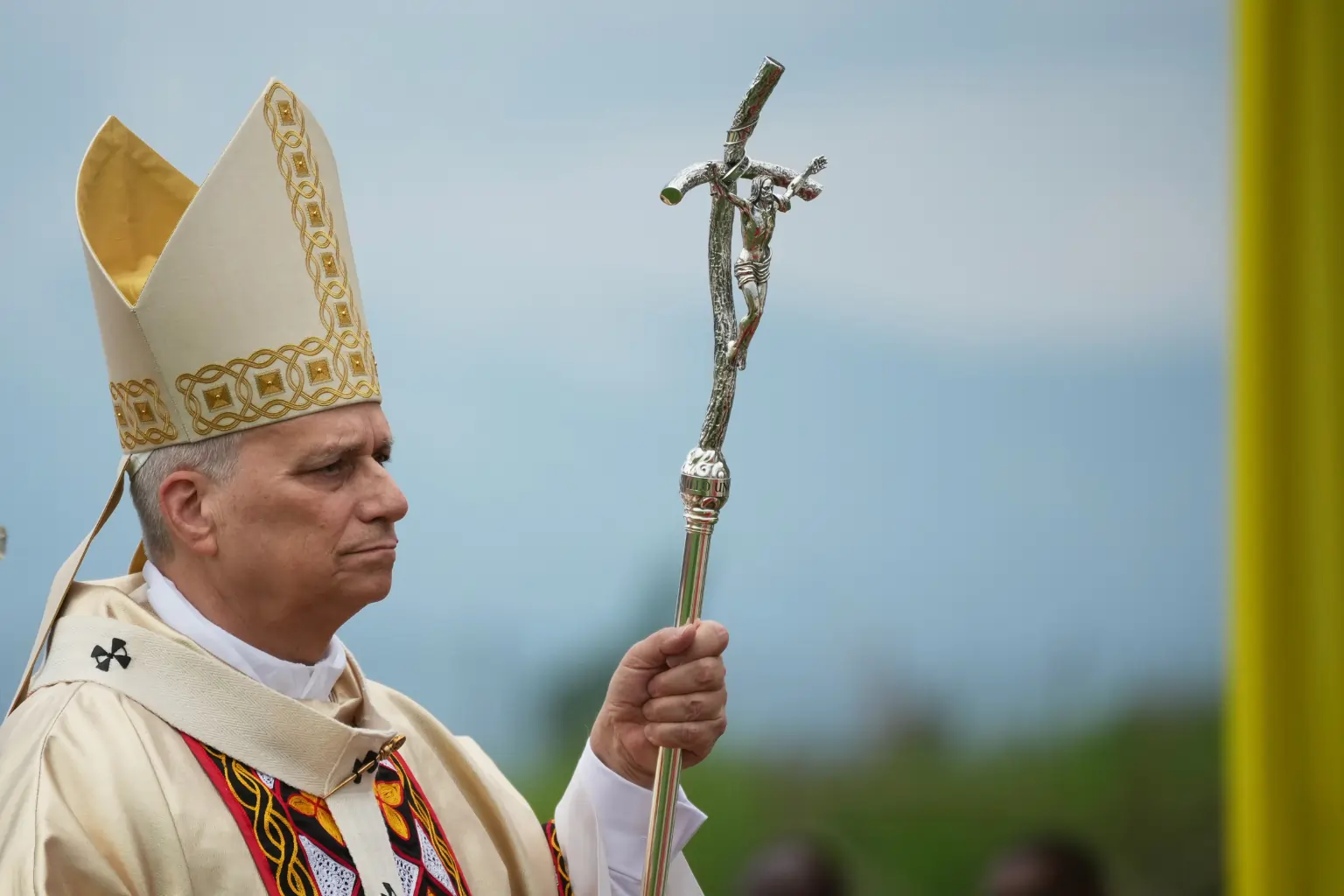
Pope Leo XIV arrives in procession to celebrate a Mass at Bamenda Airport, Cameroon, Thursday, April 16, 2026, on the fourth day of his 11-day pastoral visit to Africa. (AP Photo/Andrew Medichini)


The feud between President Trump and Pope Leo XIV continued on Thursday, when the pope decried that “The world is being ravaged by a handful of tyrants,” in what many took to be a thinly veiled shot at the president. Given that Pope Leo was speaking in Cameroon, where real tyrants have plunged much of Africa into a perpetual state of war, it’s possible that the pope’s comments were intended solely for his immediate context. However, few find that suggestion convincing.
After all, given the extent to which their feud has permeated the larger culture, it would be quite an oversight to say something so potentially incendiary without giving some thought to how others might perceive it. And, at least thus far in his time as pope, Leo does not seem like a man given to that level of oversight.
But how did we reach the point where the leader of the free world and the leader of the world’s largest church are publicly tearing one another down?
While the pope has been a critic of the war in Iran since the first bombs were dropped, his rhetoric took on a new level of force after President Trump threatened to wipe out Iran’s civilian infrastructure and even its entire civilization in the days after Easter. In response, Leo told reporters, “Today, as we all know, there was this threat against the entire people of Iran, and that is truly unacceptable. There are certain issues here of international law, but even more than that, it is a question for the good of the people.”
In response, President Trump called the pontiff “WEAK on crime” and “catering to the Radical Left.”
The pope would later say that followers of Christ should never be “on the side of those who once wielded the sword and today drop bombs.” And while the apostle Paul indicated otherwise when it comes to governments wielding the sword (Romans 13:4), Leo’s message was clear: he believes the war in Iran is unjust and that further violence would be sin.
Is he right?
Is the war just?
I explored this question of whether the war in Iran meets the criteria for how Christians have historically understood a war to be just in a recent article. But the short answer is that we just can’t know, and the reason relates largely to questions about why America is at war with Iran in the first place.
Even before the pope began publicly criticizing the president, complaints about how the Trump administration framed its rationale for the war proliferated across both sides of the aisle. And, at least in this regard, the administration has no one to blame but itself. Far too often, their explanations come across as if they are simply throwing reasons against the wall to see what sticks.
As a result, it’s hard to know with any degree of certainty whether the Trump administration is truly motivated by just principles or if they simply saw an opportunity to strike an enemy they didn’t trust and took it. You could make an argument for either rationale from a political and military perspective. But only the former carries weight from a biblical point of view.
Even if at least parts of the pope’s critiques may be valid, that does not mean his statements were wise. And that is particularly true when paired with the certainty with which they were uttered.
As Ross Douthat—who is a practicing and faithful member of the Catholic Church—points out:
Nothing in Catholic teaching says that popes are free from error about public policy, and the historical record offers copious proof that they make profound mistakes. As such, when popes engage in politicking, it’s not impious for politicians to disagree with them, and such beefs are not inherently liberal and secular and modern. If anything, they’re medieval and extremely “trad.”
Moreover, Pope Leo and many of the bishops who represented him did not act as though he were making a statement on public policy, which is a significant part of the problem.
What is the gospel?
In defending his statements against the response from President Trump, the pope said that he had “no fear with neither the Trump administration, nor speaking out loudly about the message of the Gospel.” Bishop James Massa, who leads the doctrine committee for the US Conference of Catholic Bishops, went even further:
When Pope Leo XIV speaks as supreme pastor of the universal Church, he is not merely offering opinions on theology, he is preaching the Gospel and exercising his ministry as the Vicar of Christ.
When the pope talks about the war in Iran, he’s not talking about the gospel; he’s talking about politics and how Christians should approach the world. Equating the two risks blurring the lines between what a follower of Christ is required to believe and what we are free to debate. Even if you agree with the pope’s stance on the war, losing sight of that distinction is extremely reckless for someone like the pope whose words carry so much weight with billions of people around the world.
There’s a lot more to Christian teaching than just the gospel, but it’s crucial that we keep a clear view of where we should draw that line. The gospel pertains to matters essential to salvation, and whether the war in Iran is just does not come anywhere close to clearing that bar.
Unfortunately, the pope is far from the only person to have ever erred in that regard.
Essential vs important
At its core, the gospel message is simple: believe that Jesus is God, that he died for your sins, and that if you will embrace him as your Lord and Savior, then you will be saved. Yet Scripture talks about a lot more than just how to receive eternal life, and the rest of it is important too. The problem comes when we lose track of that line between important and essential.
If you look at most of the divisions within the church today, you can often trace them back to a time when Christians lost sight of that distinction. Take all the different denominations, for example.
Every church—if it is truly a Christian church—will teach the essentials of the gospel. However, there’s room to disagree on the nature of the Lord’s Supper, baptism, eschatology, and a host of other significant theological issues while still recognizing that we’re all part of God’s family.
And even though the splits that led to many of these denominations may not have come from the most God-honoring of circumstances, the Lord has redeemed them by offering people more opportunities to find a church that best fits how he has wired them.
So long as our differences do not keep us from working together to advance God’s kingdom, then they can stand as examples of the beautiful diversity within the body of Christ. Yet, when we lose sight of what’s essential and begin to allow those beliefs that are merely important to creep up into that category, we give Satan the foothold that he needs to drive a wedge into our communities of faith.
To use the pope’s words, that type of mistake is “truly unacceptable.”
So where are you tempted to cross that line today? Are there any relationships you’ve allowed to fray over beliefs that may be important, but are not essential?
One of Christ’s final requests before going to the cross was that we would be one as he and the Father are one (John 17:11).
How can you be an answer to our Lord’s prayer today?
Quote of the day:
“Here’s the gospel: you’re more sinful than you ever dared believe; you’re more loved than you ever dared hope.” —Tim Keller
Our latest website resources:
- Is the war with Iran just?
- The most moving two minutes of my life
- Interview w/ NASA flight controller on Artemis II, faith in space missions & moon landing conspiracies. Plus quick hits on Iran, Trump, and Rory | Ep. 65
- Are we turning to AI instead of real help for mental health?
- Will the blockade of the Strait of Hormuz lead to peace?











 Search