



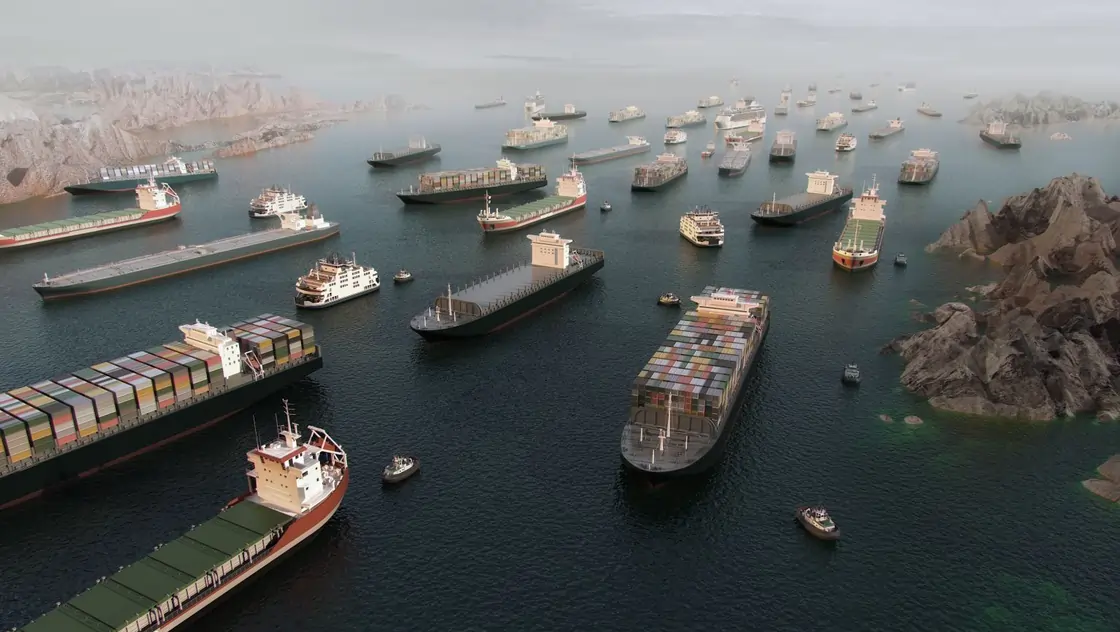
Cargo vessels congestion blocking maritime traffic in the Strait of Hormuz, tankers and container cargo ships clustered. Strategic maritime chokepoint linking the Persian Gulf and and Gulf of Oman 3D By Corona Borealis/stock.adobe.com
The US Navy began a blockade of the Strait of Hormuz in response to failed negotiations from this past weekend. The move was quickly decried by both Iran and China, though it’s unclear if either will take steps to combat it.
Why it matters: The effectiveness of that blockade is, thus far, debatable, and it remains to be seen if the economic pressure from the blockade is enough to force Iran to take a more realistic approach to future negotiations. However, it still marks a notable escalation on the economic front and, coupled with encouraging news from Lebanon, signals a significant shift in the war.
The backstory: A new front in the war
After last weekend’s negotiations with Iran ended without an agreement for peace, President Trump announced that the US Navy would begin a blockade of the Strait of Hormuz on Monday morning. As part of the announcement, the President noted Iran’s refusal to open the Strait—a key condition in the two-week ceasefire that is still, technically, in effect—and declared that Iran’s actions amounted to “WORLD EXTORTION.”
Iran has since called America’s blockade an “act of piracy,” and promised to attack any ships attempting to enforce the order, as well as other ports in the region.
It’s thought that the US will use the blockade as an opportunity to remove the mines that Iran placed in the Strait prior to the ceasefire going into effect. Part of the reason the Strait was not opened to a greater extent is that Iran reportedly does not know where all its mines are, and thus can’t guarantee safe passage, even for its own ships or those of its allies, outside a small strip that it left clear.
But while the blockade is certainly a move away from peace, it does not necessarily mean more bombs are on the way. Rather, it’s more akin to the kind of economic warfare that defined the conflict with Iran prior to February’s attacks.
The move could still cause further escalation in that direction—particularly if Iran attacks any American vessels directly—but the hope seems to be that cutting off one of the Iranian government’s only remaining economic lifelines will force them back to the table for more serious negotiations. And there are signs that progress in that direction could come as soon as this week.
By most accounts, the greatest obstacle to peace remains Iran’s unwillingness to surrender both its nuclear aspirations and the stockpile of roughly 1,000 pounds of enriched uranium that could be used to make as many as eleven bombs. During this past weekend’s negotiations, Iran was willing to suspend its nuclear activities for five years, while the United States insisted on at least twenty.
That remains a fairly large gap to cross—and represents a key distinction between delaying the desire to build a bomb and effectively renouncing it. However, the Iranian position continues to get weaker, and that is true for reasons well beyond the Strait of Hormuz.
“The Arab world has been keeping score”
While the Strait and America’s ensuing blockade have garnered most of the headlines since negotiations ended, another significant development in the war is happening much closer to home. The Lebanese government traveled to Washington earlier today to meet with Israeli officials to discuss the ongoing conflict between Israel’s army and Hezbollah.
Prior to this point, Hezbollah essentially functioned as the real government in Lebanon, with officials largely bowing to whatever the terrorist organization demanded of them. That arrangement is largely why Iran believed an Israeli ceasefire against Hezbollah was included in the initial two-week ceasefire, despite the Lebanese government stating that it “speaks with one voice—its own—and no party has the right to negotiate on its behalf except the Lebanese state.”
Lebanon’s leaders being willing to step out from under the shadow of Hezbollah—and, by extension, Iran—is perhaps the clearest sign yet of Iran’s waning power in the region. Today’s meeting marked the first time in decades that Lebanon and Israel met in official negotiations, and both sides emerged ready to continue those conversations, hoping they will eventually lead to “a comprehensive peace deal.”
For their part, Hezbollah continues to stand against any such treaty and has promised not to abide by whatever agreement the Lebanese government may eventually reach with Israel. But the fact remains that, regardless of how these conversations turn out, they never would have taken place if Iran and its proxies were still considered to pose a real threat. And they’re not alone in coming to that conclusion.
The truth is that much of the Middle East has desired to isolate Iran for decades, and many are relishing the opportunity to do so now. As Zineb Riboua describes:
During Operation Epic Fury, Faiq al-Sheikh Ali, a former member of the Iraqi parliament, stated that “I am Arab. I see humiliation from the Iranians. I do not see any humiliation from any Israeli.” The Arab world had been keeping score for years, and the IRGC had given it no shortage of reasons to reach that judgment.
Unfortunately, though, not every nation has reached the same conclusion.
The cold war continues
At this point, the greatest threat to perpetuating the war with Iran does not come from Iran itself. Rather, China remains committed—at least to some extent—to maintaining its connections with its embattled ally. And while their government is unlikely to intervene directly, they’ve also invested too much in Iran to allow for its complete devastation.
From a strictly economic perspective, as much as 40 percent of China’s oil imports are shipped through the Strait of Hormuz. Moreover, they purchase roughly 80 percent of Iran’s oil exports.
While much of Asia is dependent on Iranian oil, China is particularly vulnerable to an extended shutdown of the Strait. And considering Iran allowed Chinese ships to pass through the waterway during the war, the shift from an Iranian blockade to an American defense could really hurt their economy.
To that end, Chinese President Xi Jinping issued his most forceful statements against the war since it began on Tuesday, calling for peace while attempting to coax other nations into applying pressure on the United States.
It’s difficult to take their denouncements of the fighting too seriously, though, given that China is also preparing to send a shipment of weapons and air defense systems to Iran. The shipment is reported to include shoulder-fired anti-air missiles (MANPADs) that are similar to the Russian-made version that was likely used to shoot down the American plane that left a pilot stranded in enemy territory just before Easter.
So, while both the US and China seem more interested in a cold war than anything direct, calls for peace ring a bit hollow, and the war is likely to continue until either Iran or the United States decides they’re done fighting. Until then, prices will rise, economies will fall—though perhaps not as far or as quickly as many expect—and the people who bear the least responsibility for the conflict will feel the brunt of its impact.
And that same basic principle is true of far more than war.
Spiritual application: Understanding generational sin
One of Satan’s most effective lies is the idea that we are the only ones who will be hurt by our sin. After all, it’s far easier to justify doing what you know to be wrong if you think you’re the only one who will face the consequences. Far too often, though, that’s just not how it works.
The idea of generational sin is frequently discussed in the Old Testament. For example, in the Ten Commandments, God warns that the sin of idolatry will carry consequences that extend down to the third and fourth generations (Exodus 20:5). And the Lord reiterated that warning after the first set of tablets was destroyed (Exodus 34:7).
At the same time, though, he also told the prophet Ezekiel that “The soul who sins shall die. The son shall not suffer for the iniquity of the father, nor the father suffer for the iniquity of the son. The righteousness of the righteous shall be upon himself, and the wickedness of the wicked shall be upon himself” (Ezekiel 18:20).
So how can both of those statements be true, and which is more reflective of your experience?
Particularly in the West, we tend to revolt against the idea that we should be held accountable for anyone else’s sin. And while there are pockets of the culture where that may not be the case, I think we’re right to reject the idea that God would punish us for someone else’s mistake. That basic truth is not what the Lord was trying to help his people understand in Exodus, though.
Instead, God’s warning of generational sin is intended to help us grasp the extent to which our mistakes can echo across the lives of those who come behind us.
Blaming others will not be an option
For the parents among us, the easiest path for our children to follow is the one we leave behind. When that path leads to the Lord, we are imparting a generational blessing. When it leads away from the Lord, we’re paving the road to destruction.
And the same basic principle applies to every person over whom we have some degree of influence. Whether it’s friends, colleagues, neighbors, or even those who just know us by reputation or association, we all have people in our lives who are impacted when we sin.
The main difference from the war in Iran, though, is that we have far greater control over how we will respond.
No one else’s sin, regardless of how much it hurts us, is ever an excuse for us to sin in turn. When God spoke of the generational impact of our mistakes, he was not absolving those future generations of their responsibility to break the cycle. After all, he’s given us everything we need through the grace of Christ and the power of the Holy Spirit to resist temptation and find freedom from the mistakes of those who came before us.
God never promises that breaking these cycles will be easy. But he’s also clear that, when we stand before his throne one day, blaming others will not be an option (Matthew 12:36–37).
And if it’s not going to be an option then, it shouldn’t be an option now.
Where is that truth relevant to your life today?
News worth knowing
1. Home of Sam Altman, CEO of OpenAI, attacked
A 20-year-old man threw a firebomb at the home of OpenAI CEO Sam Altman on Friday morning. He was later captured after attempting to set fire to the company’s headquarters. The attacker was carrying a list of other AI CEOs at the time of his arrest.
Why it matters
The assailant’s social media accounts and a manifesto he was carrying during the attacks describe fears about the existential risks of AI. While it would be easy to disregard his actions as those of a madman—which would not be an inaccurate description—the truth is that a growing percent of the population holds negative views about where the future of AI is headed. That many in the AI community—including Altman himself—have sounded the alarm suggests that these kinds of threats may become more common in the future.
What to watch
Will the rhetoric of existential dread and blame placed at the feet of industry leaders change in the wake of the attacks on Altman? Will other prominent figures be targeted in the future? Please take a moment to pray for both discernment on the part of industry leaders and protection for them and their families in the wake of this attack.
The Washington Post has more on the story
2. Eric Swalwell and Tony Gonzales to leave Congress amid scandal
Representatives Eric Swalwell (D-Calif.) and Tony Gonzales (R-Texas) both announced yesterday that they would leave Congress. Both faced potential expulsion votes later this week and chose to leave before that came to pass. Swalwell also announced that he would no longer run for governor of California, a race he was favored to win.
Why this matters:
Swalwell was accused of sexual assault and misconduct, while Gonzales already admitted to having an affair with an aide, who later took her own life. While neither was running for re-election, the dual resignations kept the balance in the House of Representatives the same, which was a key emphasis for leaders of both parties.
What to watch:
The House Ethics Committee is scheduled to hold a sanction hearing for Rep. Sheila Cherfilus-McCormick (D-Florida) next week, while Rep. Cory Mills (R-Florida) is also facing a possible expulsion. Will House leaders insist on a similar one-for-one or take the novel approach of passing judgment based on the individual circumstances of each case?
Punchbowl News has more on the story
3. You probably need more sleep
A recent study found that consistently getting six hours of sleep or less resulted in “significant cumulative, dose-dependent deficits in cognitive performance on all tasks.” The impact of getting six hours or less for two weeks was equivalent to staying awake for 48 hours. Most importantly, participants in the study were largely unaware of the impact.
Why it matters
Almost three-quarters of American adults get no more than seven hours of sleep each night, with 20 percent getting five hours or less. While the idea that a fifth of the population is cognitively impaired because of how little they sleep could explain a good bit about the state of our culture, the truth is that most of us underestimate how important sleep is and overestimate our ability to function without it.
What to watch
Let’s start by watching the clock. Does anything need to change in your routine to help you sleep more? Are you willing to make those changes? And if you think this doesn’t apply to you, that’s perhaps the biggest sign that it does.
God is good
Last May, a vicar at St. Thomas Church in Aldridge, Walsall (part of the West Midlands region in England) made what he calls “a ridiculous video” for TikTok offering free Bibles to anyone who asked. While he didn’t expect the offer to amount to much, he woke up the next morning with more than 500 requests. He’s since delivered more than 3,140 free Bibles.
Kingdom impact
The vicar, Reverend David Sims, has received requests from as far as Asia and Africa, in addition to those closer to home in England. And while finances make it difficult to send Bibles abroad, he tries to connect those who reach out with a local church where they can find what they need.
Prayer point
When asked why he makes his videos, Sims replied: “I go on there shamelessly to plug Jesus.” Will you pray that God continues to bless that goal and that the Lord uses each of those Bibles to draw people closer to himself?









 Search