




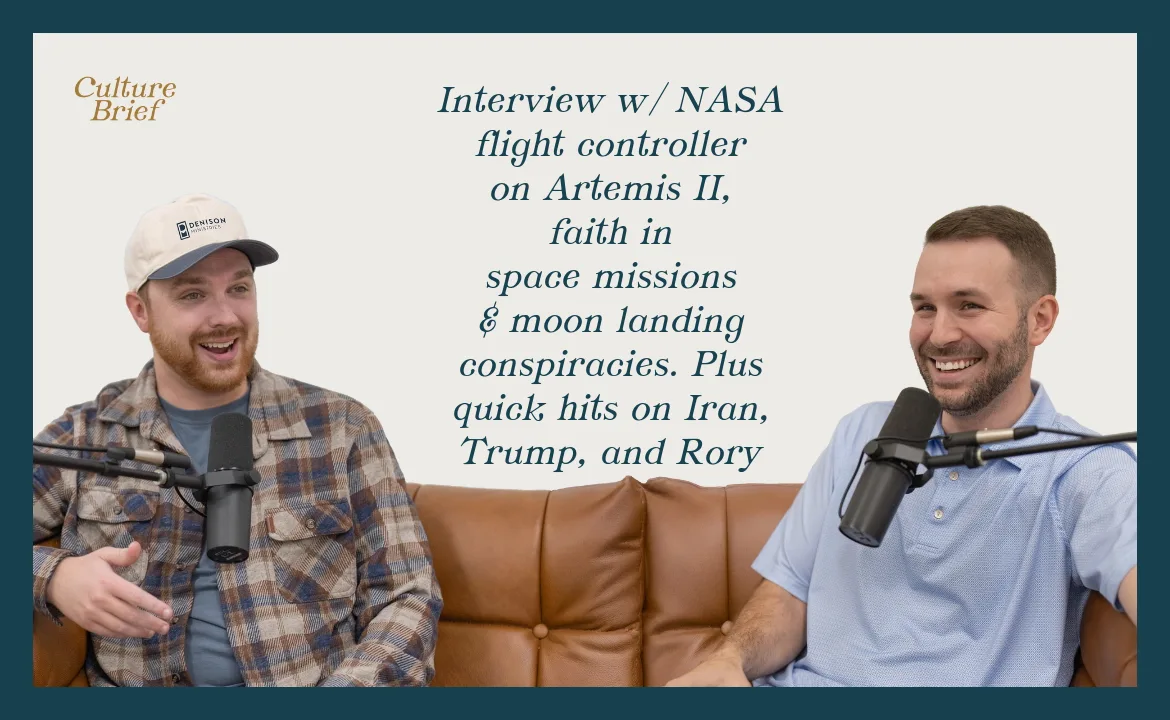
Culture Brief: Interview w/ NASA flight controller on Artemis II, faith in space missions & moon landing conspiracies. Plus quick hits on Iran, Trump, and Rory | Ep. 65
In this week's Brief: We look at the failed Iran negotiations, Trump's naval blockade of the Strait of Hormuz, Trump's controversial posts attacking the Pope and posting an AI image of himself as Jesus, and why our true guiding light is neither a president nor a Pope—it's Jesus. Plus Rory McIlroy won his second Masters in row!
Then we sit down with Zach Huffaker, a mission control flight controller at NASA's Johnson Space Center who helped lead the crew safety team for the Artemis II mission that just returned from orbiting the moon! Zach gives us an insider's look at what it's actually like to sit at the console responsible for keeping astronauts alive hundreds of thousands of miles from Earth and tells us what’s next for the Artemis program and future space exploration. And of course we asked his thoughts on if the original moon landings were faked. He also shares how faith sustains him under immense pressure and why looking at Earth from space deepens his awe of God's creation.



Topics
- (0:00) Introduction
- (2:22) Iran talks and blockade
- (6:01) Trump versus the pope
- (7:34) AI Jesus image backlash
- (12:38) Spiritual perspective reset
- (13:45) Masters weekend recap
- (16:01) NBA playoffs tune in
- (17:02) Meet NASA’s Zach Huffaker
- (22:57) Stress and faith in control
- (25:37) Why space exploration matters
- (28:47) Artemis program goals
- (31:22) Boots 2028 plan
- (35:59) Faith from orbit
- (41:01) Moon landing conspiracies
- (51:39) Best space movies
- (55:16) Final reflections and farewell
Resources
- Send us your thoughts, questions, and topic ideas: [email protected]
- Culture Brief Instagram
- Watch on Youtube
- Sign-up for a Denison Forum newsletter: DenisonForum.org/subscribe
Articles on this week’s top headlines:
- Orbán’s 16-year rule over Hungary ends in crushing election defeat
- Why the Vatican and the White House Are on the Outs
- Zach Huffaker’s Instagram
About Zach Huffaker
Zach serves as an Emergency, Environmental, and Consumables Manager (EECOM) flight controller for NASA’s Artemis program at Johnson Space Center’s Mission Control Center, where he also led the EECOM team for Artemis II. Previously, he supported the International Space Station in a similar role, holding several technical leadership positions before transitioning fully to Artemis in 2025.
He holds a Bachelor of Science in Mechanical Engineering from John Brown University and an MBA from the University of Houston–Clear Lake. Zach and his wife of nearly eight years have three young children and are active members of OneLife Church in Webster, Texas, where they host a community group in their home.
About Conner Jones
Conner Jones is the Director of Performance Marketing at Denison Ministries and Co-Hosts Denison Forum’s “Culture Brief” podcast. He graduated from Dallas Baptist University in 2019 with a degree in Business Management. Conner passionately follows politics, sports, pop-culture, entertainment, and current events. He enjoys fishing, movie-going, and traveling the world with his wife and son.
About Micah Tomasella
Micah Tomasella is the Director of Advancement at Denison Ministries and co-hosts Denison Forum’s “Culture Brief” podcast. A graduate of Dallas Baptist University, Micah is married to Emily, and together they are the proud parents of two daughters. With an extensive background in nonprofit work, finance, and real estate, Micah also brings experience from his years in pastoral church ministry.
About Denison Forum
Denison Forum exists to thoughtfully engage the issues of the day from a biblical perspective through The Daily Article email newsletter and podcast, the Faith & Clarity podcast, as well as many books and additional resources.
EPISODE TRANSCRIPT
NOTE: This transcript was AI-generated and has not been fully edited.
Connor Jones: [00:00:03] Hi, I’m Connor Jones.
Micah Tomasella: [00:00:04] I’m Micah Tomasella.
Connor Jones: [00:00:06] And this is Culture Brief, a Denson Forum podcast where we are navigating the constant stream of top stories and news, politics, sports, pop culture, and today, science and tech for sure. We’ll explain more here in just a second. But Micah, I just got to say with Justin Bieber at the face of as the face of Coachella this year, Rory McIlroy winning the Masters, I think, I think it feels like 2014 all over again. Uh, these two guys are at the front of of culture again.
Micah Tomasella: [00:00:30] Yeah, these guys just won’t go away. They’re just a little bit older and a little bit grayer and they’re still just as good or even better at their craft. I’m a big fan of Justin Bieber and I’m somewhat of a fan of Rory, but we could get into that later. All right, so we’re going to be breaking down several things. The first thing we’re going to talk about is JD Vance’s brutal weekend and everything happening with the negotiations with Iran, everything happening in the straight of Hormuz. We’ll give you a quick update on all of that. And then we have a special guest on today. His name is Zach and he is a part of mission control at NASA and was a big part of what happened with the Artemis launch. Uh, and we’re going to be able to interview him and get really a bird’s eye view, an insider’s view of everything that happened with that space mission. And we’re super excited to have him join us today. And then we’ll give you a few things to tune into. So let’s jump into the brief.
Connor Jones: [01:19] The brief. All right, yeah, like you said, JD Vance, our vice president has had a brutal weekend and I’m going to lay out three reasons why. And I’m going to do them pretty quickly because we got a lot to do in this episode. So number one, JD went to Hungary. He was sent and dispatched by Donald Trump to go to the nation of Hungary to support Donald Trump’s great friend, Prime Minister Viktor Orban there in Hungary. This is a nation of 10 million people, but Viktor Orban has been somebody who Trump has aligned with since 2016. I mean, he’s been in power for a long time over in Hungary. They see a lot of the things in politics the same way. They have eye to eye views on immigration, on Christianity and politics, on the judiciary, on fake media, all of that. And so Trump wanted Victor Orban to win his elections this past weekend. So he sent Vance over last week to go support him, show that the US is behind him. And Orban got absolutely obliterated in the election. And so it kind of just looks bad on it’s not a great look for like, hey, we sent Vance over to support this and then he got just obliterated. The people really voted him out. Um, second, Vance was dispatched by Trump again this past weekend to Pakistan to uh start negotiations with the Iranian side of everything with this war going on. Vance was the man that Trump picked. It’s also the man that the Iranians requested because they have started to not want to negotiate with Steve Witkoff and Jared Kushner, who is typically who Trump would send over. So they requested to speak to Vance and to have him be the face of the American negotiations. This was a big moment for Vance. He had the opportunity to go and like secure a deal. I think this could have been great political capital for him, but instead, a deal was not reached at all and he ended up leaving Pakistan with nothing in hand. Um, in fact, we’re not even sure if the talks continued are are going to continue. It’s kind of unknown right now. So ultimately, Trump had to say, we’re going to start a blockade. We started a naval blockade, the US did, over in the straight of Hormuz, blockading any maritime traffic entering or exiting Iranian ports. Um, so that’s not entirely Vance’s fault. They’re dealing with these hardline people in Iran, these leaders who have somehow survived to this point and they have their hardline stances and they’re saying we’re not going to give up our nuclear enrichment and that is what Trump is demanding. Um, but nonetheless, that’s for JD Vance, like he had an opportunity, it did not work out as well as obviously he or many people would have wanted. We were all hoping, we’re still hoping and praying for a complete peace deal, a total ceasefire, not just this two-week thing. Last week we said we weren’t sure what was going to happen on Tuesday night. Let up to 8:00 p.m. right beforehand, uh a deal was reached for a ceasefire for two weeks, which was the best case scenario there, I think. Um and hopefully we can get a a long-term ceasefire deal. Micah, quick thoughts on these points so far.
Micah Tomasella: [04:01] Uh, yeah, it’s tough because I mean, uh, Vance, I can almost guarantee you didn’t want this war to begin with. Right. Uh, he I mean, once he’s out doing his own thing, not under Trump’s shadow, you know, I’m sure there’s going to be some books he’s going to write and some things that he’ll say in the future, but right now he’s going to be a good soldier and trot on, but I just know for I know for a fact, just like on everything Vance started his political career with and just who he is, he did not want this Iran war from the beginning. And but I mean, you know, he’s doing what he’s told and he’s fighting the good fight. And ultimately, I know that a new agreement has been sent over to Iran. Obviously, uh, the US had multiple options. They’re choosing the basically choking off Iran’s economy to get them back to come, you know, get them to come back to the negotiating table, which personally, I like better than sending boots on the ground. Uh, I’m just hoping that it yields a a quicker deal so that there can be a deal that’s reached before this two-week ceasefire is up. I think there’s like a week left. And so hopefully, prayerfully, like you said, something more final can come from this. I think they’re calling this the Islamabad Accords or something like that or, you know, um, so we’ll see, we’ll see what comes from it.
Connor Jones: [05:15] Yeah, I I do hope there’s peace. You’re right. JD has been uh secretly or not so secretly, I guess just more quietly opposed to the war. Well, he was totally opposed and then the last year because he, you know, Trump has kind of 180 on some of this stuff. Yeah, he wants these strikes. He kind of quiet. Yeah, once the strike started, he kind of like took a back seat. He was like, I don’t really want to be associated with this. I am by by relation because I’m the vice president. Like I I I am. And JD likes to talk. And so the fact that he just kind of hasn’t been is interesting to me. Yeah. But that’s also why the Iranians wanted him. They were like, this is the guy in the administration who does not want this war to continue on. We want to talk to him and find a way to end this, right? Um, the third thing. You don’t want to talk to Rubio. Rubio likes to lay the hammer. Rubio, they’re scared of Rubio. I’ll tell you that. Oh man. Yeah, for sure. The other thing with JD Vance, he is Catholic. And so on his way home, he probably saw that Donald Trump posted this just big tirade against the Pope. And if you saw this post, you saw Trump just attack and attack and attack the Pope. Um, specifically on this Truth Social post, he said, Pope Leo is weak on crime, a terrible person for foreign policy. I don’t want a Pope who thinks it’s okay for Iran to have a nuclear weapon. He wasn’t on any list to be Pope and was only put there by the church because he was an American. And they thought that would be the best way to deal with President Donald J. Trump. If I wasn’t in the White House, Leo wouldn’t be in the Vatican. Uh, that’s a very Oh. very personal, selfish way to see the Pope’s position. Uh, I don’t think Donald Trump is the reason that Pope Leo was selected as the Pope, even though he is the first American Pope. I don’t think that was I I mean, I wasn’t in the room. Nobody was in the room during the conclave to select the next Pope, but I imagine that’s not the case. Um, nonetheless, they are arguing this didn’t completely come out of nowhere. Uh, Pope Leo has been very outspoken about the way we should treat immigrants, the way we should not cause wars, we should seek out peace. And so Trump has felt like these passive aggressive statements were made towards him specifically. The Pope has clarified that they were not towards anybody specifically, but who knows. Um, this also probably didn’t come out of nowhere because Trump was apparently watching the Masters on Sunday night, which led directly into afterwards a 60 minutes interview with a bunch of cardinals who were basically speaking out against Trump’s policies. So then about 30 minutes later, you got this long post attacking the Pope. So not completely out of nowhere. Um, the other thing that Trump posted after that was a picture and I I want your thoughts here, Micah on this of himself donning a robe and uh like a red thing around his shoulder. It kind of makes him look like he’s Jesus putting his hand on a man, a sick man’s head and healing him. Uh some sort of figures in the background, demon-like situation, American flags in there. Basically, a lot of people took it as he’s depicting himself as Jesus. This is right after the Pope post. Um, he’s he’s come out and he said, yeah, I did post that, but I I thought I was I saw it as me just as a doctor, like I worked for the Red Cross. That’s been his explanation. Micah, just initial thoughts on this AI generated. You can give me your thoughts. Well, my thoughts are, if he’s depicting himself as Jesus, that is uh, I would say sacrilegious. I can’t know his full mind and heart uh behind that post. I don’t know what he actually thought in the moment when he posted it. Maybe he came up with this explanation afterwards and was like, oh, I made a mistake. He knew he made a mistake because he deleted the post on Monday. He posted it Sunday night. By Monday morning, the post was deleted and gone because it caused quite an uproar. A lot of Christians came out of like, whoa, whoa, whoa, whoa, whoa. That that’s that is too far. You have taken it way too far. You cannot depict yourself as Jesus. You are not Jesus. You’re not even close. Like I completely, I completely agree with you and I think, uh, that almost just goes without saying, uh, just how crazy that post was, but I would even say beyond that, like he’s got to find a way to if if he wants to keep his coalition together, he’s got to he’s got to figure some things out, right? Because all the anti-war people are mad at him. A large voting block of yours, uh, people with faith are frustrated with you. I mean, the amount of people I have seen on the right who have never attacked Trump publicly came out very strongly after that photo. Uh, he did delete it. He he doesn’t delete things lightly, but uh, yeah, man, I that I don’t didn’t see one person just agreeing with that. That was pretty much resolute. Uh, he got slammed for that one. Yeah, he he’s caused an uproar among both sides, which is uh kind of crazy. He caused such an uproar that the Iranian side sided with the Pope. Uh, their their president over there in Iran posted this tweet was like, we stand with you, Pope Leo as the blah, blah, blah, like which he’s got his own reasons, right? But like he saw an opportunity where Trump was looking weak and was like, I’m going to I’m going to support the Pope in this. Okay. Um, we’ll take that. Sure. All right. Back to the Catholic. Okay. Back to the Catholic post here real fast. I just want to point out something that the Free Press put together. They had an article. It was actually came out last week. This is before the Pope post by Trump on Sunday. But the article’s titled, why the Vatican and the White House are on the outs. And in it, it said, one might wonder why a government that has no apparent qualms about bombing foreign countries and capturing or killing tyrants would bother to try to court or demand the Vatican’s favor. The answer lies in something easy to overlook. The Catholic Church is perhaps the only remaining global institution perceived to carry genuine moral authority. The Holy See, for all its imperfections and scandals, remains a body whose credibility the American superpower seeks. They know that Leo’s blessing, or at least his silence, would confer a kind of moral legitimacy that no amount of power can manufacture on its own. And it also points out in this article four ways that Catholicism is a dominant force in conservative politics. One of those is JD Vance and Secretary of State Marco Rubio are both Catholic. Those are basically the two most powerful men outside of Donald Trump. Very very committed Catholics. Very committed Catholics. Number two is the Supreme Court has a Catholic super majority. Number three is 53 million Americans identify as Catholic, which makes up 20% of the electorate. Unbelievable. And Trump, number four here, Trump won the majority of that Catholic vote in 2024. So alienating the Pope, doing this uh Jesus type of picture, uh the Pope specifically might alienate the Catholics. The Jesus picture alienated everybody in the Christian like faith, right? So, um and we can there’s a whole lot we could dive into on the difference. I appreciate you sharing that part because I, you know, we’re not Catholic and so I I think sometimes I can kind of overlook um the Pope and the Catholic faith and just the the the absolute impact and uh favor they have all over the world, just the what what word am I looking for? Um, I mean, they’re beloved by many people. There’s a billion Catholics on this planet. Influence. Influence. You know, we’re here in the Bible belt, you know, more Protestant, Baptist, you know, around here, but there’s still a large Catholic influence, but to mean you can just almost overlook how much the Pope the Pope’s words mean to so many people. So thank you for that explanation. Yeah, well, and JD Vance and Marco Rubio met the new Pope last year right after he was elected in the conclave. They went over to meet him at the Vatican. And so there is a relationship there with those two at least. And so and they’re, you know, we’ll see what happens in the next coming years. I just want to give a quick spiritual perspective before we dive into our interview here in a minute. Um, man, when we’re talking about the president, when we’re talking about the Pope, I think it’s important for us to remember that our true guiding light is neither one of those positions. It’s also not an institution. It’s not the church. Like that that statement was saying like, yeah, the Catholic Church holds this weight of moral authority for a lot of people, but ultimately, an institution and a church, it could be the Southern Baptist, it could be the Catholics, it could be any religion, they are not the true guiding light, right? It is our Lord and Savior, Jesus Christ. John 1 John 1:5 says, this is the message we have heard from him and proclaimed to you that God is light and in him is no darkness at all. That is our guiding light. Not an AI image, not a president, not a Pope, a prime minister, nobody in power. It’s Jesus. He’s the one in power. Everyone else is a fallen man. So we just have to remember that as we go into this upcoming week and you’re seeing all this stuff about these posts and all this fighting and infighting and all that. And and also consider just take a step back and remember the gospel is more important than all of this. Amen.
Micah Tomasella: [13:41] Yeah, let’s do check in. So, all right, Connor, uh, we just got done with Masters weekend. And what a beautiful and special weekend it was. Rory McIlroy, the man from Northern Ireland, took home the green jacket again at the 2026 Masters, winning his second straight at Augusta and cementing a historic back-to-back run, something only a few legends have ever done. I think he was the fourth one to ever do it. The last one to do it was Tiger in the early 2000s. So, wonderful company he’s in. The weekend had a little bit of everything. He built an early lead. He was up six strokes going into the third day. That’s a lot, y’all. Like it was hard to believe this was even going to be a competitive weekend of golf. Um, but he stumbled on Saturday and then he just kind of played well enough on Sunday to hold off any late charges, finished 12 under, a great score. But honestly, the story wasn’t just golf, it was the it was the emotion, right? Like at the end, like you love that moment because at the Masters, everybody there doesn’t have phones. Everybody’s in the moment together because the Masters doesn’t allow phones in, right? And so you see all these photos and all the fans are just totally in the moment, totally celebrating, all of that stuff, right? And so what uh what we saw here is we saw Rory celebrate with his wife, with his daughter, with his parents who sacrificed so much if you know that story so that he could get to where he is today. Um, he got choked up in his speech and he won four and a half million dollars. So good for you, Rory. Just a quick uh update here. Um, Cameron Young and Justin Rose, Connor and I’s picks to win, tied at 10 under. They tied for third at 10 under, two strokes behind Rory. So what you could say is is that Connor and I both made good picks and equally good picks. Uh, because we didn’t necessarily pick the absolute front runners, like we were trying to be a little bit dark horse with our picks and we brought up and we picked two people who finished third, two strokes behind. I’m proud of us, Connor. They both led at one point too. They both had a chance to win it and they they kind of melted down and Rory did not and Rory came in and won. So good for Rory, two masters in a row after a 10-year drought. Um, that is just impressive and uh good for him, man, even though he is debated as a favorite among golfers or not so favorite because of his emotions and the way he acts about some things. Nonetheless, it’s impressive. All right, Micah, uh the NBA playoffs are this weekend as well. Or I guess they start this week, right? On what day? Yeah, the plan is this week. So just that’s our tune in for today. The plan is is is this week. It’s a plan tournament for the final seeds. And then this weekend is when it kicks off. You got a lot of great story lines in the NBA. Personally, I think some of the competition, specifically the defense in the NBA has taken quite the hit. A lot of teams tanking, gambling scandals. Uh, the NBA is shrouded in some difficulty right now, more than I would think any other league right now. They got a lot of stuff to fix. So I think I might just be saying this because my team isn’t in the playoffs. My team wasn’t very good. I am excited about Cooper Flag though. Yeah. So, but uh overall, I just think there’s less hype and excitement going into these playoffs from at least what I’ve what I’ve noticed. But you know what? It’s playoffs for any sport is always great to watch. So make sure to tune into that. Definitely. All right, guys, let’s jump into our interview with Zach here and go talk about some space stuff. That’s going to be fun. Let’s uh Let’s do it. Okay, we are here with Zach Huffaker, uh a mission control specialist with the NASA program. He just worked on the Artemis 2 mission. So Micah, you want to give us a quick breakdown on who Zach is and then Zach, we’re going to just start tossing questions your way because we are so curious about everything with the Artemis 2 mission.
Micah Tomasella: [17:18] Yeah, Zach, I’ll just tell everybody who you are and then and then we’ll let you go from there and then you can tell us more about you. So Zach is currently supporting NASA’s Artemis program in the Johnson Space Center Mission Control Center as an emergency environmental and consumables manager flight controller. Man, what a job title, brother. And for Artemis 2, he served as the lead for the EECOM, the ECOM flight control team. Prior to Artemis, Zach supported the International Space Station program as a flight controller at the environmental thermal and consumable console and mission control, which is responsible for similar types of systems that I’m responsible that he’s responsible for on the Artemis side. He served that team in a number of technical leadership roles before officially transitioning to 100% Artemis support last March. That was probably pretty exciting, especially now that it’s all come to fruition, Zach. Zach, even more importantly, is married to what he calls the best wife. I might have to argue with you on that one, but we’ll see for almost eight years and he has three kiddos, two boys and one girl that are five and under. Uh, I understand the life that you’re living, my brother. It is a stressful one, but it is a beautiful one. They’re plugged into their church at One Life in Webster, Texas, just south of Houston. Currently, they lead a community group in their home and they seek to make Jesus a priority uh with every conversation and with who they are. He also has a bachelor of science, mechanical engineering degree from John Brown University and a master of business administration from the University of Houston, Clear Lake. All right, Zach, I only understood about half of what I read, so I’m excited to learn more today.
Connor Jones: [18:57] Yeah. Um, me too. And honestly, let’s just start off and just say, Zach, uh, you were part of this insane mission and what an achievement you guys have pulled off. The crew of Artemis, the entire flight control team, all the scientists and engineers that went behind this mission, just got to say, man, hats off to you guys. You y’all have pulled off something that I think has inspired our nation um and brought a lot of people together and even the faith of the crew, we’ll dive into that in a little bit. But Zach, if you could just from the get-go here, tell us a little bit about how you ended up at NASA. Was this always a dream of yours? Did you always want to do this? And then now that you’re at NASA, can you explain to us what this role is that you’re uh this EECOM role that you are doing at Mission Control?
Zach Huffaker: [19:37] Yeah, absolutely. Um, first I’ll say good morning and it’s a pleasure to be with you guys. Um, so I’ll say, uh, my my journey at NASA actually starts a long time ago when uh I was a little kid. I definitely was obsessed with space exploration in general. Um, and uh at one point, I I got to where I was in the fourth grade and uh got shown a website that showed you, hey, your birthday might correlate to various interesting dates in history. Uh and as it turned out, um my birthday is actually July 20th and that was the same day in 1969 that Neil Armstrong first set foot on the moon. Oh wow. Uh which was a pretty big um a pretty big inspiration for me at that point. That really got my brain going and then um from there, of course was certainly inspired by the Apollo program, you know, slews of documentaries uh from there and uh and uh the Apollo 13 movie. Those types of things all really shaped and influenced uh my desire uh to get into a career that was similar to what those guys did back in the in the 60s where they sent guys to the moon. Um, so fast forward a little bit. Uh here we are and uh we we finally just uh sent folks to the moon for the first time in about 53 years.
Connor Jones: [20:54] I’m clapping if you can’t hear. clapping. That’s exciting. Yeah, can you tell us exactly what it is you’re doing at the desk? What what is your role in mission control?
Zach Huffaker: [21:05] Yeah, that’s a great question. So ECOM is the console that I sit at, um, which uh stands for as you guys uh said there in the bio, emergency, environmental and consumables manager. So we’ll start with the emergency piece, um, which is there are a couple different emergencies that we could encounter in uh in space. Uh one being fire inside the cabin, uh the other being a cabin leak, which means you’re losing pressure inside uh the pressurized portion where the crew is is um uh located. So uh that right there is already uh a big chunk of a big chunk of conversation we could maybe get to in a little bit. Um, other things, I’ll say environmental. That is a very generic way of saying there’s a lot of dissimilar components in this vehicle that all come together and work together to provide environmental control uh for the crew. So we have coolant loops that uh think of like the radiator in your car that’s providing cooling to the engine. It’s something similar. It’s providing cooling to the spacecraft um in in a way that allows us to condition the atmosphere. Uh we’re scrubbing carbon dioxide um from the atmosphere and all kinds of other uh potential hazardous gases uh that might off gas from plastics, things like that. Um, we are uh giving the crew supply for oxygen, water and nitrogen. So those types of things all fit within the environmental and consumables realm that uh ECOM uh ECOM is responsible for in mission control.
Connor Jones: [22:45] Man. Wow. Talk about a responsibility. Like you’re it sounds like you’re kind of one of the people who’s just deeply in charge of the safety of this crew who is uh hundreds of thousands of miles away. I’m just amazed by it. That’s a big responsibility. Do you feel the weight of that and how do you process the weight of that? Does faith play a role in how you think about the lives of these people on this capsule? Um, just what what are you feeling in the day-to-day of a mission like that?
Zach Huffaker: [23:12] Yeah, that’s a that’s a really great great question that I’m going to attempt to do my best uh to put words to that. Um, what I will what I will say is the stress, the immense stress and pressure that comes with doing our job right, um, I I think is to a certain degree a very healthy thing because obviously, uh as I mentioned, a lot of those things are very, very critical functions that the crew has to have in order to survive while they’re in space. Um, and so uh I think there’s a healthy a healthy balance of, you know, uh making sure that you are mentally prepared for uh all sorts of things that could go wrong. You’re mentally prepared to execute things as if they’re going normally. So, um, they’re on console. So there’s an enormous responsibility that comes with that. I would say from a spiritual perspective, the way that I handle this is, um, uh, asking the Lord to just fill me with the strength and the power of his spirit to to, you know, uh, bring to the forefront of my mind, hey, here’s all the things that I’ve studied. Here are all the experiences that I’ve gone through in training, in simulations, in um, working with the crew in their training, uh, such that, you know, in any given instant where that expertise and that technical knowledge is needed, um, I’m actually able to through the spirit to uh to go operate uh at the best of my mental capability there.
Micah Tomasella: [24:39] Wow. Zach, I love that. I love that, man. You know, what’s interesting, I would, please be humble with me for a moment here and just let me say to you, I think you’re an extraordinary person who’s doing extraordinary things, who’s highly specialized, a part of something that will be in the history books forever or the history on the internet. I don’t even know if they write history in books anymore. But the thing is, uh, we’re all people created in God’s image, sinful, fallible and in need of a savior. And so we can all relate to you when we go into a stressful meeting or when we uh have to be really prepared for something, right? We’re all just people who have fallen short of the glory of God, who are then seeking to rise to the occasion. And that’s exactly what you’ve done. And so it should be inspiring for all of us to hear that no matter what our Artemis mission is, we have a God who will equip us for it. And I just appreciate the perspective that you gave on that, my friend. Um, okay, I’ve got I’ve I’ve got a question, um, because I think I think I kind of want to set the groundwork for this. So why do you personally believe, like just for the normal person who maybe was like, oh, I saw a few photos, the Artemis thing, that was really cool. But like, why do you believe space travel specifically is important, Zach? And for the average person listening, why should they care about what’s happening in space?
Zach Huffaker: [26:04] That’s a great question. Um, you know, I think uh a lot of folks haven’t really thought about it more than just uh, you know, what was, you know, have we been to the moon? If we go to the moon, that’s a pretty cool deal, but haven’t really thought further than that. Um, I I think there I I’m going to state this as a twofold answer. So first, there are a ton of technological benefits that we get, um, just as human beings from exploring in space. Um, you know, since the 1960s when the space race was um was in uh uh in its full vigor. I think we have learned so many things that have given us what today we call GPS. Um, you know, how many of us rely on that for just our normal life and we don’t even think about it, right? Um, random things like memory foam in your mattress. Uh that that type of technology was used originally to help uh cushion the crew uh in crash landing scenarios. Um, uh again, way back in the earlier days of the space race. Um, and so there’s technological benefits. I’m uh those are just a a handful of of uh potentially poor examples of there’s probably so many else out there that I’m not thinking of, but I would I would say that the other part of this answer is just the inspiration and the benefit that comes with exploring beyond just uh Earth’s boundaries. So, um, it uh I’ll I’ll go back to JFK’s quote, right? This is going to um, this is really going to put the the best of our skills and abilities to the test. Um, uh by by doing these things. So it’s really going to inspire a generation of folks to plug into the things that are difficult like math and like science. Um, it pushes the knowledge of what we as human beings um are actually able to comprehend and uh what we know today to be true as as science that might change in the next 10 to 20 years of exploring the moon.
Connor Jones: [27:56] Wow, I love that. Thank you, Zach. Yeah, it’s honestly a good question, Micah, because I think it is something a lot of Americans wonder. They’re like, this is an expensive program. This is risking lives, but it’s also, I mean, it’s so unique. There is a whole expanse out there that God, honestly, God created the heavens and the earth and to look at the universe and see how big it is and to know that we’ve only seen a tiny little sliver of it. Um, you know, that we’ve only explored this smallest little sliver of it is so cool to know that we’re trying to expand a little bit more. I want to talk about that now. Can you explain to us where this is all headed? What was the purpose of this mission, Artemis 2 specifically? We know that they looped around the moon. They lost communication for 40 minutes on the back side of the moon, which I want to ask you about that in a minute too. But this mission of was this like a test? Was this to determine, hey, we are going to be able to now go land people on the moon? And what are the next steps? What are the next Artemis missions? What’s coming down the line?
Zach Huffaker: [28:47] That’s a good question. So, uh I’ll take a a step back from just the Artemis 2 mission for a second and zoom out to what the whole Artemis program is looking to do. So, um, as of earlier this year, we got what I think was the right uh the right call from our administrator on uh setting the direction for the next two years at least for what the Artemis program looks like. So the goal of the Artemis program is to establish a permanent presence of uh human beings on the surface. So that way, uh again, like I mentioned, we continue to get that science, we continue to get the exploration benefits. Um, from being on the moon, um, and uh, so Artemis 2 where it fits into that is a test mission to test out the Orion spacecraft. So the Orion spacecraft is at the very, very top of that rocket that you guys saw launch a couple weeks ago. Um, that’s what the crew uh was residing in for the duration of the mission. And Orion is going to serve to take the crew members, uh take astronauts from Earth to the moon and back. So this was a test mission to test that spacecraft’s capabilities to do so. Uh so we were able to successfully um uh do what we hadn’t done since 1972, which is perform a trans lunar injection burn. We call it a TLI burn, which sends the crew from Earth orbit uh beyond Earth’s gravity and it shoots them directly to the moon. Um, so that was a big deal and of course, uh we were relying heavily on physics for this mission. So um we did what was called a free return trajectory mission. So very similar, you guys have probably heard that term thrown out in the Apollo 13 movie if you’ve seen that. Um if any folks are familiar with that. So this just allows the spacecraft to take advantage of the the moon’s gravity, slingshot back around and then uh slowly gradually fall back to the earth. Um, and during that period of time, we tested from the ECOM system perspective, so many different uh so many different things. Uh and a good amount of it was successful. So again, how successful are we at allowing the the crew to uh exercise? Can my system keep up with that? Keep up with the carbon dioxide and the humidity generation rates? Can those get scrubbed effectively? Um, can we keep the crew sufficiently cool? And it turns out uh on the way to the moon, we were doing that a little too well. Uh as you guys may or may not have seen uh in a Fox interview, I think the crew reported they were pretty cold. So all all that to say the bigger picture is Artemis 2 is serving as a test mission of this vehicle and then beyond this, we’re going to go get ready to go land on the surface in 2028.
Connor Jones: [31:18] 2028. Is that going to be the Artemis 3 mission? Artemis 4, 5?
Zach Huffaker: [31:22] That’s a great question. So 2027, around this time next year, we’re shooting to do a low, I say low Earth orbit, some form of a Earth orbit mission where we’re going to go practice rendezvousing and docking to one or both uh landers. Right now, SpaceX and Blue Origin both have their name um in the ringer. So they’re looking to so they’re looking to um uh effectively compete for who gets that first surface mission. Um, and so we might be rendezvousing and docking with uh either or both of those. Um, and then Artemis 4 and 5 are going to be looking at 2028. So the goal is to get two missions squeezed into 2028, both surface missions. Um, and so right now, we’re calling this the Boots 2028 campaign and then beyond that, the future of Artemis missions looks more like again, establishing, you know, those permanent uh uh permanent habitat type uh hardware on the on the surface.
Connor Jones: [32:19] Sounds kind of like uh what we’re currently doing with the International Space Station where it’s like it’s almost gotten normal to just always have for us, even we’re not in the program, but it’s like we just know there’s always astronauts up at the space station, whether they launch from America or another nation elsewhere in the world. It sounds like that’s where this is headed with the moon. Like if it all goes right and well, we’re going to have this base on the moon where there’s just going to be a consistent presence of humans on the moon, which is crazy to think about. Um, am I understanding that correctly?
Zach Huffaker: [32:44] That is correct. So, yeah, again, we’re we’re doing this in um I I I like how the NASA administrator put it is back in the Apollo days, we launched several missions in quick uh relatively quick pace uh within one another so that way we could hurry up and learn the goals and objectives that we needed to learn and apply those to the next mission forward so that we ultimately got to the surface and that’s what we did. Um, the original, I will say that the original Artemis campaign looked very different from what it has now morphed into just in what seems like five seconds ago. Um, uh you know, where we’re now looking to land uh crew members on the surface in 2028, not just once but twice. Um, which is which is pretty awesome and I think that um, yeah, I think that the uh anyway, we’ve got a very bright future ahead of us in terms of once we do those missions, we’ll now be able to build the technology to support those crew members staying on the surface for a much longer period of time just like we see with the International Space Station.
Connor Jones: [33:44] That’s great. I love that, Zach.
Micah Tomasella: [33:45] Yes. Yes. So, I I wanted to ask a question. Um, we played a clip of uh some of the astronauts sharing messages on Easter. Um, and one in particular sharing a very gospel-centered message that was very encouraging. And we’ve just, you know, we talk about culture a lot on this podcast and how how our faith plays into it, how we can navigate conversations, consume the news. This overall though has just been such good news, news that unites us. I I’m a big sports guy, Zach, and so I think about how how our country comes together when we’re supporting our nation in various Olympics or World Cups or whatever it might be. And the same way, and then even to a different degree, I saw something similar happen from this Artemis mission when it just seems like we’re getting so much bad news. But I just wanted to give that as the backdrop and then ask you specifically like, it just seems like the world fell in love with this Artemis 2 crew um during their time in space. How did you interact with them and are they just as awesome in person?
Zach Huffaker: [34:46] That’s a great question. Uh, I will uh I’ll kind of go backwards here. So the these crew members were some of the easiest folks to work with. So I got the privilege of not just working as a flight controller in mission control, but also as a crew instructor during their time training and learning the Orion spacecraft and how are they going to interact with that vehicle during their time on the way to and from the moon. Um, so I got to teach them several lessons about the ECOM uh subsystems. Um, uh and uh beyond that, um, again, very easy to work with. You’re talking about folks that are not just extremely competent, but also um, uh, you know, they’re a part of our team. I think of, you know, you think of the the flight controllers that sit in mission control trying to just solve all the world’s problems, uh, you know, whenever uh there’s problems to be solved with the mission. The crew members fit into that that picture um just as much as we do. Um, they are they are trying to uh think through problems technically as well and we train them to do so. Um, so that’s uh just to give give folks sort of a sneak peek at at what we really do and how we interact with the crew members as flight controllers. Um, and from a from a faith standpoint, you know, seeing these folks um uh go beyond uh Earth orbit for the first time in our lifetimes, right? We haven’t uh seen anything like that uh since my my parents were little. So which is crazy to think about, but from a faith perspective, gosh, there’s so much to break down here. I I think for me, you know, I I I’ll echo what Victor was saying there on Easter, which is, you know, you look at the earth, you look at these pictures of the earth and there everybody that’s ever lived uh or died with the exception of the Lord and Elijah. Um with the exception of the guys that we know in scripture. Um, I I looking at that really is is mind-blowing. You don’t see again, uh so many astronauts have said this, you don’t see uh boundaries between nation and nation. Um, and at the end what I what I personally see is um, gosh, there’s so many people that just need the good news of Jesus Christ uh and the salvation that comes with his death and resurrection. Um, to to say it explicitly. I think that’s what I see when I when I look at those views of the earth and of course, you see God’s beauty. Um, and I I’ll second that in saying that I also see God’s love for us. I mean, you see the earth literally suspended on nothing like scripture says. Um, and there’s nothing around us, guys. There’s no reason, it almost looks like there’s no reason that we should be uh enjoying life as good as we have it on this planet when you look at how uninhabiting and uh very dangerous the rest of the universe looks outside of the earth. Um, and so I think it goes to just show us how graceful and how loving the Lord actually is that he’s he’s giving us air to breathe, water to drink, food, uh he’s given us beyond um beyond what we need. I think that makes that scripture the make a lot more sense when the Lord says, God God the father knows your every need. You don’t even need to to worry about anything. So.
Connor Jones: [38:05] Wow. Man, that’s so cool. This is gold, brother. This is gold. I love it. Yeah, it’s really cool because you’re right. Like God gave us this home of this planet, which is insane. Space is like, in my opinion, it looks scary. Like you I you’re not going to strap me onto a rocket and send me out into it, at least not willingly. Uh, if you’ve seen Paul tell Mary, you’ll learn a little bit more what that would look like. Um, but yeah, I’m amazed by these people who have the courage and bravery to get onto a rocket, launch up into space. And I think it might have been Victor Glover who also said he’s like, you don’t typically get an atheist on the top of a rocket because when that thing starts roaring under you, you you want to start praying, which is really cool. I’m just amazed by the fact that you guys have succeeded in this mission of keeping people alive. And this is not just true of this mission, this is true of many space missions, including specifically Apollo 13 where so many people worked together to get those guys back to Earth alive, which is one of the greatest achievements I think in mankind. Um, but you guys are doing this and it’s really impressive. I just want to give you, you know, accolades for that. Uh and your job specifically is so crucial to keeping this crew safe and apparently warm too. Like that’s really that’s really something that people don’t think that much about. Um and you guys are doing a great job. And I’m curious when you’re looking at mission control, we’re talking about the faith of the astronauts and you’ve you’ve got a faith foundation yourself. Is there is there a sense of faith and prayer in the mission control room uh on top of what the astronauts are doing? Are you guys um communicating at all about like, hey, we got to trust the Lord here?
Zach Huffaker: [39:34] That’s a that’s a great question. Um, I unfortunately not as much as I I would like. Um, that’s that’s something that to be honest has been put mostly out of the um, uh I guess out of the professional workplace today, which is which is one of the sad things of I think our generation is we have a lot of a lot of non-believers in um, in this workplace and I’ll say in my workplace specifically and so, um, something that I take very seriously is not just the, you know, the the personal things that I’m trying to work on and and ask the Lord to lead me in to to help me continue to grow and and get better as a leader, as as a um, as a flight controller, crew instructor, all those things, but also, I’m like, God, I’m here to put your character on display. I’m here to make nothing of myself and make everything of you. Um, and and take myself out of the picture, whatever accomplishments I could have uh in doing this job, none of that matters if it means that I can bring at least one person to you. Um, and so I think that uh every day I’m I’m humbled by being reminded of that message uh of what the gospel really is and why why I’m here. So.
Connor Jones: [40:47] Yeah, you’ve been you’ve been sovereignly placed where you are for a reason, brother, and you have uh a truly unique purpose and gifting uh that uh before time even began, God had ready for you and you’re stepping into that faithfully and that’s so clear.
Micah Tomasella: [41:01] Zach, I have a I kind of have a fun question for you. Maybe it’s a fun question. All right, man, let’s say you’re you’re hanging out with some buddies, you maybe you just met some people, whatever it might be. I am sure you have heard a debate take place of, did we really go to the moon in the 60s, right? That’s like the biggest conspiracy theory joke. I mean, and I make these jokes because it seems like every other weekend somebody’s trying to convince me we didn’t go to the moon in the 60s. And I’m like, I’m pretty sure we did, guys. You know, but I don’t know what I’m talking about. I have has there ever been a moment where somebody was like in a debate around you and you were like, um, hello, and then you stepped in and just like destroyed them. I don’t know. What are what do you say when people uh when people make that argument? Has that argument been made in front of you without them knowing what your job is?
Zach Huffaker: [41:48] Um, so I have actually seen some folks, you know, whenever I tell folks that I work at NASA and I work in mission control, um, I’ve had, you know, Oh, they probably just lean into it. Oh yeah. I’ve had just I’ve had just the uh, you know, uh uh the experience with with certain folks. Now I’ll say most folks are when they get around someone like myself who actually uh understands the technology, the math and science behind what we do. Um, you know, for the most part, a lot of those arguments tend to go away. So I’ll say I’ll say I’ll say from a um, from a humble perspective, there are a lot of folks that just don’t understand enough about the math and science that went into and the technology that went into taking us to the moon in the 60s. Um, I mean, especially when you hear um, what uh, you hear the kinds of conversations that were recorded on tape. Um, you know, the loop conversations of our flight controllers in the 60s. Um, there are a ton of technical details that you would really, it would be very difficult to just make a lot of that stuff up. A lot of that you have not only slews and slews of data from the real spacecraft taking these crews to the moon, but um, something I also like to bring up is, hey, the Apollo 1 fire, three of our astronauts gave their lives for the purpose of trying to send someone to the surface of the moon. And I don’t I don’t think that we should take something like that lightly. There are a lot of children and wives that had to continue to move on uh with their husbands, with their dads uh as a result of that sacrifice. So I think that, you know, it it can be the cool thing to, you know, to jump on board conspiracy bandwagons like, I don’t know if we landed on the moon, there’s some weird things there. Um, but I think that uh there are a lot of other sobering facts uh with uh that reality might might uh very easily be able to dispel those conspiracies with. So.
Micah Tomasella: [43:48] Very nicely put, Zach. Thank you. You were very kind to the naysayers out there. I love it. Yeah.
Connor Jones: [43:53] Yeah, one thing I told Micah is like even when we have these sharp images now in 2026 as opposed to the 60s and 70s when we were getting images from the moon of Earth and all that. People are still questioning and I’m like, okay, it doesn’t matter. I mean, we’re getting images like I don’t know if the if the if the capsule has Wi-Fi on it, but they’re like sending back images of the astronauts looking out the little hatch and out at the moon and at Earth. I’m just amazed by it. Um and that one beautiful picture where you can literally see the auroras around our planet is just amazing. Um they took incredible images. I’m sure there’s more to come and I’m just amazed by this crew and by what y’all have pulled off here. Uh something else I want to ask about. We’ve talked about the moon, the mission’s headed towards the idea of building a base there, um or some sort of like institution where we can continue to send humans. But, you know, if you follow Elon Musk on or on uh X, he consistently talks about going to Mars. And I’m just curious if that is still a plan. Is that a SpaceX mission? Is that a NASA mission? Do are we thinking we’re going to get humans to Mars here in the next decade or so or maybe a little bit longer than that? Like is is the moon going to be a launching pad for that to help out with getting to Mars?
Zach Huffaker: [45:00] Yeah, that’s a great question and uh I I kind of let you guys hang in there on what what is the big picture of the Artemis uh the Artemis program. So yeah, that’s actually the the the ultimate goal for the Artemis program is to serve to build up the technology on the moon, uh specifically the lunar surface so that we can go send people to Mars, uh the surface of Mars and um, you know, again, that technology has been demonstrated previously so that we can have confidence that we can take that next really big step to send humans to Mars. There’s a pretty decent technology gap that we have got to go learn. Um, there are a lot of things with respect to space suits and protecting crew from radiation long-term that we need to learn. There are things of um, the again, I I talked about the environmental piece being very generic. One of the things that uh we do on the International Space Station is we actually reclaim the crew’s urine and we process that into clean drinking water and then we take that clean drinking water, uh whatever might be left from the crew drinking it, uh and we turn that into oxygen. So we’ve got and we call that a regenerative Yeah, so uh yesterday’s coffee is also tomorrow’s coffee. So we Oh my gosh. Um, so uh man, just very very renewable energy, green energy of you guys. Wow, I love it. Just a use for everything over and over and over again. Yeah. I mean, I guess that’s what you need when you’re that far away from Earth, you need solutions like that. That I mean, that makes sense. Yeah, Zach, we’re going to have to have you back on here in 15 or 20 years when you’re a part of the mission control team for the the Mars launch. Uh we’ll we’ll we’ll have some gray hairs, but we’ll be talking about this uh incredible mission, you know. Um, I I I wanted to also ask when you’re in the mission control room, do you feel the weight of that room, the history that’s there? These and I don’t know if it’s the same room today as it was back. Um I know you told me one of the one of the consoles you worked on was a part of the original Apollo missions, like I don’t know if that’s the desk or the computers that are there. But do you feel the weight of that room? Like, wow, there’s a there are the eyeballs of the nation and of the world are on us. This crew is dependent upon us. Um movies have depicted this room. I mean, you’re standing in a room that has been seen in so many films, documentaries. Um, do you feel the weight of that room?
Zach Huffaker: [47:24] I’ll answer the easy part of that question, which is uh so the room that we actually operate these Artemis missions is a an old shuttle flight control room. Um, and uh it’s actually the same room that the uh where the Columbia accident took place. Um, uh back almost 20 years ago. Um, uh the uh uh another fun tidbit is where the International Space Station is operated today by that flight control team, that is a one of the historic Apollo and shuttle uh flight control rooms. Um, again, I’m no longer, we’re not we’re not supporting Artemis operations in there. Um and then there’s the historic Apollo um control room that is upstairs above both of those uh both of those rooms and it is still preserved today. You can actually go see it uh and take tours with tons of folks go see tours of it every day. Um, and it’s restored and you can actually see the data at those consoles, video footage on the on the front um the front screens just like just like we were landing on the moon back in 1969. Um, so I’ll I’ll jump into the difficult part of your question there, Connor, which is do I feel the weight? Um, I I I feel it immensely every single time I walk into that room. I think what it means to sit in the flight controller seat means um, you are responsible for the life uh and or uh what could be fatality of the crew. Um, the the decisions that you make, the technical expertise that you carry, um, all of that uh the crew is depending on and not only that, something I actually challenged my team before the Artemis 2 mission was, I want everybody, I wanted everybody on my team to think about the crew’s families. They are the ultimate, not only just the crew, but the crew’s families are the ultimate stakeholders to us doing our job correctly. Um, with uh uh with thoroughness, uh technical competence, toughness, all the things that we say are the um, the values that we hold as flight controllers, um, vigilance, responsibility, all of those things. I could go on, but um, so I feel the weight that all of that needs to be embodied with uh all the calls that I make on the loops, um with the conversations that I’m having with my my teammates across the room. Uh, you know, we we operate our system, right? The ECOM system, but ECOM is is a part of a integrated spacecraft, right? So we have to work with um our guidance and navigation friends, our sometimes our flight dynamics officer um folks, uh certainly our power folks. We we give them a hard time. Uh our um we we’ve got lots of heaters that condition the vehicle that draw lots of power. So we’ve got to work with those folks. But that to say, we all come together to share that responsibility of taking care of the crew and taking care of the spacecraft.
Connor Jones: [50:15] Yeah. Yeah, speaking of Columbia, I I just I that was obviously the last um accident that happened or or very serious accident that happened. I remember watching that one from my backyard. I was age six and Columbia was flying over. We were out to see it fly over our backyard and then then it it broke apart and that was really sad. And so I I I understand what you’re saying. I don’t feel it because I’m not in that room like you are. You have a heavy responsibility and I’m I’m amazed by what you guys are doing and the responsibility you feel and I know you have protocols for when something goes wrong. Um and just the the but the weight of that room. Thank you for answering that. Um there is so much to it. Yeah, you know, and I I think my job is stressful, Zach, sometimes. My goodness. Um, but again, like I mean you touched on this before, it’s okay that it is. It should be. You know, like sometimes in our lives we get stressed out, we get anxious. You got to take that to God. But there there there are moments, there are pockets of time where that that stress and anxiety means only one thing and one thing only. You really care. You really understand the weight of the moment and the situation and it keeps you heightened and it keeps you focused. And so I yeah, I mean I really just I appreciate the the human perspective of all of this, the faith perspective of all of this of in so many ways we can relate to you when there’s also a lot of ways we can’t. Uh and so I I really appreciate that narrative. I’ve just got one more question for you myself and this is just another fun question as we start to wrap up today. What is your favorite space movie, Zach? And what movie most accurately depicts the mission control room that you experience every day?
Zach Huffaker: [51:56] Yeah, this is a a good question. So I’m going to cheat and throw two movies at you. So I think my Oh, okay. All right, fine. Fine. I I I think I think my favorite space movie just from an inspiration perspective was Interstellar. I think that it just gets folks really outside of the norm of what we typically have what what you’re typically used to with NASA missions. Um, you know, it shows really it it puts to visual what, you know, Einstein type science really looks like in the universe. Um, you know, there’s a lot of stuff out there. There are black holes are out there, you know, and in in theory, wormholes are possible. Those types of things are possible. And so I think when you combine that with the fact that um, uh, wow, all of these amazing things are possible uh in the universe and actually we’ve have observations of, for example, black holes being real. Um, it it it really I think widens and deepens your view of how amazing and powerful God is. Um, that uh creation is so vast. Um, the I I I think the movie that best depicts what real-time operations looks like from mission control and in space is the Apollo 13 movie, hands down. I don’t think there’s any question there. Um, so much so that actually a good amount of the script is based on some of the real loop conversations. Uh you can go listen to some of the real public uh loop recorded conversations and go, oh, that sounds very similar to uh what what was in the movie. I actually was just watching uh some of the real uh some of the real tapes from that from the Apollo 13 mission with my wife last night because again, I’m a nerd and um and like to listen. But yeah, those are those are those are the uh the fun answers to that question. No, now that Artemis 2 is back home, you’re like, oh, we can watch the Apollo 13 tapes again. Yeah, right. Yeah. Man, Apollo 13 is both those movies are great. Shout out to Christopher Nolan for just developing this like futuristic style space movie and then Apollo 13, yeah, Kevin Bacon, Gary Sinise, Tom Hanks, that whole crew. And that movie doesn’t even feel like it’s from the 90s. It feels so uh well done and modern and they they just depict that that crew so well. We we talked about Jim Lovell last week and the message he left for the Artemis 2 crew as this like torch passing. Um and even the message that Apollo 8 had for the Earth going into Genesis uh was really cool. Uh so many cool things that came out of this mission, out of all of these missions leading up to Artemis and hopefully future moon landings and even Mars landings and who knows what beyond that. I guess we’ll see. Uh but Zach, you guys have pulled off an incredible mission. I’m sure you feel the relief now that the crew has splashed down and you’re going to start working, I assume on Artemis 3 very soon. Um but just take just take a breath because you guys have done it. Uh it’s just incredible uh what y’all have pulled off here. Uh and I’m just I’m going to always give accolades to people who pull off these insane scientific achievements and showed bravery and courage and dealt with the stress and you’ve done that so well. So and thank you for taking the time to talk to us. I mean, we’re just blessed by this conversation. We hope the audience is as well. Um and you’re sharing your knowledge and expertise and insights from a very unique perspective that most of us don’t ever get to see, but you you do and God has placed you in that place for a reason. And so we’re grateful for your time here.
Zach Huffaker: [55:16] Well, guys, I I what an honor to be with you all this morning. I again, I think um, you know, if I if I was to leave you guys with anything, I would say that um, uh, you know, the Lord has shown me that if I’m faithful with a little, he entrusts you with more. And I think that is true day in and day out. Um, you know, uh, about 16 years ago, I was just working at a humble golf course, you know, cleaning cleaning carts and cleaning golf clubs and always knowing that this was the dream that uh God had put in my heart. Um, but being faithful to be a better version of yourself every day, continue to actually set your sight on what uh what your goals actually are, uh really press into God, what do you what are you calling me to do? Um, I think that’s that’s that’s where um, that that’s where all of this has led for me and uh certainly I think that’s true for everybody.
Micah Tomasella: [56:08] Man. Thank you, Zach. Thank you for that. Again, very, very relatable uh and uh I don’t know, man, I just think it’s wonderful that uh it just feels like, and this isn’t necessarily a bad thing, sometimes dreams are meant to be dreams when you’re a kid. Sometimes you stick with it and what you wanted to be and what you wanted to do in elementary school comes true for you. And uh that’s one of the coolest parts of your story, my friend. Just your your origin story. Uh it’s almost like a comic book or something, you know. Uh I I love that you chased your dreams and you never gave up on it. And now here we are and then who knows where God’s going to take you in the future. So Zach, thank you for joining us today. Thank you for your faithfulness. It is uh it’s just so clear your love for Jesus, your passion, your drive and we all gain something from this today. Thank you.
Zach Huffaker: [56:58] Thank you, guys.
Connor Jones: [57:00] Thank you for joining us on this week’s episode of Culture Brief, a Denson Forum podcast. All articles and videos mentioned will be linked in the show notes. If you want to help us reach more believers with truth in today’s chaotic culture, please share this podcast around and leave a five-star rating and review and we will see you next Thursday.
Micah Tomasella: [57:15] Bye.”










 Search