



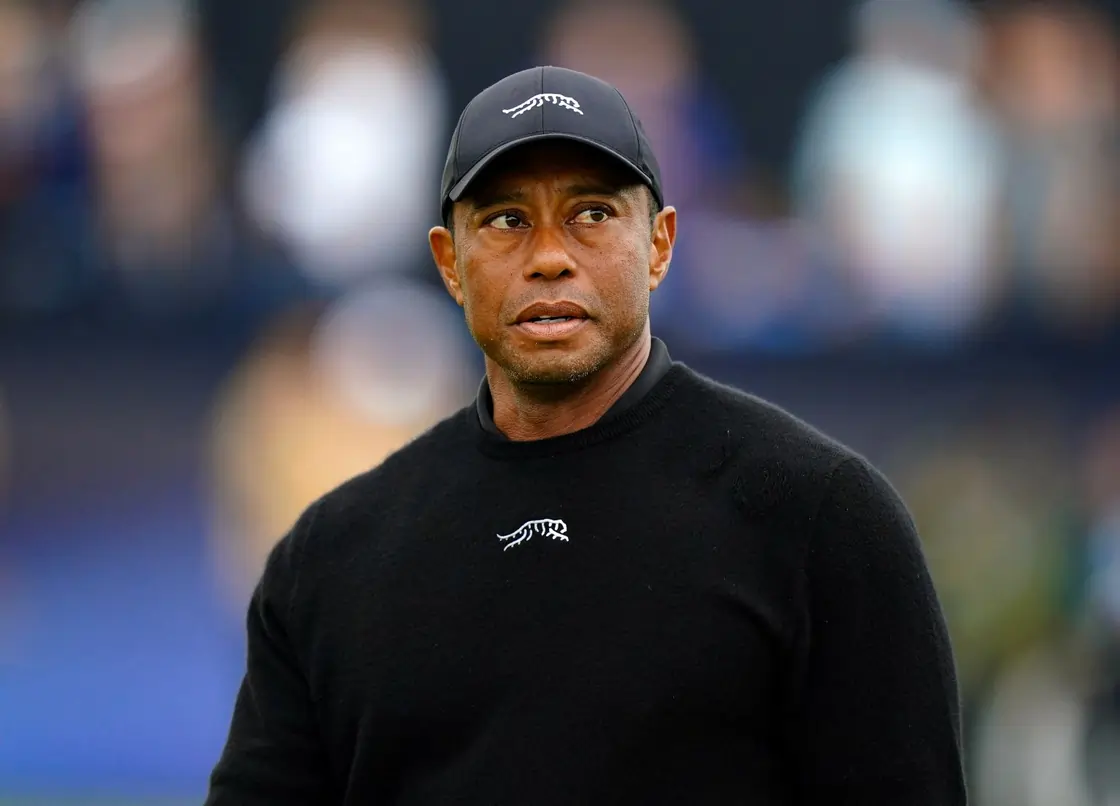
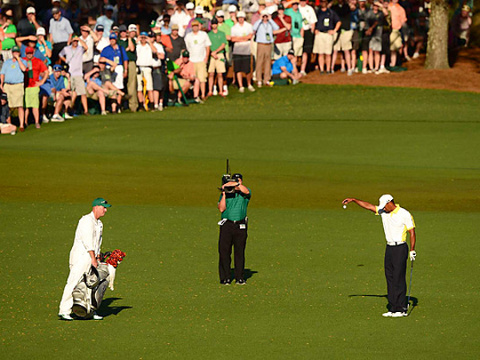
File photo dated 17-07-2024 of Tiger Woods who suffered what he described as 'one of the most embarrassing moments in my golfing career' during the latest round of TGL matches. Issue date: Wednesday February 19, 2025. 79098589 (Press Association via AP Images)
The world of professional golf has more to teach us about faith than you may think. And that’s rarely been as prescient as this past week, when the journeys of two pro-golfers could not be further apart from one another. One is a story of miraculous recovery and victory, while the other highlights another dark step down from the pinnacle of success.
Today, we’re exploring the juxtaposition of two professional golfers on completely different paths: Gary Woodland and Tiger Woods.
Gary Woodland’s Health Struggles: Brain Tumor, PTSD, and Mental Health Journey
You may not know the name Gary Woodland, but any avid golf fan was glued to the TV this past weekend when he hoisted the winner’s trophy at the Houston Open – a testament to his incredible battle against physical and mental ailments that made this win extraordinarily special.
Woodland has been on the PGA Tour since 2009 and has collected several wins in his career, including the 2019 US Open. He’s never been the world’s best golfer, though in 2019 he did reach No. 12 in the Official World Golf Ranking. His career was something to be proud of, nonetheless (after all, I suspect most of us would be content as the twelfth best person on the planet at what we do).
But in 2023, his life was flipped upside down when he was diagnosed with a brain tumor that was causing loss of appetite, regular feelings of fear, and partial seizures. And it was pressing on the part of the brain responsible for fear and anxiety. He constantly felt like he was dying.
He began taking medications and continued playing on the tour for a few months, but then started having memory loss, which led him to opt for a risky surgery to remove the tumor. Before the procedure, he wrote letters to his wife and children in case he did not survive the operation. You can see him emotionally discuss that day in this clip from the Netflix documentary Full Swing (bring tissues).
Thankfully, the surgery was successful, and Woodland returned to the golf course just four months later. But the tumor was not fully removed, and it’s still causing Woodland to experience symptoms of deep fear and anxiety.
An overflow of emotion
On March 9, 2026, Woodland publicly announced his PTSD diagnosis in an emotional interview with Golf Channel. In the interview, he explained that he is still struggling with mental health, anxiety, and hypervigilance, and that going public with the PTSD symptoms makes him feel 1,000 pounds lighter.
Then this past weekend, he won the Houston Open by five shots and secured a spot in the Masters — all just 30 months after the tumor was removed.
In an Instagram post on Monday, Woodland said:
It’s hard to put into words what this win means to me and my family. To the fans that came out last week and everyone that’s reading this post, thank you. Your love, support and energy has gotten me through some dark times and made days like yesterday possible.
He’s also said publicly how important his wife and family have been in supporting him through this trial.
The golf world was elated to share in the occasion. Just look at the comment section of that Instagram post. Fans around the world watched as Woodland’s wife rushed to embrace him in what must have been an overflow of emotion. Together, we all got to witness a victory etched with pain and suffering but defined by courage and hope.
These two statements from Woodland stood out to me this week:
“I hope somebody that’s struggling sees me out here still fighting and battling and trying to live my dreams. I’ve talked to veterans, and one thing I’ve heard from multiple people is you can’t do this on your own, no matter how strong you think you are” (emphasis added).
“I appreciate that love and support. But inside, I feel like I’m dying, and I feel like I’m living a lie. I want to live my dreams and be successful out here. But I want to help people, too. I realize now I’ve got to help myself first” (emphasis added).
Both are statements that Tiger Woods needs to take to heart.
Tiger Woods’ Ongoing Struggles with Injury, Addiction, and Accountability
Golf fans around the world were eagerly waiting to hear if Tiger Woods was going to return to the course at the Masters next weekend after having surgery on a torn Achilles and his seventh back surgery a year ago.
He made his first competitive return to golf on March 24 in the TGL indoor professional league. Nearly 1 million people tuned into ESPN just to watch Tiger hit the ball at a screen. Naturally, this had a lot of golf fans speculating that we may be in for a treat to see the greatest golfer in history take a stab at Augusta National Golf Club one more time.
But that dream was dashed just three days later when Tiger was involved in a high-speed rollover crash in his Land Rover on Jupiter Island in Florida last Friday. Thankfully, neither he nor the driver of the other truck he clipped was injured in the accident.
Tiger was arrested and booked on a charge of driving under the influence. Officers on the scene said he showed signs of impairment. A breathalyzer test did not detect any alcohol in his system, but Woods refused a urinalysis, leading to his arrest and booking at Martin County Jail, where he was held for at least eight hours.
In the arrest affidavit released on Tuesday morning by the Sheriff’s Office, officers described Woods as “lethargic” and noted that he was limping and stumbling with bloodshot, glassy eyes. The affidavit also reports that Woods had two hydrocodone pills in his pocket and was “sweating profusely” while being questioned in the back seat of a vehicle that had “cool air flowing.”
Woods said he was looking down at his cellphone, changing the radio station, and did not see the truck in front of him. On Tuesday, he pleaded not guilty to the misdemeanor charges.
This was not Woods’ first driving incident and arrest. In fact, this was his fourth single-vehicle incident in 16 years.
- 2009: He crashed into a fire hydrant and a tree in his neighbor’s yard while speeding away from his house after his then-wife discovered he’d been cheating on her with multiple women. She then used a golf club to break the vehicle’s rear window to help Woods out of the car, but that accident sparked a major public scandal for Tiger.
- 2017: He was arrested after being found asleep behind the wheel of his Mercedes, stopped in the right lane at 3 a.m. He pleaded guilty to DUI and said the incident was due to an “unexpected reaction” to multiple prescription drugs in his system at once. Shortly after the incident, Woods checked into a clinic for help with prescription drugs and completed the treatment that summer.
- 2021: Speeding at 87 mph in a 45 mph zone on a winding road near Los Angeles, he crashed his Genesis SUV, which went airborne and rolled multiple times. The accident nearly cost him his life and basically destroyed his right leg. Doctors even considered amputating, but managed to salvage the limb. And though there were no official police findings of impairment, there were signs that day.
The Impact of Pain, Prescription Drugs, and Personal Responsibility
Those accidents, compiled with the many injuries, surgeries, and personal – and very public – moral failures, are what made a potential return to the course so remarkable. (Not to mention a Masters win in 2019 that at the time seemed like the first step on a journey of redemption).
But the physical pain has clearly taken a toll, leading him to a place where he relies heavily on painkillers. Mix in the symptoms of opioid addiction with carelessness, and the reality is, he is a danger to himself, to those around him, and to everyday people sharing the road.
And frankly, his irresponsibility could have easily killed or severely injured other people in all of those accidents. Many have called out that he can afford to pay for a full-time driver, so why doesn’t he?
Beyond that, his poor decisions in life have had far-reaching reverberations on a growing web of people close to him. And yet he’s so far refused to admit he has a problem.
Golf journalist Alan Shipnuck sounded the alarm on CNN, saying that Tiger’s arrest “makes you worry about his future…makes you worry about his kids and that too much of Tiger’s inner circle is ‘on his payroll’ and has enabled his addictions for years.”
As for the immediate implications on Tiger’s golf status, I’ll let this scathing remark from golf analyst Geoff Shackelford speak for itself:
Tiger should not be at The Masters next week…they should ask him to stay home. Because other than Payne’s lecture in 2010, they’ve accommodated Woods as a five-time winner. They have the power to stop him from being a five-time rollover specialist who has miraculously not killed anyone.
Will Tiger be at the Masters?
Indeed, Tiger will not be at the Masters. On Tuesday night, Augusta National Golf Club announced that “although Tiger will not be joining us in person next week, his presence will be felt here in Augusta.”
The good news? It seems he’s taken a step in the right direction. On Tuesday, he released his first public statement since the arrest:
I know and understand the seriousness of the situation I find myself in today. I am stepping away for a period of time to seek treatment and focus on my health. This is necessary in order for me to prioritize my well-being and work toward lasting recovery. I’m committed to taking the time needed to return in a healthier, stronger and more focused place, both personally and professionally. I appreciate your understanding and support, and ask for privacy for my family, loved ones and myself at this time.”
While this is a welcome development, Tiger now needs to take a page out of Gary Woodland’s playbook: Recognize that he cannot fight his battles alone, no matter how strong he thinks he is. Offer vulnerability. Admit he has a problem and that he wants to heal. Maybe then, he too can feel that thousand-pound burden lifted and begin the progress toward recovery.
Why Tiger Woods’ failures affect the entire golf world
Ultimately, the repercussions of Tiger’s fall(ing) from grace hit those closest to him the hardest, but it also damages the sport.
He is the head of the PGA’s competition committee. He is tied to many of golf’s largest sponsors and events. He is (was?) expected to be selected as the next U.S. Ryder Cup captain. And he even designed the new par-3 course at Augusta, which is being unveiled this weekend, a ceremony that will now feel more solemn in his absence.
Tiger’s name is synonymous with the sport. He single-handedly shot golf to a whole new level of fandom in the 2000s, an outcome that can only be compared to Michael Jordan’s impact on the NBA’s popularity in the 90s. Consequently, there’s a globe full of golf fans that lose a dose of hope every time he has another failure.
And while I can’t fathom the pain Tiger feels every day from a back destroyed by the sport that he loves, a body damaged from injuries, a brain fogged by meds, and a heart sore from emotional pains…it does not excuse his recklessness.
As Joel Beall noted in his Golf Digest article “Tiger Woods Is Not OK:”
Chronic pain and how people manage it are not moral failures. They are medical realities that have unmade careful, disciplined, strong-willed people for as long as the drugs have existed. Tiger Woods is, whatever else you want to say about him, among the most disciplined human beings to ever stand over a golf ball. That discipline did not protect him. It may have obscured how much protection he needed.
Beall also wrote that “something’s wrong with Tiger Woods. We don’t know the struggle’s precise shape, but it’s there. It has been there. The evidence is not subtle, and it is not new. That is the sad and disconcerting thing, and until it is reckoned with honestly, everything else is secondary.”
But isn’t that true for everyone? The truth is, we all have struggles and demons in our lives that we have to reckon with. Romans 3:23 says, “For all have sinned and fall short of the glory of God.”
No one is in a position to judge Tiger Woods, because we all have our failures. Most of us are blessed enough to not have every shortcoming broadcast to the world. But it’s also not wrong to call out sin and offer tough love, because that’s the first step in a path to forgiveness and redemption.
The Danger of Idolatry
Golf writer Kyle Porter, himself a Christian, put it well:
Tiger has done foolish things for a long time because when everyone treats you like you’re a god, why wouldn’t you act as if you’re invincible? Why wouldn’t you live as if you’re above reproach? Why wouldn’t you reject any accountability? You are a god! This particular incident, though, is a good reminder that he’s very much not a god and that he, like millions of others in the world, is desperately in need of help.
And that’s true. Even Martin County Sheriff John M. Budensiek this week said, “We know we arrested a high-profile figure. But it doesn’t matter who you are; if you break the law, we’re going to follow the law.”
Porter also noted at the end of the piece that “Tiger is a tragic figure, which is a difficult thing for many people to wrestle with. Our western culture that is built on achievement, prestige and wealth has no category for sympathizing with someone who has oodles of all three.”
So what can we learn from this? Well, another golfer can help glean some insights.
Our true purpose and a path to healing
The current world #1 golfer, Scottie Scheffler, gave us a perfect example of how we can approach life and success last year when he said that striving for wins and being No. 1 in the world is not a fulfilling life, nor is it his end-all, be-all. Instead, he said he wants to be remembered as a follower of Christ and a family man rather than a great golfer. (You can hear Micah Tomasella and me break down that profound statement on this episode of the Culture Brief podcast.)
And that’s our answer. When we rely on our own accomplishments for hope and purpose, we’ll always come up short.
When life beats us up…when trials come our way…when we stumble over sin…God is the one who can rescue us from the pits of despair. But it requires humility. Just as athletes and celebrities are not gods, neither are we.
So this week, let’s all take a heart posture of humility, kneel before the Lord of lords, and lay our burdens at His feet.
Psalm 23:1 says, “The Lord is my shepherd; I shall not want. He makes me lie down in green pastures. He leads me beside still waters. He restores my soul. He leads me in paths of righteousness for his name’s sake.”
Exodus 15:26 calls God Jehovah-Rapha, or “the Lord who heals you.” What are you struggling with today? Where do you need healing? Is it physical? Emotional? Mental? Spiritual?
The reality is we’ll never be fully healed until we are in new, eternal bodies in the Lord’s presence. But we can call out to Jehovah-Rapha and intercede for healing here on earth.
Need help with that? Give this song a listen and just say the words “Jehovah-Rapha”. It’s powerful. As someone who has been in a pit of despair begging for healing before, I can attest to the power of just saying His name aloud.
And join me in praying that Tiger Woods will do the same. Because the reality is, he won’t be fully healed until he humbly comes to the feet of Jesus and declares him as his Lord and Savior. That is true healing. Even the legendary Tiger Woods needs Jehovah-Rapha.









 Search