




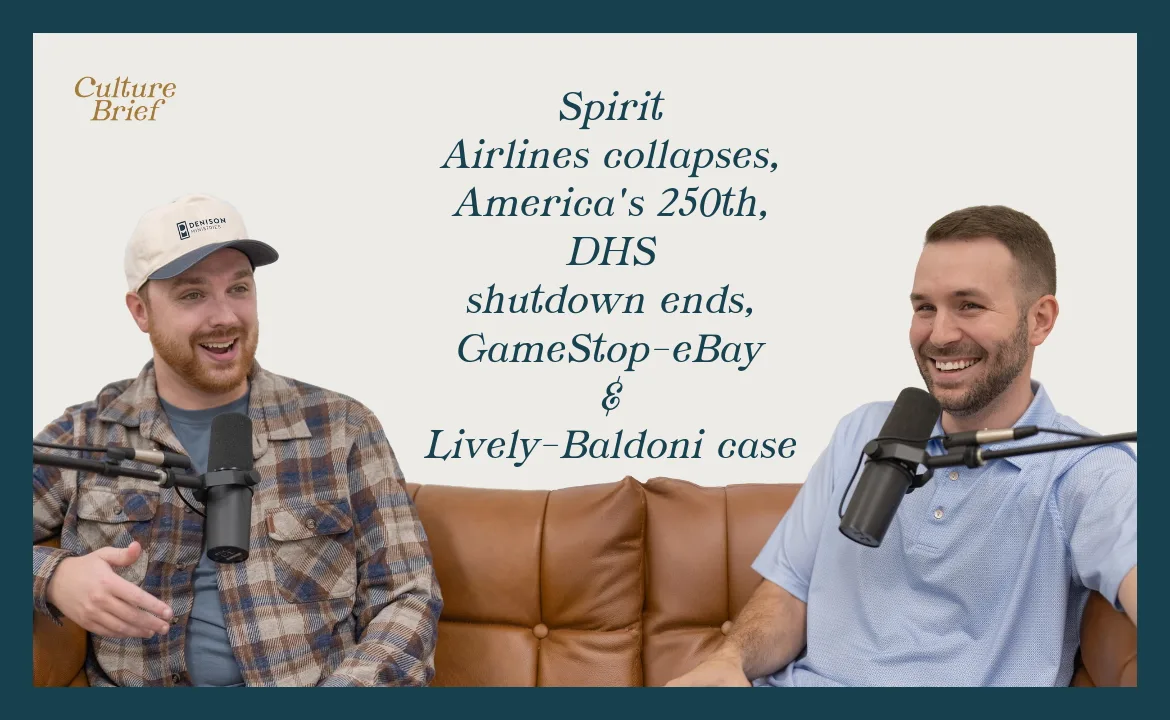
Culture Brief: Spirit Airlines collapses, America's 250th, DHS shutdown ends, GameStop-eBay & Lively-Baldoni case | Ep. 68
In this week's Brief: Spirit Airlines is gone. We break down how America's seventh-largest airline collapsed overnight, the bad decisions that led to it, the far-reaching impact on jobs, airports, and travel—and what the wisdom of Scripture says about stewardship versus squeezing every last dollar out of people.
From there, we take a deeper look at what America's 250th birthday should mean to us as Christians. In a culture where some defend the country blindly and others only see what's broken, we explore what Scripture says about God's role in establishing nations, and why our identity must be rooted in Jesus, not a political party or a flag.
Plus, the 76-day DHS shutdown finally ends, Iran ceasefire tensions escalate again, Ted Turner passes away at 87, GameStop tries to buy eBay, the Kentucky Derby delivers an all-time finish, and the Blake Lively-Justin Baldoni lawsuit settles.



Topics
(0:00) Introduction
(1:09) Spirit Airlines shuts down and why
(06:48) COVID Shift and JetBlue Merger Blocked
(08:45) Oil Shock and Bailout Talks
(12:58) Ripple effects on travel
(15:48) Lessons on wisdom
(19:41) America 250 big questions
(22:27) God and nations in Scripture
(24:11) Patriotism without extremes
(25:12) Conner on loving America
(25:40) Freedom and flaws
(27:14) Identity over nation
(28:54) Prayer and joy
(31:14) Happiness and church
(32:48) Merch and community
(34:51) Share and subscribe
(37:05) DHS shutdown ends
(38:11) Middle East tensions
(40:15) Ted Turner legacy
(41:11) GameStop buys eBay
(43:03) Derby comeback win
(43:42) Hollywood lawsuit settled
(45:11) Conclusion
Resources
- Send us your thoughts, questions, and topic ideas: [email protected]
- Culture Brief Instagram
- Watch on Youtube
- Sign-up for a Denison Forum newsletter: DenisonForum.org/subscribe
Articles on this week’s top headlines:
- How the Trump Administration’s Spirit Airlines Rescue Unraveled
- Spirit Airlines shuts down as company says it can’t keep up with higher oil prices
- Airlines reduce, cap fares for Spirit travelers looking to rebook canceled flights
- Retiring Spirit Pilot Has Impromptu Celebration After His Final Career Flight Was Canceled Due to Airline’s Closure
- X: NBC Sports
- Denison Forum: America 250
About Conner Jones
Conner Jones is the Director of Performance Marketing at Denison Ministries and Co-Hosts Denison Forum's "Culture Brief" podcast. He graduated from Dallas Baptist University in 2019 with a degree in Business Management. Conner passionately follows politics, sports, pop-culture, entertainment, and current events. He enjoys fishing, movie-going, and traveling the world with his wife and son.
About Micah Tomasella
Micah Tomasella is the Director of Advancement at Denison Ministries and co-hosts Denison Forum's "Culture Brief" podcast. A graduate of Dallas Baptist University, Micah is married to Emily, and together they are the proud parents of two daughters. With an extensive background in nonprofit work, finance, and real estate, Micah also brings experience from his years in pastoral church ministry.
About Denison Forum
Denison Forum exists to thoughtfully engage the issues of the day from a biblical perspective through The Daily Article email newsletter and podcast, the Faith & Clarity podcast, as well as many books and additional resources.
EPISODE TRANSCRIPT
NOTE: This transcript was AI-generated and has not been fully edited.
Conner Jones: [00:00:03] Hi, I'm Conner Jones.
Micah Tomasella: [00:00:05] I'm Micah Tomasella.
Conner Jones: [00:00:06] And this is Culture Brief, a Denison Forum podcast where we are navigating the constant stream of top stories and news, politics, sports, pop culture, technology, maybe the Met Gala, maybe not the Met Gala, just everything and all that's going on. All from a Christian perspective. Micah, what a week. Man, it has just been so much happening. Uh, and we lost an airline in there. We're going to have to hit on that, right?
Micah Tomasella: [00:00:30] Yeah, most definitely. If Conner Jones is in the conversation, we're probably going to talk about aviation. Conner's the most fun guy I know. All right, so we're going to talk about Spirit Airlines. I'm also going to talk about just a topic that kind of came up as I was thinking about America's 250th birthday heading into Independence Day. Going to take us through that. We're going to give you some check-in stories. We'll talk about Iran, what's going on there, what's not going on there. Hint, hint, the DHS shutdown officially ended. We're going to talk about that. Ted Turner passing away, GameStop and eBay, and so much more. So let's jump into the brief.
Conner Jones: [01:05] The brief. Yes, as you all probably saw this weekend, Spirit Airlines, America's favorite airline. No, not really. I mean, genuinely not at all. I don't know anybody who loved Spirit Airlines. That doesn't mean it's not sad that this airline and so many like collapsed and so many jobs are gone, but it truly was a terrible product. Um, and I can say that. I flew it one time. Micah, did you ever fly Spirit?
Micah Tomasella: [01:30] Yeah, I've flown it once. Yeah.
Conner Jones: [01:32] Yeah. Was it an okay experience, bad experience?
Micah Tomasella: [01:35] It's fine. You know, like if you're, if you're not flying with like checked bags, it truly is like that and Frontier is consistently, now that Southwest has kind of moved away from the self-seating model, um, Southwest is just as expensive as every other carrier, right? So now it really was between like Spirit and Frontier if you're looking for that last minute cheap quick flight. Uh, I remember it being fine. Like it, you know, like we didn't check bags and I just had carry on and that was, that was about it. I don't, I don't really remember much about it other than I felt like it was fine.
Conner Jones: [02:12] Well, here's the thing, they even charged for carry-on bags. They were the like airline that that did that. Like they…
Micah Tomasella: [02:17] Yeah, I flew it several years ago. I don't know if that changed. I can't even remember, but anyway, I remember it, I remember being like, oh, that wasn't that bad.
Conner Jones: [02:24] It no, it's it's fine, right? Like it gets you from point A to point B if that's if that's what you're trying to do. Now, if you want like a more comfortable experience and you want to bring bags and all that, that's where it was a problem. And that's what ultimately did them in here, uh, along with several other factors. So we're going to hit on that. But yeah, man, those bright yellow planes are now just littered throughout the country sitting parked. Uh, it's kind of sad. You you you would see those and be like, oh, that's a just cool looking aircraft. The the paint scheme was different. Uh, they were obviously very focused on kind of vacation destinations. They were more of a leisure airline. We're going to get you to Cancun really cheap. Now, you might get left there. We may not be able to get you back home, but we're going to get you there type of situation. The one time I flew, I got stuck in Orlando for many hours because they didn't have their systems in order and it was just a disaster. They it was supposed to be a direct flight home from Charlotte to DFW. We ended up in Orlando and just sat there and we didn't take off till like 2:00 in the morning.
Micah Tomasella: [03:15] Charlotte to DFW and ended up in Orlando?
Conner Jones: [03:17] Yeah, it's a whole story. This is what I'm talking about. This is what this is what I'm talking about with Spirit. Like the experience was not great. Getting to Charlotte…
Micah Tomasella: [03:24] Kind of the wrong direction.
Conner Jones: [03:25] I trust me, brother, I know.
Micah Tomasella: [03:27] Heading south, you needed to head west.
Conner Jones: [03:29] I know. Yeah. Um, getting to Charlotte was was fine. It was I had to pay for my checked bag, but yeah, it was, you know, not great. Um, anyways, yeah, they launched in 1992, if you did not know this. They were they've actually been around quite a while. They became the seventh largest airline in the US. They were moving about 44 million passengers every year. They were not a small airline. This is not like just a small airline going defunct and it's not going to have a big impact. There are big implications to this for the aviation industry, for travel, for hotels, for airports, for obviously loads and loads of employees and then many passengers who had their summer travel booked on the airline are now scrambling to rebook their their flights and and figure out their path forward for their vacations and people were stranded in South America, Central America, Caribbean, around the country, working to try to scramble to find flights to get back home. Um, which is just not ideal. And this came really just out of nowhere. Sort of. I people knew that they were on the brink. Like every day was like, hey, they may shut down this weekend. They could shut down this weekend. They're trying to find financing. They were working with the government to get some money, all of that. And then but on Saturday morning, they were just like, we're shutting it down. And they made that decision on Friday and they didn't want to freak people out. So they decided to shut it down as soon as the last flights that took off on Friday, uh, landed early Saturday morning in the wee hours and they were like, we're done. Airline is collapsed, which is, uh, just a kind of a sad story of how this can happen in airlines, it can happen in other industries as well. But when you do that with a bunch of passengers, with a bunch of employees around the country, it just leaves so many questions, so much unease and anxiety for a lot of people. Um, but yeah, like you said, Micah, the thing that just always kept people coming back to Spirit was those cheap tickets. It was always an affordable seat and customers were willing, honestly, like you were saying, to to brave the bottom tier experience in exchange for a very cheap A to B destination situation. You're going to fly across the country for 30 bucks. Okay. Well, you're probably going to have some rough bumps in the road getting there, but if you're willing to brave kind of like the, you know, they had the least amount of cushion on their seats that you could have legally. They had the smallest tray that you could have legally. They had the least amount of leg…
Micah Tomasella: [05:38] I see you're laughing with me here.
Conner Jones: [05:40] They had the like least amount of leg room you could legally have that like Airbus offered on their aircraft design.
Micah Tomasella: [05:46] It's crazy. The least amount of cushion. Can you verify this or are you just saying that?
Conner Jones: [05:51] No, I I'm that is a that is a thing. Like they were literally saving money on putting the minimal amount of cushion in their seats.
Micah Tomasella: [05:57] I specifically even remember getting on the aircraft and being like, oh my gosh, it's like…
Conner Jones: [06:01] No, I know it felt that way, but can you verify that information is what I'm asking you? Because I remember the seats being uncomfortable, but like are you telling me that that was their like that was what they set out to do was like whatever with all the corners we can cut, we will cut.
Micah Tomasella: [06:14] That's what they did. Yes. They they they it was a budget airline. Cut as much cost as you can and get as many people on the airplane as you could.
Conner Jones: [06:23] I guess that makes sense. Yeah.
Micah Tomasella: [06:24] That's how these low it's not just Spirit that does that. Frontier does the same thing. A bunch of European modeled uh airlines do the same thing. The ultra low cost is what they are called. Cut all costs, make it as cheap as possible to get on the aircraft, put as many people on the aircraft and then charge them for every little up charge that you can. That's what the business model is here. But like I was saying, it that didn't stick around very well. It it was going well until 2019. That's when they had their last year of profit and then COVID came, shut down the airline. Obviously the whole industry took a huge hit. And then after COVID, what happened was this transition of people wanting to get a more higher tier, more comfortable type of experience in their travel and their vacations and their uh even in their business travel. They were willing to pay a little bit more for a higher tier experience, more comfort, um, you know, especially if you're taking your family on vacation, you might want to pay a little bit more to go on Southwest or United or Delta and get a more comfortable experience, a more secure experience in terms of you know what your journey there and back will be like, right? Uh, so Spirit struggled to keep up with that with this like kind of um luxury style of travel that people were going towards. And Spirit never really built a business travel model the way that these other big airlines have. They didn't get a ton of business travelers going on their plane.
Conner Jones: [07:37] Yeah.
Micah Tomasella: [07:38] Which was never their model, but as things changed after COVID, they just couldn't keep up. So one thing they tried to do was merge with another ultra low cost carrier, which was Jet Blue. In 2023, they came to an agreement with Jet Blue. They were going to they were going to merge together. This was going to be kind of a rescue mission for Spirit as they were struggling. Jet Blue was going to benefit from it. It's going to make one big super uh airline of ultra low cost and the Biden administration at the time in 2023 turned it down. They they did not let them move forward with the merger.
Conner Jones: [08:05] It seems like they should have let them move forward now, but hindsight's 2020.
Micah Tomasella: [08:09] Yeah, and that's what a lot of people are calling out. Of course, Trump's going at that too. Like this is the Biden administration's fault. They should have never blocked the merger. Of course, the whole point of the reason the Biden administration did it was to avoid a sort of an ultra low cost monopoly of these two big airlines that would ultimately then knock other competition out of the market, raise prices for consumers. There's a lot to that. Um, and we're not going to go into the whole thing, but it is a big point in the history because after that they were never able to recover. That was supposed to be the thing that was going to bring them back.
Conner Jones: [08:37] Well, yeah. What about the failed, what about the failed government bailout that happened right there at the end? Like what happened there?
Micah Tomasella: [08:45] Yeah, so that that's where we're going now because last month is when Spirit really was like, hold up, we're not going to be able to make it. Like we are in our last days here because of the conflict with Iran that shot up the oil prices. This was like the final death nail. Like they were just barely skating by and then when oil prices shot up, it added an extra 10 to 15 million dollars in expenses each week for Spirit Airlines and they were like, we can't afford this. Um, so they reached out to the White House. Their CEO, Dave Davis reached out. He knew Susie Wiles, the chief of staff there because they're a Florida thing. She's from Florida. And he was able to reach out to her. She got him in contact with Howard Lutnick, the US Commerce Secretary, who started making calls, called Trump, started working together to put together basically a $500 million bailout. In return though, Spirit was going to have to offer a 90% stake in the company to the US government. So basically the government was going to own the majority of this company. Um, but they were going to get $500 million to keep the airline afloat. Trump apparently really liked the idea because it was going to allow him to say, hey, I saved this airline. I saved tens of thousands of jobs here. And this would be a big uh boon going into the midterms for him. He also wanted the administration to look like the good guys, whereas the Biden administration would have looked like the bad guys for killing their merger deal with Jet Blue, right? He wanted to kind of look like a savior. So we had the transportation secretary, Sean Duffy start making calls to other airlines to see if there was another airline out there that would want to kind of partner with the government to be a future owner of Spirit. Not a single other airline CEO agreed to do it. In fact, the United CEO, Scott Kirby even said, no, Spirit should be allowed to fail. Um, and Spirit's financiers after all these conversations with the government, other airline CEOs, the Spirit financiers and banks and lenders told them, hey, you'd be better off just closing shop and liquidating your assets. Sell your your aircraft fleet. You've got 172 airplanes, sell those, you'll make billions off that, pay back your debts.
Conner Jones: [10:35] Micah, just overall thoughts.
Micah Tomasella: [10:39] Well, people like to play the blame game whenever things don't work out. Like you, you know, maybe, um, somebody who you respect or you love, uh, in your life or maybe at work, a friendship, a family member might share some feedback with you that isn't so positive. I mean, we've all gotten feedback that didn't make us feel great in the moment, but it's it's there to help you grow. Um, and that's just kind of like where my mind jumps to of people are going to jump on partisan sides of this and say, well, the Biden administration shouldn't have blocked this merger. And I I remember that. I remember that whole saga, right? And then, you know, hey, the Trump administration should have done more to to save the airline. The the Iran war shouldn't have started and then this wouldn't have happened to Spirit. I think those are insufficient. I think it's insufficient to blame everyone else for your own shortcomings and issues. Um, that's I'm kind of going to talk about this in my segment, right? Like there's there's some people out there that believe America can do no wrong, um, and they defend everything America does. And then in the same way, there's those people out there that are struggling and failing in their own life and all they want to do is blame society and blame America for their problems. It's insufficient. Uh, we're all responsible for our own actions, for our own planning. So Spirit's been on its last leg for a while and so I think the leadership at Spirit has only one person to blame and that's the person in the mirror for, you know, where this ended up. My question to you, Conner, I've been seeing this a lot and guys, remember, uh, if there's an aviation expert as far as like airlines and planes, Conner is the aviation expert in our circle. Um, you know, again, like I said, he's a very fun guy. So I'm going to ask Conner, I've I've been reading a lot about how Spirit brought the floor down for prices, right? Competition is a good thing. It's what our economy is built on. I do understand that point. However, I've been reading some information recently that's like, well, Spirit wasn't in as many hubs as people think that it is and the numbers bearing out, it's kind of hard to know exactly how much Spirit was bringing the floor down on prices. So like what are the implications of Spirit going down now after you've read and kind of taken in all the information?
Conner Jones: [12:58] Well, yeah, there's a lot. I mean, it's it's pretty far reaching. And I kind of mentioned a little bit a minute ago. Obviously, the first thing you think of is the 17,000 jobs that are gone. I mean, they they were a large airline, the seventh largest airline. There's many jobs that are gone within the airline. But beyond that, think about all the people who support those jobs. There's contractors, there's uh places outside the airport that support. Now you've got people who are not going to go to the restaurants and bars across the street from the airport after they get off their shift. You know, like there's things like that. There's hotels that the pilots and flight attendants stay in typically. Now, I think a lot of those people will get hired by other airlines. They'll be able to find jobs, especially there's a pilot shortage right now. So in a way this might help other airlines like, hey, please, if you're a spirit pilot, come help us, come get, you know, we we'd like to hire you. But…
Micah Tomasella: [13:40] I was talking to a buddy of mine who's a pilot at Southwest and he said they're hiring a bunch of spirit pilots right now. As long as they're as long as they fit the Southwestern way or whatever, but they're hiring a bunch and he said all the airlines are swooping up all these pilots right now.
Conner Jones: [13:56] Yeah, because you got a bunch of qualified pilots who are like, yeah, please hire us. Um, the airport side of this. Yeah, they had a big presence at several airports though. I know you're saying like, yeah, they didn't have massive hubs outside of Fort Lauderdale. That was their primary hub, which they did make up 28% of the traffic at Fort Lauderdale's airport. That's 5.7 million passengers.
Micah Tomasella: [14:14] Okay, that's really going to affect Fort Lauderdale. Wow.
Conner Jones: [14:17] Big impact on Fort Lauderdale. And then there's two other airports that are really going to be impacted, smaller ones. Atlantic City Airport, they made up 94% of the flights there. They were like the primary airline at Atlantic City. Uh, I think Frontier and Jet Blue send in one flight a day or something there. Uh, but that's going to impact not just that airport, but think about the actual tourism of Atlantic City now gets impacted when you can't get people there. And then Arnold Palmer Regional Airport in Latrobe, Pennsylvania had one airline going into their little regional airport. It was Spirit. And so now they do not have an airline. They have an entire airport, they have an entire airport staff that is going to have to be put on furlo until they can get a new airline agreed to go in there hopefully in the next few months. But yeah, there there's implications here that go beyond just the people that work there. It impacts cities, it impacts tourism, it impacts all of that. So it's a good question, Micah. Um, even here at DFW Airport, they have a big presence at Terminal E. And so now that terminal is going to be emptied of gates. Now, other airlines have the opportunity to go in. They're going to be able to buy up these gates and expand expand their presence and buy up the routes that Spirit had.
Micah Tomasella: [15:17] This is a real opportunity for Frontier.
Conner Jones: [15:19] Yeah, Frontier could definitely take advantage. I think what you'll really see is like American, United, Delta and Southwest really chomp at the bit to take their pilots, take their…
Micah Tomasella: [15:29] Well, I don't like that because they're the most expensive ones.
Conner Jones: [15:32] Well, I'm just telling you, I I'm telling you how this industry works. Um, it's all about getting every last bit of uh bit of money you can get, but also a bit of like real estate you can get in the aviation market, right? That's how it works. And the big boys are going to they're going to fight for it. So, you know, Micah, I was thinking about just kind of like what can we learn from all of this and you've you mentioned a little bit like, hey, they can look in the mirror. Spirit can and look at some of the the bad decisions they made. I think the the biggest mistake Spirit made was not respecting its customer enough to one, they wanted to just squeeze every last dollar they could out of them with every up charge they could, which you know what that does is it doesn't build a loyalty. The airline business is built on loyalty. That's why they have lounges and credit cards and…
Micah Tomasella: [16:15] Everyone, everyone who picked Spirit was like, fine. You know, like, you know, like they're like looking at their budget and fine. You just I don't know a lot of people were like, oh yeah, I fly Spirit everywhere. No, most people were like, I fly Delta or United or Southwest.
Conner Jones: [16:31] Everyone tolerated Spirit basically. Yeah.
Micah Tomasella: [16:33] Or you just you were like, okay, I'm going to choose them for this one flight because they are the cheapest, but I'm not like loyal to them, right? Yeah. They didn't respect their customers enough to do that. Um, I think you can look at other airlines and say, well, they do. And this is not just an airline thing. This is there's a reason Chick-fil-A stands out, right? They have good service. They are efficient. Their food is good. They respect their customers, right? They have clean restaurant. All of that is something that plays right into every business that we talk about. It can be an auto body shop. You choose the person you want to go get to work on your car because you trust them. You think that they're going to treat you right and charge you a fair price. That's not what Spirit was doing here. Um, and I think they can look in the mirror and I think they could have, you know, had some discernment over the last few years of what can we change to make sure our customers know we care about them and want to take care of them, not just try to squeeze every last dollar out of them, right? Yeah. So I I think we can learn like our actions, our inactions, they all have broader implications and consequences like we just talked about with Spirit's uh collapse here, the implications there. And along with the path of, you know, along the path of Spirit's history, those bad decisions were made and they could have followed the customer's wishes better. Um, and they would have been in a better position when something catastrophic happened such as oil prices going up or let's say they did have an airplane that had a crash. A lot of airlines can't bounce back from that. Others, the bigger ones that are more ready for it can. Um, but a lot of times some sort of incident or something you don't expect to happen, a war in the Middle East maybe, can shoot your whole business down if you're not ready for it. So when we ourselves are in tough circumstances, what do we do what do we turn to? Do we turn to wisdom and discernment or folly? I mean, personally, I would recommend wisdom and I'm saying that as like I have to teach myself that too. It's easy to go the way of the the folly, the way of the world and say, oh, let me what would the world say I do? Oh, keep squeezing the money out, keep getting every last dollar you can, right? No, Daniel 12:3 speaks of wisdom. It says, and those who are wise shall shine like the brightness of the sky above. And those who turn many to righteousness like the stars forever and ever. But Micah, the question then is like, where do we find this wisdom in trying times? Well, James 1:5 tells us, it says, if you if any of you lacks wisdom, let him ask God who gives generously to all without reproach and it will be given him. And then Proverbs 1:7 declares, the fear of the Lord is the beginning of knowledge. Fools despise wisdom and instruction. So that's it for us, man. Wisdom comes from the Lord and fools deny wisdom. Fools lead to collapse, destruction, a defunct airline. And you join the history of other defunct airlines, TWA and Pan America and Braniff, these big airlines that were just institutions of the American aviation industry are all gone because they lacked discernment at some point and it led to their collapse, right? Um, so follow wisdom and discernment in your life and and avoid the path of Spirit Airlines. As sad as it is to lose this airline and so many people, we're praying for the, you know, just kind of the people who have lost their jobs, but there's a lot of I think self-reflection that can happen here.
Micah Tomasella: [19:37] It's great, Conner, and it it actually transitions pretty well into what I want to talk about today. America 250, does God specifically establish and sustain nations and what does that mean for us? I just want to talk about that. And I was actually as just as we get closer to America's 250th anniversary. One thing I would encourage you guys to do, I'm a big fan of the Wall Street Journal and they've been putting out a lot, a lot of articles and just deep dives into what has made American ingenuity great, entrepreneurial, um, insights and uh just, hey, like what are all the inventions that have come out of America? How has America contributed to the world? My goodness. I know that we are a very young nation in comparison to so many, but that American spirit, that American ingenuity has absolutely changed the world. And it's been cool to read about some of those things, but I'm going to talk more about a spiritual standpoint of this because I I want to start by giving credit to where it's due of what inspired me to deep dive into this and to talk about it today. The segment's inspired by Dr. Jim Denison and his son, Dr. Ryan Denison. They're both a part of the Denison Forum team and they're doing a special email series right now leading up to America's 250th birthday. So every Sunday for the next two uh 10 weeks, they're going to take a different slice of this. And so this was week one. This was this past Sunday. Each Sunday they're taking an honest look at our nation, where we failed, where we flourished, and ultimately asking this these questions. What kind of nation, what kind of people will we choose to be? What have we chosen to be and what will we choose to be moving forward? And that's really where this starts for me. So what is America actually supposed to be? Let's think about that for a second because if we're honest, people aren't just answering that differently. They're they're they're feeling that differently right now. For some reason, like for for some reason for some people, when we're approaching this anniversary for America, they feel a deep sense of pride. And then for others, it's it's frustration, it's it's resentment. And for a lot of people, it just feels complicated. They feel a mix of both. And there's a moment in our culture that captures that tension. And this was an example that Dr. Jim Denison threw out. For years, the seventh inning stretch at baseball games meant one thing. It was always take me out to the ball game. Okay, that's the song that they played. That was a baseball tradition. But after the September 11th attacks, after 9/11, something shifted. Now, when when games came back and still today, stadiums do God bless America for baseball games, okay? It wasn't just a song anymore, right? Especially after 9/11, it felt like a prayer. Same country, same people, but in a moment of uncertainty, the instinct wasn't just tradition, it was dependence. It was dependence on God. That instinct points to something deeper. So let's talk, so let's talk about what scripture has to say about this as I go into the next point. So scripture speaks directly to this. In Acts 17 verses 24 through 26, I'm going to read it. The God who made the world and everything in it, being Lord of heaven and earth, does not live in temples made by man, nor is he served by human hands, as though he needed anything, since he himself gives to all mankind life and breath and everything. Thank you, Jesus. And he made from one man every nation of mankind to live on all the face of the earth, having determined allotted periods, plots and boundaries of their dwelling places. So nations aren't just random, Conner. They're not just the result of politics or power or chance or just free will. In some way, God is involved and I think we can debate on how involved he is, right? But when you look honestly at our history, it's hard to ignore that. This country didn't just appear. It was formed through conviction and through sacrifice, through faith, through belief that freedom and responsibility matter. There's a reason phrases like in God we trust are written on every single government document, uh, currency, government buildings. There's a reason scripture shaped much of the early framework of this nation. There's a reason for that. Has America gotten everything right? No. No. Uh, of course not. Of course not. But it's also true that we've been given an incredible amount of of freedom, of opportunity, of influence, and the ability to openly live out our faith in ways that the much of the world to this day still can't. Still cannot. Many, many countries in Europe, you know, people are like, oh, like Europe's super free. Not really. There's a lot of countries in Europe censoring free speech right now, a lot of it having to do with religious freedom. That's worth acknowledging without hesitation. Okay? At the same time, this is where people tend to drift into extremes. I'm going to touch on this and I'm just going to ask your thoughts so far after this, Conner. On one side, you have people who treat America like it can do absolutely no wrong. Everything is defended, everything is justified, and over time, love of country quietly turns into identity. It just it it gets wrapped up into who you are. And then on the other side, you have people who only see what's broken. They dismiss what's good, focus on what's wrong, and often shift blame outward rather than inward when things don't work out for them. They shift the blame onto country, onto systems, onto other people without ever stopping to look in the mirror. I would argue that's just as much of an identity crisis, right? You got a lot of people falling into both extreme camps. And I I would just say both approaches miss it. Um, both approaches miss it. One ignores reality and the other refuses responsibility. What are your thoughts so far on this, Conner?
Conner Jones: [25:12] Yeah, man, I just think about like America is not a perfect place. Uh, no country is or ever will be a perfect place. But man, I can't imagine anywhere else that I would want to live. Um, and there's a reason so many people, so many people struggle and struggle and struggle to reach these lands every day, every year. Uh, people long to be here for a reason, uh, because it is a land of freedom. Uh, it's a land of opportunity. It's a land of religious freedom that is like you're saying, that is so first off, it's rare in history. I mean, that was not a thing really ever.
Micah Tomasella: [25:48] And I'm choosing to harp on the religious freedom part for the sake of this argument that I'm trying to make, but you're right. There are so many other freedom-based arguments, opportunity-based arguments that we're not even touching on today.
Conner Jones: [26:01] Yeah, I just, you know, we've talked about it before, but I I do think a lot of what you're saying though is you do have to reflect on our past and see where things went wrong. What did we do wrong? I mean, our biggest, our biggest flaw in our history is slavery, right? Like that and it led to a civil war where our country literally warred against each other, north versus south. And it was this massive division. And in the years after that, there's still been so much division and so much argument and all of that. But at the same time, there is a unity among us all that's like, hey, we're going to we're going to defend this nation that believes in freedoms and rights. Um, and that's why when World War II started, you know, America sat on the sidelines for a while, but as soon as it was attacked, almost every young man in the country went to the went to their recruiting office and signed up because they were like, we got to defend this. This is our this is our home. Um, and we love it and we we're going to we're going to go defend it, um, and fight for freedom. And not just defend it, but fight for freedoms of other countries. It opened up the doors for more freedom to to reach across the world, right? Um, they freed so many islands in the in the uh Pacific. They freed so many countries and people in Europe and ultimately out of Holocaust camps. I mean, there's so much to the history there that you can point to as as as argument points for you, Micah.
Micah Tomasella: [27:14] It's good, Conner. You know, the truth is that God works through nations, right? But no nation replaces his kingdom and we just have to remember that as Christ followers. So yes, you can and should approach what's good about this country. You should appreciate it. You should approach it with appreciation. And and there's a lot to be grateful for, but you also don't have to tie your identity to it in a way that keeps you from seeing clearly because once your identity is wrapped up in a nation, it becomes really hard to be honest about it. You start defending things you shouldn't defend or you swing the other direction and criticize everything without taking ownership of anything in your own life. I mean, it's just an an identity crisis in both extremes that I believe Jesus can solve. You see this play out every day in news, in politics, in social media, in just normal everyday conversations. But as Christians, we're called to something higher than both of those responses. Our identity is not rooted in a country first, it's rooted in God, duh, right? Which means we don't evaluate America based on preferences or politics, we evaluate it based on truth. So when our nation aligns with what's good, we should say that clearly and without apology. When it doesn't, we should be willing to say that too. We should be willing to call that out. Not in the heart of tearing it down, but because the goal isn't to win an argument about America, the goal is to live a life that God can actually bless and a life that actually points others to Jesus and that type of life that we're talking about. So as we think about where we are right now, maybe the better question isn't just what kind of nation America is. I think it's more are you focused on what's wrong out there or are you paying attention to what God wants to change in you? Or I'll just say this as we close, like I just want to give one more scripture. This is my prayer for our nation from 2nd Chronicles 7:14. We've quoted it many times. If my people who are called by my name humble themselves and pray and seek my face and turn from their wicked ways, then I will hear from heaven and will forgive their sin and heal their land. That is the path forward right there. And I'm thinking about, um, this clip I saw, there's this guy who goes around and he asks random people in supermarkets on the street, whatever it might be. Hey, one question for you for my social media account. I have this many followers, whatever. He asks if it's okay if they're on camera. Like very like this is not meant to be funny. Are you happy? is all he asks. Are you happy? And this last one I saw, this guy looked at him dead in the face and said, no, I'm not. And the guy says, why? And he says, global instability, everything's expensive, everyone's fighting about every single thing. And that in and of itself breaks my heart that there are so many people out there that if your identity is not rooted, if you do not have a foundation in the everlasting kingdom of Jesus, the one who is and is to come, Hebrews 13:8, Jesus Christ is the same yesterday, today and forever. If it's not rooted in that, you will root yourself and attach yourself to all of the issues and all of the information out there and all the people out there trying to convince you that everything is wrong, so you might as well just give up. That is completely false and incorrect. There is a way to live with joy, peace, purpose, happiness that is not tied to what's going right or wrong in our country. It's a mindset, but it's not a mindset just in the in the in the sense of, oh, this is what I think. It's a mindset and a heart posture and a decision that you make that's rooted to the eternal everlasting kingdom that is established through Jesus, right? And so, if we would humble ourselves and and truly repent and turn to Jesus as a nation, that's our best path forward. God bless America, man.
Conner Jones: [31:14] Yeah, and to your point, there was a, I think a report that came out this week. It was kind of a, a doing a data study that was showing that poorer people in the United States who attend church frequently are happier than wealthy people in the United States who do not attend church.
Micah Tomasella: [31:31] Who do not? Oh, that makes total sense.
Conner Jones: [31:33] Makes total sense to us. I it was going all over the internet. I was seeing it on social media everywhere. People were like, this is crazy. It was blowing people's minds that poor people would be happy. Um, because they know the Lord, everything you're just saying because they know Jesus, their peace and purpose.
Micah Tomasella: [31:48] And they have to depend on Jesus. I mean, like that's why there are like some third world countries out there, you you survey their happiness. Well, if they're finding their freedom and joy in Jesus, those those surveys turn out pretty well. Like you have a little bit, but you're depending on God. Yep. That's what he's called us to do. We're actually living out and walking out in our identity and who we've been created to worship, who we've been created to serve so then we can go and serve and love others. That makes total sense. But I guess, I guess you're right that it would make sense that a lot of people would be shocked.
Conner Jones: [32:20] A lot of people were, well, because so many people believe that money and success is what brings happiness. And we've talked about a million times on here, that is not true.
Micah Tomasella: [32:27] No. That is something maybe the Lord blesses you with, but that's ultimately not what brings you happiness.
Conner Jones: [32:31] I mean, I'm not sitting here a millionaire and saying, oh yeah, trust me. You know, it's it sounds nice. I'm not sitting here saying it doesn't, but yeah, thankfully we know what truth is. Well, um, yeah, Conner, thank you for that insight to kind of wrap it up. What you got next for us?
Micah Tomasella: [32:48] Let's talk a little bit about the mailbag. Uh, Micah, somebody asked us this week if we will ever have merch, Culture Brief merch. Uh, I would say I wouldn't rule it out. We haven't really fully talked about it, but I kind of like the idea. It sounds kind of fun, right? Um, I feel like something we need is like a nickname for people who listen to Culture Brief and are like part of this community. I don't know what it would be. You know, like how a lot of people, a lot of shows and podcasts…
Conner Jones: [33:11] The briefers. The briefers. Are you a briefer? Come join us for, you know, like should we…
Micah Tomasella: [33:18] CBs. I don't like that. I don't know. The culture bees. Culture bees. Oh, culture bees. Buzz buzz buzz. Buzz buzz buzz. Yeah, okay. Man, we're we're getting creative here.
Conner Jones: [33:29] Yeah. I would not rule it out. I here's what I would request. If merch is something you would be interested in, uh, I want to hear, Micah and I want to hear, what would you want? Are you thinking like shirts, hats, stickers, like coffee mugs? I don't know. You'd have to help us out here and tell us.
Micah Tomasella: [33:46] Do you want bobble heads of us?
Conner Jones: [33:47] Oh, I don't know. That one feels weird. I looked over and saw some bobble heads on my desk and I'm like, I think we'd I think we'd look pretty cool as bobble heads.
Micah Tomasella: [33:58] Maybe. I don't know. That's a weird one. Uh…
Conner Jones: [34:02] You want to put us as like a poster on your wall? Do you want posters of our faces?
Micah Tomasella: [34:08] Nobody wants that.
Conner Jones: [34:09] Oh, okay. Yeah, that yeah, you're right. You're right. That would be crazy. That'd be weird. Uh, but if you guys are interested in that, here's what I'm going to do. I'm going to post a poll if you're on Spotify or YouTube, there will be a poll below. You can go vote on if you would actually be interested in merch. Say yes or no. If not, that's totally fine. I don't want to spend time on it if nobody's interested in it. And then, uh, I'll post it on our Instagram story on Friday. So if you're listening on Thursday, check out our Instagram story tomorrow and I will post a poll asking if you'd be interested in merch. And then send us your ideas. Uh, respond on Instagram or wherever. Uh, email us at [email protected] or as I was saying on Instagram at Culture Brief podcast. That's our handle there. You can find us there and shoot us a direct message. What would you actually be interested in? And while we're talking about this, if you guys have a few minutes, we would love it if you would leave a review on Apple podcast or on Spotify and YouTube, drop a comment down below on this specific episode. It helps a lot, guys. It means a lot. It one, it's good feedback for us. We learn a lot from what you all are thinking or hearing, uh, what you're wanting or what you think we could fix or do better.
Micah Tomasella: [35:10] Well, if it's something bad, just email us. If it's something good, leave a review. How about that?
Conner Jones: [35:14] That that works too. Either way, we want to hear. Um, but those reviews and those comments, uh, they're great feedback. They also help new listeners decide if it's worth their time to listen. Um, and then you can also always hit follow or subscribe so that you are constantly getting updates when a new episode drops. Um, and it helps build the algorithm so that more people can find us. We can get more culture bees, as we were saying, uh, as part of this community. And share the episode, of course, with people who you might think would enjoy it and help, um, them think through everything going on in the world. Are you know people who are like anxious about everything going on? That's what we're trying to talk about and bring a Christian perspective to. So, you know, anybody that you might be able to have a faith-filled conversation on the headlines with, send it to them and tag us on social. If you're listening, throw it on your Instagram story, tag us. Also, we're probably going to be on Tik Tok very soon. So stay tuned for that.
Micah Tomasella: [36:03] Ooh, exciting. Well, to put a bow on that, there is another way, guys. There is another way to look at the world. There is another way to consume the news outside of what they're telling you. There's a way to look at the news factually, bring it to God and ask him specifically to teach you something through it. It's a spiritual discipline in this world that we live in today here in 2026. So if you've learned that way, I'm not even going to give ourselves credit for that. If you've learned that way through consuming our ministry's content, share it with others because what we're trying to do is so against the grain and the people who get it really get it because it's freeing. It's it's it's been freeing for Conner and I and so many of the people that we know and get to interact with. You do not have to give into the partisan lies, all the hate, all the bickering. There's another way and God's involved in that way. So please share it.
Conner Jones: [37:03] Yeah, please do. All right, guys, let's jump into check-ins. Check in. All right, so the DHS shutdown ended. The record long 76-day DHS shutdown ended on April 30th after President Trump did fully sign the funding bill that was approved by Congress. The legislation restores funding to key areas like the TSA, allowing for the resumption of full operations through some immigration, though some immigration enforcement functions were not included in the bill. That was the compromise. Some ICE stuff was not included in the bill. But just overall having the DHS fully funded so that our political leaders can be fully protected. There was another shooting in Washington DC just a few days ago. Don't really know exactly what the motivations were behind that, right? But it's just we need those who are tasked with defending our elected officials, uh, to be able to fully do their job. So I'm glad that that's done.
Micah Tomasella: [37:58] And keeping us safe as we fly. Everything we've talked about today. TSA agency, we're going into summer travel.
Conner Jones: [38:04] Totally. Yes, yes. It it feels like a no-brainer. But anyway, you know Conner and I could talk about that for a long time. So and and we have at length. Okay, so fighting in the Middle East has um escalated some even though the ceasefire is still in place. The US military sank at least six Iranian small boats in the straight of Hormuz on Monday after uh Iran launched some missiles, some drones and sent small boats towards US Navy ships and commercial vessels. Iran also attacked the UAE again. The UAE has said they'll respond. They haven't yet. Basically, everything is fragile and shaky. This war could fire up again. However, we're recording on Wednesday, May 6th. Trump put a 24-hour stop to basically navigating through the straight of Hormuz because apparently behind the scenes, there is a framework for a deal, this like 14-point on one page deal that's being ironed out right now that could potentially happen. So stay tuned on that. We are praying for peace in the Middle East. I'm just going to gripe one thing real quick while we're talking about this, Conner. Okay. I was just reading this morning, right, that the Gulf states are starting to feel like America is just threatening and not doing anything. And they're worried about that. Then why don't you get involved, Gulf states? Why don't why don't you help out a little bit, Gulf states, so that this can so that this can end? That's I I'm like, listen, man, like America can't do everything. I mean, I I just I don't like reading headlines like that. Like, honestly, how dare you complain? Like, what are you doing? You know? So anyway, that's just that's just my gripe.
Micah Tomasella: [39:41] No, it's true. I mean, there's a lot of people whispering in Trump's ear trying to get him to to do more attacks essentially. Um, but if that's the case and that's the best way forward, then they need to do something too is what you're saying. And I I I get that. Um, yeah, I guess we'll just see what happens there. Hopefully there is a ceasefire agreement. I do know that the Trump administration feels a little pressure. They're trying to get it done before he goes to China next week to meet with President Xi. We'll talk about his China visit next week as we get closer to that. Um, but that's going to be a huge deal. I think there's a lot of pressure.
Conner Jones: [40:08] That's a huge thing. I mean, a sitting American president hasn't gone to China in a very long time.
Micah Tomasella: [40:14] Yeah. Okay, something else right before we hopped on here, we got alerts that Ted Turner had passed away. So I don't know how or why he passed away, but he was 87, so I imagine it was um natural causes of some sort. Uh, he is just a titan of the television industry, one of the guys who made television what it is today. Billionaire, fourth largest owner of land in the United States, used to be the largest, owned 2 million acres of land, loves ranching. But he was the founder of CNN, TNT, TBS, Cartoon Network and more uh TV channels. So just one of those guys who kind of helped shape America to what it is today. You could compare him probably most closely to like Rupert Murdoch who owns Fox News. Um, and has, you know, just through their influence shaped the way a lot of people approach life and think about things.
Conner Jones: [40:59] For better for worse, huh?
Micah Tomasella: [41:00] For better or for worse. You get to decide that on your own, but you cannot deny that he had a massive impact. He was also the owner of the Atlanta Braves and Atlanta Hawks and Thrashers for quite a time there. Uh, something else, GameStop. This one's crazy, Micah. GameStop wants to buy eBay. Now, if you remember, GameStop had their own little spirit airline thing going on a few years ago where they nearly collapsed.
Conner Jones: [41:23] I thought they did collapse.
Micah Tomasella: [41:24] They were on the verge and then do you remember they had that like stock surge, the GameStop uh stock meme surge in like 2021, I want to say. Yeah. And it kind of gave them some capital. Well, they got a new CEO. He's the guy who founded Chewy, uh the pet supply company. He's a billionaire himself. He's the new CEO and he just out of nowhere, unsolicited sent a bid to eBay for a $56 billion basically takeover of eBay from GameStop. Here's the problem. GameStop is worth $9 billion. And so everyone's like, what is happening? He'll need to get some backers, some investors. Yeah, he's apparently secured a $20 billion uh loan from TD Bank. But that's it. So that that brings him to 29 of the $56 billion that he has offered to buy eBay for. I guess I'm just confused. I'm like, I don't understand why GameStop is going to buy eBay. He seems to think that he can make them a competitor to Amazon. They both just seem like dying companies to me, but…
Conner Jones: [42:17] I like the idea of competition, man. It's the same thing with Spirit, you know, I don't I don't like to see any of these companies go under. I'd love for an organization to kind of rise up and be similar to Amazon. It it drives prices down, man. It makes everything better when there's more competition, man. So I but maybe it'll work out. Probably not. We think GameStop is going to be the one to do it?
Micah Tomasella: [42:38] No, this is weird. It's probably it's Walmart is the one who's going to be able to compete with Amazon the most, right? And they they are working on that, but…
Conner Jones: [42:44] Yeah, it's just they're somewhat different lanes, you know what I mean? But yes, I mean like Walmart does directly compete with Amazon, but I'm just thinking like specifically online only, deliver quickly, not necessarily as much grocery based. Um, anyway, who knows? We'll see what happens. Probably won't happen, but I've seen crazier things.
Micah Tomasella: [43:03] Okay, the other thing I'm sure a lot of y'all saw this was Golden Tempo won the Kentucky Derby coming from last place going into that last turn. I mean, it's a crazy one-minute video going from last to first. Crazy. It just goes around everybody. It was I've never seen anything like it. Um, really cool win and the victory made I I don't know how to say her name fully. Sherry Deval. I mean it's got that French…
Conner Jones: [43:22] Probably Devo. Devo. Sherry Devo. It's very uh kind of like Cajun French.
Micah Tomasella: [43:26] Sherry Devo. Oh yeah. She is the first female trainer to ever win the Kentucky Derby. So congrats to her and her horse. That was a really cool, I just a unique win. You don't get something like that every year where a horse comes from literal last place and in 60 seconds takes over and wins. Uh, that was cool. Then, uh we've also got Justin Baldoni and Blake Lively. The lawsuit that has like upended Hollywood for the last year and a half came to an end. They were setting to go on trial uh in two weeks from now. And we were planning to kind of break down what that was going to look like, but it's been settled. The case has been settled. That is not going to happen. I think they were both trying to avoid Baldoni and Lively and their teams were trying to avoid kind of like very public and very embarrassing uh things that were going to come out. A bunch of A-list celebrities were going to be on the witness stand. So it was going to be just public fodder, big for media, big for Americans, big for Tik Tokers who were going to like just really eat alive this whole trial. Um, and I think they wanted to avoid that. And so they did. We don't know the terms of the settlement, but essentially it's over. Uh, and ultimately what was happening was Lively was suing Baldoni and his PR team for $400 million claiming retaliation, aiding and abetting retaliation and breach of contract. AKA, basically, she was saying Baldoni ran a public smear campaign to ruin her reputation and public persona, um, and even her, you know, some of her business uh interests and all of that. And ultimately, the movie that they worked on together. Just a little side note, Blake Lively and Justin Baldoni together spent a combined $60 million to sue and countersue one another, which is more than twice the budget of the movie that started all of this, which was this ends with us. Um, you know, it pays to be a lawyer, I guess, is what I would take out of that. Go be a Hollywood lawyer, kids, if you're trying to get into something coming out of college. Yeah. But that's pretty much a big wrap up of everything going on. Um, and we'll just see what comes out next week. We got a lot to dive into next week with Trump going to China, but there's going to be so much more that happens between now and then as well. We'll dive into. But yeah, guys, thanks for joining us on this week's episode of the Culture Brief, a Denison Forum podcast. All articles and videos mentioned will be linked in the show notes. If you want to help us reach more believers with truth in today's chaotic culture, please share this podcast around and leave a five-star rating and a review and we'll see you next Thursday.










 Search