




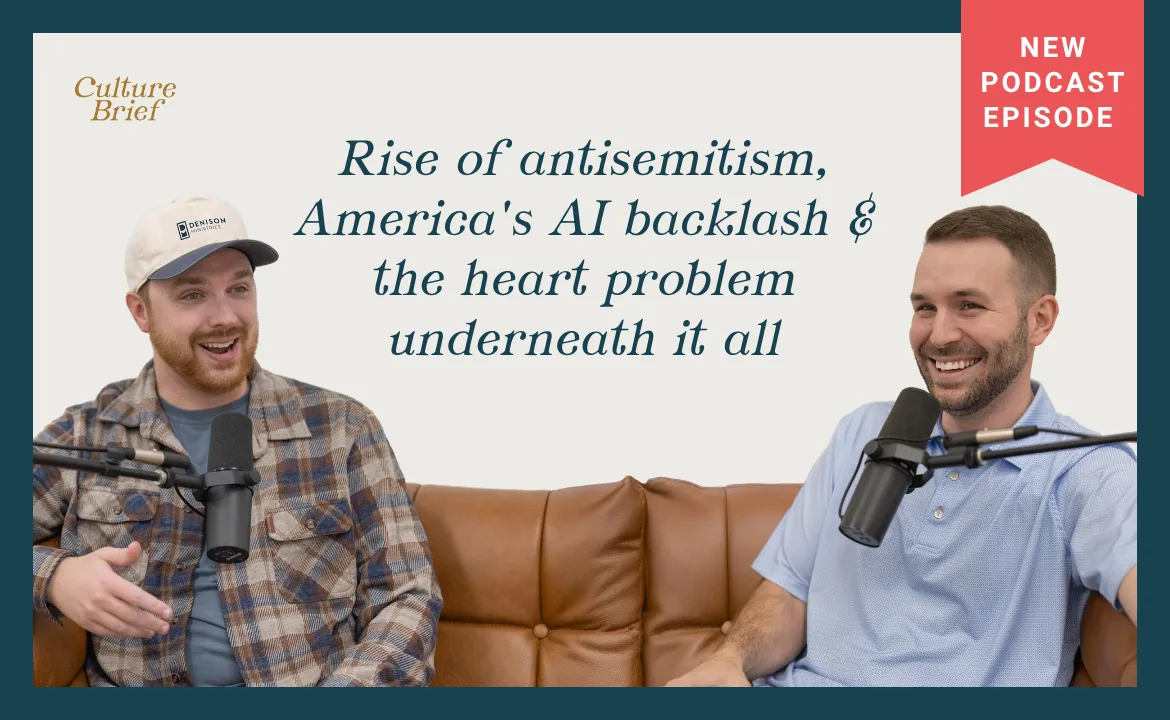
Culture Brief: Rise of antisemitism, America's AI backlash & the heart problem underneath it all | Ep. 70
In this week’s Brief: Micah Tomasella and Dr. Ryan Denison tackle two pressing cultural conversations — and find a deeper spiritual thread connecting them both.
First, they dig into a troubling trend: antisemitism is no longer lurking in the shadows. Drawing from pieces in The Free Press and Axios, they examine how weakly sourced accusations against Israel are quietly reviving ancient hatred in modern form, and how open threats against Jewish lawmakers are becoming disturbingly casual. They explore the historical and scriptural dimensions of why this hatred tends to rise in times of cultural pain — and why Christians should be paying close attention.
Then Ryan unpacks a Wall Street Journal report showing that Americans' negative feelings about AI may be growing even faster than the technology itself. From graduation speeches getting booed to massive data centers reshaping rural America, they talk honestly about the anxiety AI is stirring — and what our reaction to it reveals about our hearts.
The through-line? Whether it's antisemitism, AI, or any headline grabbing our attention, the deeper issue is the same: a culture losing its grip on truth, dignity, and trust in God. The invitation is to stop reacting and start surrendering.



Topics
- (0:00) Introduction
- (0:47) Connor on vacation
- (2:07) Anti-semitism rising
- (14:55) Americans turning on AI
- (17:20) AI in daily life
- (21:53) Data centers and division
- (26:12) AI and surrender to God
- (28:33) Faith over control
- (31:48) Conclusion
Resources
- Send us your thoughts, questions, and topic ideas: [email protected]
- Culture Brief Instagram
- Watch on Youtube
- Sign-up for a Denison Forum newsletter: DenisonForum.org/subscribe
Articles on this week’s top headlines:
- Jewish lawmakers face an explosion of antisemitism
- A Miscarriage of Journalism at “The New York Times”
- The American Rebellion Against AI Is Gaining Steam
- Let’s debate: Data centers
- FP Data Centers
- What Happens When a Data Center Comes to Town
About Dr. Ryan Denison
Dr. Ryan Denison is the Senior Editor for Theology at Denison Forum and the author of The Focus newsletter, contributing writing and research to many of the ministry’s productions. He holds a PhD in church history from B. H. Carroll Theological Institute and an MDiv from Truett Seminary. Ryan has also taught at B. H. Carroll and Dallas Baptist University. He and his wife, Candice, live in East Texas and have two children.
About Conner Jones
Conner Jones is the Director of Performance Marketing at Denison Ministries and Co-Hosts Denison Forum's "Culture Brief" podcast. He graduated from Dallas Baptist University in 2019 with a degree in Business Management. Conner passionately follows politics, sports, pop-culture, entertainment, and current events. He enjoys fishing, movie-going, and traveling the world with his wife and son.
About Micah Tomasella
Micah Tomasella is the Director of Advancement at Denison Ministries and co-hosts Denison Forum's "Culture Brief" podcast. A graduate of Dallas Baptist University, Micah is married to Emily, and together they are the proud parents of two daughters. With an extensive background in nonprofit work, finance, and real estate, Micah also brings experience from his years in pastoral church ministry.
About Denison Forum
Denison Forum exists to thoughtfully engage the issues of the day from a biblical perspective through The Daily Article email newsletter and podcast, the Faith & Clarity podcast, as well as many books and additional resources.
EPISODE TRANSCRIPT
NOTE: This transcript was AI-generated and has not been fully edited.
Micah Tomasella: [00:00:02] Well, hello there. I'm Micah Tomasella.
Ryan Denison: [00:00:05] And I'm Ryan Denison.
Micah Tomasella: [00:00:06] And this is Culture Brief, a Denison Forum podcast where we navigate the constant stream of stories and news, politics, sports, and pop culture and technology, and we're doing it all from a Christian perspective. What are we going to be talking about today, Ryan?
Ryan Denison: [00:00:22] Oh, just a few light subjects, like the rise of antisemitism and all that that means for our culture. And then we're also going to look at a growing trend where it seems like Americans are kind of starting to turn against AI. And so we're going to look at some of the implications of all that, the reasons why and just kind of see where the conversation goes.
Micah Tomasella: [00:00:38] Wonderful. Okay, so let's talk about all that and more and let's jump into the brief. Alright, so before I actually start my story on antisemitism, you're probably wondering, where is Connor Jones? Well, Connor Jones is on vacation right now and he won't be with us today. He'll be back next week. So Ryan, I'd venture to say this might be, this is episode 70 of Culture Brief. Can you believe it? This might end up being the best episode ever. What do you think, Ryan?
Ryan Denison: [00:01:10] I mean, it's got potential. We don't want to undersell Connor too much, but, you know, the vacation, we're just, we're wishing him well while he's away.
Micah Tomasella: [00:01:17] We are, we are. We hope he has a wonderful time. All jokes aside, we love Connor. We miss him. We'll see him back next week. But I'm very happy to have Dr. Ryan Denison on the podcast. He's been on the podcast with us several times. He writes quite a bit for Denison Forum and he is a PhD. He's the senior editor for theology at Denison Forum and the author of The Focus newsletter that comes out every single Tuesday. He's a contributing writer and research to many of the ministry's productions. He holds a PhD in church history from B. H. Carroll Theological Institute and has a master's of divinity from Truett Seminary. Ryan has also taught at B. H. Carroll and my alma mater, Dallas Baptist University. But more than that, I consider Ryan a friend. Ryan, thank you for joining us today.
Ryan Denison: [00:02:04] Thanks for the chance to be here. I'm excited for the conversation.
Micah Tomasella: [00:02:06] Let's do it. All right, so the first story, I'm going to talk about the rise of antisemitism and what it actually means. And I took two articles today that I focused from this from Axios and from the Free Press. So antisemitism, Ryan, is no longer hiding in the shadows. That's very clear. And I say no longer, I mean, obviously there's the Jewish people have been through so much. Think about the Holocaust, which was less than 100 years ago, right? But at the same time, there is more open hatred and vitriol that's almost becoming more mainstream. And I just think it's concerning and there was a couple articles that I read this week that really pointed it out to me. So one of those striking themes that was running through these two major publications, Ryan, was one was from the Free Press arguing that false or weakly sourced, W E A K, weakly sourced accusations against Israel are helping revive and put in the mainstream some old anti-Semitic narratives in modern form. Another form of it was noticed by Axios, which documented the explosion of direct anti-Semitic threats and rhetoric now aimed openly at Jewish lawmakers in America. And what's jarring is not just the existence of this hatred. Evil has always existed. What's jarring though is how casual it's becoming. Kind of the overall point I want to somewhat make here. According to Axios, Jewish members of Congress are receiving voicemails saying things like, Hitler was 100% right. You guys are going to be shot dead every day. One lawmaker said if people saw his social media messages, your jaw would simply drop to the floor. Another simply said, it's now just in the mainstream, accepted. That should sober all of us because antisemitism is not merely disagreement with Israel's government or policies. I want to clarify this. Healthy debate around governments and about government should exist in every free society, including Israel. Antisemitism is hostility, it's suspicion or hatred directed towards Jewish people simply because they're Jewish, something they didn't decide themselves. And history shows that this kind of hatred rarely begins with violence. That's not where it starts, not all of a sudden, it's violence, right? It usually begins with normalization, mockery, conspiracy, and just overall cultural indifference, just brushing it under the rug is not a big deal. So the deeper concern underneath all of this, I don't think is simply politics, Ryan, it's the erosion of truth itself. If we're living in an age where emotionally charged narratives spread faster than the actual verified facts, we are living in that type of age right now.
Ryan Denison: [00:04:48] No doubt.
Micah Tomasella: [00:04:49] Allegations quickly become assumptions. Viral clips become reality. There's no fact checking anymore. Outrage becomes currency. And once people are trained to hate, then the ability to really check facts and have some nuance in a subject, it evaporates pretty quickly. What are your thoughts on all this so far, Ryan?
Ryan Denison: [00:05:10] Yeah, I mean, I think so much of it goes back to the way you're outlining it there, I think is perfect because it highlights that so much of the problem, I think gets to this idea of when you denigrate an entire people and stuff like antisemitism or racism of any sort, I think what it does is it eliminates this middle ground where you can't have an honest discussion. You can't talk about Israel without antisemitism coming up. And so you can't talk about the finer nuances of this debate. You almost have to pick a side because when one side gets so vitriolic, when the antisemitism becomes so normalized that people are just used to seeing it and rightly condemn it, then it does make it hard to kind of have a have a conversation about any of the objective points without being afraid that you might be accused of antisemitism. And so it just polarizes both sides. Both sides when one side when one side becomes so polarized and so when it becomes so pervasive like that. So it's really hard. It just makes having any sort of discussion really difficult.
Micah Tomasella: [00:06:10] Yeah. Ryan, what do you think, you know, because I'm not going to dive into this in what I'm talking about. I'm not as much of an expert in this. What do you think the spiritual implications are in a society like ours where you do see antisemitism on the rise, whether if it's in history, biblically, spiritually, from your understanding, what what does that mean for our culture when we see something like antisemitism? What does it mean for our hearts, for just our spiritual state when we see antisemitism becoming more mainstream?
Ryan Denison: [00:06:38] I think it speaks to just a hurt that pervades so much of the culture. I mean, if you look at it historically, typically the the periods where antisemitism was the highest, where the Jews were targeted the most, were the time periods where people in general just needed someone to blame for their problems. If you look back at kind of the time around the Holocaust, you see that. If you go back to Europe and the way that they exiled, they tried to exile the Jews from Spain or other places in Europe, there's a general sense of pain and hurt and this this recognition that my life is not going the way it should. That leaves you with searching for someone to blame so that you don't have to blame yourself. At times people do that because the problems generally aren't their fault, but at other times it's just because you want a target. And we see a parallel even in early church history where Christians were targeted because they were a group that people recognized, but not a group that was powerful enough or a group that was large enough to where if the government or a large percentage of the population went after them, people were going to care. And I think historically, the Jewish people have often found themselves in a similar situation within a lot of Western society where people know of them, there's reputations and stereotypes around them and they just they kind of make an easy target at times. And I think it speaks to this idea of when people are hurting and when they're looking for someone to blame, often times they kind of go back to the Jewish people. And that's awful, but I think a lot of that is where the antisemitism comes from. It's a place of hurt, it's a place where people want to be able to pass the buck onto someone else and often times that ends up landing on the Jewish people.
Micah Tomasella: [00:08:15] It's just so unfortunate. Ryan, thank you for that breakdown. I appreciate the context. You know, this Free Press piece really got me thinking because it made the argument that some modern accusations against Israel are now being accepted and amplified with very little scrutiny, evidence or fairness applied to them. Now to be clear, no nation, again, I'm going to keep saying this, including Israel is beyond criticism or accountability. We've talked about Israel a lot on this podcast. But accusations this serious do demand evidence, honesty and due process, especially in a cultural environment already filled with rising hostility towards Jewish people. And Christians especially should pay more attention here, I think. Scripture is incredibly clear that the Jewish people hold a unique place in the story of redemption. Jesus was Jewish, unless I'm mistaken. He was Jewish, guys, okay? The apostles were Jewish. Paul writes in Romans that the gospel came to the Jew first, then to the Greek. That does not mean Jewish people are beyond criticism politically, just like no nation or government is beyond criticism. But there is a massive difference between legitimate disagreement and the dehumanization, which is what we're seeing, simply based on the way you were born, where you were born, what you look like, what your skin color is. Honestly, part of the danger right now is that many people can no longer tell the difference between the two. There seems to be this blurred line between legitimate criticism and debate and then we're just there really isn't a line between that and the just dehumanizing someone, devaluing them. And then that's when we start to see violence is when more and more culture accepts that in public debate and forum in a free society like this, that's when we see violence permeating more. Do you have any thoughts on that, Ryan?
Ryan Denison: [00:09:56] Yeah, I think a lot of it goes back to just asking the question of why are you offering that criticism? Like what are you hoping to accomplish by offering that criticism? If you're trying to bring to light facts that need to be discussed, then great. But if you do so in a way that denigrates people or that goes beyond the pale of the argument, then you're not helping yourself and it shows that your motivations aren't right and so the debate's not going to be right. But I think that's a lot of what we've seen in the media today is people looking at a situation, for example, in Gaza where there were some really bad things that happened. And people want a simple answer of someone to blame when the reality is like there's evil on both sides. There was tragedy on both sides. And that's not to say that there was more so one side than the other because I think it's also easy to get lost in there that none of that happens if Hamas doesn't attack Israel first. And none of that happens if Hamas doesn't use the people of Gaza as a human shield. And so like there's so much nuance required to have these debates well, but it just goes out the window when you start denigrating or talking about people as a whole or talking about Israel as equivalent to Jewish people around the world because they're not the same subject. They're related, but they're not the same.
Micah Tomasella: [00:11:07] Yeah, it's a good point, Ryan.
Ryan Denison: [00:11:07] And when you conflate those two, you lose sight of that.
Micah Tomasella: [00:11:09] Yeah, you know, I was thinking about all this comes under the microscope seemingly all of a sudden. Now again, Israel's been a big focal point in American life and we could get into that, all the lobbyists and all the money behind certain things and all the support, you know, but like it all comes under the microscope in 2023 when Israel gets attacked and those kibbutzes get attacked. And then all of a sudden, what we see happen in Gaza unfolds and it just becomes like just at the top of every American's mind, it feels like, you know, because we're speaking from an American's perspective, a Christian's perspective here in America. And then all of a sudden, everyone's trying to give a a simple one, two, three step solution to this when this is thousands of years of political, historical, national, regional history playing out all at once in this moment in time. And so people, of course, I mean, overall, you're just making a good point that people don't want to keep peeling back the onion because it's more complicated. But we do, we got to pull back the multiple layers of that onion to understand what's going on over there and why this is taking place. And we're just trying to do that kind of in a small way. But, you know, this is a heart problem, Ryan, all of this. This is a heart problem, a sin problem. It reflects the same sinful tendencies scripture warns us about over and over and over again, pride, tribalism, rage, envy, fear, deception, the desire to blame, quote unquote, those people for the problems around us. History has shown repeatedly that when societies lose their grip on truth, a foundational truth, dignity and moral clarity, hatred fills the vacuum quickly. Satan gets to work, right? So the question for Christians is not simply whether antisemitism is rising, it is. The question is whether we ourselves are becoming people shaped more by outrage, whatever topic we're talking about, and tribalism, then we are by God's truth and God's love. Romans 12:21, do not overcome evil by evil, but overcome evil with good. That verse feels especially relevant right now because once hatred becomes more normal, societies begin losing something much deeper than just the ability to be civil with each other. They lose their grip on what I talked about, truth, and what I believe is God's truth, dignity, given to us by God, and ultimately, their need for a God. So, that's all I got on that one.
Ryan Denison: [00:13:37] And one thing I would add to that is just, I do think a lot of this gets back to again, the idea that we want to see ourselves as individuals, but the world makes more sense when we view everybody else as a collective. None of us want to be judged or lopped in with our political parties, with our race, with our even with our religion. Like we're we're called to see ourselves as Christians, but what that means on a practical basis is that I am a follower of Christ, less so than that the global Christianity necessarily represents me as an individual. But we want to do that with other people. And especially with so much of antisemitism, it comes from the place like you were describing where we just we want to view a group of people as if the actions of a nation of Israel or the stereotypes of a certain aspect of that demographic represent the whole. And we do that with so many other areas of our lives as well, where we just forget that at the end of the day, God created us to be individuals. And we're meant to see each other as individuals. And to whatever extent there are collective traits, then we can talk about that, but we can't lose sight of the individuals in the process. And I think it really makes it a lot easier to have the kind of conversations you're talking about when we remember that.
Micah Tomasella: [00:14:49] Yeah, man, great, great reminder. Thanks for that, Ryan. All right, talk to us about the feelings that people are having about AI these days, my friend.
Ryan Denison: [00:15:01] Yeah, it's it's interesting. I'm working mostly from there was a Wall Street Journal article that led off by saying the only thing growing faster than the artificial intelligence industry may be Americans' negative feelings about it. And that just clicked when I was reading that because that's kind of how I feel. And kind of what we were just talking about with individuals versus collective, I think we have to be careful not to talk in, you know, too wide a swath of the population because there are very diverse feelings and very diverse reasons for those feelings among Americans. But it's been interesting how like for a while, people got really excited about AI, it seems like. There was always the jokes about, you know, like, is this going to end in the end of civilization? I've seen this movie before, all that kind of stuff that were maybe a little more like quasi joking than actual joking in some ways. But it's been interesting how recently we're seeing more and more where that seems like it really does, there's this fear related to it as well. And I think part of the pivot is when AI went from being a useful tool that could help us in our work to something that threatens our work and to something that threatens to kind of take our place in the world. When it was just helping us have an easier life or when it was just helping us to do our jobs better, that was one thing. When it becomes a threat to those jobs, that's another. And I think we're starting to see that more and more. And one of the stories that caught my eye recently was that there have been several college graduations where the commencement speaker gets up and starts talking about AI in these terms of like one speaker at the University of Central Florida, I think, likened it to a new industrial revolution. And others have talked about how it's just it's going to change the way we do the world and how it's going to make our lives better. And a lot of these students, it just started booing in the middle of the commencement speech to the point that I saw that. You see the speaker just kind of turns to the others and goes like, what's going on here? And so much of it, I think gets back to just just general angst because there is a growing, that's the young people that are graduating today that are having trouble finding jobs because of AI. And I talked about this in Tuesday's focus this week and went into some of the other details there on it. But it's just in general, there does seem to be this transition where as one of the graduates put it, he described the booing as quote, just sort of like a collective this sucks. And I think that just that epitomizes the way a lot of people are starting to see the way that it's changing society. But what are your thoughts on it, Micah?
Micah Tomasella: [00:17:20] Man, it's tough. I think it kind of depends on like what your line of work is. Like I strategically picked some roles in my career that are very relationally forward. And so it's like, I think about it on a personal level of, okay, there are so many tools we're trying to optimize and work on and integrate into our work and into our life, you know, how it it helps me plan my workouts. It it helps me take some random ingredients I have in the fridge or the the pantry. And what can I make from this, you know? And then you make something out of it, right? It it helps me put fun things together for my kids. Like I used AI to put this whole like March Madness bracket where my oldest daughter was was picking between the mascots. And so something that would have taken me hours, like an hours, hours and hours of slideshows for all of these picks. Like AI did it in five seconds. I mean, you know, there's so much fun and ease that can come from it. And I think the answer cannot be to bury your head in the sand and say, oh, well, I'm, you know, I'm just never going to use AI. Well, I mean, look, like we've got to adapt to the tools that are out there. We've got to improve our skills and if we're still working age, you know, those that are listening, like we need to get on board with this and understand it. That doesn't mean you have to have all the answers that you have to be on the leading edge of the technology. However, don't shun it just because it's different or just because it overwhelms you. Just take it a bite size at a time. I'm not an AI expert by any means, but I have been using it for the last several years and it has been helpful. But at the same time, I do totally get the angst that we're seeing in culture. But see, the thing is, Ryan, with antisemitism, with this topic, with what's going on with Iran, with all of the political stuff happening right now, even these like Republican races in the house and in the Senate, you know, all this stuff, whatever, pick your topic. The American reaction is similar. It's angst. It's frustration. It's fear. It's a lack of understanding. It's seeking to be heard rather than to listen. It's a sin problem. 100%. We're losing our way in the and I'm not doom and gloom here. I'm just saying like we're losing our way in understanding who we are. You talked about earlier the importance of being an individual. An individual, imago dei, created in God's image for a special purpose, a unique purpose, a unique plan that all of us have the ability to grab hold of as we've been created by God and for God. We're losing that. And so I think when it comes to AI, no matter what the fear might be, no matter what the revolution might be, AI or whatever comes next, the next pandemic, the next issue, right? We're reacting the same. Aren't we? I'm probably taking this a different way than you thought, but I just feel like we're reacting the same way to everything. We're just anxious. We're just nervous. We're just yelling. We're not listening. We're not talking to our neighbor. We're not trusting God. And look at what's happening.
Ryan Denison: [00:20:09] Absolutely. And I think it brings up a great point that so much of this does come from a place of when you're already high anxiety, when you're already fearful, when you're already dubious of what the future is going to hold, all of which describes the younger generations that are starting to turn against AI, then like any fears you might have become so easy just to go kind of off the deep end in terms of apocalyptic ways that this could all turn out. And because I do think there's a lot of good in AI that AI can do. I've been sort of a late adopter to it to an extent, but the more I'm starting to use it, it really is helpful when it's a tool. The problem is when it becomes more of a crutch. And I think that's kind of what we're starting to see is that it's becoming something that people just it becomes so integrated into our lives that it's it is kind of difficult at times to see a world in which this doesn't exist or a world like to or to foresee what the world might be.
Micah Tomasella: [00:21:02] Kind of like what smartphones did to us.
Ryan Denison: [00:21:03] Absolutely.
Micah Tomasella: [00:21:04] I mean, we are attached at the hip with these things.
Ryan Denison: [00:21:07] Oh, 100%.
Micah Tomasella: [00:21:08] You know what I mean? And so in the same way, it's like we used to be able to do the simplest tasks without AI and then now it's almost like, how do I even do this without it? And you know, in the same way, it's like you can't go anywhere without this thing. I've got to constantly be available. Other people, there's an expectation they should be constantly available. I mean, I'm just thinking about, you know, AI is much more powerful in a sense than just like the invention of the smartphone, but I think it's having a similar cultural effect.
Ryan Denison: [00:21:32] Absolutely. And it does kind of change the way that we see like when it becomes integrated into your life, but you're talking with or working with people who are maybe opposed to it, it creates a pretty big dividing line between how you see the world. And I think that's another piece of it is like we're not lacking in things to divide us in this world. And I think AI is quickly just adding to that list. But I think another aspect of it too is just as it becomes better developed and as it becomes more pervasive, the requirements that go into it are going to increase as well. Like another thing I talked about in the focus article on it is how there's now a push to build these new data centers to house it all. They're trying to put one in Ohio that's essentially the size of 1,200 football fields and uses as much electricity as the entirety of New York City to run it. Wow. And so part of that size is it's like a 10, I think they said like a 10 gigawatt data center that takes like a 9.2 gigawatt natural gas power plant to run it. And so they're trying to kind of to make it self-reliant so it's not going to be as big of a drain on the communities around it, but you're starting to see like a lot of rural America kind of go against this because it's the places that there's not a lot of places you can find that much land. And so I think it's further dividing our even American society along the lines of those who are just going to benefit from AI and those who are going to have to be around kind of where the sausage is being made with it a bit more. And you're starting to see Elon Musk talk about how he thinks in the next two or three years, we're just going to move it all to space or at least start putting data centers in space, but they're a long ways off from making that economically viable. But that is sort of an alternative.
Micah Tomasella: [00:23:06] Not a bad idea, though. Not a bad idea. I don't hate that idea if it was viable.
Ryan Denison: [00:23:09] They're working on it. They're working. And I've kind of given up on thinking Elon Musk is overshooting his capacities because every time someone tells me he can't do it, it's like, no, I'm going to do it just even faster than I said I would. So we'll see.
Micah Tomasella: [00:23:21] No, I mean, he's controversial, but he's got the brain power and more importantly, he's got the money to do whatever he wants.
Ryan Denison: [00:23:26] No doubt there.
Micah Tomasella: [00:23:27] But Ryan, I didn't interrupt you here, but like what's striking me here with this issue specifically with the AI issue, I am not calling this issue first world problems, but I'm just thinking about maybe third world countries in Africa or Central or South America, Asia, you know, whatever you would want to say. They're probably is less concern in those places because they're just trying to find their next meal to feed their family, to find running water, right? Like to find clean water to drink. Like we are dealing with a lot of first world American problems. And you know, AI is more than that. But I'm just saying we also have such a good life here in America compared to a lot of places in the world that we have the luxury to get stressed out about the things that we're getting stressed out about. What are your thoughts on that?
Ryan Denison: [00:24:15] No, I think that's an important point to keep in mind that there's that old cliche of like just go and touch grass. And I think that's something that I know I've told my kids at times where they're kind of holed up with the tablet or video games or something like that. It's like, all right, you just need to go outside for a bit. And there is something about kind of just being intentional about getting out of the head space that makes you concerned or about the head space that makes it feel like these problems are bigger than they are. That can be really helpful.
Micah Tomasella: [00:24:40] Get off social media for a little bit, you know, let's take a break. Yeah, totally.
Ryan Denison: [00:24:44] I mean, like biblical fasting doesn't have to be just food. The best thing I ever gave up for Lent one year was was Twitter back when it was still Twitter. And I'm since been on it because it's hard for me to do my job without it, but it was amazing the difference it made and how much I realized like, I don't need to be nearly as informed as I am about a lot of this stuff.
Micah Tomasella: [00:25:03] Man, I feel that too, brother, with this podcast. It's like, I don't need to know all this, right? But you're just reading through all of it to make sure you don't miss anything. Yeah, totally.
Ryan Denison: [00:25:12] Absolutely. And a lot of it is based on fear of like, what's going to happen if I don't know this right when it happens? It's like, well, then I'll find out tomorrow and everything will be fine. Everything will be fine. And I think AI exacerbates that a little bit because a lot of the way that it's impacted our lives is it gives us more free time. And Americans for the most part, I think are pretty crappy at spending our free time well.
Micah Tomasella: [00:25:31] Yeah, do we need more free time? You know, honestly.
Ryan Denison: [00:25:33] I think that's I mean, I know I could, it feels like I could use it, but I also know that if I got it, I don't know that I would use it well. Like I'm probably not using it to go to bed earlier and get more sleep. I'm probably not using it to relax or stuff like that more often. I'm probably just going to fill that space with more of the other stuff I'm doing. And I think that's another impact of AI is that it's just making it easier and easier to fill our lives with the things that stress us out the most because it's a lot of the more mundane tasks that give us time to think or that give us time to kind of just press pause on all the other stuff in life that are going away with AI.
Micah Tomasella: [00:26:08] That's good and practical, man. Yeah, I like that.
Ryan Denison: [00:26:10] So, yeah, but to take us kind of in a spiritual direction, where it felt like where I was I was thinking about this, where God kind of hit me upside the head with is a lot of the fear around AI and a lot of the anxiety comes from like you were describing earlier, this place of like you really can't go forward in modern society, it feels like without at least being functional with AI. It feels like it's quickly becoming that important and that pervasive. And as a result, I think you got a lot of people that they'll get used to it, they'll adopt it, but it's almost against their will. It's like a necessary evil to do their job. And I felt like as I was thinking about that, because that epitomized a lot of the way that I feel about certain aspects of it, God just kind of hit me upside the head and was like, well, you treat me the same way sometimes where our relationship with God functions as something where it's like, okay, I know I don't want to go to hell. I believe that Jesus is the only way to salvation. I believe that God's will for my life is best, but man, I wish I I wish it didn't have to be that way. I wish I could be the one to just kind of like be in charge of my day for today. I wish I didn't have to rely on God for all this.
Micah Tomasella: [00:27:13] I'm getting convicted, Ryan, stop it. Getting convicted.
Ryan Denison: [00:27:15] Well, because I do think like if you're a good Christian, like good Christian person, then you believe that's true, but it doesn't mean that you like the fact that it's true. And I think there's just there's a difference between kind of accepting that God is king and accepting that he needs to be your king versus embracing that fact. And our lives are so much better when we can just embrace it and truly turn them over to him. Not against our will, not with hesitations. C.S. Lewis talks about how we often treat as taxes, like we pay what we have to and hope there's enough left over for ourselves. And I do think that's kind of one of the problems I know I face in my walk with God is waking up some days and just wishing that I just wish I could be in charge this time. And I wish that would be okay. And when I understand that it's not, it just makes me kind of angry or it makes me kind of resentful on some level. And I just it's such a hindrance in our walk with God when that happens. But what are your thoughts on that?
Micah Tomasella: [00:28:29] It's a great point, man. Oh my goodness. I have 50,000 thoughts on that. I'll just go to the one of the last things that you said there as we wrap up is I want to be in charge because if I put in enough effort and if I'm good enough and if I can implement this, then it'll be fixed. Well, I don't know that, but also I can think about the many, many times in my life where I tried to take control, maybe where I did take control, maybe where I tried to, didn't really work out the way that I was planning, right? I mean, you know, you think about faith. Why do I need faith? Well, I struggle, I sin, I live in a fallen world. I'm separated. I was separated from God because of my sin, because of my struggle, because of my inability to connect to God. But then Jesus changed everything, the salvation that his death, burial and resurrection offers. And out of that mindset, we're able to trust and say, you know what, like I didn't have this situation pegged this way. I wouldn't have done it this exact way, but often times hindsight teaches us something different. God's so good. The Holy Spirit's so good to trigger something or show us something over time where we look back and you're like, man, I'm glad that didn't work out the way that I tried to make that work out. Like I tried to really maneuver and grasp it and grip it and try to force it into something that it wasn't supposed to be. Ultimately, I don't want to be in control. Like overall, 30,000 foot view, I don't want to be in control. I'd rather the God of the universe be in control. However, moment by moment, day by day, the amount of things we try to take control of, oh, it's a lot, right? And I don't know, man, just doesn't normally work out when I try to do that, you know?
Ryan Denison: [00:30:11] 100%. And probably my favorite Bible verse is Mark 9:24 where there's the father of the epileptic child who goes and asks Jesus to heal him. The father tells Jesus like, if you can heal him. And Jesus's response is like, if all things are possible with God. And the father immediately replies like, I believe, help my unbelief. And that verse is like my life verse in so many ways where it's just I want to believe, I want to trust, I want to just get past this desire to be my own king and just turn all that over to God. And a lot of days it just I seem incapable of it. And I love the fact that Jesus honors that prayer, that the desire to believe is enough for Jesus to step in and give that healing, for Jesus to step in and say like, all right, I can work with that.
Micah Tomasella: [00:30:58] That's how good our God is, Ryan. That's how good Jesus is. Not only is he worthy of our love, adoration and belief, but he'll actually take it a step further and help us in our unbelief. Right? He will help us, strengthen us, empower us when we humble ourselves, we come before him. I'm really struggling with this. I'm not trusting you in this situation. God. Coming to that recognition and bringing it to God can change everything. Maybe not always the actual circumstance, but it'll change us through it. And I think that that verse in Mark 9:24, I've I love that verse too. I've taught a few sermons on this verse before, right? Just that concept, but often times that heart change, God can do a lot through that and just the recognition of our sin and our struggle, bringing it before God, those two steps can change a whole lot of things. Well, Ryan, thank you for breaking down that story for us. Guys, we just did something different today. We're about to wrap up here, but we just did something different today where we are covering two stories where we were just hitting it from multiple different angles and just really diving into it and the spiritual applications from it when it comes to antisemitism, AI, whatever it might be. That's what we're trying to do here on Culture Brief is just let's talk about things a little bit differently. Let's have some discourse that's just a little bit different. Let's dive beneath the surface of partisan politics, see what God's word has to say for it. And when can we and how can we bring these issues before God and actually have him work through it and disciple us and grow us through it, sanctify us through it. I just think there's a lot that God's trying to teach us through the news and through current events and that's just what we're trying to do. So we want to continue to hear from all of you. Send us your questions, your thoughts or your topic ideas to [email protected] and you can also follow us on Instagram at the Culture Brief podcast. You can send us a DM on there and we'll get to those questions and those thoughts. Dr. Ryan Denison, thank you for joining us today for this week's episode of Culture Brief, a Denison Forum podcast. All the articles and videos mentioned will be linked in the show notes and if you want to help us reach more believers with truth in today's culture, today's chaotic culture, please share this podcast around and leave us a five-star rating and review and we'll see you next Thursday.








 Search