



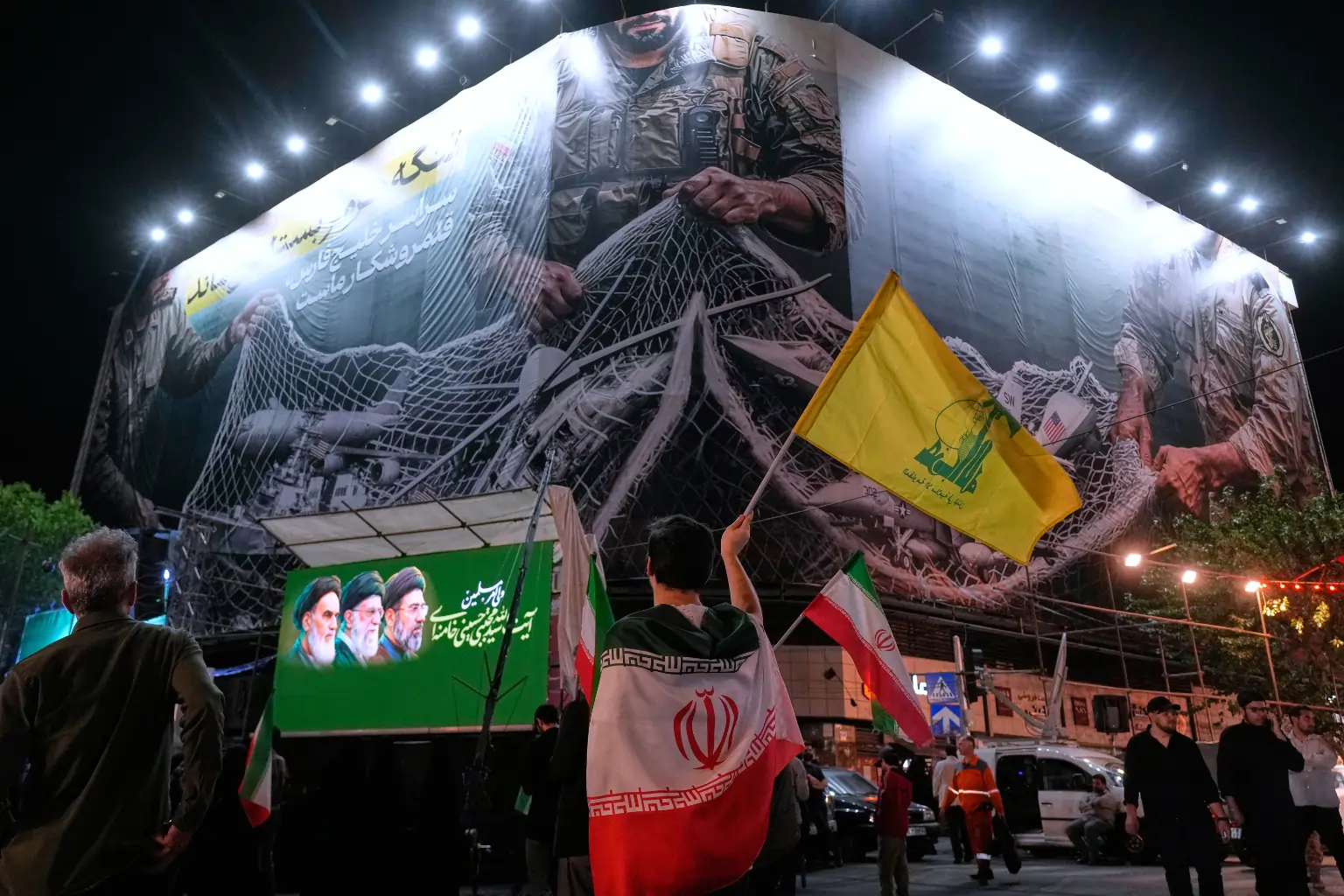
An Iranian demonstrator waves a flag of Lebanon's militant Hezbollah group under an anti-U.S. billboard depicting the American aircrafts into the Iranian armed forces fishing net with signs that read in Farsi: "The Strait of Hormuz will remain closed, The entire Persian Gulf is our hunting ground," during a pro-government gathering at Enqelab-e-Eslami, or Islamic Revolution, square in Tehran, Iran, Monday, May 4, 2026. (AP Photo/Vahid Salemi)


Iran said this morning that it had targeted a US air base in response to recent US military attacks.According to Forbes, a deal over the Strait of Hormuz now “hangs in [the] balance.”
The US shot down four Iranian drones and struck a ground control station near the Strait of Hormuz that its military assessed as presenting a direct threat to American forces and commercial shipping. Iran’s announcement today came as US ally Kuwait reported its air defenses were responding to “hostile missile and drone threats.”
Hours earlier, President Trump signaled that an agreement between the two sides wasn’t close. The global oil benchmark soared above $98 per barrel early this morning after reports of the attacks emerged.
When Americans were captured at the US Embassy in Tehran in 1979, ABC News covered the ongoing crisis under the title, “America Held Hostage.” It seems we have been held hostage to Iran ever since.
Our country is six times larger than theirs; our population is nearly four times larger. Our economy is over sixty times larger than theirs. They are some six thousand miles from us. And yet, for my entire adult life, Iran has been in our headlines, nearly always for nefarious reasons.
Why can’t the West solve this problem in a permanent way?
Three lessons that explain Iran’s worldview
In Foreign Policy, Middle East journalist and researcher Ali Hashem writes, “The world keeps asking Iran the wrong question.” He notes that Iran is best understood not in light of its 1979 Islamic revolution but in terms of its enduring geopolitical and social realities.
The country is positioned at the junction of Central Asia, South Asia, and the Middle East. As a result, Hashem writes, “Every major land empire has had to engage with it.” Consequently, he reports that its leaders over the centuries have learned three lessons.
One: “Weakness invites intervention.” The Treaty of Gulistan in 1813 and the Treaty of Turkmenchay in 1928 cost Iran its Caucasian territories; the Anglo-Russian Convention of 1907 divided the country without consulting Iranian officials. According to Hashem, the nation’s leaders learned that a state that cannot project deterrence “will find its sovereignty administered from the outside.” This explains Iran’s nuclear program, its regional proxies, and its missile arsenal, all intended to defend the nation’s sovereignty.
Two: “Sovereignty is not negotiable.” The tobacco revolt of the early 1890s and the nationalization of the Anglo-Iranian Oil Company in 1951 taught Iran’s leaders the peril of negotiating with foreign powers.
Three: “Iran does not think of itself as a regional power.” Former Supreme Leader Ayatollah Ruhollah Khomeini meant it when he said he would export the revolution to the four corners of the world. The current economic shocks from Iran’s closure of the Strait of Hormuz are just one example of its outsized impact on global geopolitics. I would add that its military and political/clerical leaders are also united in seeking to attack the West to hasten the return of the Mahdi, their messiah.
As a result, Hashem believes that Iran will not accept negotiations seen by its people as inviting foreign intervention and control, compromising their sovereignty, or constraining their global ambitions.
Metanarratives of the soul
Here is the assertion that frames Hashem’s analysis: “The more useful question is what Iran wants; not this government, not this supreme leader, but the state whose strategic instincts were shaped long before the revolution and have survived every change of system since.”
His statement calls to mind what geopolitical analyst George Friedman calls “metanarratives,” overarching cultural and strategic ambitions held by nations that explain their past and predict their future. Vladimir Putin wants to restore “Mother Russia”; Xi Jinping wants to elevate China to the superpower status it believes it deserves.
The same is true of individuals: You have a reason for living, a purpose that frames and focuses your life. Or, if you do not, your lack of purpose similarly defines your days.
Our metanarrative, the commission to which Jesus calls us, is clear: “Make disciples of all nations” (Matthew 28:19). Everything we do is to be a means to this end. Your job, school, and home are your mission field. Your gifts, abilities, and resources are instruments intended for this purpose.
But to make disciples of Jesus, we must be disciples of Jesus. We cannot give what we do not have or lead people where we will not go. To lead people to Jesus, we must walk with Jesus.
The life we were made to experience
We have focused this week on reasons to seek an intimate, transforming relationship with our living Lord. Here we find the most foundational of all: this is the life we were created to experience.
Before the Fall, our primordial parents lived in conversational relationship with God in the garden he created for them. When our Lord returns to our fallen planet, we will return to such a “garden” with its “tree of life” (Revelation 22:2).
In between, Jesus is working every day to reverse the Fall in our lives and world (cf. Ezekiel 34:15–16). His atoning death purchased our salvation and restored believers to right relationship with our Father (Romans 5:1). Now his Spirit wants to sanctify us completely (1 Peter 1:2) until we experience and manifest the very character of Christ (Romans 8:29; Ephesians 5:1–2).
One day, “when [Jesus] appears we shall be like him, because we shall see him as he is” (1 John 3:2). In the meantime, our job is to walk so closely with Jesus that we become like Jesus.
The great evangelist Dwight Moody testified,
“If I walk with the world, I can’t walk with God.”
Choose wisely today.
Quote for the day:
“We are all servants. The only question is whom we will serve.” —R. C. Sproul
Our latest website resources:
- Everyday Evangelism: The BLESS Method with Kevin Palau
- Does the anti-weaponization fund grant justice or subvert it?
- The altars of our culture’s excess: How gambling, drugs, and lust became our modern idols
- A choice between life or death
- Rise of antisemitism, America’s AI backlash & the heart problem underneath it all










 Search