



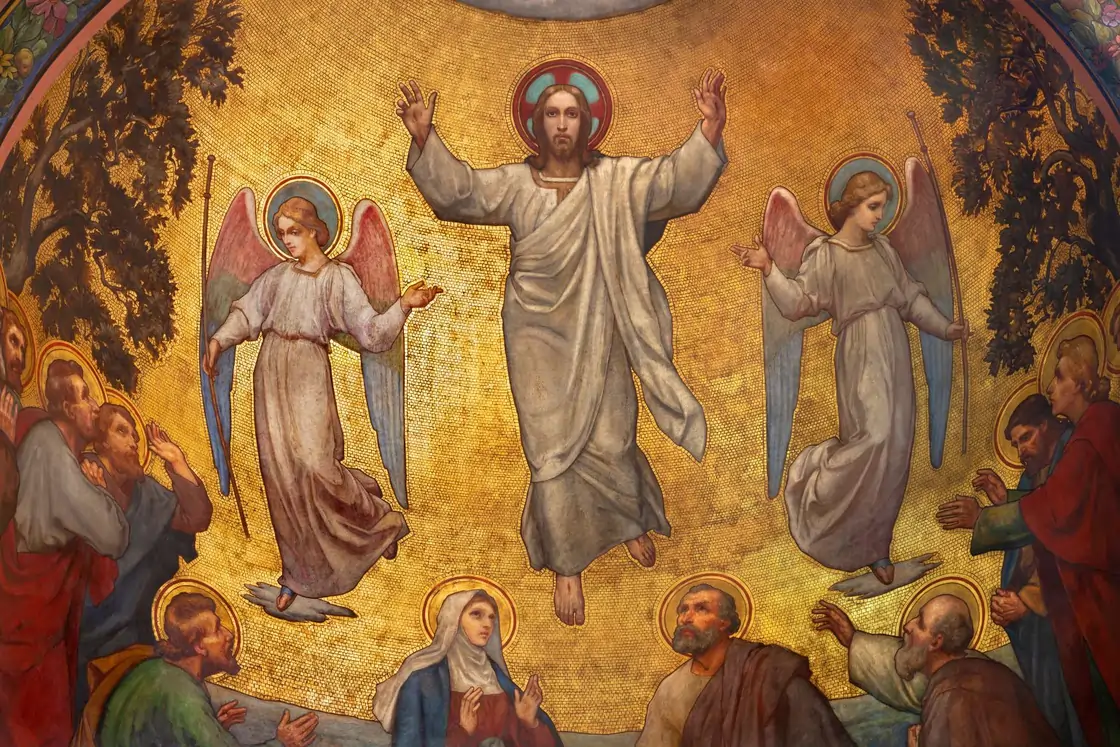
PRAGUE, CZECH REPUBLIC - OCTOBER 13, 2018: The fresco of Ascension of Jesus in side apse of church kostel Svatého Václava by S. G. Rudl (1900). by Renáta Sedmáková/adobe.stock.com
May 14 is Ascension Day, the day each year when Christians remember Jesus’ return to heaven forty days after Easter Sunday. On this day, Luke writes: “[Jesus] led [his disciples] out as far as Bethany, and lifting up his hands he blessed them. While he blessed them, he parted from them and was carried up into heaven” (Luke 24:50–51). Luke similarly reports that after Jesus’ resurrection, he stayed with his disciples “during forty days” (Acts 1:3), after which “he was lifted up, and a cloud took him out of their sight” (v. 9).
In considering the Ascension, a question came to my mind that I had never asked before: Why did Jesus return to heaven?
What follows is merely a thought exercise, but I hope you’ll come along with me for a very practical reason with which I’ll conclude.
If Jesus were still walking on stormy seas
In answering my question, I thought immediately of Jesus’ promise to his followers: “It is to your advantage that I go away, for if I do not go away, the Helper will not come to you. But if I go, I will send him to you” (John 16:7). In other words, Jesus ascended to heaven so the Holy Spirit could descend to the earth at Pentecost (Acts 2:1–4).
I understand the logic of this: Two billion Christians empowered by the Holy Spirit can do more in the world than Jesus could do in a single human body (cf. John 14:12). But why did Jesus have to leave so the Spirit could come? Why couldn’t he stay and work alongside us?
I also understand that he returned to heaven to “prepare a place” for us there (John 14:2), and that he will return visibly from heaven to earth one day at his Second Coming (Matthew 24:30; Acts 1:11; Revelation 1:7).
But, while I have no real idea what Jesus is doing to “prepare” heaven for us, it seems to me that an omniscient and omnipotent Being wouldn’t have to be there to do it. And while I certainly believe in the visible Second Coming, it seems that the risen Christ could have remained on earth and then ascended to heaven just so he could return in this way.
In addition, I recognize that Jesus returned to heaven so he could sit “at the right hand of God,” where he is “interceding for us” (Romans 8:34). But he interceded for his followers while on earth (cf. John 17:20–21). Why could he not continue to do so here?
Conversely, he is now our “great high priest who has passed through the heavens” to whom we can “draw near” to “receive mercy and find grace to help in time of need” (Hebrews 4:14, 16). But could we not pray to him on earth just as we pray to him in heaven?
Imagine the impact if the risen Lord were still here walking on stormy seas, healing sick bodies, and raising dead corpses. Imagine the difference his teaching ministry would make in our day of global social media.
I agree that this is an odd thought. And I certainly trust that our Lord did the right thing in his ascension and return to heaven. But there’s more to my thought experiment on the subject.
Three answers that are not answers
One logical answer to my question is that Jesus inhabited a physical body that aged such that he “increased in wisdom and in stature” (Luke 2:52). If he had remained in that aging body, it would be more than two thousand years old by now.
But after his resurrection, he inhabited a very different kind of body. He was still recognizable to his followers (cf. John 20:18, 27), but he could now appear through locked doors (v. 19) and in a body that physically rose into the sky and back into heaven (Acts 1:9–11).
Why couldn’t he stay on earth in this resurrected body?
A second logical response would be that we would then be overly reliant on him to do what he calls us to do. If a lost person were sitting on an airplane between Billy Graham and me, I think I would stay out of the way and allow the great evangelist to share the gospel with them. If I were talking with NT Wright when a friend approached us to ask a question about New Testament theology, I would step aside to allow the world-class theologian to respond.
But Jesus would be in only one physical location on the planet. Surely his presence there would not deter the rest of us across the rest of the world from doing what we are called to do.
A third logical option is that people would perhaps see his miracles and respond to him less out of faith than out of logic, committing themselves to him so long as he did what they expected and abandoning him if he did not. But this is just how some did respond to him on earth (cf. John 6:26), a fact that did not deter his ministry.
“Usually something you could not have guessed”
Here’s the bottom line: while I understand that Jesus ascended to heaven to prepare it for us and to intercede there for us as his Spirit inhabits believers on earth, I don’t fully understand why our risen Lord had to do so.
Now I have a decision to make: I can choose not to believe in the Ascension because I don’t understand it, or I can choose to believe in the Ascension because I don’t understand it.
In Mere Christianity, CS Lewis noted that he believed in Christianity because it is “usually something you could not have guessed” or made up. As I have often said in response to questions about God’s nature and will, if we could fully understand God, either we would be God, or he would not be.
Here we find another example of the fact that the Bible is a practical book. It tells us what we need to know, but not all we want to know. If we will not trust in Christ until we understand how God can be three in one, Jesus could be fully divine and fully human, or the Lord can be sovereign while we are free, we will persist in our unbelief.
But choosing not to decide is to decide. We then risk our eternal destiny because our finite, fallen minds cannot fully understand the Ultimate Being.
Imagine such unbelief in any other dimension of life: we won’t drive a car until we understand its steering mechanism, or use a computer until we understand its software, or swallow medication until we understand how it was made.
Of course, someone fully understands my car, computer, and medications. Someone has complete rational comprehension of their manufacture and operation. However, no one fully understands God and his ways.
This is just one more reason we need to trust him.
Paul testified, “We walk by faith, not by sight” (2 Corinthians 5:7).
Why do you need to join him today?











 Search