


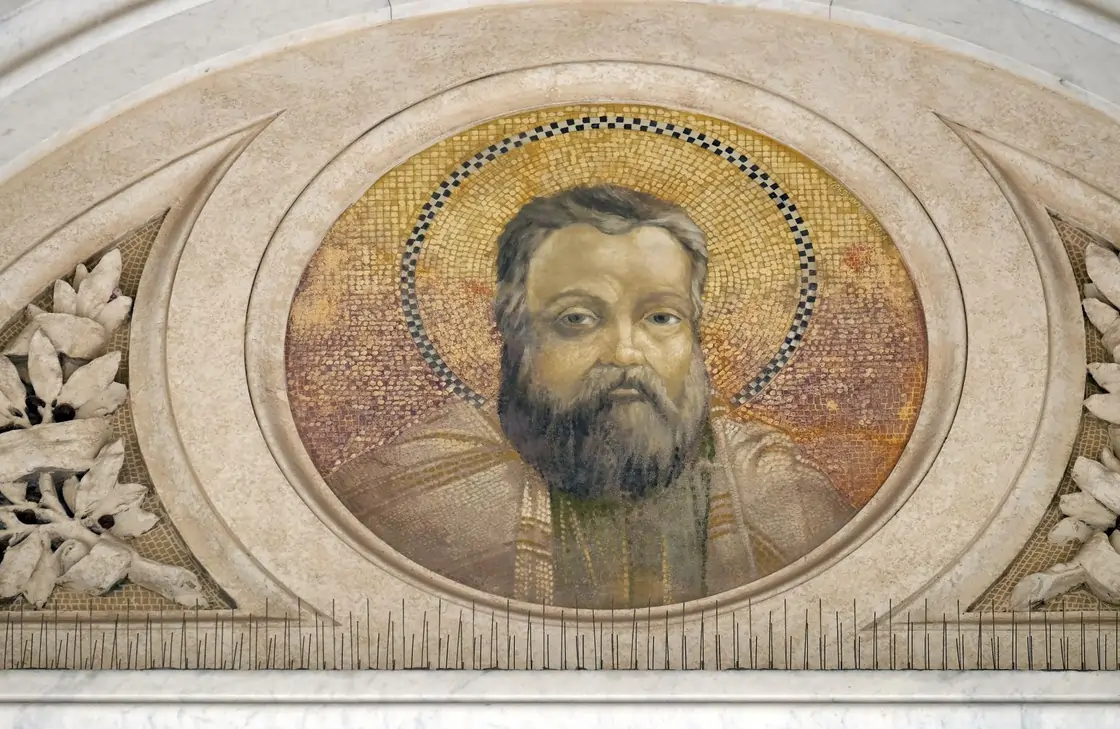
Saint Matthias the Apostle mosaic in the basilica of Saint Paul Outside the Walls, Rome, Italy By zatletic/stock.adobe.com
This Washington Post headline caught my eye: “They knew they were dying soon, so they threw a party.” The subtitle explains that “living funerals—where people near the end of life plan and attend their own memorials—are becoming increasingly popular.”
According to columnist Sydney Page, “a small but growing number of people” are choosing to hold such gatherings prior to their death. She points to research indicating that living funerals can have mental health benefits for the person dying and for those around them: “They can foster connection and community, reduce loneliness, and offer a sense of closure.”
In addition, “they provide something traditional funerals cannot: the opportunity for a person with a terminal diagnosis to see the impact they had on the lives of others, while giving survivors the chance to share their gratitude face-to-face.”
I understand the sentiment. There is something in us that wants to know that we are important beyond ourselves, that we are leaving a mark that matters. I see this as a “signal of transcendence,” an indication that we are made in God’s eternal image and thus share an innate desire for eternal significance.
The less we feel seen by the world, the stronger this desire becomes.
“The lot fell on Matthias”
Many liturgical Christians remember Matthias on May 14. All we know about him in Scripture comes from Acts 1, where Peter called on the gathered disciples to choose an apostle to replace Judas (vv. 15–20). He described the qualifications to be considered:
One of the men who have accompanied us during all the time that the Lord Jesus went in and out among us, beginning from the baptism of John until the day when he was taken up from us—one of these men must become with us a witness to his resurrection (vv. 21–22).
Accordingly, the assembly nominated two men, “Joseph called Barsabbas, who was also called Justus, and Matthias” (v. 23). The gathering prayed, asking the Lord to show which of the two he had chosen to take Judas’ place (vv. 24–25). Then “they cast lots for them, and the lot fell on Matthias, and he was numbered with the eleven apostles” (v. 26).
Here’s the part of the story that caught my eye: the apostles knew that “Joseph called Barsabbas” and Matthias had “accompanied” them from Jesus’ baptism by John until his ascension. And yet we find nothing about them in the four Gospels. Not one word, despite the apparent faithfulness of men who would devote themselves to following Jesus as faithfully as the twelve named by the Scriptures.
And they were not alone in their anonymity: the group that nominated them “was in all about 120” in number (Acts 1:15). Not to mention that Jesus, after his resurrection, “appeared to more than five hundred brothers at one time” (1 Corinthians 15:6).
All this to say, Jesus obviously had far more disciples than the twelve typically called by that name. In fact, he told them, “I have other sheep that are not of this fold” (John 10:16). Just because they are unknown to us does not mean they are unknown to God.
The opposite is the case, in fact: the One who numbers “the hairs of your head” (Matthew 10:30) and wrote “the days that were formed for [you], when as yet there were none of them” (Psalm 139:16) knows you better than you know yourself. He has a plan and a purpose uniquely designed for you. The world may not know your name, but your every act of obedience will echo forever in glory.
You cannot measure the eternal significance of present faithfulness.
Meeting Charles Carroll and Elias Boudinot
I’ve been considering this fact lately in light of research I completed for our ministry’s America250 project. We are publishing emails each Sunday leading up to July 4, celebrating our nation’s founding and looking toward our future.
In my work, I was amazed at how much I did not know. Even though I’ve been a student of history for most of my life and actually minored in church history in my doctoral studies, I was only familiar with the most well-known names in colonial America.
It turned out that some of the most significant Christian leaders in America’s founding were people most Americans scarcely know at all. For example, Charles Carroll, Elias Boudinot, John Jay, and Roger Sherman were strong believers whose faith impassioned and formed their leadership. They, in turn, helped form the culture of the nation we celebrate.
Now it’s our turn. When we submit our lives daily to the Holy Spirit, he equips, empowers, and employs us for God’s kingdom in ways that mark eternal souls. God promises that his word “shall not return to me empty, but it shall accomplish that which I purpose, and shall succeed in the thing for which I sent it” (Isaiah 55:11). His Spirit will use his people to declare, defend, and display his truth in ways that draw others to Jesus.
The more our secularized culture rejects biblical truth, the more they need it. The more they marginalize and demonize us for our witness, the more they need our compassion. The sicker the patient, the more urgent the physician.
“The darkness has not overcome it”
The key is “speaking the truth in love” (Ephesians 4:15) out of hearts of humble compassion. Lost people act like lost people, as did we before we were led to Christ. As my friend John Stonestreet notes, ideas have consequences, and bad ideas have victims.
It is therefore our privilege to share the gift of biblical truth with the next person we meet, to pray for the lost souls we know, and to exhibit the love of Jesus in our words and works. Even if society doesn’t know or remember us, our every step of obedience will be used for God’s eternal kingdom and perfect purposes.
John said of our Lord, “The light shines in the darkness, and the darkness has not overcome it” (John 1:5).
It never will.












 Search