


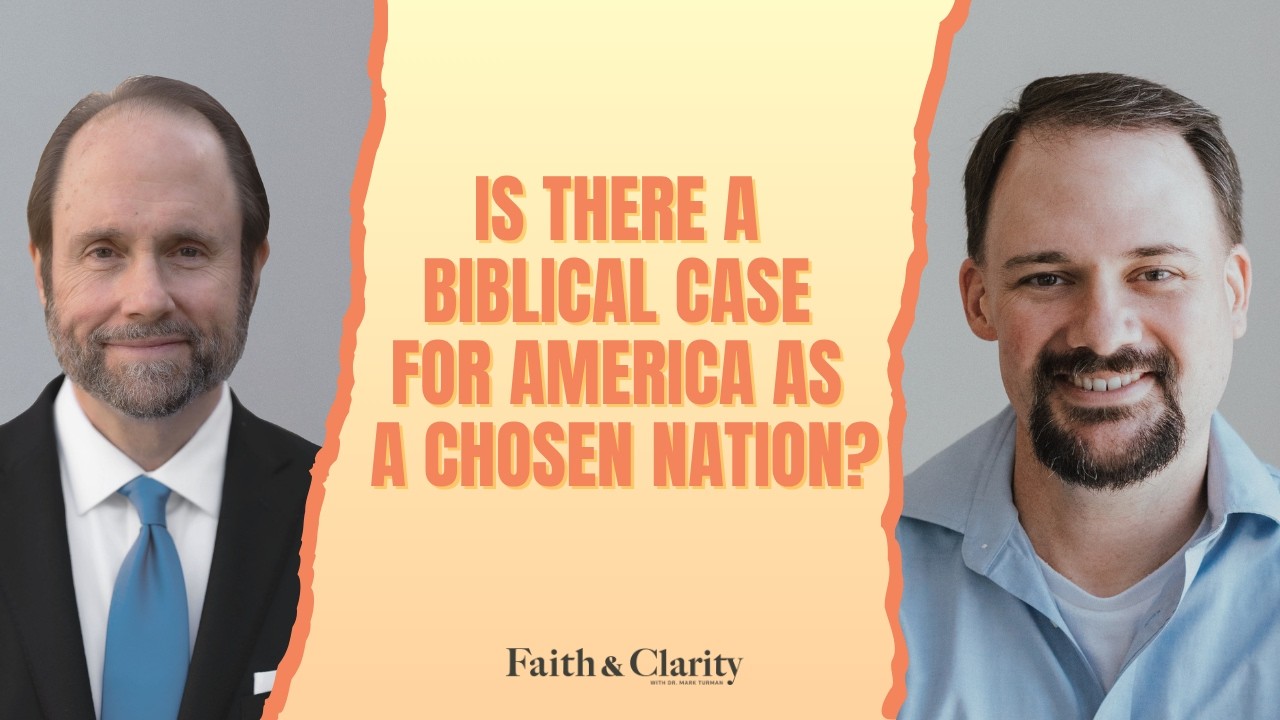
As part of the ongoing America 250 series, this episode of Faith & Clarity features Dr. Mark Turman joined by Dr. Jim Denison and Dr. Ryan Denison for a conversation about America's 250th anniversary, God's providence, and what biblical and American history reveal about the nation's relationship with God. Jim walks through the nature of biblical covenants—conditional, parity, and unconditional—and explains why Scripture does not point to a special national covenant with America as it did with Israel, while affirming that God's covenant relationship is ultimately personal. Ryan explores why people and institutions so often find it easier to unite around shared opposition than shared purpose, tracing that dynamic through U.S. history and calling Christians to lead instead with the unifying power of gospel love.
Together, they reflect on spiritual awakenings as sources of national unity, the significance of King Charles's visit as a sign of reconciliation and a deeper longing for transcendence, and the Declaration's language of "self-evident" rights and the government's role in protecting them. The conversation also takes up the challenges of pluralism and religious liberty, the erosion of shared civic virtue in a postmodern age, and the tension between national sin and the idea of progress, closing with a call for believers to submit daily to Jesus as the King who not only reigns, but truly rules.



Topics
(0:00) Introduction
(1:57) History as a warning
(3:40) Biblical covenants explained
(6:00) Does God covenant America?
(12:55) Colonies united by enemy
(21:38) King Charles and reconciliation
(31:36) Do Christians have rights?
(32:36) Do rights come from God?
(34:19) Government under higher law
(38:41) Religious liberty legacy
(46:26) Civic virtue and post-truth
(53:06) National sin and decline
(1:02:13) Daily surrender to Christ
(1:05:04) Conclusion
Resources
- King Charles III tells Congress his faith is a “firm anchor”
- How the SPLC charges reveal a dangerous dependence on hate
- Ask Us Anything: [email protected]
- Sign-up for a Denison Forum newsletter: DenisonForum.org/subscribe
About Dr. Jim Denison
Jim Denison, PhD, is a cultural theologian and the founder and CEO of Denison Ministries. He speaks biblically into significant cultural issues at Denison Forum. He is the chief author of The Daily Article and has written more than 30 books, including The Coming Tsunami, the Biblical Insight to Tough Questions series, and The Fifth Great Awakening.
About Dr. Ryan Denison
Dr. Ryan Denison is the Senior Editor for Theology at Denison Forum and the author of The Focus newsletter, contributing writing and research to many of the ministry’s productions. He holds a PhD in church history from B. H. Carroll Theological Institute and an MDiv from Truett Seminary. Ryan has also taught at B. H. Carroll and Dallas Baptist University.
He and his wife, Candice, live in East Texas and have two children.
About Dr. Mark Turman
Dr. Mark Turman serves as the Executive Director of Denison Forum, where he leads with a passion for equipping believers to navigate today’s complex culture with biblical truth. He is best known as the host of the Faith & Clarity podcast and the lead pastor of the Possum Kingdom Lake Chapel, the in-person congregation of Denison Ministries.
Dr. Turman is the coauthor of Sacred Sexuality: Reclaiming God’s Design and Who Am I? What the Bible Says About Identity and Why it Matters. He earned his undergraduate degree from Howard Payne University in Brownwood, Texas, and received his Master of Divinity degree from Southwestern Baptist Theological Seminary in Fort Worth. He later completed his Doctor of Ministry degree at George W. Truett Theological Seminary at Baylor University in Waco.
Before joining Denison Forum, Mark served as a pastor for thirty-five years, including twenty-five years as the founding pastor of Crosspoint Church in McKinney, Texas. Mark and his high school sweetheart, Judi, married in 1986. They are proud parents of two adult children and grandparents to three grandchildren.
About Denison Forum
Denison Forum exists to thoughtfully engage the issues of our day from a biblical perspective, helping believers discern today’s news and culture through the lens of faith. Led by Dr. Jim Denison and a team of contributing writers, we offer trusted insight through The Daily Article, a daily email newsletter and podcast, along with articles, podcasts, interviews, books, and other resources. Together, these form a growing ecosystem of Christ-centered content that equips readers to respond to current events not with fear or partisanship, but with clarity, conviction, and hope. To learn more visit DenisonForum.org.
EPISODE TRANSCRIPT
NOTE: This transcript was AI-generated and has not been fully edited.
Mark Turman: [00:00:02] This is the Denison Forum and today it's Faith and Clarity. We're glad to have you along with us as we seek to equip you to find hope beyond the headlines and clarity in today's chaos. So we're going to jump right in. Uh, we're jumping back into the topic of America's 250th anniversary and part of what inspires me for this conversation is Psalm 33:12, which says, Blessed is the nation whose God is the Lord. Uh, that will probably be your pastor's favorite verse coming into the middle of the summer and uh, we'll be polishing up all of our red, white and blue and uh, we're going to have a great time this summer celebrating this very significant uh, place in our history. As we talk about God's providential work in establishing, guiding, and even correcting our nation, uh, we hope that you'll follow our new summer 250, America's 250th newsletter written by the Dr. Dennison who are joining us this morning. Uh, it's called America 250, the History of our Future. Uh, Dr. Jim Dennison along with his son, Dr. Ryan Dennison. Gentlemen, good morning. Welcome back to the podcast. Jim, how are you?
Jim Denison: [00:01:09] Doing well today, Mark. How are you, sir?
Mark Turman: [00:01:11] Doing all right. Glad to have another conversation with you. Ryan, how are you?
Ryan Denison: [00:01:15] Doing well. Thanks for the chance to be here.
Mark Turman: [00:01:18] Well, we hope we have a conversation that really can help people uh, celebrate well and also, uh, just was thinking in preparation for this podcast, uh, what the next 50 years might look like and how that might affect our grandchildren. Uh, I was noticing doing a little bit of math that 50 years from now when America is 300 years old, if God so ordains that, and I believe he will, my daughter or my granddaughter will be about my age in another 50 years. So just trying to think through what that might mean. It kind of start, yeah, Jim, that that exactly the expression on my face was when I thought through that. Uh, but to get us started, uh, I was remembering what the Apostle Paul wrote to the Corinthian church. If you're not familiar, obviously the Apostle Paul was a Jew and did much of his ministry in Israel and in Jerusalem, but eventually under the call of God, made his way north and into Greece and into a very pagan city called Corinth, uh, 2,000 years ago. You can read about it in the book of Acts in Acts 16 and a number of other places. Two significant letters from Paul to the Corinthian church. And part of what he says in the first letter, 1 Corinthians 10, he talks about the Jewish experience of the Exodus. And that's kind of interesting that he's talking about Jewish history to a predominantly Gentile pagan audience. But here's part of what he says. He says, these things, the Exodus and the experience of the Jews, that these happened as an example for us and they were written down to warn us who live at the end of the age. They are to instruct us, to guide us. And so everybody on this podcast that you'll hear today loves history at many different levels, particularly biblical history, but also general history and American history. So we're going to kind of draw from those uh, rivers, if you will, and try to have a conversation that helps you. Jim, I just wanted to start a little bit more with some history out of the Old Testament. Uh, my mom before she passed, I gave her a new Bible about uh, 20 years before uh, her death and she started reading the Bible more consistently. She said to me at one point, I just like the New Testament. I don't bother with the old. Um, and and I think all of us resonate with that some. But part of what you read in the Old Testament are covenants, covenants and promises that God gave to Noah, Abraham, David, uh, Moses and even Israel. Uh, can you give us a little bit of better understanding of what we mean biblically about a covenant? Does God still make covenants? Does he have a covenant with America as some people would claim or does he only make covenants with individuals? Can you help us understand that?
Jim Denison: [00:06:06] Well, it's a very large subject, you know, as you know, Mark, and we could have a very long conversation around that, a lot of which would be speculative as you kind of apply it forward into the American context. But you're right, there are a variety of covenants all across the scripture. By some counts, six or seven. There's Adam, there's Noah, there's Abraham, there's the covenant with the land. Uh, there's Moses, there's David, and then there's the new Covenant. Jesus said, I make this new covenant with you in my blood when he was celebrating his last supper with the disciples, sometimes called the Covenant of grace, although I think they're all in a sense covenants of grace. Well, they kind of fit into three categories. One category is known as the Suzerain vassal. The Suzerain would be the master or the leader and the vassal would be the servant. That kind of a covenant is conditional. The leader says, if you do this, I'll do that. If you don't do this, I'll do that. It's a conditional sort of transactional sort of covenant and some of the covenants in scripture are along those lines where the Lord is warning his people, if you sin, you'll be cast into exile. If you commit this sin, then this is the punishment for it. A lot of Deuteronomy is caught up in the the punishments for sins and the rewards for blessings and that sort of thing. Well, that's kind of a Suzerain vassal covenant. There's some parity covenants in scripture where individuals make with each other that are on the same level of value and authority with one another. Uh, you could think about Jacob perhaps and Laban, uh, Lord watch over you and me while we're apart from one another, sort of a thing. And then there are unconditional covenants, sometimes called royal covenants, where the authority makes a covenant with the uh, inferior as it were, which has no conditions, which has no qualifications. We have a covenant in the new Covenant that's based as we said on grace where uh the Lord has just simply promised us that once we trust in Christ, we become his children and nothing can make us not his children. There's nothing we can do to go back and be un-reborn, to no longer have that new birth, to no longer be the child of God. There's an unconditionality about that. So the problem comes in applying the specific kind of covenant to the specific question that we're discussing and then moving all that forward relative to America. I don't know of any verse in the Bible that predicts that God will be making the exactly the same covenants with other nations that he made with Israel. The purpose of Israel as we know was ultimately to bring the Messiah. Well, the Messiah's come now. And so he doesn't need that exact same sort of geopolitical uh, covenantal relationship with a specific nation through whom to bring the Messiah because the Messiah's already come. And so we have to kind of move that forward by principle, by application as it were. I think myself to cut to the chase mark that with individuals and with groups of individuals, if we are willing to step into covenant relationship with God, he embraces that with us. He yearns for that with us. He wants an unconditional covenant relationship. He wants us to have that with each other. We often speak of marriage as a covenant rather than a contract. A covenant being unconditional, a contract being conditional and transactional. When I perform weddings over the years, I've always said to the couple, you're stepping from a contract, an engagement's a contract that could be broken at any moment. Now you're stepping into a covenant that is unconditional and permanent. So I think God wants that same marriage covenant with us as individuals. I don't know that I can argue that there is an intended covenant with a nation per se, such as the nation of America, because as I said, the purpose of the nation of Israel was ultimately to bring Messiah. But I certainly think he wants covenant relations with Americans and with America as uh, as a spiritual movement as it were, as a people more than as a landmass as it were. And so we certainly want a personal covenant with him that can lead as many Americans into covenant as possible. I don't know that America can be a Christian nation. America doesn't have a soul, but Americans can comprise a Christian people. And that's certainly what we want to be praying for today.
Mark Turman: [00:08:00] Yeah, that's helpful. Uh, kind of helps us understand that God is obviously involved and desires to be involved and has been involved providentially even if we don't describe it in the terms of Old Testament covenants. Um, that that doesn't mean he's not involved and not eager to see uh, all of us and all nations flourish uh, in every way. Ryan, I wanted to turn a little bit of attention to you around the problem of hate. Uh, you started a new newsletter back in January called The Focus. We encourage people to go check that out. Uh, recently you wrote about uh, an organization some people will remember from the 70s called the Southern Poverty Law Center and how they have been recently indicted uh, in a lawsuit that's going to unfold over the next number of months. Uh, but one of the reasons you pointed this out was because they have kind of set themselves up over recent years as a significant voice in attempting to define what is hate and hate speech in America. Uh, when you were writing about this, you explained that uh, that we are as people seemingly much more focused on what we are against or what we hate rather than what we're for. Uh, I wanted to get some uh, explanation from you about why you think that's true and how American Christians can perhaps use that as an opportunity for better witness where we could become more consistently focused on what we're for, what we're grateful for, what we're hopeful for. Uh, how do we move the needle in that direction?
Ryan Denison: [00:09:31] Yeah, it's it's a tough question to really kind of nail down because so much of it does go back to this basic idea that it's just easier to identify something that we're against and then focus our attention on that because it's sometimes easier just to live with a common enemy than a common cause, especially when we have to live alongside other people and other believers. And so much of it goes back to this idea that as Christians, we should find common cause in Christ among other believers, with other believers, but it's a lot easier sometimes to default to that idea of, well, we may differ on all these other beliefs, but on this on this cause or on this um, this part of the culture that goes against biblical morality, then we can we can rally around that to all work together to to oppose that. And there's a place for that. There's a place within even the Bible. Like calls us to the Bible calls us to stand against sin, to hate sin and to hate the things that God hates. That that is a biblical concept, but it's never supposed to be more important than loving the people that God loves. And I think where it gets hard to really nail this down and understand what this looks like is when we have to balance those two ideas of hating the sin but loving the sinner. That's a kind of almost to the point of a cliche now that gets thrown out in churches a lot. But I do think it speaks to this idea that we have to hold both of those things in tension. But when it comes to which we prioritize, I think the call of the Bible is to prioritize love over hate and to prioritize loving the people that God loves, standing for the truth of the gospel and letting that be the foundation of our ministry and our of our gospel calling. And I think where it really kind of the rubber meets the road on that is when it comes to our presentation of the gospel and what Christians are known for. And in a lot of parts of our culture, we're known for what we stand against more than what we stand for. And that diminishes our ability to share the good news of the of the gospel with people. If when they find out we're a Christian, their first expectation is that, oh, we must be there, okay, I guess the next words out of their mouth are going to be what they hate or the sin that they're opposing rather than the good news of the grace of Jesus. And I think that's meant to be where we need to put our focus. And that's that's really what I wanted to highlight with that Southern Poverty Law Center article was just how so much of the trouble they've gotten into is based on the fact that they're at their core, they're a group that stands against something rather than for something. And as a result, it gets really easy to start chasing hate and to need hate. Like I I think a lot of why they've gotten into trouble is they depend on the existence of hate to justify their existence. And I think as Christians, we can fall into that same trap and we really need to work hard to avoid that because we have the best news possible uh, to share with people. We have great news, joyful news. And that needs to be what we lead with. That needs to be the foundation of our gospel message. And far too often it's not. And so I really kind of that was what I felt like the Lord convicted me with that article and what I wanted to share with it is just that call to go back to base our faith, base our relationship with God and our relationship with others on the good news of Jesus rather than the existence of sin.
Mark Turman: [00:12:37] Yeah, I think that's a great point. You know, as too much of the time our reputation is not uh, a reputation, hey, those people are known for their joy, for their faith, for their love, for their hope, um, rather it's something much more negative. And uh, I love the way that you referenced that. You you referenced the a cause. Uh, so I want to kind of put this in the context of America's 250. You and I were talking about your article a couple of days ago and you mentioned that one of the main things, if not the main thing that united the 13 colonies 250 years ago, uh, even going back maybe a little bit further to 1700, was their shared hatred of the King of England, which was their king by and large, and his policies toward them. Uh, talk about that a little bit, give us a frame of reference for America 250 years old and how that served and maybe didn't serve them well uh, as colonies who in some ways didn't have all that much in common other than this common enemy. Uh, and is there a better way for us as a country and even as churches uh, to unite more around as you said, around the things that are good and that we love as opposed to those things that we're opposed to.
Ryan Denison: [00:13:52] Yeah, it's interesting if you look back at that era of history where there really was within the colonies, there was a shared agreement on a lot of the ideals that we wanted to stand for. But when it came to actually giving people the practical motivation necessary to go to war with England, a war that pretty much everybody outside the colonies and even a lot of people within the colonies thought we were going to lose, that it needed, you needed something more than ideals to unite people. And a lot of it was this idea of, um, if you think back to that Benjamin Franklin picture of the chopped up snake with around the slogan of unite or die, that kind of idea where that really was sort of what eventually drew everyone together was, look, yes, we have all these things we agree on that would be great and would be aspirational, but you have to be alive to really enjoy those. And that was a bar a lot of people weren't willing to cross or weren't willing to risk. But when it when it came to the idea of, look at all the ways they're oppressing you, look at all the ways that they're making life not worth living and to an extent. I think that really did kind of push them over the edge of being able to unite against the King of England. And as soon as the war was over though, they went right back to that all the controversy between states' rights and federal rights. And so many of the colonies saying, no, we joined together to fight a common enemy. We didn't join together to stay together. And so much of the struggle in the 10 years uh, between kind of the declaration of independence and um, and when you saw the articles of Confederation, uh, a little more than 10 years, but that period really was kind of defined by this just this constant bickering and this constant fight to know what if we are going to be a nation, what is going to be the foundation of that nation? And I think over the years we still, if you look back on what unites us most, it's something to stand against, not something to stand for. And if you think of like I think the Civil War is the ultimate example of what happens when we agree on nothing more than what we hate. And I think that there's it's a complicated war to understand, you can't boil it down to any one cause, but that was at the at the foundation was a major part of it. Um, even after that though, some of the greatest moments of unity in the last 150 years have been around World War I, World War II, and the Cold War era, there was a common enemy with the Soviet Union. Around 9/11, there was a common enemy with Al-Qaeda and with Osama bin Laden and opposing terrorism. And the thing that the problem with that is that as soon as that common enemy fades or as soon as you regain a sense of security that tends to lessen the the danger that that threat seems to pose, then the unity goes away. And as a country, we should we're strongest when we can be united for something rather than against something. But that's just really hard to do and it's hard to motivate people to stay that way, uh, to stay united around that. But I do think it's one of the areas where as Christians, we can help our culture the most because we can offer them something to stand for. We can offer them something, a common cause that goes beyond just something to hate. And I think that's but we have to model that um, we have to model that in our own lives if we want to see it in our culture. And I think that's one of the way one of the areas where we struggle, but it really is kind of that idea of we're most united when we have a common enemy really is part of our national ethos in a way that is hard to move beyond.
Mark Turman: [00:17:07] Yeah, it's it's kind of ironic that we call ourselves the United States uh, when it seems like in many ways on many subjects and in many times, we're anything but the United States. Um,
Jim Denison: [00:17:19] Mark, if I could add to that in a lot of the early transcriptions, United was lowercase and states was was uppercase. United was just an adjective. It was a descriptor of the states, capital S, you know? It's sometimes been said that prior to the Civil War, people said the United States are. After the Civil War, people said the United States is. And there's an argument that we really didn't become a United States even really until the Civil War. And to some degree that's still going on. There's still division obviously that the Civil War didn't solve even to this day.
Mark Turman: [00:17:50] Yeah, because you know, it's a really big country. It's certainly much bigger than what it was 250 years ago and the interests are even more divided and and the geography is so massive in and of itself. Um, but you know, unity is in some ways the missing secret sauce uh, in many churches and in many Christian efforts and also in our country. Um, we just don't seem to value unity uh, as much as we used to and certainly an opportunity for us to do that going forward. Ryan, what do you think?
Ryan Denison: [00:18:24] Yeah, and I I think an interesting piece of that is if you look back historically, some of the times that we did the best nationally of uniting around something positive were the times of awakening. Um, during the first great awakening, the second great awakening, especially we see the country uh, when they find their common cause in Christ, then there really is a sense of national unity we can't even approach at any other point in our nation's history. And a lot of it does come from that fact of you saw people identify one another as Christians first and kind of base our faith in that and really start to pursue a life that was uh, that was surrounded by Christ. That that was so powerful. And in a lot of ways shaped kind of brought the the states together to the point where they could unite and then in the second great awakening kept them united during some really big divisions. And I think as we think about what the church can do for our culture now, like a lot of it goes back to that idea of, I think part of why that worked and part of what we can offer is it's just simple. Part of why I think unity is so hard in our in our nation is we try and strive for complete unity when or complete uniformity and that's just not an option. But when we give people some like one thing strong enough to truly bring us together, which I think Jesus can be that one thing, then it doesn't make all the other differences go away, but it does make them less important. And maybe that's really what we need if we want to move forward on a more positive level.
Mark Turman: [00:19:49] Yeah, absolutely. Jim.
Jim Denison: [00:19:50] If you put the chair in the middle of the room, the closer you get to the chair, the closer we get to each other is the idea, you know? There's an historical argument that apart from the first great awakening, there never would have been a United States. That it was that great movement that really in many ways brought together not only a shared morality that makes possible a shared democracy, but also united the the colonies in a way that was essential to fighting the war. I love that line in that movie, a great awakening where Benjamin Franklin's grandson is asking him about Whitfield and at one point asks, was he part of the cause? And and Franklin said, he was the cause. I even right now imagining that uh, that line again, it kind of gives me chills. And it really was the awakening that Whitfield and Edwards and others were so much a part of that in so many ways made possible the unity that led to the United States. And that's the good news because what happened then can happen again today. The same Holy Spirit can do today what he did then if we're willing to do what they did. The more desperate we are, the more united we are. The more we commit to him, the more we can commit to each other.
Mark Turman: [00:20:50] Yeah, it reminds me, I think it's a Benjamin Franklin quote, right? of uh, uh, we must surely hang together or we will all hang separately.
Jim Denison: [00:20:59] That was in the signing of the declaration as they say. And as the story goes, he turned to a rather, I think it was Franklin, might have been somebody else. There was a rather large individual and turned to somebody else and uh, said, uh, if this goes poorly, I'll do better than you because when they hang me, I'm so large that I'll die instantly. You on the other hand will dangle on the end of the rope for a while. And they had those kind of macab conversations with each other, but they actually were committing treason. I mean, they they clearly were. And I mean they knew it. They knew it. They knew there was every chance that if this didn't go well that they would be hunted down and executed. So, yeah.
Mark Turman: [00:21:38] Just amazing. Jim, I wanted to kind of bring that a little bit more full circle as we talk about, you know, things that we love more than the things that we hate and the idea of reconciliation. Obviously, at the core of the gospel, uh, of reconciling uh, being reconciled in Christ to God and then being reconciled to each other. Uh, you wrote recently about this astounding reality of King Charles uh, coming from England to actually participate in America's 250th anniversary here, uh, weeks before the celebration. Uh, he recently addressed a joint session of Congress to a standing ovation, multiple standing ovations. Yeah, and so it frame this out for us. Uh, people can go back to Densonforum.org and find this article uh, that you wrote just astounding in in reality. Remind us in the light of America's 250th anniversary of the declaration of independence, just what can we learn uh, in the lens of history, spiritually, morally, practically that now the king of England is coming to celebrate our victory over his country, um, and addressing to applause uh, our Congress. What how do you think about that? Tell us a little bit more about that.
Jim Denison: [00:22:52] Yeah, it really is bizarre in one sense, you know, truly is. When they announce he and the queen and they walk into the standing ovation and a lot of the commentators, I watched it live and I agreed with the commentators that said it's been a long time since this chamber has been this unified. Since there have been applause lines that both sides stood up for. I mean, obviously both sides were sniping immediately as soon as it was done and they were claiming that this line was intended to critique Trump or this line was intended to critique the Democrats or what not and all that. They went back into fighting pretty quickly, but the unity around it really was remarkable all unto itself. And the fact that they were unified around the existing king, what did he say that uh, King George was his great-grandfather five removed, I think he said in the speech, something like that. But this is the direct descendant. I mean, the direct descendant of the king that we fought the war against now coming to this kind of celebration. So in one sense, it really is bizarre. It truly is. But I think there are two things going on here. The first is pragmatic. From the moment that we won the war back in 1783, we needed to rebuild relations with Great Britain and they with us. And I've written about that some. Trade relations, economic relations, uh, we had a very, very important sort of relationship relative to mutual security issues. We actually were obviously bound together by language and culture in way other ways others weren't. So it wasn't long at all before we sent John Adams over to rebuild relations with the king and that he received John Adams and we started moving forward and from then till now, what Churchill said in 1946 about the special relationship between the two nations is in many ways pragmatic, has been and I think probably always on some level will be. But there's another piece behind it as well that I think can explain how that king can come forward now and have this sort of a shared unity around all of this. There really is, I think, in human nature an interest in a kind of gravitation toward, a fascination almost with monarchy, with this idea of kings and queens and royalty and people that are not like us, people that live different lives than we do, people that have a historicity we don't have, people that have uh, a sort of celebrity, global celebrity that we can't imagine. We're fascinated with celebrity, whether they're athletes or they're movie stars or political leaders or whomever, but the royalty is just something different. And part of it for Americans is because they're not of us. We can celebrate them at a distance, but uh, over these centuries, there really has been a fascination with the British royal family, fascination with royalty, uh, relative to the history of it and the the coverage of it and in many ways over the years, the royal family's been more popular here than they have been at home even. And I think that's part of it as well. Well, to me that's a signal of transcendence. To me that's a built-in desire in the human heart to be in relation to the God who made us, to the king of kings and Lord of lords, to the king of the universe. It's an admission that on some level, I really don't do well as my own king, much as I want to be my own king. That I really can't govern my life without a higher authority than myself. And I think there's something in it that points us to not um, human king obviously, but the king of kings and the desire to welcome him into the congressional chambers of our own hearts and to applaud him as the ruler and the sovereign of our own lives on a level that we desperately need even more than sometimes we're willing to admit.
Mark Turman: [00:26:18] Yeah, I think that's a a really great insight, especially that idea of recognizing that we're not really good at being our own king as much as we tout it out there. Um, that really overwhelms us when we try to create our own independence, our own identity and try to run our own lives. We we know intuitively that we're incapable of that. Uh, and we we want that higher, stronger authority in our lives.
Jim Denison: [00:26:43] Most of human history would agree with us at that point. This divine right of kings idea, you know, that kings are divinely chosen by God because we can't rule ourselves. The idea whether it's a papacy or it's a theocracy or whatever, that we can't govern ourselves without a higher spiritual authority. There have been a lot of dictators and autocrats who thought that they really needed to come to this position for the sake of the people that they were uh, being dictators over. Even Xi Jinping and those that are leading the Communist Party in China would say they're doing it for the sake of people uh, they can't govern themselves. Well, that's an admission of our fallenness. Now what it leaves out is that the leader is just as fallen as we are. Where it breaks down of course is that the king's just as sinful as his subjects and Xi Jinping is just as sinful as the people he thinks he claims to be serving with his autocratic dictatorial ways. But nonetheless, there's an admission across history that humans can't govern themselves well. And that's why this idea, this this experiment in self-governance is so recent in human history and has been so difficult in many ways across human history. We've seen attempts at democracy that haven't gone well in Russia after the USSR. We've seen the same thing in parts of the Muslim world where there were elections that have not been sustained, Hamas and others such as that. Democracy is a difficult thing because governing ourselves is a difficult thing because we're fallen people. And inevitably there's this turn to autocracy and to uh, to dictators if we're not careful. If we don't keep turning to the king of kings, we'll turn to earthly kings. is the challenge. And that's I think a story of human history.
Mark Turman: [00:28:15] Yeah, yeah, I think that's so helpful. And I wanted to chase that idea a little bit further, um, around the this big topic that Americans hold on to, which is rights. Uh, that the war for independence had a lot to do with that terminology of right. Uh, Jim, you often, uh, especially in this material that you wrote and that Ryan helped with, uh, of America's 250, the the history of our future. Uh, you you talk about the declaration of independence, particularly the preamble. Let me just remind everybody what it says. We hold these truths to be self-evident that all men are created equal, that they are endowed by their creator with certain unalienable rights. Among them are life, liberty and the pursuit of happiness. Um, talk about, I've heard you explain this some in the past, but I think it would be good here. Talk about how these ideas were not self-evident in 1776.
Jim Denison: [00:29:11] In fact, there's a manuscript evidence that Thomas Jefferson wrote sacred. We hold these truths to be sacred that all men are created equal, that they're endowed by their creator with certain unalienable rights. Among these are life, liberty and the pursuit of happiness. And that the editorial process, probably Benjamin Franklin, if we're guessing, could have been uh, Roger Sherman, could have been uh, John Adams, but most likely, uh, Benjamin Franklin would be the one that changed sacred to self-evident. Perhaps because he was concerned and we're speculating that sacred would imply a level of divine mandate or would have been divisive among the colonies with those that wouldn't agree on a religious or worldview level or what not. So by pivoting to self-evident, now we're pivoting to European enlightenment. Now we're pivoting to a move that is how the Protestant Reformation moves into a rationalism, a kind of an idea that, well, we can get rid of the papacy, but we can also get rid of the Bible. If we don't need the Pope to be our ruler, we don't need a paper Pope either. We can we can govern ourselves through the highest level of unaided human reason. And so there are self-evident truths by which we can govern ourselves. And so we don't need a king to give these to us. That's what the declaration is trying to say. That these rights don't come from kings and that's why we can be independent from our king because we don't need him to give us the rights to life, liberty and the pursuit of happiness. Uh, they can be self-evident and therefore we can claim them for ourselves. That's the political move that's going on here. But by saying self-evident versus sacred, we're making a massive statement about the secularism of this democracy, about the self-reliance of this democracy going forward in ways that have been very damaging to us, I would say, as a believer who wants to see all of this in the context of scripture and awakenings and the kingdom of God. But that's the move. It's a move away from king authority to self-guided authority guided by the enlightenment that the founders were very familiar with. They had read Locke. They understood a great deal of what the European uh, sort of establishment had come to believe relative to unaided human reason without the necessity of governance from religious authority or they would say kingly authority either.
Mark Turman: [00:31:16] Wow. Okay. So a real big fundamental shift here in thinking just in one word change, just changing one word, uh, really indicates something very, very profound, which also kind of fed into a conversation I had with a friend of mine recently about where rights come from. Uh, and take us one step further and then we'll take a break, Jim, around this idea. Uh, he and I had a rather robust argument about rights coming from God versus rights coming from the government or from the king. Um, how should we think about that? I it also this conversation I have with my friend made me think, well, does is there even such a thing as a right from a biblical perspective, whether it's life, liberty, the pursuit of happiness or anything else, would that concept of rights and of particularly unalienable rights, would that be even aligned with the Bible?
Jim Denison: [00:32:14] It's a great question because the Bible doesn't speak in those terms. It doesn't speak of us as independent citizens apart from the kingship of God, apart from being citizens of the kingdom of heaven. It makes it really clear we're sojourners here on earth. And the local government, whatever it is, isn't our highest authority. Render to Caesar what is Caesar and to God what is God's. And so there's a sense in which we have no rights that are self-contained. We have no agency apart from the God of the universe. Ben Sasse the other day in one of his podcasts said there's not a rogue molecule in the universe. Really like that phrase that everything that we see and can't see is part of the kingship of the God who created it all and measures it with the palm of his hand. So in one sense, no, we have no rights per se by rights, if by rights we mean something independent from outside authority. You have no right to tell me to do this or no right to tell me to do that. If that's what we mean, we can't say that to God. Nobody can say to God, you have no right to tell me to do this or that because he's God and we're not. He's the great I am and I'm the little I am not, as Louis Giglio says. And so in that sense, we have no rights. In the larger sense of a governmental sort of an application, there's the there's the question, do rights come from government or from God? And the both and is rights come from governments as instituted under the leadership of God is a way that some have tried to look at this. And now you're to the divine right of kings again. And now kings are ruling under divine authority and the king gives you the right as God has bestowed it upon the king to do so. You get into some of that. In the American context, I think it's pretty clear to me that the founders intended us to understand that these rights came from God, not from government. The governments can recognize them, governments can defend them. That's why these truths are self-evident that all men are created equal and have the inalienable right, not the governmental right to life, liberty and the pursuit of happiness. And it's to guarantee these rights as the founder goes founders go on to say as the declaration goes on to say, it's to guarantee and to protect these rights that governments are instituted among men. Not to grant these rights, to protect these rights. And that's the sense in which I think we understand rights as coming from God and protected by government. And what the government needs to do when it's writing laws is do its best to do that which is aligned with common law or natural law or law that transcends even human reason and governmental authority. And our best laws are the laws that align with a higher law as it were. Our best rights are those that are aligned with the right that we have under the Lordship of Jesus himself. And that's the balance I think we have to seek.
Mark Turman: [00:34:44] Yeah, I think that that's helpful that part of the role of government under God's authority is to uh, give language and to legislate and codify these laws and to find proper and just ways to apply them uh, in all of the context of a society. Okay.
Jim Denison: [00:35:00] That's Romans 13. That's the sword, you know, that God is is actually using for his own providential purposes.
Mark Turman: [00:35:05] All right. All right, that's really helpful. We're going to take a quick break and then we'll be right back with a few more questions.
Mark Turman: [00:36:30] All right, we're back talking about America's 250th anniversary and how that aligns with God's providential care and work in our country. Ryan, I wanted to pick up this American reality uh, that is often called pluralism. Um, uh, probably the biggest, most practical day-to-day experience of this, if you've ever pulled up behind a car and saw a bumper sticker, uh, that said coexist, uh, that really experience expresses both the uh, aspiration and the reality that we live in a very diverse country with a lot of different uh, kinds of people, a lot of different ethnicities, a lot of different historical streams, uh, and a lot of different obviously religious streams as well. Uh, so I just went back and looked up the Webster's definition of pluralism. It simply says this, pluralism is a state of society in which members of diverse or different ethnic, racial, religious or social groups maintain and develop their traditional culture or special interest within the confines of a common civilization. So it first of all made me want to ask the question, do we think, do you think pluralism is biblical?
Ryan Denison: [00:37:49] It depends on it's tough. I will say practically speaking, it's biblical in the sense that as made clear in the New Testament, God does not want people coming to faith in him at the tip of a sword or the tip of a government law. That's not the kind of relationship with us that he's looking for. It's not the kind of relationship that Jesus died to make possible. He wants a personal saving faith relationship because we choose of our own volition to put our faith in him. And in the sense that coexisting as the bumper sticker talks about is necessary to create the environment in which that kind of choice can take place, yes, it's biblical. In the sense that we should coexist because all these different philosophies and theologies and religions are equal or have share an equal claim to the truth, then no, it's not. And I think that's kind of where it gets difficult is that a lot of the people that put the bumper stick on the back of their cars have an unbiblical view of what it means to coexist. But in terms of what the government should allow, and I think what the American government at its best does make possible through the emphasis on religious liberty is is a level of coexistence that should make it possible for us to have equal share in the and the ability to try and help people understand what Christianity means. And if you give Christianity an equal an equal right in the marketplace of ideas, then I am very confident that it will come out on top more often than not. And I think that's kind of when when we're coexisting at our best in terms of allowing these ideas to exist and compete and to be debated among one another, then that's very biblical. When it comes to the sense of enforcing pluralism by giving by trying to erase that level of debate and just make force everyone to get along, then we've we've jumped the shark at that point and it's not we're no longer talking about a biblical conversation.
Mark Turman: [00:39:44] Okay. So I let me let me take that out a little bit further. So, uh, I was wondering thinking through this just, you know, what should we be celebrating? What's what's some of the best things about America? Uh, would you say that America's pursuit, I would say aspirational pursuit of religious freedom for all is one of our best legacies?
Ryan Denison: [00:40:08] Oh, 100%. And if you look at how religion has usually been done over human history, it's one of the most uniquely American gifts we've given to the modern world. If you look at the modern world even today, there's a large most of the rest of the world that pretty much any part of the world that's not living under some sort of American influence does not have the kind of religious liberty that we see here. If you look at a lot of the Middle East and the Muslim world, there's not that level of religious freedom. If you look at China and Russia and North Korea and so many of the other places that have embraced a more autocratic or dictatorial form of government, then religious liberty has to go. Uh, because the government becomes the religion in places like China and places like even while Russia is a bit more of a mixed bag, uh, they at least ostensibly try to promote religious freedom. Uh, China will at to an extent claim that they are. Um, many countries like Iran and many of the other countries in the Middle East don't even pretend. They just their government is so intricately interwoven with with Islam that religious freedom is not an option. Um, you have the option not to practice religion, but if you're going to practice religion, then it has to be Islam. And so I think in the American context, it is one of, I think the reasons that America has thrived and one of the reasons that America has made it 250 years and has a chance to go another 250 after this is I think we give people the freedom to believe what they want to believe when it comes to religious matters. And as long as Christianity, as long as every faith is given the equal chance to um, within within reason, like if your religion promotes murder and and other things like that, then yeah, that there's limitations on that obviously. But um, in terms of when it just comes to competing ideas, I do think that's one of the reasons that America is been so strong and has a chance to keep enduring is that we allow ideas to compete under the idea under the belief that whatever is true, that the truth will come out in the end. And I think Christianity has a great chance if we give if we embrace that kind of idea.
Mark Turman: [00:42:12] Yeah, just fundamental, fundamental particularly to the stream of Christianity out of which the three of us come, right? That uh, faith can't be forced, true faith cannot be forced. It uh, everybody ought to have the freedom to worship God or not worship God according to the dictates of their own conscience. Um, and that's something that yeah, go ahead.
Ryan Denison: [00:42:32] I was just say and it is worth noting that that wasn't part of America's original founding. That was something that was added later on. Um, America as it was originally founded, every colony got to determine their version of Christianity that would be supported by tax dollars and that that people were free not to go to that church, but their tax dollars supported it. Uh, and it so the kind of religious freedom that we have today did not exist when the country was founded. That was part of the Bill of Rights later on and it was largely Baptists that pushed for it. John Leland and others. That's right. Yeah. And so I I love the story that I again, I don't know history's interesting where you don't always know how many of the stories are true versus just people liked it so they kept telling it. But I love the idea that John Leland uh, in talking with James Madison when he was writing the Bill of Rights, told him religious freedom goes in or I'm going to run for office. I will defeat you in that in that run for office and I'll make sure it gets in. And that that's part of what motivated James Madison to make sure it made it into the Bill of Rights. Again, that there's questionable historicity to that idea, but I I love the story, so I'm going to keep saying it.
Jim Denison: [00:43:36] Well, Leland was far more religious than Madison was and so it would make some sense that uh, he Madison could have needed that uh, encouragement. Let's say. Yeah.
Mark Turman: [00:43:46] Yeah. Ryan, I wanted to come back and kind of bring this down, uh, this conversation down to kind of ground level, uh, people living in their communities. Uh, I heard a faith leader that I was talking to recently, he wanted to stay away from the issue of interfaith engagement. So he just used the word multi-faith cooperation. Um, for people who are wanting in their communities, they live among, you know, where I live, there are uh, significant number of Muslims, there are some Jews, there are people of no faith, there are many Christians. Uh, there's a recent uh, surge of of people moving in from India who generally have a a Hindu or a Buddhist orientation. Uh, what could people do in their own town do you think that uh, would be in alignment with the Bible but allow for and embrace kind of a a multi-faith cooperation? Um, where where do you think we could actually make that more tangible?
Ryan Denison: [00:44:50] I think identifying causes that everyone can get around, whether it's feeding the poor, um, providing uh, often times those revolve around poverty and and combating poverty in one form or another because that is something that most most religions, uh, especially kind of whether it's Judaism, Christianity, Islam, especially like there's a common belief that we have an we have an obligation to help those who are in need. And I think so we can find common cause in that that give us a chance to work together and to work to work alongside one another. And uh, when that happens, I think it's great. I think it gives us the chance to be reminded that people are more than just their religious beliefs and not to define people by solely where they go to church and or if they go to church. And I think that is a valuable opportunity. Um, and it's a chance to engage in conversations we might not get a chance to engage in otherwise. Uh, I was and I think biblically I was actually reading the story of Paul at Mars Hill with with my kids last night before bed and one of the things that I love about that story in Acts is how Paul is invited to go essentially be the only Christian talking to a group of people that believe a whole lot of different things. Um, the way Luke describes it, I think is they just they got together because they love to debate ideas and that's all they did. And I think but within that, he uses their framework, he uses their language, he talks about, he uses the Greek poets, he uses philosophy uh, to help them understand what the gospel represents. And I think working with people of other faiths can give us the chance to have those conversations, but it can also give us the chance to bring up maybe, I know why I'm helping the poor. Why are you helping the poor? And why are you helping to feed these people that need food? And what we'll find is that in Islam, it's often because it's an obligation. I think in Christianity, it's a privilege. And there's a there's a sense where that that's overly simplistic, but I do think it can give us an opportunity even new avenues to share the gospel with people when we're working alongside them if we're willing to take advantage of those. Uh, but again, it's I think a lot of it gets back to this idea of it's really easy to define people by what they believe and say if someone goes if someone's a Muslim that that's now I know everything I need to know about that person when really they're just a person. And I think opportunities to work together can be great for helping us have a larger view of who people are.
Mark Turman: [00:47:18] Yeah, there's just certain realities in any town, in any community that uh, are common to all, you know, uh, and ought to be something that everybody can cheer for and work toward together. Uh, so that everybody can flourish as much as possible. And in that context, you get to know people at a much deeper level. Um, and and hopefully that serves everyone well. Jim, I wanted to this this podcast may uh, end up being called the United United States in some ways. I wanted to come back to that idea a little bit more uh, around something that I've heard you write and talk about a number of times over the last number of years, which is uh, the the vital need for but actually tragic loss of what you usually call a shared consensus of reality and what you use the term sometimes civic virtue. Uh, can you give us uh, a a a simple explanation of what you're talking about when you talk about civic virtue, uh, and this idea, how and and how can we reclaim a consensus around shared reality as a country? Why is that so important?
Jim Denison: [00:48:26] Yeah, it's a massive issue. Consensual moralities, civic virtue, consensual virtue, all of that. When the founders are creating the documents that we still stand upon today, the declaration of rights, the Bill of Rights, the Constitution, uh, they're doing so using shared language, shared vocabulary, shared dictionaries. They have a pretty clear sense of what they mean by that. When they're talking about religion, they're talking about morality and when in the farewell address, George Washington can say that the indispensable supports of democracy are religion religion and morality, uh, people heard that and they knew what he meant essentially by that. Today, if a president or anybody else were to say that, there would be very little unanimity around what you mean by religion and what you mean by morality. Very different sense, wouldn't there be of what morality for for instance means in the context of sexual morality, let's say, or morality relative to abortion or euthanasia or any number of moral issues, ethical issues that are out there today. Well, to make a very long story as short as I possibly can, there's been a movement that's gotten us where we are now that really started becoming popular in the states back in the 1960s. We call it postmodern relativism, but it really goes back to Immanuel Kant and and some movements even in the 18th century in Europe, but it basically boils down to the idea that your mind interprets your senses and that's how you get what you call knowledge. Well, your senses are different from mine. You might think it's hot in here when I think it's cold, you might think that thing's ugly while I think it's beautiful. And your mind will interpret your senses differently than my mind would interpret my senses. So there can be no such thing as objective reality. No such thing at least of objective knowledge of reality, no such thing as objective truth. There's just your truth and my truth. Well, that's Kant through Nietzsche, through Derrida and Foucault and a whole lot of folk that get from here to there, but it basically boils down to this idea that everybody interprets the world themselves through their own mind, their own senses. And so all we really have is tolerance. And we have no ability or any right to force our beliefs on others because everybody knows that truth is personal, individual and subjective. A few years ago, post truth became the Oxford's dictionary dictionary word of the year. This idea that you have your truth and I have my truth. Well, it has a very long philosophical history, there's a lot of culture in it, but that's where we are today. And so because we're at that place, we have great difficulty coming to a place of civic virtue where there's some shared sense of what virtue means. I think life begins at conception. I think therefore elective abortion is in principle wrong. I believe passionately that it is indefensibly wrong. If you don't share my conviction that life begins at conception, or if you come along to say it can't be known when life begins, which is what the Supreme Court did, then I have no right to tell a pregnant woman what to do with her body. My body, my choice becomes the answer to the question. A person may say I'm not pro-abortion, but I'm pro choice. I wouldn't choose an abortion, but I have no right to make that choice for somebody else. Well, I understand that thinking. I would apply that thinking to a large number of moral issues just not to abortion because I think life begins at conception. I think marriage is the covenant between one man and one woman for life. I believe that to be true from biblical perspective. If you don't agree with scripture or don't agree with my interpretation of scripture, then we don't have a shared morality relative to what marriage should be. As you drive that into polygamy and pluralism, as you drive that into biological marriage even when people are free to marry people that are with whom they're related biologically. There's even movements today to suspend age requirements relative to marriage in the belief what right do I have to impose my beliefs relative to how old a person has to be when they marry. In Islam, one man can have as many as four wives. And so the way that gets done in the United States is a Muslim marries a wife legally and then has civil relationships with three others. Well, what right do I have to tell a Muslim how many people he can or cannot marry? And so we don't have the ability to get to civic virtue relative even to the number of people with whom a person can be married and all the legal and insurance and medical things that come out of all of that. And so we're at a place now where we may have the same vocabulary but different dictionaries. And because we don't have a sense of what the words mean by what they say, it's very difficult to see how consensual democracy can thrive beyond a mutual tolerance, whatever that might mean. As you move forward beyond that, Mark, it's really difficult to know how to put the genie back in the bottle. Really hard to know how to undo what I just said. The way and we're coming back, we've said this several times now, the chair in the middle, the closer we get to the chair, the closer we get to each other. The more people experience Jesus, the more people have a genuine transformational relationship with Jesus, the more likely they are to believe the Bible to be the word of God and the more likely they are to come to a shared morality around biblical expression, revelation and truth. And so once again, as simplistic as it sounds, a shared sort of spiritual movement, spiritual awakening is going to bring with it, I believe, a greater sense of consensual morality, consensual meaning around virtue and civic virtue and makes that awakening very, very critical to our future in a way that hasn't been the case even in previous centuries where awakenings were so vital to our unity.
Mark Turman: [00:53:59] Yeah, I think that's a real call to prayer, um, because it's it's going to take some kind of massive spiritual uh, awakening to bring us back to that kind of agreement about even the definition of terms, um, and and come back to some sense of shared reality, um, that then we can can build off of. Uh, Ryan, this is a great segue into one other question I wanted to ask you about today, which is uh, in this material that your dad wrote, America 250, the history of our future, uh, newsletters coming out uh, already every Sunday afternoon. If you uh, want to receive them, go back and read the first ones. They started on the first Sunday of May, May 3rd. Uh, you can get them by subscribing to the Daily Article at our website, uh, Densonforum.org. Part of what that material talks about that you got to add to, uh, was the issue of national sin, um, and the idea that some people hold, uh, which is sometimes called the myth of perpetuity, that America will always be strong, America will always be a reality, uh, even though history shows us that almost all nations, in fact, probably all nations have a cycle of birth and growth and flourishing and then decline. Uh, where do you think it is that maybe tied to some of our uh, now prevailing sins as a culture, whether it's abortion, uh, sexuality, um, where is it that we may be blind to the reality that we could actually be moving further and further into a place of decline rather than to a place of strength as a country?
Ryan Denison: [00:55:47] That's a great question. And I think the best answer I can give relates to what my dad was just talking about where I think we've come to mistake going moving away from God's truth, moving away from what God says are things he can bless. So much of our culture has come to mistake that move as progress. And I think when you identify that as progress, then it becomes really, really difficult to see the ways in which it's really hurting us as a nation, the ways in which the division is a problem rather than a symptom. And I think so much of what we see if if America does have a threat to another 250 years, I think a lot of it comes back to this basic idea that we've redefined what it means to advance as a country. We've redefined what it means to become a better nation. Um, and as part of that, we've redefined what the kind of ideals that we should be promoting both here and abroad. And I think so much of that we see in the the rest of the West where they're more they're further down that track than we are even in terms of a rejection of biblical morality. Uh, one of the things we talk about in the America 250 material is how a lot of the founders agreed on that Judeo-Christian morality was essential to the principles on which the country was founded. They had different views on how involved God still was. They had different views on who on who Jesus was. They had different views on what it meant to be saved, but they agreed that the morality of Christ and the morality that the Bible promotes were essential pillars to the foundation to the country they were trying to build. And I think so much of the reason that our nation is struggling now goes back to this idea that we've come to the point that we see the rejection of those morals, the rejection of those pillars as progress. And until we fix that, until we get a better understanding of all the ways in which that's actually make hurting our country and hurting us rather than helping us, then I I do think we're going to continue to head down a ne we're going to continue to head down a negative path. And I I don't know I think the only at this point, I think the best hope that we move away from that is we kind of hit rock bottom of some sort. And I do think we're getting closer to that as a as a culture. I think those ideas have been around long enough that especially with the younger generations, I think you're starting to see a number of people looking around going, okay, if this is where that if this is where that thinking leads, then I don't like it. And they're open to change. They're open to the to the truth of the scriptures in a way that a lot of people like I'm I'm a millennial, people in my generation weren't. Uh, I know I've quoted this, I've brought this up a few times in articles and on podcasts, but something John Stone Street said on one of our podcasts a long time uh, last year continues to resonate with me where he says there was a generation that left the church because they felt like the church had failed them. And a lot of the younger generation is leaving secularism because they feel like secularism has failed them. And I think that gives us new opportunities. It gives me hope for where the country is going, less because I think we're actually going to make the right choice than because I think it's going to be easier to make the right choice than it has been in a while. And I think you're seeing more of the country and more of the culture willing to take an objective view of where our current path is leading and hopefully that leads us to turn away from it before it's too late. Uh, but it it's not too late yet. And I do think there are powerful forces in our culture that are going to continue to push us down that. But it really goes back to that idea of mistaking mistaking moving away from biblical morality as progress as I think the biggest blind spot we have in our country.
Mark Turman: [00:59:22] Yeah, that's yeah, what a great insight. It reminds me of something I learned as a young Christian as a teenager. I I can remember the Sunday my pastor was talking, may have been around 4th of July and the celebration of freedom and liberty and all that, but I can remember him saying very vividly that the idea of absolute freedom is absolute nonsense. Um, that we go back to that idea, we're not really good at governing ourselves and if we pursue absolute freedom, we end up with some of the levels of chaos and perhaps even worse than what we've already experienced. Jim, I wanted to give you uh, a chance to close us out today and come back around uh, to King Charles's visit uh, to the United States recently. Uh, as you wrote about that in one of your articles recently, uh, you cited the the poet Tennyson and that Tennyson had once noted that Great Britain is a crowned Republic. I thought that was an interesting term. And and then you went on to include this idea that uh, as a crowned Republic, it is one in which the monarch reigns but does not rule. I thought that was an interesting term. And and then you went on to include this idea that uh, as a crowned Republic, it is one in which the monarch reigns but does not rule. I immediately thought, in what sense can that be true? In what sense can a king or a monarch reign but not rule? And I I had the thought that maybe this is a way of explaining how some people, many people perhaps misunderstand Jesus's authority as king. Um, there's a new movie coming out by one of the the makers of faith films that talks about how some people uh, who have poor experiences as children with not having a good father or sometimes hindered from being able to think about God as their heavenly Father. I'm just wondering if something like that may be happening relative to our willingness to embrace God as our king. Uh, and we want maybe a way of saying that is is many of us want Jesus to be our king and we want him to reign but we don't want him to rule. Uh, can you is that make any sense to you? You get an idea of what I'm trying to say?
Jim Denison: [01:01:28] Yeah, I think absolutely it does. And I think it's absolutely true. Certainly true for my heart and my life. I want the cake and eat it too scenario here. I want to go to heaven when I die. I want to have God's blessings when I need them. I want to be able to pray and know that he hears me and he'll answer my prayers as I wish him to answer my prayers. I want God available to me, you know? I want the parachute on the plane. I want the spare tire in the trunk, but I want to be in front of I want the steering wheel. I want to be able to guide the plane. I want to be the one that's in charge of this thing and I want him available to me as needed. In the same way that uh, in the UK, they think of the royal family as reigning but not ruling. They have this kind of distant relationship with them. They have all of the advantages of a monarchy relative to the trappings and the ceremonial and the historicity of it and some of the unifying factors of the morality for the larger um, larger kingdoms, uh, the Commonwealth as they call it. They have the benefit of the monarch's wisdom over many, many, I think 19 prime ministers that Queen Elizabeth II worked with along the years and there was that unifying factor, that longevity factor. So you have all the advantages of the monarchy with none of the disadvantages of the monarch coming along and telling you how to live your life, how to do what you want to do on a daily basis. And isn't that how we'd love to relation love to relate to the Lord? Well, the downside of that of course is because God honors the freedom with which he makes us, he can't lead us if we won't follow. He can't give if we won't receive. As the old saying goes, God gives the best to those that leave the choice with him. When I'm in charge, he can't be in charge. And because I'm not omniscient, I can't see the future. Because I'm not omnipotent, I can't meet my basic needs. Because I'm not omnibenevolent, I can't do what's best even if I know it. And so I'm constantly living a second rate life when I could be living an abundant life. I'm constantly trying to bear fruit without being connected to the vine. I'm constantly trying to be my own God and making my life what it would be if God were God and it doesn't work. And so at the end of the day, I can salute the monarch at the distance, but what really matters is every single day getting off the throne of my own heart because I'm a fallen person. My default position is to be on the throne of my own life. I don't know why this is true, but I know it is. When I go to bed at night, I have made Jesus my king through the day. I have surrendered to him. I start the day by submitting to the Holy Spirit. I walk through the day by trying to stay in touch with him. On my good days, I stay submitted to him. On my good days, I'm praying through the day and I'm thinking biblically and I'm trying to live obediently on my good days, not all my days, but on my good days. But somehow when I wake up the next day, I've crawled back up on the throne again. I don't know how that happens. But the next day I got to start over. The next day I've got to again dethrone myself. I have to again surrender again. That's why Ephesians 5:18 that says be filled with the spirit is a continuous tense, present passive imperative. It's continuously be being filled with the spirit. It's a constantly every day decision, constant every day decision to make him the king or else I'm the king. It's it's Genesis 3. It's the basic temptation to be as God. It's the only temptation Satan ever uses because it's the only one he needs. Every sin is a version of that story. Be your own God by stealing this or lying about that. And every day, it's a submission to Christ that most glorifies him, that most draws others to him and positions me to live my best life. Not transactionally, but transformationally. My best life isn't health and wealth necessarily. I'm not saying that. I'm not saying that if you'll start the day by submitting to the spirit and stay surrendered to the spirit that you'll necessarily live in the kind of wealth and health that you would wish to have, but you will have God's best, whatever that best is. And you'll live a transformational life that enables you to know Jesus himself. Close with this. I was driving down the road yesterday, Mark, and the thought occurred to me as I'm driving down the highway and I'm looking at these trees on both sides. These magnificent trees that I'm driving by out here as I'm on highway 31 and my making my way across Texas and I'm realizing that God that made all of that lives in my heart. I can know him, not just know about him. I can know him. I can have a personal, intimate relationship with that king. And that above everything else is the joy and the beauty of making Christ your king every day.
Mark Turman: [01:06:03] No, such a good word. So makes me think every day I have the question in front of me, am I willing to abdicate my throne? Am I willing to abdicate because there's only room for one king. There's only one. Guys, thank you for this conversation. It's been so fun and uh, just love talking about how God's been at work in so many ways, including across the 250 years of our country's history. And uh, we hope uh, as our audience listens in that this has been helpful to you. If you want to follow the America 250 special series that Dr. Dennison wrote and that Dr. Ryan Dennison helped uh, in some ways with to polish it up. We like to say he polishes up his dad's stuff. And uh, those lot of polishing necessary. A lot of a lot of polishing needed sometimes, right? Um, that's why the Dr. Dennison are such a powerful combination. But you can get those uh, at our website, Densonforum.org. You can also sign up to receive them all the way to July 4th by subscribing to the Daily Article. Uh, you can also find Ryan's newsletter, The Focus at Densonforum.org, become a subscriber to that and uh, other great uh, tools and resources for you to use uh, across Denson Forum. We want to thank you for following our podcast. We hope you'll rate us, share this with others as you have opportunity and we'll see you next time on Faith and Clarity.










 Search