



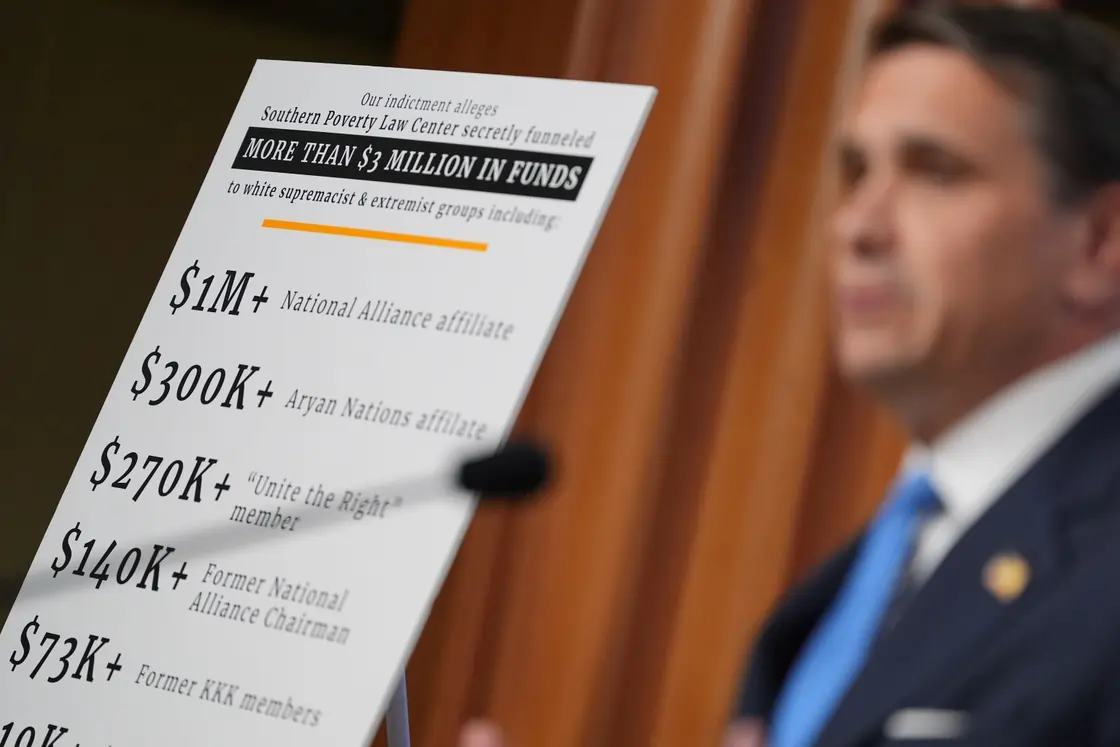
Acting Attorney General Todd Blanche speaks during a news conference at the Justice Department, Tuesday, April 21, 2026, in Washington. (AP Photo/Jacquelyn Martin)
Last week, a federal grand jury indicted the Southern Poverty Law Center (SPLC) for wire fraud, money laundering, and bank fraud. While some of those charges are more legitimate than others, they have brought nationwide scrutiny to an organization that had long avoided such criticism from many in the culture.
Why it matters: The SPLC has become one of the most relied-on sources for determining who is worthy of censorship and public deplatforming in recent years, despite both its organizational purpose and approach working against the fair arbitrating of such labels. If the recent allegations shed light on their problems and bring back a dose of reality to how we define hate, it could lead to real improvement regardless of how the court case turns out.
The backstory: How serious are the charges?
Last week, a federal grand jury in Montgomery, Alabama, issued an 11-count indictment against the Southern Poverty Law Center (SPLC). The most serious charges are wire fraud, money laundering, and bank fraud. And while some of the charges are stronger than others, the larger purpose appears to be undermining the organization’s credibility, and the Department of Justice does not need a conviction to accomplish that goal.
With that in mind, let’s take a closer look at the charges to see where this case falls on the spectrum between legitimate crime and partisan witch-hunt (spoiler alert: it’s somewhere in the middle).
The indictment claims that between 2014 and 2023, the SPLC paid more than $3 million to informants with groups like the KKK and the Aryan Nations. The SPLC has not denied that allegation; instead, it simply says that paying informants was a common practice dating back to its start in the 1970s and a tactic that both its donors and the government were aware it used.
Yet, even if their most devoted donors were likely aware of what they were doing, the general public was not. And the indictment also alleges that their informants were doing far more than merely gathering information.
In perhaps the most damning of the allegations, the DOJ claims that an SPLC informant not only attended the 2017 Charlottesville “Unite the Right” event “at the direction of the SPLC,” but also helped to organize it while making “racist postings under [its] supervision.” As Maud Maron points out:
It’s perfectly reasonable for an organization like the SPLC to pay a member’s fee or to buy an event ticket to access a questionable group’s online material, track its activities, or record a speaker. Directing and supervising the very racism you claim to be combating is not so easy to excuse.
Still, if the SPLC was only guilty of paying the wrong people—and to be clear, they haven’t even been convicted of that yet—it’s doubtful that this story would still be in headlines today. To that end, it’s helpful to know a bit more about who the SPLC was at its founding and how the organization has shifted over the years.
What is the SPLC?
The SPLC was started in the 1970s as a civil rights legal defense organization. At a time when anti-segregation laws were in effect but rarely enforced, lawyers Morris Dees and Joe Levin started taking pro bono cases in Alabama to represent those who either couldn’t afford or couldn’t find a lawyer otherwise.
Eventually, the group grew and evolved to the point that, over the course of a couple of decades, they “strategically crushed the KKK and other white supremacist groups through lawsuits.” Over time, though, they began to expand the scope of their work beyond combatting racism to fighting other forms of alleged discrimination as well.
A key component of that effort is The Intelligence Project, which started as “Klanwatch” before being rebranded in 1998 to reflect the move away from focusing on the KKK. In 2007, they added a blog called “Hatewatch,” which they claim “monitors and exposes the activities of the American radical right.” By this point, prisoners’ rights, immigrant and worker protections, and LGBTQ rights had come to stand alongside combating racism as pillars of the organization’s purpose.
However, the scope of their mission was not the only aspect of the organization that saw dramatic growth during this period. As their prominence grew, so did their budget.
If that money—currently sitting somewhere in the neighborhood of $800 million—were used to further its cause, then perhaps the current reports would not be quite so controversial. However, the SPLC has a long history of being sketchy at best with its finances and has repeatedly used deceitful tactics to raise funds. Among the most effective is the proliferation of its “Hate Map,” which tracks the existence of groups it deems to perpetuate hate.
Dependent on hate
To be sure, many of the organizations and groups that adorn the SPLC hate map have earned their place and deserve every bit of the derision they receive. However, the tool is often good for little more than shock value. Beyond a name, it provides scant information about the size, beliefs, or activities of the named groups.
The group “carolynyeager.net,” for example, is listed as guilty of antisemitism. Honestly, she very well may be, but the “group” also consists of a single woman in a small Texas town who hasn’t posted anything to her website in over two years. Her dot on the map is just as big as any of the KKK organizations truly worthy of inclusion.
And she’s not the only one.
Moreover, groups like Focus on the Family, Turning Point USA, Moms for Liberty, and Alliance Defending Freedom are listed as hate groups. You don’t have to agree with everything those organizations stand for to recognize that they don’t belong in the same category as neo-Nazis and the KKK.
Ultimately, it’s in the SPLC’s best interests for the number of hate groups to be as large as possible, and their reporting demonstrates that reality.
So, while it’s unclear if they will be convicted of the allegations in the indictments—and some of those charges are clearly a reach—the court of public opinion is already moving against them. In some pockets of the culture, it has been for quite a while. But the headlines and the litany of articles in response are doing quite a bit to raise awareness of how far they’ve fallen from their initial purpose.
Yet, given the nature of that purpose—particularly as it’s articulated today—perhaps such a fall was inevitable. And there’s an important lesson in that reality for each of us.
Spiritual application: Are we defined by love or hate?
At some point in its history, achieving the SPLC’s purpose—standing against injustice and hate—came to represent a threat to its existence. Donors gave in pursuit of a world without hate, which meant the closer we got to such a world, the less the SPLC would be needed.
As Christians, we’ll never live in a world on this side of heaven where sharing the gospel and advancing God’s kingdom are no longer required. But if the primary way we approach that goal is by emphasizing all the evil in the world that we need to stand against, then we’re likely to find ourselves in the same place as the SPLC in short order.
That’s why the true gospel is centered around all the good that God offers rather than all the evil that exists in the world. Our faith does not call us to be naïve of the devil and the ways he’s at work around us, but combating evil can never become more important than sharing the good news.
Those two endeavors are not mutually exclusive, but it’s crucial that we get the order right.
This world is filled with people and organizations that are very clear about what they stand against. God’s call is for his church to be built on what we stand for.
So, which comes more naturally to you today? Does hating what God hates or loving what God loves take up more of your time and attention?
I fear that, at least in America, we’re a lot better at the former than the latter, and that’s a problem. Fortunately, it’s a problem God stands ready to help us solve.
So, take some time today to ask the Holy Spirit to help you evaluate whether your life is defined more by hate or love. Both have their place, but love is far more likely to draw people to the Lord.
Let’s make loving like God loves our focus today.
News worth knowing
1. Vladimir Putin’s approval rating plunges
Russian President Vladimir Putin has long held the favor of his people, though often as much through fear and force as genuine affection. However, Russia’s crumbling economy and the mounting casualties from the war with Ukraine are beginning to eat away at that support. A recent report from the nation’s largest state-owned pollster found that his approval rating has fallen to 65.6 percent, a drop of more than 12 percent since the start of the year, and is now at its lowest level since the war began.
Why it matters
Given that Russia routinely exiles, imprisons, or kills dissidents and that criticizing the war is illegal, the rise in those willing to voice their discontent is notable. The government has responded by limiting internet access and pushing further restraints in the name of national security, which has only worsened the problem for Putin and his regime.
What to watch
Russia’s economic development minister said last week that the nation’s reserves are “largely exhausted.” Will deteriorating conditions back home make Putin more willing to discuss peace? Or will it have the opposite effect, and make him willing to take even greater risks in Ukraine?
The Washington Post has more on the story
2. Germany plans to build “the strongest conventional army in Europe”
Last week, Germany published its first-ever military strategy document, in which it pledged to increase its defense production in an effort to build “the strongest conventional army in Europe.” The plan calls for a military capable of defending Europe against Russia by 2029, the capacity to meet NATO’s capability targets by 2035, and the production of “cutting-edge military technology” by 2039.
Why it matters
A “culture of military restraint” has been a point of pride in Germany since its reconstruction after World War II. To that end, they have largely resisted any entanglement in foreign conflicts, even refusing to give weapons to Ukraine for much of the war. As such, a shift to “war-ready” as the military’s slogan represents an important shift in their approach to national defense.
What to watch
Will Germany and the other European nations that have pledged similar goals maintain them? Will they have time to build up their forces before Europe’s defenses are truly tested? While having a plan to defend the continent that does not require American intervention is both notable and welcome, it’s of little worth unless the nations follow through.
The Dispatch has more on the story
3. One of college football’s top QBs checks into rehab for gambling
Brendan Sorsby was one of the top transfer targets in college football this season. His move from Cincinnati to Texas Tech—at an estimated price of $5 million—was supposed to help the surprising Red Raiders stay in the national title picture. Now all of that is up in the air after reports surfaced that he’s under NCAA investigation for making “thousands of online bets on a variety of sports.”
Why it matters
Sorsby checked into a residential treatment program for help with a gambling addiction, but the standard punishment from the NCAA for betting on college or professional sports typically ranges from a third of a season to full banishment. While there’s no evidence that his betting led to shaving points or altered the outcome of any games, gambling is an area of particular emphasis in college football at the moment. Even more importantly, though, the proliferation of sports betting across the college and professional landscape means that even if he does get to play again, he will not be able to escape ads for DraftKings, Polymarket, and other betting sites every time he takes the field.
What to watch
Was Sorsby’s decision to enter rehab a genuine attempt to combat his addiction or an empty gesture to placate NCAA decision makers? Will the NCAA look to make an example of him or render a more measured judgment? And how many more stories like his will emerge over the years to come?
God is good
An international team at the University of Glasgow recently recovered 42 lost pages of Paul’s writings that date back to the 6th century. As the manuscript began to degrade, monks at the Great Lavra Monastery on Mount Athos took it apart and used its pages to help bind other books, a standard practice at the time, given how expensive parchment was. However, through the use of multispectral imaging, researchers were able to rediscover the ancient text.
Kingdom impact
While the lost pages have different chapters and headings, along with notes from the scribes who originally copied them, there are no new passages. As such, the discovery serves as yet another example of the Bible’s reliability. It’s also a good reminder that there’s a lot to be gained sometimes by reading Paul’s letters (as well as the other biblical books) straight through. That’s how God inspired him to write them, and it can be easy to lose track of the meaning and flow of an argument when we treat each section as if the chapters and headings were just as inspired as the text itself.
Prayer point
While more of a challenge than a prayer point, will you ask God to help you pick one of Paul’s letters to read straight through today? It doesn’t have to be Romans or one of the longer books (though Romans is perhaps the best example of how much is to be gained from going from start to finish in one sitting). Still, taking the time to experience the letters as those first generations of believers did can bring fresh insights to a text nearly two thousand years old.
Archaeology News has more on the story









 Search