



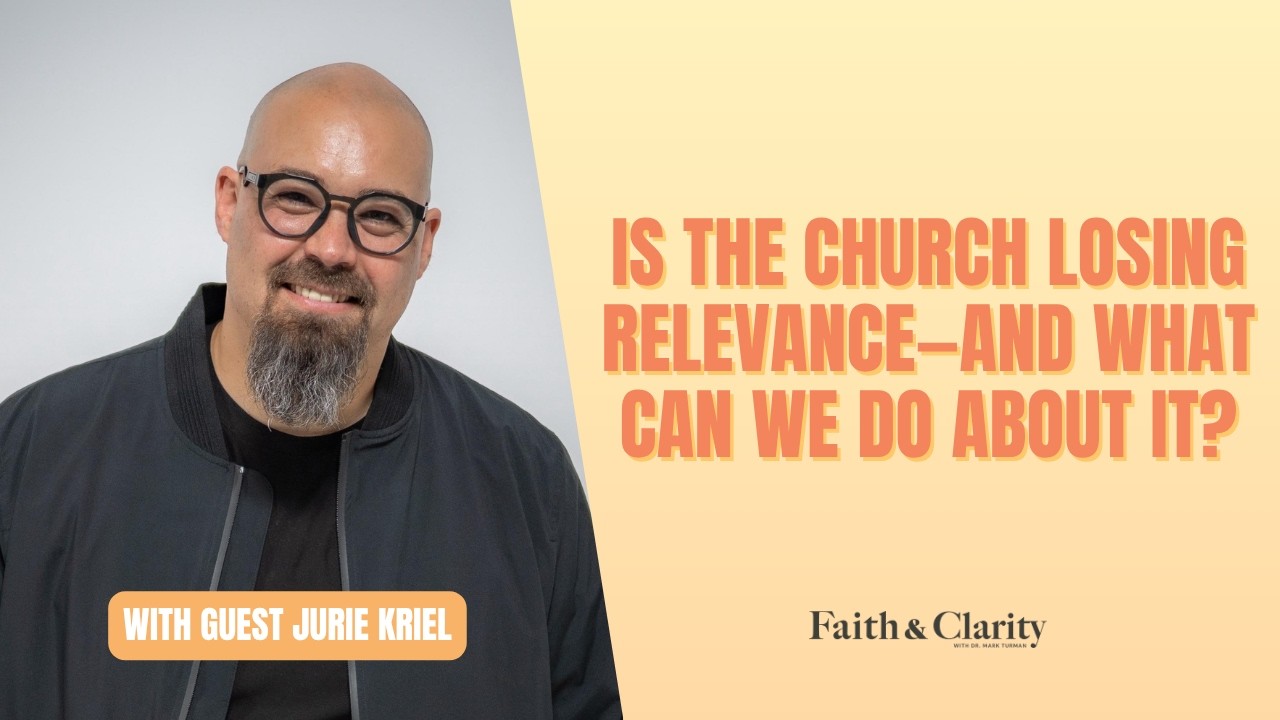
In this episode of Faith & Clarity, Dr. Mark Turman is joined by Jurie Kriel of Shoreline Church and the global initiative Next Move to explore how the church can reach emerging generations in a rapidly changing world.
They discuss the growing challenges of declining trust, loneliness, and cultural change, and why collaboration among churches and leaders is more important—and more difficult—than ever. Drawing from his book Hitting the Ball You Cannot See, Yuri highlights the “relevance deficit” many churches face and the need to adapt as technology, including AI, reshapes how people live, connect, and understand identity.
The conversation also emphasizes the importance of relational, incarnational ministry, the balance of large gatherings and deeper community, and a hopeful vision for the church’s role in a changing culture grounded in God’s sovereignty.



Topics
(0:00) Introduction
(2:20) Reality check on faith
(3:35) Three forces shaping culture
(6:08) Hope in God’s plan
(10:14) Unity over competition
(12:15) Why collaboration is hard
(18:50) The relevance deficit
(25:27) AI, identity, and digitization
(32:49) Humanity redefined by AI
(36:23) Identity received in Christ
(46:37) Truth moves at trust
(55:55) Hope for the future church
(59:21) Closing
Resources
- About Jurie Kriel
- NXT Move
- Lausanne Movement
- World Evangelical Alliance
- Ask Us Anything: [email protected]
- Sign-up for a Denison Forum newsletter: DenisonForum.org/subscribe
About Jurie Kriel
Jurie Kriel leads the NXT Move global community from Austin, Texas, where he also serves on the Executive Leadership team at Shoreline Church.
The mission of NXT Move is to gather Christian leaders to address the negative trajectory of Christianity in the next generation, recognizing duplication and siloed thinking as major obstacles to fulfilling the Great Commission.
In Texas, Jurie has served as one of the teaching pastors at Hill Country Bible Church and has planted a church in the urban core of Austin. In South Africa, he oversaw and planted multiple campuses with Doxa Deo and co-founded the Timothy Ministry Training Seminary, which continues to train leaders actively involved in ministry worldwide.
He has preached and facilitated strategic change as a leadership consultant in 42 U.S. states and 49 countries across every inhabited continent.
About Dr. Mark Turman
Dr. Mark Turman serves as the Executive Director of Denison Forum, where he leads with a passion for equipping believers to navigate today’s complex culture with biblical truth. He is best known as the host of the Faith & Clarity podcast and the lead pastor of the Possum Kingdom Lake Chapel, the in-person congregation of Denison Ministries.
Dr. Turman is the coauthor of Sacred Sexuality: Reclaiming God’s Design and Who Am I? What the Bible Says About Identity and Why it Matters. He earned his undergraduate degree from Howard Payne University in Brownwood, Texas, and received his Master of Divinity degree from Southwestern Baptist Theological Seminary in Fort Worth. He later completed his Doctor of Ministry degree at George W. Truett Theological Seminary at Baylor University in Waco.
Before joining Denison Forum, Mark served as a pastor for thirty-five years, including twenty-five years as the founding pastor of Crosspoint Church in McKinney, Texas. Mark and his high school sweetheart, Judi, married in 1986. They are proud parents of two adult children and grandparents to three grandchildren.
About Denison Forum
Denison Forum exists to thoughtfully engage the issues of our day from a biblical perspective, helping believers discern today’s news and culture through the lens of faith. Led by Dr. Jim Denison and a team of contributing writers, we offer trusted insight through The Daily Article, a daily email newsletter and podcast, along with articles, podcasts, interviews, books, and other resources. Together, these form a growing ecosystem of Christ-centered content that equips readers to respond to current events not with fear or partisanship, but with clarity, conviction, and hope. To learn more visit DenisonForum.org.
Blurb: In this week’s Faith & Clarity, Dr. Mark Turman explores the growing challenges of reaching the next generation—from rising loneliness to the impact of AI—and what it will take for the church to respond with clarity and purpose. It’s a hopeful, practical conversation about staying faithful, building trust, and rediscovering the church’s role in a changing world.
EPISODE TRANSCRIPT
NOTE: This transcript was AI-generated and has not been fully edited.
Mark Turman: [00:00:03] This is Faith and Clarity, and I'm Mark Turman. We're glad that you're with us. Our goal always is to equip you to think, live, and serve with the spirit of Christ, to cultivate gospel-centered flourishing for you and for everyone. Today, we're talking about a really, really important topic. Uh, we want to talk about accelerating the gospel into the emerging generations that are generally known to a lot of us as millennials, Gen Z, and Gen Alpha, unless they come up with a new name. And so we're going to jump right in. My guest today is my friend Yuri Creel. He serves on the senior leadership team at Shoreline Church in Austin, Texas, uh, what we like to call the Independent Republic of Austin. Um, he also leads a global ministry called Next Move that we want you to know more about. Uh, Next Move is a global initiative dedicated to mobilizing Christian leaders, uh, and servants to accelerate Christianity into the next generations. Yuri also serves as the global director for collaboration with the Lausanne movement, where he champions unified strategic actions, uh, across the global church, seeking to reduce the problem of duplication and silos, breaking down barriers that are keeping us from advancing the great commission of Christ, uh, in a more effective way. Yuri, welcome to the Faith and Clarity podcast. I'm glad we finally put this together.
Jurie Kriel: [00:01:26] Mark, I'm excited to be here. I I wish to meet that guy that you were reading that uh, resume about. That sounds very exciting.
Mark Turman: [00:01:34] He's a he's an impressive dude. If we bump into him, we'll both be excited. So. Well, I know that you have got a lot going on and I really am grateful. I've had the opportunity to be in several contexts with you over the last couple of years and, uh, love your work and love your spirit even more. And, uh, and I have family in Austin, so, uh, you know, I have a lot of stake in this conversation.
Jurie Kriel: [00:01:58] Stake and steak. And you know, do you get your passport stamped when you come across the Red River?
Mark Turman: [00:02:04] That's right. You know, they're kind of careful about who they let into Austin these days. But, uh, yeah, you know, we're glad to have you. So let's just jump right in. Uh, I've heard you talk about these things for the last couple of years. You've written about these things. Um, but let's just kind of define reality, uh, as we get ready to talk about what it means to accelerate the gospel into the younger generations of our time. Uh, you often speak about, hey, we're on a negative trajectory as, uh, Christianity moves around the world and particularly in the West. Um, some big problems of de-churching, uh, or deconstruction that we sometimes hear, a lot of distrust, not only relative to the church and to spiritual things, but a widespread problem of distrust, uh, and a crazy reality of loneliness in a highly connected world. Uh, can you kind of frame that a little bit just of where are we? What is the reality that we're all facing and waking up to every day?
Jurie Kriel: [00:03:09] Well, there's this, uh, uncomfortable reality that, uh, the world is never the same, but it's exactly the same, right? And the world has never been more different than what it is right now in any generation before us, but at the same time, we're facing the same challenges. So it's that, it's that dichotomy, right? It's the, you know, to quote Charles Dickens, it's the best of times and the worst of times and we're at the crossroads. Um, so I guess there's three prevailing things that's shaping the reality right now. Uh, the one you alluded to is it's this decline in Christianity and and it's hard to speak about that these days because I think people are very excited about some of the, uh, some of the little islands of revival that we're seeing. Um, and it's beautiful, but it's islands of revival in an ocean of of depravity, right? So, uh, people are speaking about the silent, uh, revival in the UK. It's beautiful. Young people walking into churches. It's fantastic. Um, but the reality is that it's it's not widespread revivals like the awakenings or the revivals or the reformations that we know about and that we're trusting God for in our generation. So, uh, you know, just at the highest level, uh, the world is growing at about 2.5% per year, depending on who you look, who you ask, it's between 2.5% and 5%. It's just in birth rate, right? So global population. Christianity is growing at 1.8%. So, so at this point in time, the only religion that's keeping up with birth rate is, um, is Islam. Everything else has fallen behind the birth rate and Christianity is aging. Uh, in the US, uh, Christianity is, uh, 10 years older than the average age of an American is an American Christian. Uh, that is not a statistic that any of us should be comfortable or excited about. So, I I think that's the first reality we're facing, uh, is the quickest growing religion in the world is non-religiously affiliated. Um, all right. So, so how do we, how do we address that? How do we speak to that? How do we, you know, respond to that? I think the second reality we're facing, if you're asking where are we at, uh, Mark, is that the world's changing quicker than ever before. Um, I mean, we can dig into that a little bit, but the the rate of change is through the roof and it's exponential. Um, and humanity is struggling to keep up. You and I are struggling to keep up, uh, in in the way that we deal with things and the number of contacts we have and the level of connection we have, in the lack of relationship we have, in the pace of information coming our way that we have, we're we're incapable of keeping up with that. Uh, let alone organizations keeping up and its methodology and churches and leaders out there listening to this podcast thinking, what does the future look like? It's never been more unsure, not because of any factors, but just because of the rate of change being higher than ever before. Um, and we can dig into that. But the third thing that I'll say is in the midst of all of that, where are we at? We serve an eternal God with an eternal destiny that has a plan and a purpose for humanity that is building his church and the gates of hell will not prevail and there is a lot of hope. So, yes, there's a general, yes, we're falling behind with Christianity. Yes, the world's changing quicker than ever before, but yes, God is God and he's amazing and he's got a plan. And you need to see everything else within that lens if you're going to interpret it correctly.
Mark Turman: [00:06:42] Yeah, well, you should have started with the third one instead of making that the last one. We should have started, hey, no matter what we talk about, the sovereignty of God, the power of God, the, you know, the knowledge of God is not surprised by anything that seems to alarm us at this moment. So, um, talk a little bit about the, uh, the story of Next Move as, uh, an organization, as a ministry, the motto of Next Move is not on our watch. Uh, where did, where did this initiative and this effort come from? Uh, was there kind of a triggering moment for you in, uh, in kind of facilitating and catalyzing all of this together into something that people could work through?
Jurie Kriel: [00:07:25] Yeah, I I think it it triggered for me in a in a conversation with, you know, a a years ago walking on a beach with a friend after coming from a unity gathering and complaining about how everybody was old, right? At the gathering. And I was, uh, I'm I still like to think of myself as young, but I was even younger back then. Um, and just expressing my frustration and and, you know, realizing that there's a shared frustration about how do we engage the next generation and accelerating Christianity, but there wasn't a shared solution. And so what happened was, uh, we brought a group of 12 people together from five continents in New York for a week. And we basically just said, you know, so, so these are incredibly influential leaders in their own right. Um, and we just sat down and we said, what's the the church of 2050 look like that we dream of, right? What's our dream for the future? Uh, this then resulted in a us knowing that something had to change, not knowing what had to change, and inviting, uh, 80 of our friends to Dubai in 2019. And and that was the start of Next Move, which was just this group of people, uh, that was church leaders, business leaders, nonprofit leaders from around the world, passionate about reaching the next generation, passionate about the future, coming together and just becoming, uh, relationships. So the the the metaphor is we raised the sales of relationship and trusted God to blow the winds of revival into it. Um, you know, and that's the easiest way to explain the next move. So, you know, if you think about what we do, we elevate leaders for greater impact. That's the activity we do, but our fabric is relational, right? So if you, uh, a a story from history that helps explain it is, uh, if you know about William Wilberforce that brought down slavery in the UK, uh, there's this, his home group was called the Clapham sect. And the reason is they gathered in Clapham as a home group and they were aside from the the Anglican church at the time that was formally supporting slavery, but William Wilberforce was able to do what he did because he had this group, business leaders, politicians, pastors that was around him and they were the secret society that framed the thinking that invested in one another, that that advocated for one another to bring about greater results. And that's what the next move is. It's essentially this effort to say, what if we take the brightest, most influential leaders around the world, we put them in relationship with one one another, we put them in connection with mentors and leaders and some of the best resources and organizations around the world, and we accelerated what God wanted to do through them in relationship. So.
Mark Turman: [00:10:10] Well, yeah, what a fabulous, uh, journey, uh, this must have been already. So I'm just, I'm just curious because, you know, I I bump into this, uh, more frequently than I want to in the evangelical world, which is this just this tension that, uh, we easily kind of get off track and we start building our kingdoms rather than building the kingdom. Um, so I'm wondering over the last six, seven years, uh, maybe some of the insights that you've learned around unity and around collaboration, uh, within particularly the evangelical world or even beyond that. Um, we seem to have a a real territorial problem. Um, sometimes it's around doctrine, sometimes it's around method or strategy. Um, uh, but it just seems that whether it's our church or our tribe or our denomination, um, how do we, what are you learning? What are we, uh, finding that might be hopeful to us in terms of, uh, the global church being able to come together more effectively for the purposes of the gospel?
Jurie Kriel: [00:11:17] Yeah, what a great question and not just that, what a what an incredible reality that we're facing, right? Is, um, I kind of feel like it's, I'm sure you've heard people say this about salvation, you know, there was, I always knew it in my head, but there was a day it moved to my heart, right? So it's the longest, you know, 20 odd inches in your life. Um, but but I think the same is true for our conversion to unity. If you ask Christians, do they believe that we're better together? They'll say yes. We we believe that, right? If you if you ask Christians, does the Bible teach us to work together? They'll quote Psalm 133 and John 17 and they'll they'll be able to explain it to you here, but the reality is when it comes to day-to-day, we're all building our thing. We're all doing our thing. We're all trying to make it. We're all trying to get through. Um, and the reality is that that's the hard part, right? Is we've got to acknowledge that yes, unity is effective, right? So working together, collaboration is effective. I I have this story I love to tell about draft horses. I don't know if you've ever seen one of them in real life, but it's a it's a horse that's about six foot high at its shoulder. It's these huge things. And and they can individually a single draft horse can pull 8,000 pounds, right? On a sleigh. It's it's just insane to consider that. Two of them together, you'd think could pull double that, which would be 16,000 pounds, but that's not true. Two of them together can actually do the work of three, which is 24,000 pounds. And three of the and actually, if you take that two together and you let them work together and train together, two can actually do the work of four. So, and I believe the same is true for the church, right? Is when we come together, we're able to do it. But unity isn't just effective. Collaboration isn't just effective. It's also hard because the more relationships you have, the harder it is to manage, right? You and I, we've got one line of relationship. If we add a third person, we've got three lines of relationship. But by the time we add the fourth person, we don't have four lines of relationship because now every person has three relationships. So it's exponential, right? So certainly by, you know, the time we have 16 people trying to work together, we've got 94 different lines of relationship, right? And so forth and so on. It keeps it keeps exponentially growing and so it's complicated and we each have our own thing and we're struggling for survival and we're in competition and all these different things. So I guess I say all of that just to say that we've got to acknowledge that it is hard, but then we've got to acknowledge that at the end of the day, it's as simple as converting to it and saying, what can we do together that we can't do alone? Uh, it's as simple as coming to the point where we realize that it's not about mutual self-interest, right? Because that's transactional, but it's recognizing that there's a transformational reality that's bigger than my organization, it's bigger than my existence, it's bigger than my success, it's God's success. And then comes in some of the practicalities around how do we find that places of overlap? What are the things that would truly make me better, you better, and the kingdom better? So finding those places where we could actually not just sacrifice for gain, but actually find meaning in relationship where it makes better what we do better. And this is kind of where it spirals out, but it's it's the single most important thing, Mark. It it there's no lack of resources in the global church. There's no lack on intent from God to complete the great commission. There's no shortage of people that want to see every tribe, tongue, and nation reached before the throne of Jesus, right? There's no shortage of those things. So the only thing we're short of is the only thing holding us back from from fulfilling the great commission in our lifetime is duplication. Because if we can remove the duplication, we can do it in a generation. But there's 10 organizations trying to do the same thing in the same place at the same time. Uh, so that's one of the big enemies that, you know, I I think you and I share a frustration. Let's just put it that way.
Mark Turman: [00:15:15] Well, yeah, and it's and like I said, it's complicated. It's kind of where the, uh, the biblical metaphor of the body of Christ, you know, there's lots of different pieces, lots of different parts, but, you know, we just don't have to look any further than the mirror to see something that is incredibly beautiful, but incredibly complex. There we go. Um, and, uh, you know, part of what I've learned in this role that I've had the last four or five years is sometimes God wants me to simply be aware of something else that's going on in the kingdom. Sometimes he wants me to, uh, be a promoter, a cheerleader, a fan. Uh, sometimes he wants me to be a close, deep partner. Sometimes he wants me to be at some other level. And then, but it takes a long time to kind of work through those conversations and those, uh, relationships, listening to the spirit of God and saying, okay, how are we supposed to overlap? How are we supposed to, uh, collaborate in the most effective way? Because you can look around and you can, if you're, if you're wanting to find it, you'll find a bunch of great Christians doing a bunch of good things. Yeah. Um, but how can you find those places where, uh, the connections are supposed to be the tightest and the closest and, um, and figuring that out under the Holy Spirit's work. And but like you said, it is work and it takes a lot of effort to get to that kind of wisdom and understanding. Um, that's a lot of what, but we, but we have to embrace it first of all. You have to be willing to say, you know, my thing is not the only thing. I'm one wheel or one cog or one gear in a really big, you know, uh, supernatural thing that God is doing. That's exactly. Yeah. And I just want to do my part the best.
Jurie Kriel: [00:16:56] Yeah. And and practically, you know, some of your listeners might be saying, well, that's great theory, but how do I do this, right? And I I remember asking a a unity movement leader that question some years ago and and his answer really stuck with me. He said, in your finances, right? You've got, you first 10% belongs to the Lord, second 10% you save, you know, and he was kind of going through his his financial rhythm. And he said, what if we did the same thing with our time? We all believe that we're better together. But what if we took 10% of our time and we tithed it to our city movement, or we tithed it to our unity movement, or we tithed it to collaboration, or we invested it in organizations that doesn't pay us and there's no direct return, but there's a a level of collaboration and working together. And I was really challenged by that and I I implemented that in my church teams over the years, right? Where I let and I said, listen, I expect of you on your job description, I expect of you to tithe, uh, a 10% of your time beyond our organization, beyond what we're doing into the broader kingdom. Right? You can decide what that looks like, but figure that out. And what's been incredible over the years is to see how that tithing has brought dividends over the years because the investment in relationship, the investment in collaboration, the learning from other spaces has enriched many times over, you know, so it's compound interest, right? It it gives you returns way above that 10%. But in the beginning, you feel like there's no way I can be a part of this. I don't have time. I'm so busy with what I'm doing myself that I can't do it. The truth is that is true, but if you don't start doing it, you'll never have it, just like with somebody saving, right? You've got to put the money aside and at some point that money starts working for you, the same is true for collaboration.
Mark Turman: [00:18:47] Yeah, absolutely. Absolutely. A great way to approach it for sure. Well, I wanted to talk about this thing. I've heard you talk about it in in, uh, meetings. I've heard you, uh, in your book that we'll talk about in a little bit more called, uh, Hitting the Ball You Cannot See. But you you kind of start talking about what, uh, you describe as the relevance deficit, okay? Um, this feeling that I've had, uh, my whole life as a minister, which is I'm behind and I don't know that I'm ever going to pedal fast enough to catch up. Um, and that my church is not being, uh, relevant to the situation of our day, of our community, of our situation. Uh, now Yuri, when I was thinking through this, uh, and reading some of your thoughts on this, it reminded me of something that Eugene Peterson, uh, wrote when he translated the letter of the Ephesians. Uh, in Ephesians 1, the message paraphrase from Eugene Peterson says it this way, the church is not peripheral to the world, the world is peripheral to the church. The church is the body of Christ in which he speaks and acts and by which he fills everything with his presence. And so, um, I want you to see if you can help me put this issue of relevance into a a framework that we can all understand a little bit better and that is it just the church or is it just human nature that as you go along, uh, you you run the risk of becoming irrelevant in some way?
Jurie Kriel: [00:20:20] Yeah, I I think irrelevance is just a reality for humanity, right? So, so there's the understanding irrelevance, you've got to understand two things. We all have an internal rate of change, right? You and me, we've got a rate at which we're assimilating things, we've got a rate at which we're understanding things, you've got a rate at which you're adapting your application of your world view to the world around you. So as a human being, you've got a rate of change, but around you, there's a rate of change which is often times not a part of your rate of change, right? So there's a boundary between your own personal way of operating and the way the world works. When the outside rate of change exceeds the inside rate of change, irrelevance is what follows, right? So relevance is when the inside and the outside matches, irrelevance is when the outside change quicker than what the inside could keep up. Uh, that's true for human beings, it's true for organizations. If you if you look at the the history of, uh, churches and denominations, what you'll find is from time to time, one of these churches or denominations stopped keeping up with the times, right? I I'd never forget, I walked into this this church, right? And the the the reality is you look at the things around you and you feel like you've traveled in time, right? Because you're 20 years ago, the inside of this church is perfectly, you know, relevant, but today it's perfectly irrelevant, right? Because somewhere along the line, it just got stuck and it said, I'm not transforming, I'm not going to try and keep up because we this little bubble is okay with where we're at, but it lost relevance. So they're so concerned with the people they want to keep that they're not reaching the people they want to reach, right? Um, so that happens for churches, it happens in businesses. I mean, I I've got a whole bunch of examples in the book of different organizations, but I'll just say Blockbuster and you'll know what I'm talking about. Or I'll say BlackBerry and you'll know what I'm talking about. Or I'll say Nokia and you'll know what I'm talking about, right? These are all companies that at some point were highly relevant, highly valuable, highly effective, but somehow the rate of change inside was slower than the rate of change outside and irrelevance followed. Um, and so for me, that's the greatest challenge for us in a world that is changing at a higher rate than ever before, uh, this becomes an issue. And and and I love the example that you mentioned, you know, the the the at the center of it all is the church, right? And the the world is periphery to the church, right? So, so but our misinterpretation of that is that we interpret the church as the way we do church. But the church isn't the way we do church. The church is the one we worship, right? And the way we do church has to change dramatically as the people we want to reach and he wants to reach changes, but it's the it's the the one we worship when we start messing that up, that's when we miss it, right? So there's, uh, there's a portion of the book that helps you deal with what should change and what shouldn't change, right? And one of the key things in innovation is not figuring out what you want to change or innovate, but it's figuring out what you don't want to touch and what needs to remain the same in that journey.
Mark Turman: [00:23:38] Yeah, well, I want to pick that question up in just a minute, just the the core of the gospel that cannot ever be changed or shouldn't be changed in any way. But in your book, you try to give us some handles, uh, around understanding this very rapidly changing world. Uh, and you frame the conversation around three big, uh, buckets, if you will. Sure. Uh, how we live, how the world works, and how we connect. So, take a moment to position us to get those handles in our hand. Uh, why did you use those three big categories? Yeah. Um, and why are those, why are those helpful to this conversation?
Jurie Kriel: [00:24:20] Well, it it's an attempt at finding an irreducible minimum. So I need to tell the story a little here, uh, Mark, the story behind the story is that, uh, I I got to be part of several global conversations, hundreds of leaders, actually thousands of voices, 85,000 data points. We end up with 50 ways in which the world is changing and an effort to try and write this book. And we just go, there's no way. I'm not going to read it. Yeah. Who's going to ever do it? I don't even want to write it, right? Exactly. So, so it it took us so long to kind of, uh, boil it down to the irreducible minimums, right? Because you can always, it's easy to make something more complex. It's hard to make something simpler. And it it this little three ways of doing it, uh, the first draft was at the publishers when we pulled it back and we said, we can't publish this book because at the time, we had the six ways down. And then, uh, it was actually one of our our beta readers that said, hold on, you can bring this even closer to these three. So, um, you know, we we feel excited about it. The way we live is basically these two things. Um, it's it's the definition of humanity, right? So, uh, humanity is about to go through the greatest, um, identity crisis that humankind has ever gone through. Um, because all the things that used to define us is being replaced by something we've created, right? In the form of AI, right? So, so these things that we're like, you know, it's purely human to do poetry, or it's purely human to make art, or it's purely human to, uh, show empathy. Right? Those things are now, you know, number one search term in China right now is AI boyfriend, AI girlfriend, right? There's multi-million dollar companies that exist on on creating your your boyfriend or girlfriend gets a phone number, uh, they text you, they can, they can do phone calls, and and people are saying, this is less drama and I feel equally fulfilled and I get to, but it's not a human being on the other side, but it feels human. So what does that, what does that mean in, what does that do to the definition of humanity? Uh, the second big challenge connected to this is the digital existence. Um, so, so that's just digitization. I mean, we can chat about that, but I I I think everybody would know. The second group, the way the world works is basically trusts and organization, right? So, so trust is being redefined, what we can trust, how we trust. And then the world is organizing in a particular way. So, I I mean, Mark, I'm sure you watch the news like I do and I go, I never thought I would see or hear that in my lifetime, right? Why is that? How has organization in the form of government changed so dramatically, uh, in one generation, right? How is that even possible? I think it's connected back to trust. So the world works differently and we've got to understand that. And then lastly, the way we connect, the reason this one went to the surface is because I think we realized in this research project that all these other things at the end of the day boils down to human connection and how we're more connected than ever, but more separated than ever, right? So we're more connected but more lonely than ever and we're, uh, we're thinking of belonging in a new way and understanding that redefinition of human connection, all these things helps us to, you know, we spoke about relevance. So these are the things on the outside of you and your organization that's moving more rapidly than ever before. Uh, what I try and do with these these shifts is I'm trying to present people with, uh, what a container is to water, right? So I believe that words are to life, what a container is to water. Uh, it doesn't change the water, but the container enables you to do something with the water. And it's the same thing with words, right? It it enables you to say, well, if this thing is happening, now I can take this cup of water and move it over there, or I can take a sip, or I can throw it out, but we've got to find containers to put the shifts in if we're to adapt to it effectively.
Announcer: [00:28:35] You didn't expect it to shake you this much. Maybe it was the diagnosis, maybe it was the funeral, maybe it was the prayer that went unanswered. You believe in God, you always have, but lately you find yourself wondering, why did he allow this? Why didn't he intervene? Can I really trust him? The world has answers. Everything happens for a reason. Just have more faith. Don't ask questions. But none of those bring peace because deep down, you don't need cliches, you need clarity. You need truth strong enough to hold your questions. That's why we re-released Dr. Jim Denison's new edition of Wrestling with God. In this honest and personal book, Jim tackles the hardest questions Christians carry, but rarely say out loud. Questions about suffering, about doubt, about prayer, about whether we can truly trust the God we serve. Not with shallow reassurance, but with biblical depth and thoughtful conviction, because wrestling with God is not the end of faith, it's often where deeper trust begins. If you've ever struggled to reconcile what you believe with what you experienced, this book is for you. Visit supportdf.org to get your copy today. That's supportdf.org. Get your copy today and learn to wrestle honestly and trust God more deeply.
Mark Turman: [00:30:52] All right, we're back continuing our conversation with Yuri Creel and, uh, his work with Next Move. And we're going to help you connect to that website and learn more about that and his work that's described in the book, Hitting the Ball You Cannot See. If you're a baseball fan, you probably have some sense of what that means. Um, that baseball players, especially at the major league level, they have to anticipate where the ball's going to be, not where the ball is, because, uh, that's the only way they can hit the ball in the major leagues. And the book describes that pretty well, actually, at the beginning. Yuri, I want to thank you for helping me understand the the perspective of the batter a little bit more, uh, uh, in baseball because it's my favorite sport. So, um, as we talk about these three big buckets, how we live, how the world works, how we connect, uh, you go on to kind of unpack that around six different shifts that you mentioned a moment ago. Uh, these are shifts that we as Christians, as Christian leaders, as churches organized to not only worship Christ, but to serve him and to and to share his message. Um, tell us about the shifts, uh, a little bit more. What, uh, what are these shifts? How did you identify them? What's what's perhaps the most significant one you're working on right now? Take us down that road a little bit more as we try to understand what's changed about our world and what do we need to do to catch up to it?
Jurie Kriel: [00:32:19] Yeah. Uh, and please interrupt me, Mark. I realize once I get going, I might get going, but I'll I'll give you a little bit of the backstory. So, um, the I I was in Istanbul with 270 leaders from about 60 countries with the World Evangelical Alliance where we spent a week just speaking about the future of the gospel. Uh, we had a group in Dallas with, uh, a couple hundred leaders from 40 odd nations speaking through not on our watch, you know, what can we learn from each region in reaching the next generation and what does each region need, right? So we spent a week on that. And then we, uh, had a gathering with the, uh, I said the International Council for Evangelical Theological Education and I took 700 theological presidents and seminary leaders and deans through a week-long consultation on the future of evangelical theological education, right? So we we had that conversation. And then, uh, I was part of the Lausanne movement, you know, and for the fourth Congress, we had the state of the Great Commission report and it came up with this, you know, these issues facing the global church, these gaps in fulfilling the Great Commission. And and all of that data is kind of, I realized that all of that data was great, but it wasn't palatable for people in the real world. So, so that's where this book essentially came from is we said, we've got to figure out what's moving, what's the skill we need to address that movement, right? So that we can address the impact on Christ following, right? So, um, we're we're in a space where our actions as a generation will not only affect our generation, but it will affect generations to come. And in the same way that when your car is moving at 5 miles an hour and you're slightly off course, it's okay. You've got lots of time to adjust. But take that same car, move it at 50 miles an hour or 500 miles an hour, and the slightest, uh, being the slightest little bit of course is a total smash. Um, and and that's the urgency of the hour and that's kind of where it came from. Um, where we distilled it to these. And and I don't know, maybe we can look at each of them individually and I don't know if you've got particular questions with regards to those, Mark, but, uh, the definition of humanity is where it starts, right? It's this, so, so the way we live, the way the world works, and the the way we connect is basically experiential, structurally, and relationally, if you want to look at it under different headings, same three things. But that experiential, uh, the way we live thing that's shifting is humanity is defined differently today, right? So we grew up in a generation, Mark, where the big question for the church was sexual identity, right? I'm I'm sure our listeners would agree, you know, churches have split about it. It's a big deal. Yeah, and it still stay and it still stays with us at some level, you know. Absolutely. And and I think it will be with us ongoingly, but we we we're at a point where the question isn't going to be what gender I am, the question is becoming, what does it mean to be human? Right? So, uh, if you if you just think of the, you know, the time that humanity's been around, right? So I make, therefore I am, right? I've made fire, I've made a wheel, I survive, right? Therefore I am. And then it moves on and at some point it goes and and we said, well, I think therefore I am, right? And we all know of the the Renaissance and the thinking and the intellectual reality. But then there was a point where it became I feel therefore I am, right? So the 60s, 70s kind of represent real men can cry, you know, it doesn't just all have to be and and then it shifted again and it wasn't I think therefore I am, it became I create therefore I am, right? So the most revered people in society weren't the most intellectual, it was the most influential, right? So it was this whole thing of creators. I mean, uh, kids growing up didn't want to be presidents anymore, they wanted to be an influencer, right? And and we see that power shift take place. The reality is just if you look at these different things, is all of these, I think therefore I am, I feel therefore I am, I I create therefore I am. All of these things are now we're able to build machines that can do these things at a level that we can no longer distinguish whether or not it was done by a human or it was done by a machine, right? And what does that do to your identity, right? If your if your income isn't derived by your skills anymore, uh, but it's about the skills that you own and you put to work on your behalf that isn't human. What does that do to society? What does that do to your identity, right? When when technology is beyond what we can understand, right? So a lot of people define divinity in the metaphysical, that which is beyond my understanding, right? But if if I can create things beyond my understanding, do I create God in my own image in this process, right? So what does that do? So, but just to give you an example, this sounds all doom and gloom and you're about to suddenly fake a connection problem with the podcast and kick me off, but let me just give you a little bit of the light in all of that is yes, that is the definition of human that's humanity that's struggling. But here's the thing. You and I know that our identity is not in what we do, it's not in what we know, it's not in how we create. Our identity is in Christ and that is a supernatural identity and there is no AI or technology or new world order that can take away from my identity which is founded in Christ beyond this. Um
Mark Turman: [00:37:56] Yeah, and that's, yeah, and you know, let me interrupt you just because this is this is one of the areas I really want to kind of dive in with you a little bit about. Um, is this whole issue, this this big question of identity. Yeah. Um, is is kind of held in the tension of of many in in our culture thinking and expressing, don't tell me who I am, I get to create who I am. And then people being crushed under the weight of trying to answer that question for themselves. Yeah. Um, and I and I love how you, uh, reference this in the book. Yeah. Um, that we we have to move the conversation or we get to move the conversation as Christians back to this fundamental, what I would call foundation of identity, that our identity is first, first received. Yeah. And then we get to partner with God in the unpacking of that, in the because identity is multi-layered, right? Yeah. And it does it does have some connection to our skills. It does have some connection, uh, to other parts of our lives like family of origin and all that. But there has to be a foundation for it and we're we are totally ill-equipped, Yuri, tell me if you agree with this. We are totally ill-equipped to build that foundation for ourselves. We we do not have the capacity and that's why this incredibly great gospel-centered message that your identity is a gift to you from God, um, and it is wrapped up in this big thing called the image of God. That's it. Um, run with that for a minute and just, uh, I had a had another friend on on this podcast not long ago. She did a PhD just built around the understanding of the image of God. This thing, that thing that is fundamental to our identity needs to be better understood, celebrated, and, um, and made known. Can you, what do we mean by being made in the image of God as the foundation of identity?
Jurie Kriel: [00:40:01] Well, firstly, I think we need to understand that a self-made person worships their creator. We've all met them, right? But but initially that pride of self-creation and self-worship works out very well in the beginning. The only problem is that when we become our own God, we're not God and at some point that shows up, right? And then everything crumbles because without that foundation, I love the word you used, there's nothing to stand on. The the challenge is that we've leaned into the cognitive, rational side and we've neglected the mystical, supernatural side of our identity. And I'll I'll unpack that just a tad, Mark, because I think I think sometimes that's one of the mistakes the church make, right? When there's a onslaught, uh, you will remember a time when apologetics was all the rage, right? In the church. It was all about apologetics and these great apologists and this book on apologetics and it's great because it was an intellectual attempt and I love apologetics, but I just want to tell you there's a generation that doesn't couldn't care less about whether you can intellectually defend Christianity because everything can be intellectually, uh, defended and there's a thing like your truth, which which means just the fact that you can defend it doesn't make it right. It just means you're good at defending it, right? So, so how do we, how do we go back and rather than trying to come up with the identity issue, it's like telling people that you're made in the image of God because God has a face, God has hands, God has arms and legs, and therefore humanity is in the image of God. That's not true. That's not the the point of Genesis is God isn't flesh. God is spirit. But these are the things that we can understand and see and if we try and say, well, that's the image of God. No, the image of God is far deeper than that. It's this mystery of our divine nature that we were found in Christ, in God before we were lost in Adam, right? This this incredible reality that we were we're of the God kind and God says that he breathed into us and made us a living being, right? Genesis 2. So the reality is there's a mystical side to it and if you ask me to explain it to you exactly, I can't because it's beyond me, right? Uh, but as the church, we we're leaning too hard into what we can explain and not hard enough on what we can't, right? Because my image of God reality isn't just a bunch of verses. It is that and it's important and, you know, it's the framework, but it's a relationship with a true living God that ultimately defines that.
Mark Turman: [00:42:44] Yeah, and it's and and I think we ought to be a little bit more forthcoming, a little bit more honest that this relationship with the living God is unlike, it is both like and unlike every other relationship that we have, right? Uh, it is not like the relationship that you and I have even through the miracle of technology being able to have this conversation, right? Or if we were in the same town being able to go and have a meal together. It is like that, but it is also not like that. Um, and and that there always, at least on this side of heaven is going to be an element of mystery to it. Uh, and and just it's just a little bit frustrating from the standpoint of just about the time we got really good at explaining and defending the faith from a rational point of view, the world pivoted and the devil said, no, we're going to throw, uh, curve balls this way now. Um, and we went through a feel, we went through that season that you described of, I feel therefore I am, and we we're still running some of that road, uh, until it's end. And now we're into another place where a different question. And around, I love what you bring up in the book. You you say that the question so much now is not who am I, but why am I like this? There we go. Explain that a little bit. What what's the distinction between making that question a little bit different to be why am I like this? How did you get to that point? What do you mean by that?
Jurie Kriel: [00:44:14] Well, so I think there's two sides to it and and by the way, I don't think I said that. I think I was quoting, uh, Anna Greenwood in in Poland, uh, which leads an incredible ministry. She's one of the contributors to the book. Uh, and part of what they do is they reach out to people who would never come to church, right? And I love that about it because because she goes out and she goes to people who doesn't go to church and it's interesting is people aren't asking the, every generation asks who am I, right? But that's not the thing. The the thing that stirs them is why am I, right? So, in other words, it's the origin question that precedes even who am I, right? So, what brought me about? And I love that because it's the, you know, uh, somebody once wrote that, uh, the devil has called off all attempts at converting people to agnosticism because it's far safer from his point of view to vaccinate people with a mild case of Christianity as to protect them from the real disease. Um, the reality is there's a generation growing up that doesn't have that vaccination. They have no idea. So they're asking the true questions again. They're asking the question about who created me? Why am I on this planet? Why is there a planet and why is there humanity? And in an effort to try and differentiate themselves from things that they can understand, you know, one of the first things you do when you train an agentic AI is you give it an identity, right? You tell it who it is, right? So that devalues who am I and it it values greatly why am I because that's the purpose which is greater and deeper than even, you know, that that essential thing. But you touched on something which I think is quite significant is that that mystic side of it, that's the grand adventure, Mark, and we shouldn't take that out of Christianity. You know, I I I will never, I've been married 26 years this year and I do not have my wife figured out. If if you have your wife figured out, let's have a conversation, but I do not have my wife figured out. But that's the beauty of the mystery. That's the beauty of relationship. That's what keeps it interesting. That's what makes it love is the fact that we will figure one another out. And I've made peace with the fact that in all eternity, I will not figure God out. I I love that bit in Revelation, the angels before the throne bow down before him and when they come up, they say, holy, holy is the lamb who was and is and is to come. They do this day and night repetitively. Holy, holy, holy is the lamb who was and is and is to come. You know what I love about that verse is those angels have been doing it for all eternity and they will do it for the rest of eternity, but every time they bow down and they lift up, they see something new about God, which is different, which is holy, which they haven't seen before, and they can't help but just exclaim that holy, holy, holy is the Lord God Almighty.
Mark Turman: [00:47:02] Yeah, it's just it's just so beautiful to talk about that that sense of awe and that sense of enchantment, what what novelists call the sense of enchantment. Uh, it makes me think of what, uh, my pastor friend here, uh, in in my town says, he says, you know, the devil has gotten us to the place where most of us as Christians are just bored. Um, we're we're just bored going through this religious routine that has its purpose and in many ways has, uh, value to it in some ways, but the devil has convinced us and taken away the mystery of it all, the the wonder of it all to the place where he's brought us into a place of of no good answer to why am I here and we're just bored rather than being caught up into a spirit of awe. Um, that's a big problem to try to work on. Um, but I I we could talk, I'm I'm being sensitive to the equation of our time here. So I'm going to bounce around a little bit, okay? Um, to let people give a little sense of of what you're working on. Um, you know, the the gospel of John opens up, it says that we beheld him. You're your reference to John's other work in the Revelation is a good connection here. It says, uh, about Jesus in the beginning, we beheld his glory that he was full of both grace and truth. Uh, and so this really has the idea of of kind of bringing us into the conversation about what is the opportunity for the church in the midst of all of this change and all of this, uh, very fast-paced world. Um, we we can talk a lot about if you want to, some of the breakdown, uh, around truth and trust, mostly, as you point out, it's a breakdown of trust, not of truth. But you seem to be pointing at an equation and I want to make sure that I that I heard you right, okay? The equation that you're contending for that will help us seems to be the equation of love, care, compassion that then leads to over time, uh, a level of trust with an individual or between groups that then lays the opportunity of truth being discussed, heard, and received in a way that it wouldn't be otherwise. Uh, you point out a wonderful, this wonderful phrase people may have heard before, the gospel moves, has always moved at the speed of relationship, which means it's going to at least appear to be slower, um, than what we might be comfortable with. Am I, am I thinking in your direction?
Jurie Kriel: [00:49:48] Uh, absolutely, Mark. I think you're articulating it beautifully. It's it's the it's basically this concept that, uh, people no longer believe things to be true because somebody said it's true, right? So I just want to use a real simple example, right? You and I, when, uh, 10 years ago, if you received an audio clip of a person saying something, you would believe that it is true. If you received a video of somebody saying something, you would say this is absolutely true. You and I both know that neither of those things is any indication of truth at the moment, right? So what does that do to a society that grows up? All of our kids are laughing at, you know, parents and grandparents sending videos as if it's real and they just go, oh, this is AI, right? Because they can they can recognize it straight away because they don't they're not as trusting as us because they understand the shift. In our presentation of the gospel, we learned how to present the gospel in a way that it this is true because it says it's true. They're not looking for an apologetic that is aside from the incarnation. And you know what's fascinating about this whole thing is the time of Christ was exactly the same. The Pharisees was teaching a truth that was de-incarnated into a set of rules, while Jesus brought the incarnation of Christ that was God is with us and this is what he looks like. This is what he says, this is how he acts, and he relationally conveyed the image and the fullness of Christ to us. And and it's that thing that we need to get back to where people aren't, you know, it's the old saying of they don't care how much you know until they know how much you care. I mean, it it's a cliche for a reason. It's because it's true, right? But people are looking for that incarnate, real life on life relationship and especially reaching the next generation. So I'm sure you have some people passionate about young people or youth pastors listening here. We need to create circles where people can relationally relate with real people that might know less than the person that stands at the front of the rows, but that they can know and trust for themselves because they'll listen more to those people that they're in relationship with than what they will to someone else. I had a I had a young person show up to church this this, uh, just recently and he, uh, I I was just chatting with him about the service and he said, he says, I I've never gone to church, but when I heard that you're speaking and I know you, I decided to come. And you know, that's a great challenge for us and how we're presenting the gospel.
Mark Turman: [00:52:32] So, so Yuri, as I thought through some of this, um, if we bring it down to, okay, what about my town, my community, my church, my neighborhood? Um, uh, is this a way of saying that we need to, we need to pivot back, not totally away from the rows that you talk about where, you know, we've we've we've done a lot of work, much of it good, about putting people in seats in big auditoriums or stadiums or whatever. Uh, you know, just in the time that I've been in ministry over about four decades, we we we went into this model of putting people in bigger and bigger rooms and putting some amazing experiences in front of them and in many ways the gospel, uh, was conveyed in those areas. Are are you just arguing for we need to go back to what maybe our grandparents generation was focused on, which was, yeah, we're going to go sit in rows, but we were also going to go sit in circles because by sitting in circles, we developed relationships that made what was going on in the big room become more real in our personal lives. Is that part of what you're arguing for?
Jurie Kriel: [00:53:46] It's definitely an and and not an or. Um, I I want to go further back though, Mark. I don't want to go back to our grandparents generation. I don't want to I want to go back to the early church. And and the pandemic gave us a gift. This generation that lived through the pandemic, we received a gift because if you asked, uh, if you had a group of pastors together in 2019 and and we said for X number of months, you won't be able to gather as a church, would your church survive? They would to the man have said, no, impossible, can't happen, right? But the pandemic forced us into rethinking some things, but what the gift that we shouldn't miss is the irreducible minimum of the church. At which point can't you take another thing away for the church still to be the church? And Acts chapter two does this beautifully and I I I don't have time to dig into it now, but but you know, people can get the idea. But in Acts chapter two, these three things emerge, right? The church is is experiential, right? What happened in the temple? It was people standing in rows listening, right? So, so there was a rose experiencing God, worshiping together, singing songs together, hymns, spiritual songs. There's that reality of of corporate, right? Uh, the experiential. But then there's the relational. They met from house to house, right? There's that relational component, life on life component. And then there's the missional, the marketplace. They went out and they did this. Those three components, all three needs to be in healthy proportion in the church. That doesn't mean that churches need to be smaller. I'm part of a multiple thousand on a Sunday, uh, church where I I get to serve and the reality is I'm part of that world and I I want to see the church grow, but I don't want to see the church grow in the experiential at the cost of the relational or the missional. We want to see the the church activated on its mission, not coming to the program of the church, but being the program of the church. We want to see people in relationship and we want to see people having an incredible Christ experience in a corporate worship setting. It's not or, it's and. Let's not protect the things we have. Let's protect the things that are worth protecting, which is far deeper than the way we worship.
Mark Turman: [00:55:59] Yeah. And and will require all of us getting involved in new ways, in different ways. Um, and sometimes, you know, I I haven't been able to actualize this the way I might want to yet, but is to just realize that the opportunity is as close as your living room. Just, you know, and being being the person in your neighborhood that stands out and talks to people on the sidewalk and invites them in for a cup of coffee. Uh, as as simple as that might seem. Um, uh, there's so much more that I mean, I got a whole other hour of conversation with you, Yuri. So you have to have you come back and talk some more. Anytime. I've had fun. But talk a little bit. We you and I prayed before we did this conversation and my pastor used to say this to me often, uh, before he went to heaven, which is, if God couldn't use you in this time, you wouldn't be alive in this time. Uh, even though it seems enormously overwhelming to many of us. Uh, there's a lot of exciting things going on, but a lot of overwhelming things, a lot of, uh, scary things going on. Uh, I read, uh, some data just last week from Pew Research that if you ask people, would you, if you, if you had to live in a different time from the time that we're living in, would you rather go back 50 years or forward 50 years? And the great predominance of those people said would say, I want to go back 50 years because the the future is so scary in the unknown. So with all of that, as as a a place to land this conversation, what is giving you hope? What is, you know, we started with the sovereignty of God and the the majesty of God. How does that look to you on a Tuesday morning?
Jurie Kriel: [00:57:47] Well, I I I think there's a a flaw in the question about 50 years back and 50 years forward because I think to be, uh, to have those equally weighted, we need to say 50 years back or 10 years forward because I'm convinced the world's going to change more in the next 10 than the last 50. Um, so, so the reality is you're asking me what gives me hope and the what gives me hope, gives me hope for the next 10, the next 20, the next 30, however the world changes and it's that basic thing from, uh, Ephesians, uh, 2:10 that that basically just says that for God has prepared good works for us to walk in even before we walk in them, right? So here's the concept is is God is preparing something for me that I haven't walked in yet. Our concept of time in our Western context is that time is something that we're going towards and I'm making my way towards time and I can control it, I can plan it, I can, you know, my time management, all the things. The reality is a lot of the world, Middle Eastern, uh, you know, Malagasy, different parts of the world, they believe differently about time. They believe time, we're standing still and time is coming towards us, which explains some of these cultures, uh, maybe not adhering to Western time management. But the the reality is that in some ways they're right because here's the thing is what gives me hope for the future is not what I can control into the future because I'm convinced I'm going to have less and less control over what what happens to me, the environment I'm in, the rate of change. It's a it's a current sweeping me along the river. But you know what? God is in my future and he's preparing things in the future. So God is in all of time at all time. So God is already in the future. I don't know the future, he knows the future and he is there and he has called you, me, everybody listening to this podcast for a time such as this and a place such as this to live out his purpose, to understand that why they were born, why they exist and to grab a hold of it and to impact a generation. So I am hopeful and excited having gone through this entire process. I could never be more hopeful. One of the things if you want me to boil it down to a practical thing that gives me hope is I'm hopeful for the local church. The church is the hope of the nations and if you look at these different ways the world is changing, right? So people are struggling with who they are as humans, uh, people are struggling with the way the world works, uh, people are separated more than ever before. The church brings people together, the church establishes God's government, and the church establishes us in the body of Christ for who we are. So the the ultimately, as the world is changing, the relevance of the true church isn't declining, the relevance of the true church is accelerating, but we've got to let go of what made us successful in the past and embrace what will make us successful in the future.
Mark Turman: [01:00:49] Yeah, around new questions and new understandings as as the spirit leads. Yuri, thank you so much. Tell us where we can find you on the worldwide web.
Jurie Kriel: [01:00:59] So, uh, yuricreel.com would be a simple place to get all the different links and talks and Instagrams and all the different things. Uh, note my spelling, J U R I E K R I E L. Um, so if you want to go, if you search that, you'll find it. Um, and then, uh, the book's available on nxt.pub. So next.pub without the E. So nxt.pub, you can find the book there. Um, Barnes and Noble is our big partner in the USA. Um, assuming most of your listeners are around here.
Mark Turman: [01:01:30] Okay. And the book is called Hitting the Ball You Cannot See by Yuri Creel. And, uh, we'll put all of that in the show notes so that you can go and find it. A very, very accessible and I would say very concise read. Um, you'll see some things in there that you've seen in headlines and in other places, but it'll be put together in a way that is very accessible for you to get your arms around this and be, uh, be a little bit more clued into what God is doing in these very wonderful and sometimes strange days. We want to thank you, Yuri, for being with us. God bless you. We'll have you back on. We want to thank our audience for joining us today. As we always say, if this has been helpful to you, please rate, review us on your platform and, uh, share it with somebody else so they can be a part of the conversation as well. And we'll see you next time on Faith and Clarity.











 Search