





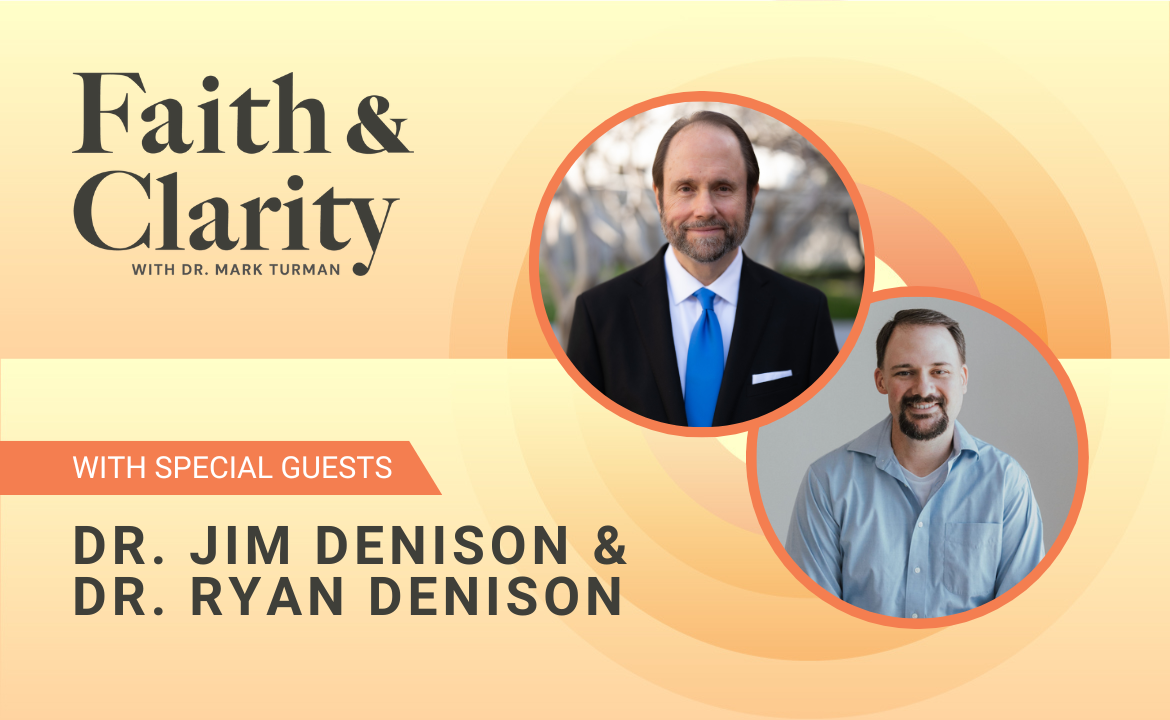
In this episode of Faith & Clarity, Dr. Mark Turman is joined by Dr. Jim Denison and Dr. Ryan Denison for a thoughtful conversation about following Jesus faithfully in a confusing cultural moment. Together, they explore how Christians can seek wisdom, clarity, and hope when the questions feel complex and the headlines feel overwhelming.
The discussion touches on faith and leadership, the role of personal character, and how a biblical worldview shapes our engagement with culture and global issues. Mark and Jim also share writers and spiritual voices that have shaped their own journeys, offering meaningful recommendations for continued growth.
Ryan joins the conversation to respond to listener questions on everyday discipleship, including spiritual practices, relational boundaries, assurance of salvation, and what it means to live as a practicing Christian. The episode concludes with reflections on Gen Z and how believers can engage culture and politics with conviction, humility, and faith rather than fear.
Powered by RedCircle



Topics
- (0:00): Welcome to Faith & Clarity
- (2:29): Biblical expectations from government
- (7:31): Foreign policy and Christian perspective
- (13:34): Spiritual heroes: Henri Nouwen and C.S. Lewis
- (25:20): Discussing yoga in Christian context
- (30:31): Relational boundaries and forgiveness
- (37:39): Defining a practicing Christian
- (43:12): Judgment and rewards in heaven
- (46:34): Can a person lose their salvation?
- (51:15): Expository sermons and pastors in politics
- (58:37): Gen Z and the future of the church
Resources
- Ask Us Anything: [email protected]
- Gen Z Archives
- CS Lewis Foundation
- Henri Nouwen Society
- New Barna Data: Young Adults Lead a Resurgence in Church Attendance
About Dr. Jim Denison
Dr. Jim Denison is a Cultural Theologian and the Founder of Denison Ministries. He speaks biblically into significant cultural issues through The Daily Article at DenisonForum.org. He is the author of over thirty books, including The Coming Tsunami: Why Christians Are Labeled Intolerant, Irrelevant, Oppressive, and Dangerous—and How We Can Turn the Tide; Respectfully, I Disagree: How to Be a Civil Person in an Uncivil Time; and the Biblical Insight to Tough Questions series.
He has taught the philosophy of religion and apologetics at several seminaries. Dr. Denison serves as Resident Scholar for Ethics with Baylor Scott & White Health, where he addresses issues such as genetic medicine and reproductive science. He is also a senior fellow with CEO Forum, the International Alliance of Christian Education, and Dallas Baptist University’s Institute for Global Engagement.
He holds a Doctor of Philosophy and a Master of Divinity degree from Southwestern Baptist Theological Seminary. He also received an honorary Doctor of Divinity degree from Dallas Baptist University. Dr. Denison is the Theologian in Residence for the Baptist General Convention of Texas.
Prior to launching Denison Forum in 2009, he pastored churches in Texas and Georgia. Jim and his wife, Janet, have two married sons and four grandchildren.
About Dr. Ryan Denison
Dr. Ryan is the Senior Editor for Theology at Denison Forum and the author of The Focus newsletter, contributing writing and research to many of the ministry’s productions. He holds a PhD in church history from B. H. Carroll Theological Institute and an MDiv from Truett Seminary. Ryan has also taught at B. H. Carroll and Dallas Baptist University. He and his wife, Candice, live in East Texas and have two children.
About Dr. Mark Turman
Dr. Mark Turman serves as the Executive Director of Denison Forum, where he leads with a passion for equipping believers to navigate today’s complex culture with biblical truth. He is best known as the host of the Faith & Clarity podcast and the lead pastor of the Possum Kingdom Lake Chapel, the in-person congregation of Denison Ministries.
Dr. Turman is the coauthor of Sacred Sexuality: Reclaiming God’s Design and Who Am I? What the Bible Says About Identity and Why it Matters. He earned his undergraduate degree from Howard Payne University in Brownwood, Texas, and received his Master of Divinity degree from Southwestern Baptist Theological Seminary in Fort Worth. He later completed his Doctor of Ministry degree at George W. Truett Theological Seminary at Baylor University in Waco.
Before joining Denison Forum, Mark served as a pastor for thirty-five years, including twenty-five years as the founding pastor of Crosspoint Church in McKinney, Texas. Mark and his high school sweetheart, Judi, married in 1986. They are proud parents of two adult children and grandparents to three grandchildren.
About Denison Forum
Denison Forum exists to thoughtfully engage the issues of our day from a biblical perspective, helping believers discern today’s news and culture through the lens of faith. Led by Dr. Jim Denison and a team of contributing writers, we offer trusted insight through The Daily Article, a daily email newsletter and podcast, along with articles, podcasts, interviews, books, and other resources. Together, these form a growing ecosystem of Christ-centered content that equips readers to respond to current events not with fear or partisanship, but with clarity, conviction, and hope. To learn more visit DenisonForum.org.
EPISODE TRANSCRIPT
NOTE: This transcript was AI-generated and has not been fully edited.
Mark Turman: [00:00:00] Welcome to Faith and Clarity. I’m Mark Turman, your host. This is a Denison Forum podcast and we wanna welcome you to a brand new season on faith and clarity, and we will hope in every way that you will pray with us, that through our conversations and your participation, we’ll be able to help all of us find clarity in our cultural confusion, hope beyond the beyond today’s headlines, and that we will all be equipped more and more each day through these conversations to live by faith rather than by fear.
One of the things we like to do about six or eight times through the year. Is to have conversations that we call ask us anything. And we want to encourage you to do that. Some of you have already submitted questions to us over the last few months. You can do that anytime you want, just by emailing us at [email protected].
That’s [email protected]. Send us your [00:01:00] questions, send us your comments. Let us know how we can address things that are on your heart and mind and a part of your experience. Let us know how we can make this podcast better. We’d love to hear from you and we get to have these kind of conversations several times through the year, and that’s what we’re gonna do today.
And talk about some of the things that you’ve let us know you are interested in knowing more about and are concerned about. In honor of the coming anniversary of nine 11, the 25th anniversary of that very pivotal moment in our country the words of Todd Beamer, one of those who was lost on that day, he liked to say, let’s roll.
So let’s roll into today’s conversation. My guest today are familiar to you, Dr. Jim Denison, our founder and cultural apologist, and the younger version, Dr. Ryan Denison, who is the better version. The, the better, younger, better, stronger, faster, higher version.
Jim Denison: Improved. New and improved. Yes.
Mark Turman: The new and improved version.
Ryan Denison: I say [00:02:00] it, but
Mark Turman: yeah. Yeah. It’s, it’s, it’s become obvious to all who read the daily article. May as well just say it. Follow our podcast. Yes. It’s fair. All. Yeah. Dr. Ryan Denison, who is our senior editor for Theology, and we’re gonna try to deal with a couple of questions. And Dr. Jim Denison is gonna be with us just for a few minutes here at the beginning, and then he needs to get on to other commitments.
But we have a couple of questions that are particularly targeted to his expertise and so we wanna start there. Jim, good morning and welcome to another election year. Aren’t we excited? I don’t, I don’t know about where you live, but where I live, there are political signs proliferating by the minute.
Everywhere because the primaries will come. And then general election in the fall, November as we have what are called midterm elections. And that kind of drives this question that came up, which is kind of a two part question. So let me just share it with you. The first part of the question [00:03:00]is, biblically, what should Christians expect from or hope for from their government?
This is just kind of the personal side of it. I kinda even wonder if we should have any expectations of our government, but from a, from a kind of a personal perspective, as biblical Christians, what should we expect and hope for when it comes to our government?
Jim Denison: Thank you as is the case for you and where I’m as well, it’s like political signs are rabbits.
You know, if there’s one tomorrow there will be two, and if there’s two there will be four. They’re just really everywhere. We’re early in the season, aren’t we? So only gonna get more that way. But the question’s really, I think, a terrific way to start the conversation because there are two very different ways to answer it as I’m experiencing the way people are engaging with this issue.
The one side is to make a separation between the character of the leader and the function of the leader. It’s to come along and say what we should expect of our government is a Romans 13, kind of, the sword of justice, the kind of protecting the populace [00:04:00] securing the borders managing our interests in the world, doing things that advance the cause of the citizenry that our leaders are elected to engage and to support.
Again, Romans 13 sort of answer to the question, which is certainly part of the answer, regardless of what we say. Beyond that, that needs to be part of the answer. But there’s a second piece that others would add to that, which is to say, Christians should expect our leaders to also model. The kind of character that we want our people to exhibit.
The character flows downhill and culture flows downhill. And the kind of character that, that our leaders model and, and emulate is exactly the kind of character that over time many people in the country will come along to, to emulate as well. And so we should be asking that of our leaders. We should be asking a sermon on the mount or a fruit of the spirit, sort of, kind of commitment to the character of our leaders, as well as the execution of the affairs of state and the defense of the country and all of that, that Romans 13 would suggest.
And you see Christians on both sides of that. You see those that would make a [00:05:00] distinction between those things and they’d say, look, I elected a president, not a Sunday school teacher or a president, not a pastor or a governor, but not a church elder. And where that person happens to be with God or what their personal morality might happen to be in their past or even their present is less relevant.
They look at them the way you would look at the CEO of a business. And you’d say I don’t really care what the personal morality of the CEO of Apple or Microsoft happens to be as long as I appreciate the product. And then others that will come along and say but no, in a country, especially a democracy, our leaders really do model so much of what makes for the flourishing of that country.
And that’s where the personal character becomes really important. Part of the, of the conversation, I myself, would lean in the second direction, I would say the Christians should pray for and hope for, and to some degree hold accountable to personal character as well as public performance of duty. But I recognize that there are others in the conversation who would separate those two things and they would answer in the [00:06:00] first way, but not so much in the second.
Mark Turman: Yeah, that’s helpful. Helpful to make that distinction. And it, it, even, even in the question I found myself kind of pondering, I wonder if Paul would just kind of giggle at even the question of what should we expect from our government? His, his answer might have been pretty much nothing but bad things.
Probably. That’s right. Be what he would’ve said.
Jim Denison: If you’re in Cuba, that would be your answer. If you’re in Russia, that would be your answer. It is true, mark, that we in America get to ask the question in a way. A lot of people in human history have not had a realistic reason even to think about, and that’s a blessing that we should not overlook.
I would say.
Mark Turman: Absolutely. And, and as we begin this year, people are probably already seeing a lot of indicators that this is a very special year for us because of its 250th anniversary of America’s founding. And there’ll be a lot of things to celebrate. We’re not a perfect country, but we we are hopefully all grateful that we get to be a part of this country, that we get to be involved in our government and in selecting our [00:07:00] leaders and those kinds of things.
Those are all things to celebrate and a lot of things to consider in this very significant moment of being a country that is now 250 years old, formally and officially. And we’re gonna be talking about those things. Just let our audience know. We’ll be having podcasts and articles and things that they can use that will help them to think more deeply about what it means to not only be a Christian, but to be.
An American Christian. Those things will be coming as we write throughout this year and have conversations like this one. But politics always, at least on a, a national and global scale, Jim always has aspects of what we generally refer to as domestic policy and foreign policy. And here as we begin 2026, obviously a lot of things coming up around foreign policy.
A few months ago we had all kinds of things going on relative to Iran and to the Middle East, to Gaza and the war with Israel to Syria. And now here at the beginning of the [00:08:00] year, we have this whole new situation with Venezuela. And that kind of drives the second part of this question, which is, as Christians thinking biblically, what kind of hopes, expectations or aspirations should we have of our government toward other nations?
Not just the immigration issue, but just. We sometimes get called or criticized as being the world’s policeman. But how should we think about that from a biblical standpoint of. What we would hope our nation would do. Toward and on behalf of other nations.
Jim Denison: Yeah. And that’s obviously a massive issue these days, isn’t, it?
Has been for a while. Will be for a while, I would imagine going forward as the world gets smaller and domestic and international relationships become in so many ways, the same thing geopolitics really started my front door now more than ever used to be, was a name when America could pretty well feel itself isolated from other issues because of the oceans east and west.
And we had forests to the north and deserts to the south and we weren’t too worried about Mexico and Canada. And [00:09:00] we really were able to, in some ways, see what happens in other world, other parts of the world is less relevant to us. That’s clearly not the case now, as used to be the case nine 11.
Taught us that if nothing else, that we’re not as safe here from what happens in the world as we thought we were. And so it makes your question more operative now than might have been the case perhaps in previous generations. And again, I think it pulls into the same two categories on just a little different scale.
On the one scale, there’s the idea that our nation owes us, putting us first. Every nation does that doesn’t make America unique. The Venezuela’s leader should first and foremost think about what’s best for Venezuelans And Israel’s leaders should think first about what’s best for Israelis and Irans and Russias and so forth, that they really have a moral responsibility to their leaders, to put them first, to do the Henry Kissinger sword of a move that nations don’t have.
Allies just interests. And as long as the interests of my people align with the interests of Canada, then we can do a NAFTA kind of a thing or whatnot, but only as it benefits. Us, [00:10:00] it’s kind of an America first sort of an approach that would say our leaders owe us that. The same way that the president of IBM owes his shareholders to put IBM first relative to competition with other tech companies.
And a pastor owes the members of his church to be resident to their issues and their needs primarily, and to think first and foremost about how we can serve them most effectively. And so that’s one answer to the question. The other would be to say along with that, and I think that’s pretty indisputable, that our leaders owe first responsibility to us.
A second way to add to that freeway into the lane on the freeway would be to say yes, but if we engage the world effectively, not only are we advancing the values that we believe are are true to all flourishing, to all human flourishing, but we’re also doing ultimately what’s best for our people as well.
That if, for instance, we can engage China in ways that don’t lead to World War iii, that’s better for our economy, that’s certainly better for any of us, would have to be involved in war with China and any [00:11:00] way that a war with China could affect our own people relative to cyber attacks and all that could be inside all of that.
And so if we can keep China and Taiwan from having a war that the South China Sea is more available to our global shipments and to our global economy, which is so interconnected. And so if we can help there be a stronger push toward democracy in Iran. Right now, then we’re not only helping Iran flourish, we’re keeping Iran from attacking America as some in Iran would wish to do, or attacking Israel that would then draw us into a war in the Middle East.
And so it’s really America, first to be America for the world as well. And so the balance always comes. How do, how do you, how do you do both of those things? How do you engage what’s happening right now for instance, the end, the larger world in South America in a way that really does advance America’s interest, even at the same time that we’re doing what is best in the context of the issues that are specific to that, to that environment.
And the same thing with the Middle East or China, Russia or [00:12:00] whatever, Ukraine, whatever might be the deal. That’s the balance, is how to, how to, how to manage both of those. I don’t think really you can plausibly argue that we can anymore be so segregated from the world, so isolationist as to not have this conversation.
Prior to World War I and World War ii, that was more plausible, we thought before Pearl Harbor and obviously all we came after that, but that’s really an implausible conversation. I think nine 11, if it proved nothing else proved that. And so we now have to ask what’s best for our people in the context of what’s best for the larger global situation as
Mark Turman: well.
Yeah. It’s so important to think about. As one of my mentors used to say that technology, be it cyber technology or military technology has made the world a neighborhood, but only Jesus can make it a brotherhood.
Jim Denison: That’s good.
Mark Turman: Well said, said. And we are more interconnected and, and globalism is just a reality.
And is only going to be a bigger reality going forward. But it, it also kinda remind me of what I used to tell young [00:13:00] couples who wanted to get married, and they come to talk to me and I say, you know, the, the, the Bible says some things, but not as much as you might think about what it means to be a good spouse.
But it starts at be a cri, a good Christ follower, and that will be the first and best gift you can give to your spouse and anybody else.
And on a larger scale that kind of applies to us as a nation, if we will, you know, first and foremost seek to be the healthiest most civil, most compassionate, most biblical nation, then that will spill over and overflow to us helping other nations to be as healthy and flourishing as they can be as well.
But Jim, before you get away had a reader write in asking about some of. Some of the people that you learn from and that we might sometimes call spirit a spiritual hero or spiritual guide and teacher which is again, relevant to us. You wrote just today in your daily article about one of the current spiritual guides and heroes, Philip Yancy, and some really sad news related to [00:14:00] him.
But one of the great things about reading your daily article consistently and the other writings that you do, is that we listen and we hear who you have learned from through the years and even today. And so a reader wrote in actually two different readers talking about how they’ve learned, listened to you enough to know that a guy by the name of Henry Nowan and another guy by the name of CS Lewis are people that have really been significant in your own journey of faith and life and growth. So tell us a little bit about who is Henry Noun and what’s significant to you about his life and maybe a book or two that you would recommend from him. And then kind of the same thing about CS Lewis. I heard somebody say just a few days ago, they grew up in a CS Lewis kind of Christian environment.
That’s an interesting idea. Now this, so I know these two, these two guys are significant to you. So tell us a little bit about each of them and maybe two or three titles that each of them would be [00:15:00]good for us to pursue.
Jim Denison: Sure. Thank you for that. Glad to do that with Henry now and first Henry, JM now, and he had four names.
He was born in the Netherlands, born and raised there at born early on in his trajectory since a call into Catholic ministry. Was ordained as a Catholic priest, although he’s never served a specific local parish. And from there, got interested in psychology. He struggled with clinical depression regularly across his life and that really made him, I think, sensitive to, and attuned to, attentive to the kind of the inner issues of life.
And that really became a focus for him. Came to the United States, studied psychology at the miniature clinic, went back to the Netherlands, did a PhD in theology, and spent the rest of his life combining theology and psychology. Or theology and psychiatry, you might even say. Taught at Notre Dame.
Taught at Yale. Taught at Harvard. Then spent the last 10 years of his life as a pastor to a, not a Catholic priest, but a pastor, a chaplain to Large, which is a community from mentally and physically disabled people in Toronto. So a remarkable spectrum from [00:16:00] teaching at Harvard to being chaplain at large, which really kind of describes the breadth of his remarkable life and career and impact.
I would recommend Life of the Beloved. I would recommend his book Out of Solitude. I would especially recommend Return to the Particle. If I’m thinking of three books, it would be influential in my life out of what he did. But to boil down the basic assertion of his ministry, the claim of his ministry, it is that we are the beloved of God.
We just don’t know it. We don’t recognize the degree to which God loves us intuitively. That he loves us passionately, that he loves us unconditionally that he loves us on a level that should make his love for us, be the basic core of our own identity. That we need to learn to love ourselves because we are loved.
And if I understand that, mark, if I understand that I’m loved that passionately by God, I’m then free to love you whether you love me or not, because I don’t need you to love me on the same degree because I already know I’m loved by God. I’m free to forgive myself because I don’t need to love [00:17:00]myself. As much as I might otherwise have felt I did, because I know I’m loved by God.
And so if I can every day be unwinding the tapes of the fall, the tapes of this consumeristic performance centric popularity driven culture that says, I’m who you think I am. If I can every day step away from that sort of transactional understanding of myself and every day, remember that I’m the beloved.
And remember that I’m the prodigal who can come home to the father, and that the father will run to embrace me and to greet me and to welcome me home. Then I’m gonna live my best life, not only for myself, but for everybody else I serve. And a life that most honors got if now one could be on this on this conversation.
That would be the way in which I think he’d want us to see this. Now he could have that conversation with you in Dutch, in English, in German, in French, and in Spanish.
Mark Turman: Just
Jim Denison: like you. He fluent Just like me. Exactly. Just like me. I’m just choosing to do this in English right now. Exactly. Because I’m just that kind.
I’m just that gracious. Yeah. But yeah, he was that brilliant. [00:18:00] He was that in Incre. I mean, he was a genius. He was an absolute world-class intellect who was called by God to apply that intellect to the inner life. To help us to embrace the, the belovedness of God. Quick story. He was at one point seeing a poster or a depiction of Rembrandt’s return to the Prodigal, his famous painting of that moment when the father embraces the prodigal as the elder brother stands disapprovingly over the shoulder back there.
Then he was able to be at the Hermitage in St. Petersburg and see the actual painting itself. It’s a massive painting, eight feet tall, and it’s so enraptured him that he wound up coming back to it day after day and standing before, and he wrote his book, return to the Prodigal out of that experience. And the cover of the book is in a depiction of that painting.
I’ve got, I’ve gotten to be in the Hermitage twice over the years, once as part of a group I was leading in another time on a cruise that I was actually able to be on with Janet. And so I’ve, I’ve stood before that very painting. At one point you could only get a poster of it in the gift shop at the Hermitage.
And so I have that [00:19:00] poster it, it’s actually framed in my office and I have it where I can see it every day. And so standing in front of that same pinning where Noun stood, I sensed something of the embracing nature of the father that Rembrandt so beautifully, so powerfully depicted. And on my good days, I remember that on my good days I remember that I’m beloved and that’s really all that matters.
Everything else flows out of that. Wow. So that would be now as he is in my life. Okay. I was at a silent retreat some years ago when I experienced his book out of Solitude. It was life changing for me. That was when I started my pilgrimage with now one. That was in 1997, I think. And that’s when I started reading.
Now one out of that little book I picked up at the bookstore of the Jesuit Catholic Retreat Center, where I happened to be having this silent retreat with our staff in Easter week of 1997 and read that little book. And it’s where I first began to understand what I’ve tried to explain today. And I’ve been reading now one ever since.
So that would be now one.
Mark Turman: Let’s talk about CS Lewis. Thank you for that. Yeah.
Jim Denison: How, how long do you have? How long would you like [00:20:00] us to have this conversation? And Ryan’s wondering if he’s ever gonna be a part of this conversation is, I’m just gonna take it over and you guys just go on about your day and just give me the time period come back in a few hours and we’ll be able to kind of maybe wrap this up a little bit.
Oh my goodness. Clive Staples Lewis. By most measures, I would think people could say the leading, popular intellectual of the Christian world in the 20th century. The greatest apologist of the 20th century, one of the greatest apologists of all time. And next to the New Testament, the most formative influence in my life.
I can get emotional talking about all of this. I became a Christian at the age of 15, so I’ve heard my story, but really struggled with how to, how to reconcile faith and, and and intellect. The pa the church where I became a Christian was a wonderful church in so many ways, but not really intellectually centered.
And I just, and asked so many doubts and so many questions, so many apologetic issues, and I just thought there was something wrong with me. And somebody gave me CS Lewis’s Mere Christianity in high school, and I read it and it changed my life.
Ryan Denison: Hmm.
Jim Denison: It’s the first time I’d seen anyone deal with faith [00:21:00] intellectually.
And help me to understand, first of all, that that is a way to relate to God and the way Lewis did it was so brilliant, so transparent, so genuine, so moving for me that it was transforming for me and I, so I read Lewis every day. And have all these years since I, I’ve done major talks on Lewis. I, I’ve led study tours at the kilns where he lived in, at Oxford for decades.
I’ve, I’ve, I’ve been in his study. I, I’ve been to where the, the lake that he used to swim in and the places he used to hike. I’ve been on Addison and Ned Lin College Walkworth. He really came back to faith through the influence, A JRR Tolkien. I’ve read most of what he’s written.
Not all of it, but most of it. If I could recommend only three things, it’d be beer, Christianity, it would be screw tape letters, and it would be the abolition of men. Not a book everybody’s aware of, but a book I think was incredibly important to the postmodern movement that he foresaw decades ahead.
But if I could boil Lewis down, it would be his assertion that it is [00:22:00] possible through the life of the mind to embrace what he called mere Christianity. It’s a phrase he borrowed from Richard Baxter that central kind of hallway of Orthodox biblical faith that has all these rooms attached. One might be Catholic, one might be Protestant, one might be Baptist, one might be Methodist.
Lewis was there to try to get you in the hallway. To try to get you to embrace mere Christianity, the essence of the faith itself, to help you to see it as reasonable, to see it as, as as repaying of intellectual inquiry and study. And he was there to help you use your mind as a way of embracing the God who embraces us.
And as is so many ways a model for me and a mentor for me by virtue of what he did in so many ways, I tried to, on a very small scale. Try to do what he did. Try to help people embrace a kind of mere Christianity. That’s a lot of why our ministry is non-denominational and cross denominational, and a lot of why I’m so interested in helping people be a embracive of Catholic and [00:23:00]Protestant theologies as they’re relevant and helpful to us.
And and have lived my life out of that sort of a, of a trajectory because that in many ways was his trajectory. Now, again, as with now, and I mean, Lewis had five languages by 15. I mean, he was a world class renaissance, medieval and renaissance scholar in Oxford and Cambridge who did apologetics on the side.
He did that just as his own personal ministry. That’s what he’s known for. But his career was as a worldclass scholar of medieval and Renaissance literature. And so that was his world-class intellect. One of the greatest intellects of human history, I would say. But using that intellect to help us in a way that can embrace beer Christianity in an intellectual way.
It’s, anyway, it was a gift to millions of us. He died the same day. Jf K did. People didn’t recognize his death because it happened on that same day, November 22nd, 1963 was only 65 when he passed. But what a remarkable life. Anyway, I, again, I do lectures on his life. I lots of stuff inside that, but I’ll, I’ll [00:24:00] try to stop there.
Mark Turman: Thank you for that. Yeah, just amazing stuff and any of us that have touched into either now and or Lewis’s work we, we sense that same kind of just amazing intellect and, and profound thinking that that helps us to, to consider the depths of who God is and how he feels about us and how we are.
In some ways it’s kind of a taste of. Some of what we’re gonna experience in heaven, I suspect of just learning more and more of the majesty and wonder of who God is. And I agree. And yeah. And we thank you for sharing it with us and for we, we, we love your excitement about them and that, that helps us in many ways.
And you know, now that you’ve kind of introduced our podcast for today we’re gonna take on the hard questions. Okay,
Jim Denison: good. Good. So glad.
Mark Turman: But yeah. But you were a great warmup for Ryan and I to, to get ready to take on the really glad to be the pre challenging question.
Jim Denison: That’s right.
Mark Turman: Yeah.
Jim Denison: I’m glad I could be the prelude a little bit.
Jill. I’m here to switch.
Mark Turman: Yeah, [00:25:00] yeah. We know. We know, we know. So thanks for stopping by and we know that you have some other commitments that you need to get onto and we will let you do that. But thanks for being a part of this conversation and we’ll have you back soon to talk about some other matters down the road.
Jim Denison: Be my privilege. Thanks guys.
Mark Turman: Alright. Take care.
Jim Denison: Thank you.
Mark Turman: All right, Ryan, we’re gonna pick up with a few other questions. So the next question really seems almost outta character with where we started. One of our readers asked what are your thoughts on yoga? And so I thought I’d try to see if I can put some thoughts together.
Their question continues. It seems like yoga is dabbling in another religion and should be avoided because it could be a slippery slope. And this writer rights, I’m amazed to see that churches offer yoga classes. Having been a pastor and having had people come and sometimes request this kind of opportunity in the context of our buildings.
I’ve run into this over time in ministry. Certainly there are aspects of [00:26:00] yoga that have connections back to eastern religion such as Hinduism, particularly Buddhism as well. The idea behind that in some ways seems to be that connecting with your body through certain practices of yoga help you to become one with the creation, which is really fundamental to Eastern religion.
That’s not been my experience as a pastor or as a person. All of my experiences relative to yoga have been more in the, in a simple category of physical health and that yoga has been a means of helping to keep yourself healthy by stretching your muscles by relaxing by working with some of the yoga techniques to reduce stress in your life.
And to do what the Bible calls us to do, which is to steward our physical bodies in a way that honors God, in a way that will keep us as effective as possible. For using our lives both [00:27:00] physically, spiritually, emotionally, and mentally to serve God well. I’ve not had any encounter with a person or a group that was pursuing yoga and the experiences of yoga from a meditation standpoint, from a spiritual or religious standpoint.
It’s always been in the context of an aspect of physical health. And, and like I said, seems to be more along the lines of what I would call physical stretching and relaxation and not anything related to religion. That’s the way I’ve experienced it. If, if there’s more to that, we would encourage people to write to us and let us know about that, and we certainly can talk about that.
I’d be very cautious about any yoga teacher or leader that tried to turn it into something of a more spiritual nature rather than simply a physical health kind of thing. Does that kind of resonate with the way you’ve encountered it, Ryan?
Ryan Denison: It does, and I think it’s, it’s really helpful to think back and remember that a [00:28:00]lot of the things that we take for granted as part of our Christian traditions, part of our, just the practice of our faith, oftentimes a lot of those came from non-Christian context and we sort of christianized them over the years, and I think yoga has the potential to be one of those.
I, I think it is important to keep in mind where the origins are. To keep in mind the way that, the ways that it could be misused to lead us away from God rather than to God. But I also think if, if you look at it as a, and treat it as a chance to be intentional about creating space in your life for the Holy Spirit to speak, then it is, there are many aspects of it where it does emphasize just slowing down your mind, taking a break from all the distractions of your day to really just focus on trying to become more aware of what’s around you, more aware of, of the Lord.
Even it can be used for that. And I think so if used well, I think it can, it can do great things. I think it also like most things I think it’s more net [00:29:00] neutral than positive or negative. And that means it has the potential for bad as well. And so I, I do really, I think you’re, you’re right to emphasize that you need to be very aware of who’s leading those classes.
If you’re taking yoga classes. Especially kind of in some context, if it’s in a church, ideally you would be able to trust that those leaders are gonna be using that time to help you encounter the Holy Spirit to help you quiet your mind, to let God speak. If you take those classes in outside of a church, I mean, that could still be awesome.
That could still be great. But I do think it’s, it’s important to go in with at, at least at the start especially at the start with a sense of caution, that, and just a awareness to see how are they using these practices? Because the practices themselves can be good if used the right way. They can be bad if used the wrong way, like many things in our lives.
Mark Turman: Yeah, I think that’s exactly the case. As I was kind of thinking through this, it just kind of reminded me that done in a healthy and biblical way, that some of the practices, physical practices of yoga can kind of align with [00:30:00] that idea of what we read in the Psalms of be Still and know that I Am God.
And being able to kind of settle down your life, slow it down, and, and really focus in on the presence of God and on and in some ways on the, the gift of what he gives us in terms of our physical bodies, our physical lives, and that. We, we are not, we don’t, we aren’t just people who have bodies. We are people who are embodied and we believe in a physical resurrection.
And so we need to steward that well with great joy and with great anticipation. Let me ask you a question, Ryan. This one really kind of has to do from one of our readers with what I might call relational boundaries. He talks about and celebrates and thanks you and your dad for riding in a way with a, a, a good pastoral heart.
And then he says, you know, I’m a, I’m a pretty mature believer in Christ he said, but I’ve been wondering and pondering on the idea of loving our enemies and how that really looks in our lives. Obvi. He points out that, obviously the Bible teaches us to serve them, to [00:31:00] pray for them. But then he re he gets really personal with this and says sometimes with angry or abusive family or friends, loving them means.
Walking away quietly, but being ready to reach out if they ask or engage with us. In his experience, it sounds like that’s not been talked about that having some kind of a boundary or not engaging with this person that has had, you’ve had relational difficulty with that. That’s not necessarily acceptable in some people’s eyes.
What do you think, Ryan, what is, what are, are boundaries acceptable in these kinds of things for us as Christians sometimes relating to other Christians with some really hard relational realities? How would you guide this person?
Ryan Denison: It’s a really great question, and I, I do think he brings up an important point that we don’t always talk about it as much in our churches as we should.
Because I do think it’s, it’s easy to get this idea that Christian forgiveness is more more akin to simply [00:32:00] acknowledging that someone hurt us and then. Forget it ever happened and move on with our lives as if it never happened. And I don’t think that’s what the Bible means. The Bible does talk about how God, when he forgives our sins, they go as far as the east is from the West.
But it doesn’t, it also, there’s pastors that make clear that he doesn’t therefore then remove the consequences of our sins. We still have to face those. And I think when we apply that principle to our relationships with others, I think it’s especially important to remember that God as our, as our perfect Father doesn’t, ex doesn’t want us to just give a blanket forgiveness that then sets ourselves up to get hurt.
Again, in the same ways I do think there’s elements of this that he, we are called to be, be wise as serpents in addition to being gentle as doves. And I think what that often looks like in terms of our relationship with others is that we never get to be the ones, as Christians, we are not allowed to say I, I will no longer have a relationship with this person.
We’re not the [00:33:00] ones that get to end relationships. But I do think there’s room for us to create boundaries as long as they’re healthy, and especially as long as they’re protective rather than punitive. I don’t think we’re allowed to set up boundaries that are intended to hurt someone or make them feel guilty for what they’ve done or constantly remind them of the, of the things they’ve done wrong.
But if we’re setting up those boundaries to protect ourselves, to protect our families, especially, then I think that is a very biblical concept. I think that can honor the Lord and if the other person is willing to. Kind of be in relationship with us inside of those boundaries to respect those boundaries, at least for a time as the, as the trust is rebuilt, then I think that is a very healthy way to approach it.
If they’re not willing to respect those boundaries, if they’re not willing to, if they want to just go back to the way things were without admitting that consequences are real, then I think in some cases it is okay to walk away, never to break off the relationship, but to create enough distance to be protected [00:34:00] doesn’t mean we stop loving them.
Doesn’t mean we stop caring for them. Definitely doesn’t mean we stop praying for them. And so I, I think that’s kind of the fine line we have to walk is how to practice relationships well where we don’t break off the relationship, but we do protect ourselves and those around us as well. Also what are your thoughts on that?
Mark Turman: Yeah, I think that’s a, a really good insight. And, and just makes me think about the, the thing that I would run into in my own life and in my own pastoral ministry as well, is that. We need to understand there’s a difference between forgiveness and trust. And I, I think it’s interesting that the, the Bible is very clear about commanding us to forgive the way God has forgiven us.
And it, it doesn’t say anything about forgiving when you feel like forgiving. It just is commanded of us. You have been forgiven way more than you even grasp. And so you must forgive. I think I’m thinking of the Lord’s Prayer. You know, there’s, there’s only one part of the Lord’s Prayer that has a qualifier after it, and it’s this conversation [00:35:00] and that God says, you’re going to appreciate in eternity just how much you’ve been forgiven.
But I’m commanding you now in that same spirit to forgive others. But there’s also a lot of very wise guidance in the Bible about building, trust in healthy ways with people who are showing themselves over time to be trustworthy. And the way I talk about this is living on the spectrum between where Jesus says you know, if you’re on your way to worship and you know that there is somebody that has something against you, don’t go to worship.
Go to that person and do everything you can to reconcile whatever that is, whether they hurt you or you hurt them. Whatever you perceive, go and work on that. Sometimes take people with you. Matthew 18 says take mature believers with you to go help that. That’s one side of it. The other side is the practical reality of what the Apostle Paul was inspired to write to the Romans in Romans 12 when he says, as far as depends upon you, be at [00:36:00] peace with everyone.
And in that verse is kind of the practical reality that you may not be able to reconcile every relationship to the fullest extent that you would want it to be. Because those people may not be showing themselves to be trustworthy. And there needs to be protection and there needs to be wisdom in that.
And so we have to live on that continuum. And I think, I think that, I think both of those truths obviously apply, is kind of the way it has worked out in my life.
Ryan Denison: Absolutely. And I do think it, it’s very helpful to remember that at times it’s easy to approach this conversation from the perspective of the one that needs to do the forgiving, when a lot of times the best way to understand it is try to put yourself in the position of someone who needs to be forgiven and understand what that’s like.
Oftentimes, when the Bible talks about forgiveness. It’s in the context of helping us understand our need to be forgiven. And so when [00:37:00] you think about what does it look like to be in relationships with others as best you can try and from their perspective, see if I committed those sins against someone, if I needed that level of forgiveness from someone, what would I expect?
What would I want? And evaluate it from that perspective as well. Like when, when Jesus says, when Jesus commands us to treat others as we want to be treated. I, I think that’s, that’s helpful from a practical perspective of knowing kind of how we interact with others. It’s also helpful just from a spiritual and mental perspective of being able to try and understand how should we see our lives?
How should we see others? And that’s especially important in the context of forgiveness. I also think it speaks really well to the next question that a reader asked about how do we define practicing Christian? And what would you consider the opposite of being a practicing Christian? So Mark, kind of, how would you answer that?
Mark Turman: Yeah, I thought this was an interesting question and it kind of relates to the one that follows it as well. We’ll get to that. But we use these terms and, and I, again, I sometimes [00:38:00]wonder if somebody like John or Paul or Peter and, and certainly Jesus, I wonder if they would, if they would even resonate with the question, the way we answer it.
But generally speaking, I, I think we commonly say that somebody is a practicing Christian. If they are pursuing a spiritual understanding and a spiritual relationship with Christ on a consistent basis, and they don’t just have a basic intellectual knowledge about Jesus and about the Christian faith, but it doesn’t influence the way they make decisions and the way that they pursue.
Relationship both with God on a consistent basis and a relationship with others. One of the verses that kind of just popped in my head is what James says when he is talking about taking God and taking his word seriously. James says, you know, even the devils know who Jesus is and they know the story of the [00:39:00] gospel but they don’t, they don’t embrace it and they don’t accept it, and they don’t choose to follow it in faith and trust.
And so what James seems to be indicating is, is that there is a level in which you can understand the facts and the story of the message of Jesus and the message of Christianity that is in the Bible. You can, you can know the knowledge, but that doesn’t necessarily mean you trust it. It doesn’t mean that you’re counting on it for the forgiveness of your sin.
For the restoration of a relationship with a personal living God, and that you’re going to then allow that truth and the reality of that relationship to become the thing that guides and informs and directs the way you do everything else. The way that you think about your job, the way you relate to your spouse or your children, or your parents, or your friends or your neighbors that it then becomes the compass, that [00:40:00] relationship of trusting in Christ as your forgiver and as your leader.
That should be the thing that directs and informs everything else that you do as you learn to let Christ live in you. That’s what a practicing Christian is. A non-practicing Christian. If you could even actually say that this person was a Christian, only God would know the answer to that, but a, a non-practicing Christian.
Would be somebody who knows and understands the basic facts of the story or many of them, but is not allowing them to influence and guide the way that they live. That’s, that’s generally the way I would describe that. Does that that resonate or sound right in your understanding?
Ryan Denison: It does, and I, I think it points to also I mean even in James, James also writes, faith Without Works is dead.
And I think that’s kind of the idea here is James isn’t saying that you earn your faith through your works, but he’s saying [00:41:00] that if your faith doesn’t produce works, then you should question really how much faith you have and how real that faith is in your life. Elsewhere in the gospels, Jesus talks about how we’ll know, you can know a tree by its fruit.
And I think it speaks to what you’re talking about there, where we are never given license to stay with any sense of absolute conviction whether or not someone else is saved. ’cause outside of ourselves, we can’t know that about anybody. But I do think the Bible part of practicing biblical accountability is when we see people living in a way that doesn’t reflect that faith in their lives that we’re meant to ask the question at least.
Because I think there’s a lot of people, especially in America, especially kind of where we live, kind of in the Bible Belt, I think it’s especially a problem where. There’s a lot of people that grow up in Sunday school, grow up, going to church at least often enough to become aware of who Jesus is. And my dad’s talked about how growing up he thought, he thought he was fine because he wasn’t a Muslim, he wasn’t a Jew, he wasn’t a Buddhist.
So of course he was a Christian. He must be Mm. Everyone else around [00:42:00] him was so he must be too. And it wasn’t until his, his teenage years when he really encountered the gospel and someone that confronted him with the question of, do you believe this? That he really was saved. And I think there’s a lot of people that grow up in church that maybe even walk down an aisle that don’t demonstrate a lot of conviction to the Holy Spirit matters in their lives.
And I think as Christians, part of our job is to ask the question because it’s much, even if it’s an awkward conversation, it’s gonna be a lot more difficult conversation if the next time, if the first time they have it is with God in the judgment seat before at the end of times like that’s, that’s not when you want.
Them to have encountered that question for the first time. And so it’s worth risking it to ask today. And because I do think there’s a difference between a practicing Christian and a non-practicing Christian. I think oftentimes that difference is just the presence of the Holy Spirit in their lives.
Mark Turman: Yeah, yeah. And yeah, and in some ways, you know, a, a [00:43:00] non-practicing Christian is the biggest oxymoron there is in my mind. There’s some way, but the Bible does seem to indicate that that is true at least in some way. And like I said, ultimately God is the only one who knows. But kind of this another reader writes a, a kind of a similar related question talking about you know, how should we think about the judgment that Christians would receive in heaven that you were just referring to?
He’s, he references second Corinthians five 10 that says, for we must all appear before the judgment seat of Christ, so that each may be repaid for what he has done in the body, whether good or evil. I, I actually love this verse because it’s one of those verses that says that yes God is sovereign, but we have been given free will by him.
And our choices do matter. They matter as it relates to our life and our relationship with God, and they matter as it relates to what happens in the world. We don’t know all of how our church choices matter, but it would, it would [00:44:00] be ridiculous for God to give you free will in which ultimately your choices in life didn’t matter or didn’t have any true and lasting impact.
So they do matter. And it also seems to relate to this question that only God knows, but there does seem to be at least three types of status relationship when it comes to faith in God. You can either be a non-believer and you may know, or you may know a lot, or you may know very little about Jesus, but you don’t believe it.
And God knows who those people are. There are people who do know Jesus, and they have, they have a relationship that has forgiven them of their sin and reconciled them to God, but they are not developing that relationship as earnestly and as eagerly as they could and as God would want. What I learned as a young Christian, that’s what it meant to be a carnal Christian.
You, you were a part of God’s family. You had accepted Christ in his forgiveness, but you were not [00:45:00] developing the relationship. You were not practicing your faith. And then there, there were those in this other category, Christians who had accepted Christ and they were pursuing Jesus on a consistent basis and they were maturing.
In their faith, and they were bearing more fruit of the spirit as God would want them to. And I think that’s a lot of what is the context of Second Corinthians chapter five? And what he’s saying is, is there I remember every time, every time I read this passage it it, it basically says in Corinthians, there are some people who are going to be in heaven, but they’re kind of gonna be coming in with smoke on their heels because they, they have not, they have not engaged and developed their faith the way that they could have and should have.
And they’re not going to lose their relationship with Christ. But they’re also not going to experience the rewards that God would like for them to have now and in eternity [00:46:00] because they got distracted or they got deceived. They just got lazy and they’re going to miss out both now and later on some of what God would want them to have now.
I don’t think that they’re gonna be I don’t think they’re gonna be suen when they get to heaven. I think they will see the, the justice and righteousness of God in making these decisions about what rewards he gives them. But clearly there is the opportunity to receive rewards if we pursue Christ consistently and and passionately after we have come to know him.
Which kind of relates to the next question, which is a question that Ryan, I’d ask you to kind of delve into, which is this idea of can a person lose their salvation? This comes from a mature believer who, you know, he is pondered this a lot, read some of the things that. We’ve written about this quotes passages like Galatians five 17 and following Hebrews chapter six.
How, how would you answer this [00:47:00] question about the law, the, the salvation being lost or potentially lost or eternally secure or something that is commonly talked about in evangelical faith?
Ryan Denison: It’s a tough question, and I think part of the reason it’s tough is because there are passages that seem to speak to both sides of this.
I, I think Hebrew six is one that’s often quoted and I think often in a way that’s misunderstood. ’cause a larger context of Hebrew six, I think is actually the author saying that we do have security of salvation because Jesus that’s the passage where it talks about how if you are a Christian and renounce Christ, Christ can’t die for you again, essentially.
And I think that’s the author of Hebrew’s way of saying, so you can’t that’s not a sin that you have to worry about. Not being able to be forgiven like Jesus has, Al can’t die for you again ’cause he’s already died to pay for that sin. And so I think the author of Hebrews there is actually saying you don’t need to worry about this because that would be impossible.
It’s, and but I, there are at the same time, there are other passages that speak to [00:48:00] the opposite that seem to speak to the opposite of that. And I think at the end of the day though, I, I do think this is one of those issues where it’s really important to remember that the Bible is a, a practical book before it’s a theoretical book.
And I think a lot of these, especially kind of the passages in question, oftentimes are written to help you just have a sense of urgency about examining your life and asking that question of yourself. Jesus, one of the scariest passages for a lot of people is where Jesus says there will be those who come to him at the end.
I’d say, Lord, look at all these amazing things I did for you. And Jesus’s answer is gonna be, I never knew you. And I think the idea is if that passage scares you, then you’re probably okay because it means you’re not taking it for granted. The people that most need to be afraid of that passage are the ones that’ll read it and go oh no, I’m good.
I’m fine. And I think that’s kind of, we are meant to struggle with this to an extent. I think part of the reason the Bible doesn’t give us just a blatant clear definition of this is that it doesn’t want us to ever take, take our faith with [00:49:00] him, our relationship with him for granted. It doesn’t want us to fall into that trap of thinking, I walked down an aisle when I was a kid.
I haven’t given God a second thought since, but I’m sure I’m okay. I, I think that’s really kind of, that’s a, a relationship with, that’s a kind of relationship with God that we don’t see the scriptures ever say is all right. I think it’s, it’s really easy for us to accept because it’s kinda what we want.
And on some level, I think a lot of us have the self-awareness to know it’s, we don’t. We don’t deserve salvation by any means. And so God would be well within his right to say, no, no, you don’t deserve it. But there’s nothing we could do to deserve it in the first place. That’s why it was a gift. And I, I think, and the other aspect of this though is I do think there’s also a passage is that where God talks about how we are adopted into the family of God and we’re held in this hand, and no man can ever remove us from God’s hand, and that includes us.
I don’t think that we can remove ourselves from God’s hand once we’ve play, once we’ve accepted salvation and placed ourselves in that, in his hand. But kind of going back to what we talked about with the previous question, though, I, I. I [00:50:00] do think it’s very important to ask the question, and if you see people living in a way that doesn’t demonstrate the fruit of the spirit in their lives, to encourage them to ask the question, because there is no more important thing to have settled than no more important issue to have settled than our relationship with the Lord.
And that’s true for ourselves. It’s true for those around us. And we’re beyond that even. I also think this is meant to inspire us to live better lives because the, the fruit of the spirit, the fruit of a relationship with God isn’t just seeing an eternity. It’s the best way to live now. And so I think this is also a part of the Bible’s way of encouraging us to really not take for granted that are not to ever get to the point where we see our salvation as something that is only eternal.
It’s meant to change the way that we live on a daily basis. It’s meant to improve our lives on a daily basis. And I think that’s really important to keep in mind in this as well.
Mark Turman: Yeah. I love, I love that the way you said that, that salvation is not just for eternal life, it’s for today’s life. You know, and it should be shaping both in, in the, [00:51:00] in the truest and biblical way that faith should be.
It, it goes to just a basic understanding of what is faith and how does faith operate? How’s it supposed to work in our lives on a daily basis? Really. Great. Alright. We’re gonna have to sprint to get to these last two questions a little bit. Alright. They’re pretty big on their own, so we may have to come back, but we had somebody write to us and say I noticed that a lot of pastors exclusively preach what is called expository sermons.
Why do some pastors seem so committed to that? And then right on the heels of that, ask the question why are some Christians, churches and pastors. Involved in politics. He kind of seems to be trying to struggle with this in his own mind about how much is too much of being in the public square and talking about cultural issues makes a reference to what pastors did.
In the aftermath of the Charlie Kirk assassination a few months ago. Some talked a lot about it, others talked not at all about it. And I know I, I sat in a group of, of 30 [00:52:00] pastors who talked about this, and no matter what any of them said, they got criticized for doing too much or too little depending upon who in their church was talking about that event and about other political, cultural realities such as that.
Let me just a, let me also say, as a pastor, it’s hard these days to be a pastor because pastors are expected to be experts in just about every category. Whether it’s politics or medicine or economics, theology psychology, sociology it, it, there, there has grown up this idea that pastors are supposed to be experts in all of these categories, and they are not.
And I get reminded often that I need to remember what my lane is. But simple definition, a, an expository sermon or teaching is something that comes from a primary passage of the Bible. And the goal initially is to, is to expose what [00:53:00] that portion of scripture, that story or that paragraph even.
What did it originally mean when it was first written under the inspiration of Holy Spirit? And what are, what is the timeless truth or principle that can be discovered out of its original meeting that still applies to our lives, our relationship with God and our relationship with others. That’s the way I would define it.
It is a teaching or a sermon that is anchored in one primary passage or story of the Bible. And it is seeking to expose that teaching in that truth, in that one place. That’s the way I was taught to preach. It’s my favorite way of preaching. And the reason is, is because there’s no, there is no other book like the Bible, and I think that the best way to read and teach the Bible is to teach it from what was its original context, purpose and meaning, and [00:54:00] where can we, under the Holy Spirit.
Mine out that timeless truth and or principles that apply to us now that’s not the only way to preach. I think it is the best way to preach. And that’s the way I do most of my speaking and teaching in churches as it relates to politics. What I would say to all of our listeners is you need to give your pastor as much grace as you can.
You need to have one-on-one conversations about your concerns, including politics and cultural issues. You need to trust that he cares about you and he cares about the world that we’re living in. I do believe that all Christians need to be aware of prayerful for, and engaged with the issues of our time.
But that doesn’t mean that our political life necessarily, or even essentially should be the most important part of our lives. We ought to be involved. We ought to be citizens. We ought to be. Seeking to bring biblical [00:55:00] faith and witness into every issue. That’s why Den and Forum exists in many ways to help people do that.
But every pastor has multiple, multiple issues and concerns to worry about, but his primary responsibility is to help people meet Jesus and follow Jesus in every area of their life, including their public, civic life. And so understand every Christian, and every pastor and every church is trying to blend together compassion, biblical conviction and truth and a spirit of civility, hopefully.
And then the other thing I would say is your pastor is not limited to talking about things in the pulpit only. When Charlie Kirk was assassinated, one of my good friends who pastors near me. I don’t know if he talked about it on Sunday morning, but I do know that within 24 hours he recorded a pastoral message that he [00:56:00] sent by email to all of his congregation, and he addressed the, the, the tragedy of that event and his own hi, his own brokenness over that and what the Bible says about how to respond to that.
But he didn’t wait for Sunday morning. He did it electronically and he was using a different platform. And sometimes we as pastors don’t realize there’s a lot of ways for us to address issues. It doesn’t always have to be in the context of a Sunday morning worship service. So that’s a little bit of how to think about that.
Anything you’d like to add to that, Ryan?
Ryan Denison: Just real quick, I, I think part of why it is so difficult at times for pastors, and we’ve encountered this to an extent at our ministry, is we have to weigh. Is it worth potentially never getting to speak any other truth into someone’s life to tell them this?
Because especially with the divisive issues, there are times where there, there are so many options now that if you, if someone comes to church and you offend them with what you say [00:57:00] about something political or something, any other cultural issue, they have other options where they can go to. And at times it, it does require weighing.
Is this, does this rise to the level where I’m willing to risk that outcome? I think at the same time we have to guard against using that to sort of like a cop out to never address controversial issues. ’cause I don’t think that’s God’s call either. But it just requires a level of dependence on the Holy Spirit to help us know when are we called to speak?
When are we called to stay silent? How are we called to speak? Is it a Sunday morning thing or is it a church email thing? Is it a special Sunday night gathering? If you have questions, come here. I do think it’s important to provide op options, but I, I, I agree. Just if you’re, if you’re unhappy with how your church has addressed addressed a topic, reach out to the pastor.
Don’t just assume that you know why they didn’t, because oftentimes, most, most of the time, they’ll have a good reason. You may not agree with it. At the end, it may be part of God’s way of [00:58:00]leading you to go to a different church. And if that’s the case, that’s fine, but don’t just assume the worst. I, I think that’s a good principle to have in mind for all of our relationships, but especially with our, with our pastors, is they’re cha most of the time.
They’re genuinely trying to do their best, and just they’re willing to, most of them will be willing to answer an email or answer a question if you have it. So reach out, let them speak for themselves versus letting your, your suspicions be the final judgment.
Mark Turman: Such a good word of, you know, start from the position of giving them the benefit of the doubt and knowing that they have very complex lives.
And yeah, that’s a great word. Let’s, let’s end on a high note here Ryan, our last question just what is going on with what we call Gen Z? Those who are generally in the age group of today, about 15 to 30, maybe a little bit l younger than that, but this gen generation that’s emerging and some unique things about them they’ve sometimes been characterized as the generation that has moved from [00:59:00]kind of an aggressive atheistic or antagonistic standpoint to moving past indifference to now this generation being characterized as having kind of an open skeptical curiosity about faith and about Christianity, about Jesus.
What are you sensing that God is stirring among this emerging generation? 10, 15 years old, all the way to 30. And what might be some things we could do to pray for and accelerate what God is trying to do there.
Ryan Denison: That’s an exciting time. Honestly, one of my main sources of hope for the future of the church is the revival we’re seeing at Gen Z right now.
And not just because of the numbers, but because of the reasons behind the numbers. And I remember we had a podcast with John Stone Street last year where he came on. One of the things he said that really stuck out to me was. I’m, I’m a millennial and my generation by and large left the church because they felt like the church had failed them.
At least a lot of people in my generation did. And what he talked about is how [01:00:00] Gen Z is largely embracing, many of them are more open to the church because they feel like secularism has failed them. And I think it really is a sense of, part of why I think this has the chance to stick is that people aren’t coming because they feel obligated to, in some cases, they may be coming out of desperation, but it’s a desperation when that’s the case.
It’s a desperation born of just an acknowledgement and awareness that they need something that culture can’t provide. And that is an opportunity for the church to step in and for us to be, to live out our faith in ways that. Really can change lives, really draw people into a legitimate relationship with the Lord in a way that hasn’t always been the case.
So many of the secret movement attempts to bring people onto the church, we ended up making the church. It was motivated, I think, by the right reasons. But in a lot of ways the methods were just, let’s see how close we can get the church to the world and think that’s gonna draw people in.
And I think what we’re seeing today is that’s not what people want. And it’s [01:01:00] a, there we have a freedom now and a calling, a renewed calling, I think to make the church look different from the culture to make it just look like the Bible says it should. And to trust that if we do, it’s going to be attractive to people.
It’s gonna draw them in. ’cause the world is gonna do a great job of showing them it’s not enough. We just have to make sure that when that happens, we’re ready to step in and say God is. And I think that’s kind of the calling and the opportunity we have with Gen Z that is really exciting. But what are your thoughts on it?
Mark Turman: Yeah, it just reminds me of, of a passage out of one Corinthians 16 where Paul says there’s, when he is in Corinth, which it was not an easy place to try to share the gospel. It was one of the most godless, corrupt communities that you’ll ever find in the ancient world. But Paul’s Paul looks at this very dark and broken place and he says There’s a wide open door of ministry here.
And that’s kind of the way I look at, at what we’re hearing about this generation and about even the wider culture of multiple generations [01:02:00] is, is this idea of, Hey sec, the secular world, the unbelieving world is really disappointing and really. Really lacking. And we need something that is substantial and true, and nothing could be more substantial and true than the story of Jesus and the the reality of what God has revealed to us as indicated in the Bible.
And what I love about Gen Z is that they are they are open and they are calm in terms of wanting to have conversation. They’re, they’re not starting from a place of anger. And that is going to serve all of us if that can continue. And that’s a lesson for all of us to embrace, right?
We’ve talked about James a couple of times. You know, be quick to hear, slow to speak, and slow to get angry. If, if we can live that out, even if we don’t know Jesus yet, that’s a really good thing and I think it’ll serve us all really well. Ryan, thank you. We we have had a really good conversation about a lot [01:03:00] of stuff and we’ll come back to this.
Wanna remind our listeners, Hey, if you got questions, please send us an email [email protected]. We’ll try to get your questions in. We’ll do this again in a few weeks and take up some other topics. But Ryan, thank you for being a part of today’s conversation and look forward to what we’re gonna talk about all through this year.
Thank you to our audience. Thank you for your faithful support in prayer as well as financially over all of 2025. Our ministry is totally donor supported and we seek to bring you biblical relevant and digital resources that are free. And we do that because of the way that you support us, and we’re grateful for that.
And we’re thankful that you’re a part of the ministry that we’re doing to share Christ in all kinds of places. So we’ll see you next time on Faith and Clarity, and we hope you have a great week.










 Search