





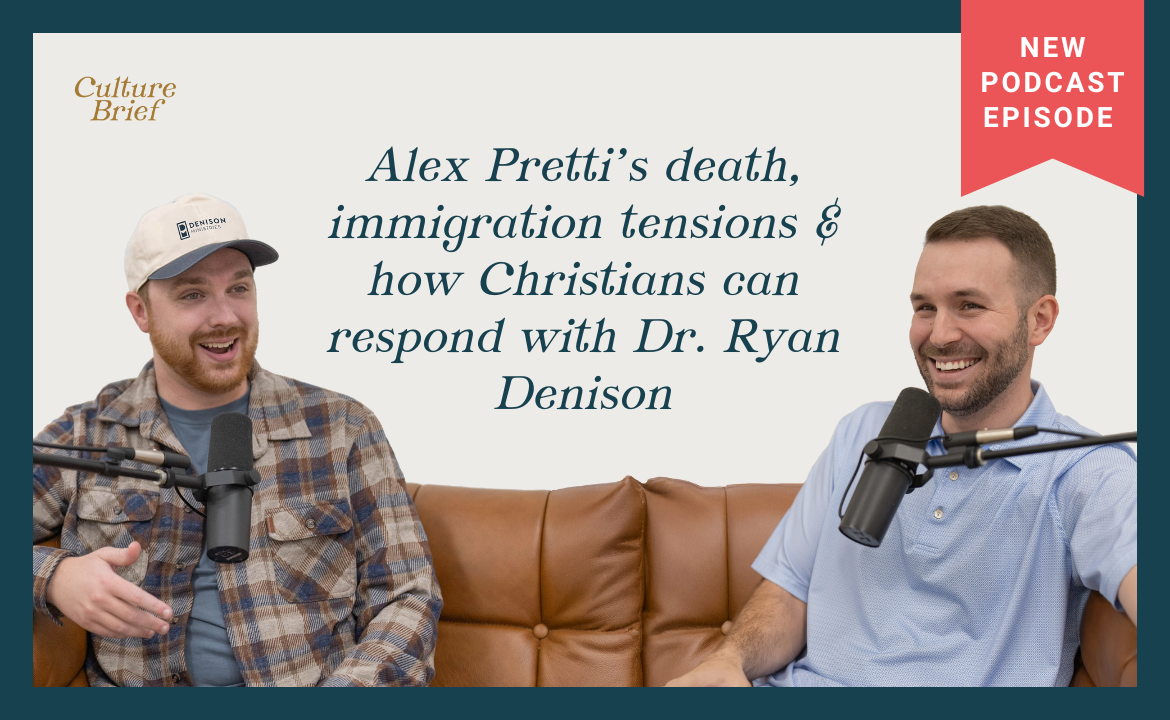
In this week’s Brief: we’re joined by Dr. Ryan Denison, Senior Editor for Theology at Denison Forum, to help us process one of the most sobering and emotionally charged stories in the country right now: the shooting of Alex Pretti in Minneapolis. We walk through what we know, what remains unclear, and why Christians must be especially careful not to rush to judgment in moments that instantly become political flashpoints.
Ryan helps us think biblically about the sanctity of life, protesting, law enforcement, and immigration while also addressing the spiritual cost of constant viral footage and outrage-driven narratives. We talk about accountability, de-escalation, and why humility may be one of the most countercultural Christian responses in a moment like this.
Along the way, we also touch on the potential government shutdown tied to DHS funding, the growing bipartisan concern over ICE tactics, and how believers can discern whether they’re responding from faith or from partisanship.
Plus: quick hits on the winter storm, Greenland, the Super Bowl teams and Bill Belichick’s Hall of Fame snub.
Powered by RedCircle



Topics
- (0:00) Introduction
- (1:20) Main topic: Minneapolis shooting
- (2:33) Details of the incident
- (4:37) Public and political reactions
- (10:26) Christian perspective and response
- (14:05) Government shutdown and political fallout
- (23:51) Balancing political and biblical perspectives
- (27:46) The complexity of immigration policies
- (34:00) The importance of humility and prayer
- (38:22) Winter storm impact and listener stories
- (39:29) Greenland and U.S. sovereignty discussions
- (40:09) Super Bowl predictions and sports talk
- (43:14) Wrapping up and final thoughts
Resources
- Send us your thoughts, questions, and topic ideas: [email protected]
- Culture Brief Instagram
- Watch on Youtube
- Sign-up for Denison Forum newsletters (including The Focus): DenisonForum.org/newsletters
Articles on this week’s top headlines:
- Ryan’s article: Reason for hope after the shooting of Alex Pretti
- The Focus articles
- Denison Forum: Was the ICE shooting in Minnesota justified?
- Timeline: A Moment-by-Moment Look at the Shooting of Alex Pretti
- X Post: Homeland Security
- X Post: Steven Miller
- X Post: Sen. Bill Cassidy
- X Post: Bill Melugin
- Creators and communities everywhere take a stand against ICE
- DHS agents kill another Minneapolis protester
About Dr. Ryan Denison
Dr. Ryan is the Senior Editor for Theology at Denison Forum and the author of The Focus newsletter, contributing writing and research to many of the ministry’s productions. He holds a PhD in church history from B. H. Carroll Theological Institute and an MDiv from Truett Seminary. Ryan has also taught at B. H. Carroll and Dallas Baptist University. He and his wife, Candice, live in East Texas and have two children.
About Conner Jones
Conner Jones is the Director of Performance Marketing at Denison Ministries and Co-Hosts Denison Forum’s “Culture Brief” podcast. He graduated from Dallas Baptist University in 2019 with a degree in Business Management. Conner passionately follows politics, sports, pop-culture, entertainment, and current events. He enjoys fishing, movie-going, and traveling the world with his wife and son.
About Micah Tomasella
Micah Tomasella is the Director of Advancement at Denison Ministries and co-hosts Denison Forum’s “Culture Brief” podcast. A graduate of Dallas Baptist University, Micah is married to Emily, and together they are the proud parents of two daughters. With an extensive background in nonprofit work, finance, and real estate, Micah also brings experience from his years in pastoral church ministry.
About Denison Forum
Denison Forum exists to thoughtfully engage the issues of the day from a biblical perspective through The Daily Article email newsletter and podcast, the Faith & Clarity podcast, as well as many books and additional resources.
EPISODE TRANSCRIPT
NOTE: This transcript was AI-generated and has not been fully edited.
Conner Jones: [00:00:00] Hi, I’m Connor Jones.
Micah Tomasella: I’m Micah Tomasella.
Dr. Ryan Denison: And I’m Ryan Denison.
Conner Jones: And this is Culture Brief, a Denison Forum podcast where we navigate the constant stream of top stories and news, politics, sports, pop culture so much more. And we do it all from a Christian perspective. And yes, you heard that there is a third name, Ryan Denison.
Dr. Ryan Denison is here with us today. We are so happy to have him on Culture Brief. Ryan, welcome to the show.
Micah Tomasella: Okay. Welcome, Ryan.
Conner Jones: Yeah, Ryan, thank you. We’re so glad you’re here. Ryan, lemme just give a quick background on your, your just like history, who you are. You are our senior editor for Theology here at Denison Forum.
You hold a PhD in church history from BH Carroll Theological Institute and an MDiv from Truett Seminary. You’ve also authored a slew of books here at Denson Forum and now you’re writing the focus newsletter that just launched earlier this month. We did a big push on that one. We’ve got thousands of people that have signed up to read your newsletter every Tuesday, and on [00:01:00] that newsletter, you are informing people of what they need to know and why it matters.
You kind of give a great curation of three to five major headlines from the past week that people need to know about. And then offer like why it matters, where God’s at work and things. And then you do a typical just big deep dive on some, some topic. I know you’ve done Greenland, you’ve done Nick Fuentes.
Interesting, interesting article there. And then you’ve been doing these Minnesota ice shootings, and that is going to be the main topic of our conversation today. And one of the reasons we wanted to bring you on was to talk through that. Just so y’all know, if you’re interested in reading, reading Ryan’s newsletter, the focus, you can find that at dennison form.org/newsletters.
I’ll also link that in the show notes so you can find it there, and I highly, highly recommend it. Mike and I, we love it. We’ve, we look forward to it every Tuesday and we, I get a little preview. You send us the test first and get to read it before everybody else. Love it. It’s good stuff. Ryan. We’re so glad you’re here.
Dr. Ryan Denison: Thank you for the chance. I’m excited for the conversation.
Conner Jones: So like I said, our conversation’s really gonna center on [00:02:00] what you wrote about this week, and that is what everybody’s talking about. It’s at the center of our culture right now. It is the shooting in Minneapolis of Alex Pretti that, that just. Fallout from that, everything that led up to it. So much tension in America right now.
How should Christians respond? And we just, we wanna dive into that ’cause this is a serious conversation. It’s definitely a big, big story. There’s so much implications here for immigration, for American rights, your rights as a, as a protestor, your rights as a second Amendment rights, all of that.
There’s so much there and what it means to be an American and a Christian response to that. So just some background information here. I’m sure most people listening to this have seen the videos. Coming outta Minneapolis, there were so many angles of Alex Preddy being tackled by border patrol agents, and then unfortunately, he was also shot and killed, and I believe he was shot 10 times total.
And it just was a really, really sad thing to see. It always, it always hurts to see somebody die. And then. It goes so viral on social media and then everybody [00:03:00] starts arguing about was it justified, was it not? And all that. But at the end of the day, this was the loss of a life. And you know, we here at Denton Forum, believe in the sanctity of life.
Whether that is an unborn child or somebody on the streets protesting at 37 years old, it’s still tragic, no matter how you put it. This whole thing is so tragic. As y’all know, this is the second death in Minneapolis in this month alone from federal agents. Basically taking down a protestor of some sorts.
We saw Renee Goode get shot and killed earlier this month as well by a DHS agent. Just really unfortunate. Just so y’all know, Alex Prety was a nurse, an ICU nurse at the Veterans Affairs Hospital in Minneapolis. He cared for people. There’s lots of videos of him in the hospital caring for veterans, something that he was very passionate about.
But while he was. Out there protesting. He was trying to help another protestor who had been pushed over by an agent and he was sprayed with an irritant and then he was tackled by those officers. At some point an officer yelled that there was, he had a gun and he did. He had a nine [00:04:00] millimeter handgun.
That handgun appears to have been removed from his body by another officer, but somewhere in there, a shock got fired. Whether it was an accidental firing of that nine millimeter handgun, we don’t know entirely yet. An investigation’s gonna have to really tell us what happened there. But shots were fired and he was, he was shot 10 times.
And it was just not a great look, and the reactions immediately poured out. It was so partisan. It’s happened with Renee, good as well, but so many people saying this guy was innocent. Should never have been shot. And there’s a lot to that, right? And then the other side saying, no, he had a gun at a protest.
And then the, the officials in Trump’s administration, Chrissy Noam specifically, she’s the Secretary of Homeland Security man. She went on a press conference way too fast in the first few hours and just said. That he was brandishing this weapon and he was a domestic terrorist. Steven Miller is the White House deputy Chief of staff.
He’s kind of in charge of this whole immigration thing for the White House for Trump. He [00:05:00]said that Preti was an assassin who was there to massacre cops. Then these videos from all different angles started coming out and it just told a totally different story that this guy was not there to attack anyone.
He was there simply to protest. He brought a gun that is up for debate. Should he have had that or not. But nonetheless, he was not harming anyone. Ryan, you said in the focus this week that the only thing that he was armed with really was, I mean, he had a gun on him, but the only thing he was wielding was his phone and he was, he was filming these officers.
And he was there to try to prevent them from getting to an illegal immigrant, but he was not, he was not doing anything with his weapon that was in any way threatening. So these, these officials really came out hard right up front. And I don’t know what, what you guys think about Noam and Miller and some of these other officials that, that yeah, the guy in charge of the border patrol, Greg Bovino, came out really hard as well, very fast.
What, what were y’all’s initial thought thoughts there?
Micah Tomasella: I mean, we’re gonna get into it of kind of what’s happened since then in the fallout. The first thing I wanna say is that I don’t know about you guys, but I’m [00:06:00] sick and tired of seeing videos go viral of people dying. Here or around the world, like those are the videos that are going viral and you almost just can’t scroll or look at anything without it being thrown in your face and it just breaks your heart.
It’s just, it’s just sad. We have the world at our fingertips and it’s driving us, it’s driving us mad. Now, there are atrocities being committed here and around the world, right? So I’m not saying we shouldn’t be upset about it, but. It only amps it up when we all have access to it just in the palm of our hands and can watch it from all these different angles and then watch so many people give their partisan perspectives on if it was right or wrong.
What I will say, Connor and I, I know you didn’t mean it this way, was the Renee good one was not as clear cut as this one. I would say that’s true, or was more clear cut than this one. As far as that one was really split on partisan lines, and we talked about this. There was a, a lot of bipartisan condemning of this last shooting of Alex Preddy a whole lot.
And I think unfortunately, if you’re letting Noam and Miller [00:07:00] represent one of the sides, that was pretty extreme. And then they’re the ones in leadership, so they should be the ones held accountable. Trump some accountability in this too. It, it’s, we just need to call that out too, that this was a little bit different because when you watch the videos.
I mean, how on earth do you watch it and not say, Ooh, did he really need to get shot 10 times? There, did, did, did he really have to lose his life? You know, it’s, it’s tough.
Conner Jones: This one’s definitely not. Yeah. It it’s way more clear cut. The Renee good one’s different. There’s a self-defense application that you could definitely make there and will probably be made in the court of law.
This one’s gonna be really hard to defend for sure. And you’re right, there’s been bipartisan condemnation of this whole thing specifically with Republicans. I mean, they, they’ve called this out and they’re like, we want a true investigation that’s not done by DHS. It needs to be an outside investigation because this is wrong.
What’s happening here is, oh,
good,
Micah Tomasella: good.
Conner Jones: Yeah. Was not good. 45 Democrats so far have signed an impeachment resolution too, to, for, for Christie Noam specifically. They want her gone. Even [00:08:00] republicans are starting to call for her job. They’re like, Trump, you gotta fire her. She is completely incompetent and she, she just tries to make a show out of this whole thing.
There’s a lot of images and videos of her specifically, but I wanna get thought Ryan, so far, Ryan, what were your initial thoughts on Yeah, on, on just everything as well.
Dr. Ryan Denison: I mean, I’d, I’d echo that. It’s tragic and part of the problem with those videos proliferating so quickly is that I, I mean, I know I’ve honestly become somewhat desensitized to it.
Like I saw the video of Alex pretty dying and my first thought wasn’t, oh man, that is tragic. It was, I wonder what happened. I need to figure out what happened. Wow. And part of that’s just the nature of the work we do, but it’s still like it. It’s turned everyone into an investigator before a human in a lot of ways.
And I think that’s, that doesn’t help the situation at all. We do need to, it’s good that the video’s out because otherwise when Christie Nome and when others get up there and start spouting just lies about what happened, it would be a lot harder to refute those Now that, you know, there’s video out [00:09:00]as soon as it happens.
Essentially everyone who watched that video knew that what she said wasn’t true. And I, I think there is value to that as well. But it, it is just. It’s a problem that needs to stop and they need to figure out how to deescalate. And that was when I watched the video. That was one of my first thoughts is I, I don’t, you know, I have no idea how hard it would be to be an ice officer out there trying to do that job Totally with all the protests going on.
But at some point, if you’re not capable of deescalating that situation by not going after those women who blew the whistle by not going after Alex Petty, you have no business being on the streets. And I think there’s a level of accountability needed for that. There’s a level of just evaluation needed to know, have your officers reached the breaking point where they can’t be trusted with firearms or they can’t be trusted on the streets, and there has to be a way of knowing that. And I think a lot of that goes back to just the way that it’s being run, the way that it’s the extensions, the way that they’ve been chasing numbers.
I, I think to whatever extent. President Trump does hold some blame for this. I think it’s a large part goes back [00:10:00] to just the idea that he’s been chasing numbers versus the right people. And that’s a, that’s a shift from the way it was at the start of his administration. That’s a shift from what he ran on.
And I think that’s we’re gonna get into that a bit in a bit, I think, in a bit more detail. But yeah, I think that’s, that’s part of the problem is just you’ve got agents out there that are in an impossible situation, but also just. If they’re not equipped to handle it, then you need to get ’em out, and there doesn’t seem to be an interest in doing that.
Micah Tomasella: You know, and Ryan, too, just to even set the table even further, the, the focus article that you wrote was specifically entitled Reason for Hope after the shooting of Alex Preddy. So that’s what we want to get to, is that you can be upset. You cannot be upset right now. You can be really upset right now. Whatever it might be.
You could be in absolute rage mode. You could be questioning. Why don’t I feel anything at all? It doesn’t. Wherever you fall on the spectrum, what we’re gonna do is we’re gonna break it down from every angle, give you [00:11:00] news that you can trust and then point you back to scripture. That we have to remember God is working in and through this.
I don’t know about you guys, but for me, I’m gonna refuse outrage. I’m also gonna refuse to be numb. I’m also gonna refuse to bury my head in the sand, but I’m also gonna refuse to let this destroy my peace or destroy the way that I lead and love in my life with my family and at work. There is a balance to all of this, but the answer is not to your head in the sand and the answer is not to freak out.
We’ve gotta find a way to, handle this and walk that tightrope, no matter how difficult it might be.
Conner Jones: Yeah, I think you’re right. You can’t let it just dictate your every thought throughout a day, but you also, you, you wanna find a moment to be like, yeah, I need to process through this a little bit and determine how this affects.
Great, greater things. Does this, does this affect our country? Yeah, it does. So you gotta think through that. Does this affect how we process elections? Midterms are coming up. This is definitely gonna [00:12:00] impact stuff like that. And you gotta think through things like that. But faith, your faith is so much more important than everyday news.
So you have to learn how to balance everyday news with faith and finding a, a path forward, like you’re saying. Mike, I think that’s good. I did just wanna point out real fast. It, it does seem like Trump specifically has since the backlash, like he has been more restrained on this than normal. He refused to like, call prey anything that has, you know, his, his people were calling them.
He never said he was an assassin or anything like that. He just was like, I didn’t like this this doesn’t look good. He didn’t, and he specifically said on Tuesday. I don’t like that he had a gun. I don’t like that he had two fully loaded magazines. That’s a lot of bad stuff. Despite that, I say this is a very unfortunate incident.
So he’s seeing it for what it is. He’s I, I don’t love all the circumstances here, but this was, this was, it was unfortunate, right? Like he’s seeing that too. I, he’s recognizing that it’s pretty much just bipartisan blowback. And much of America is pretty upset about this. That’s
Micah Tomasella: look. [00:13:00] It’s a bad
Conner Jones: look.
It’s not good, man. So with that, he basically sidelined Kristi Noam and since then, Tom Holman, his borders are, who is in charge of essentially shutting down the border, but has kind of been on the backseat a little bit in recent months. And
Micah Tomasella: Noam and Holman don’t like each other.
Conner Jones: They cannot stand each other.
So Trump is kicking Noam out of Minnesota. He’s also kicking Greg Bino the border patrol chief out of Minnesota sent him back to California and they suspended him. Access to social media, which is kind of funny ’cause he was just on Twitter, like fighting people which was really a bad look as well.
So they’re like, you can’t have access to Twitter anymore. And then he sent Tom Holman, Minneapolis. Didn’t
Dr. Ryan Denison: know that.
Conner Jones: That’s funny.
Dr. Ryan Denison: Yeah. Okay.
Conner Jones: Sent Tom Holman. He’s now working apparently with Governor Tim Walls as well as the mayor of Minneapolis. To try to figure out a plan and a path forward where federal agents can still seek out dangerous criminals but can work with local law enforcement.
This is part of the problem is federal, state and local law enforcement are definitely not on the same page and they need to be. Otherwise, you’ve got almost like a law enforcement civil war in a region where [00:14:00] Minneapolis is like, get out of our city, and the feds are like this is our country. So not a great look there either.
And now we’re looking at a potential government shutdown. Because of this, the government is set to shut down on Friday night, and we haven’t even mentioned it on this podcast because it was seen as a, just a certain thing, like they were gonna pass funding this week. No one was questioning that until this weekend when this happened because in the upcoming bill, it it includes $75 billion of funding for DHS.
Now, Ryan, you pointed out in the article this week, I thought this was interesting, that the failure to pass the bill would actually not impact ICE that much. It’s already funded from last summer’s, one big, beautiful bill, but it would impact other things like fema, coast Guard, secret Service. Yeah, everything like that else that falls under DHS
Micah Tomasella: stuff that normally gets bipartisan support.
You know, so it’s, yeah, it’s tough.
Conner Jones: But Democrats see a leverage point here. So are they gonna lead us to another shutdown? You guys already know how Mike and I feel about shutdowns. We are very anti-government shutting down. ’cause it’s just a completely,
Micah Tomasella: it’s anti doing your [00:15:00] job when you shut the government down.
Now I understand being in a position where you feel like you want to you need to do something about it and answer to your constituents. But, the American people to suffer by shutting the government down to prove a point or to, in this case, slightly change some funding, just it doesn’t feel like the right course of action.
What do you think, Ryan, about the all the shutdown stuff?
Dr. Ryan Denison: I mean, I agree. And even if they change the bill, it has to go back to the house and the house is on recess until Monday. And so they’re like, if they change anything, there’s a shutdown for at least the weekend. And that was a hundred percent planned by the house to make sure that they were not available to approve any changes made by the Senate.
That’s how they’ve done politics. That’s
Micah Tomasella: sneaky. Oh
Dr. Ryan Denison: man. I think the other side of it though is like in addition to the funding, what the Democrats are trying to make sure it gets in there is legislation that says not only are we paying for body cams on the, on the DHS agents, they have to have them on.
And what’s been interesting is Republicans have been trying to say is yeah, we’ll make sure that gets in there. [00:16:00] We’ll make sure that that’s the policy going forward. And Democrats don’t trust them and they honestly are. I understand why they wouldn’t trust them. And so they want it put in the law.
They’re not willing to just trust when the Trump’s administration says, okay, we’ll make sure that happens. And I think that speaks to the importance of just doing your job right from the start.
Micah Tomasella: So then ’cause, so then what’s the play here? Democrats are hoping that Republicans will write those things in and then that’s enough capitulation for them to go back to their.
Party and say we did something about this. So that’s the, that’s the glass half full of the bipartisan kind of frustration over the shooting could lead to something being written into the bill and into law, which by the way, I have no issue whatsoever when every other law enforcement official is held to that type of standard.
They should absolutely be held to that type of standard as well. They should have body cam on and they should turn them on a hundred percent. That, that, that seems like a no brainer to me.
Dr. Ryan Denison: And I think that was part of the initial bill in the house that got taken out in [00:17:00] the process of kind of trying to get that passed.
And so that’s part of the fear is that if they do send the bill back to the house, there won’t be enough Republican support to get it passed there. And that could extenuate the, the shutdown. And I mean, I, I think it’s a lot of bluing I’ll to an extent with, with the shutdown. I’ll believe it when we get to Friday and there’s no bill signed.
Yeah. I, I think both sides have so much to lose that. By the time we record next week, I fully expect the government to be funded or by the time y’all record next week, fully expect the government to be funded. But ideally that’s Friday. Ryan, you’ve been wrong before,
Micah Tomasella: so we’ll
Dr. Ryan Denison: see. I have, I have
Micah Tomasella: okay, Connor, keep us going.
Conner Jones: Yeah, just one last thing before we ask some more questions here. I wanna just mention how the American people feel right now. There’s been some polling done this week and right now only 39% of Americans approve of the job that Trump is doing on immigration. For contrast, last February, so just under a year ago, that number was at 50%.
It’s now down to 39%. Yeah, and I think that’s because everybody was totally fine with the way the border was closed off and nobody’s getting into this country anymore, illegally, essentially, at least not nearly as many. [00:18:00] But now, a year later, it’s, it’s the, the just kind of the dirty work of having to go into the, to the cities and the streets, and particularly where this looks not as great as Trump is going into Democrat cities like Minneapolis, that he wants to target and make them look bad.
That’s never a great justification or look, I don’t think. But the other thing is 58. Percent of voters say that ISIS tactics specifically have gone too far the way that they’re going about this in the streets and rating homes rating. Wow.
Micah Tomasella: 58%. It’s interesting.
Conner Jones: 58%. That is a big chunk of the American population that says this is too much
Micah Tomasella: on, on polls like this.
That’s a pretty big number. That’s a substantial number on polls like that.
Dr. Ryan Denison: And I think the details on that were, it was almost, it was above. I think it was 66, 60 7% of independence, if not more. And the majority of Americans do not like what ICE is doing.
Conner Jones: Doing a big deal. This is a deal, it’s a midterm year.
This is gonna look bad on the Republican party and the Trump administration [00:19:00] specifically going into November’s elections. So they’ve got some time to try to come up with a better plan and a better strategy. One more thing I wanted to just mention here and get your thought on Ryan, is the second Amendment and, ’cause I know you had mentioned in the focus article, maybe it wasn’t a great idea to bring this weapon to the protest, but at the same time.
It’s completely legal, right? Like he, he had the right to bring it. He had the gun legally. He had the certification for that. And we’ve seen plenty of Republicans bring guns to protest as well, especially in 2020 2021. Even the, the Capitol riot on January 6th. There are weapons included with that. So is there a double standard there?
Dr. Ryan Denison: I think there’s just a poor articulation of policy there. I would say, yeah. More than a double standard in some ways. Nuance.
Micah Tomasella: It needs some nuance. Yeah.
Dr. Ryan Denison: And I do think there’s, but there’s also been times where K Patel came out and said it’s illegal to bring a gun to a protest. And that’s just not true, which is troubling if the director of the FBI doesn’t know that, I would hope that he does and just either misspoke or was trying [00:20:00] to be deceptive, which if trying to be deceptive is the, the good reading on it, it’s probably a pretty bad thing to have said.
But I do think, just with Second Amendment rights. That’s been one of the interesting things though, is, and one of the reasons so many Republicans have really kinda stepped up on this has been that just, it’s another point where a lot of gun advocates are like, no, this. He had a right to bring that and there were reports that he didn’t have the permit with him at the time, and that that was illegal.
I haven’t done a lot of research into this, but from what I’ve read, that’s a $25 fine. That gets like, where nothing more happens there, wasn’t
Micah Tomasella: there enough time in that fight? For the, you know, the agents to say, let me see your, your permit papers real quick, bud. Yeah. You know, like that,
Dr. Ryan Denison: which
Micah Tomasella: is that, that feels a little bit irrelevant.
The, the leader of the NRA came out and slammed what Cash Patel said and was like, what what are, what are you talking about? A protest is exactly the type of place that someone should be able to carry a weapon to protect themselves. Here’s the, here’s the nuance of the discussion, and I wanna get your opinion on it, Ryan, real [00:21:00] quick.
The reason why I think this is nuance is on its surface, it is absolutely legal and he should be able to conceal carry, he went through the proper licensing channels to a protest. However, just from a personal perspective, ’cause both sides have to be held, held accountable here, if you are going to conceal, carry and plan to get in the face and get physical to a certain extent or around federal officials and officers.
Maybe that’s when I’m thinking it’s not a great idea, just personally, is it legal or not? It’s absolutely legal. I’m not arguing that. But if you’re going to be concealed carrying and then you’re also planning to get into some sort of an altercation with law enforcement, maybe that’s when I would say that’s probably not a good idea.
I mean, am I, I mean, is that, is that over the line?
Dr. Ryan Denison: I think that’s fair because I mean, at the very least, you had to know it was possible that it would lead to an altercation. CNN reported on Monday that he had been in an altercation where he got tackled by five [00:22:00] DHS agents a week before. And there that’s still there, there’s still a lot of hazy details on what happened there.
And so I don’t if that is true. Then I think it speaks even more to just the degree to which you like. He should have known this could go poorly, and if it goes poorly, having a gun on you is not necessarily gonna help the situation, especially if you’re not given the chance to say, I have a gun.
Like it’s. For better, worse and I think this does go back to the rhetoric that was used after the, in a good shooting and the rhetoric that’s been used in defense of the pro of the agents throughout this by the, by the Trump administration is they’ve made this seem like the agent’s lives are in danger every time they set foot on the street and.
If that’s what kind of the DHS agents have in their head and they see a protestor with a gun, they’re gonna assume the worst. And they’re not. That doesn’t mean they’re right to and doesn’t, and in no way, shape or form does it justify them shooting Alex Petty Freddy. Like he, he should be alive today [00:23:00] if, if the agents had done their job the way they should do it.
Yeah, but it’s at the same time, like there’s, I don’t think it’s wrong to say a little bit of common sense. Should have said this isn’t a good idea. Yeah. To bring the gun.
Micah Tomasella: Yeah. Thanks, Ryan. Okay, well let’s, let’s jump into some questions ’cause we do have the expert here. We do have the Dr. Ryan Denison on the podcast with us, and we’re very grateful that you’re with us.
And again, guys, subscribe to the focus on Denison Forum. Subscribe to that newsletter. I, I just can’t, I just can’t push it enough. I can’t affirm it enough. If you’re wanting that deep dive, if you’re wanting more opinion. If you’re wanting to know about other things that are going on too Ryan’s your man, and it really is a great source of truth that I have just personally enjoyed.
Okay, so Ryan, here’s a, a question for you that’s kind of struck me. I’ve, I’ve prepared a few, but this one’s really hitting me right now. How can Christians tell you know, just from like a, a believer’s perspective, how can Christians tell when they’re responding through a political lens versus a biblical one?
[00:24:00] Especially when an issue like this hits so close. It’s a home.
Dr. Ryan Denison: It’s a good question and a tough one because I think we have to evaluate it on a case by case basis. This isn’t one of those things where I think we can, you know, put some practices or some habits into place and then never check back on it because.
With, as politicized as our culture is, we’re naturally gonna be constantly pulled in that direction. And so it takes an active effort to remain biblically based more than politically based if you’re active on social media with a lot of this stuff. But I think one of the ways to tell is if your first thoughts go to what does the Bible say, you’re probably in a good place.
If your thir first thoughts go to what will the politicians say, it might mean that you’re looking at this more through a political lens. And if that’s the case, just. Ask the question, what, what does the Bible say about this? What should be my first response? And then evaluate it based on scripture rather than politics.
Kind of a, as in a second part of that too, I think if your initial read. [00:25:00] Basically the truth. As you research it more seems to point against your political views and you find yourself looking for more and more ways to justify why the truth isn’t true, then that’s, I think, a big red flag that you are using the wrong approach here.
And I, I think it’s something all of us are gonna struggle with because none of us like to be wrong. And but if we’re willing, one of the most important biblical principles is to be humble enough to recognize that. We’re human, we’re gonna make mistakes and, but if our identity is wrapped up in politics, then it becomes almost non-negotiable that the political approach that I want to take to this is correct.
And it feels really threatening when it’s not. And that’s a big problem.
Micah Tomasella: Do you feel like it would be a good barometer, Ryan, for a believer to in the moment when they’re trying to process through, ’cause again, like we said, the answer is to just not reckon with it. And not deal with it. I think that if we don’t, I think it also affects that we, we can love on our neighbors.
Where we can understand the people in our lives who are struggling with this maybe more than we are or not struggling with this at all. Then you’re almost, they might come to you and say, why am I so [00:26:00] numb to all of this? Or what, you know, what does this look like? So I think when we process, it helps us minister better.
And I think Paul and the New Testament is a really good example of, of that and, and how he went about that, but is a good barometer to honestly look back. At other issues that you process through, but then also look at the current situation like this one that we’re processing through, and ask yourself, am I willing to be wrong?
Am I willing to, to accept responsibility? Am I willing to be wrong on this issue, on this thing even if it doesn’t agree with my party’s platform or with what I tend to believe?
Dr. Ryan Denison: I think so. And honestly, the best way to do that is just to pray and keep praying. Like when Paul. When Paul writes about pray without ceasing, he doesn’t mean that you go through your entire day and you nev and you’re just constantly praying all the time.
He means that kind of, that conversation with God never ends. One of the ways I found that’s helpful in that is I just, when I’m just praying in my own personal life, I don’t say amen because there’s something in my head that kind of clicks the prayer off when I say amen. [00:27:00] And I, I think when we’re dealing with issues like this, being able to just pray at the start.
Keep praying, ask the Holy Spirit from the beginning. If I stray from the truth here, please let me know. And then be humble enough to expect to accept the spirit’s correction when he offers it. ‘Cause God wants us to know the truth as best we can, but he also doesn’t want us to become so overwhelmed by the stories that we kind of become just consumed by it.
And so I, I think prayer is honestly the best way to guard against that.
Micah Tomasella: Yep. Thanks
Conner Jones: Ryan. Yeah, I think that’s great. So Ryan’s in prayer right now as we’re speaking ’cause he hasn’t said amen on his last. I
Micah Tomasella: was about to say, I was about to say. Good for you bud.
Conner Jones: No, I like that concept. I understand what you mean.
Sometimes it can be like, okay, I’m done with God for the day or something, you know, but that’s, that’s not a great mentality either. Ryan, I, one thing I wanted to just point out that you wrote in your article Y. Or on Tuesday, you said it’s doubtful that the protesters knew anything about the man being arrested, which is part of the problem with protesting a policy as [00:28:00] broad as deportation.
Specifically the guy that the, the agents were going for when Alex Freddy was killed, was an Ecuadorian national he was one of, I think for like domestic abuse and some other bodily harm charges as well. And so these protestors are out there. Are they, do you think they’re defending people that have these very harsh, brutal, criminal charges against them?
And would you just be able to expand further on your statement about protesting as a policy, as broad, as broad as this? Is that a good idea? Is that a bad idea? How should Christians approach the topic of immigration in deportations in this instance?
Dr. Ryan Denison: Yeah. I think part of what we’re seeing is just. The government’s kind of given up the benefit of the doubt by going after such a broad swath of people by chasing numbers versus going after the people that genuinely we are criminal, like violent criminals.
We don’t want in the country that like pretty much everyone in America, ’cause the vast majority of Americans still want [00:29:00] violent criminals. Who are illegal immigrants to be deported. That is still the case, but what’s changed is that. Especially in places like Minnesota, like they don’t trust, that’s what’s going on and they don’t trust that’s what’s going on because oftentimes it’s not, but it makes it to where the times it is where they are arresting someone that deserves to be deported.
Deserves is a tricky word to use there because I mean, technically speaking free illegal immigrant is broken the law by crossing illegally and I, so I, I do think it makes, discussing this difficult when even the language around around it is so nebulous at times. True. But I, I think part of, part of what I meant by that is just I, I doubt like if you, at a lot of the protests, if, if they knew the people that were being arrested and it was a violent criminal, it was someone who would guilty of domestic abuse, then I don’t think they protest that the same way as when it’s just someone who’s been here working hard, kept their head down and is really contributing to, to the community.
But you can’t know the difference. And [00:30:00] part of the problem with the policy the way it’s been. In the last few months is that it does kind of get rid of that benefit of the doubt, and I think that’s part of the problem of what we’re seeing.
Conner Jones: Yeah, I think that’s really good. Does the Bibles can, can you think of any scriptures where the Bible specifically reinforces like border security or even deportations, like some sort of biblical basis for what’s happening essentially?
Dr. Ryan Denison: Yeah. There’s several passages in the New Testament that talk about how. It’s important to obey the government, to obey the laws, and I think border laws are. They’re fine. That’s the law of the land and we’re meant to, we’re meant to support that. I think going back even to the Old Testament, one of the things that’s often cited by people who want more of an open border policy is they look at the way that that Israel was told to welcome the aliens welcome those who are not among you to join your society.
What’s often overlooked is. Part of that expectation was that when they came in, they would assimilate [00:31:00] and they would worship, they would keep the Sabbath laws, they would become part of the culture to a degree. That’s not often the case today, especially among those who would support more of an open border.
And so I, I think it’s, as we look for biblical parallels, it’s really important to not stop when you feel like you’ve got enough information to support your preferred point of view. And I think that’s a lot of times when we see people kind of proof texting this issue with the Bible, that’s what they do.
They’ll pick and choose examples that leave out the larger context or that overlook the aspects that would go against their argument. And that’s not, that’s not a good way to read the Bible in general, and especially not a good way to apply it to a controversial to an issue as controversial as immigration.
Micah Tomasella: I also think that you can. You can hold in both hands in both hands. Like what you’re holding in both hands can be true. When you say a nation should be able to enforce its laws have borders and kick the wrong people out who are here illegally, I think that you can believe that and believe that to be [00:32:00] true and then also not take that next step.
Care less about the immigrant, right? Because that immigrant is still your neighbor. That, that immigrant is, is is still a mago day made in God’s image, right? Like I think that you can do both. And I think that there’s this assumption that if you, if you say this is right, then you also have to take it even further than that.
I think that you can hold both truths and say a, a nation has rules and laws and without it. It crumbles and we’re all held accountable to that. And there are pros and cons to all of it, but at the same time, we have to understand that that doesn’t mean that we have to dehumanize somebody too.
Conner Jones: Yep.
Micah Tomasella: I understand. And I use that word loosely, but this concept of this person is lesser than because of X, Y, Z. No, actually no. As believers, we don’t believe that.
Conner Jones: Nope. Yeah. Everybody’s in the image of God. The immigrant, the protestor, the baby, the onboard baby. One thing that I saw this week, the officers.
Yeah, the officers too. All of them. Everybody. One thing I saw this week, I think it was a, a senator is gonna propose a new plan that would almost be. A middle [00:33:00] line here where it is the idea of not letting current illegal immigrants become US citizens, but give them some sort of legal status so they wouldn’t get all the benefits of being a US citizen.
But they would also be able to stay here without so much fear of deportation if they don’t have there were restrictions. You can’t have any criminal charges, you can’t have been a criminal in your, in your home country, all of that. So maybe there’s a path forward. And the White House has sounded somewhat receptive to the idea, but I, I do think something kind of down the middle.
Sort of to what you’re saying, Ryan yeah, borders do matter, but also we gotta love our neighbor. But also assimilation was an expectation back then. So all of that, and just as a reminder, this all kind of really started. With the fraud investigation in Minnesota specifically aimed towards the Somali population in Minnesota, and that’s why Trump surged agents to Minneapolis specifically.
There’s so much there about assimilation and about loving one’s neighbor and all that, that I think is getting missed broadly. So yeah, it was a good, it was just a good point you made. So thank you for that.[00:34:00]
Micah Tomasella: Yeah. I just have one more question for you, Ryan. So in your article you, you warned against rushing to judgment, which I think we’ve kind of been alluding to that, talking about that. Why do you think believers specifically are as quick or quick as the world, as anybody else to react before the full truth is known?
Why do you think we’re so susceptible to that as believers? Why are we looking like the world and at times worse than the world in the way that we rush to judgment without knowing everything?
Dr. Ryan Denison: To be honest, I think it probably varies for every person. I do think there’s a degree to which that is maybe related to the fact that there’s a confidence that comes from knowing that when we’re speaking scripture, we are speaking truth.
Yeah. Yeah. And I think it, it can be easy to extend that confidence. To a degree that we lose the humility required when we’re approaching these kind of issues, speaking the truth in
Micah Tomasella: love, right?
Dr. Ryan Denison: Yeah. Kind of forget the love part and it becomes, yeah. And it becomes so easy to think [00:35:00] okay, if I can find, going back, and again, not every Christian does this by any means, but
Micah Tomasella: No.
Dr. Ryan Denison: If it gets easy to kind of go back and if you can find. Passage of scripture that supports your view. It gets really easy to become certain. You’re, you’re right in that. And I think the answer to all that is just a, a healthy dose of humility where we pray first, ask questions second, and then form our opinions Third.
And I think oftentimes we get that order backwards, where we start with forming our opinions, then we start asking questions to try and support them. And then at the end we pray, God, please let me be right and go on with our back. Mm. And that’s, that’s not a great way to approach it. And I think it, it just, it fills a, it’s really easy to do.
’cause you’re, you’re technically checking all the boxes you’re supposed to, but you gotta, when you get those out of order, then it becomes really easy to become entrenched in your opinions to the degree that you’re not willing to. Hold open the possibility that maybe you’re wrong. And I think that’s, that humility aspect of it, I think is the only way to guard against that.
And [00:36:00] it’s one of the things that when someone, so many the other parts of the culture are taking that same approach, like if we can be humble, I, I think it helps a lot in terms of our witness and ability to share the gospel.
Conner Jones: Yeah. One thing that we’ve talked about many times on this podcast is when there’s big stories like this and tragic events and what our first thought should be to say, stop.
And pray. Yeah, and give it to the Lord. I immediately, what was your, what was your first reaction? I think we can all question ourselves as an accountability thing here. What was our first reaction when we heard about the story or saw the video? Was it to immediately start looking into it more? Was it to immediately get mad?
Feel sad? I think a call out can be, man, just give it to the Lord first. Say, Lord, be with this individual. Be with the everybody on the ground. Be with. Everything in this situation that is gonna be so difficult to process and with the people who are now gonna have changed lives forever and have lost a loved one.
Then start to really think through and process. I think that can help set your mind and heart in the right spot before diving into everything. And it’s just, [00:37:00] it’s just a call out We’ve made several times and I’m checking myself on this, man. I, I don’t think that was my first reaction to be completely honest this time around.
I was like, oh my gosh, what’s happening? And just dove right into the whole story more and started to understand the, the political divide here without understanding first. The faith aspect. So ryan, this has been a great conversation. Thank you so much for just kind of diving into everything with us here in Minnesota.
You’ve, you’ve done so much research, you’ve done so much just analyzing of the situation. We’re grateful for your wisdom that you’re able to share with us today and that you hopped on here and we’re gonna keep you on for the end of the show. We just got a few more minutes here to hit on everything else we normally do.
But this was a good conversation. Mike had great questions. Great thoughts. Guys, there’s so much to this and we’ll continue to just learn more and we’ll process through this more. And if there’s more to go through next week, we’ll do that too
Micah Tomasella: as we pivot from that. Just joy filled discussion. We’re gonna try to have fun these last five minutes. Okay. We want to continue to hear from you. It’s [00:38:00] really important to us that we hear from you that I mean the audience engagement has just been so great, but it helps us fine tune our show, helps us make sure that we understand what you guys are processing through and what you’re thinking through loyal culture, brief Audience, we love you.
We’re so grateful for you. So please send your questions or your thoughts or your topic ideas to culture [email protected]. Again, culture [email protected] or follow us on Instagram. At Culture Brief Podcast. Okay, so I wanna talk about the winter storm real quick. We had a winter storm that impacted nearly 30 states this past week.
A major winter storm affected much of North America, and it brought record, snow, ice, and dangerous temperatures particular to. Particularly to the southern United States, northeast and Canada, the system caused widespread travel disruption caused power outages, and challenging conditions. As it moved through late January, there is still slushy ice that gets frozen over each night here in Texas, we’re still experiencing that, but we wanna hear from you.
Let us know how the winter storm affected you. Did you miss a flight? Did you have a trip get canceled? [00:39:00] Did you sled behind a truck? What did you do during the storm? Okay, let us know and we will highlight your stories next week. Please DM us on Instagram or send us an email.
Conner Jones: Dude, I’m so done with the storm.
I need this ice to melt. I’m ready to get outta my house. I’m going stir crazy, man. We’re like five days in. Anyways. Yeah, it’s very cold here still. I’m sure much of the country is still very, very cold.
Let’s check in on a few stories we’ve discussed. Greenland was the topic of discussion last week on this EPIs on this show. And after we recorded a lot kind of wrapped up, basically Trump made a, a deal with NATO that said that maybe the US is gonna get some sovereignty over certain pockets of Greenland.
They really just kind of said a framework for a future deal. Oh, we’ve heard
Micah Tomasella: that before, haven’t
Conner Jones: we? We decided. So now I guess they’re just gonna continue talks with Denmark and we’ll see what happens there. But it still seems like
Dr. Ryan Denison: they’re talking with everybody, but Greenland as well. So that’s gonna be an interesting piece when they actually have to get Greenland to agree to what [00:40:00] happens in Greenland.
Conner Jones: The Greenlanders are like, hello, you’re talking about us, right?
Micah Tomasella: I
Conner Jones: know. Yeah, I know.
Micah Tomasella: Yeah.
Conner Jones: Trying to wave the flag there. Okay guys, let’s talk about football real fast. ’cause we had the the A FC and NFC championship this past weekend. I’m assuming you guys both watched both of those games. In fact, Ryan, last year, this is not your first time on the show.
You came on last year to talk sports with us. To process through the Luca Donit trade. Oh, I think that was last February probably. So this is actually your second time show. Yeah. We coming up on
the
Dr. Ryan Denison: very side anniversary. So
Conner Jones: brutal.
Micah Tomasella: I keep like a clock in my house of time spent without thinking about the Luca Donit trade.
And it’s never gotten past three days. And then it just brings me back to much sadness.
Conner Jones: Yeah. As, as. As y’all will recall, we’re all three Mavericks fans. These two guys are, are bigger Mavs fans, so they, you know, they had a morning session on this show as we talked through the Luca nonsense trade. But sports are a big thing for the three of us.
We’ve got the Super Bowl at set. Micah, you had a, you had the correct prediction a few weeks ago. You said it was gonna be the New [00:41:00] England Patriots first, the Seattle Seahawks. That’s, it’s gonna be man, who do, who do we think is gonna win now?
Micah Tomasella: I said the Patriots when I did my prediction right. I think,
Conner Jones: I think you
Micah Tomasella: did.
Was like gonna win it. So I’m gonna, I’m gonna stick with that.
Conner Jones: Okay. Ryan, who do you think
Dr. Ryan Denison: I’m gonna go with the Seahawks? I just trust their defense more, but
Micah Tomasella: yeah,
Dr. Ryan Denison: it’s a, it’s a toss. It should be a great game either way.
Conner Jones: Totally. I, I, I agree with you. Seahawks seem like the more dominant team. I’m gonna stick with them.
Go Sam. Darn. That game is gonna be next Sunday. So it’s not this weekend, it’s next weekend, February 8th. Kickoffs at 5:30 PM it’s gonna be fun, man. I love the Super Bowl. Can we just talk real fast too about Bill Belichick not getting on the first round ballot for the Hall of Fame? What in the world?
Micah Tomasella: It’s, it’s a political decision. It’s people wanting to get at him because they don’t like him, but he is. Unequivocally just the numbers. This is an opinion. The best coach in NFL history. If he’s not a first ballot hall of famer, no player or no coach deserves [00:42:00] it. He won eight Super Bowls, eight. He’s a first ballot hall of famer.
It’s a travesty and everybody feels the same way again, this is a bipartisan agreement here. We’re in bipartisan agreement territory. Here everyone agrees. 90% of the nation, when you poll the nation says that Bill Belichick is a first ballot hall of famer.
Conner Jones: Yeah, probably not in college football, but certainly in the NFL it didn’t, for sure.
It didn’t go so well at UNC this past year, but for sure no, dude, I, I, I was just appalled by this, Ryan. I assume you were as well.
Dr. Ryan Denison: I was surprised, but I’m, I’m of the perspective that if you’re a hall of Famer, you’re a hall of famer, and I don’t think the first ballot, second ballot thing should be that big of a deal.
Like if you’re, if you’re worthy of it, I guess that’s true. Just get voted in. I guess that’s true. I think it’s, but you know, to hold that against them or think first ballot is somehow like some special honor.
Conner Jones: You’re right. But that’s, but if there’s ever a person to get the first ballot, it’s like Tom Brady and Bill Ballot check.
But
Micah Tomasella: that’s also how, how people get introduced. Like when you read bios or when people get introduced onto stages, you watch videos. First [00:43:00] ballot, hall of Famer, eight times Super Bowl. Winning. You know, coach Bill Belichick, you know, he loses that. You’re right. What are gonna say second
Conner Jones: time ballot
Micah Tomasella: Hall of Famer now?
Yeah, they they won’t say that. They’ll just say Hall of Famer, but I digress. You’re right. He is eventually going to get into the Super Bowl. Guys, we’re gonna wrap it up. Thank you so much for joining us for this week’s episode of Culture Brief, a Dennison Forum podcast. Thank you, Ryan, for joining us today.
We’re very grateful for you all articles, all videos mentioned will be linked in the show notes. If you enjoy today’s podcast, please please subscribe and please, please, please share it with a friend. We will see you next Thursday.











 Search