



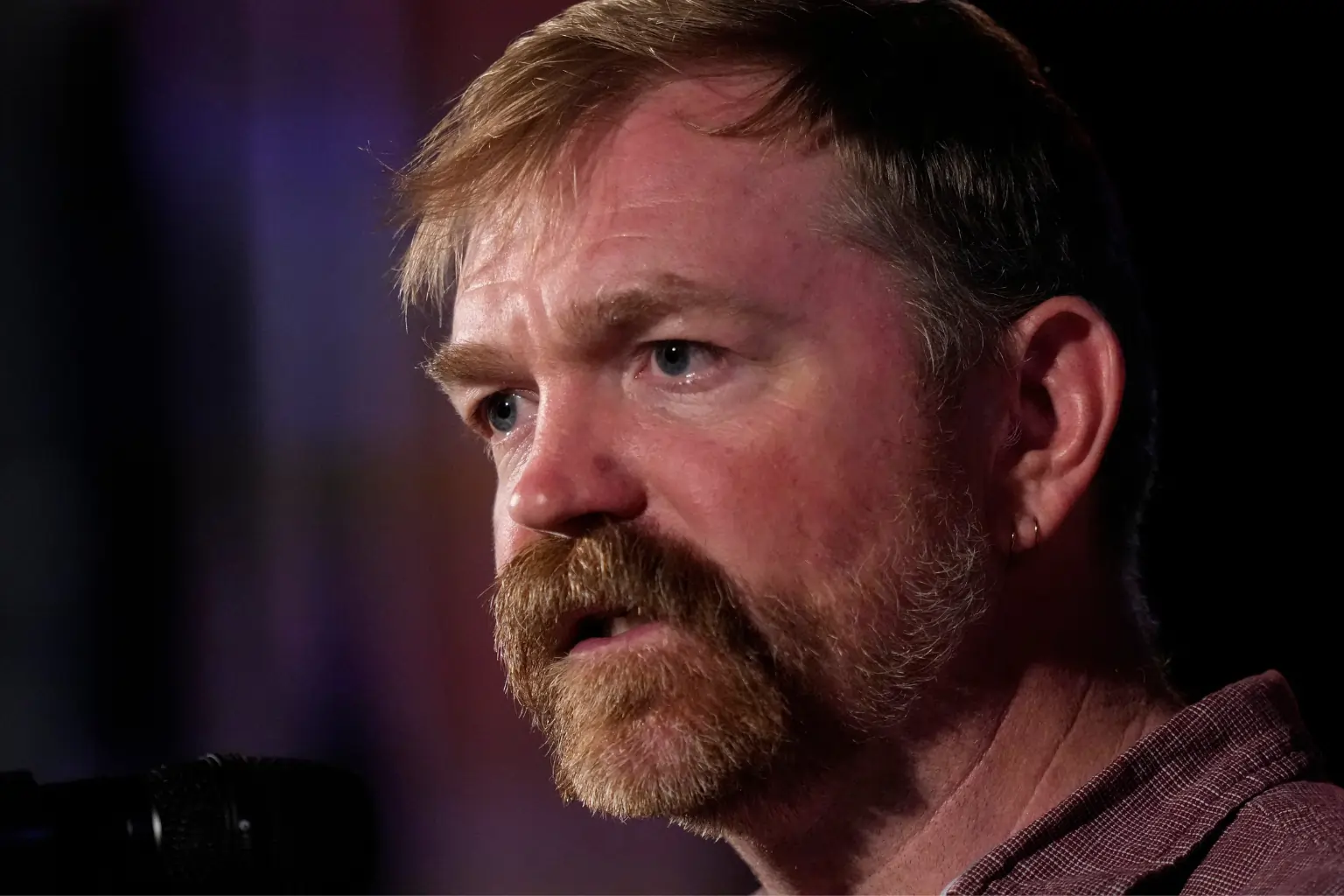
Graham Platner, Democratic candidate for U.S. Senate, speaks at a campaign event Friday, June 5, 2026, in Bar Harbor, Maine. (AP Photo/Robert F. Bukaty)


I don’t often write on political campaigns lest I appear to contradict the nonpartisan mission of our ministry. However, Graham Platner’s suspension of his Senate campaign in Maine last night illustrates principles that transcend his party and this political moment.
His story, in brief:
Graham Cunningham Platner was born and raised in coastal Maine. He enlisted in the Marine Corps following high school and served eight years, including three combat tours in Iraq as a Marine and one in Afghanistan with the Maryland Army National Guard.
He then worked as a security contractor in Afghanistan before returning to Maine, where he entered the oyster farming business. He became active in local government, then announced his candidacy for the US Senate in August 2025.
He has campaigned on housing affordability, universal health care, strengthening labor unions, and ending government involvement in what he calls “pointless” wars. He won the June Democratic primary with 72 percent of the vote. His victory in the fall election would have been vital for Democrats as they seek to retake the Senate since the incumbent, Susan Collins, is the only Republican running in a state won by Kamala Harris.
Why Platner suspended his campaign
Platner’s campaign has been extremely controversial, however. Among his many issues have been a Nazi-era tattoo on his chest, a history of sexting women during his marriage, and antisemitic statements and actions.
In June 2026, the New York Times reported allegations that Platner engaged in physically threatening behavior toward women he had dated. A former girlfriend, described by the Times as a “Virginia conservative,” alleged that he had abused her physically. He denied her allegations, calling them “politically motivated.”
Then, on July 6, came an allegation by a woman he had dated that he raped her while he was drunk nearly five years prior. The accuser agrees with Platner’s political beliefs but said she felt compelled to come forward due to the charges made against him the month before.
Platner denies her allegation, but high-profile Democrats and the Maine Democratic Party withdrew their support. A variety of national leaders called on him to exit the campaign as well. He complied with their request Wednesday night.
You cannot unring a bell
My response has nothing to do with Platner’s party affiliation. I would offer the same observations if he were a Republican or an Independent, and even if he were not a politician at all.
When I saw the story of his resignation, I thought immediately of the biblical warning, “Be sure your sin will find you out” (Numbers 32:23). It would be easy to use Graham Platner as Exhibit A. Whether he is innocent or guilty of the latest charges against him, he admittedly committed sins in his past that now directly affect his future. At the time, he had no apparent idea he would be a candidate for political office or that his personal behavior would be subjected to national scrutiny.
His story reminds us that what we do today echoes tomorrow, often in ways we cannot imagine and cannot change. You cannot unring a bell. Words spoken and actions taken cannot be unspoken or untaken.
God will forgive all we confess to him (1 John 1:9) and forget all he forgives (Isaiah 43:25), but the consequences of our actions often remain. David is known to history as a man after God’s own heart (Acts 13:22), but he is also remembered for his sin with Bathsheba and all the sins he committed to cover it up.
If everybody knew everything about everyone
Here’s the part of the story that doesn’t often get attention: For every Graham Platner whose personal failings are eventually exposed to public scrutiny, there must be many who don’t get found out. If Platner had not run for office, I wonder how much of his past would be in the news today. How many other people have done what he did without the consequences he is facing?
In this sense, it doesn’t always seem that “your sin will find you out” in ways we expect it to. You and I have sins in our past that no one knows about, mistakes and failures that we are grateful not to see the light of day. If everybody knew everything about everyone, no one would be unscathed or unashamed.
Consequently, we might think this warning doesn’t really apply to us, that our sins are somehow exempt from such repercussions. So long as we confess them to God, we are forgiven and our sins are made “white as snow” (Isaiah 1:18). If we don’t run for office or otherwise expose ourselves to public scrutiny, we can evade the consequences of our actions. Or so we think.
Here are two reasons we’re wrong.
One: We have no way to guarantee that our past, no matter how secret, will never be discovered. For example, in one of the churches I pastored, I asked our tech support to implement a pornography filter on all our computers. That same day, they caught one of our ministers watching pornography in his office. He resigned and we were able to provide counseling that saved their marriage. He thought for years that his porn addiction was secret, until it wasn’t.
Two: The consequences of private sin go far deeper than public knowledge. They hinder our prayers (Isaiah 59:2) and grieve and quench the Spirit, keeping him from empowering and using us fully (Ephesians 4:30; 1 Thessalonians 5:19). Scripture therefore warns, “Whoever conceals his transgressions will not prosper” (Proverbs 28:13a).
Here’s the good news: the verse continues, “but he who confesses and forsakes them will obtain mercy” (v. 13b).
Do you need such mercy today?
Quote for the day:
“God is against my sin because he is for me.” —James Bryan Smith
Our latest website resources:
- CS Lewis, Robert Sloan, and Rahab: Faithful obedience and the providence of place
- How the World Cup inspires awe: What is the most powerful emotion?
- Best Of: John Stonestreet on “Truth Rising” and courage in today’s culture
- Empty words or real change from NATO, Russia, and Hamas?
- Choosing between two revolutions: a final call to decide what kind of nation—and what kind of people—we will be














 Search