


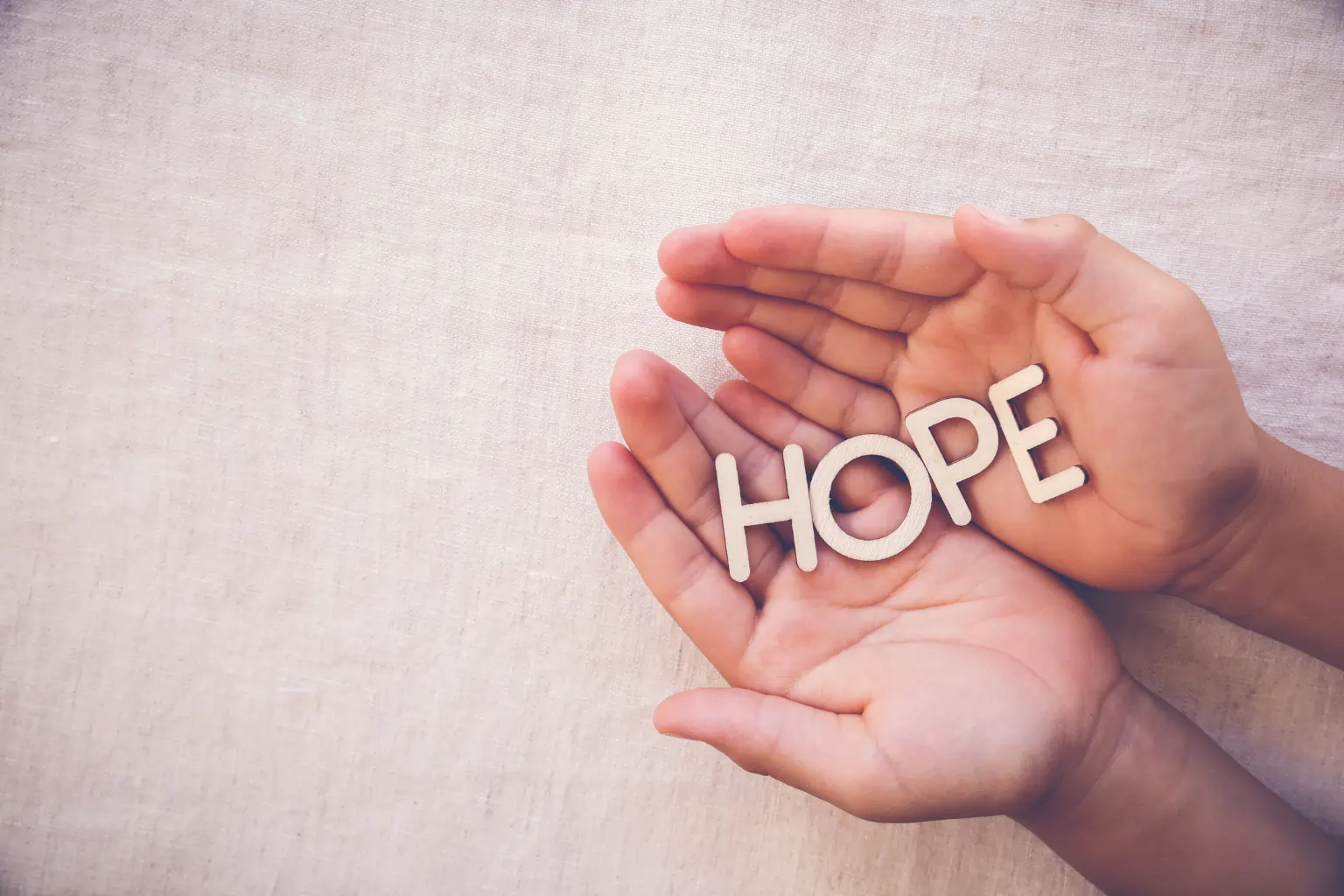
Wooden word "HOPE" on praying hands in a gratitude, faith concept. By SewcreamStudio/stock.adobe.com.


This is an article about hope. However, hope is not an independent entity. Like friendship or love, it requires an object. We do not hope—we hope “in.”
So, let’s consider some options in the day’s news.
- We could put our hope in an escalating impact of religion on our culture, but despite the large prayer rally on the National Mall on Sunday, only 37 percent of Americans say religion is gaining influence in our country. And as yesterday’s deadly assault on a San Diego mosque demonstrated, the number of hate crimes against religious groups is continuing to rise.
- We could hope in our nation’s superpower status, but 62 percent of Americans say China’s influence is getting stronger in the world. Only 34 percent say the same about the US, while 59 percent of Americans say our country’s best days are behind us.
- We could put our hope in politics and politicians, but Politico reports that our politics have become so divisive that “the political therapy boom has arrived.”
- We could trust our hope in medical science, but the ongoing Ebola outbreak shows the limits of our capacities, and medical progress can be used for bad as well as good. For example, several companies now offer genetic testing that critics call a quest for “designer babies.”
- We could put our hope for the future in artificial intelligence, but like medicine, it can be used for good or for ill. For example, a recent analysis of AI on college campuses reports that it is affecting “every appendage of the university system” and warns that “it will grotesquely disfigure, if not destroy, the university as an institute in every way that it is imagined.”
- We could put our hope in future generations, but demographers report that we are in the midst of a “headlong global birth crash” with massive implications for humanity.
By now, you probably expect me to encourage you to put your hope in Jesus. You’re right, but not for the reasons you might expect.
Why faith healers have an enviable position
The German philosopher Theodor Adorno contended that humans often use reason instrumentally, as a means to the ends we want, rather than causally, as our basis for beliefs or actions. We often do the same with faith as well.
Like the crowds who followed Jesus so he would meet their needs (cf. John 6:26), we all want our Lord to heal our hurts and help us with our problems. I’ve heard faith healers promise that he will do just that if we have enough faith. Theirs is an enviable position: If we are healed in response to their message, they get the credit; if we are not, we get the blame for lacking the necessary faith.
I am writing today to contend for the opposite position: The more we follow Jesus, the more we are likely to suffer as a consequence. But the greater our suffering, the more transforming our hope in Christ can become.
Jesus can never be accused of glossing over the cost of discipleship, warning us in stark terms, “If they persecuted me, they will also persecute you” (John 15:20). And for the same reasons: sinners resent being told they need to repent of their sins. I feel the same way. If an oncologist tells me I have cancer, I’d rather reject her diagnosis than endure the treatment she prescribes.
Add the fact that Satan wants to “steal and kill and destroy” us (John 10:10). The more we serve our Lord, the more we threaten our enemy.
Put the two together, and it is unsurprising that Christianity is far and away the most persecuted religion in the world.
“Him who is wholly lovable, wholly desirable”
So far, you’re wondering if I misplaced the hope I promised.
Here it is: “As we share abundantly in Christ’s sufferings, so through Christ we share abundantly in comfort too” (2 Corinthians 1:5). Consider three ascending facts:
- Suffering for Christ draws us out of our self-reliant culture and into dependence on the Spirit that positions us to experience his transforming power and peace (cf. Philippians 4:6–7).
- Such reliance enables Jesus to manifest himself to us and through us, transforming our character and producing his “love, joy, peace, patience, kindness, goodness, faithfulness, gentleness, [and] self-control” (Galatians 5:22–23) in our lives.
- The more Christlike we become, the more we fulfill God’s purpose for us as he redeems temporal suffering for eternal significance (cf. Romans 8:18).
St. John of Avila (1499–1569) wrote:
Dear brothers and sisters, I pray God may open your eyes and let you see what hidden treasures he bestows on us in the trials from which the world thinks only to flee. Shame turns into honor when we seek God’s glory. Present affliction becomes the source of heavenly glory. To those who suffer wounds in fighting his battles, God opens his arms in loving, tender fellowship, which is more delightful by far than anything our earthly efforts might produce. . . .
Can anyone but a man in whom all desire is dead fail to desire him who is wholly lovable, wholly desirable?
What price will you pay to follow such a Lord today?
Quote for the day:
“The question is not, will God keep his promises, but, will we build our lives upon them?” —Max Lucado
Our latest website resources:
- How to disagree better on the role of women in ministry
- Three purposes behind America’s founding
- Why did Jesus return to heaven on Ascension Day?
- Why are “living funerals” becoming popular? Lessons from St. Matthias on leaving a legacy
- Trump goes to China, summer box office predictions, Hantavirus & UFO files dropped













 Search