


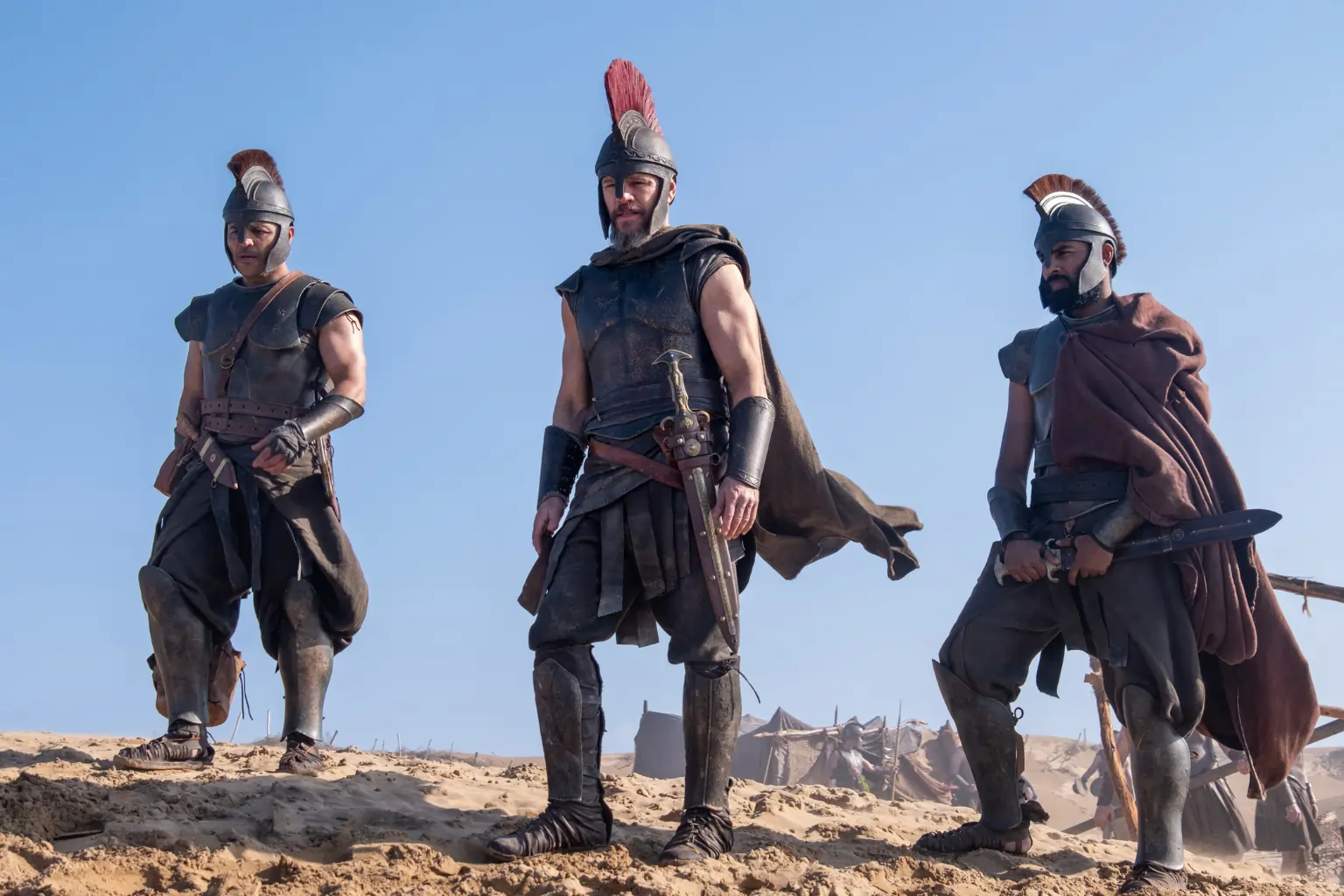
Undated film still handout from The Odyssey. Pictured: Jimmy Gonzales as Cepheus, Matt Damon as Odysseus and Himesh Patel as Eurylochus. © Universal Studios. All Rights Reserved.


I saw The Odyssey this week. I’m a bit late to the party: The film has made over $322 million as of today. When BBC Culture asked writers around the globe to pick stories that have endured across generations and changed society, Homer’s poem topped the list. The book has been translated into English at least sixty times and rendered in movies more than three dozen times.
Christopher Nolan’s version is truly spectacular. His film required 5,300 costumes and spanned 91 days of filming in six countries. Moving the Trojan horse alone required 250 actors and stunt performers. The movie amazes audiences with its mythical creatures brought to life largely without CGI.
But there’s more to the story behind the movie than many people know.
Giving the audience “reasons to believe”
The Odyssey is a poem comprising 12,109 lines that is thought to have been composed by the Greek poet Homer around three thousand years ago. The poem circulated orally for centuries before it was written down in the mid-sixth century BC for the Panathenaia Festival, likely on rolls of papyrus. More than a thousand ancient copies of The Odyssey and The Iliad have been found, substantiating the accuracy of the manuscripts we possess.
However, Odysseus’s story doesn’t end with The Odyssey. Scholars say a follow-up poem called the Telegony serves as a sequel, but because it was not as popular, it has been lost to time. Some of the people who read it wrote summaries, which is how we know about it.
The events in The Odyssey actually occurred in the twelfth century BC, five centuries before the poem began to be shared. As a result, even its first audience had no way to know if what they were reading (or hearing) was historically accurate. This would be like reading a story today set during the reign of Henry VIII and possessing no way to verify what we read.
Accordingly, like The Odyssey’s first audience, historians today don’t know if Odysseus was a figure of history. Richard P. Martin, a professor of Greek and Latin literature at Stanford, noted, “Homer’s Odyssey was already historical fiction, reimagining an ancient past when it was first composed.”
Nolan’s mission was to somehow make the myths of the story believable. “My rule of thumb for everything in this movie,” he said, “we have to give the audience reasons to believe.”
Where The Odyssey and the Bible agree
Unlike Odysseus, the evidence for the historicity of Jesus Christ is conclusive. Our earliest New Testament manuscripts are centuries closer to his time than manuscripts of The Odyssey are to the time of its hero. But we also have first-century references to Jesus’ life, death, and resurrection from Tacitus, Suetonius, Mara bar Serapion, Josephus, and others.
Here’s where The Odyssey and the Bible agree: both portray a world in which morality has consequences.
Odysseus encounters the grievous challenges he faces because he violated the “law of Zeus” by deceiving Troy with his wooden horse and treating its people unjustly. This is just one example of the stark contrast between right and wrong in the film.
In his Free Press review, Spencer Klavan notes that Nolan “isn’t afraid to say” that good and evil are real. Klavan even marshals Aristotle to reinforce the point, quoting his observation in the Poetics that The Odyssey’s plot “ends in opposite ways for the good characters and the bad characters.”
This is a narrative our culture desperately needs to embrace again.
What is our nation’s biggest problem?
According to a new Gallup poll, 36 percent of Americans say “economic problems” are our nation’s greatest problem, followed by “the government/poor leadership” at 26 percent. Despite daily news demonstrating the destructive consequences of immorality, only 6 percent think “ethics/moral/religious/family decline” is our nation’s biggest challenge.
Here’s why: In our secularized “post-truth” culture, right and wrong are matters of opinion. Most of the digital news we consume is filtered algorithmically through perspectives and biases with which we agree, which is why we consult the sources we do. Our opinions shape our view of their opinions, which shape our opinions. And the echo chambers that divided us from each other get louder by the year.
We can try harder to be good, but the fallen nature that leads us to do evil remains. The Lord asked his people, “Can the Ethiopian change his skin or the leopard his spots? Then also you can do good who are accustomed to do evil” (Jeremiah 13:23).
As Dr. Ryan Denison notes in his review of The Odyssey, “Even the best versions of who we are capable of being will fall short of the people God has created and called us to be.”
“Christlikeness is not produced by imitation”
Throughout the movie, Odysseus grieves that he is unable through his own efforts to be the man he seeks to be. By contrast, as today’s reading in Oswald Chambers’ My Utmost for His Highest reports, “The characteristic of a disciple is not that he does good things, but that he is good in motive because he has been made good by the supernatural grace of God.”
Chambers adds: “No man can make himself pure by obeying laws. Jesus Christ does not give us rules and regulations; his teachings are truths that can only be interpreted by the disposition he puts in.” As Rick Warren explains,
“Christlikeness is not produced by imitation, but by inhabitation.”
Every day we submit fully to Jesus’ lordship is a day he uses to remake us in his image and reverse the Fall through us.
Will today be such a day for you?
Quote for the day:
“When I understand that everything happening to me is to make me more Christlike, it resolves a great deal of anxiety.” —A. W. Tozer
Our latest website resources:
- BURNOUT: Reorienting our disorientation
- World Cup reflections, Trump’s election speech, Middle East update & “The Odyssey”
- Pilot helps load luggage after flight delay
- Best of: Faith, science, and the call to hospitality with Dr. James Tour
- Hamas elects new leader: What to expect from Khalil al-Hayya











 Search