


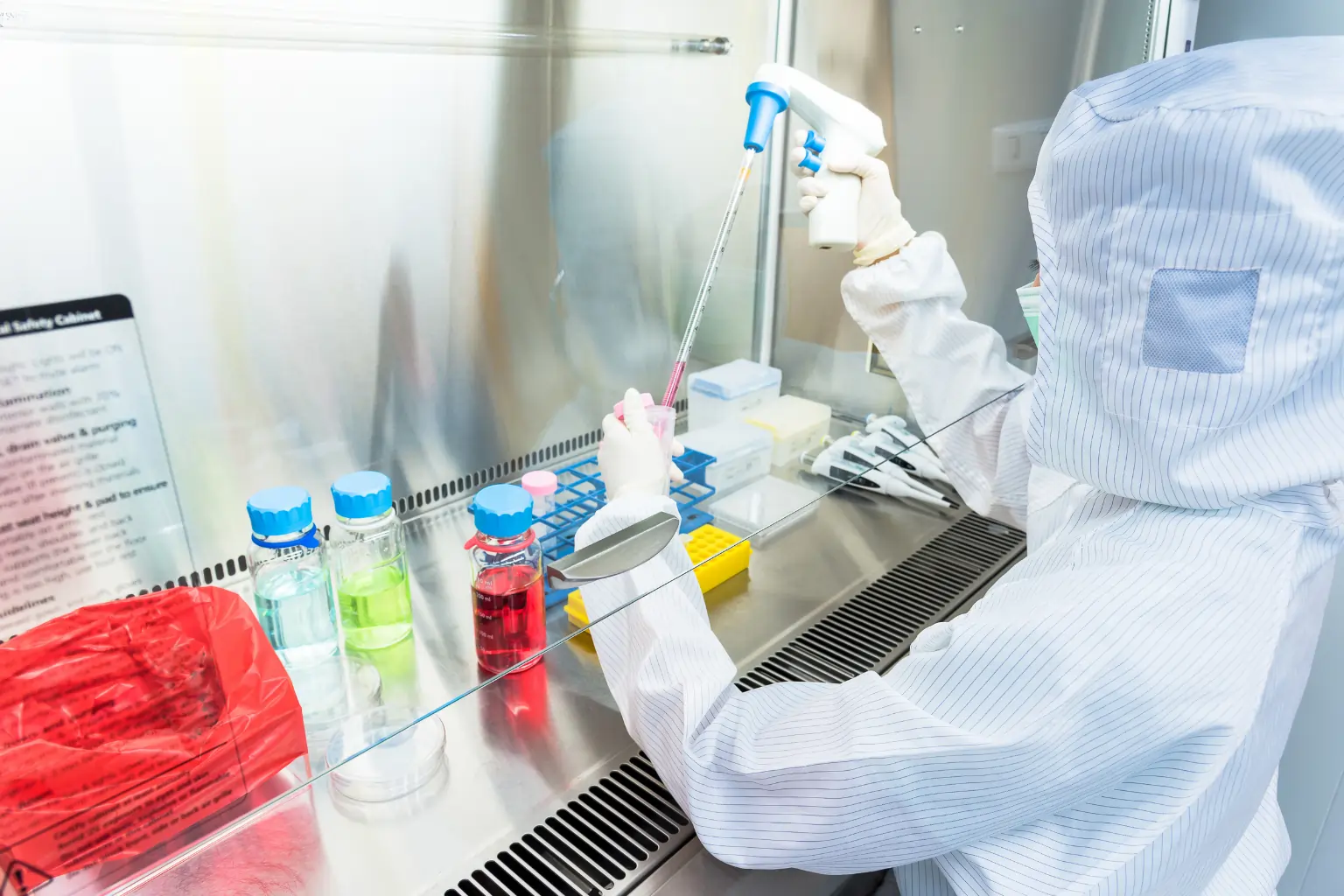
A scientist in a sterile coverall gown doing biological research. By warut/stock.adobe.com.


One of the reasons I enjoyed the America250 celebrations of recent weeks is that we have been reminded of God’s blessings on our nation and of the many ways he has used us to bless the world.
President Ronald Reagan noted that if you could condense the entire history of life on Earth into a motion picture that ran for twenty-four hours, the United States wouldn’t appear on the screen until 3.5 seconds before midnight. But in those 3.5 seconds, he stated, Americans “would perform such miracles of invention, construction, and production as the world has never seen.”
One such “miracle” is in the news these days: according to CNN, “Scientists say they have built a cell from scratch for the first time.” If you’re like me, three questions immediately emerge:
What have they actually done?
What does this mean for the future?
Is this playing God?
What have scientists done?
Kate Adamala is a synthetic biologist and professor at the University of Minnesota. She and her team say they have built a cell from scratch for the first time that can feed, grow, and replicate like a natural cell.
They constructed their cell piece by piece from nonliving chemical components. It grows and replicates for about five generations. It is made up of 150 to 200 molecules, which is far less complex than a biological cell that holds millions, if not billions, of molecules.
Each generation the cell produces requires feeding and is unable to evolve naturally. Dr. Adamala described the synthetic cell as “an incredibly wimpy organism that right now basically does nothing other than to eat and occasionally make a daughter cell.” As one biochemist said, the synthetic cell is not “life created in the lab” but a “genuine milestone on the road toward that question.”
Another commented, “We don’t totally understand life—far from it. We don’t have an all-powerful ability to manipulate matter to make stuff. I would say Kate has constructed a cell. I don’t think she’s created life.”
What does this mean for the future?
The CNN article notes that the human body has thirty-seven trillion cells, more than the number of stars in the sky, and that scientists still don’t know how every different cell type works or even what exactly they contain. Dr. Adamala said of her synthetic cell, “It’s just the beginning. It’s a chassis that we’re hoping to build on, and that’s significant, because now we actually can have some reasonable idea of how to build on it.”
She and her team have made their work available to other researchers. Their hope is that the cell will become a shared global standard for synthetic cell biology.
In its current form, the synthetic cell does not pose biosafety risks and could not be used to manufacture a biological weapon. But it could help scientists better understand the way cells form and function, perhaps ushering in an era of made-to-order organisms that function like living machines.
Is this playing God?
Whether this synthetic cell will—or even can—lead to cells that perform like those created by God is an open question. The question before us today is whether it should.
As the resident scholar for ethics with a major nonprofit healthcare organization, I often focus on the pillars of biomedical ethics: autonomy, beneficence, nonmaleficence, and justice. Stated briefly:
- Autonomy asks if the patient has the capacity and agency to make informed decisions about their care. With regard to cells created in a lab, such capacity is obviously lacking. However, if these cells are not yet “life,” this issue is irrelevant.
- Beneficence asks what benefits a particular medical or scientific act might bring.
- Nonmaleficence asks what harm this might produce.
- Justice asks if this is ethical for society at large. Does the benefit outweigh the cost? Who decides its use? To whom will it be available? Who sets ethical guardrails in place?
However, we live in a postmodern, relativistic culture to which the prophet’s description applies: “Truth has stumbled in the public squares, and uprightness cannot enter” (Isaiah 59:14). We have rejected absolute truth and objective morality, opting for tolerance as our highest value.
Consequently, with regard to synthetic cells, we might claim that such advances are ethical in that they could benefit public health, or we might warn that they could be engineered for malevolent purposes. We might claim that they will benefit all of society, akin to penicillin and similar breakthroughs, or we might allege that they will benefit only those who can afford them.
“The whole earth be filled with his glory”
In many ways, our technology has outstripped our ethics. From AI to nuclear proliferation to biomedical engineering and genetic manipulation, we have more tools capable of destroying us than ever before.
As a society, we need the wisdom only our all-knowing, all-loving Lord can offer. Our future as a nation is consequently tied to spiritual awakening, not just with regard to our individual souls but also to our collective survival and flourishing.
The good news is that the living Lord Jesus is as available to our nation today as he was when our nation was founded. John Hancock, whose outsized signature I read recently on the original Declaration of Independence, prayed “that all may bow to the scepter of our Lord Jesus Christ, and the whole earth be filled with his glory.”
Will you make his prayer yours today?
Quote for the day:
“Being a Christian is a character which I prize far above all this world has or can boast.” —Patrick Henry
Our latest website resources:
- Why the Strait of Hormuz echoes an unpredictable war
- American drone boats attack an Iranian submarine
- President Trump responds to Iranian death threats
- Should I open a Trump Account for my kids? Stewarding our children and generational investment
- How Asbury Seminary modeled truth and love in UMC departure: An example of gracefully standing firm on biblical sexuality













 Search