




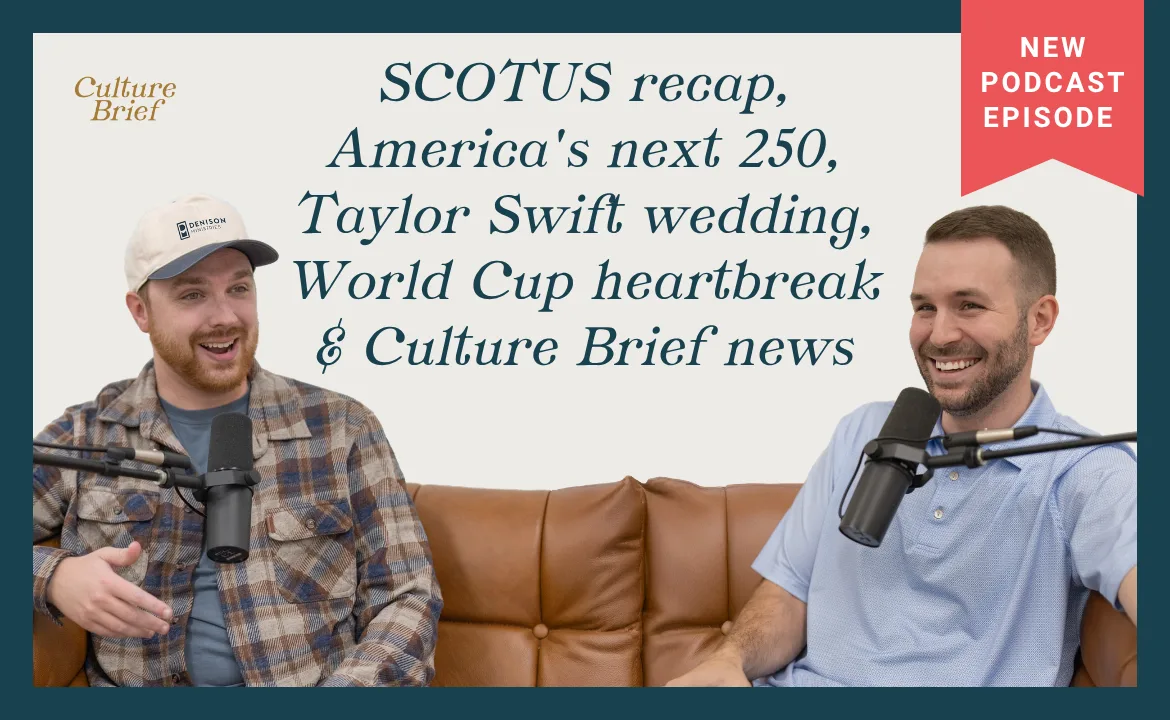
Culture Brief: SCOTUS recap, America's next 250, Taylor Swift wedding, World Cup heartbreak & Culture Brief news | Ep. 76
In this week's Brief: The Supreme Court dropped some of its biggest rulings of the year and we break down all four—campaign finance limits erased, mail-in ballots upheld, transgender athlete bans sustained, and birthright citizenship preserved. We explore what each means, where the justices split, and why our ultimate judge isn't in Washington.
Then Micah takes us through "The Next 250"—what the next 250 years of America could look like and the four forces that will shape it: technology, energy, institutions, and cultural character. He makes the case that the future of our nation depends less on DC and more on what happens in our homes, our churches, and our relationship with God.
Plus, we have a big announcement about the future of Culture Brief and exciting changes at Denison Forum. Trump threatens to end the Iran ceasefire, Taylor Swift and Travis Kelce tie the knot, LeBron is a free agent, the US gets humbled at the World Cup, and the quarterfinals are set.



Topics
- (0:00) Introduction
- (2:12) SCOTUS summer recap
- (5:35) Mail in ballots ruling
- (8:18) Trans athletes in sports
- (10:25) Birthright citizenship blockbuster
- (14:03) God above the courts
- (17:12) America at 250 snapshot
- (26:18) Faith as foundation
- (27:02) Worship shapes nations
- (31:57) Denison Forum expansion vision
- (37:06) NATO and Iran update
- (38:20) Swift Kelce wedding buzz
- (39:52) NBA trades LeBron watch
- (41:38) World Cup highs lows
- (45:51) Conclusion
Resources
- Send us your thoughts, questions, and topic ideas: [email protected]
- Culture Brief Instagram
- Watch on Youtube
- Sign-up for a Denison Forum newsletter: DenisonForum.org/subscribe
Articles on this week’s top headlines:
- A win and three losses for President Trump at Supreme Court
- Supreme Court rules on transgender athletes in girls’ sports
- Here Are the Major Cases the Supreme Court Decided This Term
- Two-Thirds in U.S. Prefer Birth Sex on IDs, in Athletics
- Supreme Court Upholds State Laws Banning Transgender Girls and Women From School Athletic Teams
- Changing the Constitution: Five Proposals for a More Perfect Union
- A profound speech about America’s past and future
- Choosing between two revolutions
- Six-Chart Sunday – America at 50, 100, 150, 200 & 250
- The Greatest Country on Earth
- America’s Next 250 Years Are Ours to Build
- 1 big thing: What America gets right
About Conner Jones
Conner Jones is the Managing Editor at Denison Forum and Co-Hosts Denison Forum's "Culture Brief" podcast. He graduated from Dallas Baptist University in 2019 with a degree in Business Management. Conner passionately follows politics, sports, pop-culture, entertainment, and current events. He enjoys fishing, movie-going, and traveling the world with his wife and son.
About Micah Tomasella
Micah Tomasella is the Director of Advancement at Denison Ministries and co-hosts Denison Forum's "Culture Brief" podcast. A graduate of Dallas Baptist University, Micah is married to Emily, and together they are the proud parents of two daughters. With an extensive background in nonprofit work, finance, and real estate, Micah also brings experience from his years in pastoral church ministry.
About Denison Forum
Denison Forum exists to thoughtfully engage the issues of the day from a biblical perspective through The Daily Article email newsletter and podcast, the Faith & Clarity podcast, as well as many books and additional resources.
All episodes are produced by Sound of a Rose. For more information, you can visit soundofarose.com.
EPISODE TRANSCRIPT
NOTE: This transcript was AI-generated and has not been fully edited.
Conner Jones: [00:00:03] Hi, I'm Conner Jones.
Micah Tomasella: [00:00:04] And I'm Micah Tomasella.
Conner Jones: [00:00:05] And this is Culture Brief, a Denison Forum podcast where we navigate the constant stream of top stories and news, politics, sports, pop culture, technology, and so much more. And we do it all from a Christian perspective. And Micah, man, it's been a minute. Welcome to the studio for your first time. Uh, how's it going?
Micah Tomasella: [00:00:24] Pretty good, man. Welcome to the studio for your second time. Yep. Everybody's done a lot of good work to get this put together. Connor mainly spearheaded this and then a lot of people here within the ministry like Josh Miller included that you guys got to see last week who are a lot smarter than us in these types of details have been able to make a dream really become reality and for us to have our own studio for Culture Brief and for a lot of our podcasts here at Denson Forum. Thank you guys for taking the ride with us. And now Connor and I get to do these podcasts together and he gets to have guests on and stuff like that together and I get to, you know, if he makes a good point, I get to kind of smack him on the shoulder a little bit and tell him he made a good point. Right? We can hit each other in person now. What a blessing. Uh, so today on the podcast, we're going to be talking about SCOTUS rulings and the recap of that. The Supreme Court made a lot of decisions. I'm going to talk about the next 250 years of America as we've looked back on the last 250. What do the next 250 look like? Because if you think about the nations around the world, 250 years, we're still kind of in our infancy. We're still figuring it out. But Americans have an enduring spirit, an entrepreneurial spirit, and over time, a spirit that's in some ways trusted God and in some ways haven't. So let's talk about all of that and so much more along with some World Cup stuff. So let's jump into the brief.
Conner Jones: [01:37] The brief. All right. Yeah, and I should mention the people did speak. They told us we should call this room the culture corner. That was the most popular option of the nickname for this studio. So
Micah Tomasella: [01:48] Did you throw out the culture cabana as an option?
Conner Jones: [01:52] Cuz that's what I was thinking.
Micah Tomasella: [01:53] Dude, I did not. I actually love that.
Conner Jones: [01:55] Yeah.
Micah Tomasella: [01:56] The culture cabana.
Conner Jones: [01:58] It's giving vacation vibes.
Micah Tomasella: [01:59] Yeah. So I don't know. Let us know about it. Maybe that's our summer name. It's the culture cabana in the summer. It's the culture corner the rest of the year.
Conner Jones: [02:05] I it's very hot here in DFW, so I wouldn't mind having a cabana by a pool or something like that. Yeah.
Micah Tomasella: [02:11] Perfect.
Conner Jones: [02:12] Okay, yeah, let's talk about Supreme Court rulings. Uh, as many of you know, every summer, the Supreme Court releases decisions that they've been mulling over for the previous months. Uh, usually June, July, they release a few dozen decisions. They did that this year as well. Uh, but there's four that I really want to focus on. Four of these major ones that came out really last week, uh, and the week previous, but the big ones were last week. They always save the biggest decisions for last right before the July 4th holiday. And so they did that. And so let's dive into some of these things that were decided. Uh, some wins for Republicans, some wins for Democrats, uh, some wins for Trump specifically, and definitely losses for Trump specifically. So, the first one would be the campaign finance limits decision that they made. That was a 6 to 3 decision where the Supreme Court basically erased limits on how much political parties can actually spend on advertising and other efforts in coordinating with candidates for Congress and president. So, essentially, it's saying when these candidates are running for now, like for instance, right now, midterms are going on. This actually opens up the door for midterms, uh, campaigns going on. When a candidate is running in another in a state, they get to work with the party directly. If it's a Republican candidate, Democrat candidate, they are working directly with the Republican National Convention or the Democrat National Convention. But historically, those conventions or committees, I should say, not convention, uh, those committees are limited on how much they can actually provide to those candidates for advertising and campaign efforts. So the outside way of getting around that has always been super packs, which you've probably heard that term. That is essentially where private citizens, typically very wealthy individuals, uh, can work together in a super pack to fund raise and then provide funds not directly to a campaign. They have to work kind of alongside a campaign. They can't work with them. They can do advertisements on TV for these candidates, but they can't say this campaign was, you know, approved by the candidate's name. Now, the actual Republican and Democrat Party can do as much money as they want to any campaign to any senator, congressman, potentially the president campaigns down the road. So, this is SCOTUS saying essentially, they saw it as a first amendment issue where there's nothing in the Constitution that should be limiting how much money can be spent. And this is money raised by the parties by the American people. I mean, American people are are donating to the Democrat or Republican Party. What are your thoughts?
Micah Tomasella: [04:27] So, well, does this eliminate the need for super packs now? Is that what you're saying?
Conner Jones: [04:30] Okay. I do not think so because super packs, they're so well connected and they're going to be able to focus more on like very specific issues. You can get a super pack.
Micah Tomasella: [04:37] Okay, so now they're even more concretely supported through this really.
Conner Jones: [04:42] Uh, potentially. I I think what you'll see is a split of money. Here's the here's the biggest reason why this is a massive ordeal right now specifically even. Both the parties have a chunk of change sitting in their bank accounts that they just can't spend as well or have not been able to up to this point. But now, for instance, the Republican Party has 254 million in their bank. The Democrats have a lot less, 124 million, but that's still a significant amount. They can now start to supercharge these campaigns in the midterms. Specifically like for instance, in Maine, this week specifically, Graham Platner is the Democrat candidate who has just been riled up in controversy and then there was some serious allegations this week. He's probably going to drop out. He has not yet as of this recording. He lost all support. Lost all of his support. So whoever the Democrats decide to go forward with, they will now have this money to supercharge the ad spend behind that campaign and that candidate. So, just a lot there with uh that one. Another big ruling was on mail in ballots. This is something that has been at the forefront of conversation since the 2020 election when Trump uh claimed and still to this day, he does believe and I I'm not here saying what happened. I'm just saying this is what he believes. He believes he was fraudulently lost the uh 2020 election because of mail in ballots uh and and some in-person ballots too as well, I think is the claim there. But the mail in ballot piece, he has always said it needs to be done by election day. Your ballot needs to be back by election day. So he really supported this uh since his people to the Supreme Court to go argue for this. But essentially the Supreme Court did not agree with that and they said you can have your ballot counted as long as it's postmarked by election day. So this means if a ballot arrives seven, 10 days later because of slow mail times, that ballot can still be counted. We just saw this in California specifically. They are a slow count state. It takes a long time there. They know that. They're apparently trying to work through that. But we saw this with Spencer Pratt, something you talked about several weeks ago, Micah, where man, it looked like he was going to win and then all those mail in ballots came in over two, three weeks and then it was clear, oh, he's not going to win. Democrats are breathing a sigh of relief here because they have more mail in ballot voters typically. Uh there are a lot of people who vote Democrat that send in their ballot via mail and so they wanted this to really uh go forward the way it's been, which is postmarked by election day accounts. Thoughts here?
Micah Tomasella: [06:53] I see the pros and cons of it. What, you know, one thing you didn't mention, Connor, is that this was a 5-4 split decision, right? So you had like Justice Amy Coney Barrett, who is always a wild card, but does lean conservative, jump in on the Democratic side, the more left leaning side of the Supreme Court to side with them on this issue. I I see it both ways. In one way, if you make mail in ballots arrive by election day, well then over time people would get used to it. They would mail it in earlier. And then we would stop maybe seeing so many cries for fraud, right? Like our election system, the integrity of our election system, we have to believe in that as a people. We have to believe that our voice matters and that our voice is important. Yep. And so, uh, you know, it it would eliminate some of those calls for fraud if that was taken care of. But at the same time, there are a lot of people who cannot make it out to vote. And so in a certain way, it's like, well, does that eliminate a lot of people's voices? If for some reason, it doesn't come in in time. Because if the mail system is slow, then I'm sure in the future Democrats would say Republicans had something to do with slowing down the USPS for the mail and balance. Oh, all these ballots came in the next day after election day. They came in at 12:01. I can just see I think people are going to be calling for fraud either way. is what I'm thinking. Um, so I can see both sides of this decision actually.
Conner Jones: [08:17] Yep, uh, I'm right there with you. Okay, another decision, transgender athletes. In a 6 to 3 decision, this one was pretty um, well, you know, supported by the Republican justices. The Supreme Court upheld the state laws that are currently out there from certain states, 27 specifically, that are banning transgender athletes from competing in girls and women's sports. So basically a biological male is not allowed to compete in female sports. Uh, I would say this is a positive ruling. This is something we've talked about here on this podcast and at Denson Forum extensively about that biological males should not be in girls sports. Uh, they have obviously a biological advantage. And so this was also a popular ruling because two-thirds of the American populace actually agrees with that. Gallup poll last year showed two-thirds of US adults don't think biological boys or males should be in women's sports. Um, but there is a caveat here. Dr. Jim Denson, he noted in his daily article newsletter last week that the court's ruling on transgender athletes does not end the controversy. The justice determined that the states can constitutionally ban biological boys from girls sports teams, not that they must. Now, as with the jobs decision on abortion, the conflict returns to the states. At present, 27 states limit school sports for women and girls to athletes whose biological sex is female. In the remaining states, biological girls have no such protections. So, this is only for those 27 states. The other states and they could pass a law that bans transgender athletes, but right now they don't have a law on the books, so it does not impact them basically passing it back to the states. Micah, you are a dad of two girls. How do you feel about this?
Micah Tomasella: [09:52] I mean, I I think we've made it clear that um how we feel about this as a ministry. I I think this is just common sense. You know, I it's it's kind of hard to imagine, right? I mean, I know it's a difficult situation all the way around, but this this is common sense. This makes sense and the American people obviously feel the same way.
Conner Jones: [10:08] Yep, yep. It's not a surprise it made it to the Supreme Court to just kind of get a final decision there. Obviously, some some of y'all probably live in states where this is not actually a law and you will uh probably have campaigns and candidates come forward and say we're going to try to fight this to get this into law in your states, California, New York and states like that. Um, okay, here's the big, big decision that happened last week. This is the one that was everybody was waiting for. It's the like blockbuster decision. That was around birthright citizenship. And in a 6 to 3 ruling, the Supreme Court upheld the long-standing definition of birthright citizenship. And they rejected basically an executive order that Trump signed on his first day back in office back in January of 2025. Uh, he signed an executive order that sought to deny citizenship to any uh children of undocumented immigrants and people studying, working or visiting the United States on limited time visas. So, the reason for that was Trump and all of his allies were trying to argue that birthright citizenship encourages birth tourism and presents a national security risk. Uh, essentially, they have said that uh, you know, there are women who will come to America just to give birth so that their child is a citizen and has rights here, uh, and then they will go back home. This is something that they argue happens particularly on the southern border. Uh, women would give birth in the, you know, US customs and border facilities and then their child is a US citizen and so they can stay, uh, or they get extra rights and even the parents might get extra, um, you know, rights with that too. So, that's something that they wanted to reject. For context, the 14th Amendment actually states, all persons born or naturalized in the United States and subject to the jurisdiction thereof are citizens of the United States and of the state wherein they reside. That's what the amendment says directly. And so that's what the justice basically said, yeah, that's it's plain and clear. Kind of clear. Um, it was for for some history behind that, that amendment was added to grant automatic US citizenship to the children of former slaves after the Civil War. Uh, and then the Supreme Court later ruled again in an 1898 case, uh, that the amendment applied to all children born in the United States regardless of whether their parents were citizens or not. So, um, basically, it's already been stated. And so this was kind of black and white in there when you read it just like that. This is always going to be probably a losing cause, but Trump really put a lot of stake into this one. He was the first sitting president to go to the Supreme Court and sit in uh oral hearings and arguments uh back in, I think it was April or May he went uh and made it clear he wanted this to pass and it did not. It's also a little bit of there's a tinge of irony here because I know what you're about to say. You know what I'm talking about? With the World Cup this week, uh the star US player, Florian Baligan was the guy who got a red card in the Bosnia game last week. Baligan. Baligan. Great player. We got a lot of thoughts on World Cup. We'll come back to that. He didn't play well last game. Yeah. But nonetheless, everybody's upset because he was going to be forced to miss this game on Monday against Belgium because he got the red card. And the red card was very controversial. Nothing about the moment looked like a red card um foul, right? And so Trump pulled some strings, he had his administration pull some strings with FIFA this uh past week and ultimately got him reinstated back into the game on Monday uh against Belgium. And he was out there on the field the whole game. He was a starter and uh he was out there. We really wanted him. He's our star player. But the tinge of irony here is Baligan was only on the US team and is to this day still only on the US team because of birthright citizenship. His mother was in Brooklyn, New York and was not allowed to board a flight back home to London and she's also Nigerian. Um and she couldn't go back home. They didn't let her board because she was so far along in her pregnancy. So she ended up at a hospital in Brooklyn, gave birth to him and then after birth, took him back to the UK where he was raised and and grew up. But he is an American citizen because he was born on US soil. So the tinge of irony here of like this ruling last week, Trump being so adamant about it and then working so hard to get this guy back on the field who's only a citizen because of birthright citizenship. Uh there's just irony there. Just pointed that out. Okay, all of this, there's a lot of decisions, a lot we can take in here, a lot of power in the hands of nine people, a lot of power in the hands of the president. Um, it's kind of interesting how this whole thing works, but it's also checks and balances. It's working. This is the system, right? So, does the Supreme Court have power? Yes. Do these rulings have implications on people's lives? Of course. But what I would say with these decisions and any decision that ever comes out of the Supreme Court, they are not our end all be all. Uh and that's because we have a much, much greater judge, right? Uh Isaiah 33:22 says, for the Lord is our judge. The Lord is our lawgiver. The Lord is our king. He will save us. So, you know, we can look at these decisions and we can say like, while the Supreme Court justice apply the law of the United States, Yeah. they do not dictate what we do in our hearts or what we do with our faith. Uh they could rule tomorrow that Christianity is illegal in the United States of America, right? They could say something like that. And it would not change our faith in God. It doesn't change where our heart stand, where our mind stand, where our soul stand. Uh, they're not our rulers. God is. We are citizens of heaven before we're citizens of America. Uh, Hebrews 12:23 calls God the judge of all, uh, as it ramps up to verse 28, which then states, therefore, let us be grateful for receiving a kingdom that cannot be shaken. And thus, let us offer to God acceptable worship with reverence and awe. Micah, I'm comforted by the fact that we are part of a kingdom of God that cannot be shaken. It will not be shaken. God is the solid foundation. I'm I'm just encouraged by that um that we're part of such a bigger kingdom. A kingdom bigger than Rome was at the time, kingdom bigger than the United States is today. That's just the reality of it. God's our judge, uh and we follow his law uh and and his dictates. Yep.
Micah Tomasella: [15:57] Love it, Connor. It's actually a really good transition into what I'm going to talk about about the next 250 years and what that could look like here in the United States. You bring up a good point too. One of the most unique things about our founding documents when our when, you know, everything was officially ratified in 1776 was that we are endowed by our creator. We have God-given rights and that's what makes us unique as we pursue our lives here on earth. That's what makes our country unique. So, before I jump into this, I called this segment the next 250. I want to give some um I want to give some credit to the sources as I gathered a lot of this together, right? The conversation was shaped by a lot of thoughtful research and writing from the Wall Street Journal, from Denson Forum, of course, from Axios, from the Free Press, from a guy named Bruce Melman and others who've been asking many of the same questions that we're asking today. We have been talking a lot about our country, about the vibes here in our country, about the state of our country. And as we just celebrated 250 years as a country, it just got me thinking and I was just reading a lot about what does the next 250 look like? Let's talk about that. As always, our goal isn't to tell you what to think. It's to help all of us think a little bit more carefully, think a little bit more uh critically, historically, biblically about the world around us. So with that, let's talk about the next 250 years. So America at 250, let's have a state of the Union for a moment. 250 years ago, 56 men signed a document that changed the world as we know it. At the time, there was no electricity, just for context. There was no automobile, there was no uh antibiotics, there was no anesthesia, there was no airplanes, there was no refrigeration. There was no internet, guys. Information truly moved as fast as a horse could travel. And most people lived one bad harvest away from hardship. They took it day by day. And yet, the founders attempted something almost unprecedented in human history, truly unprecedented in human history. A nation built not on ethnicity, not on geography or ancestry, but on ideas, liberty, equality, self-government, human dignity, the belief that rights come not from kings or governments, but from our creator. Amen. Amen. Amen. The American experiment has not been perfect. Let me tell you what. Slavery, the treatment of indigenous peoples, segregation, countless other failures remind us that America has struggled to live up to what it wants to be. Yeah. We've struggled to live up to our own ideals that we've put on paper. But perhaps, perhaps this is a part of the American story as well. Not perfection, but pursuit, a cause something greater, being forerunner for the rest of the world. The ongoing effort to move closer to the principles we claim to believe. And 250 years later, the Republic remains and despite all going on, the Republic's very strong, guys. Okay? That alone is remarkable, but here's the great American paradox that I want to talk about, Connor, and then I'm ask your opinion on something. There has arguably never been a better time to be alive or be American. Yeah. Okay? No, uh, I don't even know if it's arguable. We live longer, we live healthier, medical advances that would have seemed miraculous a generation ago are now routine. Still miraculous, but they're now routine. Americans continue to start businesses at extraordinary rates, more than anywhere in the world. And Americans gave more than 617 billion dollars to charitable causes last year alone. The United States remains the world's largest economy, continues to lead in fields like technology, medicine, higher education, entrepreneurship, innovation. That's just the American spirit coming out, right? And yet many Americans are so incredibly pessimistic about the future. And I'm not saying I don't feel that way sometimes too. I'm not saying I don't feel tempted to feel that way, but the facts say something different. That disconnect matters. Connor, is there anything surprising about what I stated just there?
Conner Jones: [19:50] No, I mean, first off, yeah, we're so blessed to live in this time. We're also we are a nation of ideas and diverse people and also diverse geography. That's always been nice too. Uh, I, you know, you're talking about the way people feel. I oddly enough, I was in church on Sunday and I was actually in the bathroom and two other guys came up to the sink next to me while I was washing my hands. And the one guy said, hey, do you have a great fourth? Great 250? And the guy said, yeah, I did. I just I worry about the next 250. I thought this was so interesting that he said that. And he said, the other guy was like, well, what do you mean? He said, well, I just don't know that our flag's going to be flying in 250 years. I was like, oh man. Uh, I don't even know these two guys. I've never seen them before, but I just was kind of thrown back by that. I was like, that's really pessimistic. And he could be right. Maybe it won't be. Did you fight him? Did you get really upset? Did you throw hands? I I said, you shouldn't even watch the soccer game this week. Uh, no, I but I was like, you know, that is a feeling people feel is they're worried that the next 250 we won't even be here. I disagree with that. I tend to think that we're just going to get better as a nation. Uh, we've got we got hurdles. I mean, every I mean, we're we're dealing with hurdles every single day. Um, but that's that's part of what makes America different is we fight through those hurdles and figure out a better way forward. At least that's what I think our history shows.
Micah Tomasella: [21:01] I think in some ways, Connor, I think we're suffering less from a crisis of reality and more of a crisis of perspective. Because I think reality is different than what the general perspective is here in our country. We consume an endless stream of information telling us that everything is broken, everything's declining, everything is worse than it's ever been. History suggests otherwise. This is actually some information from this guy named Bruce Melman that I saw on um Axios. He's talking about how throughout history at turning points, Americans have continued to worry is the Republic still going to stand and then we find a way through. Let me give you a couple of examples. Americans in 1864 wondered if the nation would survive the Civil War. You guys remember that? We we weren't alive for that, but do you remember that where literally the nation split in part and started to kill each other? Yep. And we're still here today. Americans in 1942 wondered if freedom itself would survive fascism. If you really study World War II, a few key decisions and moments could have changed the course of history. There were many moments the allies, it didn't look like the allies were going to win. Okay? Uh just a a few moments in what I believe is God's hand changed the course of history. Americans in 1968 watched riots, assassinations and social unrest unfold in real time. Every generation has had reasons to worry. Every generation has had reasons for hope. But what will shape the next 250? Let's talk about that for a second. The next chapter of the American story will likely be shaped by, again, I'm not going to say I came up with all this. It it came from a lot of the reading that I did, but it makes sense from what we talk about and what we know. It'll be shaped by four major sources: technology, energy and abundance, institutions, and culture and character. So number one, technology, AI, robotics, biotech, automation may change the human experience more in the next 50 years than the previous 200 combined. We are things are changing so rapidly at an unprecedented pace. The question is not whether these technologies will arrive. They're here. The question is whether we will use them wisely. It's a good question. Number two, energy and abundance. The next century will require an enormous amount of energy. You guys keep seeing data centers in the news, an enormous amount of energy, data centers, AI systems, advanced manufacturing, medical innovation, future transportation systems, all depend on it. The nations that figure out energy and its abundance will likely have enormous influence over the next century. And then number three is institutions. This is an important one. The Constitution has proved remarkably durable, but every institution ultimately depends on public trust and civic responsibility. Can our institutions adapt without losing the principles that made them successful? Can our society stand if we stop believing in its institutions? Okay? It's a good question. It's a big question because we are government by the people and for the people. If the people stop believing in it, uh-oh. Right? So we've got to believe that we're going to be able to figure that out and turn the corner there. And then fourth is culture and character. This may be the most important category of all and really culture, character, spirituality, the spiritual foundation, strong families, healthy communities, trust, responsibility, purpose, shared values have never been successfully outsourced to technology or government. Okay? What happens at home? Again, I quote Dave Ramsey all the time, just in this one way. What happens in your home, what happens in your house is more important than what happens in the White House. Let me tell you something. I've been looking at some data recently. I was just reading this about a month ago about how dads are spending more time with their children than they ever have in history, especially here in America. Okay? That's pretty cool. Love it. That's good for the home that dads are around finding the balance with work, but also spending more time with their kids and adolescents as they grow up. Good, strong dads being around is so important for the family, but I believe it's important for the fabric of our nation. Any thoughts there, Connor?
Conner Jones: [24:57] No, I just agree with all of that. Ultimately, you disagree with all that. I no, I I just agree. I just agree with all that. I'm glad you asked that. I need to clarify. I just agree with everything you said. Those are four major things that will be crucial. I think that last point is the biggest like where does our faith stand? How is family uh represented at the front of everything? How is faith represented at the front of everything uh before even the other items, right? Now, yeah, technology is going to be the wild card here. Like where does this go over the next 250 years? Really, where does it go over the next five years? I mean, that that changes things rapidly. But yeah, I think they're all great points. This is this is the future.
Micah Tomasella: [25:32] Yeah. You know, I think, um, I have some more prepared here, but really I just want to deduce down here to the last sentence of I really believe the next 250 years of America will depend not really, I mean, it will. It will depend on our intelligence, our wealth and our innovation. I think that's going to stay no matter what. That's just kind of the American way. Okay? I think it'll really depend on our character. And what does our character come from? What's the foundation of our character? Is our character as a nation because we want to do good? We want to do well. I want to be a good dad. Why do you want to be a good dad? Yeah. I want to be a good husband. Why do you want to be a good husband? I want to vote and be a a good productive member of society. Why? I would argue the best foundation for having a good character as a nation is if we hit our knees and repent and turn to Jesus. That's the best way for our nation to have the character that it needs to endure the next 250 years. Everything else is built on sand. It might be really strong sand, the American ideal. Um, but it's built on sand. It's not built on the rock. It's not built on something eternal. Again, we're talking about a nation of 250 years. We belong to a kingdom uh that has no beginning and no end. Yeah. Eternal. All right? So what are our deals going to be founded on? I believe our founders, uh faith was such a huge component of our country's founding. I believe strongly for our country to have a next strong 250 years, faith needs to be a big part of that as well. You know, um, as I head into kind of the spiritual application of this and the challenge for all of us, one of the temptations for Christians, I think is to believe that the future of America will ultimately be determined in DC, Silicon Valley, Wall Street, maybe even Beijing, Moscow, but not really, you know. Scripture points us somewhere much closer to home. Nations are shaped by people. People are shaped by families. Families are shaped by communities. Communities are shaped by values and values, I believe are shaped by worship. What are you worshiping? What are you spending your time on? What what are you fixing your gaze on? The psalmist reminds us in Psalm 33:12, blessed is the nation whose God is the Lord, the people whom he has chosen as his heritage. That's not a promise of automatic prosperity or political success. That's not what that promises. It's a reminder that flourishing ultimately flows downstream from our relationship with God and our willingness to align ourselves with his ways. The future of America will be influenced by America uh by elections, policies, technologies, but it's going to be influenced by parents raising their children with wisdom and courage. Yep. Churches serving their communities faithfully, business leaders acting with integrity even when it doesn't make sense, even when no one is watching, citizens choosing contributions over cynicism and truth over outrage. It's going to take us as Americans saying, look, there's stuff that needs to be fixed, but I'm not going to give up. I'm not going to spend so much time hating my country because where does that get me? You can acknowledge the issues of our country while believing in its ideals and values and how it's positively served the world. The prophet Jeremiah instructed God's people in Jeremiah 29:7, seek the welfare of the city where I have sent you. We're here right now at the precipice, you could say, for a purpose. Yep. Okay? It's not it's not by accident. So that remains our calling today. Not fear, not withdrawal, not not speaking to your neighbor. Speak to your neighbor, get to know the people around you, not cynicism, faithful presence. Christians have always been called to plant trees whose shade they may never sit under. The work you're doing, the faithfulness now in your family, in your communities, that's legacy, right? That would be such a beautiful thing. What we're doing now would somehow positively impact and lay the groundwork and framework for people that we'll never meet who are going to come after us. That's stewardship. That's discipleship and perhaps, perhaps that's patriotism. Whether America celebrates a 500th birthday someday or not, our calling remains unchanged. And again, we we believe it will. To be faithful where God has placed us, to seek the good of our neighbors and as Paul encourages us in Galatians 6:9, do not grow weary for doing in doing good, for in due season, we will reap if we do not give up. The next 250 are not ours to predict or know, but faithfulness in our generation is ours to pursue.
Conner Jones: [30:08] Mm. Yeah, man, we'll just see where where does this all go? And you know, for some of us who are at the life stage we're in, we've got hopefully, you know, Lord willing, a good number of years left to be able to to to instill some of this in our culture and in our younger generation, our kids. They've got a long life ahead of them to to see some of this go through. And so, you know, what are we going to hand off? Uh hopefully a better country than so uh we have even now. So I pray. I pray that's what happens. Yeah, and it's ultimately going to come down to what you're saying like where's our faith stand? What what is the center of what we believe in? And it's it's God. And that kingdom of heaven, that seems to be the theme here is like we have a great nation, but we have a better kingdom. Um and I think that's that's what we're.
Micah Tomasella: [30:48] Which should be the foundation for how we approach our nation and all of its beauty and all of its difficulty. Um, and just to be clear, I just want to ask you a question. You do disagree, you do disagree or you agree with everything I just said?
Conner Jones: [30:59] I think I agree with everything you said. I hope I do. Um, cool. Well, thanks Micah for that. We also wanted to offer a quick update on this podcast specifically from Micah who wants to share an update on his status. Uh, you may have noticed over the last few weeks, he's been a little in and out. A lot of that's actually been vacations and we've just been traveling. You've been on work stuff, work trips, stuff like that too. Work trips, all that stuff. So, but Micah's also got an announcement to share with you guys. So Micah, I'm going to hand it off to you.
Micah Tomasella: [31:29] Wow, that's all you're going to give me?
Conner Jones: [31:31] Oh, yeah, I'm making it a little bit uh just to you.
Micah Tomasella: [31:34] Okay. All right. Well, guys, I am eventually going to be stepping away as co-host of Culture Brief. This is not a goodbye moment. I still got a few more episodes in me and you'll be seeing me time to time as I hop on as a subject matter guest. Whatever we want to deem, I'm a subject matter guest in. I think I'm just a jack of all trades, master of none. But if you want somebody to come on and get excited about something, I'm always happy to do that. I you know, I think I I wanted to share a little bit of why this is happening because we're really stepping into an exciting next phase here in our ministry. I'm not going anywhere. Just to be just to be clear. So, I mean, Connor and I work full-time at Denson Ministries. Okay? So Connor has a big boy job outside of this podcast. I have a big boy job outside of this podcast, but we both work in this ministry and believe in what God is doing through this ministry. So I serve here as director of advancement. And so my role is I get to lean more into that as I step away from this podcast. My work is centered on building relationships with our ministry partners, encouraging and ministering to our donors, sharing the vision for what God is doing through this ministry and inviting others to join us in that work. That's what I do day in and day out. It's a lot of strategy, it's a lot of people, and I love it. But as our ministry continues to grow, I'm grateful for the opportunity to be able to devote more time to what God has in store, more energy to what God has in store for our ministry. We are in the first year of a three-year expansion campaign called a new kind of news. And I truly I truly believe there's never been a greater time or a greater need specifically for Christians to engage the news differently than the way the world is engaging with the news. The enemy is so often at work in the news of our day to stir fear, to stir division, to stir anger, hopelessness. You're listening to this podcast, so you understand that. We talk about that all the time. Our desire is to become, our ministry's desire is to become the go-to Christian news alternative that equips believers to understand what's happening through a biblical lens and respond with wisdom, hope, and conviction through expanded articles, podcasts, videos, devotionals and other resources, other contributing writers with skins on the wall and real uh knowledge of their area of expertise. We're trusting God to grow us from about 40 million content experiences a year with Denson Forum to 300 million in just a couple of years. That's that's the hope, that's the goal to expand nationally, to expand globally. That's millions more opportunities to help people encounter biblical truth, right? Navigate today's culture faithfully and make a greater kingdom impact. I truly believe this is the one the uh one of the most important opportunities before our ministry that God has placed in front of us. And I'm incredibly grateful that I get to play a small part in that. And so as a part of that next phase, I'm going to be stepping more deeply into that and stepping away from the podcast eventually. But also, Connor actually has an exciting update. He's now Denson Forum's managing editor. So Connor's stepping away from his current role that will be filled and he'll be stepping into becoming the managing editor for Denson Forum and doing content like this in many ways full-time, which is what his heart and passion is. So Connor, I'm very excited for you, man.
Conner Jones: [34:51] Yeah, I appreciate that. Yeah, very exciting times for Denson Forum. I'm grateful to be stepping into the team full-time over here now. I've been doing marketing uh stuff for Denson Ministries as a whole. We have other brands, Christian parenting, first 15 devotionals, foundations with Janet, all great, great content and I've loved doing marketing for the last few years. So stepping full-time into this though, Denson Forum specifically because guys, like Micah's saying, we have such exciting like massive exciting projects coming down the line. You're going to get big announcements in the coming months. Um and Micah's telling himself short. None of this is possible without his hard work, uh his team's hard work, the development team. Uh as we've said before, this is fully fundraised. Uh we are fully Right. We are fully donor uh driven. Uh we don't take sponsorships, we don't have ads. And that's a blessing. We are so grateful for our donors who make this possible. But that's what Micah focuses on and with this massive expansion campaign, I'm excited for you to go dive into that even more uh and go build more relationships. And yeah, the first phase is already here. That's part of why I moved over to this team. It's part of why we have a studio here. We want to make our content higher quality. We want to do it even better. So Micah's a huge piece of that. Uh obviously very grateful for all that you've done here on the podcast. Like you said, he's going to stick around for a little bit longer.
Micah Tomasella: [36:01] This is not our goodbye episode.
Conner Jones: [36:02] We'll we'll bring you back around for certain subjects. I'm thinking your your expertise is like fashion and and right? That's fashion, pop culture, everything happening on social media, celebrity news, movies. Right. No, that's that's not my expertise. No, we'll we'll bring you back on when and eventually when it definitely does happen when the Cowboys win the Super Bowl. Maybe some sports talk or maybe um tariffs. Yeah, you love tariff talk. Tariffs with Micah. Yeah, well, you know, that was another Supreme Court decision that happened. They struck those down earlier this year. So, anyways, I'm not I'm not going anywhere just yet. This isn't goodbye just yet. We'll have more time to ponder on what's happened and what's to come, but we wanted to go ahead and tell you guys about what's coming down the pipe.
Conner Jones: [36:43] Yeah, I wanted to let y'all know because Micah won't be on every week. He'll be on a few more times uh over the next couple months here, but we'll be having some other people on the podcast to help uh co-host with me. Uh and I'm excited to continue to do this and He's not going anywhere. Don't worry about it. Yeah, well, I don't know if that's a good thing or a bad thing for everybody. You're stuck with him. So, anyways, thank you Micah for your update and we'll keep y'all posted on some of these big, big announcements that are coming down the line. Cool. Um, okay, let's jump into check in real fast. We got a few things to hit on. First off, this morning, really today, we are recording on Wednesday morning. Trump is at the NATO Summit in Turkey with all the European NATO leaders and Canada. Um, and man, it's just it's it's Canada. And Canada. Yeah, Mark Carney's there too. And Canada. Well, it's because it's like it's Europe and then the US and Canada. Right, right, right. Yeah. All that to say, they are over there in Turkey. They are having lovely contentious meetings because Trump is putting the hammer down on the European nations again, still threatening to leave NATO, all of that. But in the midst of this, we've also had some more back and forth shooting between Iran and the United States and Trump even said this morning, specifically, he thinks the ceasefire that's been alive for about two weeks may already be over and that he's considering strikes again. So, we don't know what's going to happen over the next 24, 48 hours. You will see that in the news. By the time this releases, you know, it's it's going to flip-flop again. I mean, we just don't have a big update on this. It just keeps this just keeps changing. We we certainly hope the ceasefire deal will hold and this will lead to opening up the straight of Hormuz and we can figure out a a path forward. But I mean, at this point, I think I think Trump's just trying to find a way a way out while keeping the oil flowing at this point, you know, and I I think the Iranians are making that kind of hard. They are. Yeah, it's it's it's the whole thing's very it's just back and forth and never seems to have a real answer. Okay, something else. I'm sure you all saw that Taylor Swift and Travis Kelsey got married. They managed to shut down entire blocks of New York City just like they did for the Knicks games at Madison Square Garden where they got married in front of like a thousand people. They took up a whole arena for 1,000 people at this wedding. They had a smaller a smaller um marriage ceremony before or something like that with just family, I think. Yeah. I mean, who knows? Nobody knows, here's the interesting thing. Nobody knows what it looked like inside that uh arena at during this wedding. Like they have kept it lock key. I think all the celebrities. Something's going to come out. They're they're going to Oh, well, they're going to release like a movie. I okay, so And it's going to gross so much money. The CEO of AMC was at the wedding, so something tells me they've got a deal coming. A motion picture about the the American royal family basically is what this is. This was like the American royal wedding. Which, you know what, to be fair, you you bring in pop culture and football and that's like that's kind of true. And a lot of people are going to pay to go see that. If it goes into theaters, if it goes on streaming. Uh, no, I won't. I personally just don't care. Now the one part Sure. The one part that I want to mention. Sure. The one part I want to mention that intrigues me. Did you see him hesitate when I asked? I'm not going to see this. I'll watch clips on on social media. You're going to go see it in IMAX. You're going to pay like $18 for a ticket. I'm in IMAX, dude. 70 mm like Christopher Nolan directed. Uh, no, the one big thing that I'm very interested to see clips of though is Adam Sandler is the officient of this. That's probably pretty funny. That sounds like a a one of his movies, like the movie would be called like the wedding officient and he's like the guy who's like That's crazy. It's so random. How did they why I don't know. Yeah. Okay, something else. NBA news. Uh, we've seen some big trades. John Morant went to Portland, Leonard's back in Toronto. Jaylen Brown, the big one here was going from Philadelphia to or from sorry, from Boston to Philadelphia for Paul George. Seems like a bad, bad trade. Seems like a bad trade. Yeah. Uh but really the big thing everybody's waiting for is where's LeBron James going to land? He's now a free agent. LeBron James. He loves to hold the league hostage while he negotiates. He's done this like six times now. So, uh, where's LeBron going to go? I don't know. You want him on the Mavs, Micah? No. Okay, there you go. I don't know who wants him to be completely honest. Uh people want him. He'll probably go back to Cleveland. Maybe he'll go to Philly. That's that's my guess. He goes home. I I I think that'd be cool because he's he grew up in Akron. He's done a lot for that area, for that state, for that city. If he goes back to Cleveland, it's the non-glamorous choice that you probably aren't winning a championship there, but you're going home and you're finishing your career where you started. That that move would give uh would make me respect him the most, I think. I I agree. Uh for a guy who really cares about his PR image and like literally strategizes with entire teams of moves to do like in his everyday life, that's the one that I think he would choose just because of what it would do for his legacy. But if he has an opportunity to win another championship and sees a real, you know, I I get that too. Like, you know, as a competitor, obviously, Connor and I are competitors on the level of of LeBron James. No, I'm just kidding. But just that mindset of, hey, he wants to win. Why play basketball if you don't want to win? I think the Cleveland choice is probably not the winning choice. So I would get that too. You you watch two years from now they're going to win the championship and you're going to have to you're going to have to eat your We'll bring you back on for that podcast and play this from then. That's what you'll come back for. Like when I said Spencer Pratt has a has a really good shot. Never mind. Not according to those mail in ballots. No, not those mail in ballots. All right, let's talk World Cup real fast to close this episode out because I mean this is just the center of culture. Dude, I saw the ratings. They said that the the Bosnia US game had over 35 million viewers. The game against Belgium on Monday night and this is still preliminary viewership. 42. 42 million people. Dude, this is the only thing bigger that is the NFL. I mean, this is drawing in the nation's attention. Well, and these are really big. I mean, those are really big numbers, right? Like those are bigger than some of big some of the biggest NFL playoff games. I mean, that that's a really high number. Uh unfortunately, the US men absolutely stunk it up. Uh and so all those people tuned in with excitement to cheer on their country and were so very, very, very disappointed. Yeah, it was it's not like we lost honorably. Like I I could have accepted like, oh, it was a close, tough game, it's a gritty game. Belgium just edged us out and won. They just, I mean, our team went out there and just like was not. From the get go. They scored in the first eight minutes and it was a silly goal as well and I'm just like Not the first silly goal either. It just didn't feel good from the start. There wasn't really a point where there there was about 60 seconds of euphoria. Yeah, with our one goal. With our one goal where we tied it up and you know, and then a minute later they scored and then, you know, you think you think we're going to tie it and then they score again. And then they score again. No, I mean it was it was bad. Nonetheless. I'm still a little sad about it honestly. I'm I'm still sad too. I mean, we had so much hope. I didn't know if we were going to win, but just the way that it it ended was not great after all the hype that the US men have drawn in and the patriotism people are feeling with America 250 and the soccer team and then seeing all these fans from around the world say, hey man, your country's great, we love it here. It was still a net positive for our country. It was still yeah, it was still a net positive. Wasn't the only loss either because Cape Verde was like the the miracle team of this tournament. I mean, island's most of you probably never heard of until like four weeks ago. Uh they almost stunned Argentina. Like it was it was that close and then even Egypt almost stunned Argentina this week. Argentina controversy there too. Yeah, controversy, but Cape Verde, I I I just got to say man, their board of tourism is loving it. People the one of the top searches on Google this week has been direct flights to Cape Verde. So Americans and Europeans are like, what's going on on these islands? I want to learn all about it. Awesome. Uh they're going to revenue from this. Just a cool, cool story and their goalie being like the hero of the tournament. Um just really cool stuff. All that to say, we are now at the round of eight, I guess, the quarterfinals here. There are eight teams remaining. Uh by the time you listen to this, uh one game may have already been played. But next week we'll have a better picture of who will potentially be in the finals. I think the we won't have the exact two teams. We'll have one of the two teams that will be in the finals. But right now, the eight teams remaining, France, Morocco, Spain, Belgium, Norway, England, Argentina, and Switzerland. Do you want to make an early prediction, Micah, of who you think's going to win this whole shebang? France. You? Well, I was going to say France, but I don't want to agree with you. So I'm going to lean on probably England. Okay. I think we'll see France and England. Uh, I don't know. We'll see. I think what I would encourage you because I'm telling myself this, okay? The World Cup is in America. It's been the most attended World Cup ever, okay? People are loving being here in America. What I would say is is let's not tune out. No. Because I mean, I've been tempted to though because my team is out now and I'm I'm still, you know, working through the emotions of that. Pick a team and root for them. Watch the games, watch these fans. Like I have been learning about passion from these fans of other nations. Like Norway, the Viking Road. Yeah, you know, I think if I'm hitching my wagon to a team, it's Norway. I mean, I think they're just an awesome story after beating Brazil. Erling Holland is, you know, become like a national treasure. I think I'm like hoping they win. I'll probably hitch my wagon to them. But just like don't don't tune out because the World Cup is not here very often and it truly is beautiful pageantry. We're not the only ones who can be patriotic about our countries, seeing the national anthems, seeing how much it means to these fans around the world. Still keep tuning in, watch the show because it's going to be over soon. Yeah, it is. It is kind of sad all three host countries, Canada, the United States and Mexico all lost in this most recent round, but nonetheless, we still got some great soccer to watch. I'm right there with you. Well, guys, it has been a fantastic episode. Micah, I've enjoyed being in the studio with you in the culture cabana. We'll call it the cabana today. The culture cabana. We'll see you soon. Bye y'all.
Conner Jones: [46:03] Thank you for joining us on this week's episode of Culture Brief, a Denison Forum podcast. All articles and videos mentioned in this episode will be linked in the show notes. If you want to help us reach more believers with truth in today's chaotic culture, please share this podcast around and leave a five-star rating and review. All episodes are produced by Sound of a Rose. For more information, you can visit soundofarose.com. See you next Thursday.











 Search