



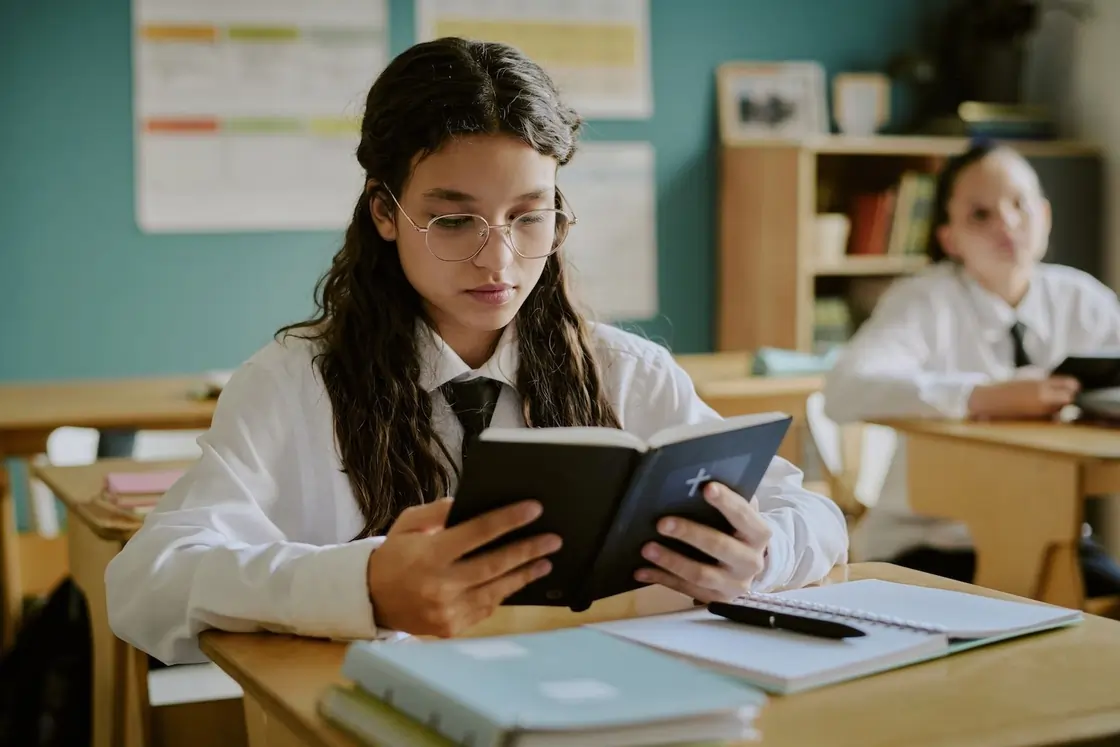
Student with glasses intensely reading Bible in classroom. Setting including open notebooks on desks and another student in background by AnnaStills/stock.adobe.com
What happened: On Friday, the Texas State Board of Education passed a required reading list for public school students that included passages and stories from the Bible alongside other works. While the biblical readings are only a small portion of the list, their inclusion has sparked numerous cries of government overreach, religious indoctrination, and other such charges in the days since.
Why it matters: The Board’s stated purpose for including excerpts from the Bible is far different from the motivations presumed by many in the media, and where the truth falls along the spectrum between those points will play a large role in whether the list proves more beneficial than divisive. Moreover, while the required reading is the first of its kind, some warn that other states could look to pass something similar in the near future.
The backstory: The Bible’s return to the classroom
On Friday, the Texas State Board of Education made national headlines after passing a new required reading list that will take effect for the 2030-2031 school year. In the days since, most of the reports have focused on the inclusion of Bible passages on the list, often portraying the required reading as an attempt to circumvent religious freedom and indoctrinate students with Christianity.
And, to an extent, that conclusion is understandable. After all, just last year, Texas passed another law last year requiring the Ten Commandments to be publicly displayed in every classroom, so including the Bible on the list of required reading is not the state’s first foray into blurring the lines between faith and education.
But are those criticisms correct? And how should Christians view the list and its implications?
To answer those questions, let’s start by looking at what the law actually says.
Why the list is unique
To begin, what sets the Board of Education’s list apart from the approach taken by other states has less to do with the Bible than with the requirement of specific books in general. As Antonio Garcia, the president of the National Council of Teachers of English, notes, reading lists are usually chosen at the district and school level rather than coming down from the state. And while many of the same classics are still shared by schools, the most novel part of the law is that those decisions are being made by people outside the schools where they will actually be implemented.
As for the content of the list, stories from the Bible will reside alongside works from Shel Silverstein, Aesop, Mark Twain, Elie Wiesel, George Orwell, William Shakespeare, and a host of others. In short, while the Old and New Testaments are represented on the list, it’s not like every day will start and end with Scripture. Rather, the law simply recognizes the word of God as one of many works that have been foundational to the development of Western culture and, more specifically, of the United States.
Nicole Russell put it well in her article for USA Today:
It’s almost impossible to understand our nation’s beginnings ‒ let alone religion, philosophy, politics, art, or literature ‒ without understanding the Bible. It has shaped human history in unfathomable ways.
And many of these stories were actively taught in public schools until the 1960’s. That absence of the Bible in classrooms is, perhaps, part of why recent generations have found it easier to overlook Christianity’s impact on Western culture.
Still, putting the Bible back in schools is not the answer to all of our nation’s woes. Fortunately, it seems like the Education Board—at least in most of their stated goals—understands that. The question many are raising, however, is whether those stated goals are their real ones.
Why choose the Bible?
One of the primary critiques leveled at the new legislation is that Texas’s 5.5 million public school students represent a far wider ideological spectrum than the new curriculum. As such, some have claimed that it’s not fair to the students of other faiths or no faiths to have to learn about stories from the Bible.
And, to an extent, that’s fair. I wouldn’t be a big fan of my kids having to read passages from the Qur’an or the Book of Mormon in their classrooms (at least not at a younger age). However, that criticism only really holds up if these texts were being included to teach religion.
While the line between teaching stories from the Bible as literature rather than truth can get pretty thin, Russell was correct that at least a basic awareness of these stories is fundamental to truly understanding Western culture. The same cannot be said—at least not to anywhere near the same extent—for the religious texts of Islam, Mormonism, Hinduism, or any other religion.
If these other texts were included alongside the Bible, then it would be far more difficult to separate the spiritual from the historical. Maintaining that separation will be essential, though, and my greatest hesitation with the new law has less to do with the required readings than how many will be tempted to use them.
Blurring the lines between church and state has seldom worked out well for the church. And if parents—or Christians, more generally—ever begin to think that teaching a few Bible stories and basics of Christian theology gets them off the hook for sharing the gospel themselves, both the nation and the church will be far worse off as a result.
Spiritual application: It’s still your job
As Dr. Jim Denison pointed out in this morning’s Daily Article, roughly half of the people in America who identify as Christians don’t seem all that concerned with seeing their fellow Americans find salvation in Christ. Given that one of the final commands Jesus left his followers before ascending to heaven was to make disciples of all nations, and to start with their own backyard, that’s a problem (Matthew 28:19–20, Acts 1:8).
That so many fail to see the importance of sharing our faith with others shouldn’t come as a surprise, though. It can be uncomfortable, intimidating, and even a bit dangerous, so attempting to minimize the importance of something we’d rather not do is a natural, human response. That doesn’t make it the right response, though.
Fortunately, I think God knew this would be hard for many of us. That’s a big part of why he calls us to start with our families (Deuteronomy 6:7).
If you’re a parent, grandparent, or even just a neighbor to a family with kids, God has given you the opportunity to practice sharing his truth with the next generation. Far too often, though, we outsource that discipleship to the church and, if we’re not careful, the same will be true of the schools.
People aren’t saved because they can recite the beatitudes or know the story of Noah’s ark. It can help, and we should be grateful for any additional opportunities these changes could provide to share the full gospel. But, at the end of the day, it’ll still be on each of us to do our part.
That’s been our privilege and our responsibility for nearly two thousand years. And, until Christ returns, that’s not going to change.
News worth knowing
1. Death toll from Europe’s heat wave continues to spike
Temperature records across Europe continue to break, with more than 1,300 excess deaths recorded over the last couple of weeks. Sunday was Germany’s hottest day on record, coming in at 41.7 °C (or, roughly 107 °F). It was the third time in as many days that a new high was set.
Why it matters
While such loss of life is tragic in any circumstance, this situation feels particularly so given that it is (at least in part) self-inflicted. As Maarten Boudry points out in his excellent Substack article on the subject, Europe suffers the most heat-related deaths per capita of any continent, and the primary reason is that it has rejected air conditioning. The article is worth reading in its entirety to understand how the continent came to the conclusion that AC was unnecessary, but the story offers an excellent reminder of how dangerous it can be when we allow our pride and biases to drive our decisions; a problem that is hardly unique to Europe, even if their rejection of AC largely is.
What to watch
When the heat wave passes, and the citizens of Europe are left to reflect on it, will anything change? The weather next Summer is unlikely to improve, but their ability to handle it could.
2. Supreme Court rules that mail-in ballots don’t need to be received by Election Day
In an outcome that surprised many, the Supreme Court ruled 5–4 in favor of a Mississippi law allowing election officials to count ballots postmarked by Election Day but received after the polls close. Justice Amy Coney Barrett wrote the majority decision, stating that “while federal law dictates when ballots must be cast, state law dictates when they must be received.”
Why it matters
After oral arguments, most who follow the Court expected the law would be struck down. That outcome was favored by President Trump, who was quick to voice his displeasure with the decision. Still, the legal arguments from Barrett and the majority make sense, and it’s another example of how the Supreme Court is not nearly as ideologically captured as they are frequently portrayed in the news.
What to watch
At the end of the day, the Court’s job is to judge laws rather than make laws. Will the spate of decisions that place the onus on Congress to do more of the latter lead to any changes in the Legislature? Will more states take advantage of this Court’s willingness to recognize their authority and pass their own laws to address some of these concerns?
The Tangle has more on the story
3. New blood test can detect 90 percent of aggressive prostate cancer
In clinical trials for Stockholm3, the new blood test detected 90 percent of high-risk prostate cancer cases. The current PSA tests caught 74 percent of cases, while also proving less accurate in their diagnoses and requiring more follow-ups than the new test.
Why it matters
If aggressive prostate cancer is detected before it spreads beyond the prostate, the five-year survival rate is close to 100 percent. However, most cases are not detected until they have reached stage four or beyond, at which point the survival rate drops to 3.2 percent. As such, anything that can help detect cancer sooner could have enormous benefits.
What to watch
The company behind Stockholm3 plans to seek FDA approval soon. If it’s approved, how quickly can it be integrated into routine checkups?
God is good
The death toll following last Wednesday’s earthquakes in Venezuela has risen to more than 1,400, with 50,000 more still missing. Conditions were poor for many in the country before the earthquakes, and the Red Cross estimates that 300,000 people need immediate assistance. And while local churches have stepped up to help as many as they can, they have often suffered and need help as well. As a result, some of their most impactful work has come from partnering with outside ministries to help direct and distribute aid from around the world.
Kingdom impact
As Rafael Ramírez, the pastor of Iglesia Bautista La Espada in the city of Maiquetía, told his congregation on Sunday, “The earth shook and destroyed what we thought was secure. The Bible does not say the earth will not tremble; it says that when it does, he will be our help. The earth he created is also awaiting its redemption.” But while the earth waits, God’s people have been a pivotal part of bringing just a bit of that redemption to their communities.
Prayer point
Will you pray that Pastor Ramírez and others continue to receive the help they need? Will you pray that God redeems this destruction in ways that only he can? And will you pray that the Lord will also be with those who are still missing and help those who have lost loved ones to find their help in him?
Christianity Today has more on the story







 Search