


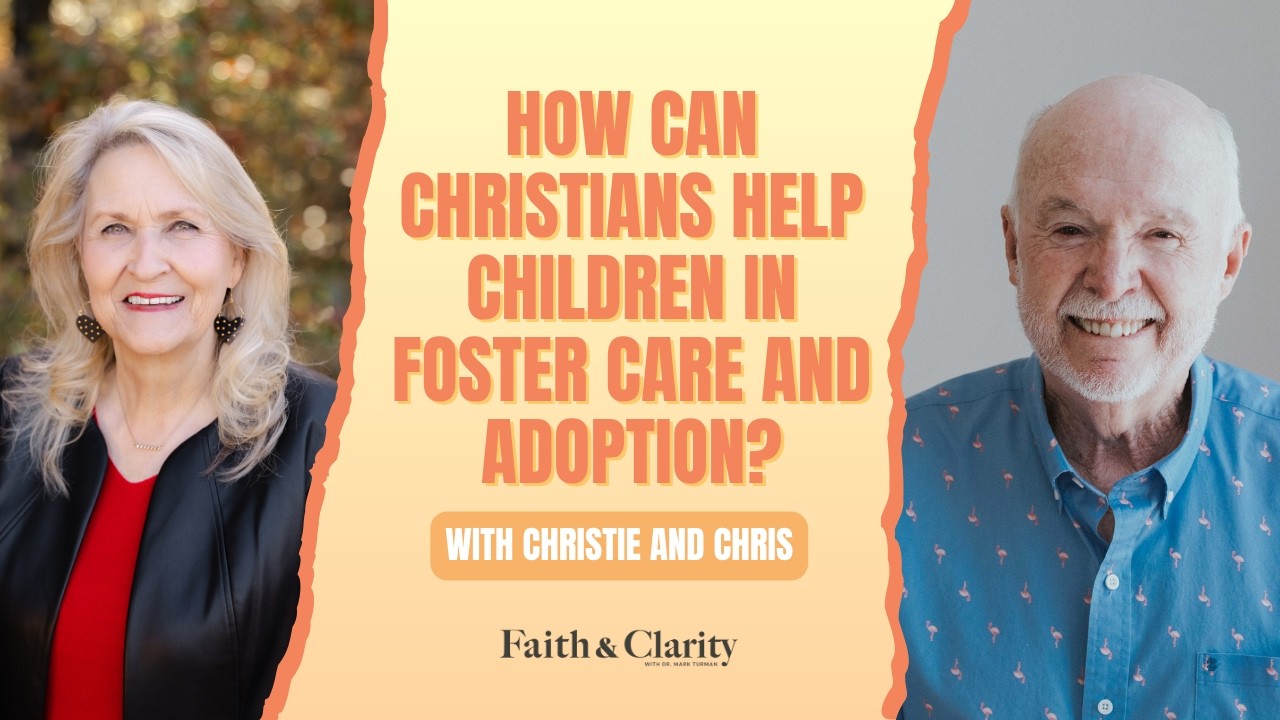
In this episode of Faith & Clarity, Dr. Mark Turman is joined by Chris Elkins and Christie Erwin, founder of Project Zero, for a powerful conversation about foster care, adoption, and the role of the church.
Christie shares how her years of fostering shaped a calling to serve vulnerable children and advocate for those still waiting for families. Together, they explore common misconceptions about foster care, the realities children face, and how churches can partner with the system through practical support and compassionate involvement.
The conversation also highlights the impact of Project Zero’s work, from storytelling to community engagement, and offers a hopeful vision for how believers can help ensure every child has a place to belong.



Topics
(0:00) Introduction
(3:14) Project Zero origins
(9:13) Fostering lessons and adoption
(18:11) System challenges and church role
(23:20) Scope of the need
(25:06) Reunification versus adoption
(31:52) Hope building and community support
(33:26) Awkwardness of adoption
(37:33) Churches can step up
(53:11) How to get involved
(55:03) Conclusion
Resources
- Project Zero
- Ask Us Anything: [email protected]
- Sign-up for a Denison Forum newsletter: DenisonForum.org/subscribe
About Chris Elkins
Chris Elkins narrates The Daily Article podcast that brings Dr. Jim Denison’s and Dr. Ryan Denison’s biblical insight on current events to a daily listening audience. In addition to his work in broadcasting and production, Chris serves as special assistant to Jim Denison and contributes articles to denisonforum.org
About Christie Erwin
Christie Erwin is the founder and Executive Director of Project Zero, an organization dedicated to finding forever families for waiting foster children. Her deep passion for children in foster care stems from her personal experience; she and her husband, Jeff, fostered over fifty children during twenty years, and their family includes six children, two of whom are adopted. Christie is the author of the book The Middle Mom and has been recognized as a 2009 “Angel in Adoption” award winner and represented Arkansas as the American Mother of the Year in 2016.
About Dr. Mark Turman
Dr. Mark Turman serves as the Executive Director of Denison Forum, where he leads with a passion for equipping believers to navigate today’s complex culture with biblical truth. He is best known as the host of the Faith & Clarity podcast and the lead pastor of the Possum Kingdom Lake Chapel, the in-person congregation of Denison Ministries.
Dr. Turman is the coauthor of Sacred Sexuality: Reclaiming God’s Design and Who Am I? What the Bible Says About Identity and Why it Matters. He earned his undergraduate degree from Howard Payne University in Brownwood, Texas, and received his Master of Divinity degree from Southwestern Baptist Theological Seminary in Fort Worth. He later completed his Doctor of Ministry degree at George W. Truett Theological Seminary at Baylor University in Waco.
Before joining Denison Forum, Mark served as a pastor for thirty-five years, including twenty-five years as the founding pastor of Crosspoint Church in McKinney, Texas. Mark and his high school sweetheart, Judi, married in 1986. They are proud parents of two adult children and grandparents to three grandchildren.
About Denison Forum
Denison Forum exists to thoughtfully engage the issues of our day from a biblical perspective, helping believers discern today’s news and culture through the lens of faith. Led by Dr. Jim Denison and a team of contributing writers, we offer trusted insight through The Daily Article, a daily email newsletter and podcast, along with articles, podcasts, interviews, books, and other resources. Together, these form a growing ecosystem of Christ-centered content that equips readers to respond to current events not with fear or partisanship, but with clarity, conviction, and hope. To learn more visit DenisonForum.org.
EPISODE TRANSCRIPT
NOTE: This transcript was AI-generated and has not been fully edited.
Mark Turman: [00:00:03] From the Denison Forum, this is Faith and Clarity. I'm Mark Turman, your host. We want to help equip you to live by faith, not fear. And we do that by helping you to think biblically, to live faithfully, to serve intentionally, to cultivate flourishing everywhere that God gives you the opportunity. So this week, we're going to talk about a very important topic. We're going to talk about what God is doing to redeem the foster care system in places like Arkansas, Texas, and maybe even all across the nation. So we're going to jump right in. My friends joining me today, first of all, uh, is Chris Elkins. Some of you may recognize Chris's name from the Daily Article podcast that we host at Denison Forum where, uh, Chris is the narrator of Dr. Jim Denison, Dr. Ryan Denison's weekly insights on the Daily Article. If you're part of that listening audience, you know his voice well. If not, if you're a reader of the Daily Article and you'd rather get it in audio form, you can get that at the Daily Article podcast. In addition to being a broadcaster and a production person with us, Chris also serves as special assistant to Dr. Denison as chief visionary officer, and from time to time, he also writes articles for Denisonforum.org. Uh, Chris is also the one to be credited or blamed, depending on your perspective, for me being on the staff of Denison Forum. So, Chris, welcome to the podcast. We're glad you're here.
Chris Elkins: [01:31] Thanks, Mark. I'm glad to be here. It's been a delight to work with you here over these years and uh, I've known Christie for 40 years, so, so this is like old home week.
Mark Turman: [01:41] Well, we're going to have a good time and and many of you may decide by the end of this podcast that Chris is to blame rather than to credit for my presence here. We are also joined today by Christie Erwin. Christie is the founder and executive director of a ministry called Project Zero, an organization dedicated to finding forever families for kids waiting uh in the foster care system in Arkansas, but we're going to have a even broader conversation to that. Her deep passion for children in foster care stems from her own personal experience. She and her husband, Jeff, have fostered, get this, over 50 children across 20 years, which just blows me away right there. Um, her own family includes six children, two of which she and Jeff have adopted. She's also the author of a book called The Middle Mom and has been recognized as the 2009 Angel in Adoption award winner by the state of Arkansas and also the American Mother of the Year in 2016. That's a pretty interesting title. Christie, we are glad to have you and honored to have you as a part of our conversation today. Glad you're here.
Christie Erwin: [02:52] Well, thank you so much. I am, I'm honored to be here. It's it's a blessing to get to be with Chris again after all these many, many years and uh it's always an honor to get to talk about waiting kids.
Mark Turman: [03:06] Well, let's just, well, thank you for that. It is great to have you with us. We look forward to learning a lot. So let's just jump right in. What in the world is Project Zero at ground level? Where did it come from? How long has it been around? Give us at least a little bit of the front story of Project Zero.
Christie Erwin: [03:25] Well, Project Zero was formed almost 15 years ago. Um, it's a nonprofit with one goal, and that is to have zero kids in foster care waiting to be adopted. Um, that sprung out of another organization that I was a part of and it came from actually a sermon uh that Jeff and I heard when we were at a foster care and adoption conference that the pastor said, you know, if believers were doing what God called us to do, there would be zero kids in foster care waiting to be adopted. And I got home and I just couldn't shake that to make a long story short and I wrestled with that. And so actually it was Jeff, he doesn't get enough credit for the name Project Zero, but he said, why don't, why don't you do, you know, start something and call it Project Zero. And so that's exactly what we did. And we wanted to be sure that we knew exactly what we were trying to do. We knew we wanted there to be zero kids waiting because that was the right thing, uh but how were we going to do that? And so we launched into raising awareness and we can talk more about that and building hope in kids while they wait, uh because as a long time foster uh parent, I realized that kids lose hope when they linger in foster care waiting to be adopted. And so that's not okay. Um, and then the last thing is to work closely with Arkansas DCFS to help uh connect kids with the right forever families.
Mark Turman: [04:53] Yeah. And you know, I think all of us would agree, right? That that the pastor had it right when he said that that's a unique calling that we should hear and that we we should receive. Um, and we can be frustrated at times by the foster care system. Um, but there are a lot of dedicated believers trying to work in that space and trying to take care of these children. Uh, now Chris, uh Christie, Chris has shared with me, I'm going to get confused through this podcast about calling you Chris and Christie, okay? Um, this is going to be a little bit of a challenge. But tell us a little bit more about your own personal faith story and how your own story and the story that you and Jeff have taken as husband and wife, uh, how has that been something that God has used to stir this sense of mission and ministry to children?
Christie Erwin: [05:41] Um, that's a great question and and it's really it's it's really interesting. Um, 33 years ago, which just seems absolutely impossible, I had a one-year-old daughter and I was rocking her just on a winter day and my two boys who never slept at the same time were sound asleep. And as I was rocking Cora, I just began to think about her and think about how blessed I was to be sitting there rocking her and how many kids didn't have that opportunity. And um, the Lord just gave me the words to the song and I just I just sang it to her and and then I just felt him say, not audibly, but as close to audible as I've ever heard and and it was this really, um, you know, the world has had enough slow life chatter. They've seen enough bickering and marching and and judgment and criticism and what they need to see from you is action. And so that was just the message and so when Jeff got home, I sang him that song. I think he thought, oh, my wife has been with three small children too long. What's happening? And um, so we began to pray about what that looked like. And we actually lived in another city, um, outside of Little Rock and we were moving back to Little Rock. And so I really thought it would be birth mothers, um, because we had three preschoolers. Uh, but that was not God's will and it was a long journey, but we began fostering newborns for a private nonprofit Christian adoption agency. And over the course of these last 33 years, the calling on my life has morphed, um, has evolved, has changed. It's gone from, um, just that that that rocking chair and that beginning, um, to a deep passion for helping people see the need. Um, I I it has gone from foster care to adoption, to advocacy, um, to to a love for the kids that I know that are waiting. Um, and I think, you know, it's it's helped me to see that God can take a housewife with a sociology degree who's ill equipped and unprepared and unqualified, um, who simply says yes to without knowing what that yes is going to mean. And he has uh, he has shown me that over and over again over these last years.
Mark Turman: [08:15] Yeah. That's awesome.
Chris Elkins: [08:16] Chris, you had a thought? You know, um, I served on uh church staff with uh Christie's father and and mother, she might as well have been on staff. Um, there was a rich atmosphere in that church of adoption. I adopted a child while we were there. And and it's it's interesting that among the three of us, we've all been impacted. Mark now has an adopted grandchild. And so, so there is something about the atmosphere of it being an acceptable and wonderful and God-called thing to be to be, you know, to even enter into this process. So, so I, you know, just the the church and and and then particularly Christie's parents were remarkable people.
Christie Erwin: [09:00] Thank you.
Mark Turman: [09:01] Yeah, and it's it's uh something that I'm new to. So I have a grandson that is about 20 months uh old at this point and um, so it's it's been a journey for us as well. Uh, Christie, I'm just wondering, I have a bunch of questions about uh, just your own fostering experience. So you said you started out with fostering babies, infants. Um, tell us a little bit more, uh, you know, 50 children over 20 years. I I get some sense that maybe they weren't all infants and that you've had some different experiences. Uh, and let me just kind of uh, uh, build a context here for our audience and just remind all of us that the very essence of what we claim as Christians is that we are all adopted. We are adopted children into the family of God by the grace of God. And so we can all resonate with this story at some level. Um, because we are all adopted in that way. My mother was adopted uh as the only child of my grandparents. She went on to have eight children of her own. Uh her seventh child is her best child, but we won't get into that. But Chris, Christie, tell us a little bit about how going from adopting infants to maybe some older children and ultimately, tell us a little bit about how you got prompted to move to the stage of adoption.
Christie Erwin: [10:22] Yeah. Um, yes. Well, um, it's really interesting because, um, when we were fostering, we actually fostered through Bethany Christian Services, which was a private nonprofit Christian adoption agency. And the very first baby we had, the Lord taught me so many lessons because I absolutely fell in love with him. And he already had a family. We were just that little bridge. Um, and so when we took him to meet his parents and I went home and I literally was just grief stricken after 10 days, even though he was in a phenomenal Christian home, it was a wonderful situation. And the Lord just kind of whispered over me, you know, doing my work is not always going to be fun and games. And I I love for people to be happy. I love I I mean, DCFS in Arkansas teases me because I don't say no because I just want people to feel loved and blessed and be happy. But it was like, you know, doing my work is not going to be fun and games and it's going to cost you something. And in this case, it's costing you grief. And that that is your sacrifice. And a friend of mine said, uh, talked about a story in the Bible where, um, Ornan offered David this this sacrifice for him to make to the Lord. And David said, no, I won't offer the Lord something that cost me nothing. And that just resonated with me. And so over the course of time, even though it was hard every time and there were times when it was harder than other times, um, that initial 11 years at Bethany, we call it the country club of foster care because when we made the move to the state, we lost our country club membership and everything uh was a whole different, you know, had a whole different tone because with Bethany, birth moms were were choosing adoption for their children. With the state, birth mothers have had their children taken from them. And there is nothing good about watching in a courtroom when a mother loses her rights to her children. There is nothing redeeming in that. There is nothing that needs to be celebrated in that. It is devastating. And so when we made that move, I had other lessons to learn, many other lessons and uh we didn't think we would adopt. We thought our place was in the middle. Um, that we would we're going to be between the birth mother and the adoptive family or them going back to their birth family. And so when the Lord said with our very first first placement, um, with the state of Arkansas, you know, after three years and and two months, you're going to adopt this child. It was a shock. Um, you know, to us. And so, um, it was a very different situation, but I think, you know, it's it's just knowing what God has called you to do and it's it may change over time. And and the thing about it is you mentioned Mark that, you know, the Bible is very specific. We don't need to pray about whether we care for widows and orphans. We don't need to pray about that. God has already told us that is what true religion looks like. So it just means what what is our part to play? Um, I would never ever try to convince someone to adopt or twist an arm or make them feel guilty or any of that because adoption is costly and I don't mean in money. It is costly. It is costly to a child who has lost everything, whether they're a newborn baby who has come out of a womb that they've lost that touch with their mama or whether it's a child that's been through things we can't imagine, they have lost. And so we would want everybody who adopts to know that that's a call on their life and to know what what God has said for them to do because in the times when it gets hard and trauma comes with loss, trauma comes when kids are coming from hard places. And so you can fall back on what God's called you to do in those times. And so I got ahead of myself, but um, I am I'm really passionate about the fact that I think believers just need to pray about what is my part. There's a lot of different things you can do. Um, we would hope many would answer the call to adopt.
Mark Turman: [14:55] Yeah, and and I love what you bring out that there's there are a number of different ways to get involved and we can we can get to some of those here in a little bit. But I wonder, uh, having had so much exposure, so much engagement with uh, foster children and even adopting them, are there two or three or four misconceptions about fostering and about foster kids that you would want people to kind of get out of their minds, some things that you would want to dispel based on your long work in this area?
Christie Erwin: [15:25] Um, absolutely. Um, one of our things with Project Zero is we don't call our kids foster kids. We say they're in foster care through no fault of their own. Uh, we don't want them living with that label, even though they do. They do live with that label. And I think one of the things for me as a young foster mom was the things that people would say that not knowing what to say, but I had someone one time, uh, I had this darling little baby boy on my on my hip and I was getting a gift wrapped out at a store and the lady that was helping me, obviously he was not my child because our skin was different colors and and you know, she started this conversation and basically then at the end said, well, he's so clean and everything. And I I I think I was stunned. I literally could not get out of that store fast enough. And I just began to process how even we as Christians, like a friend of mine had a a woman at church say, he's too cute to be in foster care. And and it's just like, what? What? And and so I think I have spent my um, my time uh, trying to make sure people understand the value of kids who find themselves in foster care. And for us, it's kids who are waiting to be adopted. It it's important for us to walk, Project Zero to walk in humility, in gratitude and do everything we do with excellence. And we do we always do that? Absolutely not. But it's at the top of our list because when we do that, we show a watching world how we value waiting kids. And more than that, we show a watching world how God values waiting kids. And it's if we see them for who they are and for what they could be, if they had the support and the nurture and the unconditional love and the fact that they knew somebody was going to be there and was going to stay with them, that they could be all they were created to be. Is it going to be easy? No, it's not. I've lived it in my own personal life. I've lived it with many, many, many families and kids. It is hard, but that doesn't mean God doesn't want us to do it. As I said earlier, it's going to cost us something. And sometimes it's more than we want to offer. Uh, and other times we can see his hand clearly.
Mark Turman: [18:07] Hmm. Yeah, absolutely.
Chris Elkins: [18:10] Chris, jump in here. Um, Christie, my image of the foster care system is kids are moving around all the time and they and and to various foster care homes. Is is that true? Are they is it like they're only one place for six months and two, I mean, is it is it so it's are they constantly on the move in foster care?
Christie Erwin: [18:31] I think it depends on the situation. Uh, many of them do move often because of behaviors or, you know, um, they might go into an acute setting because of a mental health crisis or something like that. And then on the other hand, I had lunch about two weeks ago with two of our teen brothers who were 16 and 15, longing for a family. They want a Christian family that doesn't drink, doesn't smoke, doesn't cuss. They are delightful young men and we had taken them on a tour of the Arkansas State Police. They've been in the same foster home for 15 months, thriving, doing wonderfully well and just longing for somebody to say yes. And so there are many situations like that where kids are kind of snuggled into a certain foster home and stay there until in in our case, all the kids that we're working with are waiting to be adopted. And so that's our goal. And so until they move to their to their pre-adoptive home, but it definitely is a problem. I mean, the movement is a problem. The lack of stability is a problem.
Chris Elkins: [19:39] Is the foster care system okay or is it broken?
Christie Erwin: [19:45] I would say yes, it is broken in a lot of places, but I also am very careful, um, with the way I talk about that because we partner so closely with DCFS. I have so many amazing friends at DCFS and brothers and sisters in Christ who are fighting this battle relentlessly. Um, and so I would tend to look at it as the church has not done its job. We have not done and and I have a good friend that was in top administration at DCFS and she said it very succinctly, we are not meant to be parents. The state is not meant to parent children. And so I piggy back on that and say, but the church is called to it. We are called to step into the chaos and the mess. And it's hard for us to see and it is very hard for believers to hear the kind of things that kids have been through. We don't we really don't want to know about kids being raped by a parent or kids being uh, you know, starved to death or held in a cage or, you know, not being cared for. Those are the things that our kids have lived through. And yet we as believers are shielding ourselves like there's something sacred about doing that and there's not. God wants us to step off the cliff, get our feet wet in the mess. And it is it is gut wrenching and yet, you know, it is there is nothing more sacred than being a part of God's plan. And you know, I've stood at the bedside about two months ago of a child who tried to commit suicide and we literally prayed with DCFS staff, all of us praying for this teenager who lived and is doing well. I've stood at the bedside of a child who did not live, a two-year-old who died because of child abuse. The church is called and we all have a part to play in that. We all do and it's just it's just finding out what your personal part is and then stepping off one faith step at a time. You don't have to see the picture. If I had seen my picture, I would have been scared to death. I would have thought, no, that's not, you know, I'm not equipped for that. That's you've got the wrong person. I would have been a Moses. You know, I can't do that. And yet our kids deserve nothing less than that.
Mark Turman: [22:34] Yeah. And hopefully, hopefully, you know, part of what this podcast will do will prompt people to become more prayerful and more more open. It sounds like a it just sounds like as you talk about it, Christie, like uh it just makes me think of missionaries praying about God's call to go into a far away land, to a far away country, to a culture they don't know. Um, that the sense of calling and the sense of commitment and the sense of, you know what? I I should not think of this as being easy but being sacred. And sacred things are are beautiful things, but that doesn't mean they're always easy things. Um, but it also doesn't mean that it's always a grind. There are beautiful moments and beautiful experiences that happen as well. But uh, before we take a break, can you give us some sense of just what the magnitude of this is, number of kids in foster care or are in foster care awaiting adoption in Arkansas, larger than that across the US if you have those numbers, but what's the the magnitude of the problem and the opportunity that you're working with on a daily basis?
Christie Erwin: [23:42] Well, in in the country, there's about 400,000 kids that are in foster care. Now, of that 400,000, around 100,000 have had parental rights terminated and are waiting to be adopted. Um, in our state, and I actually got the numbers this morning, as of the end of March, we had 3,417 kids in foster care. And our latest, we don't have the first quarter numbers, but at the end of December, we had 146 kids who um, were waiting to be adopted. And, uh, which we're not at zero, we're a ways from that, but when we started, we were between 6 and 700 kids waiting to be adopted. And so we give glory to the Lord for literally setting the lonely in families and for having the opportunity um, to be a part of that.
Mark Turman: [24:35] Absolutely. All right. Well, we're going to take a break for a minute or two and let everybody catch their breath and then we're going to come back and talk about some of the some of the great creative solutions that Project Zero is working on in this area. We'll be right back.
Mark Turman: [26:29] All right, we're back talking with Christie Erwin about Project Zero and what God's doing to redeem the foster care system in Arkansas and across the country. Chris, you had a question for Christie you wanted to ask?
Chris Elkins: [26:40] Yes, Christie, as you were just speaking, I never thought that there are different kinds of foster kids. It was always my assumption they were all adoptable that they but but some of them still have biological parents who could there could be some reunification.
Christie Erwin: [26:59] Absolutely. In fact, um, the goal of foster care is to is to just stand in the gap so that kids can go back home. And so the state, the government is working to give parents that opportunity, you know, if it's drugs to get in rehabilitation, if it's lack of housing, to find appropriate housing, if it's employment, to find that and give them a certain amount of time to do that because kids deserve to be with their families of origin. They deserve um, to be happy and safe and healthy in that family. And so the state wants to give them that opportunity. But when that is not an option, then parental rights end up being terminated. And those are the kids we're talking about through Project Zero. Those are the kids I mentioned uh earlier about the 100,000 around 100,000 in the United States who are waiting to be adopted. Um, so there's a significant difference in the number of kids in care versus the number of kids waiting to be adopted.
Mark Turman: [28:00] Yeah, it's a really helpful insight to realize that sometimes these families are just so so much under stress that that they need some people to come around them, church people, they need the church, but uh, often times I would suspect these families are not anchored in the church well. Um, and one of the things we can thank God for is that the the government does have a foster care system that uh, though not perfect, obviously is providing some type of net and and safety net to try to help these children and these families, but uh, I I it just think it's an amazing thing to say, you know, hey, I don't know that I am ever supposed to adopt a child, but maybe I'm here to minister to a child and its family to be a a bridge and like you said, stand in the gap for a few weeks or a few months, maybe a few years, uh, to let this family be able to breathe, let them be able to get their feet under them again, uh, and and set up a set up the kind of household they want to have but maybe have just not been able to have for a lot of reasons. Uh, and so there's a lot of different ways to step into this uh, as people think about it and as they uh, and as they try to listen to what God's direction might be. Uh, Christie, you're, uh, your ministry and Project Zero is trying to create all kinds of innovative ways to, uh, match especially these children that are waiting to be adopted. Um, tell us about some of the things that y'all are doing. You do adoption events, uh, you do kind of an introductory type of an event so people become aware. Tell us some about that.
Christie Erwin: [29:48] Well, you know, one of the things that I noticed when we we first got started was, honestly, we didn't really know what kids were available. I mean, there was a heart gallery, we had a heart gallery, the state had a heart gallery and because of the Lord's provision, we were able to just navigate this partnership, uh, where we ended up taking that responsibility for the state. We, um, we decided that we wanted to help in that way. We didn't go to them saying, hey, we know how to do this better. We know how to find families for waiting kids. We went to them and said, we want to help you. How can we help? And so we started the heart gallery, which heart galleries are all over the country. That's nothing, nothing original to Project Zero. It's professional photographs of waiting kids. Now, what is, what is important to us is that we believe that they ought to be the best photographs and that kids ought to be able to feel their best, look their best, and just like if I was taking my crew to get their their family photo made or their, you want them to feel good about themselves. So we do all kinds of things. We buy clothes, we have a hairdresser at our photo shoots and, um, and then we use professional photographers who are incredible. Many of them have been with us for since we began 14 years ago. And so, or 15 years ago. So, taking photos and then about 12 years ago, we thought, okay, if hearing the number of waiting kids, um, kind of stirs you, if seeing their photo compels you to do something, what would it mean if you got to hear from them? So we went to the state and we said, we want to start shooting short films and allow waiting kids to tell their stories. And we started working with a filmmaker named Nathan Willis, who lived in New Orleans, used to live in Little Rock. Um, he's shot over 1100 short films over the course of those 12 years with us. And it gives kids an opportunity to share their own stories, to share their own truths in their own words, in their own way, uh, to tell what they want in an adoptive family. What are their likes? What, you know, what are they longing for? What are their hopes and dreams? Some of those are are funny and and light and some of them will rip your heart out and cause you to stand back and say, friends, what are we doing? You know, and I and I say every time we do, we call it a short film blitz and we had one two or three weeks ago and every time I say, if every believer could sit in on one interview, there would be no kids waiting to be adopted. Because hearing a child just say the simple things like, I just want a family that sits on the couch and eats popcorn and throws popcorn at each other. Or I want a family that travels or that just will will help support me in in the things that I want to do. We had a boy several a couple years ago that just said, I want to know someone's in the bleachers for me when I'm playing football. And when we heard that, we actually put it out on our social media. We all went to his game. We traveled to his game. We had a big sign that someone from another state had made and sent and these kids deserve to have their hopes and dreams. And so we started doing that. So raising awareness, we do a lot of storytelling. We believe in the power of a story. And just last night, I got a text from an adoption specialist that said, I need some hope building. One of my girls is struggling. She doesn't believe anybody cares. And I I simply put her heart gallery photo out there with um, asking people if they wanted to send cards and gift cards and gifts to her. And it blew up and people have been asking me questions all ever since then, it hadn't been 12 hours and they want to know, you know, her favorite color, her favorite place to eat. So, build, you know, that's our next thing is building hope in waiting kids and we do that a lot of ways, helping them to, um, you know, maybe it's buy a violin for somebody that's longing to play the violin. Maybe it's taking them to lunch, all of all kinds of different things. We're we're open, we think outside the box and and everybody has kind of gotten used to me saying, I have an idea. And they're like, oh dear, she has an idea. Uh, but I believe in thinking outside the box. I think our kids deserve us to think outside the box and to have vision, uh, as Mark Batterson says, vision beyond our resources because our kids deserve that. And then the last thing is to help connect them with the right forever families. And that's where our events come in. We host about every month we host a what we call a connection event for waiting kids and then for uh people in our state who have completed the adoption certification process. And so they're not open to the public, these events, they're very controlled. Um, and in the middle of whatever we're doing, families are born. And you know, we we get some criticism for these events because they are awkward. And there is a sense of, um, we never ever want to be disrespectful or or allow it to look like someone's shopping for a child ever. Um, and so we will host a zoom before our events to talk to waiting families and just share with them what to expect and to let them know, these events are awkward and we want you to know that. But we also want you to know that they're awkward because adoption and foster care shouldn't be a thing, but it is. And our kids are longing for home. And many of them are asking us, when's our next event? When are there waiting families at this event? You know, all this kind of kind of things. And so we have seen over the course of these years of hosting our big Disney extravaganza in June where we have 400 volunteers and 70 Disney themed booths where churches and businesses and individuals come in and just bring Disney World to Little Rock to our Candyland Christmas event where we put out the Christmas list written by every waiting child across the nation. I mean, we put it out to the nation and people buy gifts and mail them to Arkansas because they want to be a part of that. And then being able to see families born in the middle of those wild events is just a beautiful thing. And so we're always thinking, always preparing, always looking, um, for what can we do? Uh, and as we get closer to zero, we're having to tweak some of our things and and leave things out because we might not have kids in that uh age range and that kind of thing. So
Mark Turman: [36:47] Yeah. Well, I appreciate, there's a lot I could say, but that's that's a nutshell. Yeah, and I and I appreciate you calling out the awkwardness of it. Um, because as as a new uh grandfather of an adopted child, kind of walking with my uh daughter and her husband through this journey, uh, and talking with them through the awkward moments. Um, the the awkward moments of waiting of making themselves available for adoption and then waiting uh a long number of months, almost to the point where we kind of forgot that we uh or they forgot that they were uh making themselves available and then it just happens out of the blue. And that was both exciting and kind of terrifying all at the same time. Um, but then just acknowledging that this is awkward. Um, my daughter and son-in-law were in a process where they were presented to a birth mom who was putting her child up for adoption, but they were one of three families that were presented to her and that's kind of that that kind of awkward shopping thing in on the other side of it, right? Um, and it's like it's strange that I'm being presented to this birth mom for this incredibly, you know, hard decision. And nobody would want to call this a competition. No. And then and then when she made her decision, that meeting, that first time to meet her and the first time to meet uh her baby that she is choosing to to place for adoption. There's just it's hard. There's no rule book for that, right? There's no guide book for that in any there's not covered in the Bible in, you know, Mark chapter 26, which by the way, there's no Mark chapter 26, okay? Thank you. Thank you for clarifying that. Yeah. Chris, Chris, you had something you wanted to say in this context.
Chris Elkins: [38:44] I saw that post last night uh of the teenage girl that was losing hope because she'd been in the system for so long. I I've been following and I've also seen the celebrations that come when when when you know, we're one less. I like the one less thing that you do. We're one less now. Or sometimes it's three less when siblings get adopted. Uh things like that. But what I wanted to ask was are churches stepping up? Is there something churches themselves could do? I mean, we're we're, you know, we I love the idea that people send gift cards or I remember I think it was a cowboy hat or cowboy boots that one one wanted that that was just a fabulous story. But but how can how can a, you know, if pastors are listening to this, how can they lead their church to get involved?
Christie Erwin: [39:33] Well, it's interesting you ask that and I and I love that question because I think it's it's foundationally, it's creating a culture um, in your church that embraces foster care and adoption and foster parents and adopted parents. And several years ago, the church that I go to, I began to pray. This is when we had 500 waiting kids. And I don't know, I just kind of began to pray that our church would adopt 10% of the waiting kids in our state. And I don't that was just some random number that I, you know, random percentage. And just I didn't pray it every day. I probably didn't even pray it every week, but just would breathe a prayer. Lord, let the summit church adopt 10% of the waiting kids. And so, fast forward, probably 10 years, maybe longer than that, the number of waiting, I mean of kids that have been adopted, not all from foster care, some were international, some were, um, domestic adoptions, um, was at 70. And so it and and we like in our church right now, our pastor has two adopted daughters. One of our staff members has an adopted teenage son. There is a culture of adoption within our body. It is not unusual to see that. And so not only are there adoptive and foster families, but there are people who come alongside and do respit care, who babysit, who help provide meals, who uh if there's a need of some sort will step into that. Um, and so, you know, I would challenge pastors to just pray about what is our place? What is our particular body's place in this? What can we do? Could we stock DHS's visitation room with snacks? You know, I just did that, uh Project Zero just did that for one of our local uh DHS offices that needed hope building snacks and we're like, sure. So churches can do that. You know, are there are there other ways we can step in to, could we host a night, you know, where families, you know, foster and adopted families can, you know, go out to dinner and our nursery staff that's security checked and fingerprinted and all that could help take care of the kids. There's just, you know, think outside the box, but think about what is our culture, but ultimately, I would say challenge your people to pray about whether adoption is that. You know, and and um, because for many people sitting in the pew or the chair, um, they've thought about adoption for years, many of them. And they just have not had the either the means, the ability or the courage to step into that. But when you hear it from the pulpit and you know, it it changes things. And we do a lot of things where we take our heart gallery exhibit to churches. So you can walk in and you can see the faces of the kids that are actually waiting in your state. Um, we had a story a few years ago of a couple, they had a one-year-old son, they walked into their church where her dad happened to be the pastor and they looked into the face of a little boy. It was not our best heart gallery photo. It was taken at an institution because he had a lot of medical needs. So there was no place to really make it pop. His clothing, you know, not it was not one of those pictures that you would gravitate to. They walked up to it, they looked him in the face, they said, that is our son. And they came home and she sent a message to me and said, how do we get started in this process? Moved through the process, bought a new home that was wheelchair accessible and to see their Facebook page now with their two sons traveling to Disney World and going to hockey games and doing all these things. This boy would have been living in this medical facility for his life had a family not been found. And that one photo in the church made all the difference in his life. And so I cannot challenge us all, myself included enough to look at what do we need to be doing.
Chris Elkins: [43:39] Christie, what what happens to the kids who age out of the pro age out of the foster system?
Christie Erwin: [43:44] Well, that's a whole different story. Um, and about 20,000 kids a year in the United States age out of foster care without a family. Uh, some of those did not want to be adopted. So some of those adoption wasn't their goal. But whoever they are, if you look at the statistics of what happens to kids who age out of foster care, the percentages, homelessness, addiction, teen pregnancy, sex trafficking, um, lack of education, all of those things skyrocket when kids age out of foster care without a family. Like the story of Will. Yes, like the story of Will. Yeah.
Mark Turman: [44:27] Yeah. Yeah. Will is one example we were talking about before we started recording today. And Chris, thanks for teeing up another podcast conversation. We uh, uh, I have some friends that work in that space of people uh that are aging out of the foster care system and that is a that is an entire calling and opportunity and ministry all unto itself that is desperately needed. You can imagine 20,000 uh young people every year. Um, there is a huge, huge calling and opportunity there. And as and as a pastor, I would just want to say to other pastors and church leaders, Christie to just uh to just tie on to what you were saying. Part of it just starts with becoming aware, becoming informed. Uh of making a few inquiries in your town or in your county and finding out what the situation is, what the magnitude or need or opportunity of ministering is. And I wanted to just Christie ask you to come back for just a moment to some of your comments about helping the Department of Children and Family Services. I had the privilege about a year ago to do a podcast with Governor John Kasich of Ohio. Um, he wrote a book about stories, people doing great godly things in simple ways in places where they live. And he talked about one group of people who said, you know what, we're going to stop griping about the foster care system and they just went down to the Department of Family Services and said, what can we help you with? We want to cheer for you. And they walked in with a spirit of incredible humility and servanthood. Uh, expound on that a little bit and how that works in Project Zero and how important that spirit is of just kind of coming around these people who are doing really hard, heartbreaking work day in and day out in this in this space.
Christie Erwin: [46:22] Oh, I do not know how much I love that because that is that is it. And I I've been there when Christians have walked in to the department and said, you know, we're going to help you and here's what we're going to do. You know, that's not what they need. You know, they don't need the criticism, they don't need the, they know that there are broken things. They know that. They're trying to fix them. You know, but as believers, how much better for us to to just allow the fruit of the spirit to spill out of us onto them by saying what you just said. We're walking in with humility, with servanthood, with the desire to just make a difference for you on your behalf and for kids on their behalf. And so I've known organizations, uh, Christian, you know, churches who have who have redone visitation rooms and provided the paint and the furniture and the toys and the where families come to visit their kids to make it less systemic and less sterile and more homey. Uh, there have been people, churches who have opened the doors of their church to host those visitations so they're really more homey and and, you know, just more comfortable. There's always food. There's always ways to help with snacks, to help with with warm. A church could sponsor a lunch for the staff. You could, you know, go to wherever, Texas Roadhouse or wherever and and buy a spread of food and just say, we're with you, you know. There are also organizations like Care Portal where churches can get involved with meeting tangible needs. We need a baby bed. That message, I don't know all the technology, but that message goes out to the churches that are involved in Care Portal and that baby bed comes immediately, you know, or a washer and dryer or a clothing for a four-year-old. There are so many ways that churches can get involved. Just find your niche, find it and get involved and jump on board and go all in because together, and I think that's the key, everybody doing their part, every piece to the puzzle, every spiritual gift in action can make a difference in the lives of kids. And and going back to what you said about the kids aging out, you know, we're all paying the price for us not stepping in sooner when kids age out. Because incarceration is out the, you know, just through the roof on kiddo who age out without support. And so, um, you know, I just really appreciate that, that aspect of it too that involved in that.
Mark Turman: [49:15] I don't know if I'm going to get the number right, but I think the number was uh that I heard not long ago that 75% of the people that are incarcerated have had some in some encounter with the foster care system earlier in their life. I would believe that number. I would believe it. And and that if we if we could get ahead of this when they're children and help them to have that sense of security and that sense of hope and that sense of protection and provision that we might be able to change that in a grand way. And thank you for calling out another podcast that I had, which is uh the ministry of Care Portal. Uh if you want to know, if you want to know what Care Portal is, you can search that on the Faith and Clarity archive and you can find that conversation. Uh, the number one, just uh continue to work with Care Portal actually, Christie, the number one request uh of families in need through the national ministry of Care Portal are the number one need is a baby bed, a baby crib. Who knew? Um, and you'd be surprised at the number of families who just say, you know what? Yes, I need a better environment for my infant. Would you help me have a quality baby bed or a quality car seat to transport my my child safely, okay? Um, and Care Portal will do that. You can do it by just going to careportal.org or going back to that podcast as well. That's amazing. Yeah. And just I think part of that is in churches, there are businessmen and women. There are businesses. And, you know, there might be a business that makes baby beds that might want to that be their thing. You know, we want to donate 10 baby beds. We want to, you know, we want to donate food or what, you know, whatever. And so I love that. That's, yeah, that's amazing.
Mark Turman: [51:06] Christie, I remember, uh, not I can't remember exactly, maybe two years ago, the movie, uh, Possum Trot. Yes. Um, and that that movie brought a lot of attention to the reality of children, uh, that are being cared for in foster care and those that need to be adopted. I'm just wondering, are you seeing some indications nationally that this passion, this ministry, this movement of we're going to go, we're going to drive to zero and get every child that is being cared for in foster care, we're going to get them what they need either in terms of interim care or in terms of adoption. Uh, you know, we at Denison Forum and on Faith and Clarity, we talk a lot about, uh, is God stirring a new spiritual awakening in America? I'm wondering if we could measure that by how this number goes down. Are you are you seeing hopeful signs like that?
Christie Erwin: [52:05] Yes. I mean, we, you know, we answer all of the inquiries that come in about our kids. And, um, so Anna that is on our staff answers about 10,000 inquiries a year, um, from every state and I think over the last couple of years from 44 foreign countries, she told me a couple weeks ago. So people are seeing and I like what you said earlier, Mark, about about people just aren't aware. And that was one of the things we realized early on that people are aware of kids overseas who need families and they need to be because every child deserves a family. But they're not as aware of about the 100,000 kids in the United States who who are, we don't use the term orphan, but for the Christian community, we understand that term. So who are modern day orphans because legally they don't have parents. And so, um, I think for some people they think zero is a is impossible and improbable and unlikely and never going to happen. But you know, we serve a God of the impossible, the unlikely, the never going to happen. And we like to say, there's a an anonymous quote that says, there are no unwanted children, just unfound families. And we're passionate about finding them. And so we use a little equation. I've got a bracelet on that says 1 + 1 = 0. So one child plus one family and you multiply that by 100,000 times and you get to zero because that's all it takes one at a time. And we have seen the last two years, our longest waiting children be adopted. One of them had been waiting 15 years. They both have incredible special needs. One of them had been waiting 17 years. And we got to see God literally set the lonely in families. And um, and what that does for me, uh, and what I what I pray often like Nehemiah is when Nehemiah finished the wall and they looked at him and they said, surely the good hand of his God was on him. And that's what I pray for us and for our team at Project Zero that they won't look and say, oh, look what Christie did. Oh, look what Project Zero did. But they will see there's so radical stories that they will say, surely the good hand of their God was on them. Um, and you know, zero would be phenomenal and would be, um, would be what we're what we're going for. So.
Mark Turman: [54:35] Yeah. Well, and we'll we will pray that prayer with you as well as the the other prayer of the psalmist that God will establish and and cause the work of your hands to flourish. Um, Christie, tell us uh and tell our audience where they can find out more about Project Zero, uh, where can they get that information?
Christie Erwin: [54:54] Uh, our website is theprojectzero.org. Uh, so that's where our heart gallery is housed and information about what's going on and who we are. Uh, also can follow us on Facebook and Instagram. That's where a lot of the stories are told and where uh the ability for you to get involved no matter what state you're in, uh as far as helping out or sending a note of encouragement to to a certain child or that kind of thing. Um, and then, um, if you have a question about your state, we're happy to help point you in the right direction. You can email us at [email protected] and we will point you where you need to be pointed to, uh, to have adoption happen for you. And I do have to say, Mark, I have an adopted grandson too. And he's five and they are in the process of adopting again. And so, um, it's it's, um, and this is my son who's we call him the bio baby because he's our biological baby. He's 31 and when he was two, he would wash the hair of babies as I bathe them. And he he would be washing their hair and he's he's now a youth pastor and uh, and now is adopting kiddos of his own. So I'm I'm on the grandparent train with you as well.
Mark Turman: [56:12] That's a great ride. It's a great grandparent train. Yeah. Good. Isn't it fun? I like it. I'm Kiki and Jeff is Boomer because he's from Oklahoma. So our house is Camp Kiki Boom Boom. So if you ever get a chance to come down, you can come over to Camp Camp Kiki Boom Boom and hang out and uh where there where there is never a no, it's always yes.
Mark Turman: [56:34] Yeah. That's right. That's right. That's exactly right.
Christie Erwin: [56:37] Christie, I was wondering, um, uh, we'll obviously put your website and the others that you reference in there. Uh, I also wonder, uh, whether it's your book or uh, another book or two or some other type article, uh, that you might recommend. My own daughter, uh, got on to the trail and uh, toward adoption, uh, because her husband picked up a book written by Dr. uh, Russell Moore. And Russell Moore, uh, has talked openly about, uh, his experience and his he and his family and their experience with adoption. And God just kind of reached through that book and took a hold of my son-in-law's heart and then my daughter's heart and that's how we became, uh, are there resources like that? We'll put Dr. Moore's book in the show notes as well. Any other thing like that you would recommend that if people as they feel that God may be drawing their their attention in this way?
Christie Erwin: [57:35] Oh, goodness. That, oh, I should I should have thought about that ahead of time. I a book that I love for foster and adopted parents that I would recommend for everybody to read, um, and people that are involved in in that space regardless of who you are is The Connected Child by Dr. Karen Purvis. Um, she was an amazing, um, PhD at TCU and, um, just I had the privilege of being with her at a couple of conferences and just, um, really talks about the compassionate connection. Uh, I think sometimes as Christians, people go in with maybe not quite the right, uh, mindset for how to discipline, how to parent, how to all of that and it ends up backfiring. And so just being able to, uh, to connect with your adopted child or your child that you're fostering in a compassionate way, the way God intends, um, is is uh, I know my daughter-in-law read it and it was transformational in her life, um, as she was already parenting my grandson. So I would definitely recommend that. Um, I can't think off the top of my head, um, other things, but
Mark Turman: [58:47] Well, thank you. Yeah. Well, thank you for that. We'll include that in the show notes as well. Uh, Christie, thank you for all that you're doing for the kingdom of God and for the children. Chris, thank you for connecting us to Christie and for putting us into this conversation. We'll pray that God uses it, sends it far and wide. And uh, we hope to have you back to have some more insight into this mission and ministry. We are grateful to have you. Grateful for our audience. Thank you for listening. If this has been helpful to you, please rate, review our podcast on your platform. Share this with others who may be uh sensing God's direction to help in the in these children's lives and to help them to have the kind of lives that God dreams for them. And we will see you next time on Faith and Clarity.






 Search