



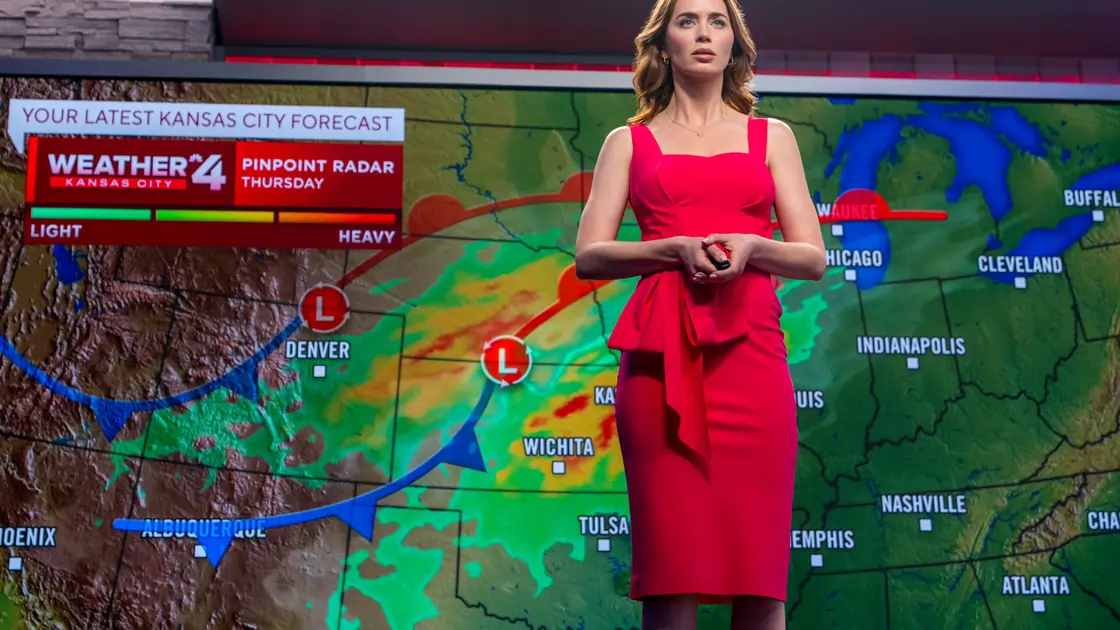
Emily Blunt in DISCLOSURE DAY, directed by Steven Spielberg
Steven Spielberg’s latest movie Disclosure Day (2026) proposes a scenario that would impact how humans perceived of themself in this world. The film explores how the world would react to the release of previously undisclosed information on the existence of extraterrestrial life, something known by a U.S. government-adjacent group for 80 years.
Disclosure Day doesn’t leave religion out of the discussion.
Comments to the press before the movie’s release by Spielberg raised some eyebrows in the Christian community with suggestions that the revelation of alien life would be a major blow to people’s faith.
In an interview with CBS, Spielberg said:
“If this truth were just known overnight, if the government announced, ‘Yes, we have been keeping this from you since 1947,’ that would mess up a lot of people. And the movie also takes the position of the church. What does this do to the fundamental beliefs that many of us have? And um, you know, is God, our God only on this planet, or is God a God for every system where there’s civilization, intelligent life, and even developing life?”
While this is a science fiction scenario, and at least as far as the mainstream public goes, there is no indisputable evidence of aliens on Earth, this is an interesting question for Christians to raise. I find that Disclosure Day does offer a decent, but still lacking, Christian answer to this hypothetical, but…
(This article contains minor spoilers)
Disclosure Day’s Faith Answer
One of the principal characters in Disclosure Day is Jane, an ex-nun and girlfriend of Daniel Kellner, one of the film’s protagonists, who stole top-secret disclosure evidence from the company he previously worked for. Jane, we learn, left life in the convent because she wasn’t sure if she believed in God. When faced with video proof of alien existence hidden by the government, she spirals and consults her former mentor, Sister Maura.
Jane appears to be Spielberg’s stand-in for the average Christian who is disturbed by these revelations. She may not have taken the path of a nun, but she’s a believer and reverently holds a cross necklace for comfort and strength during times of stress. Jane’s crisis comes from two arguments:
- If God is supposed to be the most supreme being, how do we reconcile finding out that there are other supreme beings that may be more powerful?
- If humans are supposed to be the pinnacle of creation by God, how do we reconcile the existence of intelligent life on other planets that seem to be more advanced than us?
Nothing we learn about the unnamed alien species suggests they have abilities that rival God–we see them die and grow old, for instance. So the first question doesn’t seem to be a major issue.
But the second question is what Jane poses to Sister Maura. She says that Genesis shows we are the supreme creations, God’s favorites, so to speak.
Yet Maura reminds her that humans are God’s supreme creations on earth. That Genesis teaches that we are the top creation, but only on this planet. God has a vast universe–why wouldn’t he fill it with other interesting things? This seems to satisfy Jane, and the religious dimensions of the movie are largely absent from the rest of the film.
Does the Existence of Aliens Mess with Faith?
Humans are the creatures that earn the “very good” description in Genesis 1:31, coming in on the last day of creation–truly the pinnacle of the whole creation. I can’t say with the confidence of Sister Maura that Genesis teaches that humans are only the supreme creation “on earth,” but I suppose it can be assumed. It is fair to say that the domain of humans over the fish, birds, livestock, etc. is said over the earth (Genesis 1:26).
So we can be the top intelligent species on this planet without saying that no other intelligent species may exist.
C.S. Lewis, in his Space Trilogy, explores the idea that other planets host ecosystems ruled by rational creatures with personhood, parallel to humans. In this work, inspired by Medieval cosmology and theology, each planet has an “angel” over it, all of which are subject to a greater ruler of the universe.
The “angel” of earth, in this story, became “bent” and was restricted to earth, where he corrupted Adam and Eve to prevent humans from inheriting the earth. Then the ruler of the universe, Maleldil, came to earth as a human to set things right.
In Lewis’ works, each planet has its own history and story, and thus the way the creator Maleldil interacts with them differs. On Mars, for instance, there are three dominant rational races that live in harmony and believe no single race is superior. And on Venus, the first two inhabitants are diverted from a “biblical fall,” and they usher in an Edenic paradise on their planet.
While fiction, it offers an interesting theological imagination. Lewis reminds us that the Creator of the Universe is highly contextual. On earth, our only sample size, God came to a particular people in a particular geographical area speaking in their particular language. The commands were eventually extended beyond that context, but it all started in one location, one time, in a way that the people would understand.
So perhaps if the context changed—on some planet lightyears away—God would interact with them differently. But despite that different interaction, it doesn’t mean God’s interactions with us here on earth are less valid. Or that we aren’t loved by him.
Wrestling with Scientific Revelation
What Disclosure Day can remind Christians is that our faith can survive even when science advances, even when there are “disclosures” that rock our worlds. However, scientific advances will often force us to reconsider what are necessary convictions. And what are not.
Let us not forget that many Christians once believed the sun HAD to revolve around the Earth, and they had theological and scientific reasons to believe that. It was a necessary doctrine precisely because it made humans the center of the universe, the true supreme creation.
But as advances continued to prove that the earth revolves around the sun, the church eventually realized that the belief in the earth’s centrality wasn’t a necessary doctrine. Indeed, humans can still be important image-bearers of God, given the world as our inheritance, even without geocentrism.
If intelligent life exists on other planets, we would have to wrestle with some of our theological beliefs. There are ramifications for ideas of personhood, sin, and eschatology.
But this wrestling doesn’t require us to throw out the baby with the bathwater! Instead, it may offer us a helpful opportunity to refine which doctrines are most important and which we can hold more loosely.
But until Disclosure Day happens, God’s call is to continue to focus on the work he’s already given us to do here on earth (Matthew 28:18–20).
Note: Still curious about the intersection of extraterrestrial life and faith? Below are more Denison Forum resources on the subject:
- What does the Bible say about UFOs?
- Are aliens real? Pentagon releases more UFO evidence
- Is the government lying about UFOs? What aliens could teach us about our faith
- AI, UFOs, and Morality: What Christians Need to Know Right Now












 Search