





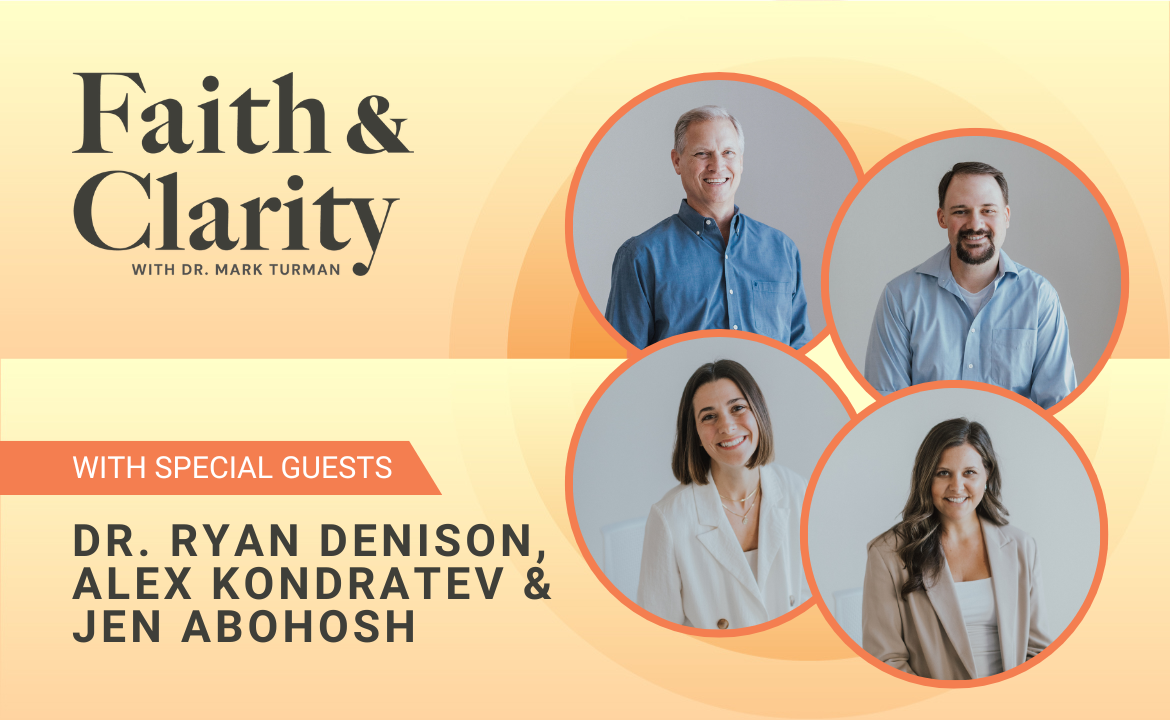
Dr. Mark Turman is joined by Dr. Ryan Denison, Jen Abohosh, and Alex Kondratev to open season five of Faith and Clarity with a thoughtful roundtable centered on what it means to remain fully human in an age of cultural confusion. Together, they reflect on Scripture, fear, hope, and the often-overlooked spiritual discipline of waiting on God, especially when the world feels loud, divided, and uncertain.
The conversation moves across timely and challenging terrain, including the influence of media narratives, the growing role of AI, and the weight of political polarization. Rather than reacting to headlines, the group models a slower, more faithful posture, one rooted in wisdom, humility, and trust in God’s presence and purposes.
The episode also introduces a new segment, Since You Asked, where the hosts share personal reflections, hopes, and intentions for the year ahead. It’s a meaningful and grounding start to 2026, offering listeners space to breathe, reflect, and rediscover faith, hope, and clarity beyond the noise.
Powered by RedCircle



Topics
- (00:00): Welcome to season five of Faith and Clarity
- (00:38): Roundtable discussion: Reclaiming our humanity
- (01:58): Exploring cultural reflections and media
- (03:05): The magic of walking with grief
- (04:25): Taylor Swift’s Eras Tour and representation
- (06:39): Gavin Newsom on bridging political divides
- (09:01): Finding humanity in our interactions
- (15:49): Faith, community, and belonging in 2026
- (19:08): Scripture, fear, and hope for the new year
- (30:47): Waiting on God: Unanswered prayers and hope
- (43:28): The complexity of our modern world
- (58:55): Resolutions for 2026
Resources
- The ‘magic’ of walking with grief
- Taylor Swift – The End of an Era – Disney+
- The Contradictions of Gavin Newsom
- 2025 YouVersion Verse of the Year
- YouVersion Announces 2025 Verse of the Year as Bible Engagement Reaches New Heights Globally
- Tom Friedman Says We’re in a New Epoch. David Brooks Has Questions.
- ‘Architects of AI’ named Time Magazine’s Person of the Year
- Denison Forum Artificial Intelligence Archives
- Ask Us Anything: [email protected]
- How has Denison Forum impacted your faith?
- The Focus newsletter
About Alex Kondratev
Alex Kondratev serves as the Chief Content Officer at Denison Ministries. With experience in creating and aggregating media from hundreds of Christian ministries, she leads the Denison Ministries brands in getting relevant and transformative content to the world.
About Dr. Ryan Denison
Ryan Denison is the Senior Editor for Theology at Denison Forum, where he contributes writing and research to many of the ministry’s productions. He holds a PhD in church history from BH Carroll Theological Institute after having earned his MDiv at Truett Seminary. Ryan has also taught at BH Carroll and Dallas Baptist University.
He and his wife, Candice, live in East Texas and have two children.
About Jen Abohosh
Jennifer Abohosh serves as the Chief Development Officer at Denison Ministries, leading the Development division with strategic oversight of fundraising, donor cultivation, and major gift initiatives. She advances the organization’s mission through vision-driven generosity strategies and collaborative leadership across all ministry brands.
About Dr. Mark Turman
Mark Turman, DMin, serves as the Executive Director of Denison Forum, where he leads with a passion for equipping believers to navigate today’s complex culture with biblical truth. He is best known as the host of The Denison Forum Podcast and the lead pastor of the Possum Kingdom Chapel, the in-person congregation of Denison Ministries.
Dr. Turman is the coauthor of Sacred Sexuality: Reclaiming God’s Design and Who Am I? What the Bible Says About Identity and Why it Matters. He earned his undergraduate degree from Howard Payne University in Brownwood, Texas, and received his Master of Divinity from Southwestern Baptist Theological Seminary in Fort Worth. He later completed his Doctor of Ministry at George W. Truett Theological Seminary at Baylor University in Waco.
Before joining Denison Forum, Mark served as a pastor for 35 years, including 25 years as the founding pastor of Crosspoint Church in McKinney, Texas.
Mark and his high school sweetheart, Judi, married in 1986. They are proud parents of two adult children and grandparents to three grandchildren.
About Denison Forum
Denison Forum exists to thoughtfully engage the issues of the day from a biblical perspective through The Daily Article email newsletter and podcast, the Faith & Clarity podcast, as well as many books and additional resources.
EPISODE TRANSCRIPT
NOTE: This transcript was AI-generated and has not been fully edited.
Dr. Mark Turman: [00:00:00] Hi everyone. I’m Mark Turman, and this is Faith and Clarity, a Denison Forum podcast. And we wanna welcome you to the New Year and to season five of Faith and Clarity. If you’ve been following us for a while, we’re grateful if you’re new. Thanks for joining in. Grab your coffee and come sit down as we talk about things going on in the world.
We want to help you find hope beyond the headlines. Get some clarity in today’s cultural confusion and fog. And we wanna mostly help you live by faith and not by fear. Faith in Christ alone as the guiding compass of our lives. Today we’re having a round table discussion with some of my friends at Denison Forum and Denison Ministries.
We’re gonna talk about reclaiming our humanity here at the beginning of the year. Scripture, fear and Hope. We’re gonna talk a little bit about how we can wait on God well, and if we have time, we’ll also talk about how we can thrive in a world that’s getting a lot [00:01:00] more complex, a lot faster, and a lot more connected.
Some of our friends are back with me, Dr. Ryan Denison, our senior editor for Theology Jen Abohosh, who is our Chief Development Officer. Jen is making her second tour of duty with us and we have welcomed her back recently. Glad to have her apart. And Alex Kondratev, who’s been on Faith and Clarity before, but it’s been a little while.
Alex is our Chief Content Officer. Good morning everybody. Welcome back to the podcast.
Alex Kondratev: Good morning. Good morning. Happy New Year.
Dr. Mark Turman: So we’re gonna have some conversation about various things that we’ve been thinking about, reading about even praying about as we get into this brand new year of 2026.
I gotta tell you. I never, ever imagined that I would ever see the year 2026. It just seemed way too far off. And I am by a significant measure, the oldest person on this conversation. Let that be a, be a warning. Just a number. Just a number. All right, Alex, we’re gonna [00:02:00] start with you. Some thoughts about as, as I listen to what you were.
We’re pondering, I called it just reclaiming our humanity. Love that. If that’s not a good way to title it, tell us.
Alex Kondratev: No, I love that. Okay, so as I was preparing for the podcast today, I was like, okay, what’s going on in culture? What’s going on in news? What have I been consuming? What has stuck out to me?
And I think that’s always like a cool way, like especially this podcast being an opportunity. It’s a cool way to see like what things from the world have stuck on me over the last couple weeks. So I just gave myself time, especially ’cause we like had time to prep for this over the weekend, so I just gave myself time, like over the whole weekend.
It was like what pieces of like media have stuck with me and like kind of stuck to me and in my brain and kept me thinking over the past week or so, couple weeks really. And three things came to mind that just kept coming up as I was just thinking as I was viewing the world and as I was living my regular life.
Little [00:03:00] pieces of content that I was consuming kept popping up in my mind, like they often do if it’s a good piece of content. So the first one was an NPR article called The Magic of Walking With Grief. And I won’t go too much into depth with these, but we can put all the links in the show notes. But the magic of Walking with Grief was this article about this group of people in Boston.
I think it was Boston, somewhere in Massachusetts. Go Bruins. But they, every week would gather, and it was for anyone in the group who had lost somebody. So they kind of advertised it out and they said, if you’ve lost anybody in your life, friend, sister, brother, spouse, family, like any, any, anyone, you can come walk with us.
And the person who was like in charge of the group said, it’s really not even walking. It’s more of strolling or meandering. ’cause really the whole point of this walking group was so that people who are grieving, who are going through loss can journey together every week. They can get out of their houses.
Many of them who had lost a spouse were saying, now I’m living alone. I don’t [00:04:00] have anyone to talk to. I don’t find myself having that regular community that I had. They could get out and actually walk with one another and talk with one another. And it was such a profound article because people’s lives were being changed, not.
Just in those moments, but broader saying wow. And now I feel like a sense of belonging and I feel like I can start to live my life afresh. I feel like I can move a little bit forward. I can continue forward instead of being stuck. The other one for any swifties out there, I actually, admittedly, admittedly am not a swifty.
I didn’t get to go to the ERAS tour. I didn’t try to get tickets. I left that for the people who were going bananas over it. But I was super intrigued by the Disney Plus documentary series that came out in December, called The End of An Era. But it was all around like her eras tour and it focused, each episode focuses on like a piece of the tour.
So the terrorist attack that happened that kept her from going and performing in Vienna, [00:05:00]what happened, I believe, and london before, like one of her performances in this, the dance group, kids being attacked. Horrific thing. And one show was all about like diversity and the people that made up the cast and the crew of her tour.
’cause obviously it was a massive tour. I think it was like. I can’t, I can’t even remember the number of shows, like over 100, maybe even the two hundreds. I don’t, it was a crazy long tour. Obviously broke all kinds of records and regardless of being a swifty or not, you knew this tour was going on and it was all over the media and the news.
But what struck me in that documentary was she had said she has dancers that are all races, sizes, looks, ages, like it is just all different people. And she said, I want people to look on the stage and see themselves. And they highlighted this one man who is an African American man who is this professional dancer.
He was a dance teacher and he’s overweight. And so he had said I, I love [00:06:00] dance. I wanna be dance. I’m a bigger person. And he just never knew if he could make it to that big of a stage. And he said, you know what I’m auditioning for. This ended up being one of the main performers on stage and so many, and so many people commented around it’s so nice to look on stage and just see.
Someone who looks like me, someone who is different, someone who can represent me. And Taylor had made a comment about him, even that his spirit just lit up the stage that he was someone who brought energy to the cast, he brought energy to the stage. And so I just thought that was cool that she had said, I want people to look at the stage and see themselves.
And then the last thing I was listening to was a podcast. So it’s a New York Times podcast called the Ezra Klein Show. I try to consume all different types of media, so this doesn’t, try not to pin me down just ’cause of what I like. One show that I listened to but this Ezra Klein show, and he was interviewing Gavin Newsom, who we all know is the governor of California.
And he was talking, as Recline was interviewing Gavin Newsom and he said, Gavin, your [00:07:00]podcast, ’cause Gavin has his own show is so different than the political campaigns you run. You’re out there talking to people who you totally disagree with. You’re out there kind of getting blasted by your own people, saying like, why are you talking to this person?
They don’t agree with our party. They don’t want the same things as we want. Because he was interviewing people like Charlie Kirk and other people who obviously were more aligned with the Republican party. And so Ezra was like you know, why do you do this? And essentially he went into this whole spiel of, the reason I do this is because this is who America is.
We are people of varying different beliefs. We were people of vast political like agendas and views. And he had said specifically about his interview with Charlie Kirk that he was so surprised that as they started talking that it was, both of their goal. He could tell, he said, I could tell it was Charlie’s goal.
I could tell it was my goal, that we wanted to find threads of interest and agreement, that we both wanted to be sincere in our beliefs and our opinions. And he said that he found after that [00:08:00]interview just to reenter, like being reenergized around like a willingness to engage with people you disagree with, that you have to debate in a fair and balanced way.
But that he wanted to find space, this podcast that he does. He was like, I wanna find space that we can find our way back together. Which is interesting ’cause we all know Gavin is out there talking about different political beliefs and very, a lot of them are like far to the left. And we know plenty of people out there that he interviews are far to the right, but.
Regardless. I thought that idea of him saying oh, I want my show to be a place where people can find a way to come back together. And he said it’s for him, it’s about the human experience. And we’ve lost that in politics, which I agree with. And he described as Ezra was asking more questions later in the show that our culture is exhausted, polarized, and code red.
Like he said, our country is in code red, essentially from the amount of polarization, the amount that we just argue with each other over and over again. So I was kind of reflecting on all of those and I was like, what do those [00:09:00] have like in common? And it really brought back to mind, to me like that we need to have humanity back in our interactions.
We need to remember that all the people we’re talking to, performing for, working with, living amongst, going to church with like they’re real humans. They’re not just a political belief, they’re not just like some scripture they memorize, they’re not, you know, the role they have as their job or the title that they are as a parent or a friend.
Like they’re a real human who has like thoughts and hurts and feelings. And yeah, and I wanted to, I, I think for 2026, a hope for myself and I think a hope for our country, if I was to have one, is that we would bring humanity like back into our interactions. So I had a question for y’all. Sorry. That was a lot to go into there, but, so we’re definitely exhausted and polarized, like I was saying.
We feel like we’re at a breaking point culturally that kind of like code red piece in a world that keeps rewarding outrage and like being certain that you like just, you have to know the answer to [00:10:00]every question. What does it actually look like to recover humanity? What do y’all think it looks like to bring back humanity in our interactions without necessarily losing the convictions that we have.
Dr. Mark Turman: Yeah, I just, as you were talking, a couple things jumped out. Number one is I’m not a swifty either. But again, no judgment. But, you know, in pastoring churches, I remember we kind of had the same kind of conversation of, you know, we want people to see themselves when they come to worship. And so we want to put a lot of different people on the stage to help lead worship, whether that’s young people singing or somebody else praying or somebody else reading scripture somebody giving a testimony.
We want, we, we talked about how when you put people on stage, you’re, you’re communicating to people that, hey, people like you belong here. Yeah. And that, that is important and, and valuable. The other thing that, as you were describing this, I just had the idea that maybe the exhaustion is a pathway toward breaking down [00:11:00] some of the polarization and and getting us to the place where we’re open to.
Being more hospitable and considerate of each other because human beings just don’t live on negativity well, for a long time. If you’ve ever seen a church that was started because of a conflict within a congregation and, you know, a bunch of them picked up their stuff and went down the street and started another church, if a, if a church stays focused or group stays focused on the, the negative, it just won’t last long because it wears everybody out and it’s just not enjoyable.
Dr. Ryan Denison: And as y’all were talking one thought that came to mind was just, I mean, it goes back to kind of the golden rule, treat others the way you want to be treated. And I think oftentimes we’d look at that verse and focus on kind of the action element of it. What can we do for other people that we would like them to do to us?
But I think also it just speaks to a general approach we’re supposed to take to other people where we just see other people the way we would want to be seen, [00:12:00] where we give people the level of respect we would want them to give to us. And that’s good. I think so much of the division we see in our culture comes from that place of treating others and viewing others through a lens.
We would be horrified to apply to ourselves. And that’s really
Alex Kondratev: good.
Dr. Ryan Denison: It’s kind of that idea of judging people by judging other people, by their actions and ourselves, by our intentions. And that kind of I think so much of the issues you’re seeing, and this is you very, you described really well. I kind of go back to that basic lack of being willing to give other people the grace that we want for ourselves.
And I think that’s a great place to start.
Jen Abohosh: I think that’s, that’s great Ryan. It, it is interesting that you brought up the Hes tour. When I think back at 2025 and culture Moments that define that year, I think we have to look at that tour. It was the highest grossing tour ever. And, but why, like, why are people interested in this in this woman and her artist, her music?
And I think you hit on something Alex I think first and foremost I’m not a Taylor Swift Swifty [00:13:00] either, but she’s an interesting person to look at because she’s a great storyteller first. I think that’s. People like her and people connect with her and kind of, she is so vulnerable about her emotional arcs in these songs that she writes.
And people, it doesn’t matter who you are, it doesn’t matter what country you’re in. You kind of find yourself in these different storylines because of her level of vulnerability and storytelling. And so there’s something to what we’re all saying here about empathy and connection and humanity. That’s just, you know, no matter where we live, no matter what our background is, we’re all a part of this, this world, and we’re experiencing similar things.
And when we can be honest about that it actually drives meaningful connection.
Alex Kondratev: That’s really good. It also had me thinking as I was. Seeing each of these like articles and PO like documentary. And this podcast is they’re, they’re all left without a little bit. And you think what [00:14:00] could maximize this?
And obviously our answer as believers is that you can’t have real humanity without Christ because the example of humanity is Christ. So I looked up the definition of what humanity was, and it says, having humanity means embodying the best human qualities like compassion, kindness, empathy, all truism, recognizing our shared human experience and acting with dignity and respect towards all people, even in the face of our flaws and struggles.
So I saw that it says, having humanity means embodying the best human qualities. And how do we do that? We look at the man who became human, who took on flesh. And embodied those different qualities. And we can look at Jesus as he walked with people over time. So I was like, thinking about that NPR article, what would it look like for me to embody Jesus as I walk with people in their grief, in their struggles, to just listen and to pause and to, like you said, Jen, just make that connection.
Find yourself within their story. Find yourself within my neighbor’s story. And really connecting there. He expressed love through listening and asking [00:15:00] questions. And I think that’s what we hope to do here on this podcast. What we hope to do within Denon Forum is actually listen, what are people struggling with?
What are the headlines saying? What’s the outrage and buzz? But what does the, what does the actual hurt? What are the actual fears of our community? And how do we listen to those and embody Christ’s humanity? Embody those qualities of compassion, kindness, empathy. Yeah, he defended the vulnerable, he shared meals with sinners.
Like I think that’s what we see in all these examples I brought up is there’s people doing these in little ways. But unless we do it with Christ, unless we do it with the intentions of who was Christ, how did he embody those things, how can I model that? How can I make that true of myself? How can I embody Christ and with the spirit in me and go live that out?
Then I don’t think we’ll see real humanity come back into the world. It’s, it obviously starts with us. So anyway, I think my last question is, do you think there’s any particular role that faith, community and belonging play in helping us find our way back to a more humane society in 2026? Or is there [00:16:00] anything you’re gonna do personally in 2026 that as you, as you think about this, to, to model Christ’s humanity?
Dr. Ryan Denison: I think it’s a good reminder that if we’re not doing this in our churches, we shouldn’t expect to be able to do this in the culture. I think one of the great things about church is that ideally our local communities of faith are a place where we can go to not live out the ideals of Christ, the ideals of Christ perfectly, but maybe with a bit more grace when we fail, and a place to really kind of practice.
If we can’t do it at church, it’s gonna be a lot harder to do it outside of church. I ideally, I, I’m sure there’s some churches where it’s maybe harder inside a church, but that’s kind of a, a larger issue. So I think as far as the role of faith can the role of faith communities can play in helping this en larger culture, I think just working on starting it in our local communities of faith and then from there, take those lessons and put ’em into practice outside of our churches as well.
But yeah, definitely start with church.
Dr. Mark Turman: Yeah. And I, and I think, you know, becomes a thing that you ought to be looking for in [00:17:00] your church. Is your, is your church helping you be more. Like the person of Christ more engaging with people the way Jesus was. And if you’re not seeing your church helping you do that you know, sometimes churches adopt a fortress mentality of, you know, we’re, we’re the only ones that have figured it out.
Everybody else is suspect and probably shouldn’t be in. If you, if you have a fortress mentality about your church that that may be a signal that something’s not the way it should be. Because Jesus was always looking to engage with people and always looking to engage with new people. And I love what you were talking about, about listening.
That was something I wanted to come back toward the end of our time together is just how listening well communicates respect. That you’re valuing people and valuing their opinion. Yeah, I didn’t, I didn’t know where you were going in terms of connecting grief and Taylor Swift and Gavin Newsom, but you did a really great job.
Clearly
Alex Kondratev: there’s a connection. And the last thing I’ll leave us on is, it was funny to me that [00:18:00] Gavin Newsome literally admitted, he said as a part of the podcast, I can’t remember where it was, he says they don’t have a prescription to deal with the real problem. And then he made inferences to faith and community and belonging.
And he himself, said he came from like a more Catholic Jesuit background and is now more, he had, he defined himself as oh, I’ll go on Christmas. But other than that, I’m, I’m not there. But it’s interesting, like I think we know in our hearts like the. Prescription isn’t going to these concerts, it isn’t going on these walks, although there’s great things in them, but you’ve gotta look deeper to like the actual meaning of those things.
Why do those give me some sort of connection feeling? And it’s because the person of Christ, it’s who he was, who he modeled himself to be, who scripture says he is. That is the prescription for humanity. It is the prescription for us individually as our church, as a, as a people group. And so it, yeah, I just thought it was cool.
Okay, Gavin I know the prescription and we all just need to like, take it and prescribe it. Take it a little [00:19:00] bit and live it out. But yeah. I think it’s, it’s very interesting. There is some connection there and it’s because Christ is the original story for all of this.
Dr. Mark Turman: Yeah, absolutely. Which is a good segue to Ryan as we begin the new year talking about just the, the challenges of, of both fear and hope.
And some of the reflection of that in scripture. What’s on your mind as we begin 2026?
Dr. Ryan Denison: One of my favorite parts about the end of the year is whenever you get kind of those like word of the year versus of the year, those kind of things. ’cause I feel like those are at times when done well, a good encapsulation on kind of the year that we’ve had.
And what I thought was really interesting is that you versions verse of the year for 2025 was Isaiah 41 10, which has fear not for I am with you, be not dismayed for I am your God. I will strengthen you, I will help you, I will uphold you with my righteous right hand. And it seemed like a fitting verse for kind of the current state of our culture.
And while a new year often brings kind of new hopes as well, I think it’s important also. [00:20:00]Embrace the, or at least acknowledge the fact that our fears don’t necessarily go away, just ’cause the calendar changed December 31st and January to January 1st isn’t, it’s often treated as this seismic shift when really it doesn’t change that much about beyond a calendar and.
I thought it was also telling to that extent that this is 2025 was the fourth time in six years that Isaiah 41 10 took that top spot. Oh wow. And so I think that speaks to the idea that apparently our desire for peace and support in the midst of our fears is not a recent development. And it’s not something that is related simply to the last year.
And everything that’s gone on, this has been a human problem, an American for a long time. And new version is not just an American app. So I think this speaks to the idea that this is a global issue, this fears these doubts, this need for God support in the midst of that is something that all of us struggle with.
And I think there’s some peace in that, but there’s also, I think, a call to realize. [00:21:00] Struggling with our fears. If needing God’s support is something that is something of an annual tradition, I guess, in the way that we look at our relationship with God, then maybe that’s a problem as well that we need to not just acknowledge the problem, but try and actually fix it and try and actually get better at it.
And I think that that’s, that is one of the things the new year offers us the chance to do is sort of offer us sort of, even though if, even if nothing technically changes beyond a calendar, it, it is a chance to kind of say, okay, starting today, I’m gonna be better on this. And I that’s honestly one of the things that I’ve started kind of doing in, in a new newsletter I’m writing called The Focus is I like to end every issue with this God is Good section.
And part of the reason why is that I, it’s, it helps me coming out of spending a lot of time in the news, a lot of times, studying stories that are written to inspire fear are written to. Elucidate all the reasons that we have to be fearful. It’s helpful for me to finish that process by focusing on an [00:22:00]example of God at work in the world, God’s of ways that God is using his people to further his kingdom.
Ways to just reminders that all, all the fear, all the other things aren’t the, don’t get the last final word. I wanted God to get the final word. I wanted. God’s goodness, God’s faithfulness to get the final word. And so that’s that’s part of why I do that. And the focus is for me, and I’m hoping it does the same thing for our readers, but it does kind of lead to this new question about how do we not just acknowledge that, that God is still at work in the world?
How do we just acknowledge that we have fears? How do we actually do something about them? And so the question I had for y’all is how do we live out this command that God gives us in Isaiah 41? How do we fear not? Because I, I know in the past I’ve, there’s been times where God’s command to fear not, doesn’t take away the fear, it just adds on a little bit of guilt.
And that’s not really, I think, God’s intention behind that verse. And so what are some of the ways that we, what’s a healthy way to handle fear and doubts when they arise? And kind of along the same lines, what are some practical ways we [00:23:00] can learn to trust God, to strengthen us, help us, and support us in the middle of those difficult times?
Jen Abohosh: I think that’s a great question, Ryan. I, when I hear the word fear, I, I, I think about, and this is funny, I was thinking about this the other day Proverbs 31 where she laughs without fear of the future. And it’s like, how do you do that? Like, how do you actually just look at the future and laugh?
And I, I think what it is, and I think this is maybe what you’re getting at with the focus, and I love that section, God is good. ’cause I think it goes back to you just believe that God is who he says he is. You know, if you really are looking at whatever problem you’re facing, whatever fear of the future, fear of what’s in 2026, it’s maybe the same as 2025 verse that we’re looking at.
If you believe that he is good. And he can be trusted and he’s in control. He’s sovereign over all things, and he is a father that gives good gifts and his timing’s perfect even when, you know, things aren’t going our way right now. And he has a plan for us. You look at all of these promises we’re given in scripture, maybe we can laugh [00:24:00] and as someone who struggles with a lot of fear and anxiety at times that can seem impossible.
But I think I think maybe what your newsletters can help us with is just remembering who God is and being anchored in his truth and his word and his character. And, and maybe that’s what makes that possible.
Dr. Mark Turman: Yeah, just the, you know, when you were talking about that, Ryan, you read part of that verse says about being, don’t be dismayed.
It’s not a word I use a lot, but it is an accurate word to describe how I think about the world. A lot of times we deal, you know, we kind of follow the news more intentionally more aggressively than probably the average person. That’s kind of one of the things that we need to do. And we are often confronted with really hard things, even in this last few weeks of the year, just, I just find myself looking at some of the stories of things that have happened and just, just absolutely dis dismayed is really a good description.
And, and you know what to do [00:25:00] about that. I, I sometimes I just find sitting down and, and having a conversation with God, sometimes with godly people of what am I really afraid of? And we are all. Afraid of many of the same things. We’re afraid of illness. We’re afraid of somebody. We love getting sick or getting injured.
We’re afraid of a pandemic. We’re, we’re afraid of a financial collapse. We all kind of share those things worldwide, but it does help. I found that I know with me and with other people that if I can talk about it, if I can bring it out into open conversation. A couple of things happen. One is, is it seems like it’s out in the light of, of, of awareness.
It’s not as scary as it is at night, and it, and in the dark. I also find out that other people have a lot of the same fears, and that makes me realize I’m not crazy
Alex Kondratev: or alone, which is, or alone
Dr. Mark Turman: I’m not. You know? And and I think that’s, this is where family, [00:26:00]friends, church, community all come in is that we realize that we’re very similar, more, we’re more alike than we are different.
And we all share a lot of the same concerns. And so maybe we can work on ’em together. That’s good. And when and when you realize at a real depth that you’re not alone, then you’re usually not as afraid. And, and you’re more equipped to battle it.
Alex Kondratev: That’s good, mark. It is so true. Why is anxiety so bad when it’s dark outside?
Like, why does it find the way to just get you when it’s dark and everyone else I like my husband’s asleep, and I’m like, then I wake up and I’m like thinking of all the crazy things that could possibly happen to me. But it reminds me of what you were saying too, Ryan, when it says the, the verse says, do not fear.
And what I try to tell myself is do not fear without Christ because. I really would love to just not fear at all, and maybe that one day will be possible as I continually submit things to Christ and realize that he is like enough and that he is [00:27:00] listening and he does care. But I always try to tell myself, especially in the middle of the night when it’s dark and when I can’t, just every night wake up.
And be like, Hey, I’m worrying about this thing. Is this gonna happen? And he’s no, go back to sleep. So I tell myself like, do not fear without Christ. And one of the verses it reminded me of was one Peter five 10. I just pulled it up and says, and the God of all grace, who called you to his eternal glory in Christ after you have suffered a little while, will himself restore you and make you strong, firm and steadfast.
That’s what I like. Try. What I try to tell myself in the middle of the night is I just lift those things up to Christ and say, man, if, if we go through suffering, if something doesn’t go the way that I plan. You will restore me, you will make me strong, you will put me on firm ground, you will make me steadfast and ultimately Christ, you are gain that as I submit these things to you.
As I try not to fear, at least as I give you my fears or share them with you and hold hands with you in those that you are gain. Christ, you are the one who makes me whole, who puts me on firm ground, who makes me [00:28:00] strong. And so I think that is also a way that when you feel lonely and it feels like in a dark place, that you don’t have someone to talk to.
That Christ is that. And that is the way, don’t fear without Christ. Don’t fear without going to God. Bring those things to him. Submit those things to him because he cares for you.
Dr. Ryan Denison: Yeah, I do. That’s really good. Yeah. That’s a good word. I think kind of the things y’all are pointing to, I I is also kind of, when I was reading through the verse that Isaiah 41 10, the first time, like my mind immediately went to the fear not be not dismayed.
I will strengthen you, I’ll help you, I’ll uphold you. And somehow in my head I kind of glossed over the four I am your God and the with my righteous right hand parts of this verse. And it just, as y’all were talking, I went back and read it again. It’s just, that’s kind of what stuck out to me in reading it in the light of what y’all have just said, is just it.
It seems like God’s answer to this is not just simply try harder, not to be afraid. It’s when we’re afraid, remember that God is our God. Remember that those promises to strengthen us and [00:29:00] help us and support us are because we can trust his righteous right hand because. God doesn’t one of the things I remember when we did a book on the summer on the Mount several years ago that God kind of just really felt like it was one of the main things I took away from that process and that research was that God never commands us how to feel.
He just gives us commands on what to do with those feelings. And I think so often it gets easy to get so caught up in the fear. So caught up in the feelings of dismay that we try and solve the feelings, try and solve the emotions rather than just take them to God and trust that, okay, I, God knew we were gonna encounter this stuff.
God knew we were gonna feel this stuff. That’s why he gives us instruction on what to do with it. But if we don’t take those back to God, if we don’t ultimately settle our fears by finding faith in in the Lord and letting that be the foundation of those, then I, I don’t think we have an answer to it. And I think as Christians, that’s one of the things that we can uniquely offer.
The world is a solution to a problem they can’t [00:30:00] fix. That’s really good. And I think that’s only Jesus can. And so that’s kind of like, thank y’all so much for kind of what y’all said and that I think that really is, as we start the new year, I think a really helpful thing for us to focus on is when we feel afraid.
When we read the news and walk away feeling discouraged, remember that God is still good, remember that he is still king and remember that we can still, the answer is to trust in him. And then when we feel the sense of peace that comes from that as well, to never take that for granted either. And remember that is also from him and that we’re called to help others know that same thing.
We’re privileged to help others know that same thing. Yeah. But if they don’t see it us, they’re not gonna want it for themselves. So it kind of has to start in our own relationship with the Lord.
Dr. Mark Turman: Yep, absolutely. And try to be a walking example of that. Yeah. Thanks Ryan. Jen, you wanted to talk about something that we probably all struggle with, which is waiting on God and waiting on him.
Talk about what’s on your mind.
Jen Abohosh: Yeah, I think, you know, as we sit here in the new year, [00:31:00] we’re tempted to make new resolutions, but but oftentimes we look back at the year before and, and all the things we hoped for, dreamed for, hopefully prayed for, and sometimes they aren’t fulfilled yet. And maybe we have unanswered prayers or things that we’re still waiting on that are carried over from years past.
For me, you know, I’m waiting on God to answer a lot of prayers. There’s people in my life that I would love to know for them to know Jesus, that I’m still waiting on those answered prayers. There’s people in my life that are sick, that I’m waiting on healing from God. There’s even just personal dreams and and things of mine.
I’m waiting on God to, to bring to fruition. And I imagine many of us are feeling something similar that we’re waiting on something and, and it’s hard to, you know, as we look forward to, okay, do we keep that in our prayer? Like how do we sustain, how do we keep that hope and faith that God will come through and do what he says he will do and answer these prayers [00:32:00] while also sitting in the reality of we’re still waiting on, on prayers to be answered.
And I think regardless of, of where we are in life, we’re all still waiting on, on Jesus to return. So there’s that, even, even over our life is, is great. And we’re going into the new year with lots of lots of joys from the past year. We’re still waiting on something. And so I, I’ve been, looking at the Hebrew word for weight kava, which I was looking into some of the definitions for that.
And part of the meaning of it is is to be intertwined with God. I thought that was just such a beautiful picture. Like you imagine yourself, if you’re on video here, you’re like twisting your hair, braiding your hair, and like you’re, you’re totally intertwined. Or maybe it’s like a tapestry you’re intertwined with God.
That’s a really beautiful picture. And when you’re waiting, you often feel like alone in that weight, or maybe it’s a silence. But to know that in Hebrew and throughout the Bible, that means to be intertwined with and, and maybe other ways. To put that would be as you’re intertwined, maybe it’s a wrestle, like maybe you’re like Jacob, like you’re intertwined, [00:33:00] but you’re like, you’re not letting go of God.
There’s this like grip and you’re wrestling with him. Or maybe like in the positive sense, maybe the most helpful way to think about waiting is, is we’re dancing with God. Like we’re sitting there and we’re intertwined. But maybe it’s like more of a dance where we’re in lockstep with who God is in the weight.
And so I just think it’s an interesting topic. I’m curious to your guys’ thoughts on this. Waiting is, is woven throughout scripture too, like a lot of people who were given promises or even anointings by God, like we look at David, he was told he was gonna become king and then he was exiled in the wilderness and chase and, and and after him throughout 12, 15 years before he actually became king.
And there was a lot of waiting for that deliverance there. So I’m curious with what you guys, if you relate on this, if there’s things you’re waiting on as we go into the new year, promises to be fulfilled and how you kind of grapple with that on your own.
Alex Kondratev: To me it brought up a quote and I had to pull it up as well, but from Elizabeth Elliot where it talks about.
What waiting is. And it says, waiting on God [00:34:00] requires the willingness to be to bear, uncertainty, to carry within oneself. The unanswered question, lifting the heart to God about it whenever it intrudes upon one’s thoughts. And it just made me realize and remember and identify with the fact that waiting is so vulnerable.
Like it is a vulnerable act. It’s telling others, telling God that I want this thing to happen and I don’t know if it will and I, or I don’t know the way it will turn out. And it’s such a vulnerable thing to hold that I want this thing, I hope this goes this way, but I am going to hold what does she say?
Bear uncertainty. I’m gonna carry within myself an unanswered question. And I just wanna encourage you, Jen, and our audience. Broader than that. And even trying to encourage myself as I say this, like it is like when you feel vulnerable waiting with an unanswered question, like that’s just true. It is vulnerable, it is scary to, like Ryan was saying just a second ago, [00:35:00] we like want to find all these solutions and sometimes we simply can’t.
Sometimes the only solution is to wait. And I think as kids you try to teach your kids that oh, we have to be patient and wait, but as adults, like it is just as hard. There are things that on a bigger scale that we have to just sit and say, I don’t know how this is gonna turn out. And I think it’s right and good for us to tell God and ask God I would love it to turn out this way.
Can you please grant this prayer and help me to understand like how to get to this place. But ultimately, he may totally. Not answer it that way. It may look totally different according to his will and what he like wants to have happen. And yeah, I, I validate what you’re saying, Jen, is some of us walk into the new year and we’re just like, this question is still unanswered, still feel like in a bad place about this or scared or fearful.
I still have all these hopes and dreams, but I don’t know how they’re gonna pan out. And I think we have to just continue to say it’s okay to be vulnerable in that place. It’s okay to hold unanswered questions and, and lift them up to God and, and encourage one another that yeah, it, it is [00:36:00]scary.
And we can pray for one another and lift each other’s burdens. But ultimately it is just a, a vulnerable place to sit when we’re waiting.
Jen Abohosh: It is a vulnerable place to sit. And I think you know, you look at, at scripture and all these different places where God makes people wait and you’re like, I wonder why, like, why is this Scott’s tool?
And I think you said something that’s super interesting. It’s, I, I think it’s a breeding ground for faith. You know, you have to keep even when it looks like you know people around you are you still waiting on that person to come to Christ? It’s been, it’s been 10 years and they’re still, you know, floundering.
We’re waiting because we have faith in God and a faith in God who is bigger than all of us. And every year that we wait, our faith has to grow with that prayer. Otherwise, why are we keep praying it? And so it is, I think it’s an interesting tool that God uses. And as we look into 2026, I think it really could be a sweet spot for us to, and an invitation maybe to keep hoping not in in the outcome, but hoping in Christ because Christ will never fail.[00:37:00]
And when we do that I think we’re, we’re kind of in our sweet spot with God.
Dr. Mark Turman: Yeah, it makes me, Jen, it also makes me think about just learning fresh lessons about what it means to be present. Waiting has a way of slowing down your world. And we’re all very anxious about what we are supposed to be doing and how we’re supposed to be pushing some kind of an agenda forward, rather than trusting that God is gonna work it out.
And I I have the image in my mind of somebody waiting in line to, you know, get into a movie or to get out of a store. And, you know, now with their technology, it’s I’m gonna, I’m gonna redeem this by using technology, which not necessarily wrong. And that’s one of the things you can do is say I am waiting on God to do this.
What, what does he want me to do in this moment that is the most redemptive, obedient, holy thing I can do? And, and part of it for me is recognizing that God so [00:38:00] respects our our free will. That, that most of the time the things that, some of the big things we’re waiting on with God just require a lot of different parts to move.
You know, he’s, you know, to your point, waiting on this person to come to faith or come back to faith, you’re like God’s not gonna he’s not gonna violate their free will. And there’s probably a lot of moving parts that might need to happen to, for this to happen in the right way. And, and it just reminds me that God sees the picture much more than I do, and I need to trust him that he, he, he sees all the possible parts and all the possible options.
And he’s working for the most redeeming thing that can happen, but he is never gonna violate somebody’s will, not mine, not the other person’s. And, and, and the other thing comes to mind is, is that. Almost every significant positive example you see in scripture and in church history involves somebody that had to learn to wait.
I think, I think about Mary and [00:39:00] Joseph okay, now we got this baby. When is it gonna become obvious to everybody else that this is not just another baby? And they, they wait three decades before Jesus steps out into the public eye. I mean, it’s you can imagine how many conversations they might have had around the dinner table about, you know, how much does he know about himself and how much do we understand about him?
And, and I mean, it’s just a lot of waiting. But that doesn’t mean that waiting is bad. I love the, the idea that Faith calls us to stay intertwined. Interconnected with him.
Dr. Ryan Denison: And I think kind of going off that same idea is I, I think it’s, I also important to look for the ways that God is gonna redeem the waiting.
Because I do think there’s times where if, if God, our perfect father asked us to wait, then he’s not doing it to be mean. I, I think about kind like when my son is hungry for dinner and it’s not dinnertime yet, and I tell him he can’t have a snack. There’s days where his world ends and it’s in my head it’s no, if, if you eat a snack now, [00:40:00] you’re not going to eat your dinner later.
You’re not gonna have the better meal if you have something. A poor representation of it now. And it is difficult at times for him to understand how that’s being a good parent to make him wait. And I think at times there’s God is looking at us the same way where he is I, I understand that you want it now, but it’s in your best interest to wait.
And in the middle of that, I don’t wanna waste the time. And so I, I do think it’s, it’s also important not to become complacent in our waiting or say like when God tells us, okay, it’s just not time yet to not just take that answer and then sit back as if there’s nothing else he’s gonna call us to do until it happens.
I think about when Paul talks about when Paul writes the churches and I forget which letter it is, but he, in one of ’em, he tells them, it’s basically you can’t eat if you don’t work. Kind of idea. And he was riding to a church. Was so convinced that Jesus was coming back soon, that they’d kind of given up on the day-to-day functions of life.
They were just content to wait until Christ returns and [00:41:00] Paul’s message to them was no. They every day has a purpose. God has a purpose for every minute of every day. And if you’re just fixated on what’s gonna come, then you’re gonna miss out on that. And I think that’s the other element of waiting is just to fully understand that this is still time that God wants to use still time that God can redeem to do amazing things.
And, and at times it’s times that if we don’t use that time of waiting, we may not ever get the end because maybe he does need us to grow up a little better, to grow something in us before we’re ready for whatever it is we’re praying for to happen. And that if we can use that time and really allow God to use it to develop us and the people he’s created us to be more and more, then maybe that’s gonna be a.
Kinda what brings about the end of our waiting is that he’s matured us enough, he’s grown something in us, or he’s, he’s done something in us that has enabled us to fully appreciate and receive the gifts he wants to give.
Jen Abohosh: Yeah. That’s so good, Ryan. That’s a good reminder to not kind of waste the waiting, but it all has a [00:42:00] purpose.
Maybe I’ll end with this. So Jim Denison, you can find it at our, on our store, has a book called Bride Hope for tomorrow. And in that book he just tells parables about that Jesus tells about just hope and all kinds of situations is very powerful. But one of the one of the parables Jim gets into is, it is a parable of, of the neighbor who in the middle of the night has some unexpected visitors and knocks on the door and is trying to get some bread. And he knocks and continues knocking, and then Hess knocking, and finally the neighbor opens the door. And it’s not because it’s not because the neighbor loves this neighbor.
It’s not because it’s convenient to open the door. It’s because he uses the word shameless audacity to keep knocking. Is the reason that he opens the door. And it’s a, it’s a parable to, to us to keep knocking and keep going to Christ and keep hoping and keep being expectant that God will answer the prayers, even the ones that we’re waiting on.
And, [00:43:00] and Jim ends the devotional with this thought that he says, it’s always too soon to give up on God. And I think that’s just a great reminder for us as we go into 2026, that you know, even the prayers that we’re waiting to be answered, don’t give up. It’s, there’s still there’s still room for more there with God
Dr. Mark Turman: amen.
Yeah. Yeah. There’s always a lot more going on than we realize. You know, always a lot more going on. Yeah. So thanks for that, Jen. We got a few minutes before we wrap up here. I wanted to take a few minutes to tell you kind of what Alex was saying about, you know, what’s, what is kind of stuck with me.
So I came across a couple of weeks ago, a podcast by two guys that I follow somewhat, two journalists, cultural analyst. One of them is Thomas Friedman and the other one is David Brooks. And they were discussing in their podcast a significant article that Thomas Friedman were wrote called Welcome to Our New Era, what do we Call It?
And this thing just [00:44:00] captured me Thomas Friedman. I’ve read a couple of his books and read his articles occasionally. He sometimes writes about really big global movements and pivots and he’s been helpful for me to just kind of understand the world on a big level. And we’re much more a global a global community than ever before.
I tell people often about my kids, my kids look at the world like it’s a neighborhood and airplanes are taxis. They don’t really worry too much about going anywhere. They’re like why wouldn’t we go there? I mean, the, the reason the world exists is so that we can all go explore and enjoy it.
And that’s just not the way that my wife and I grew up. And but in this article Thomas Friedman writes, and then they discuss the idea that we are in what he calls the poly scene. He didn’t create that term, but he explains it pretty well. The word poly meaning many, and the, the phrase scene has to do with.
Current or the current period. I remember learning [00:45:00] about different errors of the world when I almost failed my geology class when I was a freshman in college. We had to learn things about the plyo scene and the different, you know, the different ages of the, of the world, the different, I think Taylor Swift
Alex Kondratev: was talking about different eras whenever she was, it was different era, era.
Dr. Mark Turman: In, in, in Taylor Swift’s would’ve been a little boring than she called it a policy era. She wore, used the word a little bit differently. Yeah. And so anyway, they just talk about how maybe this is what, this is the age of many whether it’s many songs from Taylor Swift or many pictures that are ultimately gonna break the internet because we’re all putting so many pictures and videos out.
The idea of AI as being a tool that is polymathic, that it can do lots of different equations simultaneously, and that’s how you end up with something like chat, GBT or gr the idea of poly crisis. That there’s a lot of different [00:46:00] things that happen in our world that lace together. And it’s not just one problem.
It’s many problems that are intersecting with each other. The word polymorphic, which has to do with, there’s a lot of different structures, a lot of different governments, a lot of different organizations, and they’re all intersecting with each other all the time, making our world really, really complex.
And that’s different. We can sometimes romanticize the past that, oh, I wish we could go back, where times were simpler and it, we lived in an either or world. And that may not have ever been the truth, but it felt like it was more true. And I love one of the quotes out of Friedman’s articles.
He says, you know, we are more sharded or fractured while at the same time we’re more connected because of technology. And here’s his quote, thanks to smartphones, computers, and ubiquitous connectivity. Every person and every machine increasingly has a voice to be heard and a [00:47:00]lever to impact one another and the planet at previously unimaginable speed and scale.
And that’s what we’re all trying to get used to. And then Alex, this kind of does loop back to some of the things that you started us with, that two of the most powerful emotions and fears that drive us as human beings. One is, is we are all eager and desiring to be respected in value. We want the dignity of being seen.
What we would call in a Christian sense, in a biblical sense, we would call it the sanctity of every life, the value and the importance of every life. Because every person bears the image of God. Even if they don’t believe in God, they are still expressing in some way, very significantly the presence of God, the reality of God who created them.
And then the second powerful emotion and fear is this desire to belong [00:48:00] what Freeman calls a sense of home. And it gives this great definition of what home might mean for all of us. It is the place, the community where we feel connected, where we feel protected and we feel respected that that sense of home gives us a place and a sense of security and belonging that we are all.
Longing for. And then he goes on to describe this, this age of many as being a place where where race pace and price are all very much at in play. That America is quickly becoming what is described by demographers as a minority majority country where no one group really has the majority anymore.
Instead we’re a bunch of minorities that the speed of change and what some would call progress, what we would all hope would be progress is just seemingly [00:49:00] increasing. And then the price of being able to have a sense of home, of even buying a home feels out of reach for a lot of people. I know.
So a lot of these things seem to be real right outside my front door. I live in a north Dallas suburb. And if you walk outside my door you see a lot of different ethnic groups just living in the houses immediately around me. I literally never thought that I would be living in a global neighborhood.
But there are people literally from all out, all parts of the world living within five to 10 houses of me. And then I also am aware in the area where I live, about the incredibly fast proliferation of apartments. Because in many ways if you are a policeman, a teacher, or a nurse living in my [00:50:00] town, you probably can’t afford to buy a home on the salary that you’re making.
And those teachers and nurses make pretty decent salaries. Just the way the housing market is, you’re almost forced into a rental reality, which does change the perspective. And then the other thing that the article and the conversation talked about was just the, the real, the coming realities of ai.
And if you go back and spend some time with this, they talk about AI as, as becoming a vapor that is going to be inside and a part of everything that we do going forward. So first question I want to, to put in front of y’all is, do y’all resonate with that? Does that sound like a proper description of the age that we’re now living in?
Alex Kondratev: When you said complicated, that’s all I needed to know.
Dr. Mark Turman: That was the one word you needed. That is true.
Alex Kondratev: That resonates. It’s all just complicated. You’re like, you [00:51:00] listen to all these news stories. You watch all these different things you see on social media and everything, to me just am this is so complicated.
How could this be solved? How could we figure out how to use AI but not abuse it? How can we figure out how to get the margins, the people in the margins brought closer in? Or how can we get closer to the margins so that people have access to what they need? It’s just everything feels so complicated when you’re looking at it as an individual.
So yes, I feel very much so that’s happening in today’s world. It’s just very complicated.
Dr. Mark Turman: Yeah. Jen, Ryan, what do you think? Is that, is it a good description? We’re living in the world of many.
Jen Abohosh: It is complicated and. I think you mentioned this at the end, mark, but I think AI is, has really amplified that and, and really the speed of which things are happening.
You know, times named ai, the person of the year, and I thought [00:52:00] that was, was interesting. It’s, it,
Alex Kondratev: oh, I didn’t know that. I hate that
Jen Abohosh: 2025 person of the year is ai. And when you look at Yeah, exactly the reasons for that. I mean, I think one of the reasons is it’s, it’s kind of moved beyond the tech sphere into just ordinary life.
And so when you, you talk about your kids, your family, your neighborhood, mark, it’s, I I think this tool, artificial intelligence has moved us in a faster paced world and more interconnected world, more maybe chaotic world in a lot of places, a lot of disruption happening with ai. And so yeah, it’s, it’s an interesting place to be this year.
Dr. Ryan Denison: Yeah. And I think one of the reasons that it complicated gets so difficult is that I, I think we have a, all of us have a temptation, at least I know I have a temptation to try and to try and simplify things and make them fit inside a box. And so whether it’s like diversity stuff, whether it’s AI stuff, I [00:53:00] want to, there’s something in me that feels a greater sense of peace if I can classify it as good or bad, rather than simply accepting that there’s elements of both.
And I think that’s what makes it so hard and what makes it so divisive is that I, I do think in our culture, like if you look at any complicated issue on social media, especially, which green and social media is an awful way to judge. The reality of anything. But I do think it’s how increasingly people kind of, it’s the lens people look through for it, or it’s at least the lens through which they’re first exposed to it.
Sure. And I think part of what makes it so difficult is that there is this temptation to view these complicated subjects and go, okay, the, the thing I need out of this is to figure out if I like this or I hate this. And there’s not much in between. And the reality is that’s not the world we live in.
The world we live in is both good and bad to pretty much everything. And so I think that’s part of why we need God’s perspective on this and the Holy Spirit’s sense of peace, is to not get overwhelmed into thinking [00:54:00] if I can’t classify this one way or the other, that I don’t have a good handle on it.
Because the reality is most of the time there’s good and bad to all of it. And especially kind of when it comes to complex issues that involve other people, it’s, it’s incredibly important not to be too attached to those boxes because issues like diversity can turn into issues of racism very quickly when we have to either say, okay, immigration is good, or it’s bad.
It can’t be both. Diversity is good or bad. It can’t be both. And I think that’s what makes, that’s one of the biggest challenges of this poly world that polyculture we live in, is that for really one of the first times in human history, like the world doesn’t easily fit into one of those boxes. I mean, it never has to an extent, but to a greater extent than ever before.
I think we’re faced with the reality that we can’t just classify things as good or bad and go on with our day. And and you’ve got a lot of people who
Alex Kondratev: want. To tell you that it does. Like there, it’s either good or [00:55:00] bad. And I think that’s struggle too, is that like you listen to the news or the radio or to social or whatever, podcasts and those experts wanna say here’s what’s going on with immigration.
And it is either good or is either bad. And I think that’s the struggle that the everyday person has to deal with is like you have to be a critical thinker enough to say no, there’s more gray than they’re willing to tell me than their ad dollars are willing to let them say, you know? Yeah. So it is very interesting ’cause I think we ourselves have to be critical thinkers.
We have to know what scripture says because the world’s not gonna just give us an easy, like they’re just gonna wanna give us the easy answer and we’re gonna have to think harder than that.
Dr. Ryan Denison: No. At the end of the day, we have to be willing to live in tension and not yeah. I think that’s kind of when our peace comes from the world around us.
The intention is. Unacceptable. When our peace comes, comes from God, I think it opens up the chance to, to live in tension and be able to say, okay, that’s not gonna, I, I still don’t have a firm grasp on whether this is good or [00:56:00] bad, but I don’t have to, and that, that’s Christians, I think we can do that.
Dr. Mark Turman: Yeah.
And that’s a great, great place. That’s kind of where the article and the conversation ended was we, we have to get, we have to ask God to give us some confidence about living in the tensions and living more of an a both and rather than an either or kind of thinking. You know, you mentioned immigration, you know, as Freedman said, you know, Hey, I’m, I’m for countries having big walls high walls and big gates.
You know, countries need to be able to control their borders, but they ought to have healthy, reasonable immigration policies that are enforceable. You know, that, that’s more of. Both. And rather than either or kind of thinking and the way this conversation ended was, I thought, pretty hopeful in some ways that we, you know, it is a complex world, but it’s also a much more interconnected world, and that feels chaotic.
And there is, there’s something about us that pursues [00:57:00] clarity, understanding, and even simplicity. But as you said, Alex, we need to learn to think well, and that’s part of what we do at Denison Forum, is to help people think clearly and cri critically so that they get to the kind of understanding that God would want us to have.
Circling again back to Alex, where we started a few minutes ago, which is listening that, that becoming better listeners for 2026 might be the best resolution that we could make. Because listening communicates respect and value that we need to realize that we are all in this together.
That we now live in a world that is much the, the reality of globalization and interdependence is just clear. I love what Free Freedman said. Interdependence is no longer a choice. It is a condition, it is a reality where almost anything we do, especially on a very significant scale, touches the rest of the world.
And then I love this about technology and particularly about ai. There was a great conversation at [00:58:00] the end of their talk about how if God is gonna be in all of the things of cyberspace and ai, he’s going to be there because we take him there. Kind of what Jim Denison says at times, Jesus goes where he’s wanted.
He goes where he’s invited. If you know people like us and ministries like ours and others, if we can take Jesus and, and take the spirit of God and the truth of God into the cyber world, including the AI world then God will be visible and known there. Anyway, I just, I close this conversation. If people want it, they can find it in the show notes.
I love Freeman’s conversation ended this way. The faster, more powerful, more integrated and more complex the world gets, the more everything you learned in Sunday school matters more. And that’s pretty interesting coming from a Jewish guy.
Yeah. So anyway, thanks guys. We’re about out of time, but before we go, I am trying to create a new [00:59:00] closing segment for Faith and Clarity in 2026. It’s one of my goals is to have a, a fun way to land these conversations. So today I’m trying out the simple idea of a closing segment called, since You Ask.
And so I got a couple of quick answer questions for each of you. First of all, do you make resolutions and secondly, what are you looking forward to, curious about or anxious about for 2026? Ryan, go first. Do you spend time making resolutions?
Dr. Ryan Denison: I don’t. I’ve tried in the past and they lasted a few weeks and then went away, so I just kind of gave up on the process.
I do think there’s something to the idea of reflecting on the year that’s been. Kind of thinking of ways that the new year could be better, that has some value to it. But I, I don’t really create specific resolutions, but as far as kind of what I’m looking forward to or anxious about for the coming year politically the elections [01:00:00] in 2026, I’m interested about, I’m curious to see all the stuff with the, with the 250th anniversary celebrations of the nation this summer.
This isn’t really spiritual, but I am looking forward to the UFC event on the White House lawn. I think that’s gonna be really interesting. And then kind of just on a personal note, I’m looking forward to seeing who my kids are a year from now. ‘Cause I felt like this past year I got, they became kind of people in a way they didn’t really used to be felt like they just kind of hit, both of them just kind of hit that stage of maturity where they kind of, you start to see more and more glimpses of kind of like, okay, this is, this is who they are.
And so I’m looking forward to kind of continuing to see more of that this year. And curious to see kind of where it ends.
Dr. Mark Turman: Yeah. Awesome. Alex, do you make resolutions? Since
Alex Kondratev: you asked?
Dr. Mark Turman: Yes.
Alex Kondratev: Yes. Thank you for that. I do. I, yes. Since you asked. Yes, I do make resolutions. Typically, they’re like, my goals, like how many books do I wanna read in a year?
What do I wanna [01:01:00] do with typically Lucian I’ll make goals around like financial stuff and savings and giving and all of that. How, like, how much I wanna go to the gym. There’ll be some like, spiritual ones more so of what are the things I’m praying for? I’ll make categories like that. So yes, I do, I actually haven’t made mine yet.
They usually take me all of January. I try to just marinate on them and I like, think what do I really wanna do? Because like you said, Ryan, I don’t wanna get to the end of the year and be like, or even two months in and be like, I don’t care about any of these things and why did I say I wanna do them? So I’m a very type A person.
When I put it on the list, it needs to get done. Like I put six things on the list for 20, 25. Five of them got done, one did not. So I’m still thinking on them. I’ll report back. I don’t know what they’re gonna be. And then, what was the other question?
Dr. Mark Turman: What are you looking forward to, curious about or anxious about for 2026?
Alex Kondratev: I would say the biggest thing that is all of those categories is I’m expecting, and so we’re gonna have a little boy here in June. [01:02:00] So my 2-year-old who will be almost three by then is gonna have a little brother. And so I’m expectant, I’m anxious, looking forward to it. And that’s being a parent.
Dr. Mark Turman: Congratulations for that. Absolutely. Thank you. That’ll be fun. Yeah, Jim.
Jen Abohosh: Yeah, I, I like New Year’s resolutions. I, I, I’m definitely a goal oriented person, so they’re more so like goals for personal life or professional life than resolutions per se. But it’s always a good time of year to kind of sit and reflect.
Another practice I took on, I guess it was probably three years ago. I have a good friend Tara Matson, who says, keep your baggage down to carry on size. And it’s more of kind of a reflection going into the new year of, okay, what things do I not wanna bring forward? What, you know, whether it’s like I need to forgive these people and leave that or just really evaluating what my priorities are or things going into the new year.
And I kind of [01:03:00] like that practice as well when we enter New Year. And then personally, okay, this is, what am I looking forward to? This is funny, but me and my friends play Mahjong and they come out with new cards every year, and so they won’t be out until probably late March, early April.
But definitely looking forward to some new lines to play.
Alex Kondratev: Oh, I’ll come play.
Jen Abohosh: Yeah. It’s so fun. I’ll get on a
Dr. Mark Turman: plane. All right. I didn’t, I didn’t, you know, I gotta tell you, I didn’t think either of you are old enough to play Mahjong, but apparently you are.
Alex Kondratev: But apparently we are. It’s a poly world.
Dr. Mark Turman: It’s a poly world.
We
Alex Kondratev: room for many of us to play mj. It’s a
Dr. Mark Turman: poly world. Yeah. All right. Just to cap this off, I do make some resolutions. I spend some time at the beginning of each year, kind of reflecting and thinking about the past year and what kind of different things or corrections I might make. One things I’m looking forward to in the new year are to create some more unique experiences.
I keep telling myself last couple years that I’m gonna go [01:04:00] investigate the symphony or the theater and just go see a play. I’m actually trying to create a plan right now to go see a concert at the sphere in Las Vegas because I hear it’s incredible.
Alex Kondratev: So cool.
Dr. Mark Turman: And so I’d like to do something like that at least every quarter.
Looking forward to that and anticipating that. Kinda like what Ryan was saying, I am curious to see. How the country responds to the 250th anniversary of the country and the 25th anniversary of nine 11. Those things are kind of milestones that I keep my eye on. But yeah, looking forward to that and looking forward to what it means to celebrate 40 years of marriage with my wife.
So this next year, this next year is a pretty significant year for us. That way, and she’s telling me not to rush it. So sweetie. Yeah. So we’re looking into that. Hey, thanks for the conversation, everybody, and just wanna say, happy New Year to all y’all and also to our audience. Thanks for following us, and [01:05:00] if this podcast is helpful to you, please rate review it, share it with others, and like I said, all the articles and things we’ve referred to, you’ll find those in the show notes, and you can find more from Denison [email protected].
And that will include Dr. Ryan Denison’s new newsletter called The Focus that will be coming out in just a day or two from this podcast. It actually, I think,
Alex Kondratev: already came out.
Dr. Mark Turman: Oh, actually already came out. Okay. I’m not, I’m not following all the time. We have to figure it out when this
Alex Kondratev: releases. I think it ca it comes out January 6th
Dr. Mark Turman: okay.
So yeah, the focus may be out a day ahead of this podcast. All right. Yeah, looking forward to that. And be sure to follow Ryan and we think that’ll be a blessing to you as well. And we hope you have a great, great start to your new year. We’ll see you









 Search