



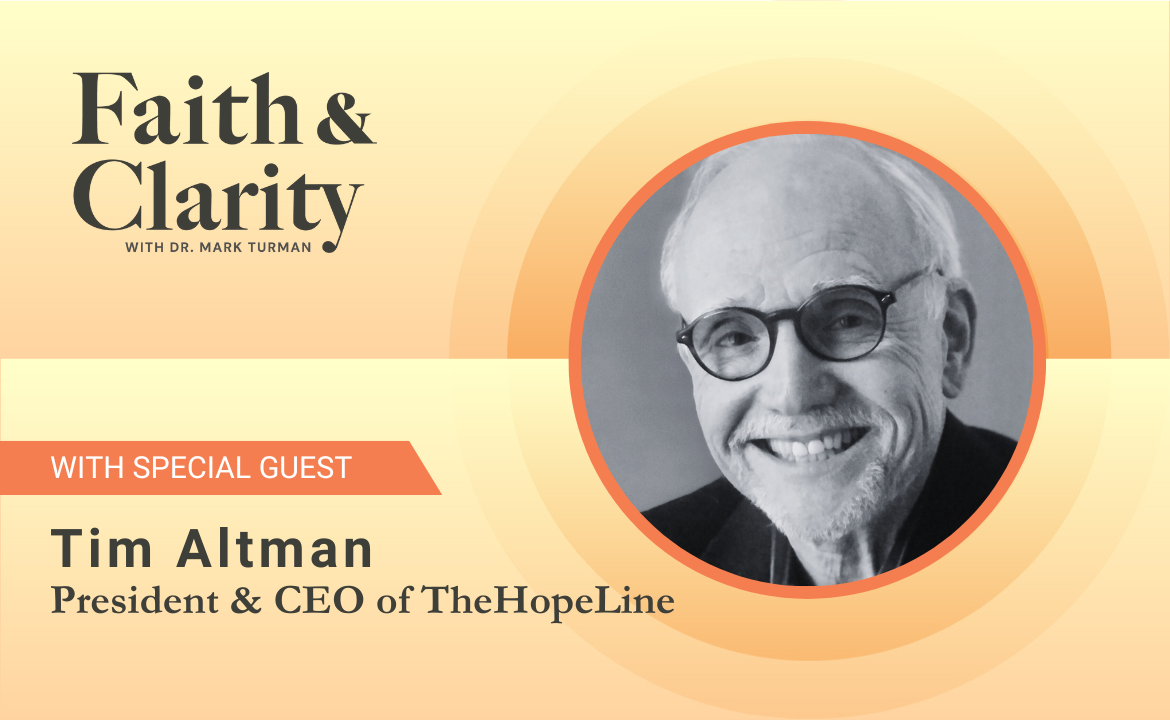
In this episode of Faith & Clarity, host Mark Turman welcomes Tim Altman, President and CEO of TheHopeLine, for a heartfelt and timely conversation about the growing need for hope among today’s young people—especially during the holiday season.
Tim shares how TheHopeLine, a 24/7 online ministry, is meeting students and young adults right where they are—offering free, compassionate support through live chat to those struggling with loneliness, anxiety, and crisis. He and Mark talk about the realities facing this generation, from the isolating effects of social media to the rise in mental health challenges that leave many searching for purpose and belonging.
Drawing from TheHopeLine’s LEAP model—Listen, Encourage, Advise, and Plan/Pray—Tim explains how hope coaches are trained to provide both practical guidance and spiritual care in real time. He also offers insight into how parents can best love and support their teens, and what families can do to bring light into what can be a difficult season for many.
Together, Mark and Tim reflect on the deep spiritual hunger behind the headlines and the remarkable ways God is working through everyday conversations of care and faith. It’s a reminder that hope is not abstract—it’s alive, active, and available in Christ, even in our darkest moments.
Powered by RedCircle



Topics
- (00:00): Introduction
- (01:17): Introducing Tim Altman and TheHopeLine
- (03:12): Defining hope and its importance
- (04:11): The rising tide of anxiety among youth
- (06:24): The impact of social media on isolation
- (09:52): TheHopeLine’s mission and history
- (14:40): Transition to internet-based support
- (19:07): The LEAP approach to counseling
- (22:52): Parental support and love
- (25:30): Hope coaches and internships
- (29:13): Future goals and vision
- (34:34): Funding and donor support
- (38:23): Holiday advice for families
- (41:17): Conclusion
Resources
- Ask Us Anything: [email protected]
- How has Denison Forum impacted your faith?
- TheHopeLine
- Facebook: TheHopeLine
- TheHopeLine (@thehopeline) • Instagram photos and videos
- TheHopeLine (@thehopeline) / Posts / X
- TikTok: TheHopeLine.com
- Tim Altman on LinkedIn
- What does the Bible say about suicide? • Denison Forum
- Having suicidal thoughts? Call or text 988
- Why are teens sadder, lonelier, and more depressed than ever before?
- To stop suicide every 40 seconds: Jacob Coyne with StayHere.live
- How to help prevent suicide and aiding survivors: A conversation with John Mark Caton
- How to navigate suicide, self-harm, depression, and emotions with preteens and teens: A conversation with Jeff and Terra Mattson
- How can Christians navigate anxiety and negative thoughts?
- How can understanding the mind-body-spirit connection improve mental health struggles?
About Tim Altman
In 1986, after 7 years in local Christian radio and video production in Denver, Colorado, Tim joined the Dawson McAllister Association (DMA). In January 1991, he helped launch and produce Dawson McAllister Live!, a syndicated call-in talk radio program for students 21 and younger. Later that same year, The HopeLine was launched as a back-end to the radio show. It began as a part-time toll-free phone connection for young people needing to connect with a caring adult volunteer. In 1994, the show was awarded Talk Show of the Year by the National Christian Broadcasters. In 1996, Tim became the Senior Vice President of Programming.
In 2000, he left to work with academia as a media consultant and producer in the development of interactive web-based curriculum, but returned to DMA in 2006 as CEO. This corresponded with a new Top 40 version of Dawson’s call-in show that became syndicated nationwide through then Clear Channel, now iHeart Radio.
This large radio platform led to major growth for TheHopeline, eventually taking on a life of its own. With Dawson’s blessing, the ministry officially changed its name to TheHopeLine in 2019. Tim has a BBS in Pastoral Theology from Colorado Christian University. He has been married to Janice for 52 years and they have the kids and grandkids to prove it.
About Dr. Mark Turman
Mark Turman, DMin, serves as the Executive Director of Denison Forum, where he leads with a passion for equipping believers to navigate today’s complex culture with biblical truth. He is best known as the host of The Denison Forum Podcast and the lead pastor of the Possum Kingdom Chapel, the in-person congregation of Denison Ministries.
Dr. Turman is the coauthor of Sacred Sexuality: Reclaiming God’s Design and Who Am I? What the Bible Says About Identity and Why it Matters. He earned his undergraduate degree from Howard Payne University in Brownwood, Texas, and received his Master of Divinity from Southwestern Baptist Theological Seminary in Fort Worth. He later completed his Doctor of Ministry at George W. Truett Theological Seminary at Baylor University in Waco.
Before joining Denison Forum, Mark served as a pastor for 35 years, including 25 years as the founding pastor of Crosspoint Church in McKinney, Texas.
Mark and his high school sweetheart, Judi, married in 1986. They are proud parents of two adult children and grandparents to three grandchildren.
About Denison Forum
Denison Forum exists to thoughtfully engage the issues of the day from a biblical perspective through The Daily Article email newsletter and podcast, the Faith & Clarity podcast, as well as many books and additional resources.
EPISODE TRANSCRIPT
NOTE: This transcript was AI-generated and has not been fully edited.
Dr. Mark Turman: [00:00:00] This is the Faith and Clarity Podcast, a Denison Forum podcast. And I’m your host, Mark Turman. Looking forward to another great conversation and wanna thank you right off the bat for being with us. I wanna remind you that we’re trying to help you live a life that is driven by faith and not by fear.
We do that by helping you to look beyond the headlines of today. Define the hope that Jesus wants us to have as we think critically, live faithfully, and serve intentionally gonna focus today on helping to generate flourishing among others and in our own lives. By living faithfully to the truths that God sets before us.
So our topic today, here in the season of holidays, Thanksgiving, Christmas, all of those things are coming toward us very quickly now. We wanna talk about hope. One of the most fundamental things about faith. So many times, God led the Apostle Paul to talk about that triad of faith, hope, and love. One [00:01:00] of the best Bible verse prayers that you’ll ever find is Romans.
Chapter 15, verse 13, that the God of all hope wants us to overflow with hope because he is overflowing with hope. And we want to talk more about that today. So I hope you’ll stay with us for this topic. My conversation partner today is Tim Altman, who is the president and CEO of TheHopeLine. And by the end of this conversation, we want you to not only have more hope, but we want you to know.
What God is doing through this incredible ministry. Tim has a background in Christian radio and video production and a number of years ago that led him into a partnership with Dawson McAllister and the Dawson McAllister Association. Some of you listening like me. We’ll, remember that Dawson McAllister had a thriving ministry among young people and young adults that really stretched 50 years, but was something that many of us became aware of in the seventies, eighties [00:02:00] and nineties, and even into the early two thousands conferences and later into Christian radio.
That’s where I first encountered him in the town I grew up in, the Christian radio station was started. In the late 1980s and Dawson McAllister became one of those voices that I heard in the early days of that radio station. In the early nineties, Tim helped launch that show called the Dallas Dawson McAllister Live radio Talk show.
And behind the scenes was what we know today as the Hope Line. Which handled the calls when people came to need some guidance and were looking for encouragement and for truth. The Hope Line was behind the radio show and answered those calls and offered biblical wisdom, biblical advice to those that were seeking help.
That was an incredibly strong radio ministry and led to what Tim is doing today. He lives in Tennessee, married to his wife Janice, for 52 years, and I love the statement. On his [00:03:00] bio, we have the kids and the grandkids to prove it. So Tim, welcome to the Faith and Clarity Podcast. We’re glad to have you with us today.
Tim Altman: Thank you so much, Mark. It’s a privilege and an honor. Appreciate it.
Dr. Mark Turman: Looking forward to learning more about you and the work that you’re doing, but you know, hope seems to be one of those things that you kind of know it when you see it or you know, when you don’t have it. But I was wondering if you could just kind of give me your gut level definition of hope and why it is so important to our lives.
Tim Altman: Wow. Gut level, definition of hope. I, I think it’s when you, when you see a future for yourself or the people you love at least in the context of what we do with young people, that would be a very apt definition because they often don’t see a future for themselves. And that’s a lack of hope.
Dr. Mark Turman: Yeah.
And when, when you see people, when you’re talking to [00:04:00] people, especially young people these days and you. Can discern that their hope is really waning. What other effects are you seeing as you talk with young people? We’ll get into some of the statistics maybe in a little bit about the rising tide of hopelessness among teenagers.
But what are the kind of the telltale signs that you see when you’re talking to these folks?
Tim Altman: I think one of the first things is anxiety. They’re just not, they, they struggle day to day with normal everyday things, and the least little trip up of their routine creates anxiety. Hmm. What’s gonna happen next?
It, it’s, it may be with their parents, it may be with their friends. But it could, it could be any event that creates that anxiety. It could be looking in the mirror and not locking what they see. There’s more anxiety out there now than ever before. Because they’re just not sure what’s coming next.
Dr. Mark Turman: Yeah. And many many [00:05:00] families, parents, grandparents will be watching for some of those things as the, the holidays come even among college kids. You know, many of us I know. I look back on my college days as some of the greatest days of my life that were just full of joy and friendship and, and the idea of a positive future, as you said, just.
When you, when you look at your future and you don’t see anything but darkness and negative outcomes, then hope runs away really fast. And those are things to be looking for, especially in this season. Sometimes the holidays have an intensification upon our sense of despair. Is that something that the hope line experiences, when you get to this time of year, do y’all see an uptick in calls?
Because so many people are being joyful or at least sound joyful, and that intensifies the despair of others.
Tim Altman: You know, interestingly enough, I don’t think we see an uptick. We’re just busy all the time. It doesn’t seem to run by the calendar, quite [00:06:00] frankly. And I mean, there are, there are certain spikes at times of the year, but I think it has more to do with the schedule of people’s lives.
Best especially for teenagers and college students. School year. Yeah, you have ups and downs in the summer and breaks and whatnot. So there’s a bit of a, a tick up because there’s a break. But there can also be a tick down because people suddenly get engaged and they’re not isolating. A lot of isolating going on these days.
And social media, of course, makes that more possible.
Dr. Mark Turman: And you, you can trick yourself into thinking that you’re not isolating if you’re engaging on social media, but it’s actually oftentimes adding to your sense of isolation. Absolutely. I, I’ve largely given up social media because every time I engage it, I feel worse after I’ve been on it for a few minutes.
Tim Altman: I know. I agree.
Dr. Mark Turman: And so
Tim Altman: why
Dr. Mark Turman: do I hasn’t
Tim Altman: talk to a bunch of people that are just gonna criticize you all the time? I don’t get it.
Dr. Mark Turman: Yeah, yeah. Or, or, or editing their lives to show only their best parts of their lives, right? Mm-hmm. [00:07:00] And not the real part of your life. Tim, you’ve done this kind of work for a, a good long time now.
And we’re living in a unique season, obviously in these next few years, post pandemic, that type of thing. Your definition of anxiety was really helpful to me just a moment ago that anxiety is when you struggle for just normal everyday stuff. You know, that really ought to just be the standard par for the course kind of experience.
But even the normal day-to-day stuff just kinda unwinds you sometimes and just overwhelms you with. A, a sense of dread or catastrophizing, those types of things. As you talk to these young people particularly over the last, you know, three, five years since we’ve kind of come out of the COVID season, are you seeing two or three big reasons?
I know we mentioned social media, but are you seeing two or three things that just become repetitive themes for why they seem to be so full of despair? So full at times of cynicism? Is that. Is there certain themes that have [00:08:00] emerged over the last four or five years?
Tim Altman: I, I, I would say some things don’t change.
Some things do. Here’s some things that don’t change. I think the, some point in our lives, we all ask the question, who am I right? Why am I here? And increasingly am I lovable? Which is a great big one. Am I lower? That
Dr. Mark Turman: is a good, yeah, that
Tim Altman: is big. And that’s, that’s growing. There is a Surgeon General came out with a report not long ago, about a year ago.
It, and it was a, it was an alert about parents it, and that it was based on research from the a PA American Psychological Association that said 41% of parents are so stressed most days that they can’t function.
Dr. Mark Turman: Wow.
Tim Altman: That was the accurate statement, 41%. So stressed most days that they can’t function.
Dr. Mark Turman: Hmm.
Tim Altman: Now 41% of parents are so stressed they can’t function. What kind of hope do students and young adults have? Yeah. How, how are young people gonna function? How are they gonna [00:09:00] avoid anxiety and fear if their parents are, are barely getting by?
Dr. Mark Turman: Hmm.
Tim Altman: So we have an epidemic in this country that’s much bigger than kids.
Kids are naturally hopeful, but when they see everything around them collapsing, including those closest relationships, those are supposed to love them and protect them, they’re gonna fall into anxiety and fear, and then that just leads, continues to spiral into other kinds of, to destructive, self-destructive relationships and actions.
Dr. Mark Turman: Yeah. So both are, are contagious, right? Both a sense of anxiety, fear, despair, as well as a spirit of, of optimism, a spirit of hope of joy. All of those things are contagious, and if it starts with the parents, it’s going to overflow to all the other people in the home, right?
Tim Altman: Absolutely. Absolutely.
Yeah.
Dr. Mark Turman: So as I continue to learn more about the Hope Line I saw some of the indicators on your website. I love this idea that the [00:10:00] ministry is about reaching, rescuing, and restoring young people who are struggling to have hope. Give us a little bit of what those words mean to you and to the ministry and some of the history and mission behind the Hope line.
Tim Altman: I’ll go back. As you said in the introduction, I, Dawson and I were friends first from the late seventies. Got the opportunity to come and work with him in the late eighties. And so we had a long friendship. His, you know, as long as I’ve known him, you know, he was always a pioneer. He always, first of all, his, he was stuck in youth ministry, never wanted to do anything else, never wanted to do anything but talk to kids.
Never, you know, it wasn’t, he wasn’t drawn to adult things. He was just to call himself the world’s oldest teenager because he often acted like one, and I mean that in the best sense of the word. Yeah. He could just relate to kids so well, and he always said, you know, I, I don’t. My goal really what God’s really put in my heart is I wanna go to the worst of them, and [00:11:00] I wanna go there first.
I’m, I wanna, I wanna build a rescue shop. A yard from hell. Hmm. Oh. A poem by a mic. It’s 19th century English missionary CT stud. Mm-hmm. And one of the lines in the poem you’re familiar with, it says, some want to live within the sound of church and Chapel Bell. I want to build a rescue shop within a yard of hell.
And that was. That was kind of his mission statement for his international missions that he did in Africa and China and Dawson adopted that. He loved that, you know, let’s build a rescue shop within a yard of hell, because that’s where kids are and that’s where they need to be rescued from. That’s where we need to reach them.
That’s where we need to rescue them, and hopefully then we can pull them back to a place where they can find restoration.
Dr. Mark Turman: So talk about how the Hope Line actually plays a part in that is anchored in a radio show. We don’t have exactly those same kinds of radio shows now. There’s some, I guess, but not exactly the same, but much [00:12:00] more in an internet world.
Tell us how the hope line works. How do you Yeah. End up connecting to, to young people, and then how does the whole process really is focused, at least initially on that reach part? How do we, how do we set up shop close to the gates of hell, and then how do we find those coming by? How do you get their attention?
Tim Altman: You know, this has, this has been a process. So let me, we’ll give a little bit of history here as we started the radio program in 1991 two hours a week every Sunday night, as you may remember. Yep. And kids would call in from all over the country as, as we were syndicated on really hundreds of Christian radio stations.
But you know, you get five minutes, so you’re doing a two hour program. You get 5, 6, 7 minutes with each student and you go on to the next. And at one point Dawson said, this is starting to feel like a, gee, I’m sorry, radio show. They come on the air. I give ’em some advice. I say, I hope you’ve got someone you can talk to about this.
Gee, I’m sorry. I can’t stick with you. Yeah. And so about six months into the [00:13:00] program, we started the Hope Line which was a backend, it was just a backend of the show. We had volunteers, we had an 800 number, and you could call into the Hope Line while the show was on and a couple hours later.
Dr. Mark Turman: Hmm.
Tim Altman: Because, you know, we were literally having tens of thousands of young people trying to get into the show and we’d get 15 on the air any given night. The Hope Line was there, and it still didn’t answer the whole call, but we started to talk to a lot more kids. It’d be 10 or 15 minute conversations.
Most of them were from a church background. They were listening to Christian Radio. They at least had some support. They may not have been believers themselves, but they had support. That the volume was so great that it moved from Sunday night. We started to answer calls after school with fact. We promoted it that way.
We’d say after school’s the rule, three o’clock in the afternoon, central time until 10:00 PM at night. We will take your calls Monday through Friday in addition to Sunday night.
Dr. Mark Turman: Yeah.
Tim Altman: And it just kept growing and growing as the demand grew. In the early two thousands, I don’t know if you knew this, but we went from [00:14:00] Christian radio to top 40 radio, got the opportunity to do a secular.
To get on secular stations all around the Ry in the top 40 format. We were ultimately on over 150 of them. Very, very large stations, six of the top 10 markets in the country, probably a million kids a week listening to the show and the, the issues got darker. Because now these are kids that didn’t come from a Christian background at all, didn’t have necessarily supportive families of any family at all.
Had all kinds of problems. And so the hope line now truly that’s the true the hope line edged its weight to we are from l without us even knowing it, quite frankly, is what happened.
And, and then. About that same time is when the internet really started to take off. Websites became popular.
Clearly the only way people knew about us at the beginning was through the radio show. But as the internet became popular, we would established a web presence and they could find us on the web. Google search eventually became popular and they would find [00:15:00] us through Google search radio show diminished through, and ended finally about 2017.
But by this time, our web people were finding us on the web who had never heard of Dawson McAllister. They just, they just were searching, I’m depressed, I’m anxious, I’m suicidal. Or more mundane things like, my boyfriend broke up with me, or my girlfriend broke up with me, or many, many other inquiries and we worked what they called in those days, search engine optimization, SEO, so that we’d show up high on those searches and that’s how people found us.
And that was really how the Hope Line kind of grew into what it is today. And it’s standalone. It’s a ministry on its own. It is. It was the succession plan to Dawson. Hmm. And you know, God, God’s succession plan. We didn’t exactly plan it that way, but that’s how it turned out.
Dr. Mark Turman: So tell us a little bit about what’s unique about the Hope Line in terms of the approach that y’all have.
How, if you have a story or two a, a [00:16:00] caller that stands out in your mind of, of kind of, Hey, this is, this is one of the best stories. What, what’s unique about how the Hope line engages and, and tries to rescue bring hope to these young people as they come in?
Tim Altman: I, I, I’ll tell you a couple, and I, I wanna make sure that we’re clear here.
We’re we are in, we were all phone calls.
Dr. Mark Turman: Hmm.
Tim Altman: Through the early two thousands, we’d began to transition because live chat beco began to become a deal,
Dr. Mark Turman: right?
Tim Altman: Yeah. You know, if you’ve no kids or have kids or been around kids, they’re on their phone all the time. Mm-hmm. And less and less we’re called.
We. So we started to do both less and less. We’re calling more and more and we’re chatting at some point. We made the decision, let’s let the phones go. It’s two complicated technology systems. Let’s just do one, right? So we’re all live chat now.
Dr. Mark Turman: Hmm.
Tim Altman: Two stories. Remember a young man who had just broken up with his girlfriend for whatever reason.
It was a horrific bo breakup. He had he had driven out into the woods in his truck. He [00:17:00] had his loaded pistol with him and he, he he just didn’t feel like he had any hope left in life and that life wasn’t worth living. But he gave one last try and connected with the hope line, and our hope coach was able to talk him through this desperate situation.
And you know, the bottom line to this is, you know, he didn’t think he was worth anything because he didn’t know who he was. And so one of the very first things we always do is we listen, you know, we have a model by the way, and I’ll, I’ll go through this. But the first part of that model is listening.
Listening very carefully, listening without judging, listening, without giving advice, you need to hear who they are before you move on. Hmm. And so as we listened to all of his story. You and encouraging him along the way. I mean, the very fact that we listened was encouraging to him,
Dr. Mark Turman: right? Yeah.
Tim Altman: And then you get the opportunity to try to help correct his thinking.
And the most [00:18:00] serious mistake in thinking is not knowing who we are. By the way, this happens to us as Christians too. We forget who we are. A lot of kids don’t know that they are made in the image of God. Therefore of incredible eternal value, not, not just mortal value, but eternal value. So many kids don’t know that, especially kids who’ve never given their lives to Christ.
And so we are able to begin to talk them into understanding that so many say, ah, never heard that before. Of course they haven’t. They’ve never had anyone telling them the deep truths of God. And so once they hear it, it gives ’em something to ponder. It doesn’t mean they change overnight, but it gives them that glimmer of hope that says, I am more than I thought I was.
I am, and eventually I’m way more than I thought I was. And that night that young man said, I’m more than I thought I was. I’ve got something to live for. He unloaded his gun and and went on with life. They gave him all wow. And we send resources and help him through. [00:19:00] I’ll, I’ll give you, and let me, let me tell you about the, the process here before we before I go to the next story.
We have a, a process we call leap, LEAP. Mm-hmm. It’s a way we’ve been training our hope coaches for over 20 years. There are other processes out there that professional counselors and whatnot use as they connect with someone who’s has a serious issue. But LEAP is very simple. ‘Cause our coaches they’re not trained counselors, they’re coaches.
They’re trained they’re trained, they’re trained professionals, but they’re coaches, not counselors. They’re not licensed. And we train them. This method called leap, it’s called leap, stands for listen, encourage, advise, and pray and plan. So LEAP, listen, encourage, advise, plan and pray. It’s very important and it often goes exactly in that order.
We certainly l is always first. You’ve got to listen, you’ve got to listen. Then we encourage the encouragement is important ’cause that’s when we often get to say, you know, things are [00:20:00] not so bad and here’s why. Here’s how important you are. Then we advise them about how to. How to make, get out of their situation.
Just some simple things that help them reconstruct their thinking and go a different direction than the one they were going. And then finally let’s, so let’s get a plan. What are we gonna do after you get off of this call? After Get off of this chat. What are you gonna do next so that you don’t fall back into this trap again?
And then of course, we ask permission to pray with them and for them and, and invite them back. And we also give them lots of re resources that they can they can take up afterwards, mostly related to the very specific issue they’re connecting with us on.
Dr. Mark Turman: Yeah.
Tim Altman: So the second. The second story is from a young girl, a young teenager.
She was 15 or 16, I don’t remember now. And she had gone with her boyfriend left the house. Actually, she told her parents she was going to her girlfriend’s house, but she didn’t. She went to her boyfriend’s house, and I don’t know if this boyfriend was older. [00:21:00] I believe he was 18. He had, he took her, I don’t know whether he took him to her house or whatever, but eventually she, he wound up raping her and and abusing her, physically hitting her.
And somehow she got away her le, I don’t even remember whether she was able just to leave or he, she escaped, but she knew, she put a search in, found us, and texted the Hope line and said, I, I don’t know what to do. I’m all alone. I’m here. I’m, I’m, I just got outta my, this is what happened to me. What I don’t know what to do next.
And so as we listened to the story and encouraged her, we said, we’re gonna help you. And so one of the things we say, especially to those who are minors or younger, is that what, where are your parents can they come and help you? And do they love you? Will they help you? My parents love me very much.
I lied to them. I told ’em I was gonna my girlfriend’s house, and I went to my boyfriend, said they’ll be furious with me. I can’t tell them. I can’t tell them how I screwed up. We said, Hmm, maybe you can, because yes, they may be mad at you for a moment, but they love you forever [00:22:00] and they wanna know what’s going on and they want to help you.
And so we were able to convince this girl to, to call her parents, and she called her father and they came and collected her. And interestingly enough, about a week later, we got a message from the father that basically said, I, I hope you don’t mind that I figured out who you were. My i, my daughter, gave us permission to contact you.
I want to thank you for saving my daughter’s life and for convincing her to contact us. I don’t know much about you, but you guys are amazing and I just want to thank you again. And so I can’t say that we get a lot of parents getting back to us like that, but that was a full circle moment.
Dr. Mark Turman: Yeah.
Tim Altman: And, and where we got a girl who was truly, truly, truly in a crisis.
And able to rescue her just by some clear thinking, just by putting her back to a support network network she already had. Yeah. She was one of those, not 41%. Her parents were not in the 41% of anxiety ridden people. They were there and ready to help [00:23:00] her.
Dr. Mark Turman: Yeah. And, and so good to point her back to, point her back to the love that was always present in her life, you know? Amen. It’s such a great thing. Tim, thank you. We’re gonna take a, a break for a moment, step aside and catch our breath and let you do the same. And we’ll be right back with Tim Altman and the Hope Line.
Dr. Mark Turman: Alright, we’re back talking with Tim Altman of the Hope Line, trying to help people who need hope, find hope, and find it fast. Especially young people.
Tim, thanks for the stories that you’ve been sharing. Tell us a little bit about just the scale, the scope and scale of the Hope Line. Where, what are the numbers of people that you’re able to reach? You mentioned the Hope coaches. How many of those folks do you have anything? That will help us understand the scope and scale of what y’all are able to [00:25:00] do.
Tim Altman: First of all, I think it’s important to understand that we are a 24 7 operation. Hmm. The hope line is operating around the clock and frankly, it’s got a global reach. About 80% of the chats we receive are to, are from the us, but the other 20% are from around the world. We had over 120 countries that we had chats from last year.
Dr. Mark Turman: Wow.
Tim Altman: Including places that are just would amaze you like Saudi Arabia, Iraq, Iran, Pakistan they’re coming from everywhere. That 24 7 reach requires a lot of scheduling and work with our hope coaches. We have about 45 Hope coaches. They work an average of, two, two to three, four hour shifts a week.
They’re all part-time. They all have other engagements, but they work every week. They’re on the payroll because we want to train them and keep them accountable. We need them to show up for their shifts. We want them to get better. We have a quality assurance program. So we are able to continually give them feedback about how to get better or tell them what they’re doing really well.
So it’s important. These are all people that have [00:26:00] tremendous caring. They are actually located. All over the US and in eight different time zones around the world. So we have coverage in lots of places, and that is continuing to grow. This year we were able for the first time ever to start some internships, which we’re still exploring, but we have we had three internships this year.
Have a bit of a partnership going with ywam Youth with a Mission. Mm-hmm. If you’re familiar with them, I’m and that has been exciting. We’ll see what the Lord does with that. But all of that together. It means that this year we’re going to actually have, life changing one-on-one conversations with over 32,000 students and young adults by the end of this year.
Wow.
Dr. Mark Turman: Wow.
Tim Altman: And that’s when I talk about those aren’t five second conversations, they, they average 45 minutes or more.
Dr. Mark Turman: Hmm.
Tim Altman: Because if you’re gonna get down deep into the core of what. Folks is we don’t rush them, right? This is not in a hurry. We’re trying to get to the bottom and truly give them some help.
And they’re [00:27:00] coming with all kinds of crises and it’s important to understand these, these calls, sometimes they’re not all suicide. About 12% deal with suicide ideation Of those 32,000 and that’s. Fairly consistent year to year that it runs to that number. We deal, we’re filing about 12 to 15 abuse reports with child Protective Services around the country every week.
For, for minors who call in and saying they’re in an abuse situation. ‘Cause we are a mandatory reporter and so we train on how to do that. But lots of things, you know, start more innocently but turn into very self-destructive behavior. You know, my boyfriend just broke up with me. Sounds what, what?
Who hasn’t gone through that from one side or the other. My girlfriend just broke up with me. But when you add this layer of anxiety in and suddenly, and you don’t feel lovable, and you don’t really know who you are or value the fact that you’re made in the image of God, that can be devastating.
Dr. Mark Turman: Mm.
Tim Altman: And it can lead you into alcohol abuse. It can lead you into drug abuse. It can lead you into intermi [00:28:00] promiscuous sex. It can lead you into trying to find that love in other places, and it can ultimately lead you into the hopelessness that that. Test you on taking your life, on your, taking your own life and, and create suicidal impulses.
So there is no, a crisis is whatever a crisis is to the young person that’s coming to us,
Dr. Mark Turman: right?
Tim Altman: And we take them all seriously because you don’t know where they’re at in that cycle or where it’s leading. And so we have to make sure they try to leave us in a healthy state of mind. I, I said we, you know, hopefully answered 32,000.
There’s another third of those ch those people trying to get through to us that we can’t get to. Because we don’t have the capacity. You know, it varies throughout the day. Some, some hours are bigger than others and we try to staff accordingly, but it, it, there we’re still, we still need to grow our capacity to get more.
And frankly, that’s just the one that’s coming to us. You know, the other thing we need to grow is helping people find us. I keep, one of the, the most painful things people tell me is you’re the best kept secret. Yeah, in the [00:29:00] country, I’m going, oh gosh, I don’t wanna be the best kept secret. How do I get out and do it?
It’s expensive to get kind of brand awareness. It’s expensive to get in front of kids who need you. But we’re working all the time to do that. And I, frankly, we have a dream. It’s a vision that one day soon we’re not gonna answer 32,000 chats. We’re gonna answer over 300,000 chats. We want to grow 10 times from where we are right now.
Not, not for growth sake, but because I know there are millions and millions and millions of teenagers who are struggling and young adults who need to be who need to find hope, and they need to find Christ. Frankly. Our mission statement’s pretty simple. We want to nurture young people through crisis to Christ.
That’s it.
Dr. Mark Turman: Yeah.
Tim Altman: And that’s what we try to do every single day and spiritual conversation in the hopes of getting to make a gospel presentation in the hopes of a young person coming to a decision is, is part of every single chat we do.
Dr. Mark Turman: And so much so in line with the ministry of Jesus of Jesus [00:30:00] encountering so many people in the midst of some kind of a crisis and trying to help them get from that crisis to a place of, of true salvation and a place, you know, where they can connect to Jesus as the, the wellspring of hope that never runs dry.
Just such a great thing. I was just curious, where do you find your hope coaches? Maybe maybe our conversation today is something that God will use to spark somebody to investigate the Hope line. Maybe consider becoming a hope coach. Where, where do you find them In churches and all kinds of places?
How do they connect to you?
Tim Altman: You know, it’s interesting. We’ve never really advertised for, oh, wow. We’ve never done job search. Yeah. We started off with a handful back in the day and they, they talk to their friends. Our hope coaches love do, they do so much. You know, they’re people who obviously, they’re geared to do what they do, and they go, you know, I’ve got a friend who I think would enjoy this very much. And so they keep referring to their friends and acquaintances and [00:31:00] telling them about us, and they. Put in an application. And so far that application pool is never run dry. When we need to replace or grow, there’s always somebody else there willing to take on the, the task and, and, and try out being a hope coach.
You know, it’s not a forever job. As I said, it’s part-time. Yep. Part of that is because you know, if you’re familiar with professional therapy, one of our board members is a licensed therapy and had a counseling business. Mm-hmm. And he, he set a full load for a a therapist is 20 hours a week because you can’t, you know, more than that, you’re just gonna burn yourself out.
You can’t keep up with more than that. The rest of it is in, you know, paperwork and whatnot. And you know, we’re, we’re, we’ve got them on. Basically eight to 12 hours a week, which is already, you know, half half to more than half of a full load, right? And they’ve got other jobs that they’re doing.
It, it’s an interesting you know, we, we work very hard at self-care. We work very hard at keeping them connected and energized. They encourage one another. It’s amazing how much they [00:32:00] encourage one another. But culture a culture of care for them is as important as the culture of care for the kids who we, we’re trying to serve. So that’s important. So more and more are coming, as I talked about the kind of informal partnership with YAM. One of the great things that happened there is, is we started to recruit a couple of Y AERs. We found them through France and they came on and they recruited other Y AERs and it mm-hmm.
It is such a perfect fit. ’cause these are young people that are already giving their lives to missions, at least the early part of their lives. They’re already doing work that’s very similar. And so when they come on and they get the training we give them and they get the, the reps all week. Mm-hmm.
Every week, all week long. It makes ’em so much better at engaging conversations. They are now able to go out and have difficult and crisis conversations in a much better way than they ever were before. They’ve all said, this enhances our ministry. So we feel like not only are we. Helping young people across the world directly with chats, but we’re training slowly but surely a, a, a legion of folks who can go [00:33:00] out in their daily lives, whether it’s ministry, other things, and make them really good at what we, what they do.
Dr. Mark Turman: Yeah.
Tim Altman: Just
Dr. Mark Turman: carries,
Tim Altman: can I, can I Go
Dr. Mark Turman: ahead.
Tim Altman: Yeah, go ahead. I, I was gonna say that transition mm-hmm. In line with that. We would, we would like to we’re going to start producing an event next year. Okay. We’re call, we’re calling it Ready set Leap, and we’re gonna take it into churches and it’s gonna be primarily to train parents how to have.
These important conversations with their students. Yeah. The students in their house, because they, it frankly, they aren’t happening. We, what we’ve discovered time and time and time again is, is kids saying, oh, my parents are too busy. Do your parents love you? Yes, I know they love me. Do you love them?
Yes. Why aren’t you talking to ’em? They’re too busy. They’re working too much. Mom or dad is never home. Whatever. They have all kinds of reasons why they think their parents aren’t talking to them. They ask the parents, why aren’t your, why aren’t you talking to your kids about their issues?
We want to, but they don’t seem interested or they don’t trust us or they’re too busy. For us, it’s the same thing both directions, right? And so we’re trying to [00:34:00] break down. We think we can break down those barriers, get upstream of the problem so that less of those kids need to come to us and Right.
And they’ll go out to their parents. And if we, the more we train the less they need to come to us. That’s the whole pool.
Dr. Mark Turman: Absolutely, Tim, you haven’t said anything about it, but I would want all of our audience to know that all of what you’re doing at the Hope Line is free. These young people coming to you, looking for some guidance, looking for some help, Tom’s at times in very desperate places of loneliness and of pain, and of despair.
How in the world does this ministry happen? How are you funded? So that you can provide this resource.
Tim Altman: Thank you, mark, for bringing that up. It, it, we are free because we don’t, Jesus didn’t ever charge anyone for helping them, you know, and we, we just think we can’t go to kids, especially unbelieving kids, and ask them to pay.
In fact, a lot of the kids say to us, you mean you’re doing this for free? What’s this gonna cost? Nothing. [00:35:00] And this is real people. You’re not a bot, right? No, we’re not a bot. It’s real people. So being it’s, it’s important that we offer this service. How do we do it? We have generous donors. We are entirely donor supported.
And I’m, I’m amazed at the folks that say I, I, you know, I tell you what happens, kids say, I went, I had a problem when I was a teenager, and I don’t, I don’t want other teenagers to have to go through what I went through. Or they just, you know, God’s just motivated them. So we are entirely. Donor supported, and yes it is.
There’s almost nobody else that’s doing what we do the way we do it, and the reason is it’s very, very expensive to do it really well. We are a premium service. In my mind, if I was paying for this, if we were charging for this, it would be expensive because we don’t these kids for the same thing. We tell them they’re made in the image of God and of eternal value.
If they are of eternal value, we better do be our best work for them. We don’t need to give them any schlock. This is not a discount live chat coaching service. This is [00:36:00] the best we can possibly do. We want to do a Rolls Royce service for them because they are kings and queens of the universe, but they don’t know it yet.
And so we want to help them grow into that heritage that God has given them. Then one day, hopefully, if they give their lives to Christ, rule with him for eternity throughout the heavens. That’s how important they are, and that’s why we give our very best, and that’s why it’s expensive.
Dr. Mark Turman: Yeah I’m so grateful for donors.
We both we both are carried along by a bunch of faithful people who are generous with the resources that God has entrusted to them, and we’re grateful for that all the way all the ways that we can be grateful and that allows us, and enables us to be able to try to bring hope and clarity and, and the gospel to people in every way we can in a digital format.
Where things are biblical and they’re relevant and they’re accessible and they’re free to those that need them. Tim, sometimes ministries have websites that are for [00:37:00] the people they’re trying to serve. In this case, teenagers, young adults, and then they have a separate website for maybe donors. Is that the case for the Hope Line?
Are there a couple of websites you would. Okay. Where would you want people to go and find you?
Tim Altman: Yeah,
Dr. Mark Turman: yeah,
Tim Altman: yeah. First of all, I would love people to go to the hope line.com. It’s just it sounds, the hope line, T-H-E-H-O-P-E-L-I-N e.com. And that our site’s over a thousand pages long because it’s filled with resources for students.
I’ve got over 50 topics we deal with. These topics are rich and deep. And lots of resources so they can even self refer themselves to organizations. They may not all chat with us. Mm-hmm. We had 50,000 people come to our website last month. Certainly not all of them chatted with us by any means.
A lot of ’em found help for their issues without going there, and so we work very hard at that. But at the bottom, if you come to our homepage the hope line.com and just scroll down, there’s what they call the footer at the very bottom right. And there are, there are several things down there. One of ’em says, partners in hope.
[00:38:00] Just a little line Partners in Hope. If you go to that page, that page is for the people that wanna know more about how to help, wanna support us financially, wanna pray, wanna tap into other things that they might be able to do to help the organization. So how can you become a partner in hope? That’s where you would go.
The bottom of our homepage to the footer partners in hope
Dr. Mark Turman: Yeah. Thank you for that. And we hope our audience will check that out. I just was wondering as we get ready to wrap up, Tim we are in the season of the holidays, college kids coming home, family gatherings, that type of thing. I would imagine that there are some parents, some grandparents even some young adults who are just anxious because of the interactions that may be coming because of the way holidays go.
Or the, the interactions that will be missed or that will not happen because of maybe dysfunction in their family. It may be just another way of you reaffirming that leap approach. But I just wonder you have a background in pastoral care and pastoral theology. [00:39:00] What word would you give to parents, to grandparents, aunts, uncles, when they gather in these unique settings of the holidays and there’s lots of generations that are represented from very young to teenagers and then on up what would you share with us about what to look for and how to bring hope into some of these special gatherings that we have here at the end of the year?
Tim Altman: Hmm. I think I’d start with Rick Warren’s famous sat in his in his book that says, it’s not about you.
Dr. Mark Turman: Hmm.
Tim Altman: You know, if you’re a parent or a grandparent, if you’re the adult in the room or one of the adults, it’s about them. So don’t so focus on them, not on the things that frustrate them about frustrate you about them, but on, on who they are and where their dreams and aspirations are, where their hurts are, and how you can encourage them.
And I, I, you know it, you’ve gotta listen. Just sit down and listen, ask questions. I, I’m so proud. I got a brother-in-law and I’ve got an [00:40:00] an f a grandson who’s 15. And he loves my brother-in-law. And the reason he loves him is because that brother-in-law, every time he sees him, he, he asks him, how, how are you doing?
What’s going on at school? He just takes the time to ask him a lot of questions and engages with him. Doesn’t act like he’s a pinch of furniture in the room while the adults talk. He really engages with him, and my grandson loves him for that. So engaging. And the second thing I would say is avoid like the plague.
Any impulse to judge. Your kids, your grandkids are not perfect. Guess what? Neither were you. And so don’t judge them. They’re, they’re trying to figure this thing called life out in a very, very complicated world where the digital, they’re, they’re getting their attention digitally is getting stolen every day in ways that, that you and I never had to face.
We didn’t have all these interruptions. And so don’t judge them. Encourage them. Yes. They’ve made a lot of mistakes and they may even. They may [00:41:00] even make some mistakes right there in front of you. And so stop and pray and then just say, you know what? Life is hard, but I just want you to know I still, I love you and I, and I wanna know what’s going on in your life.
Gauge them and don’t judge them.
Dr. Mark Turman: Yeah. Yeah. And if you need additional resources, point people, especially young people, to the hope line.org.com, not.org, dot com, and great resource. You know, Tim, every time I sit down to have a podcast conversation with somebody like you at the very top of my.
Plan is Romans 1513, and I was looking on x seeing the presence of the hope line on the X platform. And I saw this same verse, Romans 15, 13, may the God of hope fill you with all joy and peace as you trust in him so that you may overflow with hope by the power of the Holy Spirit. That is God’s dream for all of us that we would.
Not only [00:42:00] encounter his hope, but we would overflow with hope as it overflows from him. And we hope that that is exactly what happens for you as our listeners and with you and your family as you gather at this Thanksgiving season and on down through the rest of the year as we seek to bring God’s hope.
To the rest of the world. Tim, thank you for being a part of Faith and Clarity. God bless you and your family and the ministry of the hope line.com. We look forward to collaborating with you even more in the future. And thank you to our audience for being a part of our conversation today, and we look forward to seeing you next time on Faith and Clarity.
Tim Altman: Thank you very much, Mark.













 Search