



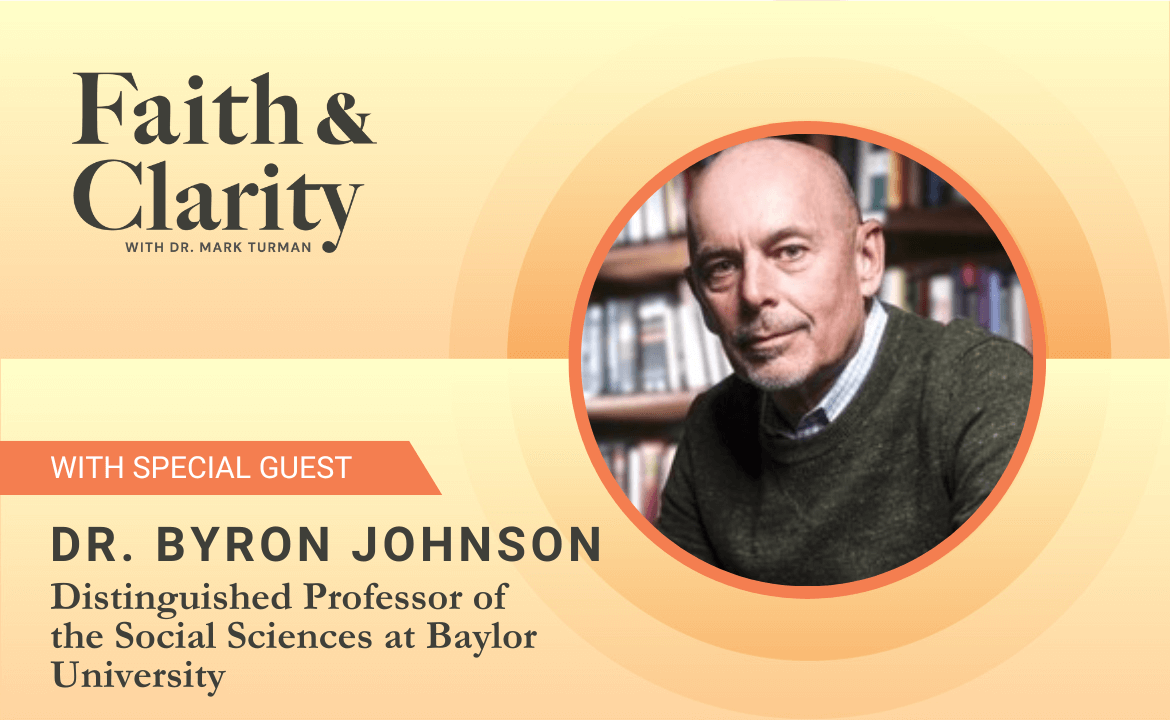
In this episode, Dr. Mark Turman, executive director of Denison Forum, talks with Dr. Byron Johnson, distinguished professor at Baylor University, about the Global Flourishing Study—a landmark research project following more than 200,000 people around the world. Together they explore how faith, relationships, and community shape human well-being, why this research matters, and what it can teach us about living lives of true flourishing. Dr. Johnson also shares his own story and the vision behind this ambitious project.
This conversation highlights the vital connection between faith and research and offers a hopeful look at what it means to thrive as people created in God’s image.



Topics
- (01:36): Introducing Dr. Byron Johnson
- (06:58): The role of religion in society
- (11:13): Challenges and opportunities in higher education
- (18:08): The Global Flourishing Study
- (30:39): Exploring the concept of the abundant life
- (33:32): Challenges in survey participation
- (35:03): Retrospective questions and early findings
- (36:14): The impact of early relationships on adult flourishing
- (38:16): Current status and future of the Global Flourishing Study
- (45:52): Global and local implications of the study
- (47:40): Faith and flourishing: Universal findings
- (53:39): The role of participation in faith communities
- (55:19): Conclusion and future directions
Resources
- Ask Us Anything: [email protected]
- How has Denison Forum impacted your faith?
- Global Flourishing Study
- Global Flourishing Study – Wave I
- Religion’s Relationship to Happiness, Civic Engagement and Health | Pew Research Center
- Faith & Human Flourishing with Byron Johnson
- Can religion make you happy? Scientists may soon find out.
- Baylor Institute for Studies of Religion
- The Human Flourishing Program
- Center for Faith and the Common Good | Pepperdine University
- Center for Open Science
- Religious Freedom Institute
About Dr. Byron Johnson
Dr. Byron Johnson is Distinguished Professor of the Social Sciences at Baylor University and is the founding director of the Institute for Studies of Religion and the Institute for Global Human Flourishing. Johnson is a faculty affiliate of the Human Flourishing Program at Harvard University and is co-executive director of the Center for Faith and the Common Good as well as Visiting Distinguished Professor in the School of Public Policy at Pepperdine University. He is a senior scientist at the Gallup Organization, and in 2016, co-founded of the Religious Freedom Institute, based in Washington, DC.
Johnson is a former member of the Coordinating Council for Juvenile Justice and Delinquency Prevention (Presidential Appointment). He has been the principal investigator on grants from private foundations as well as the Department of Justice, Department of Labor, Department of Defense, National Institutes of Health, and the United States Institute for Peace, totaling more than $100 million. He is the author of more than 300 journal articles, monographs, and books. He is recognized as a leading authority on the scientific study of religion, the efficacy of faith-based organizations, and criminal justice. Recent publications have examined the impact of faith-based programs on offender treatment, drug addiction, recidivism reduction and prisoner reentry. These topics are the focus of his book More God, Less Crime: Why Faith Matters and How It Could (2011).
Johnson’s work examines the ways in which religion impacts key behaviors like volunteerism, generosity, and purpose. These topics are covered in four books, The Angola Prison Seminary (2016), which evaluates the influence of a Bible College and inmate-led congregations on prisoners serving life sentences; The Quest for Purpose: The Collegiate Search for a Meaningful Life (2017), which examines the link between religion and finding purpose and meaning, and the subsequent link to academic integrity; The Restorative Prison: Essays on Inmate Peer Ministry and Prosocial Corrections (2021), which looks at the empirical evidence in support of the link between religion and the emerging subfield of positive criminology; and Objective Religion Volume 1,2, 3 (2023, 2024, 2025), which examine factors related to the importance and resilience of religion. His forthcoming book The Faith Factor and Social Welfare: Rethinking Evidence, Practice, and Polity (2025), examines evidence for the important role of religion and faith-based organizations in addressing social problems including drug/alcohol addiction, crime and delinquency, homelessness, offender rehabilitation, prison reform, and prisoner reentry. A Compendium of Global Flourishing Study Translations (2025), provides details on the elaborate process of translating the questionnaire from the Global Flourishing Study into 37 different languages. His forthcoming book The Death of Religion?: Nones, Others, and the Global Renaissance of Faith (2026), provides an empirical as well as historical argument countering the claim that religion in the United States and around the world is in decline.
He is the project co-director (with Tyler J. VanderWeele) of the Global Flourishing Study (GFS) a five-year longitudinal data collection and research collaboration between researchers at Baylor University and Harvard University, in partnership with Gallup and the Center for Open Science (COS), and with the support of a consortium of funders. This initiative includes data collection for approximately 200,000 participants from 22 geographically and culturally diverse countries. As part of this project, COS is making the data from the study an open access resource so researchers, journalists, policymakers, and educators worldwide can access detailed information about what makes for a flourishing life.
About Dr. Ryan Denison
Ryan Denison, PhD, is the Senior Editor for Theology at Denison Forum. Ryan writes The Daily Article every Friday and contributes writing and research to many of the ministry’s productions. He holds a PhD in church history from BH Carroll Theological Institute after having earned his MDiv at Truett Seminary. He’s authored The Path to Purpose, What Are My Spiritual Gifts?, How to Bless God by Blessing Others, 7 Deadly Sins, and has contributed writing or research to every Denison Forum book.
About Dr. Mark Turman
Mark Turman, DMin, serves as the Executive Director of Denison Forum, where he leads with a passion for equipping believers to navigate today’s complex culture with biblical truth. He is best known as the host of the Faith & Clarity podcast and the lead pastor of the Possum Kingdom Chapel, the in-person congregation of Denison Ministries.
Dr. Turman is the coauthor of Sacred Sexuality: Reclaiming God’s Design and Who Am I? What the Bible Says About Identity and Why it Matters. He earned his undergraduate degree from Howard Payne University in Brownwood, Texas, and received his Master of Divinity from Southwestern Baptist Theological Seminary in Fort Worth. He later completed his Doctor of Ministry at George W. Truett Theological Seminary at Baylor University in Waco.
Before joining Denison Forum, Mark served as a pastor for 35 years, including 25 years as the founding pastor of Crosspoint Church in McKinney, Texas.
Mark and his high school sweetheart, Judi, married in 1986. They are proud parents of two adult children and grandparents to three grandchildren.
About Denison Forum
Denison Forum exists to thoughtfully engage the issues of the day from a biblical perspective through The Daily Article email newsletter and podcast, the Faith & Clarity podcast, as well as many books and additional resources.
EPISODE TRANSCRIPT
NOTE: This transcript was AI-generated and has not been fully edited.
Dr. Mark Turman: [00:00:00] Welcome to Faith and Clarity, a Denison Forum podcast. I’m Mark Turman, the executive director of Denison Forum and host for today’s conversation. We want to take you, as we often say, beyond the headlines to a place of hope. We also want to help you to think live and serve in ways that cultivate flourishing, not only for you, but also for others.
You know that that comes out of a biblical background. Jesus said that he came to give us life, abundantly life to the full, and that he wants us to experience that, but he also wants us to be working with him to build that and to expand that, not only for. Ourselves and for those that we know and love, but for others as well until he comes back.
Other passages in the Bible speak to that. As we get ready to start school here in this time of year, we know that that leads to graduation and so many graduation cards always include. That verse out of Jeremiah 29 that says [00:01:00] that God has great plans for us. Another part of that same passage is that God tells the people of Israel to seek the welfare of the city where he has placed them for that time, and that really applies to all of us today.
Jesus also told us that we were to pray and also work. That we were to say, your kingdom come and your will be done. And so we’re gonna talk today about flourishing. What does that mean from a biblical perspective, and what are some of the newest efforts that are being done to understand what flourishing means and how you and I can be more a part of it.
In the days to come. My guest today is Dr. Byron Johnson. He is the distinguished professor of social sciences at Baylor University. He is also the founding director of the Institute for Studies of Religion and the Institute for for Global Human Flourishing. Additionally, he is faculty affiliate with the Human Flourishing Program at Harvard.
He is co-executive director of the Center [00:02:00] for Faith and the Common Good. He is also a visiting distinguished professor in the School of Public Policy at Pepperdine, and if he wasn’t busy enough, he is senior scientist. At the Gallup organization. So Dr. Johnson, welcome to the Faith and Clarity Podcast. We are thrilled to have you.
Byron Johnson: Thanks, mark. It’s good. It’s great to be here. I’m a big fan of the Denison Forum and I know so many people that are in my network that are always saying, did you hear the latest from the forum? And so it’s, it’s, it’s nice to be on the show. And again, a big fan.
Dr. Mark Turman: Thank you. We are big fans of yours and also of Baylor.
I wore my olive Green because I’m a, a Truet Seminary at Baylor graduate wow. I know that the director of the program, Dr. Previn Vaughn, would be mad if I didn’t represent the school in some way. So excited to be a part of that and also a part of this conversation as we get started.
Wanted to just [00:03:00] ask you to share a little bit about your personal story. Sure. Maybe some about your family, your journey of faith Sure. And how you ended up at Baylor.
Byron Johnson: Yeah. Raised in a Christian home. With, you know, godly parents and a great big family four sisters and two brothers, all believers.
And my dad was an academic and I kind of followed in his footsteps. And you know, faith has always just been central to my life and to my own family’s lives. And early on. I in my academic career, after getting a PhD, I began doing a lot of ministry on campus working with the navigators, inter varsity campus Crusade for Christ, and so much so that I found myself getting into trouble quite a bit for being so outspoken about my faith.
And eventually I was asked to leave the university. So right before tenure so that was [00:04:00] kind of a, a disappointing season for me. I had worked really hard. I thought I was a good academic but I was asked to leave and I thought my career was over. But God in his grace provided a much better job for me and.
Within a few years after being fired at Memphis State, I was directing a research center at Vanderbilt, which is just a few hours east of Memphis. And yeah, I was in a top 20 school. My career had just taken off. You know, sometimes God uses these things in unusual ways and so early on, very outspoken in my faith.
And then. After the, the Memphis State situation and my career, kind of just taking off as I was writing and getting grants, one of the, the things that a mentor told me said, you know, prove yourself a scholar. Hmm. Don’t worry about the ministry, because he knew how focused I was on the [00:05:00] gospel. And so that’s exactly what I did.
And then after being at Vanderbilt, I went to the University of Pennsylvania, which is an Ivy League school. And now I’m in hostile territory. I mean, you know, this is where that’s hard ground as as you might know the northeast. And, but here I am directing a research center on religion at an Ivy League school, and I thought, this is perfect.
And then Baylor kept recruiting me and you know, I told Baylor, I said. I, I think your mission is great, but I feel like I’m called to be here behind enemy lines, kind of, and with this unusual platform. But over time God changed my mind and my wife’s mind, and we moved to Baylor that was 21 years ago.
And I was recruited to build a major center dedicated to this study of religion. So when people hear about this, they think that we’re all theologians at, iSR Institute for [00:06:00] studies of Religion, but we’re, we’re not theologians. We’re sociologists, historians, philosophers we even have our own resident epidemiologist who does religion and health.
So as scholars from all backgrounds that are looking at how and why religion is so important to life. Both here and around the world. So that’s, that’s kind of the, the journey that we’ve been on. The, the institute that I direct here has become quite muscular and perhaps the, the biggest research shop in the world just dedicated to cranking out quantitative studies on the impact of religion in the world.
And then just in the last few months Baylor’s asked me to. Launch a new institute dedicated to flourishing largely because of this big study that we’ve been directing for the last few years.
Dr. Mark Turman: Yeah, that’s really helpful clarity. And something that the [00:07:00] average person may not pick up on initially, which is there is a distinction between the study of Christianity and the study of religion.
Yes. The study of religion is much more broad in scope. Is that a fair way to say it?
Byron Johnson: I, it’s absolutely a fair way to say it. And so we’re not just interested, we are interested in Christianity and there’s so many different stripes and shades of Christianity. So for example, I’m interested in the decline of the main line.
You hear so much about the decline of religion and that’s if you look more closely that you see that there are declines, but it, it tends to be in a part of religion and, and much of what people hear regrettably is incorrect, and that’s one of the things that we do is to try and. Produce research that helps people understand what’s really taking place.
Tommy Kid who’s a world class historian and I [00:08:00] just finished a, a book that will be coming out soon called The Death of Religion question mark. And in there we expose the reality that religion is alive and well in the world. And in fact, you could argue that the world is more religious than it’s ever been, but you certainly won’t pick that up from headlines that you read.
In the media. Yeah.
Dr. Mark Turman: And as, as pastors often say everybody worships something. Yes, we, we are ha hardwired to worship. It’s just a question of who or what we’re worshiping. I think that’s fair. Dr. Johnson, I was wondering if there is, was there something early on that felt like a calling or a clarity that led you into being a social scientist?
And working in this area with history Yeah. And psychology and sociology and all these different aspects and disciplines.
Byron Johnson: I never dreamed that I would be running a re a research center, which is what I’ve done for the last 30 some odd years. [00:09:00] But when I was in graduate school, I got a job working as a parole officer.
And it wasn’t by any plan, and I only did it for a little while, but. I was fascinated with the criminal justice system and some of the problems with the system. And then how might faith improve? The system and especially if, if you look at things like addicts and inmates and rehabilitation, how might religion be a part of that?
That led me to meet Chuck Colson and I began doing research for Prison Fellowship in, in the mid 1990s and have been working with. Prison Fellowship and Prison Fellowship International, as well as other groups for many, many years. And, and so I just, it just naturally felt like this is the direction I, I would need to go in.
And, and so I have felt this calling to do research and, and in that way you could argue that research is, [00:10:00] its. Its own mission field. Hmm. And you, you know, we’re we’re told by the Apostle Paul to be all things to all people. And so for some people that means preaching. And to other people that might mean would you be willing to have this conversation if we could bring evidence to this discussion and have people to see where the evidence might lead us?
And so that’s largely what we do. Present evidence that, for example, faith-based approaches to crime and delinquency or homelessness or addictions, there’s evidences to support the notion that these faith-based approaches are actually not only cost effective, but they are more effective than others. And so I think that that’s a calling that I have responded to.
And back in the mid 1980s when I was. Going to grad school, there are not that many scholars doing work like that. [00:11:00] And, and so now there are many more, which is great. Yeah.
Dr. Mark Turman: Yeah, it really really needed and very interesting how all of the different dynamics of human existence intersect and, and play on each other.
We wanna get to this new big project that you’ve been working on in collaboration with Harvard. This thing called the Global Flourishing Study. Before we do, I wanted to go down just a little rabbit trail mm-hmm. With you for a second, which is universities have been much in the news in a lot of ways.
Some would say taking it on the chin. Yeah. Others would say getting what they deserve. Yeah. Harvard in particular. Yep. Because of everything that Harvard is in the general culture has certainly been at the forefront of that. And I was just wanting to see, you know, sure, as all institutions, but particularly institutions of higher education have really come under fire in a lot of ways.
I wanted to see what you would say about how that’s been for you [00:12:00] personally. Yeah. What is it like to Yeah. Do a project with people at Harvard? What have you found in terms of, yeah. People of faith there. Yes. And even Baylor has at times Sure. Taken some knocks on the chin as well. Yeah. What’s it been like from the inside of higher education?
Byron Johnson: These are interesting times to say the least, and I’m so glad, mark, that you, you’ve taken a few minutes to, to go there. Let me start with the Baylor piece first. Baylor’s a Christian university with a great mission. And it was one of the things that was appealing to me, and I think over the last 20 years, a lot of people have only come to Baylor on the faculty because of the mission statement.
Hmm. Otherwise, why come here? Yeah. I, I, I, I would’ve just stayed in the Ivys if it weren’t for that, that mission statement. But I, I always feel like our faith journeys are one where if we’re not careful. We can be retreating [00:13:00] instead of moving forward in, in our faith journey. And it’s, it’s true for an institution.
And so a place like Baylor it needs checks and balances. And you know, when you have over 20,000 students and, you know, a thousand faculty you don’t expect that they’re all going to walk in lockstep, but you do want them to support the mission. And, and so at, at Baylor, this is something though that I, I don’t think we should just assume naturally happens.
Mm-hmm. And I know for a lot of Baylor alums, they just assume, you know, that everybody’s wholeheartedly committed to, to live out that, that mission. And I, and I know that people can see the mission in different ways. We have to be intentional and we, we do our own journey and we do as an institution.
So whenever invariably we make our own missteps, I think that’s one of the reasons why if you look at congregations that are thriving, it, it’s because a lot of these [00:14:00] congregations not only have great leadership, but they also have, you know, a very strong small group. Program as well as other programs that reach out to people’s needs and, and where you can hold people accountable.
And, and so we, we need accountability at Baylor for sure, so that we don’t stray from the mis mission that we don’t need another TCU or another SMU. We already have those, those are schools that were kind of formally faith-based that would say that, you know, that’s not their mission anymore. And, and you know, at one time Harvard was a.
A Christian university and that’s why it was founded. And now, and now you see open antisemitism at Harvard as well as other Ivy League schools and even state universities. This is very sad. Yeah. And, but you know, donors can play a key role not just regions, but. Hmm. A lot of [00:15:00] donors now are pulling back their funding from Harvard.
It’s not just the federal government. I mean, this is, this has been highly unusual for the federal government to freeze all federal funding for, for academic institutions that have now become dependent. On these grants. So we’re talking hundreds and hundreds of millions of dollars that has just been stopped.
Hmm. And, and I think this is a, a wake up call. To, to universities and also to people that support these universities that, you know, maybe they need to, to, to hit a reset button. I think we need to keep monitoring it because I do think a lot of universities will just figure out another way of doing the same thing.
Hmm. They may say that they’re going to do X and y just so those federal funds will come back, but then they, they reformulate these policies in different ways, these DEI policies, for example. So I, I do think we [00:16:00] need to keep watching it. I do think it’s a sign of the times. I mean, who would’ve thought that we would see such open hostility to Israel?
Hmm. And, and to Jewish people after what we’ve experienced in the Holocaust. But here we are. Yeah. And, and so that, I think one of the things that’s that Christians need to understand, of course, is that the same people who hate the Jews have a similar feeling. For, for Christians that are serious about their faith.
So this is, this is something we should all be very concerned about. And I will say this Harvard, the Human Flourishing Program, which is our partner at Harvard University, is led by Tyler Vander Will, who is one of a, a generational scholar and impeccable character. A very serious Christian.
And he has assembled an amazing team. At Harvard obviously they’re, they [00:17:00] don’t have a requirement a faith requirement at Harvard like we do here. But they certainly have a number of people on their team that are faithful. And we have just enjoyed this incredible relationship of working together.
It’s been great for Baylor. To be partners with Harvard, even though I think some people think, whoa, what’s, what’s going on there? Yeah. And, and the partnership is essentially with the human flourishing program. And a great connection and our team of about 50 between Baylor and Harvard have become one big team.
And it really has been quite phenomenal. As you know, academics are weird in general. Yeah. And so when you get 50 academics together, you think that’s not gonna work out very well. But we, we’ve been working together for a number of years now, and it’s a, it’s a special. Season for us. For sure.
Dr. Mark Turman: Does that sounds, sounds like there could be a plethora of stories coming out of Yes.
50 academics being together. [00:18:00] Yeah. But that’s kinda sets us up for the larger part of our conversation, which is this thing, this very big project that you’re working on now with. Harvard called the Global Flourishing Study. So help us kind of set the table before we take a break about Sure. What in the world is Yeah.
The Global Flourishing Study and how long has it been around, what’s the right size and scope of this thing? Yeah. And what is it trying to do?
Byron Johnson: In 20 18, there was a meeting at Harvard University at the Human Flourishing Program on flourishing, and 13 scholars were invited to attend this meeting for three days.
And it was just a time for 13 people from different fields, political science, econ psychology, sociology. Et cetera to come together and talk about their work. And, and Tyler Vanderwell at Harvard convened a meeting. And so I presented on a lot of the work that I do in criminal justice and the, the role that religion plays in reforming individuals in, in [00:19:00] reforming institutions.
And it was in that meeting where Tyler was giving a talk on correlation versus causation. Hmm. That really convicted me. And the talk was, most of what we know is correlational. We know that X is related to Y, but do we know that X causes Y? No, we just know they’re related. So for example, we know that people who go to church tend to be happier than people that don’t go to church.
Is, is that because going to church makes you happy or is it just the other way around? We know they’re correlated. But you have to do a certain kind of research to be able to say, oh, now I get it. We can now demonstrate that going to church helps you lead a happier life. Not only that, a longer life and a more fulfilled life.
So you, you need that kind of causal research. And it [00:20:00] got me thinking, what kind of a study might we do? That would allow for causal conclusions. And, and one way of doing that is a longitudinal study where you follow the same people. But those, those are expensive and that’s why there’s so few of them.
And so typically you might say, let’s do a study of 3000 people that live in the, in the Dallas metroplex, and let’s follow these 3000 people over time. It’s a heavy lift because they’re moving, changing locations changes in their life. You can’t find them. But that’s what you really want to do.
And because I, I’m a, a, a scientist at Gallup and I have strong ties there, going all the way back to George Gallup, Jr. I mentioned to Tyler, what if we could do a longitudinal study but do it globally? Hmm, not, not 3000 people in Dallas, but what about you know, over 200,000 people around the [00:21:00] world?
And he was Byron, who wouldn’t wanna do something like that? But I don’t even know if it, if it’s technologically possible or. If it could even be funded. And I said I’ve got a big meeting with Gallup next week with the, the leadership of Gallup. I’d love to pitch the idea, do you wanna come with me?
And, and so that was late 2018 and took us three years mark to raise the funding. To launch the study, which has become now known as by far, the largest longitudinal study in history. And there’s not even a close second. So it’s a massive project in about 40 languages on all six populated continents.
And this will allow us over time to do causal studies. We released a bunch of studies in on April the 30th in the nature portfolio of journals showing the early results from wave one, but [00:22:00] now we’re in. Wave two studies and, and so we have two different time points, and then next year we’ll have three different time points.
That’s when all the causal studies will start taking place. So nothing like this has been attempted before. And it truly has been kind of a pathbreaking project or we wouldn’t be getting, nature and nature journals, the top journals in the world to take a, a serious look at us if, if it weren’t something that was truly extraordinary.
Dr. Mark Turman: Yeah. And it just, every time I learn a little bit more about it, it just seems to be unbelievable in terms of its. Of its reach. Mm-hmm. Tell me if I’m, I’m getting some of these details that it’s a five-year study that it involves hundreds of thousands of people, as you said, from 40 different languages.
And if you pull all that together, it represents something like 67% of the entire population of the world representative in the, in a, in a, in a statistical, credible way.
Byron Johnson: Yeah. I [00:23:00] mean, when you say it. I, I’ve said that myself so many times, and every time I hear it, it’s kind of mind boggling because sometimes you’ll hear something about a new study and you’re going, I don’t think the findings sound right.
What was the sample? Was it a convenient sample of people in your backyard or was it something that’s representative of the population? And so these are nationally representative samples, so to say that we’re talking to a representative sample of two thirds of the Earth’s population, it’s, it’s a bit difficult to comprehend how difficult it is to make something like that happen.
Dr. Mark Turman: Yeah. It just, it is just astounding. And and to do it over time is, is a really phenomenal kind of effort. Hmm. And yeah, and when we come back, we’re gonna take a break here for a minute, but when we come back, we wanna talk about, you know, what is it like to be a participant in this study? And everybody would love to be able to get to that place of what you were [00:24:00] talking about a moment ago of, Hey, we don’t know that these, we know these things are just related.
But can we get to the place of saying this is causing that? Hmm. And to get to that level of clarity in any kind of a research project is kind of the gold, the golden bar, if you will. Yeah. So we’re gonna take a minute to step aside, let you catch our, catch your breath, let us do the same, and we’ll be right back and we’ll continue our conversation about flourishing.
Alright, we’re back talking with Dr. Byron Johnson about human flourishing and this project called The Global Flourishing Study. Dr. Johnson, not too many of us perhaps have ever participated in a research study, especially one of this magnitude. Tell us a little bit if you, when you find participants, I think I heard something around the number of 40,000 Americans.
Something like that to create a credible data set within our part of the world. What’s it like for [00:25:00] these participants? Mm-hmm. How, how do you connect to them? Yeah. What kind of time do you get to spend with them?
Byron Johnson: Yeah. Great. Great question. The Gallup organization based in Washington, DC is our partner.
And they do the field work for us, and they’ve been just an unbelievable partner. And so we impanel participants. So people are invited to participate based on a, a, a number of characteristics that help us identify people randomly. And they’re asked to participate in a survey. We, we, we do give them a, a small token.
Gift for participation. It’s, it’s, it’s nothing significant, but when you multiply it times 200,000, it does add up. And then we want to keep people in the study, so we have to do what we call retention efforts. We wanna stay in touch with you. We don’t wanna be a pest. [00:26:00] But we don’t wanna lose sight of you because what if you change addresses or or what if, what if a relative dies and your life just really does change in significant ways?
We wanna make sure we don’t miss anything. So we’re talking to people once a year. But then there’s this midyear. A retention effort where we’re in touch with people just to make sure nothing has changed, like an address or, or employment, something like that. So these efforts are ongoing and it is a heavy lift when you’re talking about this many people.
And it’s not like these people are all located in urban centers. Some of them are located in remote villages a hundred miles from the nearest big city. And so that’s why the project is such it is, it’s kind of hard to get your arms around when you think of the, the, the scope of, of getting people both in rural and in urban communities and then going through a [00:27:00] 22 minute survey with them.
You know, people may think we’re talking to these people for an hour and a half. No, we’re not, because when you’re talking to someone. Either on the phone or if they’re happen to be on a computer and they’re completing a survey. There’s only so much that people are really willing to, to take the, before they experience what we call fatigue in a survey.
So 22 minutes is the cutoff for us. And you can’t ask everything you would like to ask. So we, we have about 109 questions that we go through. And these, these are typically on a scale where we’re asking people where zero indicates on the low end of the scale, like a disagreement or the worst possible situation, and 10 is the best possible situation or, you know.
Total agreement and, and so people can respond on those scale on a scale like that. And we’ve had [00:28:00] to trim the survey dramatically from the original survey. Even the, the, the, the building of the survey took us a year because we wanted to pilot. The survey, how does the survey do? So in each of these countries, these 22 countries, we had to go and do pilot work to see if the questions actually worked.
And if they didn’t, why didn’t they? And then rework those items. And most of these items had been validated in, in previous research. And a number of people have said, okay, do you ask questions about music? I think you need music if you’re gonna flourish. And it’s a good point, and some people have said to us, how can I worship if I’m not listening to or participating in music?
It’s a great question. We just couldn’t afford to have another question on music. So as we think about the future, we’re, we’re actually looking at adding questions that would tackle some of these issues that are really good points. [00:29:00] Like how can you have flourishing without art? And so we, we do have areas that are missing from the global flourishing study, but we do also cover quite a few areas in a 22 minute survey that allows us to ask questions about a host of things, including, for example, what it means to flourish.
And, and before I forget, I do wanna tell your listeners, what does it mean to flourish? And I’m, I’m sure most people have a good idea of what it means. Some people would think it’s, I’m, I’m happy or I’m not happy. And, but, and we have a question that deals with happiness, but happiness is fleeting.
Mm-hmm. And it’s only one item. We, we feel like flourishing is a, a much more complicated thing than happiness. And so we ask questions that, that deal with your physical health. Your mental health, your relationships with other people. We ask about [00:30:00] character and virtue and then we ask about financial security.
These domains are important meaning and purpose, it’s very possible that someone that has a terminal cancer diagnosis would take the survey and would come out and score very high on flourishing, even though they’ve just received this terrible diagnosis. You know, flourishing is not the absence of pain or suffering.
Hmm. Flourishing is living a life well. And so that’s why some of the, your listeners and viewers may be familiar with a documentary series on the Blue Zones. This is about people living to be a hundred. And it’s a, it’s a fascinating documentary, but it’s not based on science and it’s based on anecdotes.
What, how do people live to be a hundred? And it’s about the Fountain of Youth, but we would say it, it’s really not about the Fountain of Youth. It’s about living your life well [00:31:00] or what, as you said at the top of the show, living the Abundant life. Talked about in John 10, right? And so what, what is the abundant life?
And so the abundant life, we think captures all of these domains. If you’re doing well in all of these domains, you’re probably doing really well overall. And so that’s why I think the global flourishing study really helps us at the individual level to take an inventory. How am I doing? And then the idea also.
Is, how am I doing in the community that I live in? Hmm. Because it’s hard for me to flourish if my family isn’t flourishing. And, and, and, and likewise, you could even take this to the congregational level for, for listeners. How, how, how is our congregation doing as a body? Are we flourishing as a community?
The, the interest in the global flourishing study has been quite phenomenal, be, and we didn’t expect it, but major businesses are [00:32:00] wanting to talk to us because they want their companies to be flourishing companies, right? And these are completely secular companies, but they are interested in making money.
And they feel like if they have employees that are flourishing, then they’re gonna make. More money for the company. How in the world do we see if we’re doing that in, in a way that facilitates flourishing? So that’s, that’s kind of how we look at flourishing.
Dr. Mark Turman: Yeah. So much, so much to think about. And like I said, so many things you would want to ask.
And to your point about businesses, you know, businesses choose where they expand to based on, hey, is it a good school system? Do they have good roads? Yeah. Can you get to an airport? They’re, they’re basically asking questions that, yes, hey, can all of us flourish in this area if we put the company there?
Yes. Because they’re concerned about it. And and we all have this flourishing, kind of feels like one of those things of I know it when I see it. Mm-hmm. Mm-hmm. But, but your project is trying to actually define something that we [00:33:00] all kind of. Intuitively think that we know what it is. Yes. But there actually is a lot of work just to try to define what flourishing means.
Yep. And as I’ve, as I’ve listened and learned more about your work. That so much of this does. It’s not overtly something you’re asking about from a biblical standpoint, but it does line up with what the Bible describes as flourishing, both in a earthly sense and what will be ultimate in the kingdom of heaven that it does line up around that.
And I, I kind of resonate with the idea of trying to keep up with these people in 22 minutes. In one way, doesn’t sound like very long, but from a research survey standpoint, if you’ve ever been, you know, you go to your favorite store, your favorite restaurant. And they send you a request, Hey, would you fill out this survey?
You know, I, in my part of the world, I’m a big Whataburger guy. Yeah. And I’ve, I, I don’t think I’ve paid for [00:34:00] a hamburger for the past three years. ’cause I always do their customer survey. Survey. Yep. And they give me a free hamburger because of that. But most people don’t do that. They’re like, oh, I don’t have time for a survey Even.
Yeah. Even a three question survey, they don’t wanna do it. That’s, I’m
Byron Johnson: so glad you mentioned that. You know, because those surveys, you get irritated if it’s gonna take you more than two or three minutes.
Dr. Mark Turman: Yeah.
Byron Johnson: But you, you begin to see why pushing the outer limits at 20, 22 minutes is about as far as we can go.
Dr. Mark Turman: And then not only 22 minutes, but you’re asking them, you’re not asking them about hamburgers, you’re asking them about stuff that’s much, much more profound and much, much more significant. You talk. So give us a, a, we talked about this offline, but going a little bit further into kind of what this is like and what are you asking these people.
Mm-hmm. You were telling me offline that you asked people about, Hey, tell me about your life when you were 12, and then tell me about your life now and Yeah. What are you trying to [00:35:00] find out? Yeah. In those kinds of questions and conversations.
Byron Johnson: You could argue that the global flourishing study.
Rightfully so will be more meaningful in the next three to four years when we have data over time. But how can we make the data relevant right now? And one of the things that we did was to ask a series of questions about your life at the age of 12. And you know, you could argue that people’s memory may not be that clear, but.
This is not uncommon to ask these retrospective questions, and people tend to respond honestly, to these questions. And so we ask them, you know, what kind of a relationship did you have with your mother? What kind of a relationship did you have with your father? Did you participate in religious services regularly or not at all?
As when you were growing up, did you experience any kind of abuse? Did you feel like an outsider? So asking [00:36:00] these questions, let’s just say that you’re 40 years old. It’s not too hard to think back to when you were around 12 and what your life looked like and, and what we’re finding. And this won’t come as a great surprise.
Is that people who have a good relationship with their mother and their father at, at the age of 12. Do better on a host of outcomes as adults and they’re much more likely to flourish. People who participated in religious services as a 12-year-old are much more likely to participate in religious services as an adult, and they’re more likely to score higher on these domains of human flourishing.
Not a great surprise. People that grow up in a broken home. Are, are much more likely to pr have lower flourishing scores. Hmm. This doesn’t mean. That if you experience trauma as a 12-year-old, you, you’re, you’re not, you’re gonna languish your whole life. [00:37:00] That is not the case. And, but it does set many people back to have these negative early childhood experiences, and I think, again, this won’t come as a surprise to many.
That those are important years. And so there, there’s, I, I’ve said this so many times that raising kids is the most important thing that you’ll ever do. And so you need to do it well. And this is just some preliminary evidence. It gives us what we call a synthetic longitudinal, where we’re asking these questions that happened 20, 30 years ago to see how they connect with your life now.
And I think that’s just another another warning to us to, to, to try to take these things seriously. If, if people have young families.
Dr. Mark Turman: Yeah. And so helpful. You know, we, we all, as broken people, we try to justify our decisions and one of the ways we try to do that is to say it’s not gonna hurt.
Or at least not, [00:38:00] it’s not gonna hurt that much. Mm-hmm. Yeah. We’ll, people are resilient. Kids are resilient. We’ll recover. And in many cases that is true. Yes. Especially with God’s grace and strength. Yes. But the choices we make do matter. Yes. And they have far reaching consequences. Both personally and corporately.
Dr. Johnson, before we take another break for a minute, I wanted to ask where are, where are we, where are you in the study? Mm-hmm. When did you start gathering data? Yeah. When will you stop gathering data?
Byron Johnson: Yeah. Great. Great question. The study officially launched in late 2021. We did a year of pilot work around the world.
Then we began collecting data in 22 and 23, and then we released the first wave of data about 16 months ago, and then we released the first studies a couple, two or three months ago. April the 30th was when we released about 40 studies at one time. That too [00:39:00] is unprecedented. Usually when you do a special collection, you’re talking three or four papers, and so the, the nature journals were overwhelmed with the response when we said that we would like to write a bunch of papers.
I don’t think they ever thought that we’d be submitting that many papers, but it’s been a, a very prolific team. So now we have wave two data in hand. And as we speak, we’re writing many papers and these papers will begin to roll out in February of 26 from wave two. We are now, on the field already collecting wave three data.
Hmm. So once the, so this cycle will continue for five waves and so we still have a ways to go. But the real key question that a number of people are asking, oh, this is so sad that at some point this study’s gonna end. And because it is an expensive [00:40:00] study. Hmm. So it’s already a $48 million project and we’ll probably need to raise an additional 12 million to get us through all five ways of data collection.
Hmm. So it’ll be more like a $60 million project and you can’t keep that up indefinitely. But we are looking at ways that we might be able to reimagine the global flourishing study at the conclusion of this. Project that would allow it to continue what we’re calling GFS Global Flourishing Study 2.0.
Wow. How, how might, how might you reinvent it so that you could. Potentially keep it going. Yeah. That too has never happened in history. It’s a, it’s, it, it’s a big lift and but we’re just trying to dream Big Mark to see what might be, what might be possible, how we think that the Global Flourishing study, the response has been overwhelming.
By the way. We, as of a month ago, there were over 1500 stories around the world on the global [00:41:00] flourishing study. Wow. And so it received massive coverage outside of the west, which is what we were really hoping. And the funders were hoping, because most of the research is done here in the United States or the West more generally.
So to get that kind of global coverage with the media has just been fantastic. And even more fantastic is most of the coverage has been from the secular world. Hmm. And Christians I think are very interested and religious people are interested in the findings, but to see the secular. Response is, I mean, we were in the New York Times, three times in one week, so that response is much more significant than we anticipated, which really is encouraging to us because we do feel like there’s so much that that’s consistent with a, a worldview that you’re listeners would appreciate.
And it’s a way we think it’s a compelling way to ask people. Important existential questions about meaning and [00:42:00] purpose in life. Yeah, absolutely. And, and I did an interview on Sirius xm and this, this one person was saying, you know, I’m really struggling as an atheist with some of your findings because you, you’re finding that religion is so important.
Yeah. You know, why is religion so important? And I said you know, perhaps it’s the fact that people coming together. And being in a community and forming these networks, these strong support networks where they support each other and, and they, they, they take, they look after each other. They, they look after the needy in their midst and in their communities.
I said, you know, it could be that these kinds of things are having a real effect. So I’m trying to talk strictly in academic. Jargon, but you know, this, this is why the scripture says that, you know, we should not forsake in, in Hebrews the, the assembling together. There’s something that’s powerful that’s happening in congregations that, [00:43:00] that we think is really significant and driving a lot of the effects that we see with religion.
Dr. Mark Turman: Yeah, we’re gonna, I wanna come back after our next break and talk about that specifically for a few minutes. And just this, this sense that we so desperately are made for community and we are also we know in, in our, our soul and our being that there’s something transcendent about us. What the Bible means when it says that God put eternity in our hearts, that there’s something eternal about us that.
Many unbelievers haven’t yet put their arms around in some ways. So we’re gonna take another break and then we’ll be right back and finish our conversation with Dr. Johnson. I. All right. We’re back to finish our conversation with Dr. Byron Johnson at Baylor about human flourishing. Dr. Johnson, I wanted to kind of just wrap up this section with a question of, this idea kind of got started in 2018, and then it started to really happen in, as you said, the later part of 2021.[00:44:00]
How if, if at all, did the COVID experience factor into your situation? Is it showing up in the research in any way?
Byron Johnson: You know, it’s such another great question. When we first started the conversation in 2018, we didn’t think it would take three years to get the project funded. Hmm. And if we had been able to get it funded much quicker, we would’ve had pre COVID data.
And so as it turns out, the project launched at the end of COVID. Hmm. And so it, this would’ve been a perfect natural experiment where you could look at pre and post COVID. So we don’t have that luxury, but I do think we see things that happened during COVID. That are in the data. So for example, young people are not doing well and this [00:45:00] is a new finding in that traditionally if you look at flourishing, you see a U-shaped curve where the young do do really well and the older do really well, and in the middle, the middle aged population not so well.
And you think why wouldn’t they be doing well? They have all the burdens of life. They have a mortgage, they have kids, they have aging parents. Mm-hmm. There, there’s a lot of pressure on families and people in that era of their lives. And so you see a u shape, but now we, we don’t see the U shape.
We’re, we’re seeing what we call a j where young people are actually struggling. And then as the, the older people get they tend to flourish more. And so this is a cause for concern for many around the world, clearly for policy makers. And, and, you know, what do you do about it? So the implications of the Global Flourishing study have [00:46:00] significant policy ramifications on down the road.
In fact, we’ve been talking to people in in local governments. As and state government as well as the, the federal government, if, believe it or not, we do not ask data on flourishing in the federal government. None of the agencies,
Dr. Mark Turman: nobody does. So you would
Byron Johnson: think agencies like the Department of Defense where you have all these families that are dealing with deployment, right?
And they’re really struggling. You’d think we’d want to ask them questions that deal with human flourishing, but we have not. And we dealt with HUD and the homeless. So you, this is deeply troubling. And so we’ve been meeting with officials in, in Washington about the possibility of including flourishing items across the federal government as kind of a report card.
You know, how are we doing with all of our programs and cities too have been reaching out. I, you know, we wanna be a flourishing city. What do we need to do? So [00:47:00] there’s these huge implications. Congregations have been reaching out to us as well, and we’ve launched a major flourishing in the church. A project that’s anchored with churches in San Francisco and churches in San Antonio.
Six churches in either location. And then we’re including a church actually in the metroplex for our 13th congregation, where we’ll be following these congregations over time to see how they’re doing.
Dr. Mark Turman: Yeah. So many roads to go down here, it’s, it’s hard to, to just narrow it in. And like I said, there’ll be years of.
Of more interpretation and understanding and explanation of what the study reveals. While we have a few minutes talk about what the study is already indicating about either the positive or negative impact of faith or even kind of the non-impact of faith. Yeah. And maybe to set that up, Dr.
Johnson, the idea of. That in the study, faith is defined broadly. It doesn’t ignore Christianity, but it’s not exclusive to [00:48:00] Christianity. Yeah. What are you finding about the factor of faith? Yeah. As it, as it relates to flourishing
Byron Johnson: you people. The first thing they want to know is, are there universal findings?
Right across the world. And what we find of course, is that there’s significant variation in countries, between countries. I mean, as you indicated earlier, we have 38,000 people just in the US sample alone, which is just fantastic because now we’re looking at, believe it or not, the states, how are the states doing in flourishing?
Oh, wow. And we’re comparing them. That’s another conversation mark that we’ll have to have later and, and people are interested in. The countries, which countries are flourishing more than others? Because the World Happiness Report says that Finland, for six years in a row is the happiest country on the planet.
And the Scandinavian countries more generally are the happiest on the planet. Guess what? We don’t find it. We, we [00:49:00] find that the US and the Scandinavian countries are in the middle. And that Indonesia and Israel are the two happiest, are the two most flourishing countries, Japan at the bottom. So maybe we
Dr. Mark Turman: don’t, so maybe we don’t all need to move to Finland, is what you’re telling me that I think that’s exactly right.
Byron Johnson: And, and so I think a lot of journalists are saying, I, I was always troubled with that. I never could understand. But here, here’s a couple of things that, that I think are just telling, and that is that GDP. Is not a good predictor of flourishing, and I think people want to bring everything down to money and the economy.
Does that mean that the economy and money are not important? No, they are important, but if you look at the US in terms of financial security as a country on that domain, we’re doing really well. But if you look at the US with meaning and purpose and close relationships, we’re not doing so well. [00:50:00] And so that pulls us down a bit.
And then you look at some of these countries in the developing world where their economy is in shambles. They had, they have more meaning and purpose and, and, and maybe even more character and better relationships. And so I think there’s lessons to be learned here. And, and someone said are you saying that we’ve lost our way in the United States?
And you could argue in, in many ways, perhaps we have lost our way a bit, and you know, how can you pay attention to all of these things? You don’t deny that the economy isn’t important, but how do you focus on these other matters like faith? Hmm. Because faith is a universal finding, right? It, it, and, and you know, so you’re right.
We, we do look at how often you participate. That’s our our main variable. But we do look at other things like prayer and meditation and other religious practices that are also important. We will be doing studies [00:51:00] where we literally compare the, the, the, the construct of gratitude. Or generosity or forgiveness, and look at different religious traditions.
That’s the beautiful thing too. We have data on all the great religions of the world, so we can actually compare between the religions. And those are studies that will be forthcoming that, and that too has never been done before with an with a representative sample. And but it, the good news is faith matters.
The bad news is a lot of people are hurting across the world. And even though we have the internet. People are more isolated increasingly than they have been. There’s a, a significant number, a percentage of the population. They’re dealing with stress and anxiety. And I think for, for, for believers out there, this is another reason why I think faith becomes so central, [00:52:00] seeing that there are people struggling and what might we do to help people?
Dr. Mark Turman: Yeah. And that’s so much a part of what the church needs to be about. You know, and interesting that you point out that technology. You know, we’re, we’re gonna be studying on multiple levels, the impact of technology and social media. You know, my pastor, another great Baylor graduate, said to me 30 years ago, you know, technology can make the world a, a neighborhood, but only Christ can make it a brotherhood.
Mm-hmm. You know, and, and just because we have this technology doesn’t mean that we’re necessarily gonna thrive. Also makes me, you talk about GDP and the, the economy of a nation. You know, I’m, I’m helping with a a city and countywide movement here where I live. And some of the research that we’ve been able to gather that’s several years old indicates that, hey, just because we have a, a really striving and thriving economy, it’s not resulting in, in happiness and flourishing.
Yep. There are some things you simply can’t buy with money. That’s right. And it reminds me of a, a [00:53:00] much more shallow survey of some 30 years ago where people were asked in America, what do you most want? And. The overwhelming answer was I wanna be thin and I wanna be rich. Yeah. And, and there are a lot of thin, rich people walking around who are not flourishing.
Byron Johnson: That’s so true. And, and so I think that the, the Global Flourishing study will give us some rigorous data to come behind those, those stories that you’re mentioning. They’re, they’re really spot on. Hmm.
Dr. Mark Turman: I, I would love to just keep talking for a long time, but we’ve got a couple minutes.
I know you need to run. Let me ask you kind of a commitment question. Yeah. The study indicates that there are very significant difference differences between people who are religiously affiliated versus religiously participating, or not affiliated at all. You’ve alluded to that already. Talk for just a minute about the significance of actually participating in your faith as compared to just.
[00:54:00] Saying that you’re affiliated with faith.
Byron Johnson: It it, it’s the game changer. It really is. And I think that it, this finding supports previous findings and I think that, that if people attend Houses of Worship, they, they are at times passive beneficiaries of just being in that congregation, but they’re, they’re bystanders.
They’re observing, they’re not participating. And I think that that’s where the magic happens. And I think for, for me, I study prisoners and, and, and so when you see a prisoner that comes to faith and they be, they become a part of a family, they become a part of a group, then they become more other minded.
Hmm. And then over time they, their whole mentality is focused on others and serving others. This is something that happens as a result of just participating and, but I think our natural tendency is to pull away. [00:55:00] And, and so this is why participation is so important because what happens is there’s a transformation that takes place that’s other minded, which is essentially the gospel.
Hmm.
Dr. Mark Turman: Yeah. So important for us to remember and so important for us to model Yes. For other people starting with our families. Yeah. Dr. Johnson, I know you need to, to move on to other projects this morning. I wanna thank you for being a part of our conversation. My pleasure. Is there a, is there one place that people can go to?
Yeah. Keep following the Global Flourishing Study?
Byron Johnson: Yes. So there’s a website and it’s just spelled global Flourishing study.com. Hmm. That’s, that’s where people can go. We’re launching a, a, we just launched this week, a new website here at Baylor, and perhaps I can send you that too. But the global flourishing study.com is already live and, and people can get all kinds of great information and, and download the data, by the way, are available to the public.
Hmm. It’s an [00:56:00] open access project. That in and of itself is really important to.
Dr. Mark Turman: Yeah. And lots, lots of stuff to come and we hope to have you back for updates. Love to come back. And things that you’re learning. And like I said, we, you know, we’ll need really smart people like you and people on your team to interpret the data and help us get our minds and hearts around it, and then to apply it well, yeah, and we look forward to doing that so that we can all flourish and flourish as much as possible.
Until Jesus comes again, wanna thank our audience? For being a part of our conversation. As always, if this has been helpful to you, please rate and review us on your platform and share this with others that helps them to connect to things that matter as well. We’ll see you next time on Faith and Clarity.










 Search