



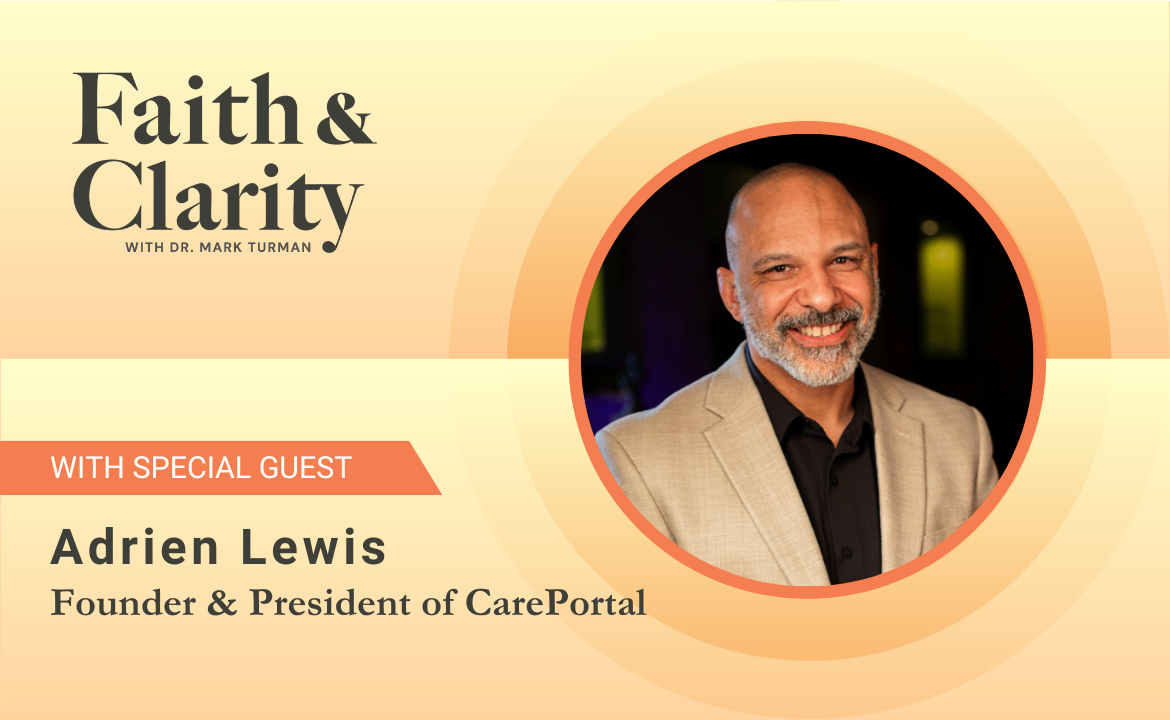
On this episode of the Faith & Clarity podcast, Dr. Mark Turman sits down with Adrien Lewis, founder of CarePortal. This platform connects people and resources to meet the real-time needs of children and families in crisis. Adrien shares how a single mission trip shifted his path from business to a life of serving vulnerable kids and how that moment of clarity sparked what would become CarePortal.
Since its launch in 2015, CarePortal has been addressing a hidden foster care crisis in the US, where millions of children are referred to child protection agencies each year. By leveraging technology, CarePortal enables local communities to respond quickly, connecting caseworkers, churches, individuals, and businesses to meet urgent needs in real-time. Adrien explains how the platform empowers people to share responsibility for care, turning moments of crisis into opportunities for transformational connection.
You’ll also hear about the role of the church in this mission—how helping children and families unites communities, provides common ground in a divided world, and gives believers a tangible way to follow God’s call to love their neighbors. Adrien walks through how CarePortal works, how it’s funded, and the impact it’s had on communities nationwide.
If you’ve ever wondered how faith and innovation can come together to change lives, this conversation will inspire you.
Powered by RedCircle



Topics
- (01:11): Introducing CarePortal and Adrien Lewis
- (03:06): Adrien’s faith journey
- (07:21): The pivotal mission trip
- (12:00): Understanding foster care
- (14:53): Adrien’s personal foster care experience
- (18:43): Community and foster care
- (25:36): Understanding the impact of poverty on children
- (27:38): Introducing CarePortal: A technological solution
- (28:04): How CarePortal works: Connecting needs with helpers
- (30:52): The role of the church and community in CarePortal
- (43:24): CarePortal’s growth and vision for the future
- (47:05): How to get involved with CarePortal
Resources
- Ask Us Anything: [email protected]
- How has Denison Forum impacted your faith?
- Facebook: Adrien Lewis
- CarePortal Website: CarePortal
- CarePortal Facebook: CarePortal | Kansas City MO
- CarePortal Instagram: CarePortal (@careportal) • Instagram photos and videos
- CarePortal X: CarePortal (@_careportal) / X
- CarePortal YouTube: CarePortal – YouTube
- CarePortal app connects charities to families in need | Fox News Video
- Adoption and foster care isn’t a have to—it’s a get to – Christian Parenting
- Our ordinary family’s extraordinary foster care journey – Christian Parenting
- What Every Christian Parent Needs to Know About Foster Care
- Foster Care & Adoption: “Lies, Truths, and Horror Stories” – Christian Parenting
About Adrien Lewis
Adrien Lewis began his career as a business development professional, spending a decade working in healthcare, technology, and education. In 2007, a mission trip to Haiti with his wife, Cynthia, transformed his perspective and deepened his calling. Over the next three years, he volunteered with The Global Orphan Project, where he witnessed firsthand the power of connection in caring for vulnerable children.
In 2010, Adrien felt a clear call from God to leave the business world and fully dedicate himself to advocating for orphaned and abandoned children. This journey led him to become a foster and adoptive parent and, ultimately, to develop CarePortal — a Care-Sharing technology that mobilizes communities to take action for children and families in crisis, creating meaningful connections that change lives.
About Dr. Mark Turman
Mark Turman, DMin, serves as the Executive Director of Denison Forum, where he leads with a passion for equipping believers to navigate today’s complex culture with biblical truth. He is best known as the host of the Faith & Clarity podcast and the lead pastor of the Possum Kingdom Chapel, the in-person congregation of Denison Ministries.
Dr. Turman is the coauthor of Sacred Sexuality: Reclaiming God’s Design and Who Am I? What the Bible Says About Identity and Why it Matters. He earned his undergraduate degree from Howard Payne University in Brownwood, Texas, and received his Master of Divinity from Southwestern Baptist Theological Seminary in Fort Worth. He later completed his Doctor of Ministry at George W. Truett Theological Seminary at Baylor University in Waco.
Before joining Denison Forum, Mark served as a pastor for 35 years, including 25 years as the founding pastor of Crosspoint Church in McKinney, Texas.
Mark and his high school sweetheart, Judi, married in 1986. They are proud parents of two adult children and grandparents to three grandchildren.
About Denison Forum
Denison Forum exists to thoughtfully engage the issues of the day from a biblical perspective through The Daily Article email newsletter and podcast, the Faith & Clarity podcast, as well as many books and additional resources.
EPISODE TRANSCRIPT
NOTE: This transcript was AI-generated and has not been fully edited.
Dr. Mark Turman: [00:00:00] Welcome to Faith and Clarity. I’m Dr. Mark Turman, executive director of Denison Forum, and here to be your host for today’s conversation, where we try to help you find hope beyond the headlines. And we also want you to find real practical ways to serve. In the kingdom of God, intentionally so that you can be that salt and light that Jesus talked about and that you can be a part of what God is doing today to cultivate flourishing communities for everyone.
And we’re gonna have a really great conversation about that today. You know, I love the way the Bible sometimes just makes what seems really complex, very, very clear, and hardly any Bible writer does that better than James sometimes called the New Testament Prophet James One. 27, probably familiar to many of you that says pure and undefiled religion before God the father is this, to look after orphans and widows in their distress and to keep oneself [00:01:00] unstained from the world.
If we just tried to live out that one command, I think we would spend the rest of our lives in a really good way. But we wanna help you find ways to do that. In an even more direct, even technological way as we introduce you today to a ministry called CarePortal that was called by the Wall Street Journal, the Uber of the foster care system.
I’m not sure all of what that description means, but we’re gonna find out my conversation. Partner today is the founder of CarePortal. He is Adrien Lewis. Adrien began his career in business, working as a professional. Business development and also in healthcare technology and summit in education. In 2007, he did what probably many of you listening to this have done, which is he went on a mission trip and that mission trip became pivotal in his life, changed his perspective, and really deepened his calling in a profound way that we’re gonna get him to talk about a little bit.
Over the next three [00:02:00] years, he got more and more involved. Taken care of and looking after vulnerable children. And then in 2010, 15 years ago, he felt a clear call from God to step out of the business world and to dedicate himself to helping orphaned and abandoned children. That led him to use his background and skills to found what we are talking about today as CarePortal a care sharing technology that mobilizes people to help people who are in need and to help them connect in a way that’s dignified and.
Respectful and honorable, and also in many ways transformative. So that’s where we’re headed today, and we wanna thank you for being a part of the conversation. Adrien, thank you for taking time to be with us today.
Adrien Lewis: I’m so grateful for the invitation, Mark. I’m glad to be here, sir.
Dr. Mark Turman: Looking forward to where this goes and to deepening my own understanding about how CarePortal works.
I will admit to you, I’ve played around on the website, I’ve become a participant and am [00:03:00] learning just how this whole system works and I hope our audience will grab hold of it by the time we get to the end. But tell us a little bit about the Adrien story that Yeah. Is the background a little bit about your faith.
About this mission trip that kind of became pivotal for you?
Adrien Lewis: Yeah. I love talking about my faith journey and I love hearing about people’s faith journey. It’s such an important part of their overall story where God meets you, when he meets you, how he meets you. I, I, I don’t wanna lose sight of it, you know, because it’s, yeah.
It’s a driver. For me, I didn’t grow up in the church. I, my parents split up when I was really young. My mother is a, an immigrant from Armenia, and, you know, off and on we went to the Armenian church, but, you know, they spoke Armenian and I didn’t speak Armenian. And that, that’s kind of hard, right? Yeah.
You know, I was with my dad they, they went to a kind of. Bicostal type of church, you know, on and off. And and I can say that I, I, [00:04:00] I remember being in an environment where I didn’t understand what was going on, and that was the gist of it. Hmm. I didn’t actually become a believer until I was 27.
Hmm. And, and you know, how that worked is I, I went to church with my wife for some years, and I played by the rules and I, I said all the things, but I had no concept of Hmm. Needing a savior. In fact. I would say in my, and the men in my family in particular, the pride gene is really strong, like superhuman.
Not, not superhuman in a hero kind of way. And, and, and the Bible’s very clear, you know, God opposes the proud and he gives grace to the humble. And so I’m 27, my first daughter is born. And. When she was born, mark, I remember having two very specific thoughts. [00:05:00] The first one was I compared to her this pure little girl.
I am a schmuck like I am. I am so bad. Yeah. And it was the first time that I’d, through all of my pride, thought of myself in that way. Hmm. I’m not happy to say the words I’m saying, but it’s true. It was the way it was. I compared myself to other men in particular and found myself superior in my own mind, and that was my past, you know?
Dr. Mark Turman: Yeah.
Adrien Lewis: And the second thing is, is that she was like a miracle. I mean, the human life for anybody who has children, a human creating a human life is what, what is happening? You know, this is a, how does this happen? I, I can’t do this in my own strength. And I say all that just to provide the [00:06:00] context that the.
Like where God met me there was, was in a bit of humility to realize I am not as good as I think I am and I can’t do all the things I thought I could. Like I don’t have that power. And six months of pursuing the Lord, I found myself asking and seeking and knocking for real. And, and when you do that for real, God promises to meet you.
And he did. He showed up. And one day I surrendered my life to the Lord, recognizing that this Jesus I’ve been hearing about for some years now is a, he’s actually for me. I, I personally, Adrien Lewis, need a savior. And and that was pivotal. And in, in that time, I, soon after I got baptized and, and the Lord gave me a gift in that moment, that was a, a supernatural encounter in a way.
And I would say. I have been I’ve had the favor of supernatural encounters ever since that have been, [00:07:00] have shaped my life and, and the, the directions I have gone with this or that. That equal lead to who you’re talking to today?
Dr. Mark Turman: Hmm. Wow, wow. Just love, love hearing that and how just, just clear and transparent and and honest that is.
Wow. Just love that. So you end up on a mission trip 2007. Tell us 2000, tell us a little bit about that trip.
Adrien Lewis: Yeah, brother. 2007. I go on this mission trip. First one ever for me. The, I got invited kind of at lunch one day by a guy I went to church with, and so my wife and I got to go and, you know, the purpose of the trip was to go to Haiti, to hang out with kids and their caregivers, kids who had no family, kids who lived in an orphanage, you know, quote unquote right.
And, and love on them and catch a vision for what God was doing in this country. And through the work of this ministry, the ministry is called the Global Orphan Project. [00:08:00] And so we go on this trip and we’re probably day two or three and we’re on this field. Mark and, and in the field, like it was this weird contrast between this brokenness, like this abject poverty.
I mean, kids walking literally hours to get to school from all over that area, that to get to this school that’s in this field and, and that that was, it was just destitute in so many ways. And then there was this beauty, I mean, there’s, it’s like more of a valley and there’s mountains around and the sun is shining, and it’s and the people are kind and resilient and humble and grateful and, you know, all the things that we appreciate in people.
I mean, it’s mm-hmm. These two things are happening at the same time. And we’re, we’re walking on this field. My wife and I are holding hands and, and this is one of those moments these supernatural moments. I, I, I don’t know. I don’t, I don’t know why God [00:09:00] sometimes does what he does, but, you know, on, on that field I just experienced his presence in a, in a powerful way.
So powerful that I would say I went from being a believer. To being a follower on that field on that day. Yeah. And he gave me a purpose, like in the following, he gave me a purpose specific to the transformation that can happen in people’s lives when they follow it’s happening to me and, and what it means to pursue caring for orphans in a God-sized way.
And that launched. A whole path for my wife and I, I mean, she ended up quitting her job and becoming a stay home mom. And, and we ended up giving to this ministry and, and becoming leaders and trip leaders and all the things. And then three years later. I got an invitation to leave my company and to join them.[00:10:00]
And, you know, I was climbing the corporate ladder, man. I was doing the things. I was, I was making the money. I was, I had the act, act, I mean, all the things, all the trappings. Not that, not that the corporate world is evil. It’s not my point. But my, my pursuit was in. The things that would most people feel like have the highest value.
Mm-hmm. But God had planted this seed of purpose that, you know, you follow me and you do things that are radical when I ask you to do them. And leaving my comfortable job to go into full-time ministry was one of the things that he, he asked me to do.
Dr. Mark Turman: Wow. Wow. And just, yeah. And some people could hear that and, and not hear the eternal nuance of going from believer to follower.
Mm-hmm. And all that is involved in that and all the sense of calling and sense of intimacy as well as purpose. The, the oneness that God brings in the middle of that which starts to then [00:11:00] form up, from what I understand. A real focus for you and for your wife into the foster care realities here in our own country, which is really been intriguing to me the last couple of years.
I have a friend and fellow minister here in my area who. Just bumped into a person that was aging out of the foster care system in our state and showed up on his door with, you know, they gave him, you know, a suitcase and a couple hundred dollars and said, you know, good luck. And he’s turned that into a whole ministry of helping.
You know, older teens and young adults get, actually get on their feet, get education, get housing, that kind of thing. So that’s kind of been an upfront Yeah. Confrontation with that end of the foster care system. I suspect many listening to us probably saw the movie a couple of years ago. Sound of Hope.
Hmm. Which is about the Possum Trot community that you and I were talking about offline, but on the, on the CarePortal website that we’re gonna point people to several times [00:12:00] today. There’s a statement that the Amer, that America has a hidden foster care problem. What do you mean by hidden problem when it comes to foster care?
Adrien Lewis: Yeah, it’s a, it’s a great question, and I, if it’s okay, mark, I’ll, I’ll go back to. You know, what, what the Lord did to even wake us up. Okay? Absolutely. Because back back, you know, 2010, I didn’t even hardly know, know what the foster care system was. And I, I imagine for many Americans, all they people listening, all, all they know about foster care is that’s where kids go and they.
When they can’t be with their family. Like I, I, yeah. You know, there’s a, there’s a, a general concept of that, but it’s not a, it’s not a, oh my goodness, what, what does this mean in my neighborhood? Mm-hmm. There’s, there’s a, there’s a gap of that in some ways, and it was for us. In fact, I will even go so far and say I had this [00:13:00] misconception and my, my misconception was the kids.
Who were in the foster care system were bad kids, and they had parents who didn’t care about them. And that’s just not true. But it’s what I thought.
Dr. Mark Turman: No.
Adrien Lewis: And so my wife and I you know, had very little exposure. I go on this trip to Haiti, to, not Haiti. This was in, uganda Lira, Uganda, and I’m, I’m at a pastor’s house or behind the house and he’s got this Circle hut, this round hut thatched thing, you know, and they do meetings in there and they have tea in there and it’s, it’s like their communal place.
And we’re in there and we’re just talking, you know, I’m, I’m working for the global OR project at that point in time, and. I had another one of those moments, those supernatural moments, where I just heard from the Lord [00:14:00] and the sentence I heard was, take the foster care class. Does it, that that was the sentence and it was so out of place.
I guess I so didn’t, I mean, I mean, Lear Uganda. What? What? There’s no foster care system in Uganda. We’re not talking about that, you know? Yeah. And I text my wife and I’m like, I think I just heard from the Lord, which is a weird thing to, to do. You know, I’m, I’m in Uganda, and so I get home and we pray, we talk, we pray, we talk, and the Lord confirms that, you know, this was from him.
And, and so we start taking the foster care class and we learn about. About this thing that’s hidden yeah, we learn the stories.
Dr. Mark Turman: Did you even know what the foster care class was when you heard this in Africa?
Adrien Lewis: Not the class. No. I, I didn’t. I I didn’t, I didn’t. I I never even thought it, you didn’t even know there
Dr. Mark Turman: was a class, right?
Yeah. I was
Adrien Lewis: like, what is this? Take the foster care class. Oh, okay. So we’re in this class and it’s the second class, and in this class I’m learning [00:15:00] about the kids who live down the street from me. Okay. Don’t, like we can’t miss this. It’s so good for us to go to the ends of the earth to do the work of the Lord, and we can’t skip over the kids in our own zip code.
We just can’t. That’s not part of the plan and and most people do. The foster care system is in your zip code. These children are in your zip code. It’s hidden because it’s right there and you don’t know it. Yep. And I had my heart broken for the kids in my zip code. Hmm. And the Lord led us to become adoptive parents.
We fostered to adopt and we had different sets of kids coming and going in our home before the last few, the last three of my, three of my six kids. We’ve adopted now, Jacob, Jalen, and Isaac. And and while we’re going through that process, [00:16:00] the founder of the Global Warfarin Project is on a trip to the Philippines and on the way home from that trip.
What he hears from the Lord is to stop flying over the kids in your own backyard.
Dr. Mark Turman: Hmm. Wow.
Adrien Lewis: And so here we are. I’m following this personal path of, of becoming a foster and adoptive parent. The, the founder of our organization is, is, is now saying, this is what the Lord has for us. And so I just fall into leadership of this new initiative.
What does it look like to help the church in our country care for the most vulnerable in our country? Hmm, and that is in and around the foster care system.
Dr. Mark Turman: Yeah. Wow. So six kids total, right? Yeah. Yeah. Tell us the age range of who you’re parenting now. From what age to what age? [00:17:00]
Adrien Lewis: Parenting. Wow.
You. No matter how old they get, you’re still their parent, right? That’s true. Yes. Yeah, I can
Dr. Mark Turman: vouch for that.
Adrien Lewis: Yeah.
So we go from 37 with two grandkids, okay. All the way down to 12 which is a huge span. It’s a, it’s crazy to have. You know, young ki kids in my home and have a 7-year-old grandson at, at the same time.
They’re, they’re like, they’re not, they’re like brothers. More so than uncle and nephew. Yeah. But we have Andrew and Kelly Jean are, are married, and then we have Adora, Malachi, Jacob, Jalen Isaac.
Dr. Mark Turman: Yeah. Yeah. Let me, let me, yeah, just, it sounds like the crazy big family I grew up in, to be honest with you.
Yeah. I, I have nieces and nephews that are closer to my age and almost like additional siblings, so I, yeah, I totally get that. Talk a little bit more about some of these misconceptions about foster care because, you know, I can hear somebody listening to us and [00:18:00] they’re, they’re sitting there going that’s, you know, that’s what the state does when families are broken and they’re not working and the kids need a safe place to go.
And it may be that the kids aren’t bad. Maybe sometimes they are, but. Maybe it’s the parents that are bad. Mm. And the kids end up being the victims. And that’s certainly true at a certain level. But come, come back around to tell us a little bit more about some of those other misconceptions that maybe got cleaned up over the last number of years as you got more and more involved in how this looks in your own zip code around your own neighborhood over, you know, three doors down or three blocks over.
What else have you kind of seen that’s kind of informed and stood out to you?
Adrien Lewis: Yeah, there, there are a couple big, big rocks here. Mark, one of ’em is. That there is abuse children are harmed. There, there are cases where you, you absolutely need to remove a child because the parent [00:19:00] is harming the child in one way or another.
No, no question about it. We need to keep doing that. Yeah. And in fact, the, the three boys that we adopted, there was harm being done, right? Mm-hmm. I, I. Just calling that out. And when you look at the numbers, you know there’s 7 million children Hotlined every year. That means a doctor or a nurse, or a neighbor or a teacher.
Somebody called the the child welfare hotline and said, I think there’s a problem. Many of those cases get closed, like they don’t go through. But millions stay open. And when you think about the millions that are open, most of them, 76% actually have to do with neglect, not abuse. In fact, the kids in foster care.
76% are there because of neglect, not because of abuse. Okay. Let me an all,
Dr. Mark Turman: [00:20:00] yeah, let, let, yeah, let me get you to clarify that because somebody is, somebody’s sitting there going, okay, I thought, I thought neglect was abuse. Yeah. Can you, can you, can you kind of tease that out a little bit? What do you, what do you mean the difference between neglect and abuse?
Adrien Lewis: Yeah. Let, let me give you some concrete examples, right? Okay. So if a parent is physically beating their child. That is a clear case of abuse, right? If a parent is intent intentionally not feeding their child, that is a clear case of abuse. Mm-hmm. Okay. And if a neighbor sees that happening and calls the hotline, or a nurse, or a doctor or a teacher, they’re gonna do a investigation and that’s a, that’s gonna be found as abuse.
Yeah. If a parent. Let’s say Johnny goes to school for three days and he’s wearing the same clothes, or he or he smells bad, right? And the teacher’s Hmm, Johnny’s been wearing the same clothes for three days and I’m gonna do a [00:21:00] hotline call. That’s not a horrible thing in itself. But what they find is Johnny’s mom actually is trying to do the best she can for Johnny, and she’s working double shifts and her car broke down and now she’s gotta take the bus in order to get to where she’s going.
And the last thing on her mind is whether Johnny took a shower or changed his clothes. Yeah, that’s the last thing on her mind. Now, does she have issues that are going on? Yes. Does she need help? You bet. But is she like doing something to harm her child? No. This is a poverty and circumstance related neglect.
And maybe even sometimes there is substance abuse in the, in that case, that that does happen. And when that happens, does that mean that mom is. Is bad. I mean, I know a lot of people who have a lot of resources who have substance abuse issues and they’re able to hide it way differently than. A [00:22:00] parent who’s in poverty.
Yeah. And so you have these compounding factors where it’s really poverty’s at the core of why the child’s not getting the things that they need that will be best for them to have. And it has not so much to do with, does my parent love me and are they trying? And so neglect is not the same as abuse.
Yeah.
Dr. Mark Turman: Yeah. And yeah. And let’s, let’s see if we could put that. That whole, which those stories that you’re just describing, and put that in the context of actual communities. Mm-hmm. Because while you’re talking, I’m thinking about just some of the stories in my own community. You know, I live in a pretty affluent white collar environment.
My zip code is just one of those zip codes in the North Dallas area. And they’re communities like mine and very different from mine all over the world, all over the country. But as you said, it doesn’t matter where you live in the United States. Foster care needs and families living literally on the [00:23:00] edge of survival.
When it comes to food, when it comes to clothes, when it comes to proper shelter, when it comes to basic healthcare, they are right around us and the houses at times may look exactly the same. Even if, even if it’s not around the corner from you, it’s less than three miles from you. That’s right. Help us understand what that looks like in every community.
Adrien Lewis: Yeah. I mean, I can, I can tell you the numbers are there. Like if you’re, if you’re interested in seeing the number of children who are in the foster care system, you know, right now there’s 350,000 or so at any given moment. We can look into your specific county and see those numbers and there’s probably 10 x of that, whatever the number is, there’s 10 x of that that are on the brink, right?
So like in, in Kansas City where I live, there’s, at any point in time, roughly 1500 or 2000 kids in the foster care system. So you’re talking 15 to 20,000 kids who. On the brink, like they’re, they’re [00:24:00] just, they’re on the edge. And then there, there are families, there’s always families involved. There are places on the, on the country where the numbers are much smaller.
Maybe in your particular county, in your particular zip code, it’s, it’s lower, but they’re there. And to your point, if you just. Looked a few miles away. Like you, you know where the tracks are. Like you, you know where the housing is. That’s not quite as good as your housing. No, it, it isn’t a stretch of the imagination to say there are children in that neighborhood.
Who are either being cared for by a, a, a kin, like a grandparent or something like that on the brink of being in foster care or, or maybe trying to get back to their family who lived there because they’re already in, in foster care. No one in our nation is absolved from the most vulnerable, like James 1 27, to care for the orphan and widow and distress.
No one in our country is absolved from thinking there is an orphan. [00:25:00] Near me.
Dr. Mark Turman: Yeah. Yeah. And I, yeah, and I, I just tell you one quick story. I, I had the opportunity over a number of years to volunteer in one of our schools here in my town. And the way this really came home to me Adrien was. We were coming up to a school holiday and I was talking to this young man, eight or nine years old that I was getting to mentor in the context of the school and part of his day we would eat lunch together once a week, that type of thing.
And I was asking him what he was gonna be doing for the week of the school break and he didn’t really want to have the conversation. And then I kind of found out talking to him and talking to his teacher. That because of his situation, he was in a family that was living on the edge of of poverty, and he didn’t like when the school had a break.
He didn’t like when there was a vacation time. He didn’t look forward to summer. Because the school represented the [00:26:00] safest, most stable environment in his world. Hmm. And so that was completely opposite because I didn’t grow up in that kind of a way. Hmm. I couldn’t wait till school was out, you know?
And, but for him, it was completely flipped over because he was living on the edge of poverty and, and if certain things had happened, he could have become a foster child within. A matter of two or three steps.
Adrien Lewis: That’s right.
Yeah.
Dr. Mark Turman: And
Adrien Lewis: go. Yeah. You, I mean, what you’re, you’re throwing strikes here.
’cause in my life I have so many layers of support. I mean, if I just, if I just started making really bad decision after bad decision, after a bad decision, it would take a long time before my family would be in a position where. We could be on the street because there’s just so many people around us who could be helpful.
I I isolation for people who are in poverty or close to it is significant. There is nowhere to turn. [00:27:00] And when the tire blows out on your car and you miss three days of work, that could be a life changing event. Yeah. Yep. It’s like that mark, like it’s like that. And in our country, 28 million children live at 200% or below the federal poverty line.
Wow. And when we think about like that, that statistic, there are a lot of those kids who are okay, like they’re gonna be fine. But a lot of those kids are the kids that we’re talking about.
Dr. Mark Turman: Hmm. Yeah. All right. We’re gonna, we, I think we’ve done a pretty good job of kind of presenting the need. Yeah.
And we’re gonna come back in just a moment after a break and talk about what God seems to be raising up is a really big part of the answer, which is what CarePortal is. Adrien, I’m gonna tip you off. I need your elevator speech when we come back mm-hmm. In just a second. So we can get the, the answer, the solution to this rolling around CarePortal.
We’ll be right back in just a second, and we’ll pick it up in just a [00:28:00] moment.
We’re back talking with Adrien Lewis about Care Portal and how it addresses the needs of people that are either in the foster care system, on the verge of the foster care system or in other situations as well. How do we help people who need help find help? From a whole lot of people like those listening to this podcast perhaps that want to help, but they’re trying to find the really best, most effective, most useful ways of doing that.
And Adrien and his team have come up with a. Really unique and powerful technological, scalable solution called CarePortal. So if we stepped on the elevator with you sometime Adrien, and we said, what in the world is CarePortal? What would you tell us?
Adrien Lewis: You just did such a great job, Dennis. You did, you just did.
I mean, if I, if I was to, to simplify it to a couple of sentence, [00:29:00] it’s CarePortal is care sharing technology, like it connects people who have real needs in real time with people who want to help and. It’s like the Uber of care, right? If you want two sentences, that’s it right there.
Dr. Mark Turman: Yeah. So talk about I love how CarePortal is positioned around helping identify children who are in family systems that need hair help and then connecting people that.
Are called of God and motivated by their faith to want to help talk about how children, children in the that we’ve been describing in the first part of our podcast, that children are kind of the common bridge in all that you’re trying to do.
Adrien Lewis: Yeah, it’s, it’s great. So for, for clarity. The, the Bible’s super clear for us to say we should love our neighbor as we love ourself.
Hmm. It’s not limited to children. Even the verse [00:30:00] that you talked about, James 1 27 is, you know, pure and UNFI religion to care for orphans and widows and they’re distressed. So we’re, we we’re really saying is the Bible’s really saying is like the most vulnerable among you, care for them and we have a particular call to.
Focus on the most vulnerable of the vulnerable. And that is always going to be a child. Always gonna be a child, right? Yep. A child can’t take care of themself without an adult of somebody helping them. So they are the, the most vulnerable. That’s why they are. The bullseye for us and the, and the foster care system in our country is that, is that manifestation of that bullseye?
That’s where the most vulnerable are. But it’s, it’s not the but for, the but for is broader. It’s really about how do we mobilize the church, those who say they love Jesus to show up, to see [00:31:00] and serve their neighbors. How do we do that? And, and CarePortal is a mechanism to help make that happen in a vetted, trusted, reliable, scalable, all the words that you use in all of those ways.
And so if we do a good job of focusing around the child, we’ll still get the others, but we won’t miss the most vulnerable.
Dr. Mark Turman: Yeah. Yeah. And that’s, that’s just such a really ingenious thought as far as driving the mission. And and I, I wish we could say that everybody loves children. Mm-hmm. Unfortunately we know that that’s not true, but most people love children.
Adrien Lewis: Yeah.
Dr. Mark Turman: Regardless of what your faith background may or may not be, most people would agree with that and start with that. And like I said, if you start with the most vulnerable, you’ll catch a lot of the others as well. That’s right. Including their parents and Absolutely. Possibly even more layers of their family.
Walk us through how CarePortal works. If I’m an individual and [00:32:00] I go to CarePortal.org. There’s some great real clear simple pathways that you can learn on the website, but walk us through it for a minute. How does CarePortal work for an individual who wants to help or for a church that might want to be involved?
Mm-hmm.
Adrien Lewis: So we think of CarePortal as a, a multi-sided market. And, and for some people that don’t know those words mean, but you, you know what it is, right? You know what Uber is? It connects riders and drivers, right? You know what Airbnb is? It connects somebody who’s got an empty home with somebody who wants to rent a home.
You use Facebook Marketplace and Zillow, et cetera, et cetera. CarePortal is not unique in what it and what it is. It is unique in the, in the space that it’s in, right? We’re the first care sharing multi-sided market platform that now has scale and states all over the country, and, and we think about what are we doing, what we’re taking.
Caseworkers, whether they’re part of a school [00:33:00] or a child welfare agency, or a homeless shelter or a pregnancy center, those caseworkers, they’re, they’re on the front lines with families who have these real needs. They’re in their homes, they’re getting the phone calls, and it’s their job to try to help them improve their wellbeing.
Hmm. And so we partner with those organizations, we call ’em agencies. And those agencies have these caseworkers who, who literally download the CarePortal app, or they go to the CarePortal website and their agency gets all signed up and the caseworkers got access, and now they’re submitting the needs on behalf of these families.
Hmm. And then on, on the other side of the marketplace, we have. Responders, so you’ve got submitters and responders, and the responders could be a business. Could be an individual, could be a rotary club, it could be anybody who sees the needs on our, on our app or the website [00:34:00] and they say, I am interested in helping to pay for that bed or that crib, or that.
Home repair so that the grandma can keep the grandkids from going into the foster care system. The the needs are always very specific to a particular child and family and exactly what they need and what difference, meaning that need would make in their life. Might this help keep a child out of foster care or might meeting this need help re reunify a family, or might it help a kid get back to school?
It’s always very, the purpose is always very specific, which is so powerful for people who want to respond because one, they wanna know that they’re helping someone, right? Mm-hmm. And they wanna know that that need is valid. Mm-hmm. And so when we have caseworkers submitting the needs on behalf of families, we are validating that that need is real.
So [00:35:00] important. And then when we have the visibility and transparency of the actual story of that family, you know, that the zip code that they live in, you don’t know their personal information. We know the zip code that they live in, you know, how many kids we’re talking about and what we’re trying to accomplish.
So powerful for a responder who’s I’ll give a hundred dollars towards that. And then you have churches and in our. Our mindset, the local church is always at the point of care. Hmm. And what I mean by that is when someone shows up to the grandma’s house and brings the bed for that grandchild she’s caring for now that she didn’t expect to care for.
When somebody shows up with that bed, they are showing up as part of a local body of Christ of some sort. Hmm. Who sees the, the opportunity to not just bring the bed, but to actually make a meaningful [00:36:00] connection? Hmm. That leaves a lasting impact on that family’s life. We, we know as the body of Christ, that feeding somebody is fantastic, but when you can engage in a relational experience with them, that’s.
It’s, it’s, it’s a multiplying factor, right? That’s right. That’s 10 xing of meeting the, the tangible need itself. And so our little conspiracy here, mark, our conspiracy is that we are trying to position the local church to make meaningful connections at scale. How do we get neighbors to see and serve their most vulnerable neighbors?
Dr. Mark Turman: Yeah. And I, I just, it just jumped into my brain. So I have to help, I have to ask you to do this, that you talk about how you are lowering the wall mm-hmm. For people who want to help turning that wall into a step Yes. That they can reason describe that. [00:37:00] Metaphor for me.
Adrien Lewis: Yeah. I mean, when God gave us the vision for CarePortal, it was, it was very simple.
And it’s, it’s what I’ve just described in, in a, in a fewer words, but ultimately, when people think about the foster care system or caring for their neighbor, they’re thinking it’s like such a high barrier, six foot wall, right? No, I can’t, I, I can’t possibly, I don’t even know what I would do next.
That’s so hard to get there. And as a foster parent. It’s a six foot wall. It’s really hard to get through the process and the class and all the things. Yeah. But if a person just knew, man, in my zip code there’s this grandma who just took in her grandkids and she needs two beds for them. Mm-hmm. In order to keep those grandkids to be safe and by the state standards.
I could, I could provide for one of those beds or two of those, I could do that. That’s like a six inch step. And and our belief is that when you make people aware of those real needs and they can [00:38:00] trust it, that they’ll do it. And that actually is proven true.
Dr. Mark Turman: Yeah. And it’s just such, such a great way of thinking about it because we see a problem and we get overwhelmed with the magnitude of the problem, even helping one family to achieve stability.
And we think it’s just too big of a thing. It’s too big of a reach, and we, we don’t realize what you just said about yourself, you know, whether, if it was you or me that were. If we went off the rails and we started making stupid decisions and going crazy, we have multiple layers of people who would get involved and come after us.
Many of these people in these families that we’re talking about, they don’t have those layers, but CarePortal can provide some of those layers in. That bring the wall down and bring a sustainable environment to these people who are living on the edge and, and just need oftentimes a little bit of a help through a pothole that they’ve landed in.
You know, like you said, they [00:39:00] walked out in the, the tire was flat and they can’t get to work, or the battery was dead and they can’t get to work. And that, that cascades into all kinds of additional problems that just. You know, become insurmountable for them. That’s right. They feel like the whole world is rigged against them at some point.
Adrien Lewis: And man, how cool is it that that a, a moment of help can turn. Into a movement of hope. How cool is it when the church is positioned to be at the point of care for their neighbors over and over and over again, and we show up with dignity, not with a savior complex, not with I’m better than you in any kind of way.
We show up and we’re like, you’re in a moment of need. And I’ve been given something that I can give away. My time, my talent, my treasure. What? What? Whatever. That’s what it means to be a follower of Jesus. Yeah. We do that a hundred thousand [00:40:00] times. We do that a million times. That changes culture mark.
Dr. Mark Turman: Yeah. Yeah. And what a tool. You know, the other thing I was thinking about, just what a tool this is for that school teacher, for that school counselor who depending on what kind of school you’re working in, you see these needs all the time. Yeah. And you’re like what can I do? What, what resources do I have?
A lot of times teachers pull it out of their own pocket. That’s right. And they’ll. Provide clothing or food or whatever the case might be, school supplies, they’ll oftentimes go out of their own pocket. Most of the teachers I’ve ever met have been generous that way, but CarePortal gives them another tool so that we don’t finally get to the last resort, which is the state’s foster care system.
That’s. And that’s just part of the magic of this. Talk about some of the options that I want you to, to get to maybe another transformative story, but a person can participate as a helper at whatever level they can, [00:41:00] they can give financially and not meet the people that are receiving it all the way up to possibly forming a relationship.
Adrien Lewis: Yeah, that’s exactly right. So businesses or individuals, they mostly give financially, they see a need in the platform, they’re inspired by it. They make a contribution towards helping to meet that specific need. And then there are other churches who we train, we, we train their response teams and sometimes their response teams are small groups or men’s ministries or women’s ministries or, or whatever.
And, and sometimes they have the resources themselves. And they just go do it. But sometimes when a a a a business or somebody says, oh, I’ve gonna fund part of that, we actually have a, a FinTech to get a little geeky. We have some technology that trans transfers that money through our platform onto a reloadable debit card that we give each of the churches.
And so we actually empower churches as close to the families as possible. [00:42:00] To get the resources they need to go make the connection with the family. And, and, and so anybody, like literally anyone can part, can participate at the smallest level of making a financial contribution. And at the biggest level of taking those contributions and, and engaging families directly.
Dr. Mark Turman: And there’s, from what I understand, a high percentage of the families that need help who get onto the to the platform, if you ask them, and it’s always a request, do you want to meet the people that are helping you?
Adrien Lewis: Yeah.
Dr. Mark Turman: Most of them are open to that, right?
Adrien Lewis: Absolutely. We, we do ask the, the, the caseworkers are the ones who ask that question, right?
They ask the family, are you okay? You know, connecting with. With somebody in the community who wants to help. And the vast majority of the time they say yes to that. Occasionally they don’t. And we respect that. You know, if you, I mean, listen, if I’m in a, in a precarious position, I might not want a stranger showing up at my house.
I got, I can, I can understand [00:43:00] that. And fascinatingly enough, most of the time they say yes. And, and I think the truth is they know they need community. They know that they need a connection. And what we say, what we believe is that connection changes everything. That’s actually the thing that makes a difference.
Dr. Mark Turman: Yeah. Yeah, it does. It, it really does. Do you date the launch of CarePortal at 2015 and Yeah. Where did you start? How, what has growth been looking like the last number of years?
Adrien Lewis: We do date the official launch as March of 2015. Okay. We did a pilot in Austin, Texas in late 2014 and learned some things.
We had relationships there in Texas that helped us smooth the way over. Bishop Aaron Blake was one of the key people that helped to envision this with us and helped the state of Texas to. Adopt it and actually help us to create the [00:44:00] infrastructure for caseworkers. And then we moved to a couple other markets in Texas and in Kansas City as of March of 15.
So we’re like 10 and a half years in now. And I can tell you, mark God has been gracious. I do have a lot more gray hair than I had 10 years ago, I’ll tell you that. It has been work, right? It has been work, and he has been so gracious. His favor is here. We are now in 39 states. Wow. And. Have served 550,000 people or so through the local church.
And, and it’s crazy. 150,000 of them has been just in the last year. Wow. So when you talk about scale, like it, we, we grew slow in some ways, and then the last few years things are just really ramping up. We have a vision. That by 2029 that we would be serving a million people a year through the local church making these meaningful connections.
[00:45:00] And and that’s a lot of growth from here to there. I mean, just do the math where it’s a, it’s a multiple by far.
Dr. Mark Turman: Yeah. Yeah. That’s super exciting. And you know, like I said, God has been laying the foundation for that. I, I can hear some people going, this is just, just amazing. But somebody in, in probably the business world is going, how does this work financially?
How is CarePortal funded? Yeah. What keeps the lights on for all the technology?
Adrien Lewis: I wish it was cheap, mark. I really wish it was cheap. It’s not. And, and so we’ve had to be very creative in. And how do we sustain making this work? Because it’s not just the technology. The technology is a big piece, but the biggest piece is that we actually need people in cities all across the country.
To build these networks, these care sharing networks of churches and businesses and individuals and agencies and schools and all, all the people who need to know, wow, here is a platform that we can all jump on together. [00:46:00] It’s a lot of work. And so our funding model is a combo of public and private. And what I mean by that is we, we largely work with child welfare agencies that are state run.
They are all over the country and they have a tremendous return on investment when they use CarePortal. It’s a no-brainer financially for them to have off budget resources and community supports that come to their serve the families. And so we have agreements with them. Are, some are small and some are humongous, and they, they go from one county to a whole statewide in, in some states.
And that’s a big part of our revenue. And the other side is philanthropy. That’s the private side. And so we have grants and foundations and private investors who say, I want this to flourish in my city. And so I’m willing to get behind it financially to make it happen. And the combination of those two things is what sustains the, the work that we’re doing and helps us grow.
Dr. Mark Turman: Yeah. [00:47:00] Okay. Yeah, and you can learn about all of that and [email protected]. I want to give you the, the last word here. Mm-hmm. Of what are you hoping somebody listening to us. How do you hope that they will respond? Just, Hey, they, for the first time Yeah. They heard the term CarePortal. Yeah. And what would, what would be your dream tonight that that person takes away from this conversation and does next?
Adrien Lewis: The simplest thing Mark is. Download the app. If I saying just do one thing, just download the CarePortal app and start looking for needs in your, in your own community where you live. Do do that, be, do what you just did, mark, like you’re engaging as an individual and that is the lowest barrier of entry.
But if you’re caught by the vision, you look on there, you start to see some needs, and you’re part of a church, talk to the missions or outreach pastor, whoever the leadership is and say, is this something that we could do? And, and lean into how [00:48:00] you might mobilize more people at your church to do, to take that action.
And if you have a business, man, we have so many stories of people engaged in their business to have a tangible way to really do community. Support from their office. And if you work in an agency and you’re like, I wish I had connections to churches and people who wanna help. Yeah. You just go to the website and, and there’s an easy path for you to enroll your agency that the opportunity here is, is such a low barrier to get started and downloading the app.
Is this the simplest thing for somebody to do?
Dr. Mark Turman: Yeah, and it, I can, I can speak from personal experience. You can sit down while you’re watching your favorite baseball or football game and play around on the app. You can put in whatever metrics you want. Hey, I wanna know about this zip code, or I wanna know about this county.
And you’ll see real needs that come up. And you’ll see that there’s simple descriptions of, Hey, [00:49:00] this person needs a few dollars to repair their car, or they need a baby stroller, or they need some diapers. I mean, it, it can be a full range of things. And the great thing about CarePortal is, is it, it aligns all the people that are involved in this process so that everybody sees how it’s coming together.
And that, and a lot of times we, you know, we all get all kinds of requests to help from one thing to another. Most of the time it’s just, Hey, give us your credit card number and a few dollars, and you don’t see anything else that comes out of that. But CarePortal can make this really, really come alive.
And so we would, we would just together plead with our audience to just check this out. Go get the go, get the app, spend a few minutes on your computer [email protected], and if God puts it in your heart, then move forward with it individually, move forward with it as a small group leader or as a church leader in some way.
I think you’ll be very, [00:50:00] very impressed with what this tool can do to help really transform people’s lives and transform your life in the process. Adrien, thank you. It’s been a joy to get to talk with you today and to learn more about Adrien about you and about CarePortal. And again, that website is CarePortal.org.
The app is just CarePortal, right?
Adrien Lewis: Mm-hmm. That’s right. Yep.
Dr. Mark Turman: That’s right. Mark. Thank
Adrien Lewis: you so much. I mean, really. Oh, bet. This has been a huge honor for us to be part of your ministry. You’re doing a lot of great work in the country and we’re glad to be part of it.
Dr. Mark Turman: I’m glad our mutual friend Jim connected us.
Yeah. And, we won’t pat him on the back too much, but we, we will say thank you to Jim for putting us together and as we always do at Denon Forum, we hope that if you have a question or a comment that you’d like to share with us, you can do that at [email protected] and you can find other resources in addition to this podcast.
If you’re looking for ways to help make a difference in your world, check us [email protected] and we’ll see [00:51:00] you next time on the. Faith and Clarity Podcast.











 Search